Archive for ‘Surat’

04/04/2020

Coronavirus: India doctors ‘spat at and attacked’

File photo showing two Indian doctors checking a thermometerImage copyright MAJORITY WORLD
Image caption Indian doctors have been working extra hours to halt the spread of the coronavirus

Several healthcare workers in India have been attacked as they battle to stop the spread of the coronavirus.

Reports say doctors have been spat at and chased away from homes, and that in one case patients directed abusive and vulgar language towards female nurses.

Some physicians and their families have also been ostracised by their neighbours because of their exposure to patients infected with Covid-19.

India has reported more than 2,300 cases and at least 50 people have died.

One video, which has gone viral, showed a mob throwing stones at two female doctors wearing personal protective equipment in the central city of Indore.

The doctors had gone to a densely-populated area to check on a woman suspected of having Covid-19 when they came under attack.

Presentational white spaceDespite being injured, one of the doctors seen in the video, Zakiya Sayed, said the incident “won’t deter me from doing my duty”.

“We were on our usual round to screen suspected cases,” she told the BBC. “We never thought that we would be attacked.”

“I had never seen scenes like that. It was frightening. We somehow fled from the mob. I am injured but not scared at all.”

Dr Sayed added: “We had no reason to suspect that people would be agitated against medical teams.”

“We are working to keep people safe. We had information about a person coming in contact with a Covid-19 patient. We were talking to the person when residents got agitated and attacked us.”
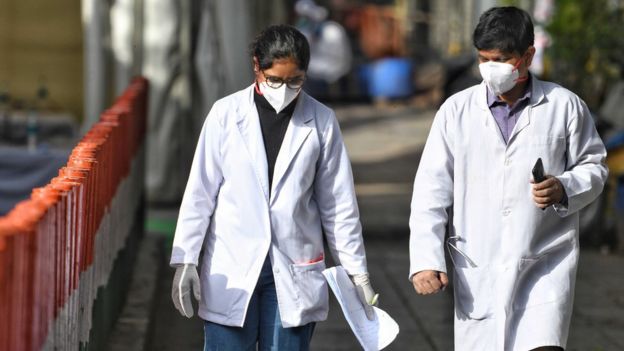
File photo showing two Indian doctorsImage copyright HINDUSTAN TIMES
Image caption Doctors have been abused and attacked in different parts of India

Seven people have been arrested in connection with the incident.

Dr Anand Rai, who is also a part of the Covid-19 taskforce in Indore, told the BBC: “Nothing can justify the attack against medical team. But it happened in a Muslim-dominated area where there is general distrust against the government.”

He said the area had recently witnessed protests against a controversial new citizenship law.

“So that anger spilled over and took the form of this attack. But whatever maybe the reason, nothing can justify violence, especially against doctors during a national health emergency,” he added.

Banner image reading 'more about coronavirus'
Banner

Meanwhile, a hospital in the northern city of Ghaziabad also witnessed unruly scenes on Thursday.

The hospital put at least 21 people in quarantine after they attended a religious event that has been linked to hundreds of positive cases across the country.

Thousands who attended the gathering in Delhi, organised by Islamic preaching group Tablighi Jamaat, have been put in quarantine, and authorities are still tracing others. It is believed that the infections were caused by preachers who attended the event from Indonesia.

At the Ghaziabad hospital, some of the quarantined attendees allegedly used abusive and vulgar language against members of staff.
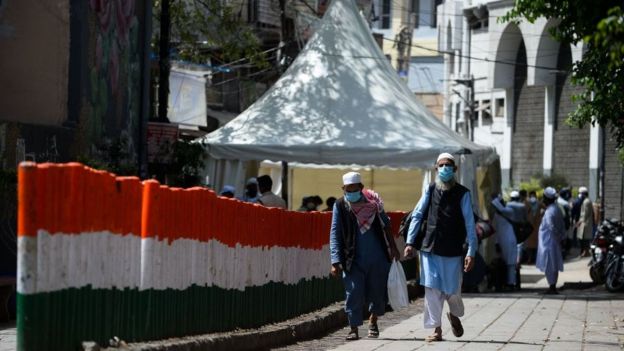
Men wearing protective facemasks walk to board a special service bus taking them to a quarantine facility amid concerns about the spread of the COVID-19 coronavirus in Nizamuddin area of New Delhi on March 31, 2020.Image copyright GETTY IMAGES
Image caption Almost 400 cases of Covid-19 have been traced to a Tablighi Jamaat event in Delhi

“Some were walking naked in the hospital ward and harassing women doctors and nurses,” a doctor who works at the hospital told the BBC. “They kept asking for cigarettes and tobacco.”

A senior police officer in the city told the BBC that cases had been registered against some people after doctors filed a complaint.

“Registering cases was the last resort. Police are still trying to make them understand the severity of the situation,” he said.
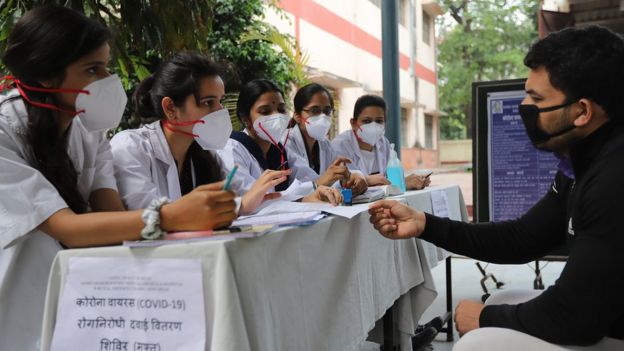
A man speaks to healthcare workers in IndiaImage copyright SOPA IMAGES
Image caption Doctors and nurses have asked people to follow their advice and not panic

Similar incidents have been reported in neighbouring Delhi.

Some attendees of the Tablighi Jamaat event who are being held in a quarantine facility run by the railways are said to have spat at doctors and misbehaved.

Deepak Kumar, spokesman for Northern Railways, said the situation there was now under control.

“The attendees have been counselled and they are now co-operating with the staff,” he said.

Delhi’s state government has reportedly written to the police, requesting more security for medical staff.

Reports of attacks on doctors and nurses have also come from the southern city of Hyderabad and the western city of Surat.

A doctor who was treating coronavirus patients is Hyderabad’s Gandhi Hospital was attacked on Wednesday.

Police have promised the doctor that “strict action will be taken against the culprits”.
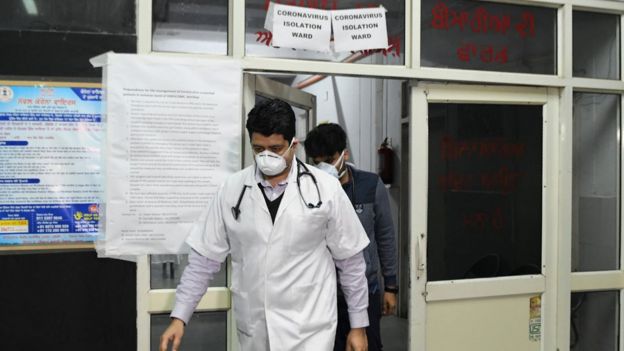
File photo showing Indian doctorImage copyright NARINDER NANU
Image caption Prime Minister Narendra Modi has said that doctors are “front-line soldiers”

But it is not just a work where medical workers are facing discrimination. It has followed them home.

One doctor, who did not wish to be identified, said she felt “extremely disheartened when I learnt that even my neighbours think that me and my family shouldn’t be allowed to live in the building”.

“We want our families to be safe. But we are being discriminated for doing our job.”

“A number of doctors have tested positive across India and that shows how tough our job is at the moment. And that is why we need everybody’s support to win this war against coronavirus.”

She added: “We are following all safety protocols. We are not meeting even our families and that is stressful.”

“But seeing this open discrimination just breaks my heart. But we will go on because there is really no other option.”

Source: The BBC
30/03/2020

Coronavirus: India’s pandemic lockdown turns into a human tragedy

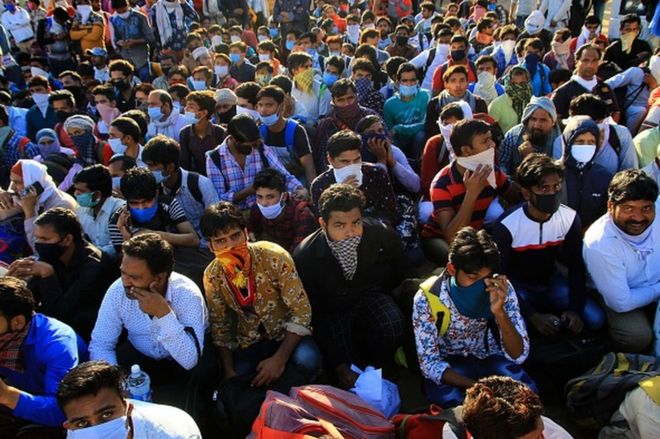
Stranded workersImage copyright GETTY IMAGES
Image caption Millions are workers are defying a curfew and returning home

When I spoke to him on the phone, he had just returned home to his village in the northern state of Rajasthan from neighbouring Gujarat, where he worked as a mason.

In the rising heat, Goutam Lal Meena had walked on macadam in his sandals. He said he had survived on water and biscuits.

In Gujarat, Mr Meena earned up to 400 rupees ($5.34; £4.29) a day and sent most of his earnings home. Work and wages dried up after India declared a 21-day lockdown with four hours notice on the midnight of 24 March to prevent the spread of coronavirus. (India has reported more than 1,000 Covid-19 cases and 27 deaths so far.) The shutting down of all transport meant that he was forced to travel on foot.

“I walked through the day and I walked through the night. What option did I have? I had little money and almost no food,” Mr Meena told me, his voice raspy and strained.

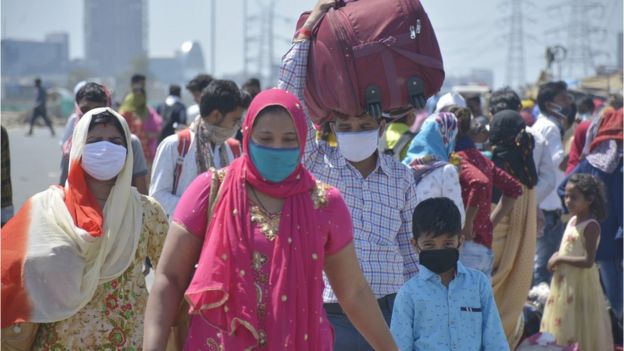
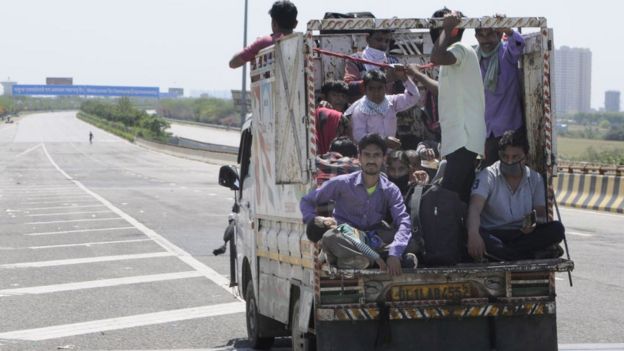
He was not alone. All over India, millions of migrant workers are fleeing its shuttered cities and trekking home to their villages.

These informal workers are the backbone of the big city economy, constructing houses, cooking food, serving in eateries, delivering takeaways, cutting hair in salons, making automobiles, plumbing toilets and delivering newspapers, among other things. Escaping poverty in their villages, most of the estimated 100 million of them live in squalid housing in congested urban ghettos and aspire for upward mobility.

Migrant workers head home on Day 5 of the 21 day nationwide lockdown imposed by PM Narendra Modi to curb the spread of coronavirus, at NH9 road, near Vijay Nagar, on March 29, 2020 in Ghaziabad, IndiaImage copyright GETTY IMAGES
Image caption Informal workers are the backbone of India’s big city economies

Last week’s lockdown turned them into refugees overnight. Their workplaces were shut, and most employees and contractors who paid them vanished.

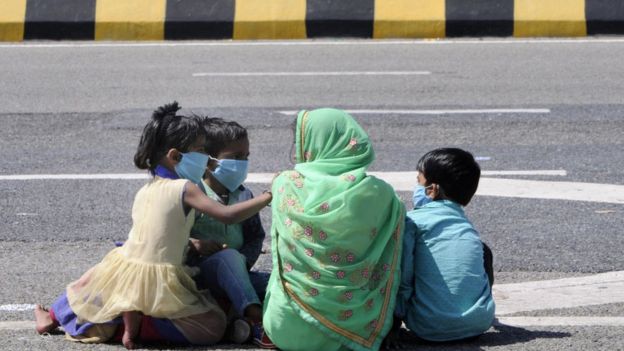
Sprawled together, men, women and children began their journeys at all hours of the day last week. They carried their paltry belongings – usually food, water and clothes – in cheap rexine and cloth bags. The young men carried tatty backpacks. When the children were too tired to walk, their parents carried them on their shoulders.

They walked under the sun and they walked under the stars. Most said they had run out of money and were afraid they would starve. “India is walking home,” headlined The Indian Express newspaper.

The staggering exodus was reminiscent of the flight of refugees during the bloody partition in 1947. Millions of bedraggled refugees had then trekked to east and west Pakistan, in a migration that displaced 15 million people.

migrant worker with children headed back home pauses for break, on day 5 of the nationwide lockdown imposed by PM Narendra Modi to check the spread of coronavirus, at Yamuna expressway zero point, on March 29, 2020 in Noida, India. (Photo by Sunil Ghosh /Hindustan Times via Getty Images)Image copyright GETTY IMAGES
Image caption Migrant labourers feel they have more social security in their villages

This time, hundreds of thousands of migrant workers are desperately trying to return home in their own country. Battling hunger and fatigue, they are bound by a collective will to somehow get back to where they belong. Home in the village ensures food and the comfort of the family, they say.

Clearly, a lockdown to stave off a pandemic is turning into a humanitarian crisis.

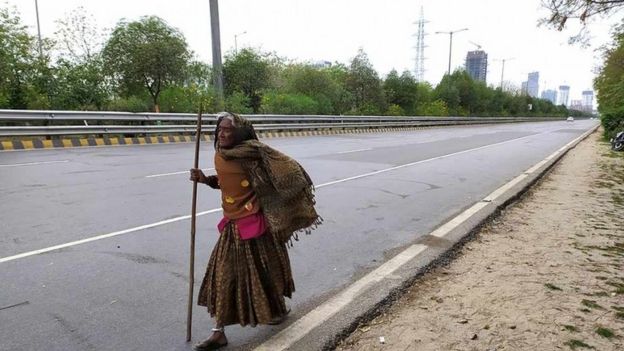
Among the teeming refugees of the lockdown was a 90-year-old woman, whose family sold cheap toys at traffic lights in a suburb outside Delhi.

Kajodi was walking with her family to their native Rajasthan, some 100km (62 miles) away. They were eating biscuits and smoking beedis, – traditional hand-rolled cigarettes – to kill hunger. Leaning on a stick, she had been walking for three hours when journalist Salik Ahmed met her. The humiliating flight from the city had not robbed her off her pride. “She said she would have bought a ticket to go home if transport was available,” Mr Ahmed told me.

Others on the road included a five-year-old boy who was on a 700km (434 miles) journey by foot with his father, a construction worker, from Delhi to their home in Madhya Pradesh state in central India. “When the sun sets we will stop and sleep,” the father told journalist Barkha Dutt. Another woman walked with her husband and two-and-a-half year old daughter, her bag stuffed with food, clothes and water. “We had a place to stay but no money to buy food,” she said.

Then there was Rajneesh, a 26-year-old automobile worker who walking 250km (155 miles) to his village in neighbouring Uttar Pradesh. It would take him four days, he reckoned. “We will die walking before coronavirus hits us,” the man told Ms Dutt.

He was not exaggerating. Last week, a 39-year-old man on a 300km (186 miles) trek from Delhi to Madhya Pradesh complained of chest pain and exhaustion and died; and a 62-year-old man, returning from a hospital by foot in Gujarat, collapsed outside his house and died. Four other migrants, turned away at the borders on their way to Rajasthan from Gujarat, were mowed down by a truck on a dark highway.

As the crisis worsened, state governments scrambled to arrange transport, shelter and food.

Kajodi DeviImage copyright SALIK AHMED/OUTLOOK
Image caption Ninety-year-old Kajodi Devi is walking from Delhi to her village

But trying to transport them to their villages quickly turned into another nightmare. Hundreds of thousands of workers were pressed against each other at a major bus terminal in Delhi as buses rolled in to pick them up.

Delhi chief minister Arvind Kejriwal implored the workers not to leave the capital. He asked them to “stay wherever you are, because in large gatherings, you are also at risk of being infected with the coronavirus.” He said his government would pay their rent, and announced the opening of 568 food distribution centres in the capital. Prime Minister Narendra Modi apologised for the lockdown “which has caused difficulties in your lives, especially the poor people”, adding these “tough measures were needed to win this battle.”

Whatever the reason, Mr Modi and state governments appeared to have bungled in not anticipating this exodus.

Mr Modi has been extremely responsive to the plight of Indian migrant workers stranded abroad: hundreds of them have been brought back home in special flights. But the plight of workers at home struck a jarring note.

“Wanting to go home in a crisis is natural. If Indian students, tourists, pilgrims stranded overseas want to return, so do labourers in big cities. They want to go home to their villages. We can’t be sending planes to bring home one lot, but leave the other to walk back home,” tweeted Shekhar Gupta, founder and editor of The Print.

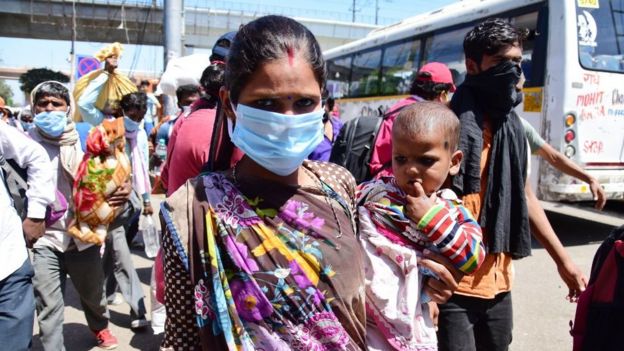
Migrant woman with a baby wearing a face mask as a preventive measure, at Anand vihar bus terminal during the nationwide lock downImage copyright GETTY IMAGES
Image caption There is a precedent for this kind of exodus during crisis

The city, says Chinmay Tumbe, author of India Moving: A History of Migration, offers economic security to the poor migrant, but their social security lies in their villages, where they have assured food and accommodation. “With work coming to a halt and jobs gone, they are now looking for social security and trying to return home,” he told me.

Also there’s plenty of precedent for the flight of migrant workers during a crisis – the 2005 floods in Mumbai witnessed many workers fleeing the city. Half of the city’s population, mostly migrants, had also fled the city – then Bombay – in the wake of the 1918 Spanish flu.

When plague broke out in western India in 1994 there was an “almost biblical exodus of hundreds of thousands of people from the industrial city of Surat [in Gujarat]”, recounts historian Frank Snowden in his book Epidemics and Society.

Half of Bombay’s population deserted the city, during a previous plague epidemic in 1896. The draconian anti-plague measures imposed by the British rulers, writes Dr Snowden, turned out to be a “blunt sledgehammer rather than a surgical instrument of precision”. They had helped Bombay to survive the epidemic, but “the fleeing residents carried the disease with them, thereby spreading it.”

More than a century later, that same fear haunts India today. Hundreds of thousands of the migrants will eventually reach home, either by foot, or in packed buses. There they will move into their joint family homes, often with ageing parents. Some 56 districts in nine Indian states account for half of inter-state migration of male workers, according to a government report. These could turn out to be potential hotspots as thousands of migrants return home.

Migrant workers headed back to their towns and villages hitch a ride, on day 5 of the nationwide lockdown imposed by PM Narendra Modi to check the spread of coronavirus, at Yamuna expressway zero point, on March 29, 2020 in Noida, IndiaImage copyright GETTY IMAGES
Image caption The fleeing migrants could spread the disease all over the country

Partha Mukhopadhyay, a senior fellow at Delhi’s Centre for Policy Research, suggests that 35,000 village councils in these 56 potentially sensitive districts should be involved to test returning workers for the virus, and isolate infected people in local facilities.

In the end, India is facing daunting and predictable challenges in enforcing the lockdown and also making sure the poor and homeless are not fatally hurt. Much of it, Dr Snowden told me, will depend on whether the economic and living consequences of the lockdown strategy are carefully managed, and the consent of the people is won. “If not, there is a potential for very serious hardship, social tension and resistance.” India has already announced a $22bn relief package for those affected by the lockdown.

The next few days will determine whether the states are able to transport the workers home or keep them in the cities and provide them with food and money. “People are forgetting the big stakes amid the drama of the consequences of the lockdown: the risk of millions of people dying,” says Nitin Pai of Takshashila Institution, a prominent think tank.

“There too, likely the worst affected will be the poor.”

Source: The BBC

12/07/2019

India air pollution: Will Gujarat’s ‘cap and trade’ programme work?

Air pollution in IndiaImage copyright AFP
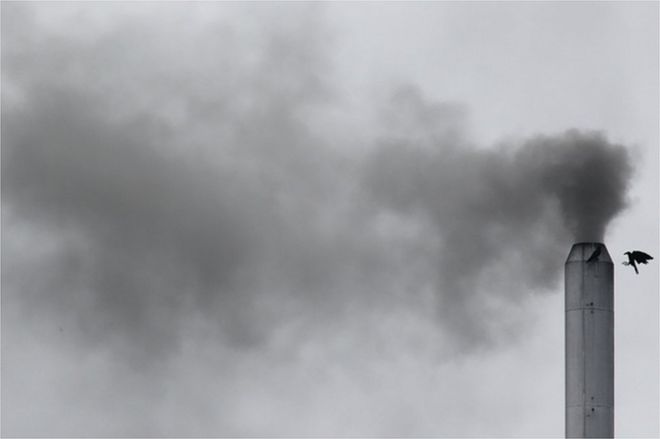
Image caption Much of the air pollution is caused by factory emissions

Air pollution contributed to the deaths of at least 1.2 million Indians in 2017 – but a unique pilot scheme to combat air pollution in the western state of Gujarat could prove to be a model for the rest of the country. The BBC spoke to experts to find out more about the world’s first ever such experiment.

The concentration of tiny particulate matter (known as PM2.5) in India is eight times the World Health Organization’s standard.

These particles are so tiny that they can enter deep into the lungs and make people susceptible to respiratory and cardiovascular diseases, making them extremely deadly.

Air pollution in India is caused by fumes from cooking on wood or dung indoors in villages, and a combination of traffic exhaust, soot and construction dust and factory emissions in the cities.

Now Gujarat has launched the world’s first “cap and trading” programme to curb particulate air pollution.

Textile factory in SuratImage copyright AFP
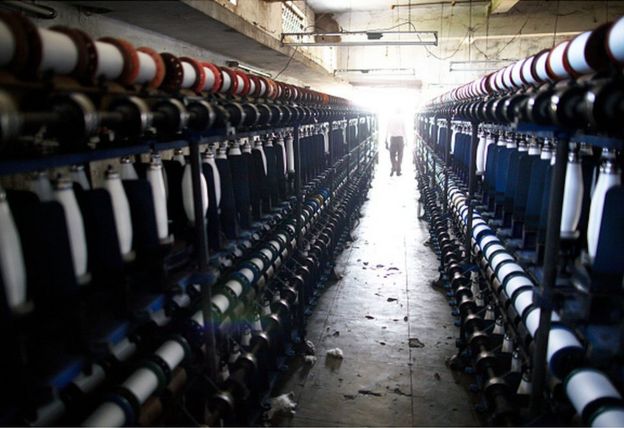
Image caption Surat is a dense industrial city where textile and dye factories are a major source of pollution

Put simply, the government sets a cap on emissions and allows factories to buy and sell permits to stay below the cap.

It is being launched in the dense, industrial city of Surat, where textile and dye factories are a major source of pollution. Since 2011, local pollution control authorities have been working on the impact of emissions trading in Surat, along with the University of Chicago and Harvard University.

How will this programme work?

The basic commodity in the emissions trading system is particulate matter, which is emitted by industries through their smoke stacks.

Under the emissions trading system, industries must hold a permit for each unit of particulate that they emit, and must comply with the prescribed standard of 150 milligrams per cubic metre of particulate matter released in the atmosphere.

Although industries can trade permits among themselves, the total quantity of these permits are fixed, so that air pollution standards are met.

For example, an industry that finds it inexpensive to decrease emissions is likely to over-comply with the standards – this would allow them to sell its excess permits to another industry that finds it more expensive to decrease emissions.

Both industries benefit by reducing their total costs of compliance, while the total emissions are held constant.

Importantly, this trading system gives firms an incentive to find ways to reduce emissions because they are able to sell any extra reductions to other firms.

These incentives have been shown to prompt firms to innovate so that they find new and inexpensive ways to reduce their emissions.

This standard will be used to set the overall emissions from all the industries that are participating in the pilot programme.

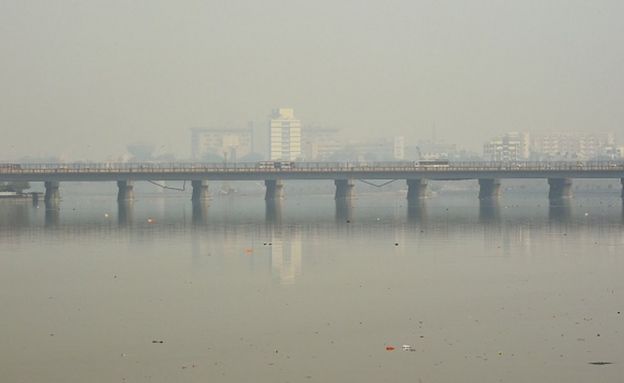
Traffic is pictured on a bridge over the Sabarmati River during heavy smog conditions in Ahmedabad on February 5, 2019.Image copyright AFP
Image caption Smoggy skies over the Sabarmati river in Gujarat

Why is this programme being implemented in Surat?

Michael Greenstone, economist and director of the Energy Policy Institute at Chicago (EPIC), says the programme in Surat is a result of a multi-year process that his institute has been working on with the Gujarat Pollution Control Board (GPCB) over the last four years.

In 2015, the environment ministry ordered 17 highly polluting industries – such as pulp and paper, distillery, sugar, tanneries, power plants, and iron and steel – to mandatorily install continuous emission monitoring system (CEMS) devices. They are a network of sensors installed in factories that send live readings of pollution emitted through their smoke stacks.

In the first phase of experiment, some 170 industries installed the devices, which cost anywhere between $2,500 and $7,000 (£2,000-£5,600).

“We worked with GPCB and the industries extensively on how to understand and use this data for regulation,” Dr Greenstone says.

Factory pollution in indiaImage copyright AFP
Image caption Highly polluting industries in India have been asked to install emission control systems

“In the Gujarat experiment, we are working with textile, paper and sugar manufacturing industries.”

Can this programme be scaled up in a country as vast as India?

The state’s pollution board set this up as a pilot so that whatever is learnt here can be applied to help the operation of the market, says Dr Greenstone.

If successful, there will be a strong case for expanding this regulatory approach to other parts of Gujarat and other states in India.

“Particulate air pollution is shortening lives in India, so if the pilot is successful there is a terrific opportunity for a win-win by scaling up emissions trading in order to reduce industries’ compliance costs and to improve air quality which would ultimately [improve] people’s health,” he adds.

Will this ambitious programme work?

Siddharth Singh, energy expert and author of The Great Smog of India, says the emissions trading scheme has the potential to work.

“Firstly, unlike in other countries, emission trading schemes are not a politically sensitive topic, so it could quietly be tested and scaled up if it proves to be successful. Secondly, India has some experience in running a similar scheme.”

India’s Bureau of Energy Efficiency has been running a programme to improve industrial energy efficiency. It targets some 500 large users of energy across India and encourages trade in energy efficiency certificates. This has led to decreased energy use and emissions, as well as cost savings.

Media caption A hair-raising drive through the Delhi smog

“India is only testing the trading programme at the state level,” he adds.

“There is nothing to lose here, even if the pilot fails. But if it succeeds, it could be scaled up and prove to be a great policy tool to address particulate air pollution in India.”

Source: The BBC
25/05/2019

India tuition class fire kills at least 19 students

Fire rips through Gujarat collegeImage copyright GETTY IMAGES
Image caption The fire ripped through tuition classes in the western state of Gujarat

At least 19 students have died in a fire at a school in India, officials said.

Students were seen jumping and falling from the building in the western city of Surat as black smoke billowed from windows.

Most of the victims were teenagers who had been studying at a tuition centre.

The initial cause of the fire was not immediately clear. Officials said the blaze spread through packed classrooms because of flammable roofing.

At least 20 others sustained serious injuries and were being treated in hospital in Gujarat.

“The students lost their life both because of the fire and jumping out of the building,” Deepak Sapthaley, a local fire official, told AFP.

All of the dead were aged below 20 years and many were trapped because the fire began near the staircase, Reuters reported.

Prime Minister Narendra Modi offered his condolences on Twitter and called for local authorities to provide assistance.

An inquiry into the incident has been ordered and a report is expected within three days, said the spokesman for the office of Gujarat Chief Minister Vijay Rupani.

The fire is the latest in a long line of deadly blazes in India. In February at least 17 people died in a Delhi hotel fire.

Source: The BBC

Law of Unintended Consequences

continuously updated blog about China & India

ChiaHou's Book Reviews

continuously updated blog about China & India

What's wrong with the world; and its economy

continuously updated blog about China & India