Chindia Alert: You’ll be Living in their World Very Soon
aims to alert you to the threats and opportunities that China and India present. China and India require serious attention; case of ‘hidden dragon and crouching tiger’.
Without this attention, governments, businesses and, indeed, individuals may find themselves at a great disadvantage sooner rather than later.
The POSTs (front webpages) are mainly 'cuttings' from reliable sources, updated continuously.
The PAGEs (see Tabs, above) attempt to make the information more meaningful by putting some structure to the information we have researched and assembled since 2006.
Pictures of packed trails over the weekend highlight difficulties in maintaining social distancing while trying to get back to normal
Attraction in Anhui province said it would be forced to close on Sunday after exceeding its 20,000-visitor limits
== PICTURE CAPTURED FROM WEIBIO
Huangshan Mountains in China’s Anhui province was forced to close after tens of thousands of people flocked to the popular mountain range over the weekend, highlighting the difficulties in getting the country’s social life back to normal while keeping the coronavirus outbreak under control. Huangshan, or the Yellow Mountains, located in southern Anhui province in eastern China, said in a notice today that it had to close because the number of visitors had reached its limit of 20,000 for the day. Tourists are advised to visit the site on other days or try travelling to other sites. Since April 4, the Anhui government has been offering free access to 29 tourist sites in the Huangshan region, including the Yellow Mountains, to local residents for 2 weeks, in a bid to drum up more business since its reopening in late February as it seeks to get its economy back to normal. Photo: WEIBIO
A popular mountain range in southeast China was forced to close after tens of thousands of people flocked to its trails over the weekend.
The crowds flocking to the Huangshan, or Yellow Mountains, in Anhui province highlight the difficulties the country may face in future as it tries to get back to normal while keeping Covid-19 under control.
Starting from Saturday, the Anhui provincial government had been offering free entry to 29 sites, including Huangshan, to boost visitor numbers.
Visitors were asked to show their health status on an app, wear surgical masks and their body temperatures had to be checked before entering the site.
But on Sunday the park authorities said it would have to close because the number of visitors had reached its daily limit of 20,000 and urged people to visit other sites or come to the mountains at another time.
Coronavirus: China pulls the plug on wasteful, unnecessary research into Covid-19
5 Apr 2020
Pictures and video circulated on the social media platform Weibo showing packs of visitors walking up the mountain range over the three-day Ching Ming festival.
“Tourism has been hit hard, and also its related industries,” said one Weibo comment. “But the epidemic isn’t over. If you must open the sites, you have to restrict the flow [of tourists], and those visitors from outside.”
As of Sunday, the number of confirmed cases being treated in the country had fallen to 2,382, according to the National Health Commission, but the total number of imported cases rose to 913.
Police try to hold back visitors to the mountain range. Photo: Weibo
“I think China is keeping a close eye on Covid-19 detections and may need to tune the social distancing measures that are needed to keep Covid-19 contained. For now, it may be OK to relax some measures, but those measures should be tightened if case numbers pick up,” said Benjamin Cowling, a professor of epidemiology and biostatistics at Hong Kong University.
“I would not be surprised if most countries continue to prohibit mass gatherings for the rest of 2020,” said Cowling, adding that temperature checks at entrances would be a good idea, but it might not be sufficient to protect visitors.
Coronavirus: Beijing’s ban on foreign travellers comes into force months after it criticised other countries for ‘isolating China’
27 Mar 2020
Anhui, which shares its western border with Hubei province, the initial centre of the outbreak, last reported a new infection on Feb 27, according to official figures. The province reported a total of 990 cases of Covid-19, including six deaths.
China’s tourism and cultural sectors are among the worst hit as a result of the outbreak.
A number of Shanghai’s popular tourist spots, including the Shanghai Oriental Pearl Tower and Shanghai Jinmao Tower had to close again last week only two weeks after reopening.
Dai Bin, president of the China Tourism Academy, a research institute under the Ministry of Culture and Tourism, told a forum in February that he expected domestic tourism would contract as much as 56 per cent in the first quarter and 15.5 per cent for the whole year.
Dai also estimated that annual income loss from tourism could hit 1.2 trillion yuan (US$169 billion) this year.
LUCKNOW, India (Reuters) – Heavy rains have killed at least 113 people in India’s Uttar Pradesh and Bihar states over the past three days, officials said on Monday, as flood waters swamped a major city, inundated hospital wards and forced the evacuation of inmates from a jail.
India’s monsoon season that begins in June usually starts to retreat by early September, but heavy rains have continued across parts of the country this year, triggering floods.
An official said that at least 93 people had died in most populous Uttar Pradesh since Friday after its eastern areas were lashed by intense monsoon showers.
Rising water levels forced authorities to shift 900 inmates from a prison in eastern Ballia district, police officer Santosh Verma said.
In neighbouring Bihar, an impoverished agrarian region that was hit by floods earlier this year, the death toll from the latest bout of rain had reached 20 on Monday, a state government official said.
Bihar’s capital city of Patna, home to around 2 million, has been badly hit, with waist-deep flood waters across many streets, and entering homes, shops, and even the wards of a major hospital. In some parts, authorities deployed boats to rescue residents.
“The rains have stopped but there is waterlogging in many areas,” Bihar’s Additional Secretary in the Disaster Relief Department Amod Kumar Sharan said.
In its bulletin on Monday, India’s Meteorological Department said the intensity of rainfall over Bihar was very likely to reduce. Showers in Uttar Pradesh are also expected to abate this week.
Weather department officials said this month that monsoon rains were likely to be above average for the first time in six years. [nL3N26B1MD]
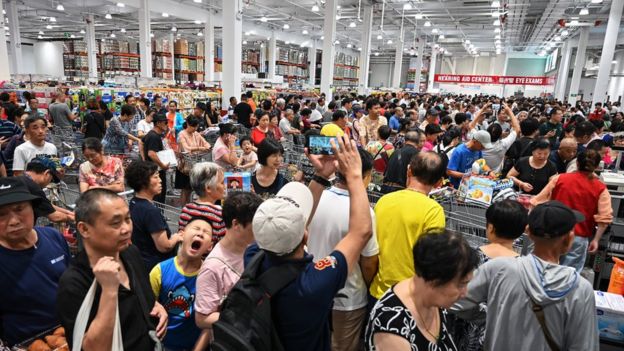
US retailer Costco was forced to close early on its opening day in China, after the store was swamped with shoppers.
Buyers battled long queues and traffic chaos, before the Shanghai store was shut hours early due to “overcrowding”.
Costco’s push into China comes as other foreign retailers have struggled to compete with local rivals.
It also comes at a time of rising tensions between the US and China over trade.
Costco is a discount warehouse store that sells a range of goods, from fresh foods to household electronics.
Some customers spent two hours lining up to pay for their purchases, while some had to wait three hours for parking, state news agency Xinhua reported.
Image copyright AFPImage caption Images from the store show customers caught up in heavy crowds
One video showed people pushing through heavy crowds to get their hands on roast chickens.
“Due to overcrowding in the market, and in order to provide you with a better shopping experience, Costco will temporarily close on the afternoon of August 27. Please avoid coming,” the retailer in a notice on its official app, according to AFP.
Image copyright GETTY IMAGESImage caption Some customers reportedly spent two hours lining up to pay for their goods
Costco has had an online presence in China since 2014, through a partnership with e-commerce giant Alibaba.
The firm’s first store in the country comes as other international retailers battle tough competition in China.
Earlier this year, Amazon said it was downsizing its operations in China and France’s Carrefour agreed to sell 80% of its China business to local retailer Suning.com after a series of losses.
The world’s two largest economies have been fighting a trade war for the past year, and tensions have escalated with the threat of more tariffs from both sides.




 CHINDIA ALERT: You'll be living in their world, very soon