Chindia Alert: You’ll be Living in their World Very Soon
aims to alert you to the threats and opportunities that China and India present. China and India require serious attention; case of ‘hidden dragon and crouching tiger’.
Without this attention, governments, businesses and, indeed, individuals may find themselves at a great disadvantage sooner rather than later.
The POSTs (front webpages) are mainly 'cuttings' from reliable sources, updated continuously.
The PAGEs (see Tabs, above) attempt to make the information more meaningful by putting some structure to the information we have researched and assembled since 2006.
SHANGHAI (Reuters) – China’s smog-prone northern province of Hebei met its air quality targets by a big margin over the winter after concerted efforts to tackle emissions, a local official said on Sunday, without mentioning coronavirus-related factory shutdowns.
Average PM2.5 concentrations over the October-March period dropped 15% from a year earlier to 61 micrograms per cubic metre, while sulphur dioxide also fell by a third, said He Litao, vice-head of the provincial environmental bureau.
Most experts have attributed the significant decline in air pollution throughout China in the first quarter to the coronavirus outbreak and tough containment measures, which saw cities and entire provinces locked down and sharply reduced traffic and industrial activity throughout the country.
With millions staying at home, concentrations of lung-damaging PM2.5 particles fell by nearly 15% in more than 300 Chinese cities in the first three months of 2020.
Shanghai saw emissions fall by nearly 20% in the first quarter, while in Wuhan, where the pandemic originated, monthly averages dropped more than a third compared to last year.
However, He of the Hebei environmental bureau attributed the local decline in pollution to the “conscientious implementation” of government decisions even in the face of unfavourable weather conditions.
According to a winter action plan published last year, 10 cities in Hebei were expected to cut lung-damaging small particles known as PM2.5 by 1%-6% compared to the previous year.
Despite the decline, average PM2.5 was still much higher than China’s official standard of 35 micrograms, and the recommended World Health Organization level of 10 micrograms.
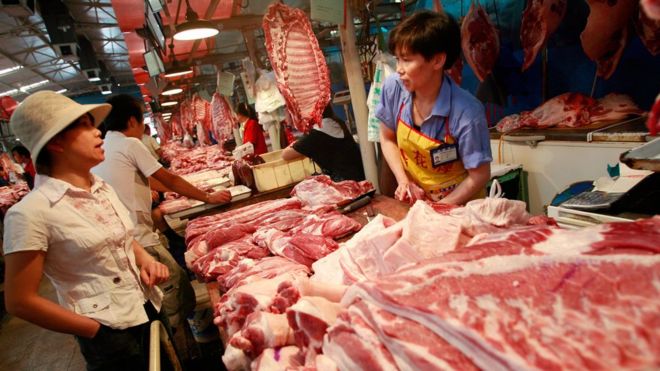
China is set to release pork supplies from its central reserves as it moves to tackle soaring prices and shortages caused by an outbreak of swine fever.
A state-backed body will auction 10,000 tonnes of frozen pork from its strategic reserves on Thursday.
China, the world’s biggest producer and consumer of pork, has struggled to control the spread of the disease.
In a bid to stabilise prices, a state-backed group that manages the pork reserves will auction imported frozen pork from countries including Denmark, France, the US and UK.
Only 300 tonnes will be sold to each bidder at the auction.
Pork is used widely in Chinese festivals, and the auction comes as the country prepares to celebrate a week-long national holiday for the 70th anniversary of the People’s Republic of China.
Julian Evans-Pritchard, senior China economist at Capital Economics, said the auction would provide slight relief to the industry but would not do much to contain prices.
“In itself, I don’t think it will be able to prevent pork prices from rising further unless they manage to get the disease under control,” he said.
Beijing created its strategic pork reserve in 2007 but the size of the stockpile is not known.
Capital Economics estimates that at most, the stockpile would hold four days’ worth of pork supplies to feed China.
About 1.2 million pigs have been culled in China in an effort to halt the spread of swine fever since August 2018, according to data from the Food and Agriculture Organization, a UN agency.
In April, Rabobank estimated Chinese pork production would fall by up to 35% this year due to swine fever.
The supply shortage has sent pork prices soaring and has eaten into household incomes.
That poses a fresh challenge for the Chinese economy, which is already facing a slowdown and a trade war between Beijing and Washington.



 CHINDIA ALERT: You'll be living in their world, very soon