29/04/2020
- Hardline politicians want president to fulfil promise to overhaul constitution to reflect the self-ruled island’s political reality
- A petition calls for two referendums on the issue – proposing it either be replaced with a new one or revised
The push for constitutional change could lead to a cross-strait conflict. Photo: Handout
Taiwanese President Tsai Ing-wen is under growing pressure from the hardline camp to push for constitutional change to reflect the self-ruled island’s independent status – something observers say could provoke a cross-strait conflict.
With Tsai due to be sworn in for a second four-year term next month after a landslide victory in January’s election, hardline pro-independence politicians want her to fulfil a 2015 campaign promise: to overhaul the constitution so that it reflects Taiwan’s political reality. The process has been stalled since Tsai’s first term, which began in 2016.
Leading the charge is the Taiwan New Constitution Foundation, a group formed last year by a Tsai adviser and long-time independence advocate Koo Kwang-ming.
The foundation launched a petition at the end of March calling for two referendums on the constitution – proposing that it either be replaced with a new one or revised.
The existing constitution was adopted when Kuomintang leader Chiang Kai-shek and the KMT fled to Taiwan and set up an interim government in 1949 following their defeat by Mao Zedong’s communists in mainland China.
Drawn up in 1947, the constitution still puts the mainland and Mongolia under the Republic of China jurisdiction – Taiwan’s official name for itself. In reality, its jurisdiction extends only to Taiwan and its outlying islands of Penghu, Matsu and Quemoy, which is also known as Kinmen.
Taiwan’s constitution was adopted when KMT leader Chiang Kai-shek fled to the island in 1949. Photo: Handout
“We have garnered more than 3,000 signatures from the public for the first phase of initiating the proposals to hold two referendums asking the president to push for constitutional change,” Lin Yi-cheng, executive director of the Taiwan New Constitution Foundation, said on Wednesday.
He said they would propose that voters be asked two questions in the referendums: “Do you support the president in initiating a constitutional reform process for the country?”
And: “Do you support the president in pushing for the establishment of a new constitution reflecting the reality of Taiwan?”
“We’re ready to send the two referendum proposals to the Central Election Commission on Thursday,” he said.
Confusion prompts call for China Airlines name change in Taiwan, but at what cost?
Under Taiwan’s Referendum Act, the process for holding a referendum involves three stages: a proposal, endorsement and voting.
Lin said there should be no problem for the commission to approve the proposal stage since they had gathered far more than the minimum 1,931 signatures needed under the act.
The endorsement stage requires a minimum of 290,000 signatures, and if the referendum is held, they will need at least 5 million votes.
Lin said if the process went smoothly, he expected a referendum could be held in August next year, allowing time for review and making the necessary arrangements.
He said if the referendum questions got enough public support, Tsai would need to deal with the issue.
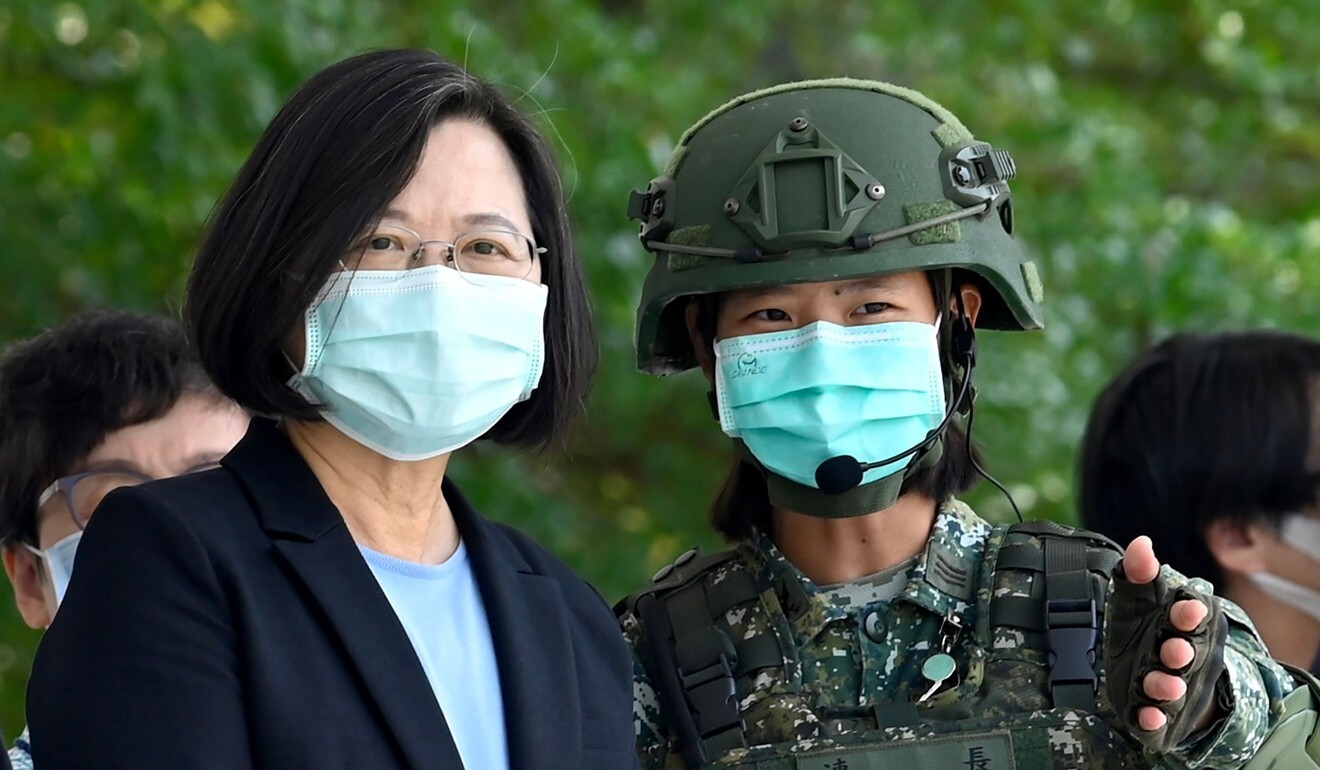
Tsai Ing-wen visits a military base in Tainan earlier this month. The pressure for constitutional change creates a dilemma for the president. Photo: AFP
Tsai’s Democratic Progressive Party government has been tight-lipped over the constitutional change issue, which Beijing sees as a move for the island to declare formal independence from the mainland.
Beijing considers Taiwan a wayward province that must be returned to the mainland fold, by force if necessary, and it has warned Tsai against declaring formal independence.
A DPP official said the foundation’s push would put Tsai in a difficult position.
“If she ignores the referendums, she will come under constant pressure from the hardline camp, and if she seriously considers taking action and instituting a new Taiwan constitution, she will risk a confrontation with Beijing, the consequence of which could be a cross-strait conflict,” said the official, who requested anonymity.
On Tuesday, Zhu Fenglian, a spokeswoman for the mainland’s Taiwan Affairs Office, warned the island against holding any referendum on constitutional revision, saying it would be doomed to end in an impasse and would ultimately fail.
“It will only push Taiwan towards an extremely dangerous abyss and bring disasters to Taiwanese compatriots,” she said.
Chinese air force’s drill ‘aimed at signalling deterrent around Taiwan’
But according to Wang Kung-yi, a political science professor at Chinese Culture University in Taipei, Tsai should not be too worried about the hardline camp move.
“The hardline camp has been marginalised greatly in the past several years as reflected by the poor showing in the legislative elections in January,” Wang said, adding that he expected Tsai to continue her relatively moderate cross-strait policy of not sharply provoking the mainland.
Source: SCMP
Posted in 1949, 2015, 2016, also known as, amid, August, be replaced, Beijing, by force, call for, calls for, campaign, Central Election Commission, Change, Chiang Kai-shek, China Airlines, Communists, confusion, considers, Constitution, constitutional, creates, cross-strait conflict, declare, defeat, Democratic Progressive Party, dilemma, earlier, either, Election, endorsement, fled, formal independence, four-year term, Hardline politicians, independent, island, islands, issue, January’s, jurisdiction, Kinmen, KMT, Kuomintang, mainland, Mainland China, Mao Zedong’s, March, marginalised, Matsu, military base, Mongolia, move for, name change, necessary, new one, next month, next year, observers, outlying islands, overhaul, Penghu, Petition, political reality, political science professor, politicians, President, pressure, pro-independence, promise, prompts, proposal, proposing, provoke, push for, Quemoy, Referendum Act, referendums, Republic of China, returned, revised, second, sees, self-ruled, status, sworn, Tainan, Taipei, Taiwan, Taiwan Affairs Office, Taiwan New Constitution Foundation, Taiwanese President, this month, Thursday, tight-lipped, to fulfil, to reflect, Tsai, Tsai Ing-wen, two, Uncategorized, under pressure, Voting, warned, wayward province |
Leave a Comment »
25/04/2019
- Quake hits area around Hualien at 1.01pm, followed by aftershocks
- Tremors send residents fleeing and rattle buildings more than 100km away in Taipei
A magnitude 6.1 earthquake hit the area around Hualien in Taiwan on Thursday. Photo: CNA
A magnitude 6.1 earthquake rocked eastern Taiwan at 1.01pm on Thursday, sending panicked residents rushing onto the streets and shaking buildings 115km (71 miles) away in the island’s capital, Taipei.
The quake’s epicentre was just over 10km northwest of the city of Hualien, at a depth of 18.8km, the island’s Central Weather Bureau said, adding that a 4.1 quake was reported 17 minutes later.
At least 17 people were injured, and a 12-storey building in Taipei was left leaning to one side, but there were no reports of major property damage.
Two Malaysian tourists – a man and a woman – were injured by falling rocks at Taroko National Park in Hualien county, with both being airlifted to a hospital in the city. Ten people in Taipei and five in New Taipei City also suffered injuries.
Train services on Taipei’s subway were suspended as were the airport subway to Taoyuan International Airport and most other metro and train systems in various parts of Taiwan, especially those around eastern and northern Taiwan, for safety inspections, the island’s cabinet said.
Taiwan Power Company said operations were normal at the island’s first and second nuclear power plants in northern Taiwan and asked the public to stay calm.
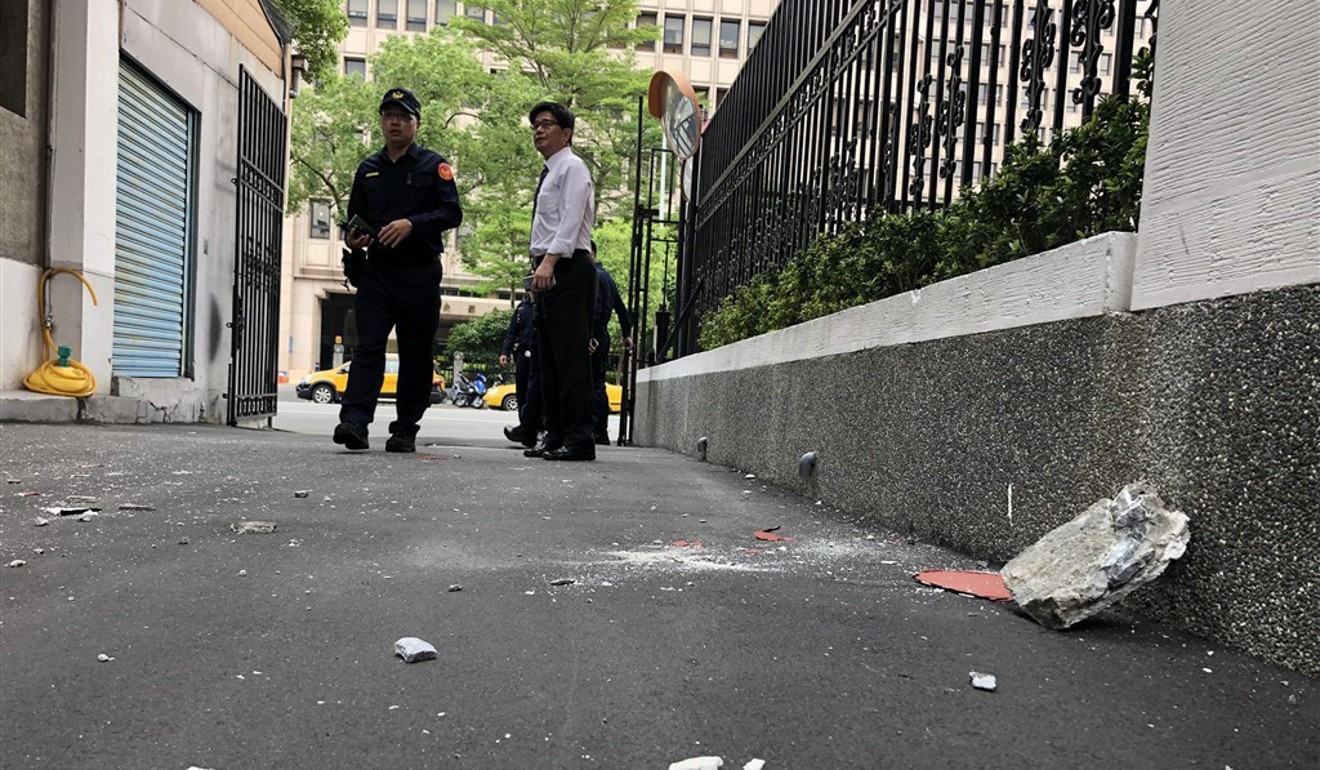
Debris outside the Legislative Yuan, in Taipei, after a magnitude 6.1 earthquake hit the area around Hualien. Photo: CNA
Share:
The strong quake sent high-rise buildings swaying in Taipei, with a number of households and offices reporting fallen objects.
“I was so panic and tried to find some place for shelter after the quake rocked for a moment. It seemed like the building was going to collapse. All the books were shaken off the shelves and glasses shattered all over the floor,” a resident of Taipei’s bustling Ximending district said.
The Daan District Office in Taipei reported that a ceiling had fallen into the middle of its office, but nobody was injured.
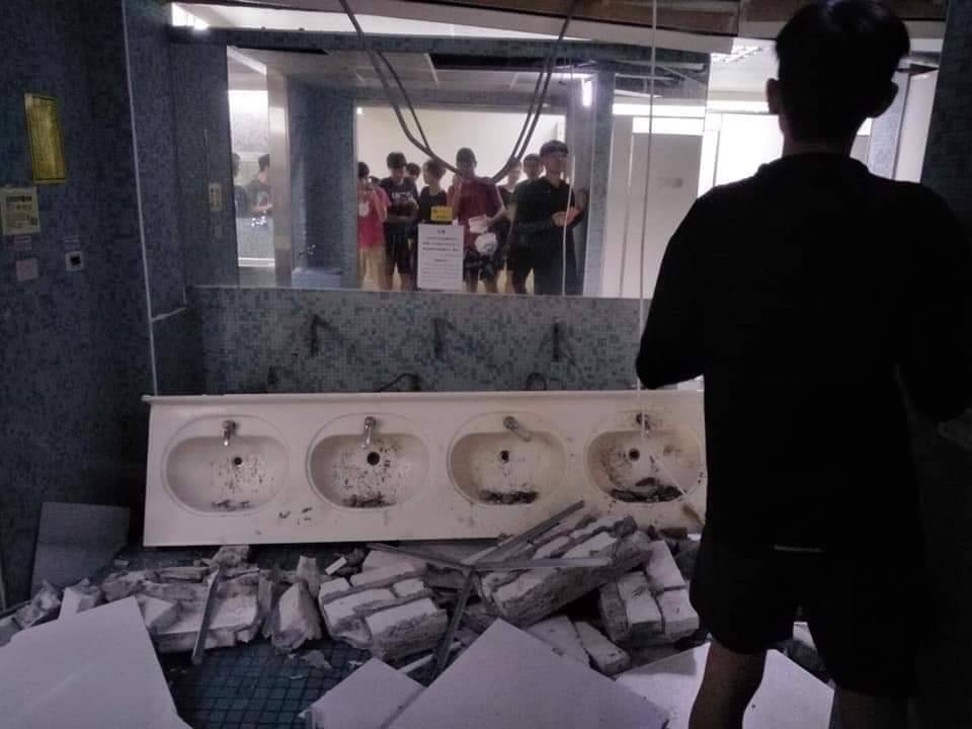
The quake damaged a bathroom in a men’s dormitory at Taiwan Normal University. Photo: Handout
A building on Changan East Road in Taipei was reported to have tilted to one side, prompting residents to flee into the street.
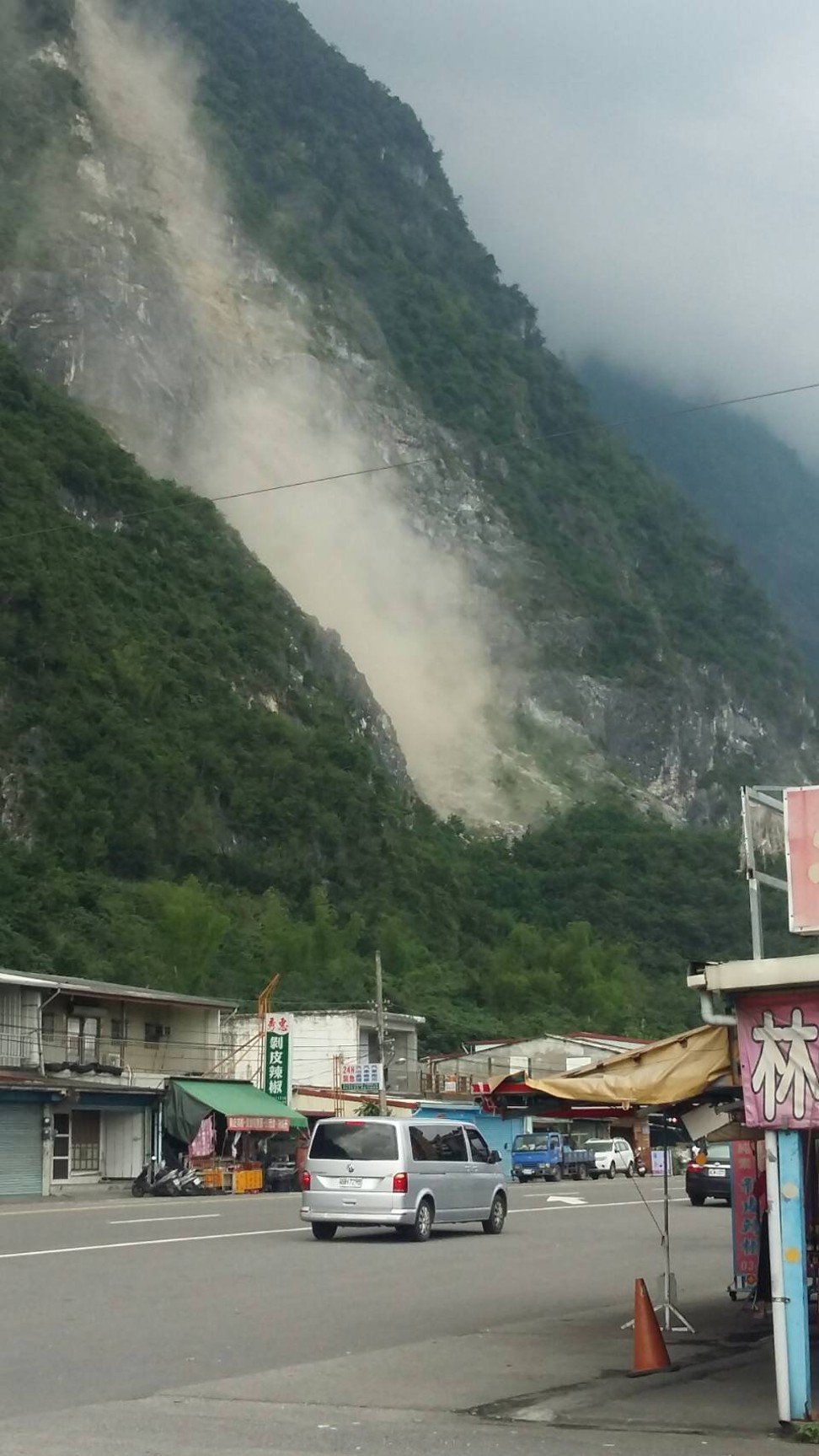
Taiwanese television stations ran footage showing overturned furniture in homes and offices and at least one landslide along the mountainous and lightly populated east coast.
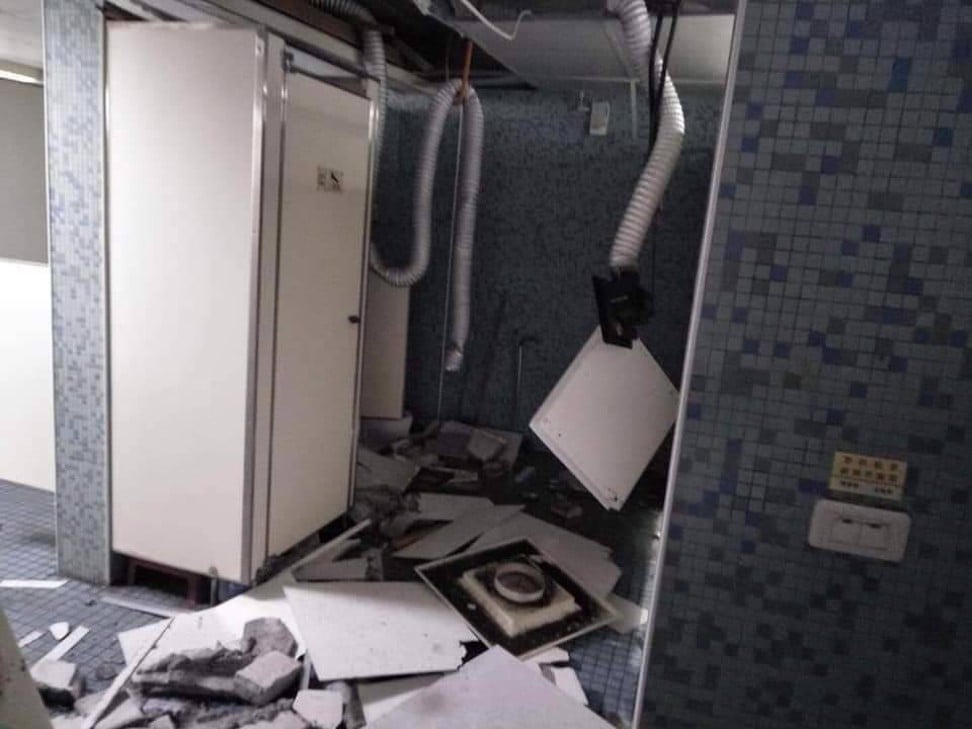
A bathroom at a Taiwan Normal University dormitory in Taipei was damaged in Thursday’s quake. Photo: Handout
Elsewhere in Taiwan, part of the Suao-Hualien Highway collapsed but there were no injuries, the National Fire Agency said.
Near the epicentre in Hualien, more cases of damage were reported, including several supermarkets where items were shaken off shelves.
A resident said he was taking an afternoon nap when the earthquake shook.
“I felt as if my heart was spilling out of my mouth and was so panicked that I could hardly move, but I managed to rush to the street,” he said, adding that aftershocks were rocking the area.
Workers at Hualien’s main railway station were struggling to clear a flooded lobby after several water pipes burst in the quake, county authorities said.
Operations remain unaffected at Taiwan’s hi-tech industrial estates, including Hsinchu Science Park.
A landslide near Hualien. Photo: Handout
Taiwan is on the string of seismic faults around the Pacific Ocean known as the “Rim of Fire” and is frequently rocked by tremors, including a 1999 quake that killed more than 2,300 people.
An earthquake in Hualien in February last year killed 17 people when four buildings partially collapsed. That quake hit two years to the day after a residential building in the southwestern city of Tainan collapsed in an earthquake, killing 115 people.
Posted in airport subway, Central Weather Bureau, Changan East Road, China alert, Daan District Office, eastern Taiwan, epicentre, Hsinchu Science Park, Hualien, Legislative Yuan, Magnitude 6.1 earthquake, Malaysian tourists, metro and train systems, New Taipei City, Pacific Ocean, Rim of Fire, Suao-Hualien Highway, Tainan, Taipei, Taipei’s subway, Taiwan Power Company, Taiwan’s hi-tech industrial estates, Taiwanese television stations, Taoyuan International Airport, Taroko National Park, Train services, Uncategorized, Ximending district |
Leave a Comment »





 CHINDIA ALERT: You'll be living in their world, very soon