Archive for ‘Taj Mahal’

19/03/2020

Coronavirus: Indian cities go eerily quiet as cases rise

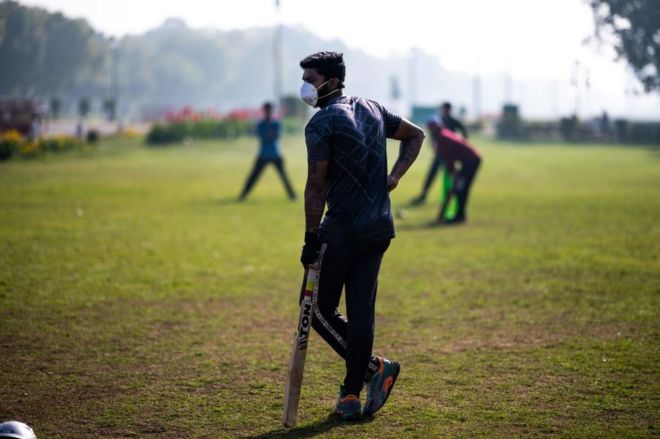
A youth (C) wearing a facemask as a preventive measure against the COVID-19 coronavirus plays cricket with his friends at a park in New Delhi on March 18, 2020.Image copyright GETTY IMAGES
Image caption Small groups of young people can be seen playing sports as schools, colleges and even gyms are shut.

Life in India has changed dramatically as the world’s second-most populous country grapples with the coronavirus outbreak.

Otherwise crowded and chaotic cities have quietened down as people stay home, traffic slows and even weddings shrink in size and scale.

India has confirmed 151 active cases and three deaths – but public health experts fear that the low count is the result of limited testing and under-reporting. The country has only conducted about 12,000 tests so far, partly because of a shortage of testing kits.

So it’s still unclear if and to what extent community transmission exists in India – community transmission means a patient had no known contact with another confirmed case or travelled from a country badly affected by the pandemic.

However, India’s central government, several state governments and city administrations have already responded with drastic measures.
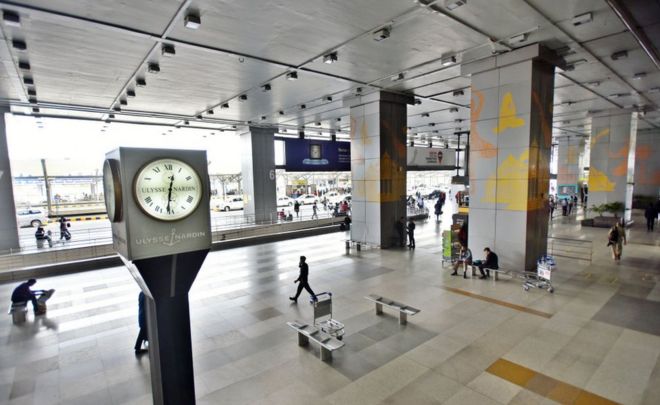
Low footfall seen at Indira Gandhi International (IGI) Airport amid rising coronavirus fear on March 16, 2020 in New Delhi, India.Image copyright GETTY IMAGES

The Indira Gandhi international airport in the national capital Delhi, is the country’s busiest airport but it appears deserted nowadays.

India has barred entry to everyone, including citizens, flying from certain countries, including the UK and most European nations. It has also cancelled most entry visas to people (excluding citizens) flying in from other countries.

This has led to numerous flight cancellations.

Airlines are also struggling as fewer people are flying even within India, wary that new regulations could see them stranded away from their homes. Two of India’s top airlines are reportedly considering grounding planes amid plummeting demand for flights.
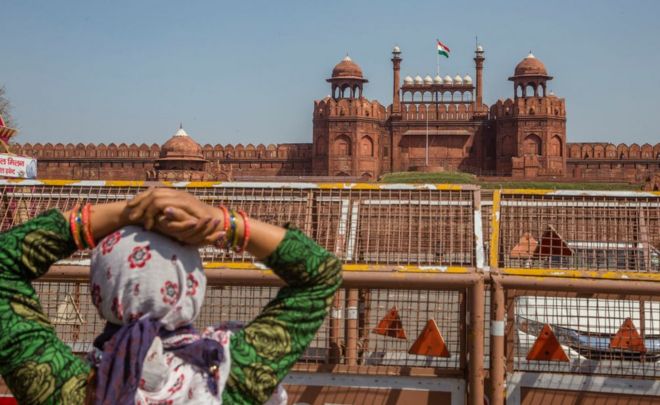
An Indian tourist disappointed to see the Red Fort, closed for tourists to prevent spread of Covid-19, as she look towards the ford on March 17, 2020 in New Delhi, India.Image copyright GETTY IMAGES

Popular Indian monuments – such as the 16th Century Red Fort in Delhi – have been shut to visitors to prevent large gatherings.

Taj Mahal, the country’s most iconic monument, closed its doors on Tuesday, along with more than 140 other monuments and museums.

With fewer people visiting and closures of public places likely to go up, tourism is expected to take a huge hit across India – the Taj alone draws as many as 70,000 people a day.
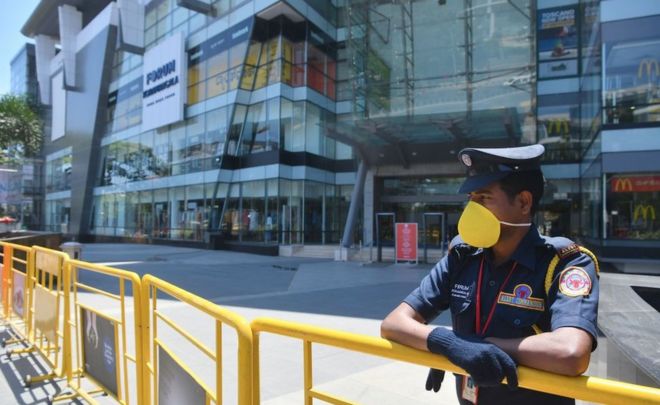
A security personnel stands guard in front of a closed shopping mall amid concerns over the spread of the COVID-19 novel coronavirus, in Bangalore on March 16, 2020.Image copyright GETTY IMAGES

Bangalore, an IT hub in southern India, is among the major cities that has shut down its malls – such as the one above – and schools, colleges, cinema halls and other public places have been closed since late last week. Other major cities such as Delhi, the financial hub Mumbai and Hyderabad in the south, have done the same.

City officials have also imposed restrictions on large gatherings such as weddings, cricket matches or any public ticketed events.
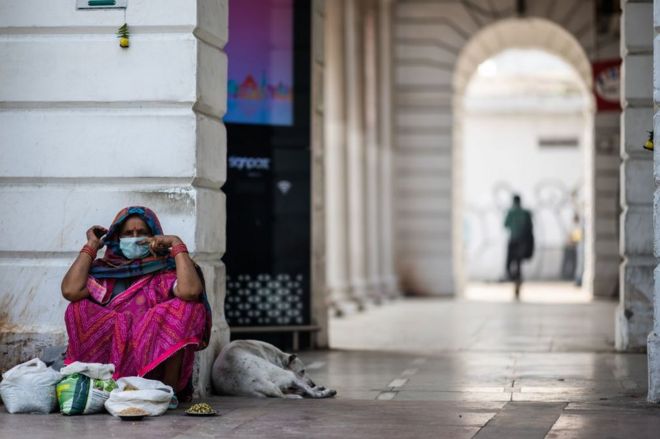
A bird feed vendor wearing a facemask as a preventive measure against the COVID-19 coronavirus waits for customers at a market area in New Delhi on March 19, 2020Image copyright GETTY IMAGES

Some of Delhi’s busiest spots, such as Connaught Place, are mostly empty.

There has also been a significant drop in the number of people using trains, which remain the most popular form of transport in India.
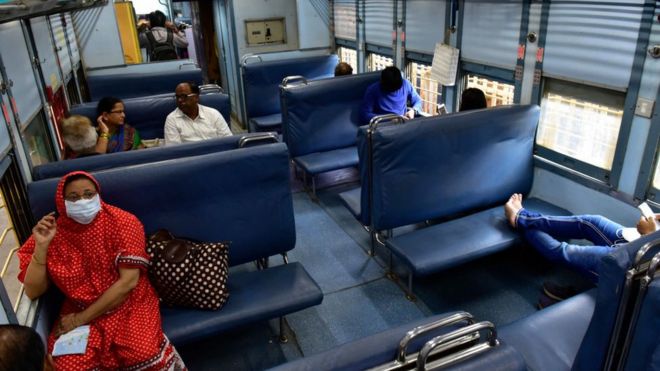
Around 25% to 30% drop of passenger traveling from Mumbai to Pune in Deccan Queen was observed after coronavirus outbreak, at CSMT, on March 16, 2020 in Mumbai, India.Image copyright GETTY IMAGES

The service from Mumbai to Pune city – which takes about three to four hours – has seen about a 30% fall in passenger traffic, according to some estimates.

The western state of Maharashtra, where both cities are located, has reported the highest number of cases in India so far. The central railways has already cancelled 23 long distance trains going to and from Mumbai – officials say the reason is both the virus and the lower number of passengers.

Overall, more than 150 trains have been cancelled across India. This number could increase in coming days.
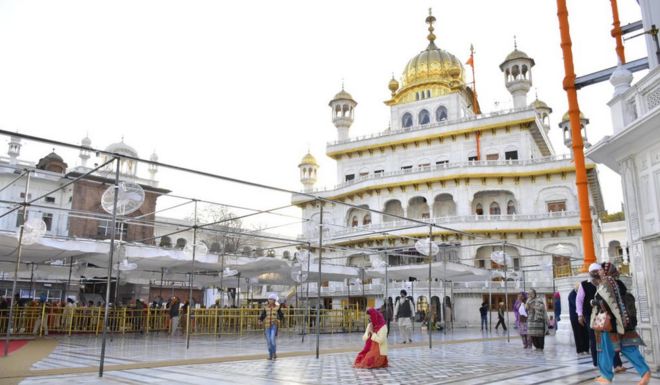
Low footfall of devotees seen at Golden Temple due to the spread of coronavirus (COVID-19) on March 17, 2020 in Amritsar, India.Image copyright GETTY IMAGES

Many holy sites, including the Golden Temple – one of the holiest shrines in Sikhism – remain open, although the footfall is much lower. It’s quite unusual to see such few people in what is one of India’s busiest shrines.

Tirumala Tirupati, the richest Hindu temple, has cancelled many of its daily rituals and is restricting the number of pilgrims for the first time.

Some major Hindu temples, such as the Siddhivinayak temple in the heart of Mumbai, and the Vaishno Devi cave shrine, have closed.
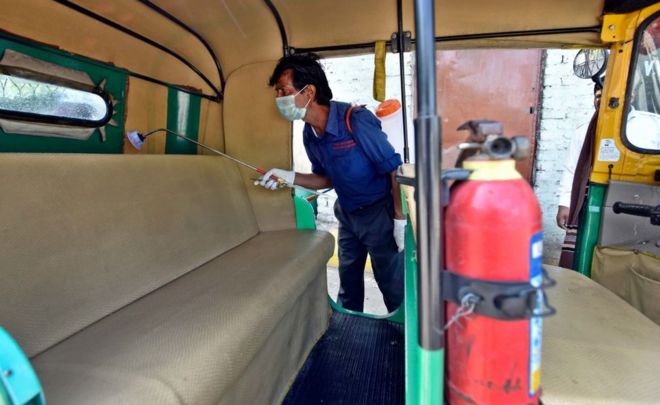
DTC cleaning staff chemically disinfect and sanitize auto rickshaw as a precautionary measure in view of coronavirus concerns, at Vasant Vihar Depot on March 17, 2020 in New Delhi, India.Image copyright GETTY IMAGES

City officials in Delhi have begun sanitising auto rickshaws and taxis to contain the spread of the virus.

Public transport poses a major challenge to containing the outbreak. But it continues to be used regularly across India, even as governments encourage people to stay home as much as possible.

But not all offices have work from home options, and this is especially a challenge for the millions who work in India’s informal sector – these include domestic help, street vendors and daily wage workers.
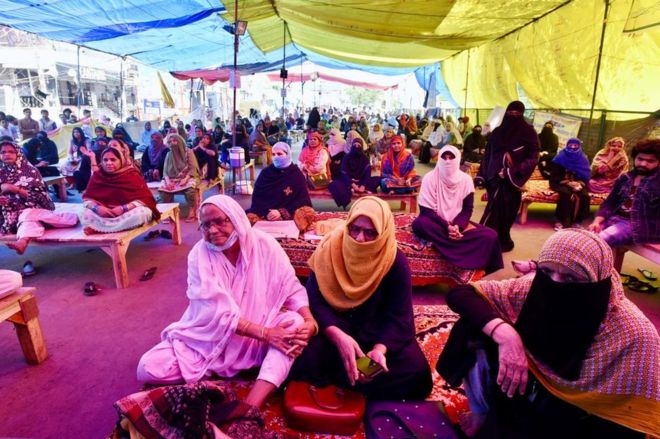
Women of Shaheen Bagh continue their sit-in protest against the CAA-NRC-NPR despite the Coronavirus advisory issued by Delhi government, at Shaheen Bagh on March 17, 2020 in New Delhi, India.Image copyright GETTY IMAGES

Surprisingly, sit-in protests against India’s controversial new citizenship law continue in some cities, including Delhi and Bangalore.

The most prominent of these, pictured above, is happening in Delhi’s Shaheen Bagh neighbourhood. Thousands of protesters, mostly Muslim women, have been demonstrating against the law, which critics say is anti-Muslim, since December.

But Delhi has shut down schools, colleges, gyms, night clubs, spas and swimming pools – and Chief Minister Arvind Kejriwal has said all social, political and religious gatherings with more than 50 people would be stopped.
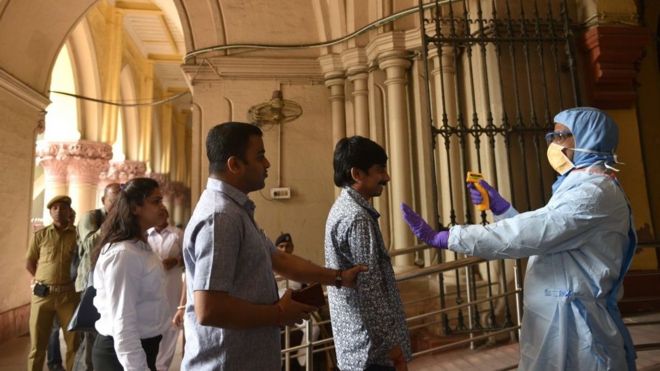
Doctor of West Bengal Health Government Department conduct thermal screening as prevention from coronavirus (COVID-19) infection at Kolkata High Court in Kolkata, India on Tuesday, March 17, 2020.Image copyright GETTY IMAGES

Temperature checks have become a common feature across cities – here, people are being screened before they enter the high court in the eastern city of Kolkata (formerly Calcutta).

This practice has been adopted at airports, corporate offices and several other places that remain open despite the restrictions.
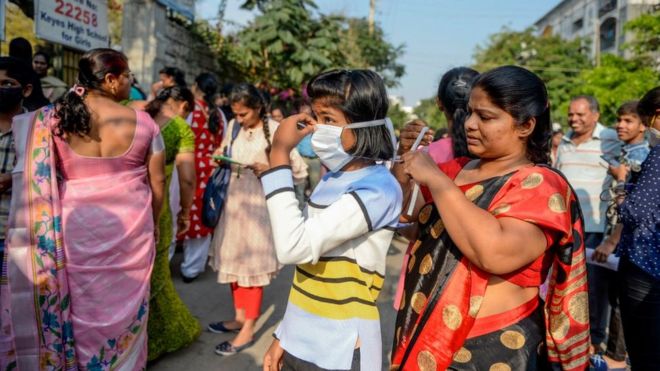
A mother ties a facemask on her daughter amid concerns over the spread of the COVID-19 coronavirus as she attends the first day of her tenth class examinations in Secunderabad, the twin city of Hyderabad, on March 19, 2020.Image copyright GETTY IMAGES

In the southern city of Hyderabad, students appeared for their school-leaving exams, but they came armed with masks.

Delhi, however, has postponed all school examinations.

Experts say India could impose more sweeping lockdowns as the toll climbs further.

Source: The BBC
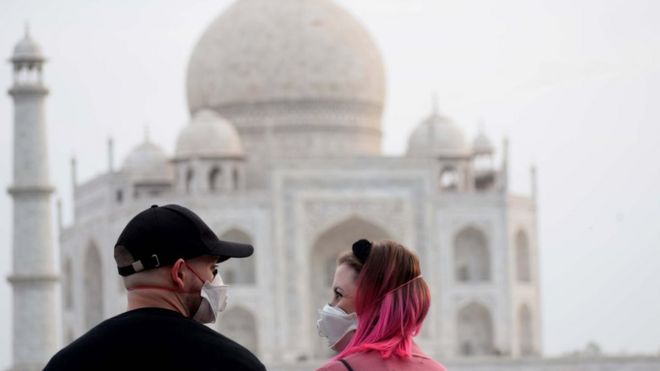
17/03/2020

Taj Mahal: ‘Monument of love’ shuts down amid coronavirus fears

Tourists wear face masks as a preventive measure against the spread of the COVID-19 coronavirus outbreak, near Taj Mahal in Agra on March 5, 2020Image copyright GETTY IMAGES
Image caption The Taj Mahal is one of the world’s leading tourist attractions.

India’s iconic monument Taj Mahal has shut down to halt the spread of the coronavirus, officials say.

The culture ministry said tens of thousands visit the “monument of love” every day and it was “imperative to shut it down”.

The Taj Mahal is one of the world’s leading tourist attractions, and draws as many as 70,000 people every day.

India has 137 reported cases of Covid-19 and three related deaths. It has tested 6,000 people so far.

On Tuesday, the Indian government announced that all monuments and museums run by the Archaeological Survey of India across the country have also been shut to keep people safe.

Culture Minister Prahlad Patel said all the 143 monuments and museums would remain shut until 31 March and the decision would be reviewed after the shutdown period.

On Tuesday, a 60-year-old doctor in the southern state of Karnataka tested positive after treating a man who died from the coronavirus last week.

Media caption Everything you need to know about the coronavirus explained in one minute

India has taken a number of steps to halt the spread of Covid-19:

  • All visas, barring a select few categories, have been suspended for a month
  • Visa-free travel afforded to overseas citizens of the country has been suspended until 15 April and even those allowed in could be subject to 14 days of quarantine
  • Schools, colleges and movie theatres in most states have been shut until 31 March
  • The Indian Premier League (IPL), featuring nearly 60 foreign players and scheduled to begin on 29 March, has been postponed to 15 April

India’s health ministry says it was among the first countries in the world to prepare for an outbreak of the respiratory illness, and denied allegations that it was slow in testing suspected cases.

Experts say that India is in a critical phase where it needs to halt community transmissions. The country has only tested 6,000 people so far and many believe that it’s not enough to halt the spread. Experts say that India needs to start testing thousands daily to effectively stop community transmissions.

The government says it’s prepared and has now allowed even private labs to test, apart from government-run labs.

Source: The BBC
24/02/2020

‘Namaste Trump’: Modi holds huge rally for Trump’s visit

AHMEDABAD, India (Reuters) – Donald Trump was cheered by more than 100,000 Indians at the opening of the world’s largest cricket stadium on Monday, promising “an incredible trade deal” and “the most feared military equipment on the planet” at his biggest rally abroad.

Indians wore cardboard Trump masks and “Namaste Trump” hats to welcome the U.S. president at the huge new Motera stadium in Prime Minister Narendra Modi’s own political homeland, the western city of Ahmedabad.

Modi, a nationalist who won re-election last year and has shifted his country firmly to the right with policies that his critics decry as authoritarian and ethnically divisive, touts his relationship with Trump as proof of his own global standing.

U.S. officials have described Trump’s visit as a way to counter China’s rise as a superpower.

“You have done a great honour to our country. We will remember you forever, from this day onwards India will always hold a special place in our hearts,” Trump said to thunderous applause.

India is one of the few big countries in world where Trump’s personal approval rating is above 50%. It has built up ties with the United States in recent years as Washington’s relationship has become strained with India’s foe Pakistan.

“As we continue to build our defence cooperation, the United States looks forward to providing India with some of the best and most feared military equipment on the planet,” Trump said.

Trump said the two countries will sign deals on Tuesday to sell military helicopters worth $3 billion and that the United States must become the premier defence partner of India, which relied on Russian equipment during the Cold War. Reuters reported earlier that India has cleared the purchase of 24 helicopters from Lockheed Martin (LMT.N) worth $2.6 billion.

But in a sign of the underlying political tensions in India, violent protests broke out in Delhi – where Trump is due on Tuesday – over a new citizenship law that critics say discriminates against Muslims and is a further attempt to undermine the secular foundations of India’s democracy.

Vehicles were set on fire in the eastern part of Delhi, metal barricades torn down, and thick smoke billowed through the air as thousands of those who are supporting the new law clashed with those opposing it.

In his speech Trump extolled India’s rise as a stable and prosperous democracy as one of the achievements of the century. “You have done it as a tolerant country. And you have done it as a great, free country,” he said.

Trump planned to raise the issue of religious freedoms in India with Modi, an administration official said last week.

VERY BIG DEALS

In Ahmedabad, Modi embraced Trump as he stepped off Air Force One, along with his wife, Melania.

Folk dancers carrying colourful umbrellas danced alongside the red carpet as drummers, trumpeters and other musicians performed at the airport to welcome Trump and the U.S. delegation. Crowds lined the route along his cavalcade, many taking pictures on their phones.

The two sides did not manage to hammer out a trade deal ahead of the visit, with differences remaining over agriculture, medical devices, digital trade and proposed new tariffs. Trump said he was going to discuss economic ties with Modi, describing him as a tough negotiator.

“We will be making very, very major, among the biggest ever made, trade deals. We are in the early stages of discussion for an incredible trade agreement to reduce barriers of investment between the United States and India,” he said.

“And I am optimistic that working together, the prime minister and I can reach a fantastic deal that’s good and even great for both of our countries – except that he is a very tough negotiator.”

Modi, who has built a personal rapport with Trump, is pulling out the stops for the president although prospects for even a limited trade deal during the visit are seen as slim.

“There is so much that we share, shared values and ideals … shared opportunities and challenges, shared hopes and aspirations,” said Modi at the rally.

Trump, who faces his own re-election campaign this year, has frequently praised Modi for his crowd-pulling power.

Last year, Trump held a “Howdy Modi” rally with Modi in Houston, drawing 50,000 people, mainly Indian Americans. At the time, Trump likened Modi to Elvis Presley as a draw for crowds.

Later, Trump and his entourage which includes daughter Ivanka and son-in-law Jared Kushner flew to Agra to see the Taj Mahal at sunset. Children lined the route cheering and waving flags as his convoy drove past.

Trump and Melania posed for pictures at the Taj, the 17th century monument to love. “It’s incredible,” he told reporters.

Source: Reuters

22/02/2020

Trump in India: A brief history of US presidents’ trips

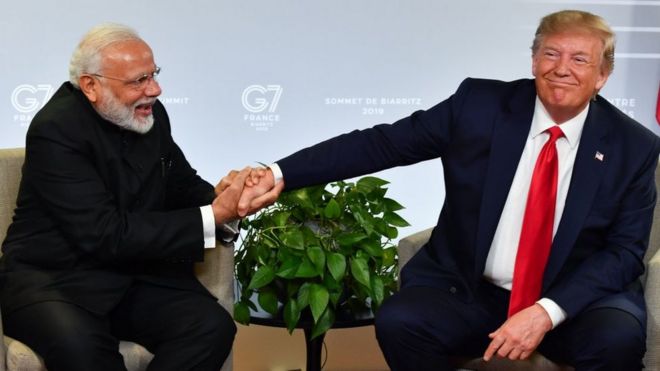
Indian Prime Minister Narendra Modi (L) and US President Donald Trump shakes hands as they speak during a bilateral meeting in Biarritz, south-west France on August 26, 2019.Image copyright GETTY IMAGES
Image caption Mr Trump is making his first official visit to India

US President Donald Trump is expecting a raucous welcome on his first official state visit to India on Monday and Tuesday.

He follows a long line of leaders who have made the journey. Some of his predecessors were greeted enthusiastically; others stumbled through diplomatic gaffes; one even had a village named after him.

Can history be a guide to how this diplomatic tryst might go? Here’s a brief look at past visits, ranked in order of how they went.

The good: President Eisenhower

Let’s begin at the beginning.

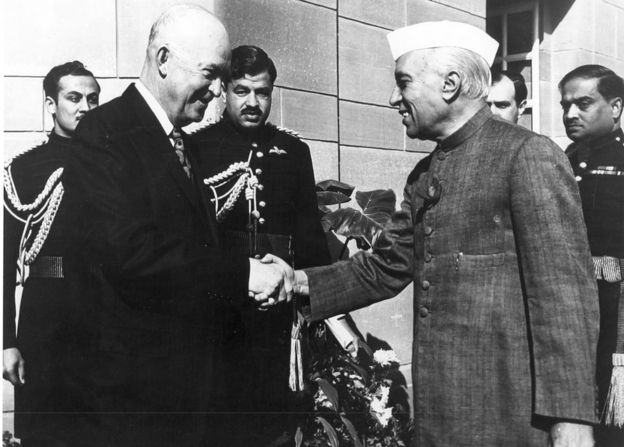
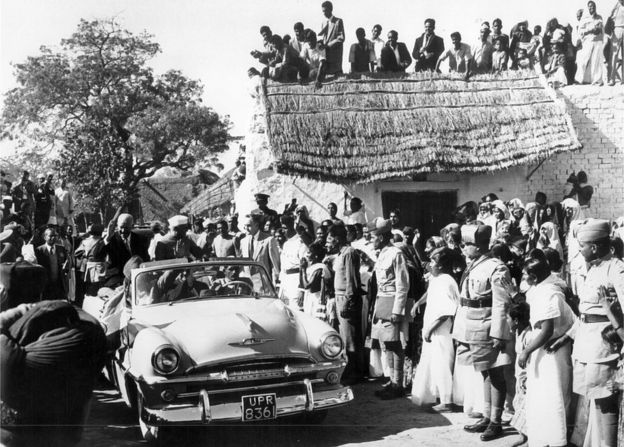
Dwight D Eisenhower, the first US president to visit India, was greeted with a 21-gun salute when he landed in the national capital, Delhi, in December 1959. Huge crowds lined the streets to catch a glimpse of the World War Two hero in his open-top car – Mr Trump is expecting a similar reception in Ahmedabad city, where he will be doing a road show.

President Eisenhower (L) with Prime Minister Jawaharlal NehruImage copyright US EMBASSY ARCHIVES
Image caption Dwight D Eisenhower, pictured with Prime Minister Jawaharlal Nehru, was the first US president to make the trip

The warmth between President Eisenhower and Indian Prime Minister Jawaharlal Nehru helped during what was a rocky phase in US-India ties. This was early in the Cold war, when the US and Pakistan had become become close allies, and India insisted on staying neutral or “non-aligned”. Like today, relations with China were at the core of the India-US equation, with Washington pressuring Delhi to take an aggressive stance with Beijing on the issue of Tibet.

But, on the whole, Eisenhower’s four-day trip was billed a success. And nearly every US president on a state visit to India has emulated his itinerary: he laid flowers at Mahatma Gandhi’s memorial, took in the splendour of the Taj Mahal, addressed parliament and spoke at Delhi’s iconic Ramlila grounds, which, according to one news report, attracted one million people.

When he left, Nehru said he had taken with him “a piece of our heart”.

President Eisenhower drove in open car to small village to get a glimpse of rural India on December 13, 1959.Image copyright US EMBASSY ARCHIVES
Image caption President Eisenhower was greeted by large crowds
Presentational white spaceThe game-changer: Bill Clinton

If there was a game-changing visit, it would be Bill Clinton’s in March 2000 with Prime Minister Atal Bihari Vajpayee. Mr Clinton’s arrival came after a two-decade lull – neither Ronald Reagan nor George Bush Snr made the journey East. It came at a tricky time as Washington had imposed sanctions on Delhi following its 1999 test of a nuclear bomb.

But, according to Navtej Sarna, a former Indian Ambassador to the US, the five-day trip was “a joyous visit”. It included stops in Hyderabad, a southern city that was emerging as a tech hub, and Mumbai, India’s financial capital. “He came and saw the economic and cyber potential of India, and democracy in action,” says Mr Sarna.

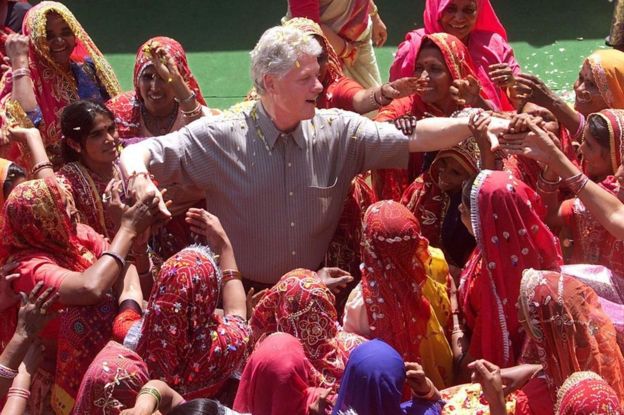
US President Bill Clinton shakes hands with local villagers after touring Nayla Village 23 March 2000.Image copyright GETTY IMAGES
Image caption Bill Clinton’s visit was described as “joyous”
Mr Clinton also danced with villagers, took a tiger safari and sampled Delhi’s famously creamy black dal (lentils) at a luxury hotel that has since been associated with the president.

The country’s reaction is perhaps best expressed in this New York Times headline: “Clinton fever – a delighted India has all the symptoms.”

The nuclear deal: George W Bush

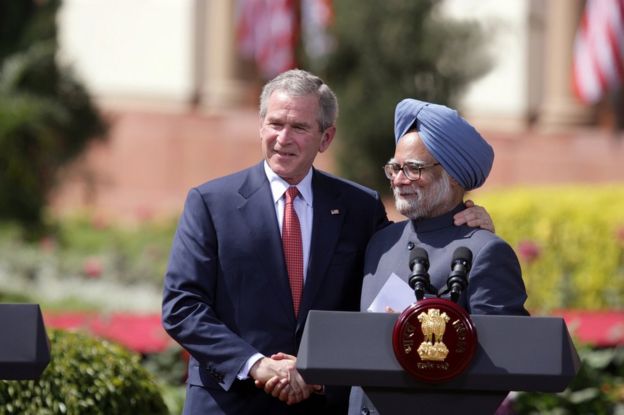
George W Bush, as Forbes magazine once put it, was the “best US president India’s ever had”. His three-day visit in March 2006 was a highlight in the two countries’ strategic relationship – especially in matters of trade and nuclear technology, subjects they have long wrangled over. His strong personal dynamic with Prime Minister Manmohan Singh was hard to miss – after he left office, Mr Bush, a keen artist, even painted a portrait of Mr Singh.

The two leaders are credited for a historic but controversial nuclear deal, which was signed during Mr Bush’s visit. It brought India, which had for decades refused to sign the Nuclear Non-Proliferation Treaty (NPT), out of isolation. Energy-hungry India got access to US civil nuclear technology in exchange for opening its nuclear facilities to inspection.

George W Bush (L) with Manmohan Singh (R)Image copyright US EMBASSY ARCHIVES
Image caption George W Bush and Manmohan Singh had a very good relationship
However, while the visit was substantive, it was not as spectacular as others – there was no trip to the Taj, nor an address to parliament. But the timing was important. Anti-US sentiment over the invasion of Iraq was running high – left-wing MPs had staged a protest against Mr Bush’s visit, and there were demonstrations in other parts of India.

Double visit: Barack Obama

Barack Obama was the only president to make two official visits. First, in 2010 with Prime Minister Manmohan Singh, and then in 2015 with Prime Minister Narendra Modi.

On his first visit – in a break from the past – he landed in Mumbai, instead of Delhi, with a large trade delegation. This was not just about economic ties but a show of solidarity following the Mumbai terror attacks of 2008, which killed 166 people. Mr and Mrs Obama even stayed at the Taj Mahal hotel, one of the main targets.

It was significant that the US president declared support for India to join a reformed and expanded UN Security Council, says Alyssa Ayres, a former US deputy assistant secretary of state for South Asia. “That all these years later nothing has changed in the UN system is another matter, but that was a major policy shift for the United States.”

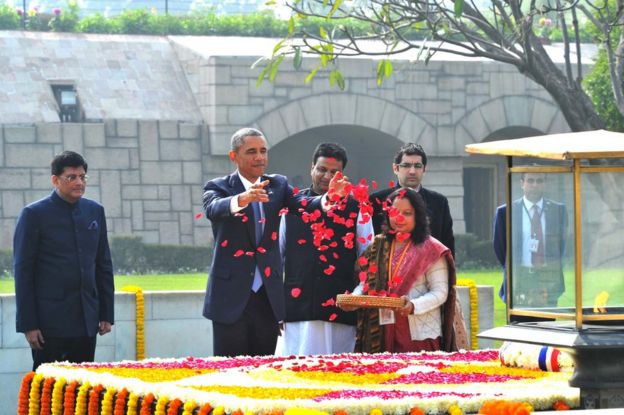
US President Barack Obama paying floral tributes at the samadhi of Mahatma Gandhi at Rajghat in Delhi.Image copyright US EMBASSY ARCHIVES
Image caption Barack Obama visited India twice
Mr Obama returned in 2015 as chief guest at India’s Republic Day celebrations, at PM Modi’s invitation. Trade, defence and climate change were at the heart of the talks. The trip also emphasised an Indo-Pacific strategy, where both leaders expressed unease over Beijing’s provocations in the South China Sea.

The not-so-good: Jimmy Carter

Although Jimmy Carter’s two-day visit in 1978 was a thaw in India-US relations, it was not free of hiccups.

With some 500 reporters in tow, Carter followed a packed itinerary: he met Prime Minister Morarji Desai, addressed a joint session of parliament, went to the Taj Mahal, and dropped by a village just outside Delhi.

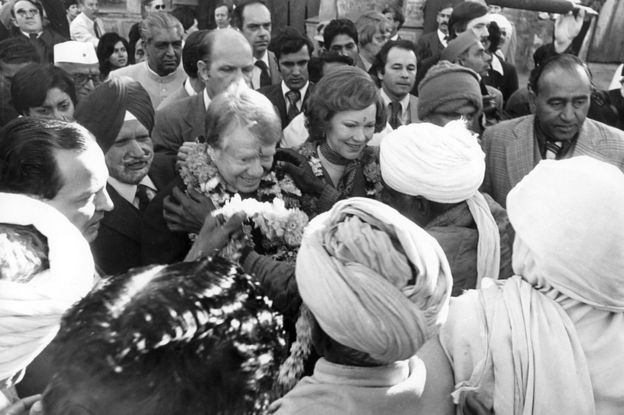
The village, Chuma Kheragaon, had a personal connection: Carter’s mother, Lillian, had visited here when she was in India as a member of the Peace Corps in the late 1960s. So when Carter and his wife, Rosalynn, made the trip, they gave the village money and its first television set. It was even renamed “Carterpuri”, a moniker it still holds.

Jimmy Carter being greeted by villagers of 'Carterpuri'Image copyright US EMBASSY ARCHIVES
Image caption Jimmy Carter being greeted by villagers of ‘Carterpuri’
But beyond the photo-ops, India and the US were sparring. India was building its nuclear programme, and had conducted its first test in 1974. The US wanted India to sign the NPF, which sought to stop the spread of nuclear weapons. But India refused, saying the agreement discriminated against developing countries.

In a leaked conversation that made headlines and threatened to derail the visit, Mr Carter promised his Secretary of State, Cyrus Vance, a “very cold and very blunt” letter to Desai. The two leaders signed a declaration, promising greater global co-operation, but Carter left India without the assurances he had hoped for.

The ugly: Richard Nixon

Richard Nixon was no stranger to India when he arrived in August 1969 for a day-long state visit. He had been here as vice-president in 1953, and before that on personal trips. But, by all accounts, he wasn’t a fan.

“Nixon disliked Indians in general and despised [Prime Minister] Indira Gandhi,” according to Gary Bass, author of Blood Telegram: Nixon, Kissinger and a Forgotten Genocide. And, he adds, the feeling was said to be mutual.

This was also at the height of the Cold War, and India’s non-alignment policy “appalled” American presidents. Mr Bass says that under Gandhi, India’s neutrality had turned into a “noticeably pro-Soviet foreign policy”.

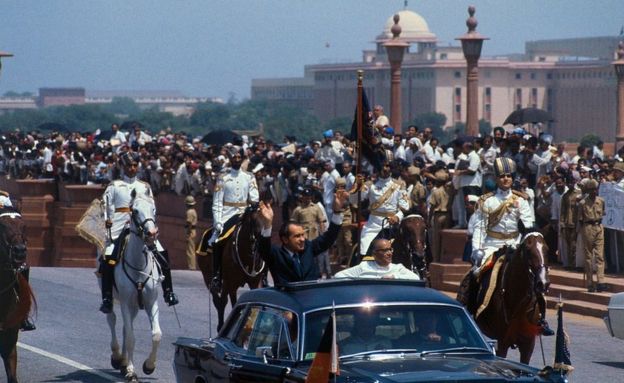
President Richard Nixon waves to crowds as he rides in open car with the acting president of India, Mohammad Hidyatullah, in motorcade from airport upon arrival here July 31.Image copyright GETTY IMAGES
Image caption Richard Nixon waves to the crowds alongside Mohammad Hidyatullah, India’s acting president
The relationship only turned frostier after the trip as India backed Bangladesh (then East Pakistan) in its fight for independence from Pakistan, a close American ally. The differences were laid bare when Gandhi visited the White House in 1971. Declassified state department cables later revealed that Nixon referred to her as an “old witch”.

And the future: Donald Trump

The US and India have certainly had their ups and downs, but during the last official visit in 2015, Mr Obama and Mr Modi signed a declaration of friendship: “Chalein saath saath (Let’s move forward together)…” it began.

President Trump’s visit will take the relationship forward, but it’s unclear how.

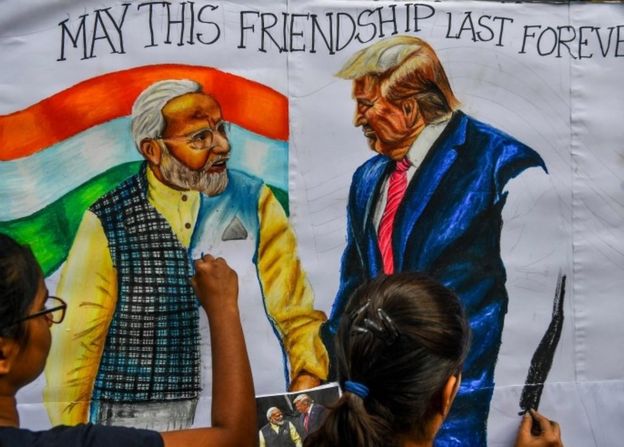
Students paint on canvas faces of US President Donald Trump (R) and India"s Prime Minister Narendra Modi, in the street in Mumbai on February 21, 2020, ahead of the visit of US President in IndiaImage copyright AFP

His arrival in Ahmedabad, the main city in PM Modi’s home state of Gujarat, followed by a big arena event, is expected to draw a massive crowd. It will echo President Eisenhower’s rally in Delhi years ago, perhaps cementing the personal ties between the two leaders.

But while Mr Trump’s trip will be packed with pageantry, it could be light on policy. Unlike other presidential visits, this one is not expected to yield concrete agreements, with the trade deal Mr Trump so badly wants looking unlikely.

Source: The BBC
29/12/2019

Tourists stay away from Taj Mahal, other Indian attractions as protests flare

MUMBAI (Reuters) – India’s tourism industry has been hit by a wave of violent anti-government protests against a new citizenship law that have rocked several cities this month, with at least seven countries issuing travel warnings.

At least 25 people have been killed in clashes between police and protesters, and demonstrations against the law continue.

Officials estimate about 200,000 domestic and international tourists cancelled or postponed their trip to the Taj Mahal in the past two weeks, one of the world’s most popular tourist attractions.

“There has been a 60% decline in visitor footfalls in December this year,” said Dinesh Kumar, a police inspector overseeing a special tourist police station near the Taj Mahal who has access to visitor data. He said the decline was compared to December last year.

“Indian and foreign tourists have been calling our control rooms to check security. We assure them protection, but many still decide to stay away,” said Kumar.

The 17th century marble monument is in Uttar Pradesh, the northern state that has witnessed the highest number of deaths and intense bursts of violence in two weeks of unrest.

A group of European tourists travelling in a group across India said they now planned to cut short their 20 day trip.

“We are all retired folks, for us travel has to be slow and relaxing. The newspaper headlines have led to a sense of concern and we will leave sooner than we had planned,” said Dave Millikin, a retired banker living on the outskirts of London, who spoke to Reuters from the capital New Delhi.

The Taj Mahal, situated in the town of Agra, attracts over 6.5 million tourists every year, generating nearly $14 million annually from entrance fees. A foreign tourist pays 1,100 rupees (about $15) to enter the grounds, although nationals from neighbouring countries get a discount.

Managers in luxury hotels and guest houses around the Taj Mahal said last minute cancellations during the festive season have further dampened business sentiment at a time when the country’s economic growth has slowed to 4.5%, its slowest pace in more than six years.

In a bid to clamp down on violence and unrest, authorities have suspended mobile internet services in Agra.

“Blocking the internet has affected travel and tourism in Agra by about 50-60%,” said Sandeep Arora, president of the Agra Tourism Development Foundation that groups over 250 tour operators, hotels and guides.

The United States, Britain, Russia, Israel, Singapore, Canada and Taiwan have issued travel advisories asking their citizens to either refrain from visiting or to exercise caution when visiting regions embroiled in India’s protests.

Jayanta Malla Baruah, the head of the Assam Tourism Development Corp., said the state, home to the world’s largest concentration of one-horned rhinoceroses, is visited on average by 500,000 tourists during December.

“But this time, due to the ongoing protests and travel advisories by various countries, the number is down by 90% if not more.”

Source: Reuters

02/12/2018

Why is the Taj Crumbling?

Twilight of the Taj

By Salman Ravi

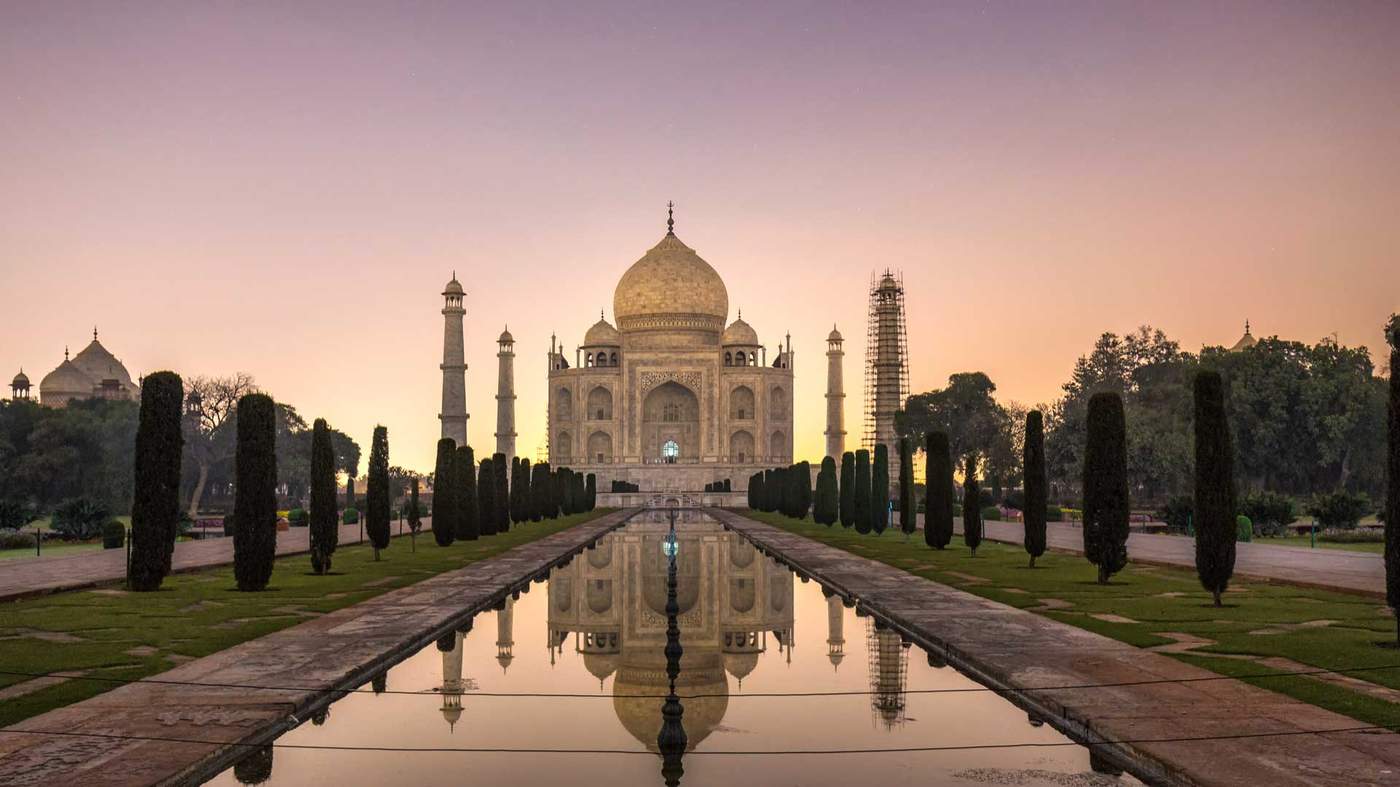
The Taj Mahal is India’s most famous building, attracting millions of tourists.

But a combination of neglect and pollution is threatening its existence.


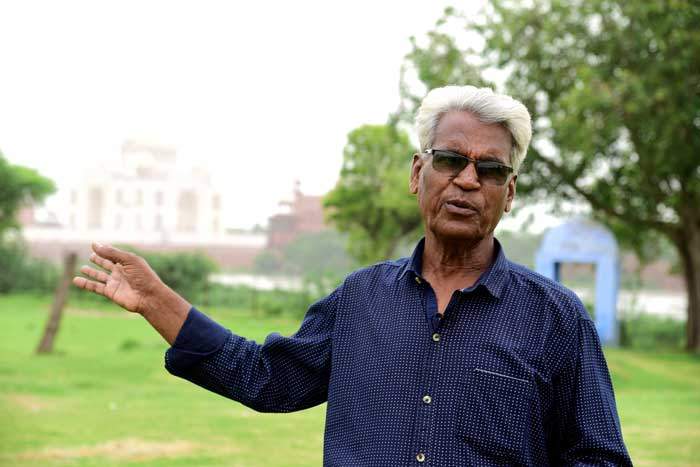
Shamshuddin Khan has been showing visitors around the Taj Mahal for more than 30 years. During that time he has been a tour guide to more than 50 world leaders – recent guests have included the Sri Lankan president and the Israeli prime minister.

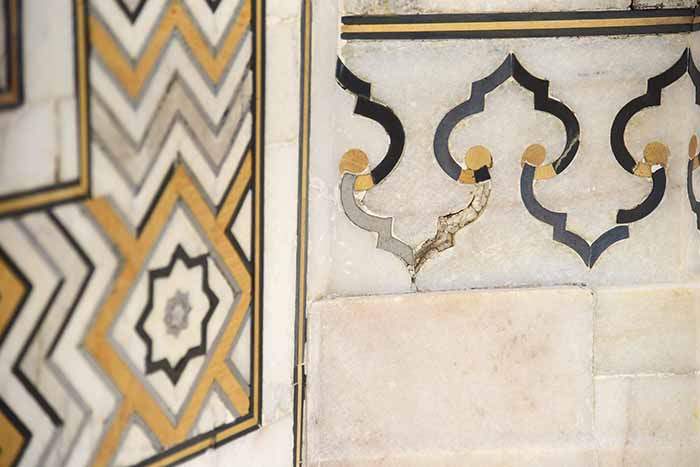
Over the past three decades, he says, his hair has turned greyer, but the Taj Mahal has become darker. Approaching the building, Khan points out the cracks and the decaying marble of the structure.

“There are embarrassing moments when the foreign tourists ask me why the Taj Mahal is not being maintained the way it should have been. They also ask us why it is losing its colour and shine. We guides have no answers.”

Shamshuddin Khan, Taj Mahal tour guide

Shamshuddin Khan, Taj Mahal tour guide

The Taj Mahal was built in the city of Agra in the 17th Century by the Emperor Shah Jahan. It was a mausoleum for his favourite queen, Mumtaz Mahal, who died giving birth to their 14th child. The emperor used marble from Rajasthan which was said to have a unique feature – it looks pink in the morning, white in the afternoon, and milky in the evening.

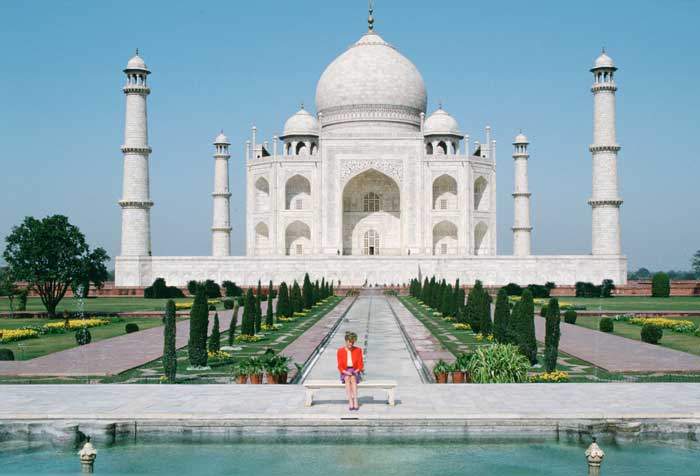
Rabindranath Tagore, one of India’s most celebrated poets, described the Taj Mahal as “a tear of marble… on the cheek of time”. In 1992, Princess Diana was famously photographed, alone in front of the building, a few months before the announcement of her separation from Prince Charles.

1992: The Taj's most noted modern visitor, Princess Diana

1992: The Taj’s most noted modern visitor, Princess Diana

The Indian tourism and culture ministry says that between four to six million tourists visited the Taj Mahal in the five years to 2015. Peak tourist season begins in the month of October and continues until March.

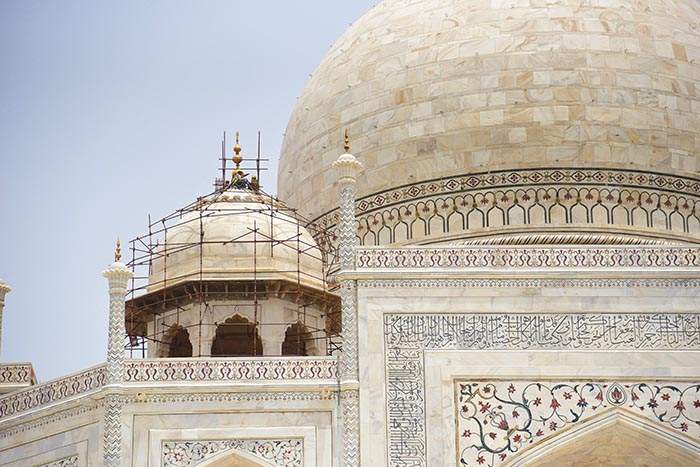
But the Taj Mahal has indeed begun to lose its shine. Its foundations are weakening and cracks are becoming larger, and deeper in the marble dome and the monument. The upper parts of the minarets are said to be on the verge of collapse. In high winds earlier this year, two pillars on an outer building fell to the ground.

In July, the veteran environmentalist and lawyer MC Mehta brought a petition to India’s Supreme Court, calling for fresh efforts to save the Taj Mahal.

Judges agreed, and ordered regular hearings involving all those responsible for the building’s conservation – the state and federal governments, and the Archaeological Survey of India (ASI). It criticised the “lethargy” of state and federal officials towards the fate of India’s most famous building:

“Taj Mahal should be protected. However, if such an indifference of officials continues then it should be closed down. Even then if things do not shape correctly, then the authorities should demolish it.”

While few are willing to countenance the demolition of the Taj Mahal, the mere mention of the idea by the Supreme Court indicates that there is now a real question mark over its future.

Pollution

The petition which MC Mehta delivered to the Supreme Court this year was not his first. A lawyer by profession, he has been attempting to make the Indian authorities take action to preserve the Taj Mahal since the mid-1980s.

At that time, airborne pollution had already been a problem in the area for many years.

Environmentalists were particularly concerned about a major oil refinery in Mathura, 50km away, which started operating in the 1970s.

In 1978, an expert committee conducting studies on air quality in and around Agra found substantial levels of sulphur dioxide (SO₂) and particulate matter in the atmosphere. According to Supreme Court documents, “the four-hourly average values of SO₂ at Taj Mahal were observed to be higher than 300 µg/m³ (micrograms per cubic metre)”.

Leaving aside the ruinous effect on public health, the effect of this pollution on the Taj Mahal was becoming increasingly clear. Sulphur dioxide, along with other pollutants, were combining with moisture in the atmosphere to cause acid rain. A report by Unesco for the Indian government found that the monument was turning yellow because of “suspended particulate matter and dust impinging on the surface”.

In 1984, Mehta brought a petition to the Supreme Court, arguing that foundries, chemical industries and refineries were the main cause behind the discoloration of the Taj Mahal.

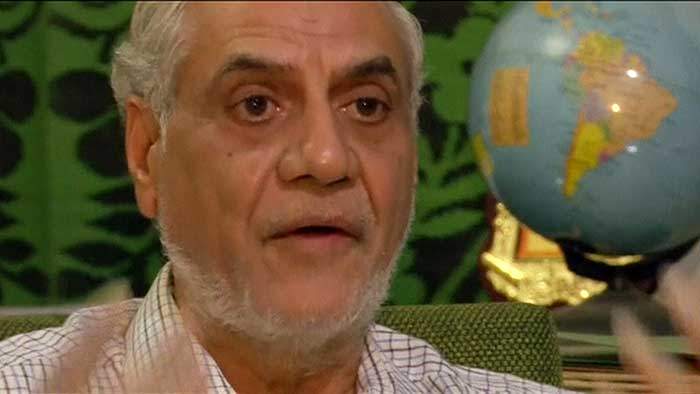
MC Mehta has been fighting a legal battle to save the Taj Mahal since the 1980s

MC Mehta has been fighting a legal battle to save the Taj Mahal since the 1980s

Nine years later the Supreme Court announced that it agreed with him, and drew up a list of measures to reduce pollution in the area. Orders were passed to close all polluting industries in around Agra and especially those very near the Taj Mahal.

Companies operating in and around Agra were ordered to use only natural gas as a fuel. The use of coal was made illegal in the area.

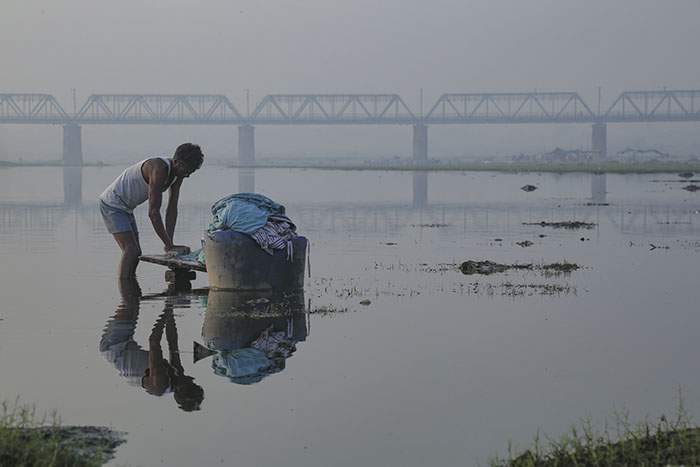
A ban was imposed on on diesel vehicles and machinery in the city, and orders were passed to remove all tanneries from the area. It was made illegal to take buffalo to the Yamuna, the river on whose banks the Taj Mahal stands, and illegal to wash laundry there.

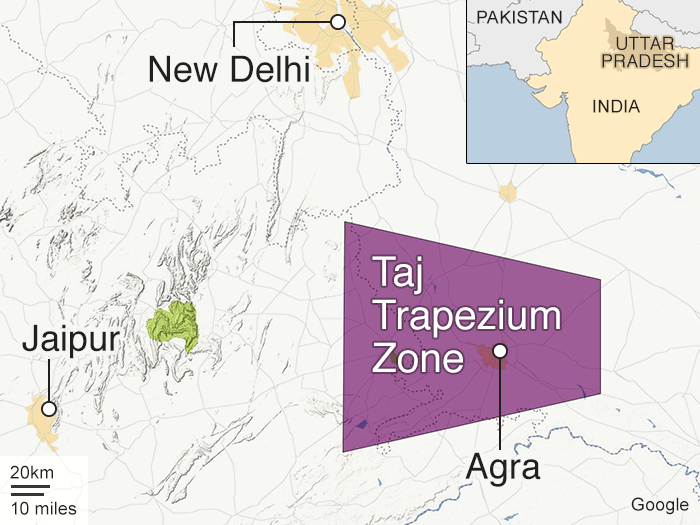
In 1998 the Supreme Court established a special exclusion area to keep heavy industry at a distance from the monument. The Taj Trapezium Zone (TTZ) covers an area of more than 10,400 sq km.

Mehta says that much could have been changed if the authorities had followed the Supreme Court’s order. “Unfortunately nothing changed and I had to knock at the door of the Supreme court again,” he says.

Use of diesel-operated vehicles continued unabated. Local industry owners protested against the restrictions and even formed an organisation with a slogan – “remove Taj, save industry”.

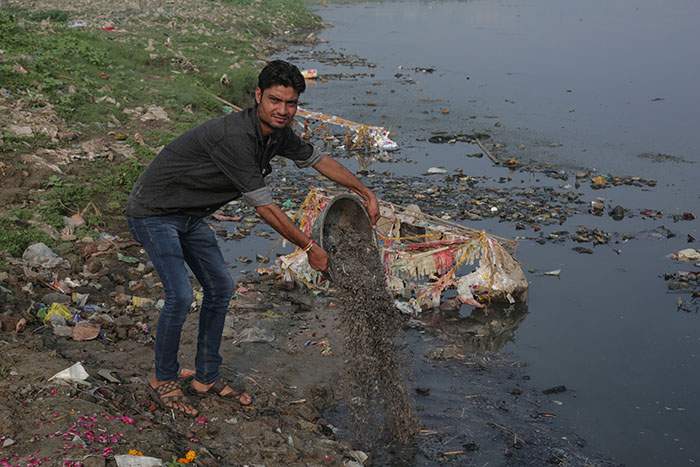
Smoke, dust and toxic effluents from industries in and around Agra continue to be dumped into the river Yamuna, and pollution has continued rising at an alarming rate. While tanneries were relocated, other activities – such as the use of diesel vehicles and generators – continued unabated. Moreover, cattle continued to bathe in the Yamuna, and clothes continued to be laundered there.

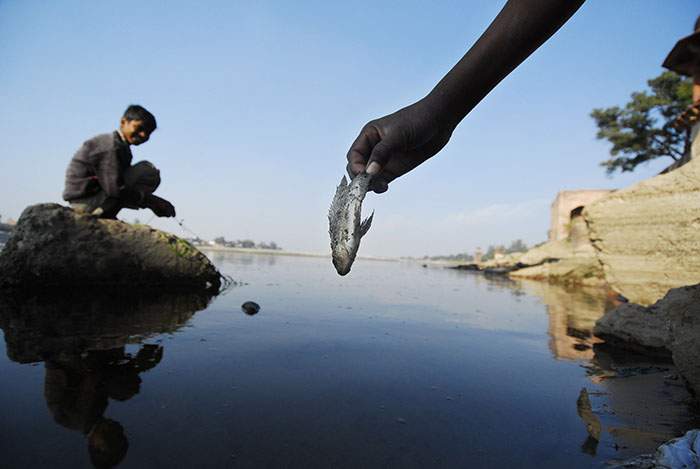
The threat to the Taj Mahal does not just come from the air – it is also waterborne. Here, too, the situation seems to be worsening. The stretch of the Yamuna river which passes through Agra is one of the most polluted waterways in the world.

“The industries along the river right from Delhi to Agra have been draining their chemical and other waste directly into the river,” says local environmentalist Brij Khandelwal. He points out that the city drains of Agra – about 90 of them – eject sewage directly into the Yamuna without any treatment.

Fish cannot survive these conditions, and in their absence, flies, mosquitoes and other insects – which would normally be eaten by the fish – proliferate above the dirty water and swarm around the Taj Mahal, where their droppings also discolour the monument.

Insects breed on the polluted Yamuna river and discolour the Taj Mahal with their droppings

A lack of water, as well as its poor quality, is also causing major problems for the Taj Mahal.

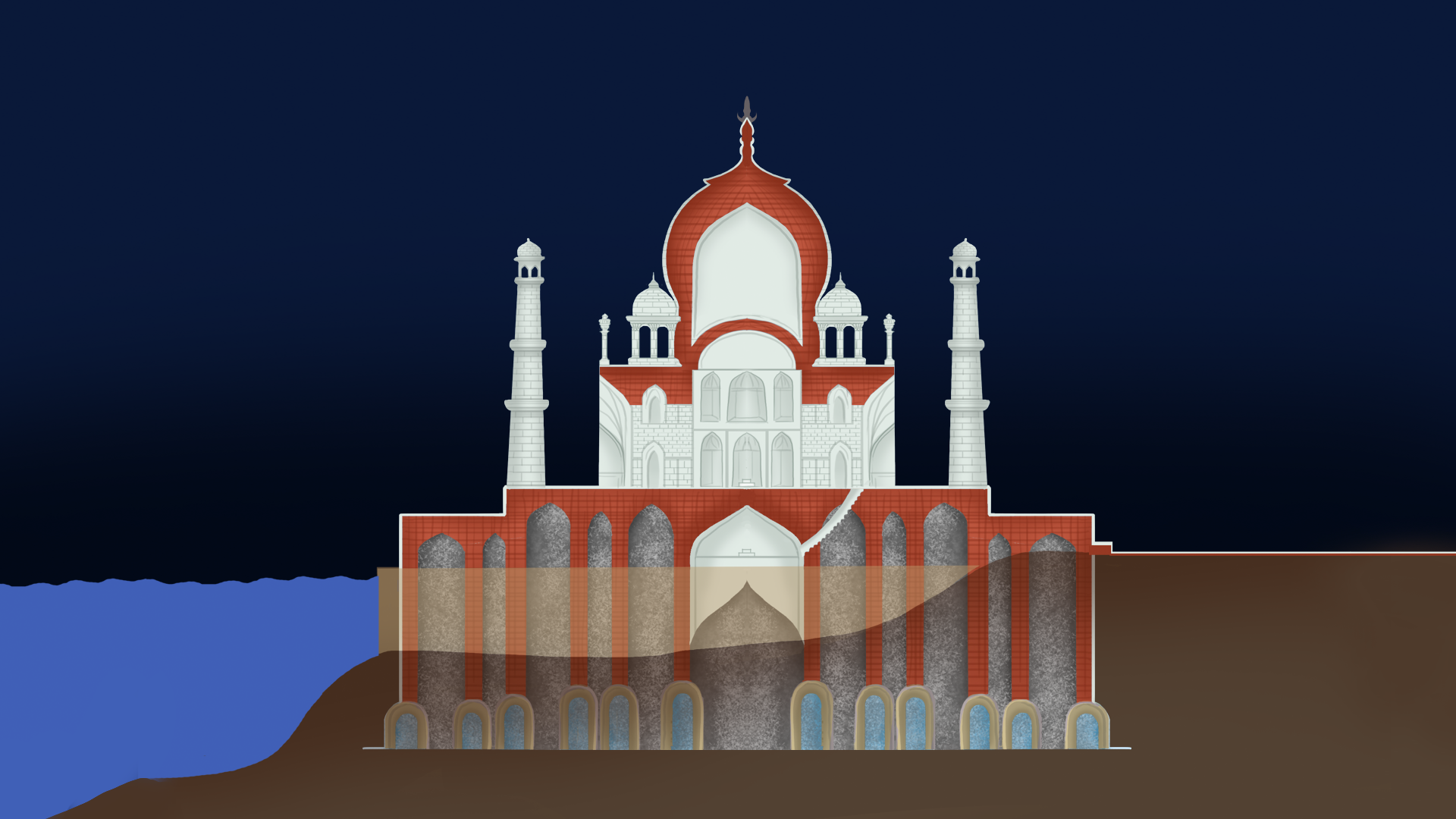
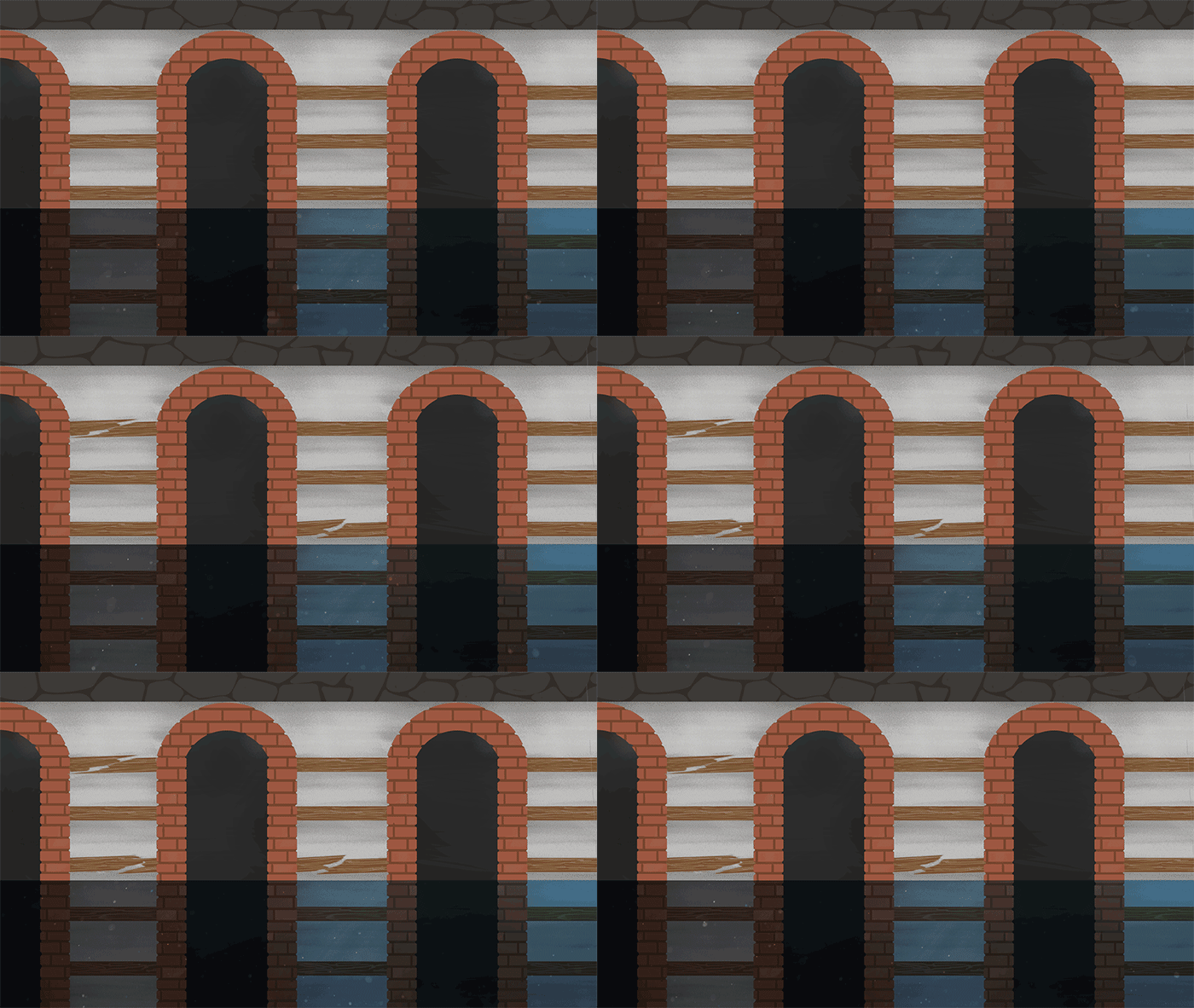
The building’s foundations are laid on 180 wells and wooden bases, which require water all year round.

According to the historian Prof Ramnath, most Mughal buildings are situated in the middle of a garden. The Taj Mahal is unusual because it was built at the corner of its garden, on the banks of the Yamuna.

The reason behind this, he says, was to ensure a supply of water to the wells and the wood bases. If the foundation isn’t watered all year round, the wood below will eventually dry up, break and rot.

As water levels fall, timbers supporting the Taj Mahal begin to crack

As water levels fall, timbers supporting the Taj Mahal begin to crack

When the Taj Mahal was constructed, most business and travel took place along the river. But as the population grew and the industries flourished, dams and barrages were built on the Yamuna, reducing the river flow.

“The Yamuna river that flows down the Himalayas, shrinks and converts into a virtual drain by the time it reaches Agra,” says Khandelwal.

The pre-monsoon depth of the water table in Agra has been declining steadily for decades. In the 1980s, the pre-monsoon depth was about 15m below ground level (bgl), according to the ground water department of the Uttar Pradesh state government.

Today, the ground water table has declined to alarming levels – 35m bgl and even lower in some areas.

In order to save the Taj Mahal, says Khandelwal, the Yamuna needs to be restored to its original levels.

“When 12,500 tons is the weight of the dome only, the estimated weight of the remaining building can well be imagined. The foundation of such a heavy building should always be strong,” he says.

As the river bed dries up, it also creates dust particles which blow up against the Taj Mahal in windy conditions. Dust storms are frequent in the region. Due to change in climate patterns, Khandelwal says, the desert is moving rapidly towards Agra.

In Taj Ganj

Sandeep Arora walks briskly along the narrow lanes of Taj Ganj – the settlement of streets and houses which surrounds the Taj Mahal. He owns a local hotel and is in a hurry to reach his workplace on time. Driving is out of the question because of the restrictions on the use of diesel vehicles.

He points out the dilapidated structures and fallen buildings in Taj Ganj. “This area is a part of Taj Mahal’s heritage. We have been living here for generations. The houses that you see were constructed when Taj Mahal was built. Most of the people living in Taj Ganj are the descendants of the ones whose gave their sweat and blood for the construction of the monument. But, what are we getting in return? Indifference, neglect, apathy,” he says.

Taj Ganj was the settlement where the workers, craftsmen and artisans who built the Taj Mahal lived. It has a population of about 5,000 people, including many “Pachchikars”, descendants of the original builders, who follow traditional artisan techniques.

The streets are lined with shops selling small marble replicas of the Taj Mahal, “crafted by the local artisans who have been living with the traditions of their ancestors”, according to Shamsuddin the tour guide.

It is not highly paid work. “If we are lucky, and some foreign tourist wants to buy a replica of the Taj Mahal, we get a few hundred rupees. This is how we earn a living,” says Basheer Ahmed, a local shop-owner.

Shamsuddin Khan says that not enough is being done to harness the collective knowledge of the Pachchikars. “They are the descendants of those craftsmen who worked during the construction of the Taj Mahal. Who will save the Taj Mahal? Only these artisans. They know it as it is in their genes. But the government has not taken any initiative to preserve their art or to teach this art to other people.”

RK Dikshit, a retired ASI official, disagrees, saying that the Pachhikars have been engaged in the Taj Mahal’s conservation for a long time. They are the people who know the art, he says.

The Indian Supreme Court has deemed the population of Taj Ganj – along with the area itself – to be a “living heritage”. But it’s a decision that has displeased many local residents. They say that the authorities are ensuring that the area will become a slum.

“The residents don’t have the right to rebuild their damaged walls and roofs. We need to have permission or a no-objection certificate from the district administration to even put a nail on the wall. We can’t use diesel generators while bigger diesel generators are used by big hotels in rest of Agra,” says Arora.

When a toilet in his hotel needed repair, Arora says he had to send six letters to government officials before permission was granted. He also complains that local residents are restricted from using diesel vehicles, while 5,000 passes have been distributed to officials, politicians and their relatives. “They come on diesel vehicles right up to the entrance of Taj Mahal, which is prohibited,” he says.

The complaints of Taj Ganj residents mirror a more general lack of agreement on how the Taj Mahal could be saved.

The Supreme Court has entrusted the job of conserving the Taj Mahal, and the heritage of Agra, to K Mohan Rao, the city’s divisional commissioner. He says that measures are being taken to tackle the amount of garbage emanating from the canals and city’s houses.

“Several committees have been formed by the state administration for waste management. Sewage treatment plants are being installed,” says Rao. He says that proposals have also been drawn up to convert Agra into a “smart city” – involving a complete revamp of the city’s infrastructure. But activists like Khandelwal feel that in the process the heritage of the city will get lost.

He thinks that any plan should also involve conserving all those structures that were built alongside the Taj Mahal, as well as restorations made by the British in the late 19th Century.

Khandelwal and Mehta are also unhappy with the ASI’s conservation programme of treating the Taj Mahal with a paste of Fuller’s earth, which is supposed to absorb the dirt and excrement discolouring the walls. They say that the paste makes the surface of the marble rough, which in turn makes the building more vulnerable to damage from the dust storms which frequently strike Agra.

To restore the glory of the Taj Mahal, Mehta, Khandelwal and the people of Taj Ganj believe that attention has to be paid to how conservation was carried out during the Mughal era and even during British rule.

This would be achieved by restoring the river Yamuna back to an unpolluted state, and involving the traditional “pachhikars” in the conservation work.

But after devoting so many years to the Taj Mahal, Mehta says he has little hope that anything will be done to save it. As the foundations become weaker, he worries that the day will come when only the memory of the Taj Mahal will be left.

“So many agencies have been involved by the Supreme Court to conduct studies on how to save the Taj Mahal. These agencies have submitted their findings to the court from time to time. The court has been issuing orders after orders.

“Unfortunately, the authorities are not serious. I am growing old now. But I will still fight.”

Law of Unintended Consequences

continuously updated blog about China & India

ChiaHou's Book Reviews

continuously updated blog about China & India

What's wrong with the world; and its economy

continuously updated blog about China & India