29/04/2020
- Carrier targets return of daily services to major Asian cities and more frequent long-haul services
- Airline to monitor global situation and adjustments may be made ‘as necessary’
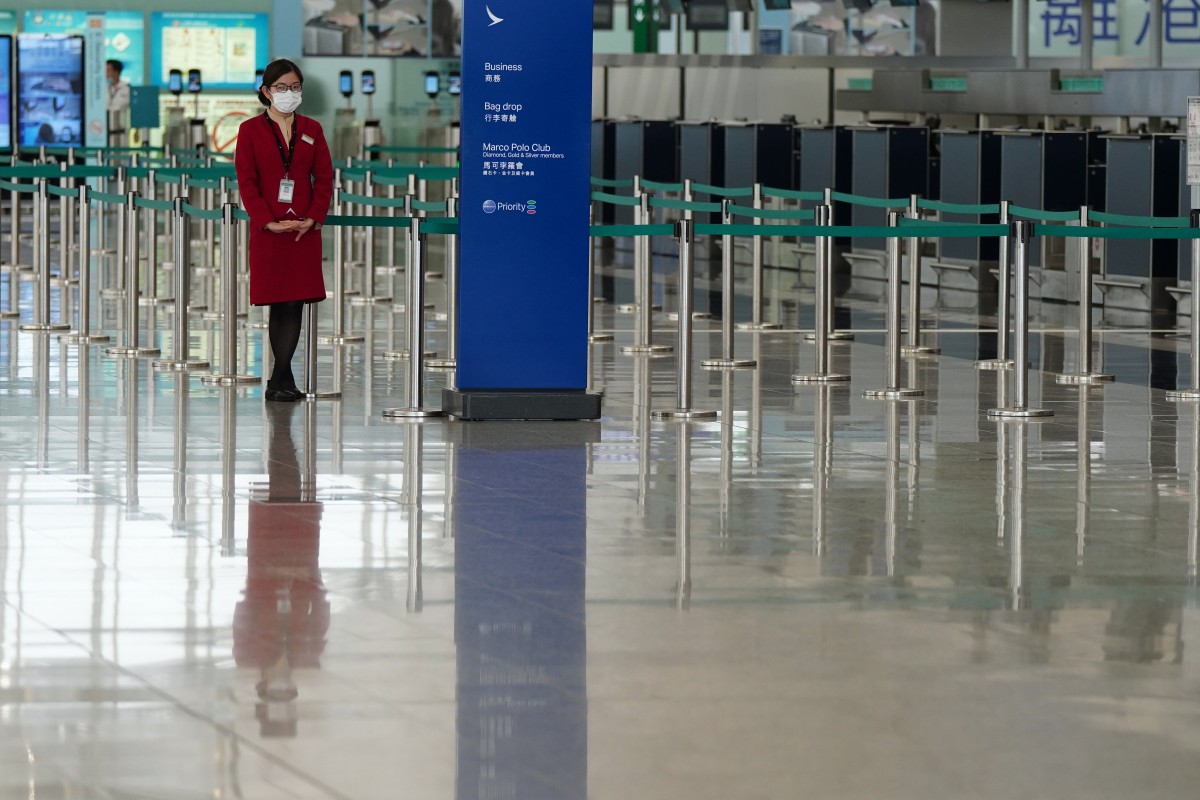
A Cathay Pacific employee stands near the check-in desks at a virtually deserted Hong Kong International Airport. Photo: Sam Tsang
Cathay Pacific Airways has signalled its intent to start reversing its near-total grounding of aircraft because of
the coronavirus pandemic, and plans to start increasing its number of passenger flights in the last week of June.
The airline said it hoped to add more long-haul destinations, make flights more frequent, and reinstate some major Asian cities to its daily schedule for the first time in several months, “subject to government travel restrictions”.
Cathay scaled its operations back to a skeleton schedule of 3 per cent of services in early April, and that was extended until June 20. The newly announced increases would take that up to 5 per cent.
The global airline industry has been rocked by the pandemic, which triggered a collapse in air travel demand amid severe travel restrictions and tough quarantine measures.
Tracking the massive impact of the Covid-19 pandemic on the world’s airline industry in early 2020
Singapore Airlines, another of Asia’s major carriers, said last week it would maintain a 96 per cent reduction in flights until the end of June.
Cathay, which has 236 aircraft, currently operates long-haul flights to London Heathrow, Los Angeles, Vancouver and Sydney twice a week, but will increase that to five times a week.
On top of that, Amsterdam, Frankfurt, San Francisco and Melbourne are among the long-haul destinations set to return three times a week.
With regional routes currently operating three times a week, including Tokyo Narita, Taipei, Beijing and Singapore, Asian routes will increase to a daily service. Osaka and Seoul would also return to the network, too.
“We will continue to monitor the developing situation and further adjustments may be made as necessary,” the airline said.
Coronavirus: ban on non-residents leaves Hong Kong airport virtually deserted
Earlier this month, Cathay’s budget unit HK Express extended its total grounding until June 18, having been on hiatus since March 23.
Meanwhile, Boeing has added to warnings of a very slow recovery in air travel, with Dave Calhoun, its CEO, saying demand may not return to 2019 levels for two to three years.
Cathay Pacific’s daily passenger volume has collapsed from regular previous peaks of 100,000 to less than 1,000 in April. Over the past two months, the company has been running more than 250 extra pairs of cargo-only passenger flights to maintain air freight capacity, much of which is accounted for by passenger services.
In a bid to cut costs, most of the Cathay Pacific Group’s 34,200 staff have taken three weeks of unpaid leave. Also, 433 cabin crew in the US and Canada were told they would be laid off, while about 200 pilots in the UK, Australia have been furloughed.
The International Air Transport Association, which revised down pandemic-related revenue losses for the global sector to US$314 billion (HK$2.4 trillion) two weeks ago, said last week the Hong Kong aviation market would take a US$7.5 billion hit this year, a 27 per cent increase on the previous estimate. That equates to a 59 per cent decline in air travel demand, or a loss of almost 31 million passengers, in 2020.
BOCOM International, a financial services company, forecast in a report on Monday that the city’s aviation sector would lose HK$65.2 billion in revenue in 2020, yet Cathay Pacific could emerge as a winner if it survived largely unscathed, given the weakness of rivals at home and in the region plus its dominant position in Hong Kong.
“Hong Kong aviation is at the most critical juncture in its history. Though calamitous, Covid-19 is set to reshape Hong Kong’s aviation industry for the years, possibly decades, to come,” said transportation analyst Luya You.
“Covid-19’s sweeping blows now offer a blank slate for remaining players to regain lost leadership or gain new markets. If [Cathay Pacific] can survive intact from Covid, the carrier could enjoy winner-takes-all growth trajectory in the years following [2020].”
Source: SCMP
Posted in 200, Amsterdam, April, Asian, Asian routes, Australia, aviation market, Beijing, BOCOM International, Boeing, cabin crew, canada, carrier, Cathay Pacific, Cathay Pacific Airways, Cathay Pacific Group’s, cities, coronavirus, Coronavirus pandemic, COVID-19, daily services, deserted, destinations, eased, Frankfurt, frequent, furloughed, global airline industry, Hong Kong airport, Hong Kong International Airport, increase, June, laid off, late, London Heathrow, long-haul, looks to, Los Angeles, Melbourne, more, passenger flights, pilots, return, San Francisco, Services, Singapore, Singapore Airlines, Sydney, Taipei, targets, The International Air Transport Association, Three, Tokyo Narita, travel restrictions, UK, Uncategorized, unpaid leave, US, Vancouver, weeks, winner-takes-all |
Leave a Comment »
26/04/2020
SHANGHAI (Reuters) – China’s smog-prone northern province of Hebei met its air quality targets by a big margin over the winter after concerted efforts to tackle emissions, a local official said on Sunday, without mentioning coronavirus-related factory shutdowns.
Average PM2.5 concentrations over the October-March period dropped 15% from a year earlier to 61 micrograms per cubic metre, while sulphur dioxide also fell by a third, said He Litao, vice-head of the provincial environmental bureau.
Most experts have attributed the significant decline in air pollution throughout China in the first quarter to the coronavirus outbreak and tough containment measures, which saw cities and entire provinces locked down and sharply reduced traffic and industrial activity throughout the country.
With millions staying at home, concentrations of lung-damaging PM2.5 particles fell by nearly 15% in more than 300 Chinese cities in the first three months of 2020.
Shanghai saw emissions fall by nearly 20% in the first quarter, while in Wuhan, where the pandemic originated, monthly averages dropped more than a third compared to last year.
However, He of the Hebei environmental bureau attributed the local decline in pollution to the “conscientious implementation” of government decisions even in the face of unfavourable weather conditions.
According to a winter action plan published last year, 10 cities in Hebei were expected to cut lung-damaging small particles known as PM2.5 by 1%-6% compared to the previous year.
Despite the decline, average PM2.5 was still much higher than China’s official standard of 35 micrograms, and the recommended World Health Organization level of 10 micrograms.
Source: Reuters
Posted in 10, 15, 15%, 20%, 2020, 300, 35, according, action plan, air pollution, air quality, also, at home, attributed, Average, averages, “conscientious implementation”, big, China, China's, China’s, cities, compared, concentrations, concerted, conditions, containment, coronavirus outbreak, coronavirus-related, Country, cubic metre, cut, decisions, decline, dropped, earlier, efforts, emissions, entire, environmental bureau, even, expected, experts, face-of, Factory, fall, Fell, first, first quarter, from, Government, Hebei, industrial activity, known as, last year, level, local, local official, locked down, lung-damaging, March, margin, measures, mentioning, micrograms, millions, monthly, months, more than, most, nearly, northern province, October, Official, originated, over, pandemic, particles, Period, PM2.5, Pollution, previous, provinces, provincial environmental bureau, published, recommended, reduced, said, saw, Shanghai, sharply, shutdowns, significant, small, standard, staying, sulphur dioxide, Sunday, tackle, targets, third, Three, throughout, tough, traffic, Uncategorized, unfavourable, weather, which, while, winter, without, World Health Organization, Wuhan, year |
Leave a Comment »



 CHINDIA ALERT: You'll be living in their world, very soon