Archive for ‘Tata Motors’

12/09/2019

Why is India’s car industry in breakdown mode?

India’s second-biggest manufacturer of commercial vehicles, Ashok Leyland, is suspending production at several units from five to 18 days in September, triggering fears that the slump in the automotive sector shows no sign of letting up. The BBC’s Nitin Srivastava reports.

Ram Mardi is worried he may lose his job. He works for a company that makes spare parts for cars and heavy vehicles in Jamshedpur, an industrial city in eastern India. But he has worked only 14 days in August.

“We had a comfortable life until recently. Now, it’s hard to arrange food or pay for the children’s education,” Mr Mardi says.

The factory he works at temporarily suspended production for half of the month to reduce inventory in the face of shrinking demand.

Industry heavyweights such as Maruti, Tata Motors and Mahindra & Mahindra have all announced production cuts over the past several months.
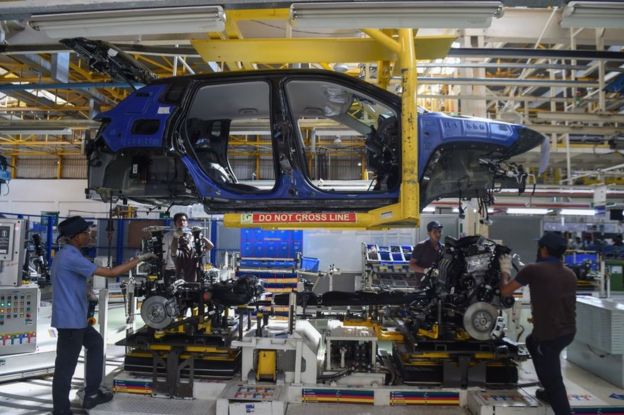
Workers assemble a car at a FCA India Automobiles manufacturing facility in Ranjangaon, some 200km east of Mumbai.Image copyright GETTY IMAGES
Image caption India’s automotive industry employs some 35 million people

India’s economy is facing a slowdown. It grew at 5% in the quarter ending June 2019 – its lowest in five years. This – along with a drop in private investment and a banking crisis that has made it hard to access credit – has weakened consumer demand.

The Indian government is also pushing for a transition to electric vehicles over the next decade, which some experts believe, has contributed to falling vehicle sales.

As the automotive industry declined for the 10th month in a row in August, car sales dropped by 41% – the steepest fall in two decades.

The industry is one of India’s biggest, considering it employs some 35 million people, directly or indirectly, and contributes more than 7% to the country’s GDP.

By some estimates, more than 100,000 workers, many of them contractual, have lost their jobs so far. Now fears are rising that if demand continues to fall, forcing lower production, more jobs could disappear.

Small and medium businesses – thousands of ancillary units that supply to the big manufacturers – have been hit the hardest. And daily wage labourers such as Mr Mardi are the most vulnerable.

And employers are also concerned. “I have never had so much trouble keeping my factory up and running”, says Sameer Singh, who heads a family-owned business in Jamshedpur that makes spare parts for vehicles.

“My employees are jobless for a few weeks and I feel for them. If this continues they may move out, perhaps find another job. But I can’t even look out for a job. My life starts and ends here”.

Mr Singh says it’s also been hard for business owners, companies and consumers to borrow money because banks have tightened credit lines after a spike in bad loans in recent years dented their balance sheets.
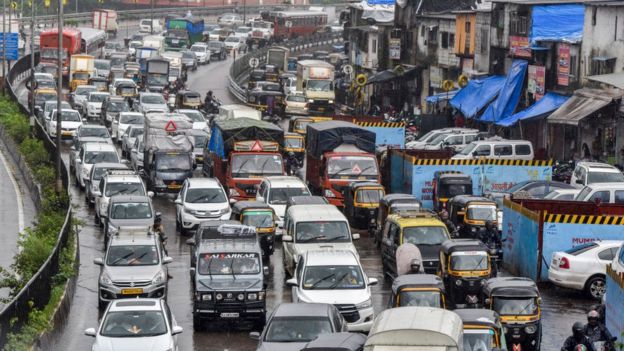
Vehicles on a road in MumbaiImage copyright GETTY IMAGES
Image caption Car sales in India have dropped to their lowest in 20 years

“The fall [in production] is so large and so dramatic that it has affected every single product – two-wheelers, car, commercial vehicles,” says Sanjay Sabherwal, member of the Automotive Component Manufacturers Association of India, an industry body.

Auto executives have been demanding tax cuts and easier access to financing for manufacturers, sellers and consumers. The government recently announced a slew of measures – this includes a delay in increasing the registration fees for new vehicles and asking banks to lower interest rates on loans for cars and two-wheelers.

But, will that be enough? That is hard to say with experts calling this the worst downturn to ever hit India’s automotive industry.

Source: The BBC

08/02/2019

Tata Motors posts record $4 billion loss on Jaguar woes, shares crash

BENGALURU/NEW DELHI (Reuters) – Jaguar Land Rover’s owner Tata Motors Ltd stunned markets by posting the biggest-ever quarterly loss in Indian corporate history of about $4 billion (£3.1 billion) on slumping China sales, sending its shares crashing as much as 30 percent.

Tata Motors also warned that the Jaguar Land Rover (JLR) unit, which brings in most of its revenue, would swing to an operating loss in the year to March versus an earlier projection for breakeven, given weak sales at the luxury British carmaker.

JLR’s China retail sales almost halved in the December quarter as overall demand in the world’s biggest auto market contracted last year for the first time since the 1990s. The firm has also been buffeted by Brexit woes and weaker business for diesel cars that account for bulk of its sales in Europe.

SPONSORED

Tata Motors turned in a third-quarter loss of 269.93 billion rupees ($3.8 billion) on Thursday, more than half its current market capitalisation of $6.1 billion, mostly due to a massive impairment at JLR. Analysts were expecting a profit.

“We are now taking clear and decisive actions in JLR to step up its competitiveness, reduce costs and improve cash flows and make the business fit for the future,” Chief Financial Officer PB Balaji told reporters on a conference call on Thursday.

JLR has taken steps to address the slide in China sales by changing its strategy to focus on profits for dealers instead of sales and incentivising retail sales over wholesale, he said.

FILE PHOTO – A Tata Tigor car is pictured at the assembly line inside the Tata Motors car plant in Sanand, on the outskirts of Ahmedabad, India, August 7, 2018. REUTERS/Amit Dave

“We are encouraged by continued demand for the refreshed Range Rover and Range Rover Sport,” JLR Chief Commercial Officer Felix Brautigam said in a statement.

“With deliveries of the new Evoque due to start later this quarter, we look forward to building momentum.”

But analysts expect JLR to struggle to generate profit with China’s economy projected to slow further this year after growth eased to its weakest pace in almost three decades in 2018.

JLR’s overall retail sales in January plunged 11 percent.

(For an interactive graphic on monthly sales at Jaguar Land Rover, click: tmsnrt.rs/2te4M1L)

BROKERAGE SLASH PRICE TARGETS

The dour numbers prompted Tata investors to make a beeline for the exits as markets opened on Friday, with shares of the company skidding to their lowest in nine years at one point.

The stock was down about 20 percent by 0720 GMT near 150 rupees, on track for its sharpest drop since 2003.

Slideshow (2 Images)

At least four brokerages cut their price target for Tata Motors shares after its quarterly loss.

Analysts at Jefferies pegged the stock at 250 rupees, versus an earlier target of 300 rupees, citing weak performance at JLR.

Tata Motors took a non-cash charge of 278.38 billion rupees for an impairment at JLR in the quarter. Changes in market conditions, especially in China, technology disruptions and rising cost of debt led to the charge.

JLR, Britain’s biggest carmaker, also faces disruption due to persistent uncertainty over a Brexit deal and has decided to halt production for a couple of weeks in April.

British Prime Minister Theresa May’s Brexit deal was rejected in parliament last month and the government is trying to make changes to win the support of lawmakers even as the date for Britain’s departure from the European Union looms less than two months away.

(For an interactive graphic on sales of India’s biggest automakers, click tmsnrt.rs/2Hr877P)

Law of Unintended Consequences

continuously updated blog about China & India

ChiaHou's Book Reviews

continuously updated blog about China & India

What's wrong with the world; and its economy

continuously updated blog about China & India