Archive for ‘Technology’

03/10/2016

How Google’s Bicycle-Riding Internet Tutors Are Getting Rural Indian Women Online – India Real Time – WSJ

The internet fails to reach millions of women in the small towns and villages of India, so Google is trying to deliver it to them — by bicycle.

The Alphabet Inc. unit has built an army of thousands of female trainers and sent them to the far corners of the Subcontinent on two-wheelers, hoping to give rural woman their first taste of the web. Each bike has a box full of connected smartphones and tablets for women to try and train on.

The idea is to give people who have never even sent an email a better understanding of how being connected could improve their lives. Families that can afford to be online often chose not to be because they do not see the value. Meanwhile women are sometimes blocked by their families from new technology.

ENLARGEA web trainer who is taking part in Internet Saathi, the joint program of Alphabet, Inc.‘s Google and local philanthropy Tata Trusts, in the village of Habibwala, in Rajastan, India, Sept. 28, 2016. PHOTO: GOOGLE

Bhagwati Kumari Mahawar got her very first taste of the internet just a month ago.

The 19-year-old used a smartphone Google brought to her remote village in the desert state of Rajasthan to search for designs of mehndi, the elaborate henna designs Indian women get on their hands and feet. Then she looked up information on how to sew a blouse.

ENLARGEBhagwati Kumari Mahawar in the village of Habibwala, in Rajastan, India, Sept. 28, 2016. PHOTO: GOOGLE

“I really wanted to learn,” she said, sitting in the shade near the Google bicycle and a water buffalo.In the project, called Internet Saathi, Google partnered with local philanthropy Tata Trusts to show women in rural India how to connect to the web.

Instructors are trained in how the web works, and then are given bicycles with large boxes on the back containing internet-enabled devices running Google’s Android mobile operating system. The newly equipped “saathis” — or “partners” in Hindi — then cycle from village to village providing instruction to their peers.

“I wasn’t sure if I could do it or not,” said the instructor who helped Ms. Mahwar get online, 30-year-old Kamla Devi Mahawar, who is unrelated to her pupil.

She never used the web until she began her Saathi training ten months earlier, but since then has enjoyed showing women how to search for information like recipes and stitching guides, and showing them how to use voice queries if they are unable to type in text.

ENLARGEWomen look at cell phones as part of Internet Saathi, the joint program of Alphabet, Inc.’s Google and local philanthropy Tata Trusts, in the village of Habibwala, in Rajastan, India, Sept. 28, 2016. PHOTO: NEWLEY PURNELL/THE WALL STREET JOURNAL

In a demonstration, she sat on the ground while half a dozen women circled around her, watching as she searched for images of nearby temples and forts. Some women want to learn how to use Facebook Inc.’s WhatsApp messaging service, while others simply want to make phone calls, she said.

Since the program’s launch last year, about 9,000 guides have helped reached 1 million women, Google said, noting that the program fits its mission of helping expand internet access globally.

India is an increasingly important commercial market for the Mountain View, Calif. search titan given its nascent internet economy.

While the country is home to more than 1.2 billion people, consultancy McKinsey & Co. reckons some one billion people still lack regular web access. More online consumers in the years ahead could mean more users of Google’s services, like its search engine, email and Android.
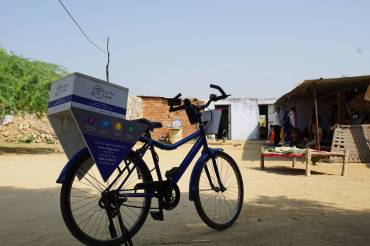
A bike used by an instructor who teaches women how to use the web, part of Internet Saathi, the joint program of Alphabet, Inc.’s Google and local philanthropy Tata Trusts, in the village of Habibwala, in Rajastan, India, Sept. 28, 2016. PHOTO: GOOGLE

Last week, at an event in New Delhi, Google executives said they are expanding their efforts to reach Indians with products and features like a new version of its YouTube app designed to work even on India’s often sluggish mobile networks.

Asked how her work with others could be made easier, Ms. Mahwar, the trainer, was quick to point out that better web connectivity is key.

“The internet doesn’t work half the time,” she said. Fixing that “would help a lot.”

Source: How Google’s Bicycle-Riding Internet Tutors Are Getting Rural Indian Women Online – India Real Time – WSJ

30/09/2016

Glass loos with a view open in China – BBC News

Whatever will the Chinese think of next?

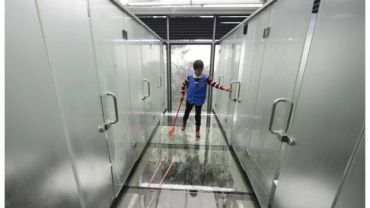
China’s recent obsession with glass tourist attractions has gone round the U-bend with the opening of some see-through treetop public toilets.

The loos, near Shiyan Lake in southern Hunan province, have fabulous views of both the forest below and other people using the facilities.

Cubicle walls, even those between the men’s and women’s sections, are only separated by lightly frosted glass.

But state media said few visitors dared use the loos on their opening day.

Image copyrightBARCROFT IMAGESImage caption

Shy users of the urinals may take comfort from the privacy barriers between them, though not in the fact they are made of glass

Despite a boom in the construction of glass bridges and walkways in scenic locations in China in recent years – in some cases so popular they had to be closed – these are thought to be the first entirely glass public bathrooms in the country.

However, it not the first time those busting to go have been exposed a little more than they might like by the enthusiasm for glass.

There were reports recently of some male toilets in a university dorm in Hunan which included one very public cubicle.

Image copyrightBARCROFTImage captionUnusually, a head for heights is a requirement for a job as a cleaner there

Image copyrightBARCROFTImage caption Awkward: cubicle walls are only lightly-frosted, even between the men’s and women’s sections

News of the wide-view WCs at Shiyan Lake sparked a range of reactions online.Responding to a Facebook post about it by state television channel CCTV, Ejike Nnadi summed up the feelings of many: “Hell no.”

Others were more taken by the idea. “You’ll be surprised by what you can tolerate when you really, really need to go,” said one post.

Another nodded towards another modern use for restrooms: “I’d be in there ’til my battery hit zero if there was signal in there!”

Image copyrightBARCROFTImage captionThe well-lit lavs are built on a steep hillside

Tina Chen took a dimmer view of all such projects though. “(It) is not about being shy, just again someone had extra money to waste.”

Image copyrightGETTY IMAGESImage caption Unusual glass structures have provided popular photo ops for tourists across China

Awkward or not, it is hoped that these bathrooms for the brave will encourage tourists to visit the countryside around Changsha city and admire the spectacular autumn colours of its forests.

Source: Glass loos with a view open in China – BBC News

23/09/2016

A glowing future | The Economist

UPON learning (via a terse government statement) that their bustling port city in eastern China had been tipped as the likely site of a plant to recycle used nuclear fuel, residents of Lianyungang took to the streets last month in their thousands. Police, whose warnings against demonstrations were ignored, deployed with riot gear in large numbers but only scuffled with the protesters, who rallied, chanted and waved banners in the city centre for several days. “No one consulted us about this,” says one woman who participated in the protests. “We love our city. We have very little pollution and we don’t want a nuclear-fuel plant anywhere near us. The government says it is totally safe, but how can they be sure? How can we believe them?” she asks.

Such scepticism is shared by many in Lianyungang, which already hosts a nuclear-power plant (pictured), and elsewhere in China, where the government plans to expand nuclear power massively. China started its first nuclear plant in 1994. There are now 36 reactors in operation, and another 20 under construction (see map). A further four have been approved, and many more are in the planning stages. Only one new plant has been built in America, in contrast, since 1994; four more are under construction. By 2030 China is projected to get 9% of its power from nuclear, up from 2% in 2012. In absolute terms, its nuclear generation capacity will have increased eightfold over the same period, to 750 billion kilowatt-hours a year, roughly America’s current level.

After disaster struck Japan’s Fukushima nuclear power station in 2011, the Chinese authorities briefly halted this pell-mell rush toward the nuclear future, announcing a moratorium on the construction of new plants, urgent safety checks on existing ones and a prolonged policy review to decide whether nuclear power would remain a part of China’s energy strategy. The following year, however, the government resolved to carry on with its nuclear-energy programme.

The need is clear. Despite slowing economic growth, energy consumption per person is projected to rise dramatically, with no plateau in sight before 2030. Pollution from coal-fired power plants, China’s main source of electricity, causes widespread respiratory disease and many premature deaths each year, a source of persistent public anger. China has also made ambitious promises to reduce greenhouse-gas emissions. If it hopes to meet such targets, it will need to embrace nuclear, “because the only other truly reliable 24/7 source of electric power is coal,” says Zha Daojiong of Peking University.China’s utilities are also keen. The state-owned firms that run all the country’s nuclear plants are thought to earn a good return on their investment (their accounts are too murky to be certain), in part because their official backing allows them to finance new reactors very cheaply, and in part because regulators have fixed power tariffs in a favourable manner. One estimate put the return on nuclear assets between 2002 and 2012 at 7% a year, compared with 3% for coal- and gas-fired plants.

China even harbours ambitions to export its growing expertise in nuclear power. After relying first on Russian designs, and more recently importing American and French ones, China has also developed indigenous nuclear reactors. A recently approved deal with Britain, valued at $23 billion, will see China help finance a French-designed nuclear-power station and possibly build one of its own design later.

But China’s nuclear push has its critics. These include those who live near proposed nuclear facilities. Many, like the protesters in Lianyungang, are happy to have the power they need to run their air-conditioners but want to keep the unpleasant parts of the operation far from their doorsteps. Chinese now has a word for NIMBY: linbi, a fusion of the words for “adjacent” and “shun”. The government has repeatedly backed down in the face of public demonstrations, twice agreeing to relocate a uranium-enrichment plant, for example. It has also put the decision about the reprocessing plant in Lianyungang on hold.

Yet attitudes to nuclear power may be less hostile than in many Western countries. A study published in 2013 found an even split between supporters and opponents of expanding China’s nuclear-power industry. Compared with their counterparts in the rich world, Chinese citizens showed much greater “trust and confidence in the government” as the manager of nuclear policy and operations, the emergency responder in case of accidents and the provider of reliable information about the industry. The lead researcher for that study, He Guizhen of the Chinese Academy of Sciences, says that even protesters like those in Lianyungang are not implacably opposed. “Their message is not really that you can’t build these things no matter what, but that we are concerned about safety, especially after Fukushima, and we demand that you take safety seriously,” she says.

It appears this message is getting through. Early this year the government acknowledged in a white paper that its system for responding to a nuclear accident had “certain inadequacies”. In April officials revealed plans to draft a national nuclear-safety law. In May officials announced 600m yuan ($91m) in funding for six new nuclear-emergency squads, which would be ready for action by 2018. In August—on the same day that protesters marched in Lianyungang—China conducted its first “comprehensive nuclear-security emergency drill”. This week the government said officials must consult locals before settling the location of new nuclear facilities.

Deborah Seligsohn of the University of California, San Diego, says that because China’s nuclear-power industry is centrally run and limited to a handful of companies, authorities are able to keep tight control over safety standards, and that they have not hesitated to slow projects down when seeing signs of strain. Supervision, however, falls to several different agencies and levels of the bureaucracy. The burden of inspecting and managing the growing number of plants, she says, could be better handled by a more independent regulator in charge of its own budget.

In July China Energy News, a newspaper, reported that “quality problems” with domestically manufactured pump-valves were forcing some plants to shut down unexpectedly. (Most plants have since switched to imported valves.) More alarmingly, regulators this month revealed that a radiation-monitoring system at the Daya Bay nuclear-power station, which is within 50km of the huge cities of Shenzhen and Hong Kong, had been turned off inadvertently for three months before anyone noticed. Since no radiation leaked, the government deemed the oversight an event of “no safety significance”—one of several such lapses this year. The residents of Shenzhen and Hong Kong, presumably, would not see it in quite the same way.

Source: A glowing future | The Economist

23/09/2016

Indian-Born Biologist Is Among MacArthur ‘Genius Grant’ Winners – India Real Time – WSJ

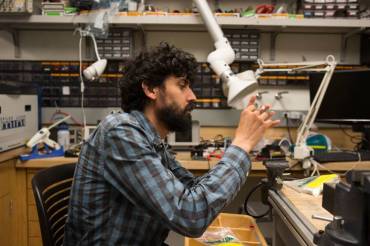
Manu Prakash grew up folding origami paper frogs and cranes in his hometown in northern India.

Indian-Born Biologist Is Among MacArthur ‘Genius Grant’ Winners

So it seemed natural for the 36-year-old Stanford University biologist to build an inexpensive microscope for the developing world that can be put together from a single piece of paper.“

I was inspired by tools like pencils, and what it takes to make those tools available to everyone,” he said. “The goal is to enable and inspire others to do science.”

His Foldscope, which costs less than $1 to produce and includes built-in lenses, is now used in 130 countries to help identify infectious diseases, among other things.

The gadget helped propel Mr. Prakash, along with 22 others, into the ranks of the MacArthur “genius” grant recipients, who are awarded a no-strings-attached $625,000 grant by the John D. and Catherine T. MacArthur Foundation for showing exemplary creativity in their fields.

Source: Indian-Born Biologist Is Among MacArthur ‘Genius Grant’ Winners – India Real Time – WSJ

15/09/2016

Britain approves China-backed Hinkley Point nuclear plant deal after review of scheme | South China Morning Post

The British government said on Thursday it was giving the green light to a controversial new nuclear project at Hinkley Point after Prime Minister Theresa May ordered a review.

“Having thoroughly reviewed the proposals for Hinkley Point C, we will introduce a series of measures to enhance security and will ensure Hinkley cannot change hands without the government’s agreement,” Business Secretary Greg Clark said in a statement.

Beijing calls for British nuclear project financially backed by China to proceed.

“Consequently, we have decided to proceed with the first new nuclear power station for a generation.”

The board of French state-owned power company EDF approved its participation in the project in southwest England on July 28, only for Britain’s new government under May to announce hours later that it wanted to review it.China has a one-third stake in Hinkley Point and analysts have warned that Britain would have risked its relations with the world’s second-largest economy if it cancelled the costly deal.

Source: Britain approves China-backed Hinkley Point nuclear plant deal after review of scheme | South China Morning Post

14/09/2016

India-Born MIT Scientist Wins a $500,000 Prize for Invention – India Real Time – WSJ

India-born innovator and scientist Ramesh Raskar has been awarded a $500,000 prize, one of the world’s largest single cash awards that recognizes invention.

The annual Lemelson-MIT prize, administered by the School of Engineering at the Massachusetts Institute of Technology, honors U.S. inventors who are mid-career and trying to improve the world through science and technology.Mr. Raskar is an associate professor at MIT’s Media Lab. He is known for his trailblazing work which includes the co-invention of an ultra-fast imaging camera that can see around corners, low-cost eye-care solutions and a camera that enables users to read the first few pages of a book without opening the cover.

“We are thrilled to honor Ramesh Raskar, whose breakthrough research is impacting how we see the world,” said Dorothy Lemelson, chair of the Lemelson Foundation, which funds the prize, in an MIT news release Tuesday.

Mr. Raskar hails from the Hindu pilgrimage town of Nashik in the western Indian state of Maharashtra. Despite living in the U.S., he has stayed connected to his native land through his work.In 2015, while his hometown was hosting the Kumbh Mela, a month-long Hindu bathing festival that draws millions of pilgrims, he collaborated with other innovators to launch so-called Kumbhathons–special innovation camps to incubate ideas for the development of smart cities in India. The Kumbhathon tried out innovative solutions to challenges like providing housing, sanitation and transportation to pilgrims during the festival.

That effort evolved into Digital Impact Square, or DISQ, an online platform and open lab in Nashik to encourage innovation.

“The world is our lab, and a co-innovation model that spans the globe is critical for any impact-driven research,” Mr. Raskar said in emailed answers to questions.

Mr. Raskar said his background helped with his work. “My upbringing does help there, growing up in a house without even a separate bedroom or working on a farm, living in mud houses without power or water during weekends and summer holidays,” he said.

The scientist plans to use a portion of his prize money to launch help young inventors innovate in multiple countries.

“Everyone has the power to solve problems and through peer-to-peer co-invention and purposeful collaboration, we can solve problems that will impact billions of lives,” Mr. Raskar said in the MIT news release.

The past winners of the Lemelson-MIT prize include Douglas Engelbart, inventor of the computer mouse; biologist Leroy Hood and Nick Holonyak, inventor of the light-emitting diode, or LED.

Source: India-Born MIT Scientist Wins a $500,000 Prize for Invention – India Real Time – WSJ

31/08/2016

86-year-old transforms her village by selling eggs online[1]| Society

Liao Xiuying, a woman who survived the Japanese invasion more than half a century ago, is now helping to lift her village out of poverty with the help of e-commerce.

Liao’s parents died in the Chinese People’s War Against Japanese Aggression (1937-1945).

Liao started making and peddling salted duck eggs as a teenager, but she had never thought selling the eggs could turn into big business.

Last year, a cooperative was set up in Fenggang village of Ruijin to help the local residents sell farm produce including salted duck eggs through an online platform.

The new business model has paid off. Since its founding, more than two million salted duck eggs have been sold, and residents in poverty have seen their revenues and income increase significantly.

Source: 86-year-old transforms her village by selling eggs online[1]| Society

03/08/2016

Startups hope to capitalize on the massive IoT market – Times of India

Fresh from the sale of their first venture focused on the heating, ventilation and air conditioning (HVAC) market, Shishir Gupta, Nithin David and Varun Gupta embarked on what they thought was their next breakthrough idea.

In mid-2013, the trio decided to devise solar air conditioners based on their previous experience in the market but, after some pilots, they discovered the idea was commercially unviable.

From the ashes of their second enterprise, they did manage one small gain — a connected controller that reduced energy use by 30% during the night. Using this, they pushed their entrepreneurial energy in a new direction — towards the rapidly emerging opportunity in the internet of things (IoT) , or devices and objects that send and receive data over the internet. Rather than build large systems for this, their new venture Oakter is thinking much smaller. It is building out a series of IoT-based devices to “smarten” homes across India.

In around two years of operation, Oakter’s controllers have smartened some 10,000 gadgets, claims Shishir Gupta, without disclosing the number of homes his controllers have been installed in currently. The startup’s full launch hasn’t even happened, he says, since it is still reaching out informally to consumers. Around Diwali this year, Oakter is expected to make a big-bang offline launch and expects to reach 10,000 homes in a year and revenues of Rs 100 crore by 2018-19.

“Within 10 years, IoT will transform the way we manage our lives,” says Shishir. There are plenty of data points to back his enthusiasm. In 2008 itself, there were more objects connected to the internet than people, and technology researcher Gartner forecasts that by 2020 there will be nearly 21 billion connected devices. If the ATM was perhaps the first popular connected device in the early 1970s, hundreds of companies have since shown an interest in getting wired up.

IoT’s the Thing

In the US, the largest technology market, there has been a mixed response to various kinds of IoT. According to CB Insights, a tracker of this kind of deal data, deal volume is on track to surpass 2015’s total by 30%. Fundingwise, 2016 should be a robust year for IoT in the West, and the second year in a row of $1.2 billion-plus in funding. Several startups in the field raised significant amount of funding, including IoT software and services company Greenwave Systems ($45 million Series C), commercial drone developer Airware ($30 million Series C), and connected HVAC and lighting company Enlighted ($25 million Series D financing).However, deal flow looked less upbeat on a quarterly basis, with both value and volume declining in the second quarter of 2016. After an increase in the first quarter with 54 transactions, deal-making fell 26% quarter-over-quarter. And funding fell from $328 million to $325 million — a 9% quarter-on-quarter decline. At a global level, there is massive potential.

According to a statement from Gartner’s research chief Peter Sondergaard, the incremental revenue generated by IoT suppliers is estimated to reach $309 billion per year by 2020. This growth opens up new business opportunities, as half will be attributed to new startups and 80% will be in services, not products. Manufacturing, healthcare and insurance are expected to lead the IoT race.

Some of this entrepreneurial interest is being generated in India, too. For example, in May this year, Entrepreneurship and Venture Capital (EVC), an early stage investor, launched a $50 million unit to focus on IT.

Qualcomm Ventures, the VC arm of the global chipmaker, recently unveiled its $150 million India fund and made its first investment of $10 million in healthcare IoT venture Attune Technologies. In early July, a centre of excellence for IoT was launched jointly by software industry lobby Nasscom, the department of electronics and information technology and the Education and Research Network. This centre can house up to 40 startups and the model is expected to be replicated nationwide.

Source: Startups hope to capitalize on the massive IoT market – Times of India

26/07/2016

Could India Become a Cashless Economy? – India Real Time – WSJ

Cash is set to lose currency in India, as an explosion in smartphone usage drives a digital payments boom, according to a new report.

By year 2020, nearly $500 billion worth of transactions in India will happen digitally, using online wallets and other digital-payment systems, 10 times the level currently, according to a report by Google India and The Boston Consulting Group.

Indians traditionally prefer to save and spend in cash, and a vast majority of the more-than 1.2 billion population doesn’t have a bank account.

Last year, 78% of all consumer payments in India were made by cash, whereas in developed countries like the U.S. and U.K., only 20% to 25% of such payments were made that way, the report said.

But the reliance on notes and coins in India is likely to diminish, as spending habits change and financial services reach more people, said the Google-BCG report. It expects cash-based consumer payments to fall to 40% to 45% by 2025.

A sharp increase in the use of mobile phones with internet connectivity will help drive the move to digital payments, said the report.

India has more than 1 billion mobile subscribers, a quarter of whom use smartphones, according to the report. By 2020, the number of smartphone users in the country will likely be 520 million, and the number of internet users 650 million, twice the number currently, according to the report.

Personal internet banking has become more popular in India over the past few years along with digital payment options that allow users to settle mobile phone, electricity and even taxi bills.

The recent spurt of growth has come from non-bank companies offering payment services. Cellphone companies like Airtel and Vodafone offer facilities to transfer money using phones, while “wallet” companies like One97 Communications’ Paytm unit, and MobiKwik, allow users to store money digitally and pay through their systems.

The next level of growth will come when local mom-and-pop grocery stores start accepting digital payments, said the report.However, there are plenty of consumers and merchants who still feel skeptical of digital payments, or find them too complicated, said the report. And others just don’t want to give up using cash, it added.

Source: Could India Become a Cashless Economy? – India Real Time – WSJ

22/06/2016

China’s newest space rocket, Long March 7, ready for blast-off | South China Morning Post

China’s latest Long March rocket arrived on the launch pad on Wednesday morning three days before it is due for blast-off on the maiden launch of both the rocket and the launch site.

At 8am on Wednesday the 600-tonnes Long March 7 rocket began a three-hour rail journey of several kilometres from the assembly complex to the launch site at Wenchang Satellite Launch Centre, China Central Television reported.

The Long March 7 will use new liquid fuel, which is environmentally friendly and costs only a fraction of the fuel used by its predecessor, LM-2.It will be carrying a test model of China’s next-generation manned spacecraft, together with several small satellites.

China’s second space lab to go into orbit this year as part of permanent manned space station by 2022

The rocket’s role in future will be to send up cargo ships to the Chinese space station.

If the weather turns bad on Saturday – which is not uncommon at the nation’s southernmost launch site on the tropical Hainan Island – the launch window will be able to remain open until Wednesday.

This launch will be different from others carried out by China because the public will be able to watch what happens in person on the mainland for the first time.

Eight designated “best spot” viewing areas covering 40 hectares around the launch site, including public parks and a private hotel beach, can accommodate about 25,000 spectators.

“This launch will open a new chapter in the history of Chinese space exploration,” a space scientist involved in the development of the new Long March rockets told the South China Morning Post.

“The blast of flames, rise of vapour, the chest-pounding noise and the trembling of the ground under people’s feet … it will be a life-changing experience for many people [watching],” the scientist said.

Source: China’s newest space rocket, Long March 7, ready for blast-off | South China Morning Post

Law of Unintended Consequences

continuously updated blog about China & India

ChiaHou's Book Reviews

continuously updated blog about China & India

What's wrong with the world; and its economy

continuously updated blog about China & India