Archive for ‘Technology’

30/03/2012

* Apple hit by China Foxconn factory report

BBC News: “An independent investigation has found “significant issues” among working practices at Chinese plants making Apple iPhones and iPads. The US Fair Labor Association FLA was asked by Apple to investigate working conditions at Foxconn after reports of long hours and poor safety. The FLA says it has now secured agreements to reduce hours, protect pay, and improve staff representation.Apple said it “fully accepted” the reports recommendations. “We share the FLAs goal of improving lives and raising the bar for manufacturing companies everywhere,” it said in a statement.

The findings emerged as Apple CEO Tim Cook visited Foxconn facilities. Mr Cook toured Zhengzhou Technology Park, where 120,000 employees work, on Wednesday. A string of suicides at Foxconn last year put the spotlight on working conditions at its factories. Last month, the company announced it was to send independent inspectors from the FLA to audit the facilities.

The investigation – one of the largest ever conducted of a US companys operations abroad – found employees often worked more than 60 hours a week and sometimes for seven days running without the required day off. Other violations included unpaid overtime and health and safety risks. Average monthly salaries at the three factories ranged from $360 (£227) to $455 (£289).

Deutsch: Foxconn Logo

Deutsch: Foxconn Logo (Photo credit: Wikipedia)

Foxconn raised salaries by up to 25% recently. The FLA said Foxconn had agreed to comply with the associations standards on working hours by July 2013, bringing them in line with a legal limit in China of 49 hours per week. The company will hire thousands more workers in order to compensate for the move, Reuters reports.

The BBC’s Adam Brookes in Washington says the report has been much anticipated as embodying a new and transparent approach to an old problem: that of cheap but popular consumer goods manufactured in poor conditions in developing countries. However, he says, a telling line in the report is the one which notes that the Foxconn workers did not have true trade union representation. The authorities in China are very wary of unions and are likely to remain so. Before the report was released, labour unions expressed doubts that the company was committed to improving standards. “The report will include new promises by Apple that stand to be just as empty as the ones made over the past 5 years,”

SumOfUS.org, a coalition of trade unions and consumer groups, said.Foxconn employs 1.2 million workers in China to produce products for Apple as well as Microsoft, Hewlett-Packard, and other companies.”

via BBC News – Apple hit by China Foxconn factory report.

Good news: Foxconn workers to be treated fairly under Chinese labour laws. Bad news: having incvreased pay by 25% recently and now having to increase it further, China’s 1.2 million workers at Foxconn (a Taiwanese company) better be prepared for layoffs in the medium term as Foxconn turn to countries with cheaper labour; and there are plenty of these around. The latter follows the “law of unintended or contrary consequences.”
16/03/2012

* India changes strategy to stay competitive globally in IT sector

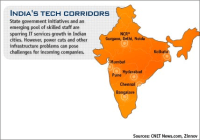
extract from The Hindu: “Competition to India’s information technology and IT-enabled services (ITeS) companies from other cost-effective nations and protectionist moves of some key markets like the U.S. have caught the attention of the government. As a result, the government is not only changing its strategy to stay competitive globally but also taking initiatives to promote growth of the sector by increasing IT adoption within the country. …

As per industry estimates, India’s IT and BPO sector (excluding hardware) revenues were $87.6 billion in 2011-2012 (a growth of 14.8 per cent) – $68.7 billion exports and $19 billion domestic, while it generated direct employment for nearly 2.8 million people and indirect for around 8.9 million people.

As a proportion of national GDP, IT and ITeS sector revenues have grown from 1.2 per cent in 1997-98 to around 7.5 per cent in 2011-12. “Consistent demand from the U.S., which increased its share from 61.5 per cent to 62 per cent, characterised 2011-12. Emerging markets of the Asia Pacific and the rest of the world also contributed to overall growth,” the Survey pointed out.

Referring to future strategy for the sector, the Survey said the government had been a key catalyst for increased IT adoption – through sector reforms that encouraged IT acceptance, National e-Governance Plan (NeGP), and the Unique Identification Development Authority of India (UIDAI) programme that created large-scale IT infrastructure and promoted corporate participation.

Talking about electronics hardware production, the Survey said it was expected to grow by 27.6 per cent in 2011-12 and cross Rs.1.55-lakh crore ($33 billion). Electronics hardware exports is expected to grow by 12.8 per cent and cross Rs.47,090 crore ($10 billion) in 2011-12 as against Rs.41,721 core ($8.86 billion) in 2010-11. In its recently released draft, the National Policy on Electronics (NPE), the government projected that the electronics system design and manufacturing industry was likely to reach a turnover of $400 billion by 2020, involving investment of about $100 billion, besides creating 28 million jobs.”

via The Hindu : News / National : Centre changes strategy to stay competitive globally in IT sector.

09/03/2012

* Indian government clears distribution of 5 million tablet PCs in schools, colleges

The Hindu: “In a move that will give a big push to broadband penetration in the country, the Department of Telecommunications (DoT) has cleared an ambitious plan to distribute 50-lakh (5 million) tablet PCs (personal computers) to students in the next financial year (2012-13). A note containing the nitty-gritty of the ambitious Aakash-2 project is likely to be placed before the Cabinet soon. …

The government wants to initially assemble the tablet PCs through its public sector undertakings (PSUs) and eventually indigenise it to maintain cost-competitiveness.

The DoT has declared that the Centre for Development of Advanced Computing (C-DAC), the research and design wing of the Department of Information Technology, will be the nodal agency for successfully implementing the Aakash-2 project. It will be assisted by the Indian Institute of Technology-Mumbai. They will be responsible for finalising specifications, ensuring quality and testing the tablet PCs. The DoT has decided to rope in two PSUs — Bharat Electronics Ltd and ITI Ltd — for manufacturing and procuring the tablet PCs that will be priced between $55 and $70 (around Rs.2,750 and Rs.3,500).”

via The Hindu : Sci-Tech / Gadgets : DoT clears distribution of 50 lakh tablet PCs in schools, colleges.

This initiative will help push India further into the information era both in terms of the next generation of knowledge workers as well as in terms of hardware development.

Related page: https://chindia-alert.org/economic-factors/information-technology/

03/02/2012

* Indian Supreme Court cancels all 122 telecoms licences

Declaring the allocation of 2G spectrum by the Congress-led United Progressive Alliance (UPA) government “illegal” and an example of the arbitrary exercise of power, the Supreme Court on Thursday cancelled all 122 telecom licences allotted on or after January 10, 2008 to 11 companies during the tenure of the former telecom minister, A. Raja.

http://www.thehindu.com/news/national/article2853159.ece

Mr Raja is charged with corruption.

This ruling, although deemed to be a step in the right direction, makes foreign investors nervous as it means any past deals, if proven to be corrupt, could be overturned, several years later.

For a view about corruption in India go to http://chindiapedia.org/Indianpitfalls.aspx

26/01/2012

* Huawei invests in British research firm

Huawei, China’s premier telecoms supplier, is acquiring the Centre for Integrated Photonics (CIP), the UK’s world-leading photonics research laboratory, for $10m.

The optical networking research unit is currently owned by the East of England Development Agency (EEDA), but is being sold as part of a larger rationalisation of assets.

Huawei said CIP will “significantly deepen” its optical research and development capabilities. The CIP research team will be retained and will form the core of a new Huawei UK R&D centre, part of Huawei’s global network.

This acquisition is much more significant than that of a 10% ownership of Thames Water by a Chinese sovereign fund. It will enable Huawei to tap into British brainpower. Given China’s meed to diversify its surplus from the US$ and other static holdings into tangible assets, this will not be the first such acquisition.

However, there is no need for alarm. Years ago Microsoft set up a research facility in Cambridge and HP set one up in the Thames valley. Even long before then, IBM set up research labs in Switzerland, Britain and France. This all plays to one of the three strands of global power shift that Paddy Ashdown talked about in his talk at TED.com – http://blog.ted.com/2012/01/05/the-global-power-shift-paddy-ashdown-on-ted-com/. From national states to global corporations.

19/01/2012

* RedPad launched

This week, China introduced its RedPad based on Andriod. It is much more expensive than Apple’s iPad but it has feeds from all sorts of official Chinese government agencies and organs and is intended for the busy Communist cadre who has little time to sit at a desk and browse the web. The government perhaps hopes that this will help counter the largely critical comments spread through a twitter-like site Weibo.

http://www.huffingtonpost.com/2012/01/19/redpad-number-one-china_n_1215393.html

See also:

Law of Unintended Consequences

continuously updated blog about China & India

ChiaHou's Book Reviews

continuously updated blog about China & India

What's wrong with the world; and its economy

continuously updated blog about China & India