Archive for ‘patents’

25/11/2016

China breaks patent application record – BBC News

China-based innovators applied for a record-setting number of invention patents last year.

The country accounted for more than a million submissions, according to an annual report by the World Intellectual Property Organization (Wipo). It said the figure was “extraordinary”.

Many of the filings were for new ideas in telecoms, computing, semiconductors and medical tech.

Beijing had urged companies to boost the number of such applications.

But some experts have questioned whether it signifies that the country is truly more inventive than others, since most of China’s filings were done locally.

What is a patent?

A patent is the monopoly property right granted by a government to the owner of an invention.

This allows the creator and subsequent owners to prevent others from making, using, offering for sale or importing their invention into the country for a limited time.

In return they must agree for the patent filing to be publicly disclosed.

To qualify as an “invention” patent, the filing must contain a new, useful idea that includes a step – a new process, improvement or concept – which would not be obvious to a skilled person in that field.

Some countries – including China – also issue other types of patents:

Utility model patents. The ideas must still be novel, but it is less important that there is a “non-obvious step”

Design patents. These require the shape, pattern and/or colour of a manufactured object’s design to be new, but do not require there to be a novel technical aspect

Skewed figures

A total of 2.9 million invention patent applications were filed worldwide in 2015, according to Wipo, marking a 7.8% rise on the previous year.

China can lay claim to driving most of that growth. Its domestic patent office – the Property Office of the People’s Republic of China (Sipo) – received a record 1,101,864 filings. These included both filings from residents of China and those from overseas innovators who had sought local protection for their ideas.

The tally was more than that of Sipo’s Japanese, South Korean and US equivalents combined.

Applicants based in China filed a total of 1,010,406 invention patents – the first time applicants from a single origin had filed more than one million in a single year.

But they appeared to be reticent about seeking patent rights abroad.

According to Wipo, China-based inventors filed just 42,154 invention patent applications outside their borders – Huawei and ZTE, two smartphone and telecoms equipment-makers, led the way.
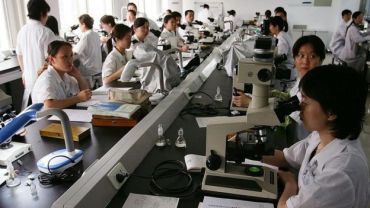
There was a rise in the number of medical tech patent filings from China

By comparison US-based inventors sought more than five times that figure. And Japan, Germany and France also outnumbered the Asian giant.

One patent expert – who asked not to be named – suggested the disparity between Chinese inventors’ local and international filings reflected the fact that not all the claims would stand up to scrutiny elsewhere.

“The detail of what they are applying for means they would be unlikely to have the necessary degree of novelty to be granted a patent worldwide,” he said.

But Wipo’s chief economist said things were not so clear cut.

“There is clearly a discussion out there as to what is the quality of Chinese patents,” said Carsten Fink.

“But questions have also been asked about US and other [countries’] patents.”

And one should keep in mind that China is a huge economy.

“If you look at its patent filings per head of population, there are still fewer patents being filed there than in the United States.”

Patent boom

Part of the reason so many applications were made locally was that China set itself a target to boost all types of patent filings five years ago.

Sipo declared at the time that it wanted to receive two million filings in 2015.

The government supported the initiative with various subsidies and other incentives.

Adding together China’s invention, utility and design patents, its tally for 2015 was about 2.7 million filings, meaning it surpassed its goal by a wide margin.

One London-based patent lawyer noted that Chinese firms were not just filing patents of their own but also buying rights from overseas companies.

“This all goes to show the growth of the telecoms and high-tech industries in China, and that these companies are playing a more significant role globally than hitherto,” said Jonathan Radcliffe from Reed Smith.

“The fact we are now seeing them suing and being sued for patent infringement in Europe and in the US on subject matter such as mobile phones and telecoms standards – and indeed seeing Chinese companies suing each other over here in Europe for patent infringement – shows that they have truly arrived.”

Source: China breaks patent application record – BBC News

16/01/2015

China accepts more invention patent applications – Xinhua | English.news.cn

China accepted about 928,000 invention patent applications in 2014, some 103,000 more than in 2013, the State Intellectual Property Office (SIPO) said on Thursday.

SIPO director Shen Changyu said invention patent applications accounted for 39.3 percent of all patent applications last year, compared with a 34.7 percent in 2013.

China grants patents for three major categories: invention, utility model and design.

Invention patent application growth slowed from 26.3 percent in 2013 to 12.5 percent in 2014, according to Shen.

Growth in invention patent applications is moderating, but its share in total patent applications is rising, said Shen.

The director said the SIPO will step up law enforcement in 2015 and put more efforts in intellectual property protection.

via China accepts more invention patent applications – Xinhua | English.news.cn.

24/06/2014

China’s Government Admits Chinese Patents Are Pretty Bad – Businessweek

For years, China’s leaders have exhorted the country’s businesses to become innovative. After all, a glorious country like China that is reasserting its role as a global superpower should be known for more than just its copycat and me-too companies. So while Chinese presidents come and go, the message is the same: Whether it’s Jiang Zemin, Hu Jintao, or the current boss, Xi Jinping, the country’s leaders have consistently talked about the importance of local innovation. Paraphrasing Xi’s remarks at a speech earlier this month at the Chinese Academy of Science and the Chinese Academy of Engineering, the Xinhua news agency reported that the government’s goal is to “push forward the fusion of science and [the] economy, so that science and technology strength can be transformed into industrial and economic power.”

Chinese President Xi Jinping at the Chinese Academy of Science and the Chinese Academy of Engineering in Beijing on June 9

By China’s own scorekeeping, though, the country’s innovators still have a way to go before they can meet the Communist Party’s expectations. While the number of patent applications inside China is “booming,” according to a report today by Xinhua, “the quality of patents is still poor.” Writing about a report to the Standing Committee of the National People’s Congress, China’s rubber-stamp legislature, Xinhua added, “China owns very few patents featuring originality and high or core technology.” Fewer than 1,000 Chinese patents have won recognition from counterparts in the U.S., Europe, or Japan, added Xinhua.

China is making progress. The gold standard in international patents remains the U.S., and Chinese from the People’s Republic applied for almost 6,600 patents in the U.S. last year, according to data from the U.S. Patent and Trademark Office (USPTO).  That’s just ahead of France and more than double the number from India. China had the sixth-largest number of patents granted by USPTO. Still, China’s innovators are hardly leaders in the U.S. The Chinese total of 6,597 U.S. patents puts it far behind Japan’s 54,170 applications. Even more embarrassing, Taiwan, the island that Beijing considers a province of China, had 12,118 patent applications granted.

via China’s Government Admits Chinese Patents Are Pretty Bad – Businessweek.

06/06/2014

Creativity advances as patent filings rise – China – Chinadaily.com.cn

An increase in overseas patent applications from Chinese applicants is a positive sign for China’s innovation and economy, World Intellectual Property Organization Chief Economist Carsten Fink said.

WIPO emblem.

WIPO emblem. (Photo credit: Wikipedia)

According to the WIPO, China’s patent office became the world’s largest intellectual property office in 2012 in terms of the number of its patent applications, but Chinese patent applicants did not file their patents as frequently abroad in other countries as did those from the United States, Europe and Japan.

Fink said that a changing picture was observed as patent filings abroad by Chinese companies and research institutions have been growing rapidly.

The WIPO found in its new study that the growth of Chinese patent filings abroad increased significantly after 2000, with a five-year average annual growth rate of 40 percent between 2000 and 2005, and 23 percent since 2005.

“That is important because on the one hand, it signals that Chinese companies really operate on the world technology frontier, and (on the other hand) it also suggests that indeed they are pushing the world’s technology frontier. That is a good sign for China’s innovation system,” Fink said.

Fink stressed that overseas patent filings weighed heavily for China’s economy and could be a positive boost.

“That will help Chinese companies to transfer their business models from the past one that relied on low wages to another one that will rely more and more on new technologies, new products and new ideas,” he said.

via Creativity advances as patent filings rise – China – Chinadaily.com.cn.

Enhanced by Zemanta
16/05/2013

* China in innovation challenge to Europe

FT: “Europe’s business leaders fear its industry will fall behind China in technological innovation within a decade as the economic crisis undermines one of the continent’s competitive advantages.

More than two-thirds of business leaders surveyed by Accenture, the consultancy, on behalf of BusinessEurope, the business lobby group, said China would reach or pull ahead of Europe in innovation by 2023.

Weak demand caused by Europe’s economic crisis has sent industrial production into decline, while corporate reluctance to delve into cash reserves is holding back new investment, training and R&D.

Rising unemployment threatens labour flexibility and Europe’s ability to maintain a highly skilled workforce. Fewer than half of those surveyed said Europe’s workforce remained a competitive advantage for industry.

European policy makers are determined to reverse industry’s decline. The European Commission last year proposed by 2020 to raise industry’s share of EU gross domestic product from 15.6 per cent to 20 per cent.

“We cannot continue to let our industry relocate outside Europe,” said Antonio Tajani, vice-president of the European Commission.

European companies remain leaders in sectors ranging from automotive to aerospace, engineering to pharmaceuticals, and two-thirds of surveyed business leaders said European industry was still competitive internationally.

But some Chinese companies such as Huawei, the telecoms equipment maker, are drawing level in innovation capability and gaining share in Europe. Some 61 per cent of those surveyed said they feared Europe would struggle to recover from its economic crisis for at least three years.

Some 90 per cent of German business leaders said Europe’s industry was competitive compared with only half of business leaders in Spain.

The Accenture study identified two areas to support growth: rebuilding Europe’s skills base and reinvigorating industry’s access to finance, including better access to capital markets and venture capital funding for start-ups.

Although Europe is mired in recession, there remain opportunities in areas ranging from low-carbon technology and smart grid networks to biotechnology and advanced manufacturing.

“The China machine is definitely going to invest a lot of money in technology innovation over the next 10 years . . . [But] there’s a sense that if we get our act together Europe can remain successful in manufacturing,” said Mark Spelman, strategy chief at Accenture.

“Just because there is zero growth across Europe doesn’t mean there are not segments of good growth within that . . . So it’s about how you place bets in an intelligent way.

To address the innovation deficit, business leaders want to see more public funding for R&D, reduced tax for R&D and capital investment and improved financing conditions.

European executives raised a variety of other worries ranging from the cost of energy to labour costs.

A majority of respondents were pessimistic that European industry would be cost-competitive in energy compared with markets such as the US, Russia and China in three years’ time.

US industry is enjoying cheap energy courtesy of discoveries of shale gas that permit new investment in gas-intensive industry, such as petrochemicals.

In contrast, Europe remains dependent on more expensive Russian gas, and costly regulation and investments in renewable energy are adding to the burden.”

via China in innovation challenge to Europe – FT.com.

See also: https://chindia-alert.org/prognosis/how-well-will-china-and-india-innovate/

25/01/2013

* China’s Huawei Creeps up on Apple, Samsung

WSJ: “As Samsung Electronics Co. and Apple Inc.  try to defend their dominance in the smartphone market, the latest data show China’s Huawei Technologies Co. coming third in terms of market share for the first time, indicating that a rapid increase of smartphone users in China and other emerging markets may be starting to alter the global landscape.

According to research firm IDC, Samsung’s smartphone market share in the fourth quarter through December rose to 29% from 22.5% a year earlier, while Apple’s share dropped slightly to 21.8% from 23%. Meanwhile, Huawei’s share rose to 4.9% from 3.5%, ahead of Japan’s Sony Corp. , whose share also increased to 4.5% from 3.9% a year earlier. Another Chinese company ZTE Corp., came fifth with 4.3%.

“The fact that Huawei and ZTE now find themselves among the Top 5 smartphone vendors marks a significant shift for the global market,” said IDC research manager Ramon Llamas.

via China’s Huawei Creeps up on Apple, Samsung – China Real Time Report – WSJ.

20/01/2013

* China’s R&D expenditure expected to top 1 trln yuan

Xinhua: “China’s spending on research and development (R&D) in 2012 is expected to surpass 1 trillion yuan (160.8 billion U.S. dollars) as the country has been pushing for a more innovation-driven economy, according to official statistics released Saturday.

The expenditure will bring the proportion of R&D funds in the country’s gross domestic output (GDP) to 2 percent, Minister of Science and Technology Wan Gang said at a national science and technology work conference.

Businesses invested the most in R&D, accounting for 74 percent of the total, according to official statistics.

Wan said that China’s innovation capability has been greatly boosted in the past five years, with scientific progress contributing 51.7 percent to the nation’s economic growth in 2011, compared with 48.8 percent in 2008.”

via China’s R&D expenditure expected to top 1 trln yuan – Xinhua | English.news.cn.

04/10/2012

* IPR awareness rises in China: experts

As China increases its own Intellectual Property and the number of registered and granted patents, it is in its own self-interest to take IPR and copyright more seriously than it has hither to.  This is good news for all innovators whether Western or Eastern.

Xinhua: “An increasing number of patents and trademark registrations is boosting social awareness of intellectual property rights (IPR) in China, which will change the way that the world’s second-largest economy grows, experts said.

The number of trademark registration applications reached 1.42 million in 2011, a sharp rise from the 19,000 applications submitted in 1983, when the country’s trademark law took effect, a national news magazine Outlook Weekly reported.

“The increasing number of patents will be conducive to IPR awareness in China,” said Prof. Liu Chuntian at Renmin University.

Liu said IPR protection is a basic tenet of the modern market economy, adding that China should carry out top-down reforms to further improve IPR regulations and laws.

The government’s previous efforts to protect IPR include a strategic guideline published in 2008 that set a goal of making substantial progress in creation, application, protection and management of IPR by 2020.

China has only 21 of the world’s top 500 brands, despite a large number of patents and trademark applications, the report said, adding that China’s performance in IPR does not match the size of its economy.

However, home-grown technologies, including the TD-SCDMA and TD-LTE telecommunications interfaces, and emerging hi-tech giants, such as Huawei and ZTE, indicate that China is starting to improve its capacity to innovate, the report said.”

via IPR awareness rises in China: experts – Xinhua | English.news.cn.

Law of Unintended Consequences

continuously updated blog about China & India

ChiaHou's Book Reviews

continuously updated blog about China & India

What's wrong with the world; and its economy

continuously updated blog about China & India