Archive for ‘Space flight’

15/02/2017

India Breaks Record for Launching Most Satellites From Single Rocket – India Real Time – WSJ

India’s space agency on Wednesday launched a record 104 satellites from a single rocket as it crossed another milestone in its low-cost space-exploration program.

The satellites from seven countries were carried by the Indian Space Research Organization’s Polar Satellite Launch Vehicle on its 38th consecutive successful flight.

The mission reinforces India’s emerging reputation as a reliable and cost-effective option for launching satellites. In 2014, ISRO put a satellite into the orbit of Mars, becoming the first Asian country to reach the red planet at fraction of the cost of a similar launch in U.S. and Europe.

ISRO has now put 226 satellites into orbit, including 180 from foreign nations. The global space industry was estimated to be worth $323 billion in 2015, the latest year for which data are available, according to the Space Foundation, a U.S.-based research group. Commercial space business comprised as much as 76% of the industry.

Rajeswari Pillai Rajagopalan, senior fellow in space-security studies at the Observer Research Foundation, a New Delhi think tank, said the launch was a “showcase of India’s growing capabilities.”
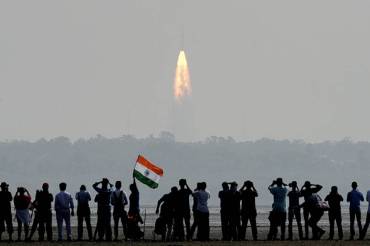
 

Spectators watched the launch of ISRO’s Polar Satellite Launch Vehicle (PSLV-C37) at Sriharikota on Feb. 15, 2017.

“India’s space program has come a long way,” she said.

Ms. Rajagopalan said the trend for sending more small satellites–instead of fewer large ones–will benefit ISRO due to the cost advantages it offers over its American and European competitors. The Space Foundation said nano satellites comprised 48% of launches in 2015

Wednesday’s feat eclipses the record set by Russia in 2014 when it launched 37 satellites in a single mission. A National Aeronautics and Space Administration rocket carried 29 satellites in 2013.

The PSLV rocket blasted off from the Satish Dhawan Space Center at Sriharikota in the southeastern state of Andhra Pradesh at 9.28 a.m. Wednesday local time (10.58 p.m. Tuesday ET).

The ISRO rocket hurtles through the sky after launch from Sriharikota, India, Feb. 15, 2017.

It first released its main cargo, ISRO’s 714 kilogram Cartosat-2 series satellite, which will be used for earth observation. It then released two smaller ISRO satellites, followed by the remaining 101 nano satellites, one each from Israel, Kazakhstan, Netherlands, Switzerland, United Arab Emirates, and 96 from the U.S. As many as 88 of the nano satellites belonged to U.S.-based company Planet Inc.

ISRO’s two smaller satellites are carrying equipment for conducting various experiments.

Indian Prime Minister Narendra Modi tweeted his congratulations. “This remarkable feat by @isro is yet another proud moment for our space scientific community and the nation. India salutes our scientists,” the message said.

Mission Director B. Jayakumar said it was a challenge to “find real estate (on the PSLV rocket) to accommodate all the satellites.” He said a “unique separation sequence” was designed due to the large number of satellites.

ISRO chairman Kiran Kumar Rao, right, held up models of the CARTOSAT-2 and Polar Satellite Launch Vehicle (PSLV-C37) after the launch in Sriharikota, India, Feb. 15, 2017.

ISRO said the satellites went into orbit 506 kilometers from earth, inclined at an angle of 97.46 degrees to the equator–very close to the intended orbit–after a flight of nearly 17 minutes. In the subsequent 12 minutes, all 104 satellites were successfully separated from the rocket in sequence, it said.

After separation, the two solar panels of ISRO’s Cartosat-2 series satellite were deployed and the space agency’s command center in Bangalore took control. In the coming days, the satellite will begin to provide start sending back black and white, and color pictures, ISRO said.

Source: India Breaks Record for Launching Most Satellites From Single Rocket – India Real Time – WSJ
17/10/2016

China launches longest manned space mission | Reuters

China launched its longest manned space mission on Monday, sending two astronauts into orbit to spend a month aboard a space laboratory that is part of a broader plan to have a permanent manned space station in service around 2022.

The Shenzhou 11 blasted off on a Long March rocket at 7:30 am (2330 GMT) from the remote launch site in Jiuquan, in the Gobi desert, in images carried live on state television.

The astronauts will dock with the Tiangong 2 space laboratory, or “Heavenly Palace 2”, which was sent into space last month. It will be the longest stay in space by Chinese astronauts, state media reported.

Early on Monday, Fan Changlong, a vice chairman of China’s powerful Central Military Commission, met astronauts Jing Haipeng and Chen Dong and wished them well, state news agency Xinhua reported.

“You are going to travel in space to pursue the space dream of the Chinese nation,” Fan said.”With all the scientific and rigorous training, discreet preparation, and rich experience accumulated from previous missions, you will accomplish the glorious and tough task… We wish you success and look forward to your triumphant return.”

Shenzhou 11 is the third space voyage for Jing, who will command the mission and celebrate his 50th birthday in orbit.

In a manned space mission in 2013, three Chinese astronauts spent 15 days in orbit and docked with a space laboratory, the Tiangong 1.Advancing China’s space program is a priority for Beijing, with President Xi Jinping calling for the country to establish itself as a space power.

China insists its space program is for peaceful purposes.

Shenzhou 11, whose name translates as “Divine Vessel”, will also carry three experiments designed by Hong Kong middle school students and selected in a science competition, including one that will take silk worms into space.

The U.S. Defense Department has highlighted China’s increasing space capabilities, saying it was pursuing activities aimed at preventing other nations using space-based assets in a crisis.

China has been working to develop its space program for military, commercial and scientific purposes, but is still playing catch-up to established space powers the United States and Russia.

China’s Jade Rabbit moon rover landed on the moon in late 2013 to great national fanfare, but soon suffered severe technical difficulties.

The rover and the Chang’e 3 probe that carried it there were the first “soft landing” on the moon since 1976. Both the United States and the Soviet Union had accomplished the feat earlier.

China will launch a “core module” for its first space station some time around 2018, a senior official said in April, part of a plan for a permanent manned space station in service around 2022.

Source: China launches longest manned space mission | Reuters

22/06/2016

China’s newest space rocket, Long March 7, ready for blast-off | South China Morning Post

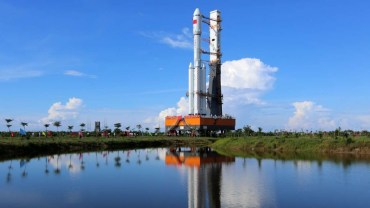
China’s latest Long March rocket arrived on the launch pad on Wednesday morning three days before it is due for blast-off on the maiden launch of both the rocket and the launch site.

At 8am on Wednesday the 600-tonnes Long March 7 rocket began a three-hour rail journey of several kilometres from the assembly complex to the launch site at Wenchang Satellite Launch Centre, China Central Television reported.

The Long March 7 will use new liquid fuel, which is environmentally friendly and costs only a fraction of the fuel used by its predecessor, LM-2.It will be carrying a test model of China’s next-generation manned spacecraft, together with several small satellites.

China’s second space lab to go into orbit this year as part of permanent manned space station by 2022

The rocket’s role in future will be to send up cargo ships to the Chinese space station.

If the weather turns bad on Saturday – which is not uncommon at the nation’s southernmost launch site on the tropical Hainan Island – the launch window will be able to remain open until Wednesday.

This launch will be different from others carried out by China because the public will be able to watch what happens in person on the mainland for the first time.

Eight designated “best spot” viewing areas covering 40 hectares around the launch site, including public parks and a private hotel beach, can accommodate about 25,000 spectators.

“This launch will open a new chapter in the history of Chinese space exploration,” a space scientist involved in the development of the new Long March rockets told the South China Morning Post.

“The blast of flames, rise of vapour, the chest-pounding noise and the trembling of the ground under people’s feet … it will be a life-changing experience for many people [watching],” the scientist said.

Source: China’s newest space rocket, Long March 7, ready for blast-off | South China Morning Post

22/06/2016

India’s Space Agency Sends 20 Satellites Into Orbit – India Real Time – WSJ

India on Wednesday put 20 satellites into the Earth’s orbit, including 17 from foreign countries, a record number for its space agency as it seeks to become a low-cost and reliable choice for launches.

The successful mission by the Indian Space Research Organisation puts it right after Russia and the U.S. for the number of satellites launched from a single rocket so far, said an ISRO official. In 2014, a single Russian space launch vehicle deployed 33 satellites. A National Aeronautics and Space Administration rocket carried 29 satellites in 2013.

ISRO’s rocket, the Polar Satellite Launch Vehicle, carried its own Cartosat-2 series satellite for earth observation along with 13 satellites from the U.S., two from Canada, one each from Germany and Indonesia and two from Indian academic institutions.

“ISRO continues to break new barriers,” Indian Prime Minister Narendra Modi said on his Twitter account. He said the country’s space program “has time and again shown the transformative potential of science and technology in people’s lives.”

The launch comes as global space agencies face competition from private companies who are aiming to bring down the cost and time for manufacturing and launching satellites by automating their production and using unmanned reusable rockets.

U.S. businessman Greg Wyler has joined hands with Airbus Group SE to build an automated manufacturing facility in Florida that can churn out hundreds of satellites each year. Traditional satellites are built using touch labor. SpaceX, an aerospace startup founded by Elon Musk, successfully landed a rocket on an ocean platform in early May after launching a communications satellite.

India has been fast achieving recognition as a budget option for launching satellites. In 2014, ISRO put a satellite into the orbit of Mars, becoming the first Asian country to reach the red planet, and at fraction of the cost of a similar launch in U.S. and Europe.

In May ISRO launched the test model of its planned reusable space shuttle.  In April, it launched the seventh satellite needed to create its own navigation system, joining a small group of nations with their own versions of GPS.

The global space industry was estimated to be worth $330 billion in 2014, the latest year for which data are available, according to the Space Foundation, a U.S.-based research group. Commercial space activities comprised as much as 76% of the industry, it said.

There were 92 rocket launches in 2014, and Russia continues to hold its leadership in this area with 32 rocket launches, followed by U.S. with 32 and 11 by Europe, the Space Foundation said. It didn’t provide figures for India.Ajay Lele, a senior fellow at New Delhi-based Institute for Defense Studies and Analyses estimates the U.S. has about a 40% share of the global satellite-launching market, while Europe has 25% and Russia 20%. Countries such as China and India have a much smaller share of the market of about 3% percent or less, Mr. Lele said.

ISRO officials said after the launch they want to accelerate the pace of sending satellites into space by extending partnerships with private Indian companies. The space organization has launched more than 57 satellites from about 20 countries on board the PSLV over about two decades.

Source: India’s Space Agency Sends 20 Satellites Into Orbit – India Real Time – WSJ

30/06/2014

Indian Rocket Launches Five Foreign Satellites Into Space – India Real Time – WSJ

The Indian Space Research Organization launched five foreign satellites into space on Monday morning. The shot’s main cargo was Spot-7, a high-resolution earth-observation satellite belonging to Airbus Defence & Space Co. of Europe. It also carried four other smaller satellites: AISAT from the German Aerospace Center; NLS7.1 and NLS7.2 from Canada’s University of Toronto Institute for Aerospace Studies’ Space Flight Laboratory; and VELOX-1 from Nangyang Technological University, Singapore.

It follows the November launch of a spacecraft to Mars, the first such attempt at interplanetary exploration by an Asian country.

The cost of launching the five satellites wasn’t revealed. India’s Mars satellite, dubbed Mangalyaan, or Mars craft, in Hindi, cost $73 million. Speaking at Monday’s launch, India’s Prime Minister Narendra Modi noted that amount is less than what it took to produce “Gravity,” the blockbuster Hollywood movie about space. “Gravity” cost about $100 million to make.

via Watch: Indian Rocket Launches Five Foreign Satellites Into Space – India Real Time – WSJ.

27/09/2013

China in space: How long a reach?

The Economist: “THE Soviet Union in 1961. The United States in 1962. China in 2003. It took a long time for a taikonaut to join the list of cosmonauts and astronauts who have gone into orbit around Earth and (in a few cases) ventured beyond that, to the Moon. But China has now arrived as a space power, and one mark of this has been the International Astronautical Federation’s decision to hold its 64th congress in Beijing.

The congress, which is attended by representatives of all the world’s space agencies, from America and Russia to Nigeria and Syria, is a place where eager boffins can discuss everything from the latest in rocket design and the effects of microgravity on the thyroid to how best an asteroid might be mined and how to weld metal for fuel tanks.

All useful stuff, of course. But space travel has never been just about the science. It is also an arm of diplomacy, and so the congress serves too as a place where officials can exchange gossip and announce their plans.

And that was just what Ma Xingrui, the head of the China National Space Administration (CNSA) and thus, in effect, the congress’s host, did. He confirmed that an unmanned lunar mission, Chang’e 3, will be launched in the first half of December. This means, if all goes well, that before the year is out a Chinese rover will roam the surface of the Moon. It will collect and analyse samples of lunar regolith (the crushed rock on the Moon’s surface that passes for soil there). It will make some ultraviolet observations of stars. And it will serve to remind the world that China intends—or at least says it intends—to send people to the Moon sometime soon as well.

Mr Ma also confirmed that China plans to build a permanent space station by 2020. Such manned stations are expensive and scientifically useless, as the example of the largely American International Space Station (ISS), currently in orbit, eloquently demonstrates. But they do have diplomatic uses, and that was why Mr Ma reiterated in his speech that foreign guests will be welcome on board his station—in contradistinction to the ISS’s rather pointed ban on taikonauts—though any visitors will first have to learn Chinese. What he did not do, though, was comment on the aspect of China’s space programme that most concerns outsiders, namely exactly how militarised it is.”

via China in space: How long a reach? | The Economist.

See also: https://chindia-alert.org/prognosis/how-well-will-china-and-india-innovate/

07/10/2012

* India poised for giant leap in space science, 56% jump in collaboration with US, France, Russia

India is in an undeclared space race with China. The difference is that China is doing it alone whereas India is doing it collaboratively with several other countries. Both are making substantial progress.

Times of India: “India may have taken a giant leap into the hallowed club of space research, with leaders like the United States and Russia, increasingly joining hands with Indian space scientists in quest for the unknown. Latest data on India’s international collaboration in space sciences has shown an almost 56% increase between 2001-05 and 2006-10.

Between 2001 and 2005, 629 publications were internationally co-authored between Indian and international space scientists. The output increased to almost 980 publications by 2006-10 — a growth of 55.8% in raw volume.

These internationally co-authored publications, which contributed to 45.2% of India’s total research output in 2001-05 increased to 47.1% by 2006-10.

The analysis, done by Thomson Reuters and submitted to the ministry of science and technology, says these levels of international cooperation are the highest among all the fields under analysis. The US was India’s most frequent collaborating partner in this field with American researchers co-authoring 465 publications with their Indian counterparts — 22.3% of India’s total research output in space science.

France was the second most important collaborating partner with India, co-authoring 206 publications with Indian researchers in 2006-10. France accounted for 9.9% of India’s total research output in this field, an increase of 1.7% since 2001-05.

Collaborating in space science as percentage of India’s total research output in this field also increased with the UK (+0.8%) and Germany (+1.4%), Russia (+1.9%), Spain (+1.4%), Australia (+0.7%) and the Netherlands (+0.7%). Collaboration has increased substantially across the board with all major countries.

Consider the case of Russia. Indian and Russian space scientists co-authored 29 papers between 2001 and 2005, and the output increased to 82 papers between 2005 and 2010. Ditto for Germany. As against 98 papers co-authored in 2001-05, the output rose to 175 in 2006-10.

via India poised for giant leap in space science, 56% jump in collaboration with US, France, Russia – The Times of India.

29/09/2012

* India’s heaviest satellite GSAT-10 launched

The Hindu: “GSAT-10, the country’s newest and heaviest satellite, was launched in the wee hours of Saturday from the Kourou launchpad in French Guiana in South America. It will directly boost telecommunications and direct-to-home broadcasting among others.

The satellite, 9th in ISRO’s present fleet, will be operational in November and add 30 transponders to the domestic INSAT system, Indian Space Research Organisation (ISRO) said soon after the launch.

The ISRO launched the 3.4-tonne spacecraft on the European Ariane 5 rocket as the agency cannot currently launch satellites of such mass on its own vehicles. The satellite and the launch fee cost the agency Rs. 750 crore.

The ISRO called its 101st mission “a grand success,” adding that the satellite was in good health.

ISRO’s Chairman and Secretary, Department of Space, Dr. K. Radhakrishnan, and senior scientists have been at the Master Control Facility, Hassan (some 80 km from Bangalore) since Friday evening. It is also the first time that the Chairman was not present at the launch site.”

via The Hindu : News / National : India’s heaviest satellite GSAT-10 launched.

See also:

09/08/2012

* Agni-II successfully test-fired

the Hindu: “India successfully test-fired nuclear weapons capable strategic ballistic missile, Agni-II, for its full range of more than 2,000 km from Wheeler Island off the Odisha Coast on Thursday.

The launch was carried out by Strategic Force Command personnel from a mobile launcher. The Intermediate Range Ballistic Missile, which carried a dummy payload of 1,000 kg, was fired at 8.46 a.m. from a rail mobile launcher. Agni-II has already been inducted into the services and belongs to the group of Agni class of strategic missiles which form the bulwark of India”s nuclear deterrence policy.

Top Defence Research and Development Organisation (DRDO) officials told The Hindu from Wheeler Island that the two-stage solid-propelled missile followed a text-book trajectory and zeroed in on to a pre-determined target point in the Bay of Bengal with a single to two digit accuracy after a 700-second flight.

They said the re-entry systems worked well and all other systems functioned perfectly.The electro-optical systems and telemetry stations tracked and monitored the missile’s flight path. Two ships stationed in the vicinity of the target point witnessed the terminal event.

The SFC personnel conducted the trial as part of regular user exercise. Agni-II is 20 metres long and capable of carrying a nuclear warhead weighing one ton.

It was the third success in a row for Agni variants following the launch of Agni-V in April and Agni-1 recently.”

via The Hindu : News / National : Agni-II successfully test-fired.

16/06/2012

* China launches spaceship with first female astronaut

Xinhua news: “China launched Saturday Shenzhou-9 spacecraft with the country’s first female astronaut aboard.

Shenzhou-9, atop an upgraded Long March-2F carrier rocket, blast off from the Jiuquan Satellite Launch Center in northwestern China at 6:37 p.m. Saturday.

A see-off ceremony was held at the center hours before the launch. Wu Bangguo, the country’s top legislator, attended the ceremony and extended wishes to the three astronauts.

“The country and the people are looking forward to your successful return,” he said.

The first Chinese woman in space Liu Yang, 33, is joined by commanding officer Jing Haipeng and Liu Wang, who has been selected as an astronaut trainee since January 1998.

Main tasks of the Shenzhou-9 mission include the manual docking procedure conducted between the Shenzhou-9 and the orbiting space lab module Tiangong-1.

China succeeded in the automated rendezvous and docking between unmanned Shenzhou-8 spacecraft and Tiangong-1 last year.

A successful manual docking will demonstrate a grasp of essential space rendezvous and docking know-how, a big step in the country’s manned space program to build a space station around 2020.

Liu, a People’s Liberation Army (PLA) major, was a PLA Air Force pilot with 1,680 hours of flying experience and deputy head of a military flight unit before being recruited as an astronaut candidate in May 2010.

After two years of training, which shored up her astronautic skills and adaptability to space environment, Liu excelled in testing and was selected in March this year as a candidate for the Shenzhou-9 manned space mission.

“Female astronauts generally have better durability, psychological stability and ability to deal with loneliness,” Wu Ping, spokeswoman for China’s manned space program, said.

More than 50 female astronauts from seven countries have gone into space to date. The longest space flight by female astronauts lasted 188 days.”

via China launches spaceship with first female astronaut – Xinhua | English.news.cn.

https://chindia-alert.org/prognosis/innovation/

Law of Unintended Consequences

continuously updated blog about China & India

ChiaHou's Book Reviews

continuously updated blog about China & India

What's wrong with the world; and its economy

continuously updated blog about China & India