Archive for ‘technology transfer’

25/02/2019

Trump to delay further tariffs on Chinese goods

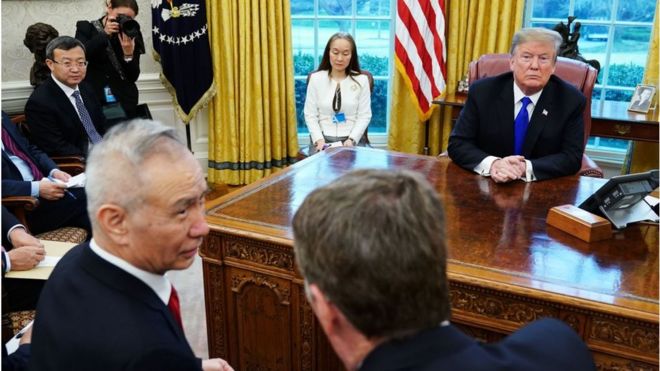
Donald Trump and China's Vice Premier Liu He in the Oval OfficeImage copyrightAFP
Image captionPresident Trump met China’s Vice Premier Liu He on Friday

President Donald Trump has announced that the US will delay imposing further trade tariffs on Chinese goods.

The rise in import duties on Chinese goods from 10% to 25% was due to come into effect on 1 March.

Mr Trump said both sides had made “substantial progress” in trade talks, which sent Chinese stocks up nearly 5%.

He added that he was planning a summit with Chinese President Xi Jinping in Florida to cement the trade deal if more progress was made.

A report from China’s official news agency Xinhua also noted “substantial progress” on specific issues such as technology transfer, intellectual property protection and agriculture.

Mr Trump’s decision to delay tariff increases on $200bn (£153bn) worth of Chinese goods was seen as a sign that the two sides are making progress on settling their damaging trade war.

Last week, Mr Trump noted progress in the latest round of negotiations in Washington, including an agreement on currency manipulation, though no details were disclosed.

Sources told CNBC on Friday that China had committed to buying up to $1.2 trillion in US goods, but there had been no progress on the intellectual property issues.

What has happened in the trade war so far?

Mr Trump initiated the trade war over complaints of unfair Chinese trading practices.

That included accusing China of stealing intellectual property from American firms, forcing them to transfer technology to China.

The US has imposed tariffs on $250bn worth of Chinese goods, and China has retaliated by imposing duties on $110bn of US products.

Mr Trump has also threatened further tariffs on an additional $267bn worth of Chinese products – which would see virtually all of Chinese imports into the US become subject to duties.
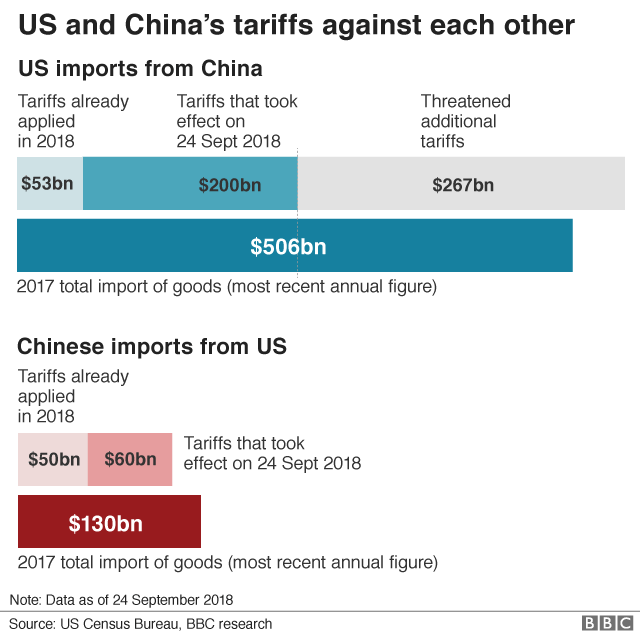
US and China's tariffs against each other

The trade dispute has unnerved financial markets, risks raising costs for American companies and is adding pressure to a Chinese economy that is already showing signs of strain.

It has also stoked fears about the impact on the global economy.

Last year, the International Monetary Fund warned the trade war between the US and China risked making the world a “poorer and more dangerous place”.

Source: The BBC
03/02/2017

Apple Is Set to Make in India, State Official Says – India Real Time – WSJ

In a potential boost to Prime Minister Narendra Modi’s “Make in India” initiative, tech giant Apple Inc. is nearing a deal with Taiwanese contract manufacturer Wistron Corp. to start making products in the southern state of Karnataka, a senior state official said.

“The contractual agreement between the two companies is on the verge of being signed,” the Karnataka government official who has direct knowledge of the matter said.

The first phase of assembling iPhones will likely start as early as the end of March, and further expansion is expected over the next two to six months, the official said.An Apple spokeswoman said the company has nothing to share beyond a statement it made last week, which said: “We appreciate the constructive and open dialogue we’ve had with [the] government about further expanding our local operations.”

A Wistron spokeswoman declined to comment. The company has a factory in the southern Indian city of Bangalore where it makes smartphone components, and has sought permission from the state authorities to expand the facility with additional power supply and fire-fighting facilities, the official said.

“What we are given to understand is that Apple is awaiting a final word from the government of India regarding tax and tariff concessions sought by the company, before signing up the contractual agreement,” the official said.

Making goods such as the iPhone locally may help the Cupertino, Calif., company to open its own stores in India, in turn building its brand in a country where it has less than a 5% share of a booming smartphone market.

Karnataka’s Information and Technology minister, Priyank Kharge, welcomed Apple’s proposal to consider Bangalore, also known as Bengaluru, as the location for potential manufacturing.

“Apple’s intentions to manufacture in Bengaluru will foster cutting edge technology ecosystem and supply chain development in the state, which are critical for India to compete globally,” Mr. Kharge said in a statement Thursday.Apple is looking to ramp up revenues in India as sales stagnate in China, long an engine of growth. India should soon overtake the U.S. as the world’s second-largest smartphone market after China. Smartphone shipments in India grew 18% last year, compared with just 3% globally, according to Counterpoint Research.

Apple Chief Executive Tim Cook in a call with analysts this week confirmed the company is “in discussions” to open retail stores in the country, and said Apple intends to “invest significantly in the country and believe it’s a great place to be.” (http://blogs.wsj.com/indiarealtime/2017/02/01/what-tim-cook-said-about-apples-big-plans-for-india/)

Last week, a team of executives led by Priya Balasubramaniam, an Apple vice president, met with senior Indian government officials in New Delhi as well as state officials in Karnataka to discuss the firm’s proposals. (https://www.wsj.com/articles/apple-nears-deal-to-manufacture-products-in-india-1485340934)

Under Mr. Modi, India has been eager to attract foreign investment and create the manufacturing facilities and jobs the country needs to sustain long-term growth.

Source: Apple Is Set to Make in India, State Official Says – India Real Time – WSJ

Tags:
15/09/2016

Britain approves China-backed Hinkley Point nuclear plant deal after review of scheme | South China Morning Post

The British government said on Thursday it was giving the green light to a controversial new nuclear project at Hinkley Point after Prime Minister Theresa May ordered a review.

“Having thoroughly reviewed the proposals for Hinkley Point C, we will introduce a series of measures to enhance security and will ensure Hinkley cannot change hands without the government’s agreement,” Business Secretary Greg Clark said in a statement.

Beijing calls for British nuclear project financially backed by China to proceed.

“Consequently, we have decided to proceed with the first new nuclear power station for a generation.”

The board of French state-owned power company EDF approved its participation in the project in southwest England on July 28, only for Britain’s new government under May to announce hours later that it wanted to review it.China has a one-third stake in Hinkley Point and analysts have warned that Britain would have risked its relations with the world’s second-largest economy if it cancelled the costly deal.

Source: Britain approves China-backed Hinkley Point nuclear plant deal after review of scheme | South China Morning Post

18/02/2015

Modi wants more technology transfer from global defence firms | Reuters

Prime Minister Narendra Modi has asked global defence contractors to transfer more technology to India as part of the lucrative deals that they win to modernise its armed forces.

India's Prime Minister Narendra Modi attends an event organised by the Christian community to celebrate the beatification of two Indians by Pope Francis late last year, in New Delhi February 17, 2015. REUTERS/Stringer

The country’s offsets policy, which requires contractors to invest a percentage of the value of the deal in India, will be tweaked to encourage more technology transfer, and less simple assembly or production, Modi said at the opening ceremony of the Aero India airshow at Yelahanka air base in Bengaluru.

“We have the reputation as the largest importer of defence equipment. This may be music to the ears of some of you. But this is an area where we do not want to be number one,” Modi said before an air display of Indian military planes.

“It will no longer be enough to buy equipment and simply assemble here.”

India is forecast to spend $250 billion over the next decade to upgrade its military, which still largely relies on Russian equipment it bought from the 1960s to the 1980s, and catch up with strategic rivals like China.

via Modi wants more technology transfer from global defence firms | Reuters.

Law of Unintended Consequences

continuously updated blog about China & India

ChiaHou's Book Reviews

continuously updated blog about China & India

What's wrong with the world; and its economy

continuously updated blog about China & India