Archive for ‘The Global Times’

10/03/2020

China’s President Xi visits Wuhan as number of new coronavirus cases tumbles

BEIJING (Reuters) – Chinese President Xi Jinping visited Wuhan, the epicentre of the coronavirus outbreak, on Tuesday, the first time he has done so since the epidemic began and a sign that Beijing believes its efforts to control the virus are working.

His arrival in the city, where the virus is believed to have first taken hold late last year, comes after its spread in mainland China has sharply slowed in the past week and as attention has turned to preventing imported infections from overseas hot spots such as Iran, Italy and South Korea.

News of the visit gave a lift to Chinese stocks, with the blue-chip index .CSI300 climbing back into positive territory after falling as much as 1% in morning trade.

“It is obvious that Xi could not have visited Wuhan earlier because the risk of him contracting the virus there was initially too high,” Zhang Ming, a professor at Renmin University in Beijing, told Reuters.

“He is there now to reap the harvest. His being there means the CCP (Communist Party of China) may declare victory against the virus soon,” Zhang said.

China came in for criticism at home and globally over its early response to the outbreak, suppressing information and downplaying its risks, but its draconian efforts at control, including the lock-down of Wuhan and Hubei province where it is originated, have been effective at curbing the spread.

Hubei province, of which Wuhan is the capital, said on Tuesday it would implement a “health code” system to allow people in areas at a medium or low risk of contracting the coronavirus to start travelling.

During his trip to Wuhan, Xi will “visit and express regards to medical workers, military officers and soldiers, community workers, police officers, officials and volunteers who have been fighting the epidemic on the front line, as well as patients and residents during the inspection,” state news agency Xinhua said.

Separately, Taiwan’s government said on Tuesday a second round of evacuations of its citizens who had been stranded in Wuhan had begun, after weeks of arguments between the Chinese-claimed island and Beijing over the arrangements.

NEW CASES FALL

Mainland China had 19 new coronavirus infections on Monday, the National Health Commission said on Tuesday, down from 40 a day earlier. It also marked the third straight day of no new locally transmitted coronavirus cases outside of Hubei.

Of the new cases, 17 were in Wuhan, while one was in Beijing and one other in Guangdong due to people arriving from abroad, according to the health authority.

That brings the total number of confirmed cases in mainland China so far to 80,754.

However, Chinese authorities have ramped up warnings about the risks from foreigners and Chinese nationals travelling to China from viral hot spots abroad such as Iran and Italy.

The one case in Beijing on Monday was due to a traveller from Britain, and the one in Guangdong was an imported case from Spain. As of Monday, there have been 69 imported cases.

More than 114,300 people have been infected by the coronavirus globally and over 4,000 have died, according to a Reuters tally of government announcements.

Outside China, Italy, South Korea and Iran have reported the most cases and deaths.

Since the outbreak, 59,897 patients have been discharged from hospitals in China. Recently discharged patients need to go into quarantine for 14 days.

In Wuhan, 12 of the 14 temporary hospitals dedicated to treating coronavirus patients have closed, with the remaining two due to shut on Tuesday.

On Saturday, a small hotel used to quarantine people under observation in southern Fujian province collapsed, killing 20, while 10 had yet to be rescued.

Of the 71 people inside the hotel in Quanzhou city at the time of the collapse, 58 were in under quarantine, the Quanzhou city government said.

As of the end of Monday, the overall death toll from the coronavirus outbreak in China reached 3,136, up by 17 from the previous day.

Hubei reported 17 new deaths, all of which were in Wuhan.

Xi, who was mostly absent from Chinese state media coverage of the crisis in its early days, has become for more visible in recent weeks.

The Global Times, a nationalist tabloid published by the official People’s Daily, on Tuesday detailed the various instructions and actions Xi had given and taken between Jan. 7 and March 2 to combat the epidemic.

“Xi personally commands the people’s war against the epidemic. He has been paying constant attention to the epidemic prevention and control work and made oral or written instructions every day,” the newspaper said.

Source: Reuters
07/02/2020

Li Wenliang: Coronavirus death of Wuhan doctor sparks anger

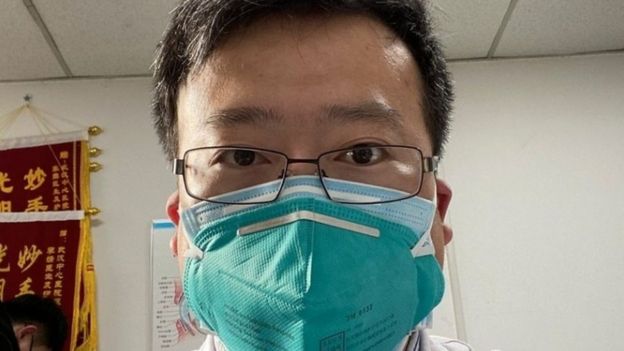
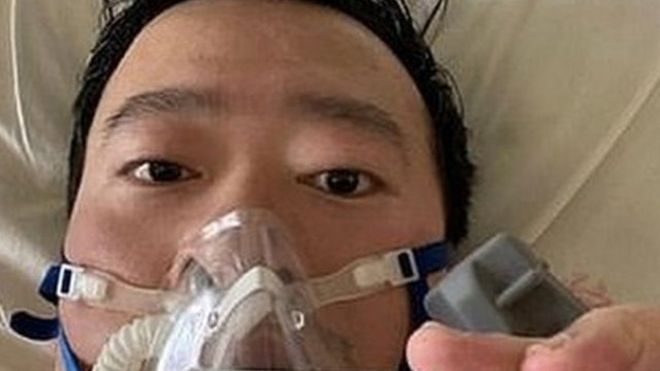
Dr Li posts a picture of himself in a gas mask from his hospital bed on FridayImage copyright DR LI WENLIANG
Image caption Dr Li had posted a picture of himself on social media from his hospital bed

The death of a Chinese doctor who tried to warn about the coronavirus outbreak has sparked an unprecedented level of public anger and grief in China.

Li Wenliang died after contracting the virus while treating patients in Wuhan.

Last December he sent a message to fellow medics warning of a virus he thought looked like Sars – another deadly coronavrius.

But he was told by police to “stop making false comments” and was investigated for “spreading rumours”.

News of his death was met with an intense outpouring of grief on Chinese social media site Weibo – but this quickly turned into anger.

There had already been accusations against the government of downplaying the severity of the virus – and initially trying to keep it secret.

Dr Li’s death has fuelled this further and triggered a conversation about the lack of freedom of speech in China.

The country’s anti-corruption body has now said it will open an investigation into “issues involving Dr Li”.

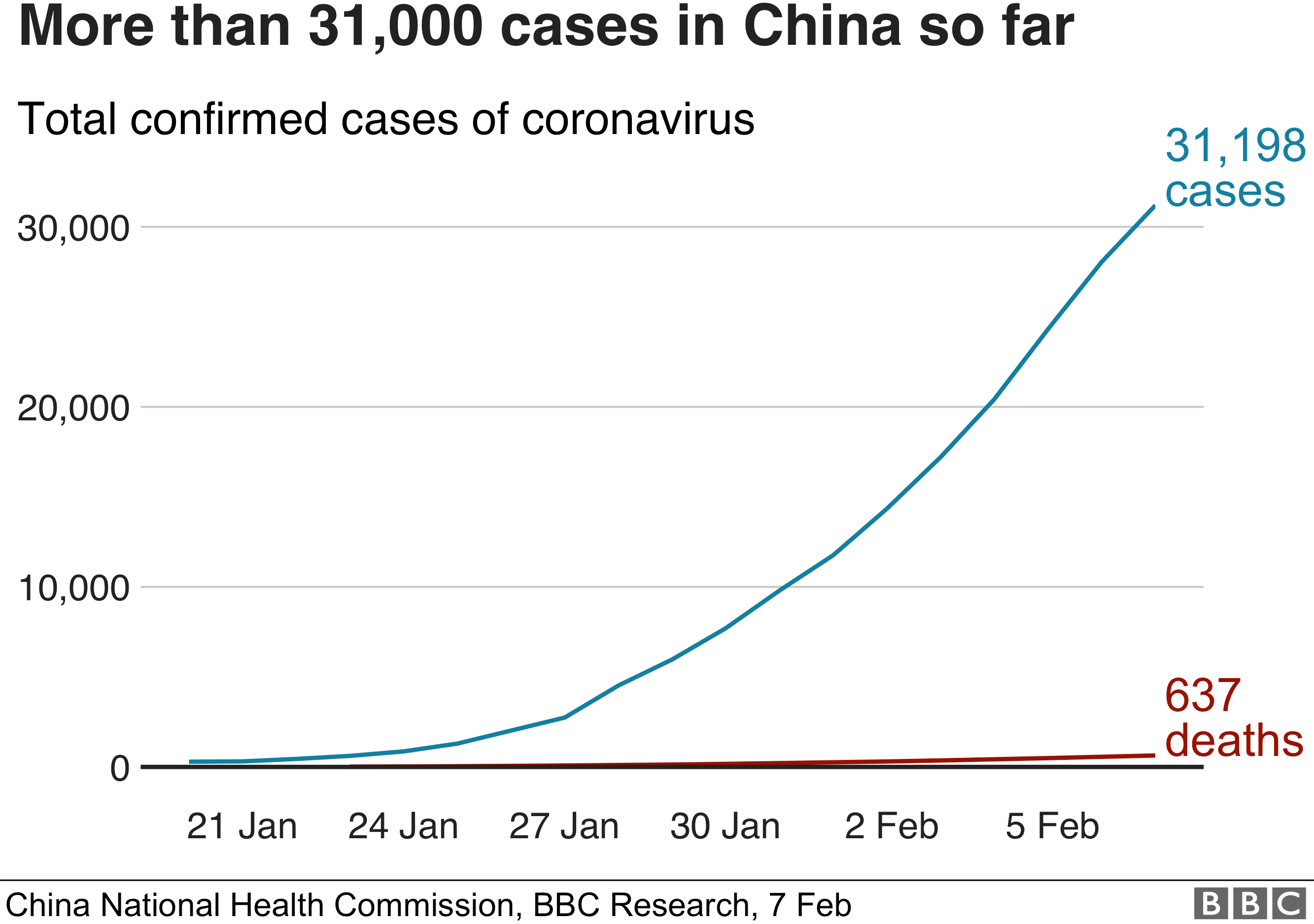
The Chinese government has previously admitted “shortcomings and deficiencies” in its response to the virus, which has now killed 636 people and infected 31,161 in mainland China.

Graphic showing the number of cases in China so far
Presentational white space

According to Chinese site Pear Video, Dr Li’s wife is due to give birth in June.

What has the public reaction been?

Chinese social media has been flooded with anger – it is hard to recall an event in recent years that has triggered as much grief, rage and mistrust against the government.

The top two trending hashtags on the website were “Wuhan government owes Dr Li Wenliang an apology” and “We want freedom of speech”.

Both hashtags were quickly censored. When the BBC searched Weibo on Friday, hundreds of thousands of comments had been wiped. Only a handful remain.

“This is not the death of a whistleblower. This is the death of a hero,” said one comment on Weibo.

A photo circulating on Twitter reportedly sourced from messaging platform WeChat also shows a message in Chinese saying “Farewell Li Wenliang” written in the snow on a riverbank.

Many have now taken to posting under the hashtag “Can you manage, do you understand?” – a reference to the letter Dr Li was told to sign when he was accused of disturbing “social order”.

These comments do not directly name him – but are telling of the mounting anger and distrust towards the government.

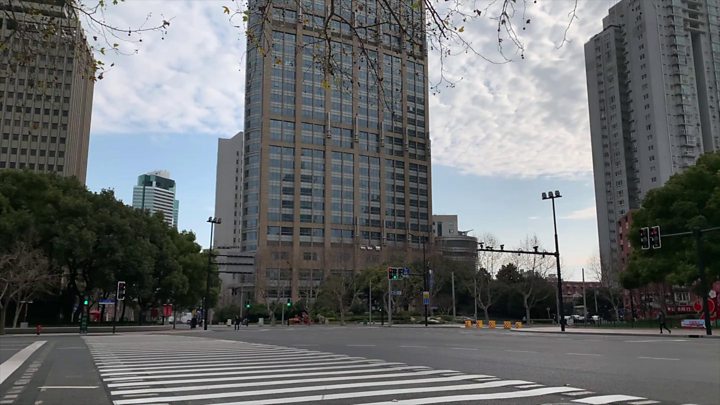
Media caption Coronavirus: Shanghai’s deserted streets and metro

“Do not forget how you feel now. Do not forget this anger. We must not let this happen again,” said one comment on Weibo.

“The truth will always be treated as a rumour. How long are you going to lie? What else do you have to hide?” another said.

“If you are angry with what you see, stand up,” one said. “To the young people of this generation, the power of change is with you.”

Presentational grey line

An epic political disaster

Analysis box by Stephen McDonell, China correspondent

The death of Dr Li Wenliang has been a heart-breaking moment for this country. For the Chinese leadership it is an epic political disaster.

It lays bare the worst aspects of China’s command and control system of governance under Xi Jinping – and the Communist Party would have to be blind not to see it.

If your response to a dangerous health emergency is for the police to harass a doctor trying to blow the whistle, then your structure is obviously broken.

The city’s mayor – reaching for excuses – said he needed clearance to release critical information which all Chinese people were entitled to receive.

Now the spin doctors and censors will try to find a way to convince 1.4 billion people that Dr Li’s death is not a clear example of the limits to the party’s ability to manage an emergency – when openness can save lives, and restricting it can kill.

Chinese people are going to take some convincing.

Presentational grey line

How was the death announced?

There was confusion over when exactly Dr Li had actually died.

He was initially declared dead at 21:30 on Thursday (13:30GMT) by state media outlets the Global Times, People’s Daily and others.

Hours later the Global Times contradicted this report – saying he had been given a treatment known as ECMO, which keeps a person’s heart pumping.

Journalists and doctors at the scene said government officials had intervened – and official media outlets had been told to change their reports to say the doctor was still being treated.

But early on Friday, reports said doctors could not save Dr Li and his time of death was 02:58 on Friday.

Li WenliangImage copyright LI WENLIANG
Image caption Li Wenliang contracted the virus while working at Wuhan Central Hospital

What did Li Wenliang do?

Dr Li, an ophthalmologist, posted his story on Weibo from a hospital bed a month after sending out his initial warning.

He had noticed seven cases of a virus that he thought looked like Sars – the virus that led to a global epidemic in 2003.

On 30 December he sent a message to fellow doctors in a chat group warning them to wear protective clothing to avoid infection.

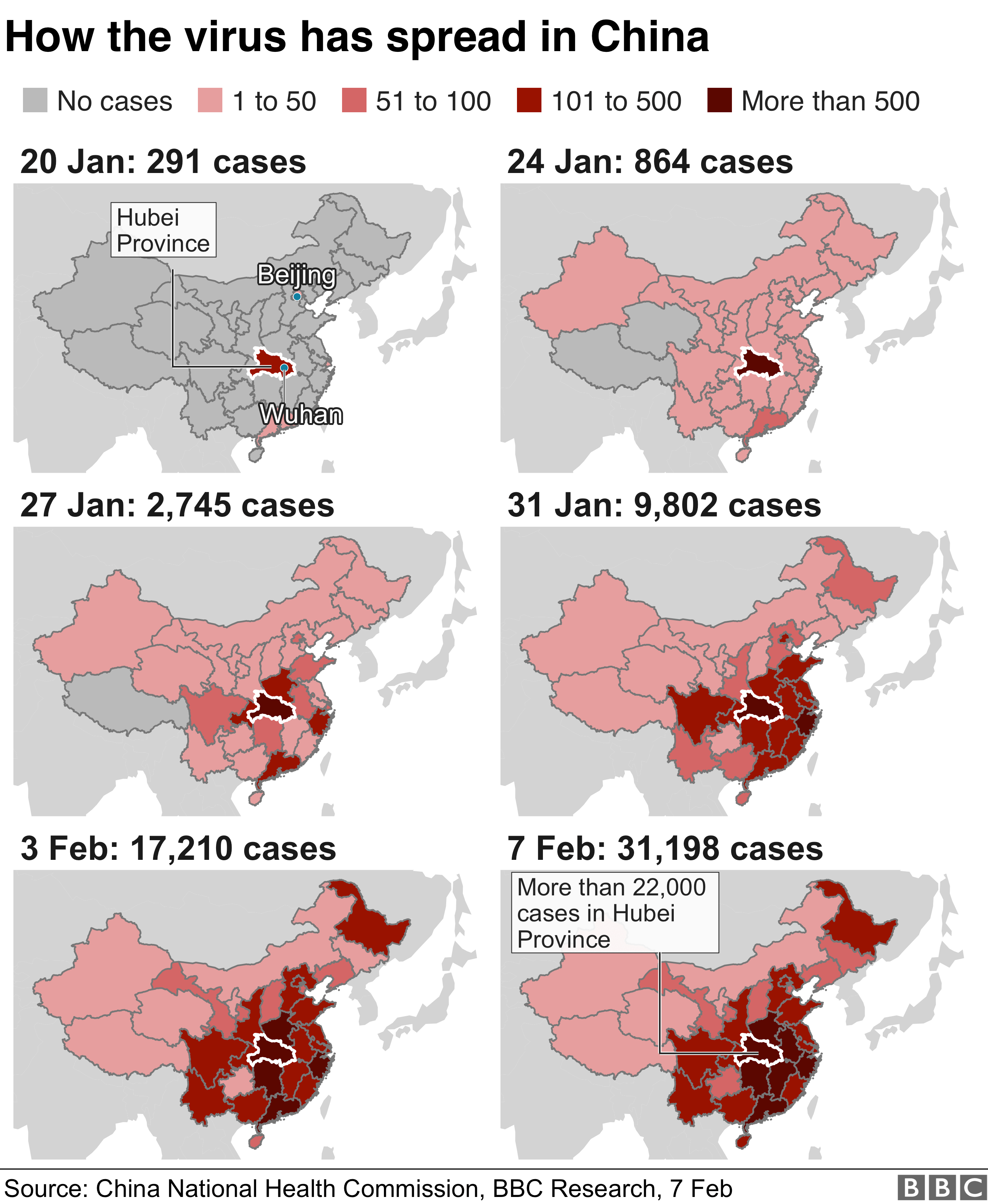
Graphic showing how the virus spread inside China
Four days later he was summoned to the Public Security Bureau where he was told to sign a letter.

In the letter he was accused of “making false comments” that had “severely disturbed the social order”. Local authorities later apologised to Dr Li.

In his Weibo post he describes how on 10 January he started coughing, the next day he had a fever and two days later he was in hospital. He was diagnosed with the coronavirus on 30 January.

Media caption The BBC’s online health editor on what we know about the virus

What is the latest on the coronavirus?

Chinese President Xi Jinping has told his US counterpart Donald Trump that China is “fully confident and capable of defeating the epidemic”. The country has introduced more restrictive measures to try to control the outbreak:

  • The capital Beijing has banned group dining for events such as birthdays. Cities including Hangzhou and Nanchang are limiting how many family members can leave home each day
  • Hubei province has switched off lifts in high-rise buildings to discourage residents from going outside.

The virus has now spread to more than 25 countries. There have been more than 28,000 cases worldwide but only two of the deaths have been outside mainland China.

Source: The BBC

05/11/2019

Chinese pilot banned from flying after passenger cockpit photo

Photo taken from microblogging site WeiboImage copyright WEIBO/SCREENSHOT
Image caption The female passenger is seen here with her fingers in a V pose, also known as the peace sign

A Chinese pilot has been banned from flying after a photo went viral showing a female passenger in the cockpit.

The photo was taken in January on an Air Guilin flight from Guilin city to Yangzhou city, state media said, but was widely shared this week – causing the airline to take action.

It shows a woman posing in the cockpit with refreshments laid out next to her.

Air Guilin said in a statement the pilot had violated air safety regulations.

‘Thanks to the captain’

The incident took place on 4 January on flight GT1011 from Guilin city to Yangzhou city, according to state media outlet The Global Times.

But it was brought to the airline’s attention on Sunday after screenshots of the alleged passenger’s post started being shared widely on micro-blogging site Weibo.

The post showed the woman making a V sign with her fingers – a popular pose in China – with the photo captioned: “Thanks to the captain. So happy.”

The woman is rumoured to be a flight attendant in training at a Guilin university, according to news site Chinese News Service.

Air Guilin did not specify if the photo was taken mid-flight, but Chinese pilots and analysts said the photo appears to have been taken during the flight.

The pilot, who was not named, has been banned from flying for life, though it is unclear if he was fired from all roles by the airline.

Air Guilin said in a statement that he had “violated [regulations] by allowing irrelevant personnel into the cockpit”.

According to the Civil Aviation Administration of China, passengers are not allowed to enter the cockpit without special approval or under “necessary” circumstances.

Other staff members involved in the incident have also been “suspended indefinitely” while further investigations are held.

“Passengers’ safety is always Air Guilin’s priority. We take a zero-tolerance approach against any inappropriate and unprofessional behaviour that might risk the aviation safety,” the Chinese carrier said.

Last year, Chinese carrier Donghai Airlines suspended a pilot for six months and revoked his qualifications as a flight instructor after he allowed his wife to go inside the cockpit.

Source: The BBC

Law of Unintended Consequences

continuously updated blog about China & India

ChiaHou's Book Reviews

continuously updated blog about China & India

What's wrong with the world; and its economy

continuously updated blog about China & India