Chindia Alert: You’ll be Living in their World Very Soon
aims to alert you to the threats and opportunities that China and India present. China and India require serious attention; case of ‘hidden dragon and crouching tiger’.
Without this attention, governments, businesses and, indeed, individuals may find themselves at a great disadvantage sooner rather than later.
The POSTs (front webpages) are mainly 'cuttings' from reliable sources, updated continuously.
The PAGEs (see Tabs, above) attempt to make the information more meaningful by putting some structure to the information we have researched and assembled since 2006.
Chinese military takes aim at operations by American warships near the Spratly and Paracel islands
US says sweeping maritime claims in the area pose a threat to freedom of the seas
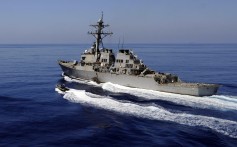
The USS Bunker Hill (front) and the USS Barry have been conducting operations in the South China Sea. Photo: US Navy
The Chinese military called the United States a “troublemaker” in the disputed South China Sea on Thursday, stressing that China was on “high alert” to safeguard its interests in the contested waters.
The two powers, already mired in a dispute over the handling of the coronavirus pandemic, have engaged in tense stand-offs over the South China Sea, with two back-to-back operations by the US to challenge China’s expansive claims in the region in the last few days.
The US’ guided-missile cruiser USS Bunker Hill conducted a “freedom of navigation operation” in the Spratly Islands on Wednesday, a day after the guided-missile destroyer USS Barry conducted a similar operation near the Paracel Islands.
The US 7th Fleet said the operations were in response to “unlawful and sweeping maritime claims in the South China Sea [that] pose a serious threat to the freedom of the seas, including the freedoms of navigation and overflight and the right of innocent passage of all ships”.
More footage emerges from 2018 near collision of US and China warships in South China Sea
And last week, an Australian frigate joined US warships in a joint exercise in the South China Sea after the Chinese research ship Haiyang Dizhi 8, accompanied by a Chinese coastguard vessel, tailed a Malaysian state oil company ship conducting exploration in the area.
China’s defence ministry spokesman Wu Qian said China had been “closely watching and on high alert” against the activities by the US and Australian militaries.
“The frequent military operations in the South China Sea by extra-regional countries like the US and Australia are not conducive to the peace and stability in the South China Sea and we resolutely oppose them,” Wu said.
“Time and again, the US has proven itself to be the biggest force in pushing militarisation in the South China Sea and a troublemaker in preventing peace and stability in the region.”
China military lashes out at US warship’s ‘intrusion’ in South China Sea
29 Apr 2020
On Tuesday, the People’s Liberation Army’s Southern Theatre Command said the
The command said it scrambled air and sea patrols to “track, monitor, verify, identify and expel” the American vessels.
Also on Thursday, Wu rejected a US report that China had secretly conducted an underground nuclear test.
Citing a report from the US State Department, The Wall Street Journal reported two weeks ago that Washington was concerned by an increase in activity at China’s Lop Nur test site in the far western region of Xinjiang, including extensive excavations that raised the suspicion of an explosion.
“The report by the US is fabricated and nonsense,” Wu said. “China, unlike the US, has always kept its promise on international arms control.”
Large-scale drills conducted across island in what defence ministry describes as test of combat-readiness
Exercise follows US Navy live-fire exercise last month and a series of incursions by Chinese warplanes in recent weeks
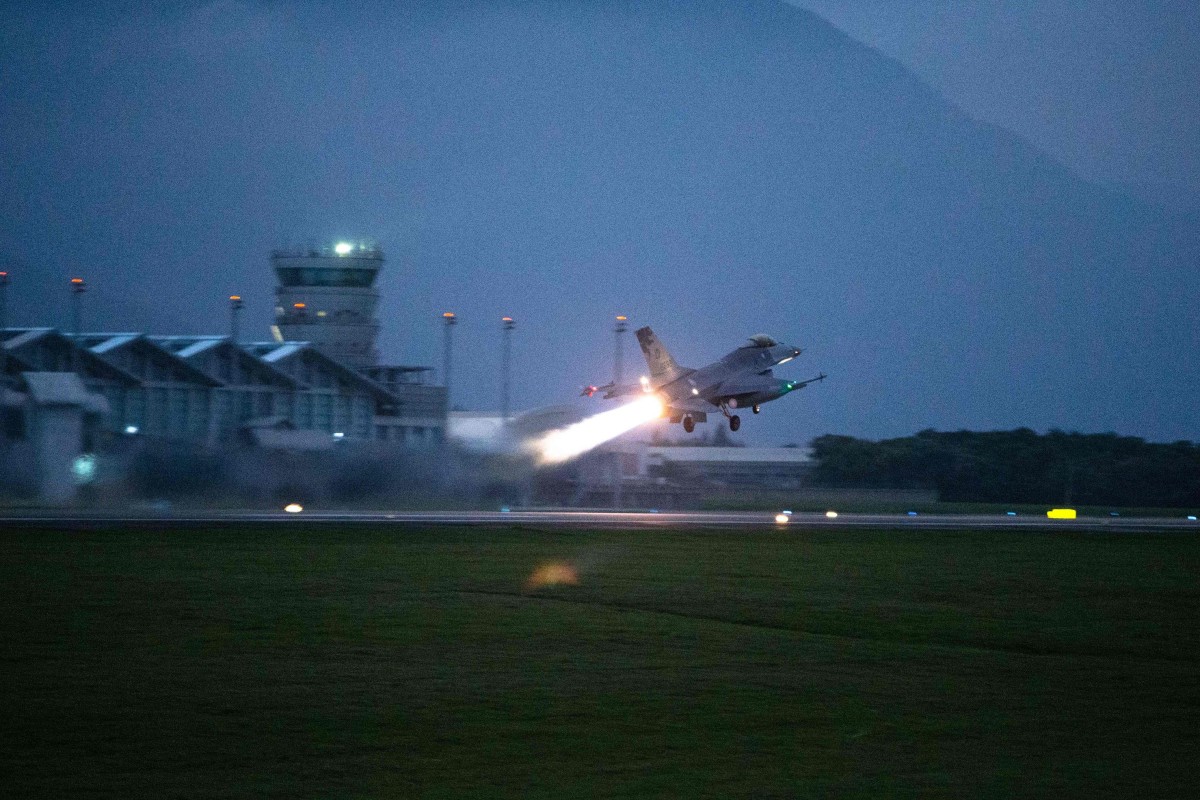
An F-16 fighter takes off from Hualien air base in eastern Taiwan. Photo: Military News Agency/ AFP
Taiwan has staged large-scale military drills throughout the island, including an exercise to repel an invading force, against a backdrop of rising tensions with Beijing.
The exercises, dubbed “Lien Hsiang,” involved the air force, army and the navy and were conducted on Tuesday from various military bases and strongholds in Taiwan, the island’s defence ministry said in a statement.
“The drills were designed to test the combat readiness of our forces and their responses to an all-out invasion by the enemy,” the ministry said, referring to the People’s Liberation Army, which has threatened to attack the self-ruled island.
The exercise follows a live-fire US drill in the region last week.
Taipei says Chinese military aircraft flew night exercise across Taiwan Strait
17 Mar 2020
Eight F-16 fighter jets took off from the air force base in the eastern county of Hualien at dawn on Tuesday, simulating an emergency mission to scramble and intercept enemy warplanes entering the island’s airspace, the defence ministry said.
Elsewhere on the island, F-16 and other fighter jets were spotted taking off from other air force bases in the southwestern county of Chiayi, the northern county of Hsinchu, Ching Chuan Kang in central Taiwan and the southern city of Tainan, according to Taiwanese media.
The exercises also involved operations testing cyberwarfare capabilities, while the air force ground crew simulated an emergency repair of the aircraft runway, the ministry said.
Anti-air units of both the army and the navy also joined the air force in the drills, while various types of naval warships, including Kidd-class destroyers, plus Perry and Kang Ding-class frigates, were deployed near Taiwan’s coast for separated training drills, it added.
The ministry said the training mission, carried out without live ammunition, was also designed to test the military response and make improvements based on the results.
Hundreds of Taiwanese to return from coronavirus centre after Beijing and Taipei reach deal
10 Mar 2020
Beijing considers Taiwan a wayward province that must be returned to the mainland fold, by force if necessary.
Beijing has staged a series of war games close to the island and poached seven of Taiwan’s diplomatic allies to heap pressure on President Tsai Ing-wen, from the independence-leaning Democratic Progressive Party, who was re-elected in January.
The exercises came after recent missions by PLA warplanes which briefly crossed the midpoint of the Taiwan Strait into the Taiwanese side in what analysts saw as testing the response from Taiwan and the US.
Three separate groups of warplanes approached Taiwan on their way to the western Pacific over the Bashi Channel for long-distance training exercises before returning home over the Miyako Strait to the northeast of Taiwan on February 9, 10 and 28.
Coronavirus threat shows ‘unacceptability’ of Beijing isolating Taiwan, US official says
28 Feb 2020
On March 17, another flight of PLA warplanes approached Taiwan in a rare exercise which analysts said was aimed at showing off their night navigation and all-weather capabilities.
Taiwan’s air force scrambled fighter jets to shadow, intercept and disperse the PLA warplanes through radio warnings during each approach by the mainland’s planes, according to the ministry.
Those actions also prompted the US to send two B-52 bombers on southbound flights off Taiwan’s east coast, while a transport plane flew over the Taiwan Strait, the defence ministry said.
DPP legislator Wang Ting-yu asked the Tsai government to take note of developments in the South China Sea, saying the US actions indicated that Washington must have learned “certain information suggesting that the Chinese government is planning certain military activities” or the 7th Fleet would not have made such a bold move.
Lawrence Chung covers major news in Taiwan, ranging from presidential and parliament elections to killer earthquakes and typhoons. Most of his reports focus on Taiwan’s relations with China, specifically on the impact and possible developments of cross-strait relations under the pro-independence Democratic Progressive Party and mainland-friendly Kuomintang governments. Before starting work at the South China Morning Post in 2006, he wrote for Reuters and AFP for more than 12 years.
Japan risks massive financial losses and a political blow for Shinzo Abe’s government if the Tokyo Olympics are cancelled or postponed
The Olympics were last cancelled in 1940 after Japan invaded China and the outbreak of World War II, but the Zika virus did not stop the 2016 Rio Games
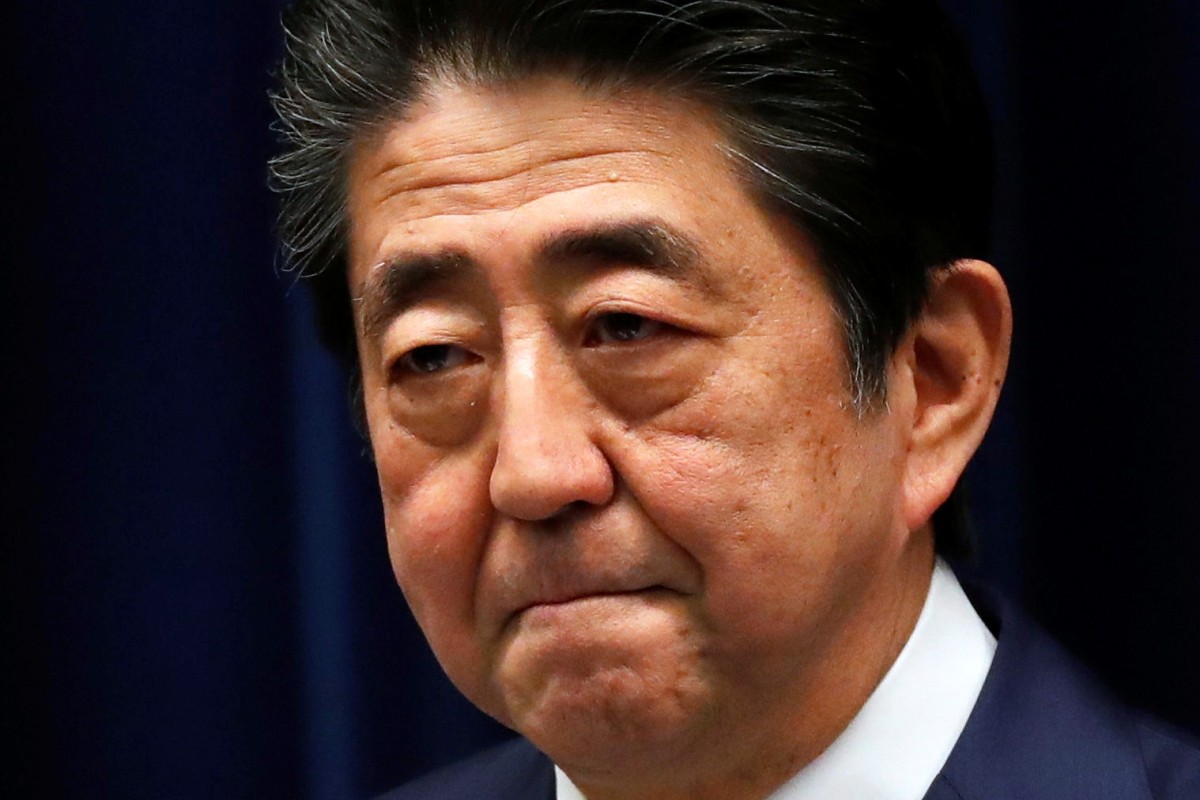
Japan’s Prime Minister Shinzo Abe attends a news conference on the coronavirus. An analyst said the cancellation of the Olympic Games would not only be a financial blow, but would also dent the political pride of his government, which wanted to show the world that Japan could host a successful Olympics. Photo: Reuters
, which explains the government’s single-minded commitment to going ahead with the event in the face of the threat posed by the novel coronavirus.
The Japanese government on Wednesday morning reiterated that the Games would go ahead in July as scheduled, with chief cabinet secretary Yoshihide Suga declaring that preparations were continuing despite the spread of the virus worldwide.
The previous day, the International Olympic Committee (IOC) threw its weight behind Tokyo’s position. “We are preparing for a successful Olympic Games, Tokyo 2020,” said IOC head Thomas Bach.
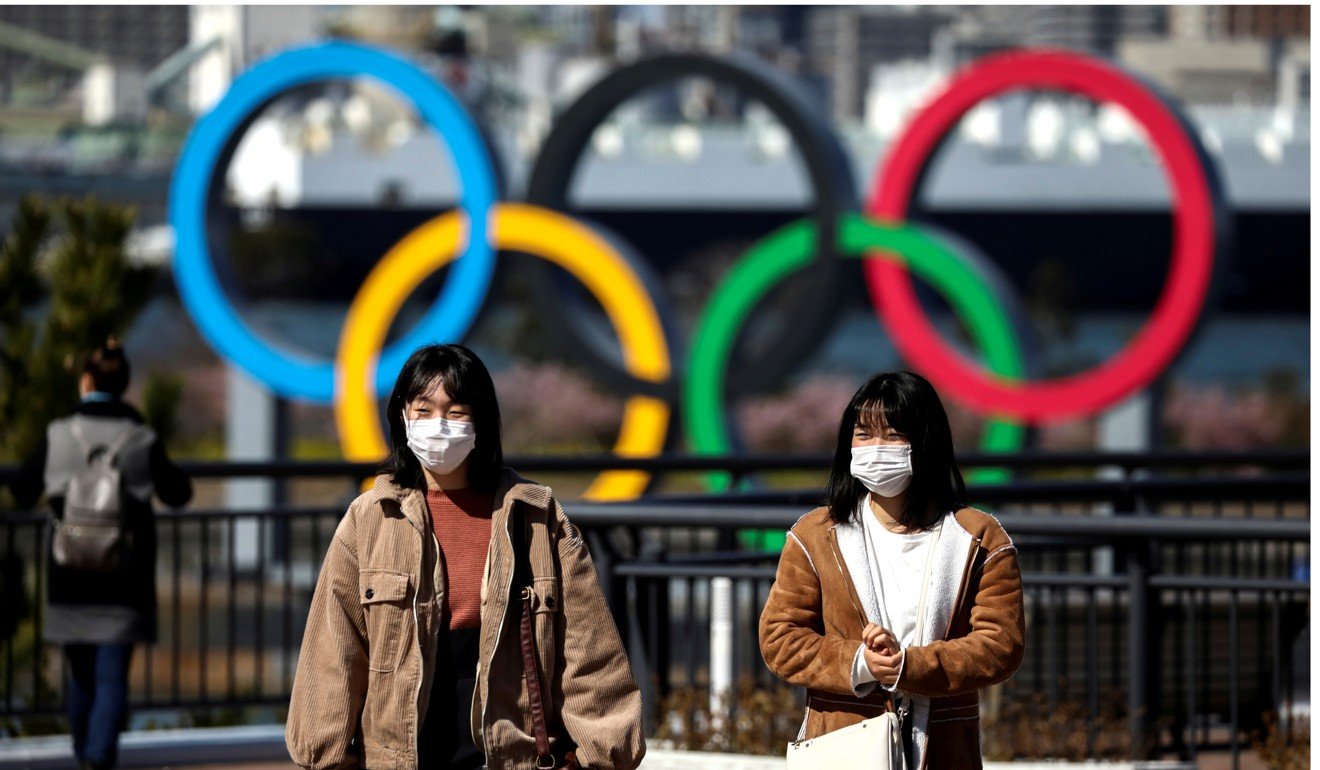
People wearing protective face masks are seen in front of the Olympic rings at the waterfront area at Odaiba Marine Park in Tokyo, Japan. Photo: Reuters
“I would like to encourage all the athletes to continue their preparations … with great confidence and full steam,” he said. “From our side, we will continue to support the athletes and the national Olympic committees.”
Both statements came on the heels of a comment by Seiko Hashimoto, Japan’s minister with responsibility for the Games, who suggested that the contract with the IOC “could be interpreted as allowing for a postponement” until later in the year. On Thursday, Hashimoto acknowledged to the Upper House budget committee that a cancellation or delay of the games would be “unacceptable for the athletes”.
Stephen Nagy, an associate professor of international relations at Tokyo’s International Christian University, said a great deal is at stake for Japan as the last time a modern Olympic Games was cancelled was in 1940 – ironically as a result of Japan’s invasion of China in July 1937, and the outbreak of World War II. Meanwhile, the Rio Games in Brazil went on as planned in 2016 despite the outbreak of the Zika virus.
While the 1940 cancellation has largely been forgotten, it would unquestionably cause serious loss of face to the Abe administration if events did conspire to halt Tokyo 2020, he said.
I think it’s much more about the national political pride of ‘Team Abe’Economist Noriko Hama
Noriko Hama, an economist at Doshisha University in Kyoto believes a number of issues are behind the government’s refusal to contemplate the Games being postponed or cancelled, but one is dominant.
“Yes, it’s about the money that has already been spent on facilities and new infrastructure and the windfall from tens of thousands of foreign tourists, but I think it’s much more about the national political pride of ‘Team Abe’,” she said.
“They wanted to show the world that they could do this, that they would be one of the very few cities to host an Olympics for a second time and that it would be a massive success,” she said. “It’s about chest-thumping.”
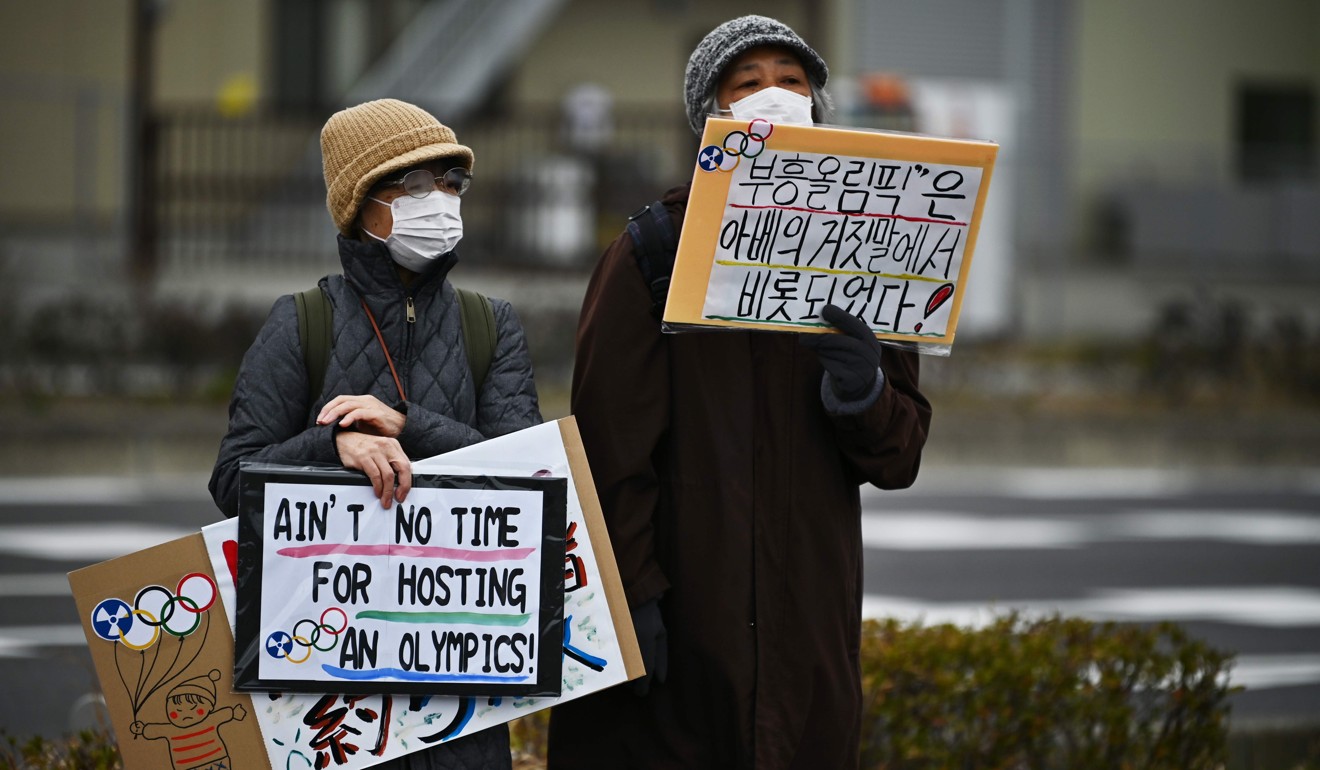
Protesters hold placards during a demonstration against the Olympics, Prime Minister Shinzo Abe and nuclear energy. Photo: AFP
Hama pointed out that many Japanese people had been sceptical about the Games, and for a variety of reasons.
Many are unhappy at the cost, which was previously estimated at 1.06 trillion yen (US$9.81 billion) but organisers confirmed in December had risen to 1.35 trillion yen (US$12.35 billion), plus another 3 billion yen required to move the marathon and walking events from Tokyo to Sapporo, in Hokkaido, to avoid the heat and humidity of the capital.
Others said the Games will cause widespread disruption to the lives of ordinary people and that Tokyo was still not fully prepared for the huge numbers of people that will inevitably flood the city. Some voiced concerns that holding the Games at the peak of a Japanese summer would cause problems for athletes, officials and spectators alike. There have been predictions that the heat is going to cause loss of life.
Only an apocalypse – or government ineptitude – can stop the Olympics
29 Feb 2020
“But there is this strange sort of blind obstinacy that is driving the whole thing forward regardless,” said Hama. “And now the coronavirus has added another layer of very serious concern and I believe the government need to think very carefully what they are going to do.”
Nagy said the Japanese government would be reluctant to postpone the Games as that would “once again tarnish the brand”.
“Seven or eight years ago, Japan was largely seen as a stagnant country that was struggling to shake off the legacy of two decades of economic underperformance, but that changed quite suddenly,” he said.
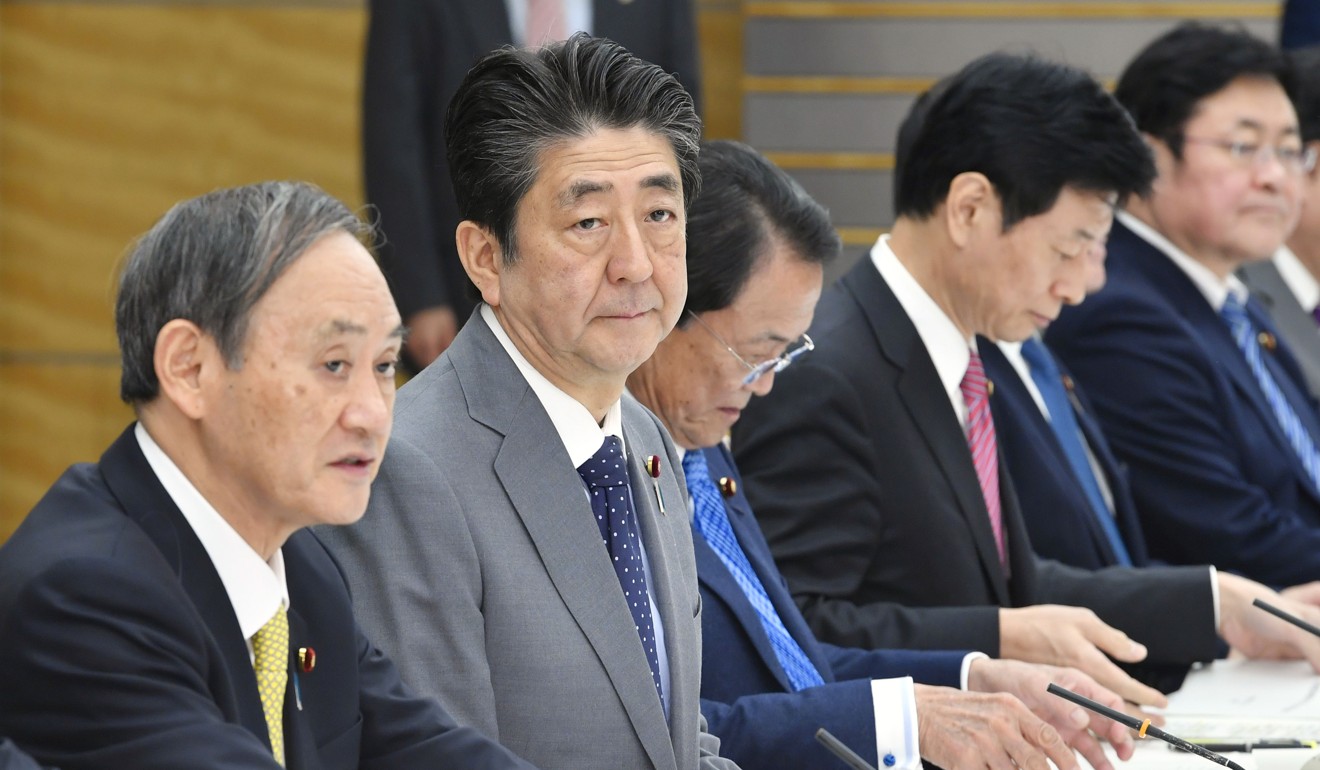
Japan’s chief cabinet secretary Yoshihide Suga and Prime Minister Shinzo Abe attend a meeting with other ministers in Tokyo. Photo: Kyodo
“Now the ‘Japan brand’ is strong and vibrant as they have successfully hosted G-7 conferences and, more importantly, last year’s Rugby World Cup.”
The rugby served to put Japan on the world stage, said Nagy, and everyone went away feeling very positive and it worked exceptionally well as a “dry run” for the Olympics.
Other considerations are the massive amount of money that was spent on preparing for the Games, as well as the political capital that Abe was obliged to use up to win the right to be the host city and then smooth the way in the run-up to the event.
Hong Kong backs IOC’s Olympic pledge despite coronavirus threat
4 Mar 2020
Dick Pound, a senior member of the IOC, said there is a window of two to three months in which organisers must make a decision, meaning there could only be clarity by the end of May. He told Associated Press that if the coronavirus situation worsens, it would probably mean a cancellation.
“You just don’t postpone something on the size and scale of the Olympics. There’s so many moving parts, so many countries and different seasons, and competitive seasons, and television seasons. You can’t just say, ‘We’ll do it in October’,” he said. It was also unlikely that the IOC would move the Games to another city at such short notice.
In the meantime, the local organising committee said it had stepped up its measures to protect runners and spectators for the torch relay, including limiting the number of visitors at venues and monitoring the health of runners.
While the Japanese government remains defiant that the Olympics will go ahead as scheduled, Nagy said both Abe and the IOC were walking a “fine line” on making a final decision.
“There are simply no good choices at this point,” he said. “Policymakers just do not know how long this virus is going to stick around, whether it is going to mutate or anything else. But there will come a point when they absolutely have to make a decision.
Coronavirus fear, paranoia reveal cracks in Japan’s polite facade
3 Mar 2020
“If they wait too long and the outbreak goes on longer than anticipated, then they risk the possibility of a poor public turnout and people getting ill,” he said. “But if they cancel too early and the virus disappears, then they will be accused of being alarmist and of wasting all the effort and money that has already gone into the Games.
“The best they can do, in the circumstances, is to use science and facts and compare this outbreak to previous cycles – and then hope the decision that they do make is the right one.”
BEIJING (Reuters) – The spectre of new confrontation between Pyongyang and Washington hangs over meetings between China, Japan and South Korea this week, with growing risks North Korean actions could end an uneasy detente and upend recent diplomatic efforts.
South Korean President Moon Jae-in and Japanese Prime Minister Shinzo Abe are expected to meet Chinese President Xi Jinping separately on Monday. They will then travel to the southwestern city of Chengdu for a trilateral meeting with Chinese Premier Li Keqiang. Though they are expected to discuss various economic matters, North Korea appears likely to dominate the agenda.
Pyongyang has grown increasingly frustrated that its halt of nuclear and long-range missile tests has not ended the crippling economic sanctions against it. It set a Dec. 31 deadline for the United States to make concessions, but Washington has been unmoved.
Some experts believe North Korea may be readying to test an intercontinental ballistic missile launch soon, which would likely end the 2018 agreement struck by its leader, Kim Jong Un, and U.S. President Donald Trump.
“Safeguarding the stability and peace of the Korean Peninsula and pushing for a political solution to the Korean Peninsula issue are in the interests of China, Japan and South Korea,” Chinese Vice Foreign Minister Luo Zhaohui told reporters on Thursday at a briefing on the trilateral meetings.
U.S. special envoy for North Korea Stephen Biegun met with two senior Chinese diplomats during his two-day visit to Beijing this week, following similar meeting in South Korea and Japan days earlier, as diplomats make last-ditch attempts to prevent new confrontation.
North Korea has not responded to his public call to resume dialogue, however.
“The silence, even after Biegun’s speech in Seoul, makes me concerned,” Jenny Town, managing editor at the North Korea monitoring website 38 North, said on Twitter.
Beijing, jointly with Russia, proposed on Monday that the United Nations Security Council lift some sanctions in what it calls an attempt to break the current deadlock and seeks to build support. But it’s unclear whether Beijing can convince Seoul and Tokyo to break ranks from Washington, which has made its opposition clear and can veto any resolution.
Though South Korea sees China as instrumental in reviving negotiations, it has so far sidestepped questions on whether it supports the new proposal by Beijing and Moscow. Japan, which has historically been a staunch supporter of sanctions against North Korea, has also refrained from commenting on the proposal.
“With the (2020 Tokyo) Olympics coming up, North Korea going wild would pose a problem for Japan,” said Narushige Michishita, professor at Japan’s National Graduate Institute for Policy Studies.
“But bilateral talks with North Korea, for example, will probably be a better approach for Japan than easing UN sanctions.”
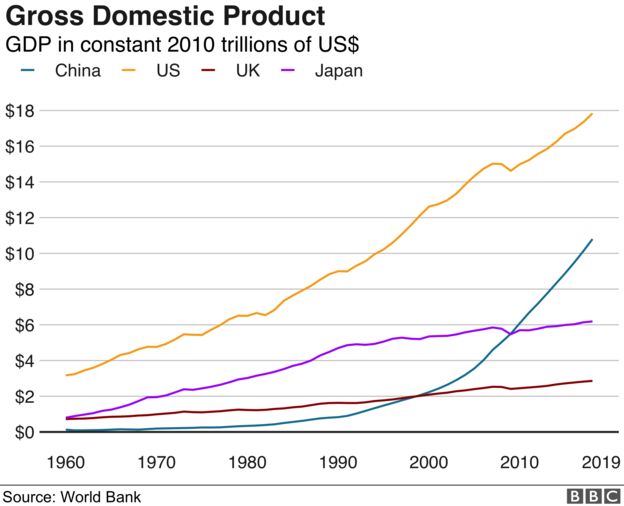
It took China less than 70 years to emerge from isolation and become one of the world’s greatest economic powers.
As the country celebrates the anniversary of the founding of the People’s Republic of China, we look back on how its transformation spread unprecedented wealth – and deepened inequality – across the Asian giant.
“When the Communist Party came into control of China it was very, very poor,” says DBS chief China economist Chris Leung.
“There were no trading partners, no diplomatic relationships, they were relying on self-sufficiency.”
Over the past 40 years, China has introduced a series of landmark market reforms to open up trade routes and investment flows, ultimately pulling hundreds of millions of people out of poverty.
The 1950s had seen one of the biggest human disasters of the 20th Century. The Great Leap Forward was Mao Zedong’s attempt to rapidly industrialise China’s peasant economy, but it failed and 10-40 million people died between 1959-1961 – the most costly famine in human history.
This was followed by the economic disruption of the Cultural Revolution in the 1960s, a campaign which Mao launched to rid the Communist party of his rivals, but which ended up destroying much of the country’s social fabric.
‘Workshop of the world’
Yet after Mao’s death in 1976, reforms spearheaded by Deng Xiaoping began to reshape the economy. Peasants were granted rights to farm their own plots, improving living standards and easing food shortages.
The door was opened to foreign investment as the US and China re-established diplomatic ties in 1979. Eager to take advantage of cheap labour and low rent costs, money poured in.
“From the end of the 1970s onwards we’ve seen what is easily the most impressive economic miracle of any economy in history,” says David Mann, global chief economist at Standard Chartered Bank.
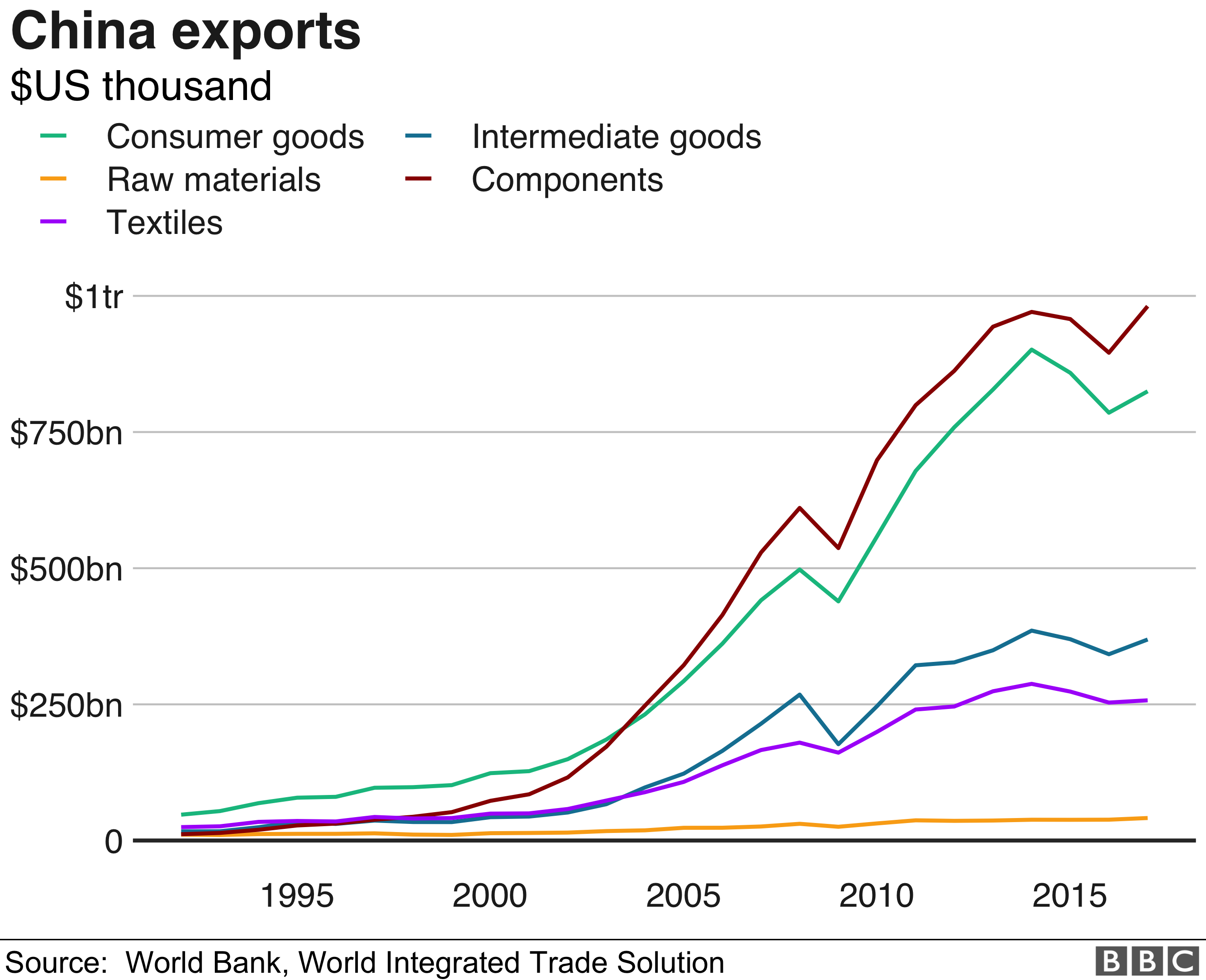
Through the 1990s, China began to clock rapid growth rates and joining the World Trade Organization in 2001 gave it another jolt. Trade barriers and tariffs with other countries were lowered and soon Chinese goods were everywhere.
“It became the workshop of the world,” Mr Mann says.
Take these figures from the London School of Economics: in 1978, exports were $10bn (£8.1bn), less than 1% of world trade.
By 1985, they hit $25bn and a little under two decades later exports valued $4.3trn, making China the world’s largest trading nation in goods.
Poverty rates tumble
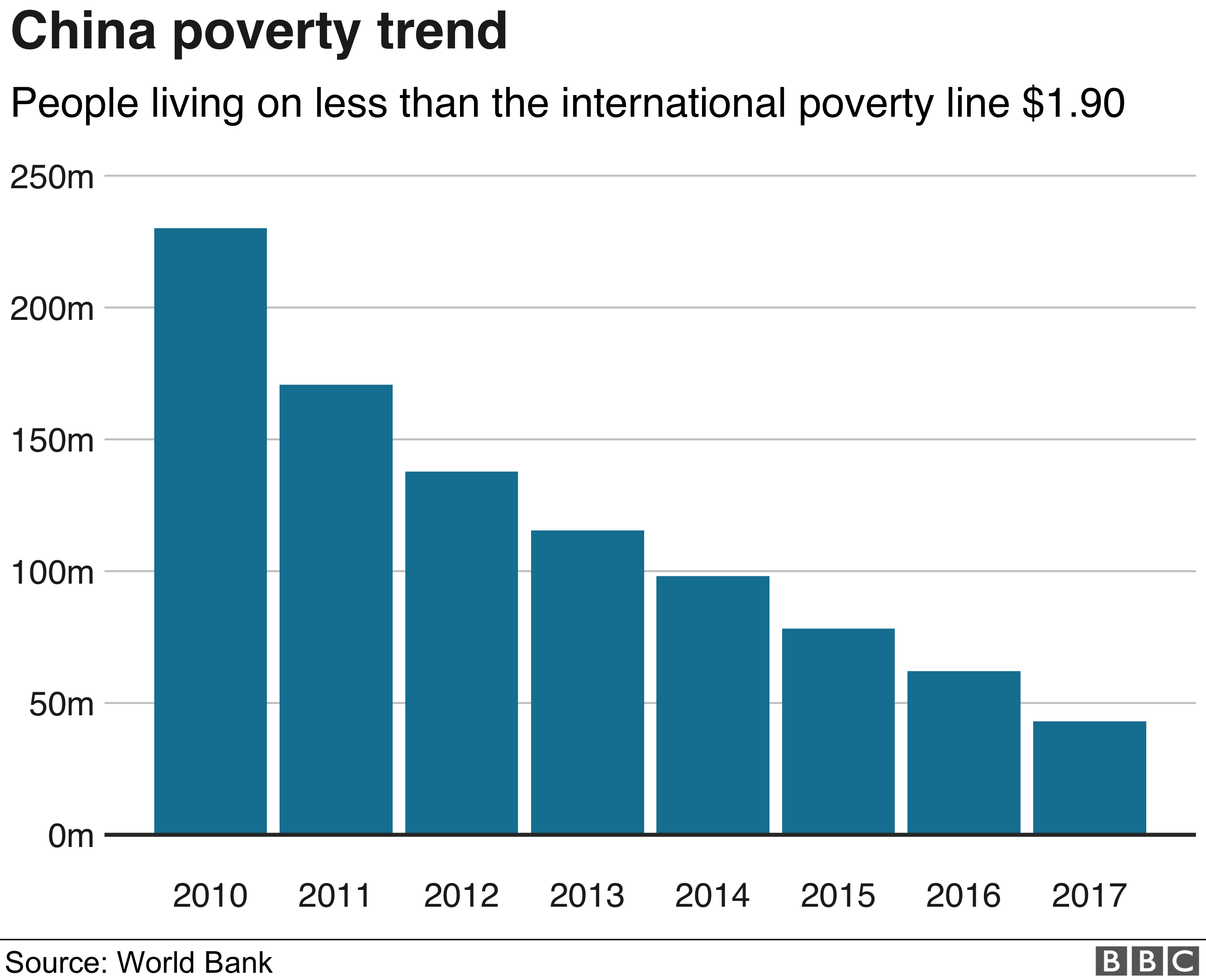
The economic reforms improved the fortunes of hundreds of millions of Chinese people.
The World Bank says more than 850 million people been lifted out of poverty, and the country is on track to eliminate absolute poverty by 2020.
At the same time, education rates have surged. Standard Chartered projects that by 2030, around 27% of China’s workforce will have a university education – that’s about the same as Germany today.
Rising inequality
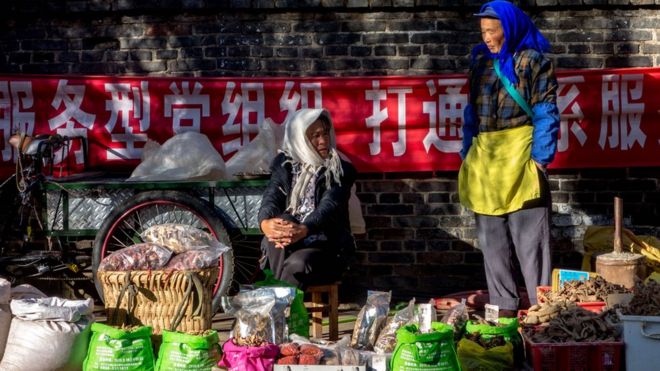
Still, the fruits of economic success haven’t spread evenly across China’s population of 1.3 billion people.
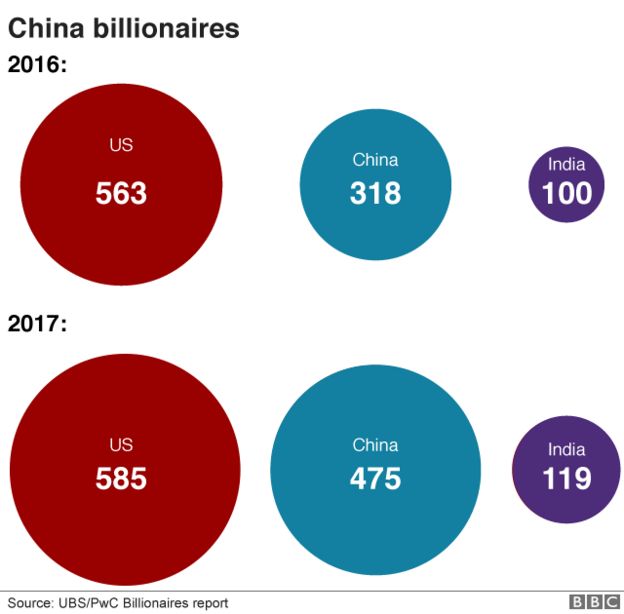
Examples of extreme wealth and a rising middle class exist alongside poor rural communities, and a low skilled, ageing workforce. Inequality has deepened, largely along rural and urban divides.
“The entire economy is not advanced, there’s huge divergences between the different parts,” Mr Mann says.
The World Bank says China’s income per person is still that of a developing country, and less than one quarter of the average of advanced economies.
China’s average annual income is nearly $10,000, according to DBS, compared to around $62,000 in the US.
Slower growth
Now, China is shifting to an era of slower growth.
For years it has pushed to wean its dependence off exports and toward consumption-led growth. New challenges have emerged including softer global demand for its goods and a long-running trade war with the US. The pressures of demographic shifts and an ageing population also cloud the country’s economic outlook.
Still, even if the rate of growth in China eases to between 5% and 6%, the country will still be the most powerful engine of world economic growth.
“At that pace China will still be 35% of global growth, which is the biggest single contributor of any country, three times more important to global growth than the US,” Mr Mann says.
The next economic frontier
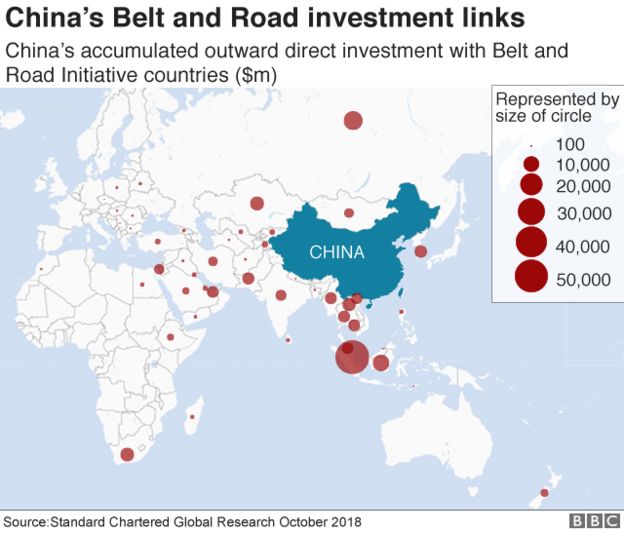
China is also carving out a new front in global economic development. The country’s next chapter in nation-building is unfolding through a wave of funding in the massive global infrastructure project, the Belt and Road Initiative.
The so-called new Silk Road aims to connect almost half the world’s populations and one-fifth of global GDP, setting up trade and investment links that stretch across the world.






 CHINDIA ALERT: You'll be living in their world, very soon