25/04/2020
- But trade with partner countries might not be as badly affected as with countries elsewhere in the world, observers say
- China’s trade with belt and road countries rose by 3.2 per cent in the January-March period, but second-quarter results will depend on how well they manage to contain the pathogen, academic says
China’s investment in foreign infrastructure as part of its Belt and Road Initiative has been curtailed because of the coronavirus pandemic. Photo: Xinhua
The
coronavirus pandemic is set to cause a slump in Chinese investment in its signature
and a dip in trade with partner countries that could take a year to overcome, analysts say.
But the impact of the health crisis on China’s economic relations with nations involved in the ambitious infrastructure development programme might not be as great as on those that are not.
China’s total foreign trade in the first quarter of 2020 fell by 6.4 per cent year on year, according to official figures from Beijing.
Trade with the United States, Europe and Japan all dropped in the period, by 18.3, 10.4 and 8.1 per cent, respectively, the commerce ministry said.
By comparison, China’s trade with belt and road countries increased by 3.2 per cent in the first quarter, although the growth figure was lower than the 10.8 per cent reported for the whole of 2019.
China’s trade with 56 belt and road countries – located across Africa, Asia,
Europe and South America – accounts for about 30 per cent of its total annual volume, according to the commerce ministry.
Despite the first-quarter growth, Tong Jiadong, a professor of international trade at Nankai University in Tianjin, said he expected China’s trade with belt and road countries to fall by between 2 and 5 per cent this year.
His predictions are less gloomy than the 13 to 32 per cent contraction in global trade forecast for this year by the
World Trade Organisation.
“A drop in [China’s total] first-quarter trade was inevitable but it slowly started to recover as it resumed production, especially with Southeast Asian, Eastern European and Arab countries,” Tong said.
“The second quarter will really depend on how the epidemic is contained in belt and road countries.”
Nick Marro, Hong Kong-based head of global trade at the Economist Intelligence Unit, said he expected China’s total overseas direct investment to fall by about 30 per cent this year, which would be bad news for the belt and road plan.
“This will derive from a combination of growing domestic stress in China, enhanced regulatory scrutiny over Chinese investment in major international markets, and weakened global economic prospects that will naturally depress investment demand,” he said.
The development of the Chinese built and operated special economic zone in the Cambodian town of Sihanoukville is reported to have slowed, while infrastructure projects in Bangladesh, including the Payra coal-fired power plant, have been put on hold.
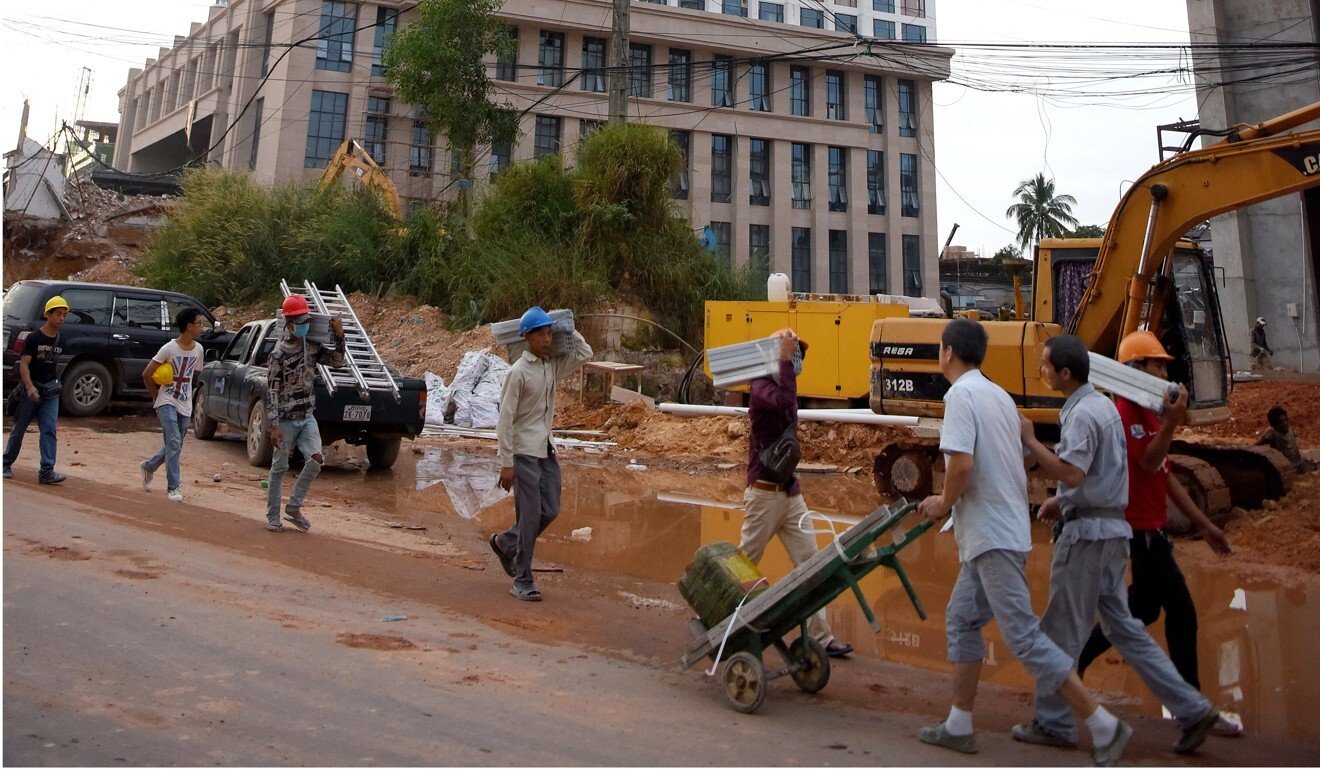
The development of the Chinese built and operated special economic zone in the Cambodian town of Sihanoukville is reported to have slowed. Photo: AFP
Marro said the reduction of capital and labour from China might complicate other projects for key belt and road partner, like Pakistan, which is home to infrastructure projects worth tens of billions of US dollars, and funded and built in large part by China.
“Pakistan looks concerning, particularly in terms of how we’ve assessed its sovereign and currency risk,” Marro said.
“Public debt is high compared to other emerging markets, while the coronavirus will push the budget deficit to expand to 10 per cent of GDP [gross domestic product] this year.”
Last week, Pakistan asked China for a 10-year extension to the repayment period on US$30 billion worth of loans used to fund the development of infrastructure projects, according to a report by local newspaper Dawn.
China’s overseas investment has been falling steadily from its peak in 2016, mostly as a result of Beijing’s curbs on capital outflows.
Last year, the direct investment by Chinese companies and organisations other than banks in belt and road countries fell 3.8 per cent from 2018 to US$15 billion, with most of the money going to South and Southeast Asian countries, including Singapore, Vietnam, Indonesia and Pakistan.
Tong said the pandemic had made Chinese investors nervous about putting their money in countries where disease control measures were becoming increasingly stringent, but added that the pause in activity would give all parties time to regroup.
“Investment in the second quarter will decline and allow time for the questions to be answered,” he said.
“Past experience along the belt and road has taught many lessons to both China and its partners, and forced them to think calmly about their own interests. The epidemic provides both parties with a good time for this.”
Dr Frans-Paul van der Putten, a senior research fellow at Clingendael Institute in the Netherlands, said China’s post-pandemic strategy for the
belt and road in Europe
might include a shift away from investing in high-profile infrastructure projects like ports and airports.
Investors might instead cooperate with transport and logistics providers rather than invest directly, he said.
“Even though in the coming years the amount of money China loans and invests abroad may be lower than in the peak years around 2015-16, I expect it to maintain the belt and road plan as its overall strategic framework for its foreign economic relations,” he said.
Source: SCMP
Posted in 10-year, 2018, 2019, 2020, 30, academic, according, accounts, across, activity, africa, airports, allow, ambitious, analysts, annual volume, answered, Arab countries, Asia, bad news, Bangladesh, because, Beijing, Belt and Road Initiative, belt and road plan, billion, billions, budget deficit, Cambodian, capital, capital outflows, cause, China, China’s, Chinese, Clingendael Institute, combination, Commerce Ministry, compared, comparison, complicate, contained, contraction, cooperate, coronavirus, Coronavirus pandemic, countries, curbs, Currency, curtailed, Dawn, decline, demand, depend, depress, derive, development, dip, direct investment, disease control measures, domestic stress, dropped, Eastern European, economic prospects, economic relations, Economist Intelligence Unit, elsewhere, Emerging markets, enhanced, epidemic, especially, Europe, extension, fall, falling, Fell, figure, first-quarter, forecast, foreign, foreign trade, GDP [gross domestic product], global trade, gloomy, great, growth, health crisis, high, impact, increased, increasingly, Indonesia, inevitable, Infrastructure, infrastructure projects, international markets, International trade, Investment, investors, involved, January, Japan, Labour, last week, loans, local newspaper, located, logistics, lower, Major, manage, March, might not, nations, naturally, nervous, Netherlands, observers, official figures, on hold, other, overall strategic framework, overcome, overseas, Pakistan, pandemic, parties, partner, pathogen, pause, Payra coal-fired power plant,, per cent, Period, ports, predictions, production, professor, programme, providers, Public debt, put, questions, recover, reduction, regroup, regulatory scrutiny, repayment, reported, results, resumed, Risk, second-quarter, signature, Singapore, slowed, slower, slump, South, South America, Southeast Asian, sovereign, special economic zone, stringent, take, this year, Tianjin, time, Total, town, Trade, Transport, Uncategorized, United States, US dollars, US$30, Vietnam, weakened, while, World, world trade organisation, worth, year, year-on-year |
Leave a Comment »
09/12/2018
NEW DELHI (Reuters) – China and India may be talking about improving their trade relationship but there is little action to go with the words.
According to Indian government officials and representatives of various Indian trade bodies, progress is very slow – and may even be getting slower after last weekend’s truce between the United States and China in their trade war.
Both India and China have sought to rebuild trust after a armed standoff over a stretch of the Himalayan border last year.
Indian Prime Minister Narendra Modi and Chinese President Xi Jinping have met a number of times this year to give impetus to the trade discussions. The latest was last week, when they met on the sidelines of the G20 meeting in Argentina.
Indian and Chinese officials said after that meeting there was talk of Beijing increasing its soymeal, rapeseed meal, rice and sugar imports from India, while China would push for more Chinese exports of dairy products, apples and pears to India.
India is also keen to increase its exports of drugs to China.
In reality, though, getting such exchanges turned into deals is going to be a laborious process.
“When we say the Chinese are receptive, it means the talks are happening, but it’s going slow,” said one senior Indian government official with direct knowledge of the discussions. “It can be termed as progress because just a few months ago, we weren’t even talking,” said the official, who did not wish to be named because he is not authorized to talk to media.
The Chinese commerce ministry did not respond to a faxed request for comment for this article.
Bilateral trade between China and India touched $89.71 billion in the year ending March 2018, with the trade deficit widening to $63.05 billion in China’s favor, more than a nine-fold increase over the past decade.
The Indian government is very keen to reduce that gap. A recent study commissioned by India’s trade ministry and reviewed by Reuters, said: “There is no bilateral trade relationship of greater economic and political significance for India than with China.”
The reduction in trade tensions between Washington and Beijing, which has led to a delay in the imposition of larger punitive tariffs by the United States pending further trade talks over a 90-day period, means that the Chinese government may not feel the need to speed up its discussions with New Delhi, Indian officials said.
The government has received calls from jittery exporters who want to know whether the improvement in the relationship between China and the United States would make India’s position weaker, said the senior Indian government official.
ROADBLOCK FOR INDIA
Ajay Sahai, director general of the Federation of Indian Export Organisations, also said China’s truce with the United States may be a roadblock to improved trade with Beijing.
“As it is, the China-U.S. tariff tension was a temporary opportunity and it is not correct for companies to base their long-term strategies on it,” said Sahai.
One longer term impediment to improved trade is product quality, and trade, industry and government officials in India said both Beijing and New Delhi could take time to iron out their differences.
Last week, India and China signed an agreement allowing Beijing to inspect imports of Indian fish meal and fish oil.
A Chinese trade delegation is coming to India on Dec. 10 to inspect soymeal plants, said D.N. Pathak, executive director of the Soybean Processors Association of India.
India wants China to drop a years-long ban on soymeal imports from the South Asian nation. China was a leading buyer of Indian soymeal, a key ingredient in animal feed, until Beijing banned the purchases in late 2011 over quality concerns.
In November, India’s trade ministry said the country could export up to 2 million tonnes of sugar, but trade officials said the target was too steep because China has already exhausted its import quota for this year.
Although India has contracted to sell some tiny shipments of rice to China, officials said New Delhi would find it difficult to boost volumes as Beijing has traditionally been importing the staple from Vietnam and Thailand and the Chinese would take time to develop a taste for Indian rice.
Posted in Beijing, China alert, Chindia Alert, India alert, ripen, time, Trade, Uncategorized |
Leave a Comment »



 CHINDIA ALERT: You'll be living in their world, very soon