Archive for ‘to beat’

30/08/2019

Is China set to beat Facebook’s Libra by launching its digital currency this autumn?

  • ‘Forbes’ magazine reported that China’s central bank will launch its own sovereign digital currency to coincide with the Singles’ Day online shopping festival
  • The People’s Bank of China is seeking to address financial risks and counter the current dominance of the US dollar
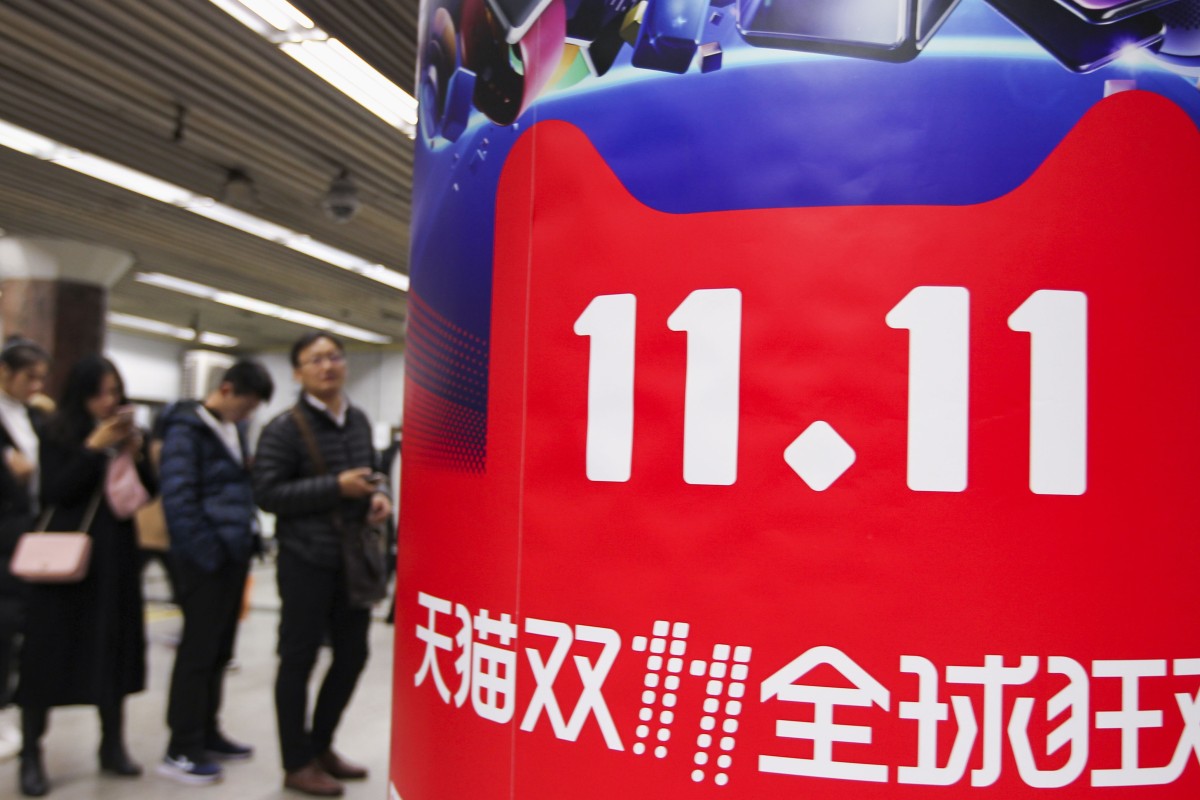
The Singles' Day is a holiday celebrated in China on November 11 and has become the largest online shopping day in the world. Photo: Simon Song
The Singles’ Day is a holiday celebrated in China on November 11 and has become the largest online shopping day in the world. Photo: Simon Song

China’s desire to launch the world’s first government-backed digital currency could see the possible rival to Facebook’s Libra be launched in time for November’s Singles’ Day online shopping festival despite a Chinese media report playing down the timing as “inaccurate speculation”.

Several central bank officials have publicly spoken out over the past several weeks about the need for China to launch its own digital currency since Facebook unveiled its plans for Libra, and the People’s Bank of China (PBOC) appear to be making rapid progress ahead of an expected launch.

Forbes magazine reported this week, citing a source who previously worked for the Chinese government, that China’s central bank could launch the digital currency as soon as November 11 as its bids to address financial risks and to counter the current dominance of the US dollar.

The PBOC did not respond to a faxed request for comment on the Forbes story, although Sina.com said that the report was “inaccurate speculation” citing an unnamed source close to the central bank.

China’s central bank is expected to distribute its digital currency through the big four state-owned banks – the Industrial and Commercial Bank of China, China Construction Bank, the Agricultural Bank of China, and the Bank of China – and mobile payments systems Alipay and WeChat Pay, as well as UnionPay, the state-supported credit card provider, according to the Forbes report. Alibaba is the owner of the South China Morning Post.
Ma Changchun, deputy chief of the Payment and Settlement Division of the PBOC, said at the start of August that a digital currency prototype existed and that the central banks’ Digital Money Research Group had already fully adopted blockchain architecture to ensure its use in retail transactions.

“The People’s Bank digital currency can now be said to be ready,” said Ma on August 11.

The People’s Bank digital currency can now be said to be ready Ma Changchun
Former central bank governor Zhou Xiaochuan said last month that, in addition to central banks, “commercial entities” should be allowed to issue banknotes backed by their own private currency assets, although he did not elaborate on what kind of “commercial entities” might be appropriate to issue a digital currency in China.

China is also ready to make Shenzhen a pilot zone for digital currency as part of plans for the city to become a socialist model city, according to a statement summarising a meeting between the Shenzhen party secretary Wang Weizhong and central bank governor Yi Gang released on Thursday.

The PBOC implemented a blanket crackdown in China on trading of cryptocurrency, including bitcoin, which are not backed by any government, viewing them as risks to China’s financial stability and security. At the same time, in 2014 the central bank created its own academy to study digital currencies and the related blockchain technology.

Neil Woodfine, director of marketing at blockchain start-up Blockstream, said a digital currency created by the PBOC would be “just like cash” and “would be fully controlled by the central bank.”

“If it’s digital instead of physical, they can close accounts and monitor all activities [in the entire financial system]. Commercial bank deposits are difficult for them to monitor, control or pull information out of for verification because the numbers are in each bank’s data centre,” Woodfine said.

Wang Xin, director of the central bank’s research bureau, said last month that

Facebook’s plans 

to create its own digital currency have pushed Beijing to speed up its own digital currency plan as Libra could potentially pose a challenge to Chinese cross-border payments, monetary policy and even financial sovereignty.

Leonhard Weese, the president of the Bitcoin Association of Hong Kong, said that a government-backed digital currency may enhance the PBOC’s control of China’s monetary system, cutting reliance on commercial banks to transmit changes in monetary policy.
“It would be similar to just killing the commercial banks,” Weese said.
Facebook’s Libra,

which would be a non-sovereign digital currency controlled by a Swiss-based company, has come under intense scrutiny by regulators and central banks worldwide. Last month, the Group of Seven industrialised nations, known as the G7, called for urgent regulatory measures and other types of action to address serious concerns over Libra.
Central banks, however, have expressed interest in launching their own digital currencies to counter the US dollar and to gain more control of their own monetary systems.
Mark Carney, governor of the Bank of England, argued last week that the US dollar, the current dominant reserve currency, could be replaced by a global digital alternative to tackle ultra-low interest rates.
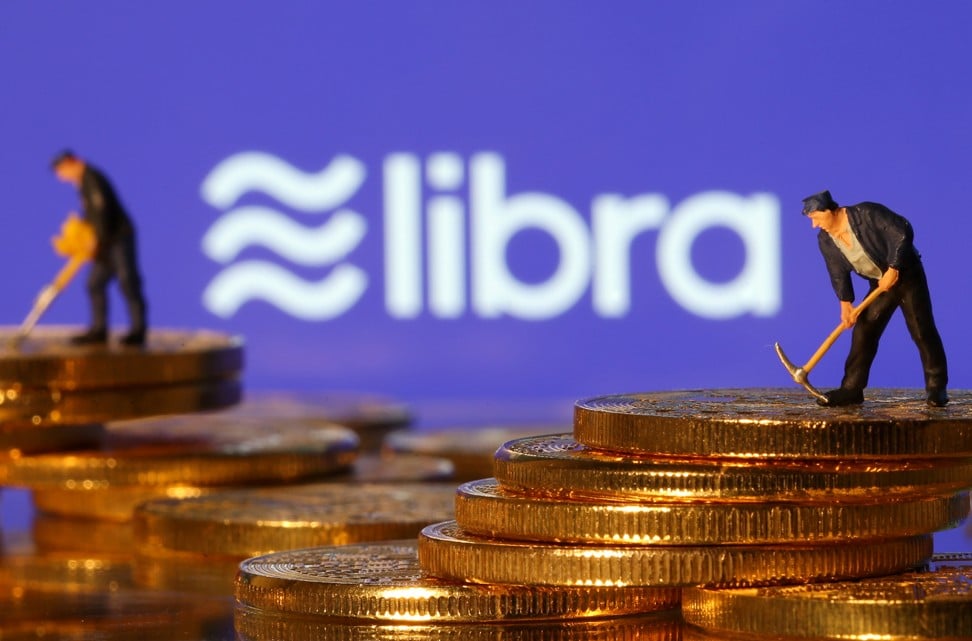
Facebook’s Libra, which is expected to be launched next year, will be pegged to a basket of convertible currencies – so it could serve as a stable online currency – while its payments will be endorsed by Visa and Mastercard. Photo: Reuters

A digital currency “could dampen the domineering influence of the US dollar on global trade”, Carney said last week at the US Federal Reserve’s annual conference, adding that a digital currency has the edge to counter shocks emanating from the US through trade and exchange rates.

Daniel Wang, chief executive and co-founder of blockchain start-up Loopring, said that a Chinese government-backed digital currency may provide a new way for the yuan to compete globally.

“If the central bank wants to increase the global competitiveness of the yuan through its digital currency, only an open and standard-based competitor carries any hope,” said Wang.

A digital yuan would “remain a sovereign currency under a centralised sovereign,” continuing to require the trust from users in the Chinese central bank and government institutions behind it, Wang added.

Alfred Schipke, senior resident representative for China at the International Monetary Fund (IMF), said that the bank is “open” to digital currencies, including the one being developed by China’s central bank.
The IMF in principle is looking at these things favourably. It’s a two-way process where we learn from China, which is often at the forefront of development. Alfred Schipke

“We don’t have a specific view on a particular currency, we haven’t looked at the details of the latest proposals from China,” Schipke said on Thursday. “The IMF in principle is looking at these things favourably. It’s a two-way process where we learn from China, which is often at the forefront of development.”
Blockstream’s Woodfine said that Beijing’s move also reflects a growing concerns among central banks that a financial disaster is on the horizon.
The 30-year US Treasury bond yield fell to an all-time low 1.976 per cent on Thursday, while yields around the world also plunged to multi-year or record low, triggering rising fears over a global recession.
Central banks around have also been driving down interest rates, with the PBOC recently unveiling a key interest rate reform that effectively cuts borrowing costs for companies to boost its slowing economy.
“We’ll see a move by governments and central banks to take back control over the financial system and use that power to direct their economies, continuing to pump money into the system to keep it afloat,” Woodfine added.
“A digital currency would be the perfect channel for helicopter money,” he said in reference to the idea that a central bank could stimulate the economy by giving out large quantities of money to the public, as if dumped from the sky. “They can send out free money to consumers.”
Source: SCMP
24/07/2019

India turns to electric vehicles to beat pollution

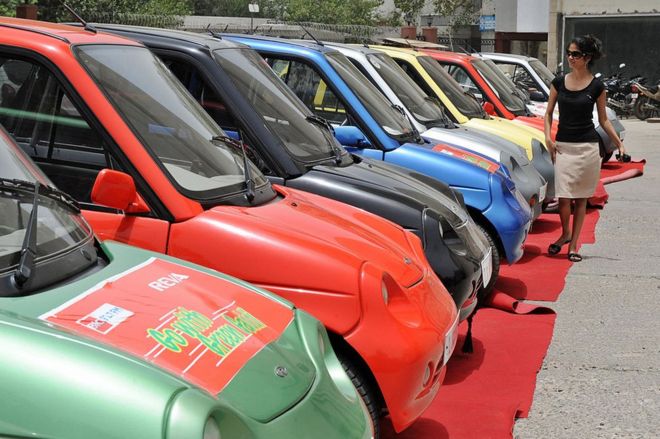
An Indian woman walks past a line of electric Reva motorcars prior to a Reva car rally held to celebrate World Environment Day in New Delhi on June 5, 2009.Image copyright GETTY IMAGES
Image caption India wants to move to 30% electric cars by 2030

India is making a big push for electric vehicles, signalling a turning point in its clean energy policy, writes energy writer Vandana Gombar.

In 2017, Transport Minister Nitin Gadkari shocked the automobile industry (and the world) when he announced that he intended for India to move to 100% electric cars by 2030.

“I am going to do this, whether you like it or not. And I am not going to ask you. I will bulldoze it,” he said at an industry conference.

That was an ambitious target given that even the UK and France were hoping to phase out conventional combustion-engine cars only by 2040.

Mr Gadkari and his Bharatiya Janata Party or BJP-led government eventually diluted their plans for electric passenger cars – from 100% the target is now down to 30%.

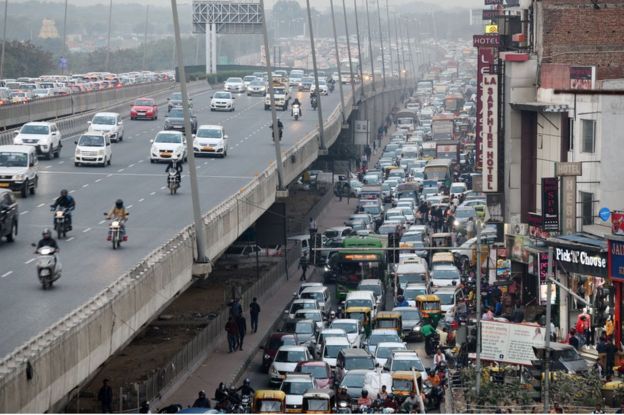
Traffic jams in Delhi, the capital of India on December 2, 2018 in Delhi, India.Image copyright GETTY IMAGES
Image caption India has some of the world’s most polluted cities, including Delhi

A pushback by the industry and the fear of job losses were among the reasons for the government to do so.

The government has now decided to focus on the segment below cars: two-wheelers, where sales are much higher, and three-wheelers (largely auto-rickshaws).

In the financial year that ended in March, about 3.4 million passenger cars were sold in the country against 21.2 million two-wheelers, according to data released by Indian automobile manufacturers. The number of three-wheelers sold totalled 0.7 million.

The new proposal is to have only electric three-wheelers operating in the country by 2023, and only electric two-wheelers by 2025.

The government seems to have two dominant objectives – to control pollution and take the lead in an emerging industry.

Media caption How an electric car can make money

India wants to become a “global hub of manufacturing of electric vehicles”, Finance Minister Nirmala Sitharaman said in her budget speech earlier this month. The Economic Survey, a government forecast, released a day before the budget envisaged an Indian city possibly emerging as the “Detroit of electric vehicles” in the future.

But it will be a challenge to create a competitive advantage in electric vehicle manufacturing, or even a market for them, given that India does not have the infrastructure or deep pockets that the world’s current leader in electric mobility, China, has.

China is the world’s largest electric vehicle market. It has the world’s largest network of charging stations for such vehicles and is also the world’s largest manufacturer of batteries. And according to recent figures, sales of New Energy Vehicles (NEVs) – including electric and hybrid models – increased substantially in 2018 in China.

Presentational grey line

Read more stories from India

Presentational grey line

The American electric carmaker, Tesla, is setting up a manufacturing plant in Shanghai that is expected to be operational by the end of 2019.

India can perhaps learn a few lessons from China. The authorities there spurred sales partly by placing caps on the number of conventional combustion vehicles that can be sold in its most congested and polluted cities. Beijing has also limited the number of electric vehicles that can be sold. Further, car manufacturers now have to ensure that a specified share of their production is of so-called zero emission vehicles.

Another inspiration for India could be Norway, where electric vehicles accounted for half of last year’s total car sales. A phase-out of combustion vehicles in the country is planned by 2025.

Media caption Why is Norway the land of electric cars?

But there are many encouraging signs in India too.

For one, charging stations are being built at government offices, malls and even within neighbourhoods. Government-owned power companies such as Bharat Heavy Electricals and Energy Efficiency Services plan to begin rolling out charging stations soon. The latter is looking at 10,000 stations over the next two years.

Second, electric vehicle models are proliferating. Hyundai launched its electric Kona car in India in July and Nissan is expected to launch its Leaf model soon. Indian carmakers Mahindra & Mahindra and Tata Motors both sell electric cars.

There are already several models of electric two-wheelers, and bike-sharing companies like Bounce are also going electric. Electric buses too can be spotted in many cities, partly fuelled by incentives. India’s capital, Delhi, is expected to have 1,000 electric buses running on its roads soon.

Even taxi-hailing apps and home delivery services have taken to ferrying parcels and passengers on electric bikes. After a pilot run with electric cabs, Indian ride-hailing giant Ola is now focussing on electric bikes and three-wheelers.

Instead of charging batteries, which could be a time-consuming task, it intends to opt for a battery swapping model where a fully charged battery would quickly replace the discharged one at swapping stations. Bounce too is experimenting with battery swaps.

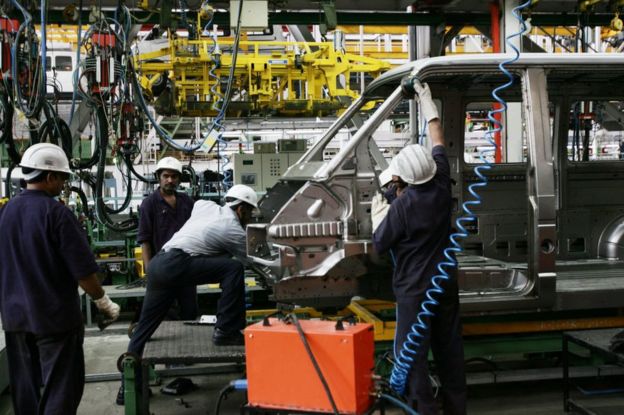
Workers at a Tata Motors assembling plant in Pimpri, India.Image copyright GETTY IMAGES
Image caption India sold 3.4 million passenger cars this past financial year

The government is also planning to offer incentives for manufacturing electric vehicles and batteries to boost economic growth and encourage local manufacturing under its Make in India initiative.

The falling cost of batteries could boost India’s electric mobility plans, and make it that much easier for electric vehicles to be competitive with those running on other fuels. And there is the added bonus of cleaner air.

That would push India towards electric mobility in its own unique style and at its own unique pace.

Source: The BBC

Law of Unintended Consequences

continuously updated blog about China & India

ChiaHou's Book Reviews

continuously updated blog about China & India

What's wrong with the world; and its economy

continuously updated blog about China & India