Archive for ‘top diplomat’

07/05/2020

Trump says coronavirus worse ‘attack’ than Pearl Harbor

US President Donald Trump has described the coronavirus pandemic as the “worst attack” ever on the United States, pointing the finger at China.

Mr Trump said the outbreak had hit the US harder than the Japanese bombing of Pearl Harbor in World War Two, or the 9/11 attacks two decades ago.

His administration is weighing punitive actions against China over its early handling of the global emergency.

Beijing says the US wants to distract from its own response to the pandemic.

Since emerging in the Chinese city of Wuhan in December, the coronavirus is confirmed to have infected 1.2 million Americans, killing more than 73,000.

What did President Trump say?

Speaking to reporters in the Oval Office of the White House on Wednesday, Mr Trump said: “We went through the worst attack we’ve ever had on our country, this is worst attack we’ve ever had.

“This is worse than Pearl Harbor, this is worse than the World Trade Center. There’s never been an attack like this.

“And it should have never happened. Could’ve been stopped at the source. Could’ve been stopped in China. It should’ve been stopped right at the source. And it wasn’t.”
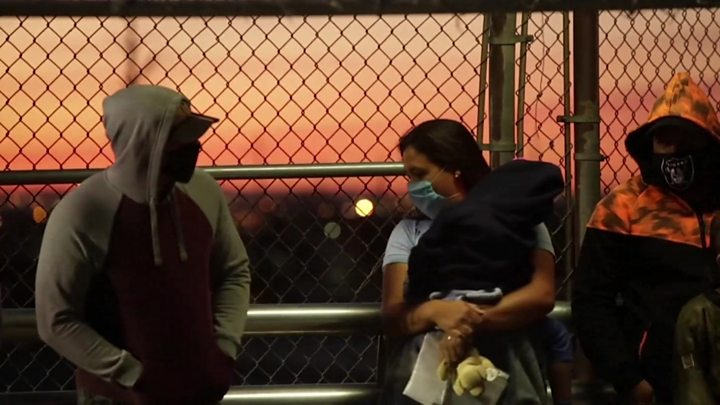
Media caption Life for asylum seekers in lockdown on the US-Mexico border

Asked later by a reporter if he saw the pandemic as an actual act of war, Mr Trump indicated the outbreak was America’s foe, rather than China.

“I view the invisible enemy [coronavirus] as a war,” he said. “I don’t like how it got here, because it could have been stopped, but no, I view the invisible enemy like a war.”
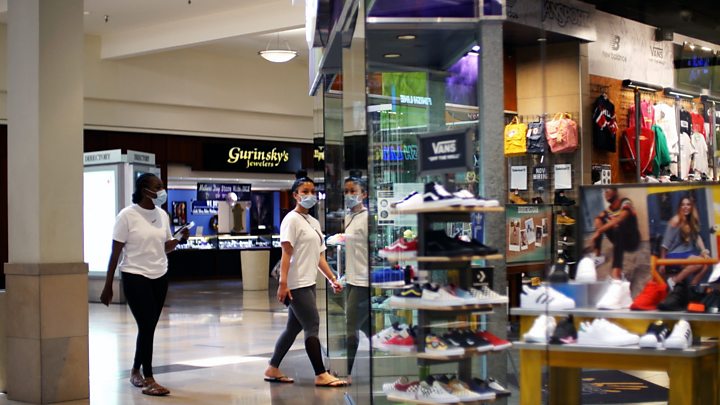
Media caption US shopping centres re-open: ‘This is the best day ever’

Who else in Trump’s team is criticising China?

The deepening rift between Washington and Beijing was further underscored on Wednesday as Secretary of State Mike Pompeo renewed his rhetoric against China, accusing it of covering up the outbreak.

He stuck by his so far unsubstantiated charge that there is “enormous evidence” the coronavirus hatched in a Chinese laboratory, even while acknowledging there is still uncertainty about its origins.

“Those statements are both true,” America’s top diplomat told the BBC. “We don’t have certainty and there is significant evidence that it came from a lab.”

Chinese state media accused him of lying.

One of the most trusted US public health experts has said the best evidence indicates the virus was not made in a lab.

Dr Anthony Fauci, a member of Mr Trump’s coronavirus task force, said on Monday the illness appeared to have “evolved in nature and then jumped species”.

Why is the US blaming China?

President Trump faces a tough re-election campaign in November, but the once humming US economy – which had been his main selling point – is currently in a coronavirus-induced coma.

A Pew opinion survey last month found that two-thirds of Americans, a historic high, view China unfavourably. But roughly the same margin of poll respondents said they believed Mr Trump acted too slowly to contain the pandemic.

As Mr Trump found his management of the crisis under scrutiny, he began labelling the outbreak “the China virus”, but dropped that term last month days before speaking by phone with Chinese President Xi Jinping.

Both Mr Trump and his likely Democratic challenger, Joe Biden, appear to be fastening on to China’s unpopularity as an election issue, with each accusing the other of being a patsy for America’s primary economic competitor.

As the coronavirus began spreading in the US back in January, Mr Trump signed phase one of a trade deal with China that called a truce in their tariff war. The US president’s hopes of sealing a more comprehensive phase two deal are now in limbo because of the pandemic.
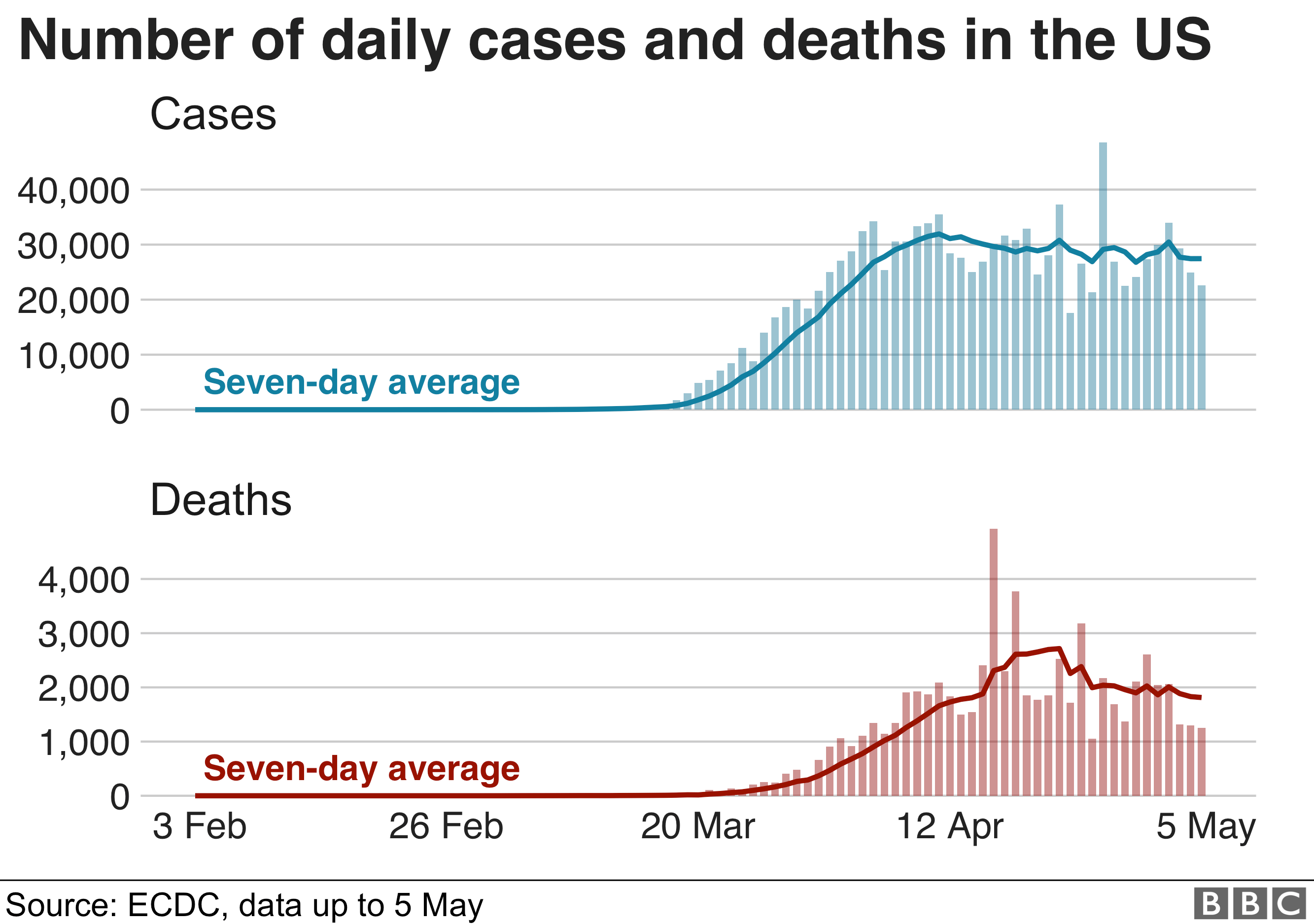
graph showing deaths and cases in the US

Source: The BBC

22/02/2019

Saudi Arabia strikes $10 billion China deal, talks de-radicalisation with Xi

BEIJING (Reuters) – Saudi Crown Prince Mohammed bin Salman cemented a $10 billion (7.7 billion pounds) deal for a refining and petrochemical complex in China on Friday, meeting Chinese President Xi Jinping who urged joint efforts to counter extremism and terror.

The Saudi delegation, including top executives from state-owned oil company Saudi Aramco, arrived on Thursday on an Asia tour that has already seen the kingdom pledge investment of $20 billion in Pakistan and seek to make additional investments in India’s refining industry.

Saudi Arabia signed 35 economic cooperation agreements with China worth a total of $28 billion at a joint investment forum during the visit, Saudi state news agency SPA said.

“China is a good friend and partner to Saudi Arabia,” President Xi Jinping told the crown prince in front of reporters.

“The special nature of our bilateral relationship reflects the efforts you have made,” added Xi, who has made stepping up China’s presence in the Middle East a key foreign policy objective, despite its traditional low-key role there.

The crown prince said Saudi Arabia’s relations with China dated back “a very long time in the past”.

“In the hundreds, even thousands, of years, the interactions between the sides have been friendly. Over such a long period of exchanges with China, we have never experienced any problems with China,” he said.

Crown Prince Mohammed, who has come under fire in the West following the murder of Saudi journalist Jamal Khashoggi at the kingdom’s Istanbul consulate in October, said Saudi Arabia saw great opportunities with China.

“The Silk Road initiative and China’s strategic orientation are very much in line with the kingdom’s Vision 2030,” he said according to SPA, referring to Saudi Arabia’s sweeping economic reform programme.


Trade between the countries increased by 32 percent last year, he said.

China has had to step carefully in relations with Riyadh, since Beijing also has close ties with Saudi Arabia’s regional foe, Iran.

China is also wary of criticism from Muslim countries about its camps in the heavily Muslim far western region of Xinjiang, which the government says are for de-radicalisation purposes and rights groups call internment camps.

Xi told the crown prince the two countries must strengthen international cooperation on de-radicalisation to “prevent the infiltration and spread of extremist thinking”, Chinese state television said.

Saudi Arabia respected and supported China’s right to protect its own security and take counter-terror and de-radicalisation steps, the crown prince told Xi, according to the same report, and was willing to increase cooperation.

Meeting the crown prince earlier on Friday, Chinese Vice Premier Han Zheng said the two countries should enhance exchanges on their experiences in de-radicalisation, China’s official Xinhua news agency said in a separate report.

Chinese state media made no direct mention of Xinjiang in their stories on the crown prince’s meetings.

DEALS SIGNED

Aramco agreed to form a joint venture with Chinese defence conglomerate Norinco to develop a refining and petrochemical complex in the northeastern Chinese city of Panjin, saying the project was worth more than $10 billion.

The partners would form a company called Huajin Aramco Petrochemical Co as part of a project that would include a 300,000-barrels per day (bpd) refinery with a 1.5-million-metric tonnes per year ethylene cracker, Aramco said.

Aramco will supply up to 70 percent of the crude feedstock for the complex, which is expected to start operations in 2024.

The investments could help Saudi Arabia regain its place as the top oil exporter to China, a position Russia has held for the last three years. Saudi Aramco is set to boost market share by signing supply deals with non-state Chinese refiners.

Aramco also signed an agreement to buy a 9 percent stake in Zhejiang Petrochemical, Saudi state news agency SPA said. This formalised a previously announced plan to gain a stake in a 400,000-bpd refinery and petrochemicals complex in Zhoushan, south of Shanghai.

China sees “enormous potential” in Saudi Arabia’s economy and wants more high-tech cooperation, State Councillor Wang Yi, the Chinese government’s top diplomat, said on Thursday.

But China was not seeking to play politics in the Middle East, the widely read state-run tabloid, the Global Times, said in an editorial.

“China won’t be a geopolitical player in the Middle East. It has no enemies and can cooperate with all countries in the region,” said the paper, published by the ruling Communist Party’s official People’s Daily.

“China’s increasing influence in the Middle East comes from pure friendly cooperation. Such a partnership will be welcomed by more countries in the Middle East.”

Source: Reuters

Law of Unintended Consequences

continuously updated blog about China & India

ChiaHou's Book Reviews

continuously updated blog about China & India

What's wrong with the world; and its economy

continuously updated blog about China & India