Archive for ‘town’

25/04/2020

Coronavirus: China’s belt and road plan may take a year to recover from slower trade, falling investment

  • But trade with partner countries might not be as badly affected as with countries elsewhere in the world, observers say
  • China’s trade with belt and road countries rose by 3.2 per cent in the January-March period, but second-quarter results will depend on how well they manage to contain the pathogen, academic says
China’s investment in foreign infrastructure as part of its Belt and Road Initiative has been curtailed because of the coronavirus pandemic. Photo: Xinhua
The coronavirus pandemic is set to cause a slump in Chinese investment in its signature

Belt and Road Initiative

and a dip in trade with partner countries that could take a year to overcome, analysts say.

But the impact of the health crisis on China’s economic relations with nations involved in the ambitious infrastructure development programme might not be as great as on those that are not.
China’s total foreign trade in the first quarter of 2020 fell by 6.4 per cent year on year, according to official figures from Beijing.
Trade with the United States, Europe and Japan all dropped in the period, by 18.3, 10.4 and 8.1 per cent, respectively, the commerce ministry said.
By comparison, China’s trade with belt and road countries increased by 3.2 per cent in the first quarter, although the growth figure was lower than the 10.8 per cent reported for the whole of 2019.
China’s trade with 56 belt and road countries – located across Africa, Asia, Europe and South America – accounts for about 30 per cent of its total annual volume, according to the commerce ministry.

Despite the first-quarter growth, Tong Jiadong, a professor of international trade at Nankai University in Tianjin, said he expected China’s trade with belt and road countries to fall by between 2 and 5 per cent this year.

His predictions are less gloomy than the 13 to 32 per cent contraction in global trade forecast for this year by the World Trade Organisation.

“A drop in [China’s total] first-quarter trade was inevitable but it slowly started to recover as it resumed production, especially with Southeast Asian, Eastern European and Arab countries,” Tong said.

“The second quarter will really depend on how the epidemic is contained in belt and road countries.”

Nick Marro, Hong Kong-based head of global trade at the Economist Intelligence Unit, said he expected China’s total overseas direct investment to fall by about 30 per cent this year, which would be bad news for the belt and road plan.

“This will derive from a combination of growing domestic stress in China, enhanced regulatory scrutiny over Chinese investment in major international markets, and weakened global economic prospects that will naturally depress investment demand,” he said.

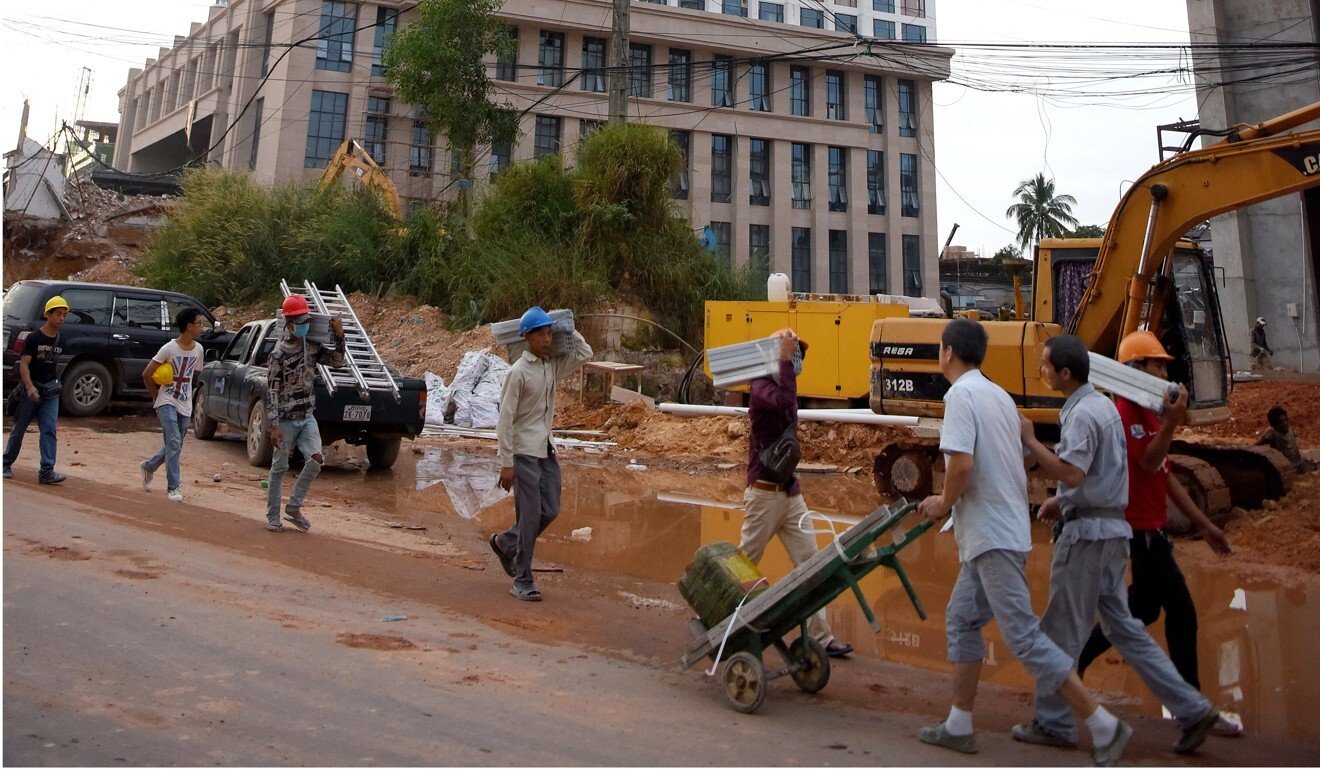
The development of the Chinese built and operated special economic zone in the Cambodian town of Sihanoukville is reported to have slowed, while infrastructure projects in Bangladesh, including the Payra coal-fired power plant, have been put on hold.

The development of the Chinese built and operated special economic zone in the Cambodian town of Sihanoukville is reported to have slowed. Photo: AFP
Marro said the reduction of capital and labour from China might complicate other projects for key belt and road partner, like Pakistan, which is home to infrastructure projects worth tens of billions of US dollars, and funded and built in large part by China.

“Pakistan looks concerning, particularly in terms of how we’ve assessed its sovereign and currency risk,” Marro said.

“Public debt is high compared to other emerging markets, while the coronavirus will push the budget deficit to expand to 10 per cent of GDP [gross domestic product] this year.”

Last week, Pakistan asked China for a 10-year extension to the repayment period on US$30 billion worth of loans used to fund the development of infrastructure projects, according to a report by local newspaper Dawn.

China’s overseas investment has been falling steadily from its peak in 2016, mostly as a result of Beijing’s curbs on capital outflows.

Last year, the direct investment by Chinese companies and organisations other than banks in belt and road countries fell 3.8 per cent from 2018 to US$15 billion, with most of the money going to South and Southeast Asian countries, including Singapore, Vietnam, Indonesia and Pakistan.

Tong said the pandemic had made Chinese investors nervous about putting their money in countries where disease control measures were becoming increasingly stringent, but added that the pause in activity would give all parties time to regroup.

“Investment in the second quarter will decline and allow time for the questions to be answered,” he said.

“Past experience along the belt and road has taught many lessons to both China and its partners, and forced them to think calmly about their own interests. The epidemic provides both parties with a good time for this.”

Dr Frans-Paul van der Putten, a senior research fellow at Clingendael Institute in the Netherlands, said China’s post-pandemic strategy for the belt and road in Europe
might include a shift away from investing in high-profile infrastructure projects like ports and airports.
Investors might instead cooperate with transport and logistics providers rather than invest directly, he said.
“Even though in the coming years the amount of money China loans and invests abroad may be lower than in the peak years around 2015-16, I expect it to maintain the belt and road plan as its overall strategic framework for its foreign economic relations,” he said.
Source: SCMP
09/04/2020

Pass the salt: The minute details that helped Germany build virus defences

MUNICH (Reuters) – One January lunchtime in a car parts company, a worker turned to a colleague and asked to borrow the salt.

As well as the saltshaker, in that instant, they shared the new coronavirus, scientists have since concluded.

That their exchange was documented at all is the result of intense scrutiny, part of a rare success story in the global fight against the virus.

The co-workers were early links in what was to be the first documented chain of multiple human-to-human transmissions outside Asia of COVID-19, the disease caused by the coronavirus.

They are based in Stockdorf, a German town of 4,000 near Munich in Bavaria, and they work at car parts supplier Webasto Group. The company was thrust under a global microscope after it disclosed that one of its employees, a Chinese woman, caught the virus and brought it to Webasto headquarters. There, it was passed to colleagues – including, scientists would learn, a person lunching in the canteen with whom the Chinese patient had no contact.

The Jan. 22 canteen scene was one of dozens of mundane incidents that scientists have logged in a medical manhunt to trace, test and isolate infected workers so that the regional government of Bavaria could stop the virus from spreading.

That hunt has helped Germany win crucial time to build its COVID-19 defences.

The time Germany bought may have saved lives, scientists say. Its first outbreak of locally transmitted COVID-19 began earlier than Italy’s, but Germany has had many fewer deaths. Italy’s first detected local transmission was on Feb. 21. By then Germany had kicked off a health ministry information campaign and a government strategy to tackle the virus which would hinge on widespread testing. In Germany so far, more than 2,100 people have died of COVID-19. In Italy, with a smaller population, the total exceeds 17,600.

CHART: Contrasting curves reut.rs/3c2UZA4

“We learned that we must meticulously trace chains of infection in order to interrupt them,” Clemens Wendtner, the doctor who treated the Munich patients, told Reuters.

Wendtner teamed up with some of Germany’s top scientists to tackle what became known as the ‘Munich cluster,’ and they advised the Bavarian government on how to respond. Bavaria led the way with the lockdowns, which went nationwide on March 22.

Scientists including England’s Chief Medical Officer Chris Whitty have credited Germany’s early, widespread testing with slowing the spread of the virus. “‘We all know Germany got ahead in terms of its ability to do testing for the virus and there’s a lot to learn from that,’” he said on TV earlier this week.

Christian Drosten, the top virologist at Berlin’s Charite hospital, said Germany was helped by having a clear early cluster. “Because we had this Munich cohort right at the start … it became clear that with a big push we could inhibit this spreading further,” he said in a daily podcast for NDR radio on the coronavirus.

Drosten, who declined to be interviewed for this story, was one of more than 40 scientists involved in scrutiny of the cluster. Their work was documented in preliminary form in a working paper at the end of last month, intended for The Lancet. The paper, not yet peer-reviewed, was shared on the NDR site.

ELECTRONIC DIARIES

It was on Monday, Jan. 27, that Holger Engelmann, Webasto’s CEO, told the authorities that one of his employees had tested positive for the new coronavirus. The woman, who was based in Shanghai, had facilitated several days of workshops and attended meetings at Webasto’s HQ.

The woman’s parents, from Wuhan, had visited her before she travelled on Jan. 19 to Stockdorf, the paper said. While in Germany, she felt unusual chest and back aches and was tired for her whole stay. But she put the symptoms down to jet lag.

She became feverish on the return flight to China, tested positive after landing and was hospitalised. Her parents also later tested positive. She told her managers of the result and they emailed the CEO.

In Germany, Engelmann said he immediately set up a crisis team that alerted the medical authorities and started trying to trace staff members who had been in contact with their Chinese colleague.

The CEO himself was among them. “Just four or five days before I received the news, I had shaken hands with her,” he said.

Now known as Germany’s “Case #0,” the Shanghai patient is a “long-standing, proven employee from project management” who Engelmann knows personally, he told Reuters. The company has not revealed her identity or that of others involved, saying anonymity has encouraged staff to co-operate in Germany’s effort to contain the virus.

The task of finding who had contact with her was made easier by Webasto workers’ electronic calendars – for the most part, all the doctors needed was to look at staff appointments.

“It was a stroke of luck,” said Wendtner, the doctor who treated the Munich patients. “We got all the information we needed from the staff to reconstruct the chains of infection.”

For example, case #1 – the first person in Germany to be infected by the Chinese woman – sat next to her in a meeting in a small room on Jan. 20, the scientists wrote.

Where calendar data was incomplete, the scientists said, they were often able to use whole genome sequencing, which analyses differences in the genetic code of the virus from different patients, to map its spread.

By following all these links, they discovered that case #4 had been in contact several times with the Shanghai patient. Then case #4 sat back-to-back with a colleague in the canteen.

When that colleague turned to borrow the salt, the scientists deduced, the virus passed between them. The colleague became case #5.

Webasto said on Jan. 28 it was temporarily closing its Stockdorf site. Between Jan. 27 and Feb. 11, a total of 16 COVID-19 cases were identified in the Munich cluster. All but one were to develop symptoms.

All those who tested positive were sent to hospital so they could be observed and doctors could learn from the disease.

Bavaria closed down public life in mid-March. Germany has since closed schools, shops, restaurants, playgrounds and sports facilities, and many companies have shut to aid the cause.

HAMMER AND DANCE

This is not to say Germany has defeated COVID-19.

Its coronavirus death rate of 1.9%, based on data collated by Reuters, is the lowest among the countries most affected and compares with 12.6% in Italy. But experts say more deaths in Germany are inevitable.

“The death rate will rise,” said Lothar Wieler, president of Germany’s Robert Koch Institute for infectious diseases.

The difference between Germany and Italy is partly statistical: Germany’s rate seems so much lower because it has tested widely. Germany has carried out more than 1.3 million tests, according to the Robert Koch Institute. It is now carrying out up to 500,000 tests a week, Drosten said. Italy has conducted more than 807,000 tests since Feb. 21, according to its Civil Protection Agency. With a few local exceptions, Italy only tests people taken to hospital with clear and severe symptoms.

Germany’s government is using the weeks gained by the Munich experience to double the number of intensive care beds from about 28,000. The country already has Europe’s highest number of critical care beds per head of the population, according to a 2012 study.

Even that may not be enough, however. An Interior Ministry paper sent to other government departments on March 22 included a worst-case scenario with more than 1 million deaths.

Another scenario saw 12,000 deaths – with more testing after partial relaxation of restrictions. That scenario was dubbed “hammer and dance,” a term coined by blogger Tomas Pueyo. It refers to the ‘hammer’ of quick aggressive measures for some weeks, including heavy social distancing, followed by the ‘dance’ of calibrating such measures depending on the transmission rate.

The German government paper argued that in the ‘hammer and dance’ scenario, the use of big data and location tracking is inevitable. Such monitoring is already proving controversial in Germany, where memories of the East German Stasi secret police and its informants are still fresh in the minds of many.

A subsequent draft action plan compiled by the government proposes the rapid tracing of infection chains, mandatory mask-wearing in public and limits on gatherings to help enable a phased return to normal life after Germany’s lockdown. The government is backing the development of a smartphone app to help trace infections.

Germany has said it will re-evaluate the lockdown after the Easter holiday; for the car parts maker at the heart of its first outbreak, the immediate crisis is over. Webasto’s office has reopened.

All 16 people who caught COVID-19 there have recovered.

Source: Reuters

09/04/2020

Coronavirus in Suifenhe: Remote border town locks down as China opens up

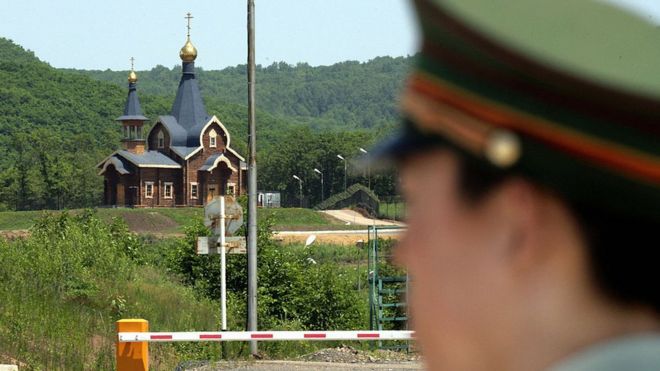
Guard at the Russian borderImage copyright AFP / GETTY
Image caption Suifenhe, where around 100,000 people live, has a road and rail crossing with Russia

A Chinese city on the Russian border is entering a “lockdown” due to an increase in coronavirus cases – even as the rest of China cautiously opens up.

In Suifenhe, 1,000 miles from Beijing, people have been ordered to stay indoors, with some exceptions.

The border is closed to people, although not goods, and a 600-bed isolation hospital is being built.

One business owner told the BBC she was “very scared” – but another local said he had confidence in the government.

What is the virus situation in Suifenhe?

On Wednesday, China reported 59 imported cases of Covid-19 across the whole country.

According to state media, 25 of them entered the country via Suifenhe – making the remote north-east crossing something of a hotspot.

The patients were all returning Chinese citizens who had flown from Moscow to Vladivostok, a Russian city around 100 miles south.

All the new patients were taken to hospital, with two in a serious condition.

In addition, another 86 people in Suifenhe – who came via the same route – were classed as “asymptomatic” but positive for the virus, which China counts separately.

What has Suifenhe done?

The border was closed to people on Tuesday, the local government said, although cargo can continue. Russia closed its border with China in February.

People in the city have been told to stay at home, although the lockdown isn’t as severe as Hubei province experienced. One person per house can shop for essentials every three days.

At the same time, the new hospital – in an existing building – is due to open this weekend, intended for patients with mild symptoms.

“Of course I’m very scared,” one woman who runs a bakery shop told the BBC.

“We don’t leave the house now. Many people already left the city. But we can’t do that, because we have a shop need to take care of.”

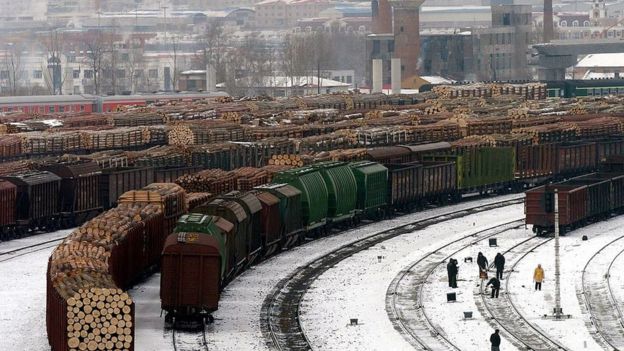
This picture from 2005 showed the extent of Russian timber exports passing through Suifenhe railway stationImage copyright SOVFOTO
Image caption This picture from 2005 showed the extent of Russian timber exports passing through Suifenhe railway station

Meanwhile, a member of staff at a restaurant in the city said it was normally their high season, with around 1,000 customers a day.

Instead, they were told to close earlier this week, with “no idea” when they can open again.

But the staff member was not critical of the government. He said the lockdown made him feel “secure” – and that he was “very confident” the government would look after the situation.

What is the situation in the rest of China?

China’s recorded rate of Covid-19 infections has slowed dramatically in recent weeks.

On Tuesday, it reported no new deaths for the first time since publishing daily figures in January.

On Thursday, it reported 63 cases – 61 imported from overseas – and just two new deaths.

The “flattening of the curve” has allowed restrictions to be lifted, and some normality to return.

On Wednesday, people were allowed to leave Wuhan – where the outbreak emerged – for the first time in 11 weeks if they were deemed virus-free.

There were 221 inbound and outbound flights, with more than 7,000 people leaving and 4,500 arriving. More than half a million used public transport, state media reported.

But although people from Wuhan can leave, they still face restrictions in other cities. In Beijing, for example, they will be tested upon arrival, according to local media.

Even if they pass, they will then be quarantined for 14 days – and tested again – before being released.

Source: The BBC

Law of Unintended Consequences

continuously updated blog about China & India

ChiaHou's Book Reviews

continuously updated blog about China & India

What's wrong with the world; and its economy

continuously updated blog about China & India