10/12/2019
- The Battle of Triangle Hill is known in China as a victory against foreign aggressors
- Film’s timing linked to deteriorating relations between Beijing and Washington on multiple fronts
A scene from the 1956 Chinese film Shang Gan Ling, about the Korean war Battle for Triangle Hill, subject of a new film which is about to go into production in China. Photo: Handout
One of the bloodiest battles of the Korean war is the subject of a film that will soon start production in China, in a move which is being linked to surging Chinese nationalism amid poor relations between Beijing and Washington.
The film, based on the Battle of Triangle Hill – also known as the Shang Gan Ling campaign in China – was given the green light by state regulator the China Film Administration in July, but was not reported by Chinese official media until last week.
Hou Jianwei, one of China’s best known war novelists, has been signed on as screenwriter for the film, to be produced by Ao Bo Film Zhejiang which confirmed on microblogging platform Weibo that production was already in “active preparation”.
“More than 100,000 people from the People’s Voluntary Army and forces from the US and South Korea took part in the 43-day fighting, and over 2.4 million shells of ammunition were fired. The battle was unprecedentedly fierce and 40,000 lives were lost,” the film company said in its most recent Weibo post.
“With a multitude of heroes, our army built up an impenetrable barrier in the East.”
China invokes Korean war talks as reason not to bow to US in trade dispute
News of the film has coincided with mounting confrontations between Beijing and Washington on multiple fronts ranging from trade and technology, to Hong Kong and Xinjiang.
Korean war-themed productions have long been a taboo subject for China’s heavily censored film industry, partly because of Beijing’s complicated relations with the US and North Korea.
But the 1950-53 war, in which China and North Korea battled Western forces led by the US, has increasingly become a tool to rally public opinion behind Beijing’s ongoing trade war with the US. Study Times, a Central Party School publication, for example, has directly likened the trade war to the end of the Korean conflict, saying China was determined to oppose US bullying as trade negotiations entered their 17th month.
While Beijing has never given an official account of its decision to join the Korean war, it is often portrayed as a necessary intervention to shield China from US aggression.
The Battle of Triangle Hill has often been presented in China’s official media as a victory by the “volunteers” of the People’s Liberation Army over foreign aggressors.
News of the production has raised avid discussion on Chinese social media, with many seeing the new film as part of China’s efforts to reinforce surging Chinese nationalism in the face of growing pressure from the West.
“Isn’t the approval [to make the film] a strong signal to the West that we are now a strong power?” one Weibo microblogger wrote.
Source: SCMP
Posted in against, Ao Bo Film, Beijing, boost, Central Party School publication, China Film Administration, China’s, foreign aggressors, Hong Kong, Korean, Korean War, Microblogging, nationalism, North Korea, People’s Voluntary Army, platform, poor relations, rare nod, seen, South Korea, Study Times, taboo subject, talks, The Battle of Triangle Hill, trade and technology, trade dispute, Uncategorized, US, victory, war film, Washington, Weibo, Xinjiang, Zhejiang |
Leave a Comment »
07/08/2019
- 46 countries agree protocol aimed at using mediation instead of legal action
- Singapore set to capitalise on the naming of the convention, at Hong Kong’s expense
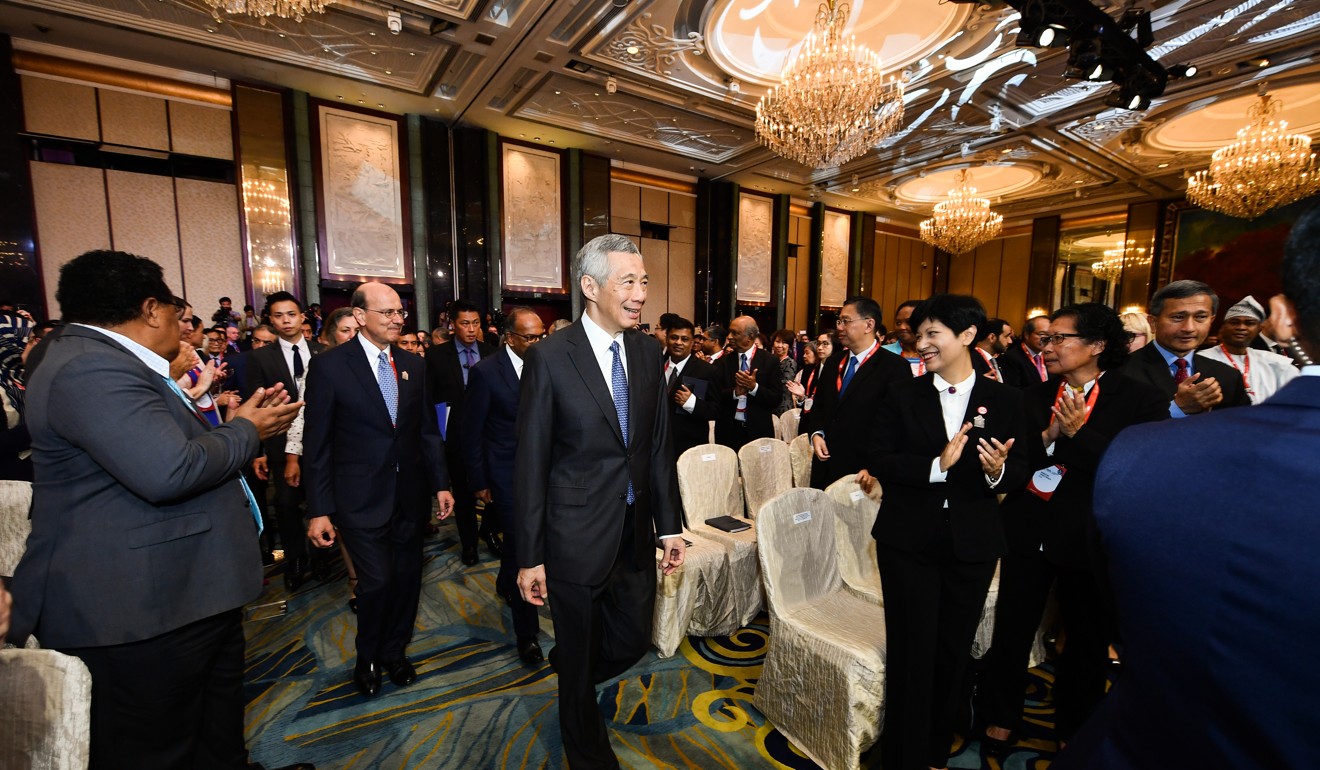
Singapore Prime Minister Lee Hsien Loong attends the signing ceremony of the Singapore Convention on Mediation. Photo: Handout
China and the United States have briefly put aside their escalating trade war and joined 44 other countries in signing a new global protocol on mediation aimed at settling cross-border trade and commercial disputes.
The
Singapore Convention, under the United Nations framework, will allow mediation agreements to be recognised and enforced in the courts of all 46 signatories, which include South Korea and India. European Union nations are expected to sign in the next phase.
It was agreed against a backdrop of ongoing tensions between China and the US over tariffs and currency manipulation, and a trade dispute between South Korea and Japan
Singapore Prime Minister Lee Hsien Loong addresses delegates at the Singapore Convention on Mediation event. Photo: Handout
Speaking at the signing ceremony, Singapore Prime Minister Lee Hsien Loong said the protocol demonstrated that countries are capable of achieving consensus through effort and creativity, and are open to binding commitments.
He also observed that the established world order of multilateralism is “under pressure”.
“Existing multilateral institutions are not perfect, many are in need of urgent reform, suffer from a loss of confidence, or have practices and structures that are no longer fit for purpose,” Lee said, without elaborating which bodies he was referring to.
He added that the solution would not be to abandon these bodies, but to improve them through reform and bringing them up to date.
“We must make sure they reflect current economic and political realities, and ready them to deal with the new issues created by the progress of technology and globalisation.”
Stephen Mathias, the UN’s assistant secretary-general for legal affairs, said the agreement helped unify mediation rules and remove uncertainty in enforcing mediation agreements.
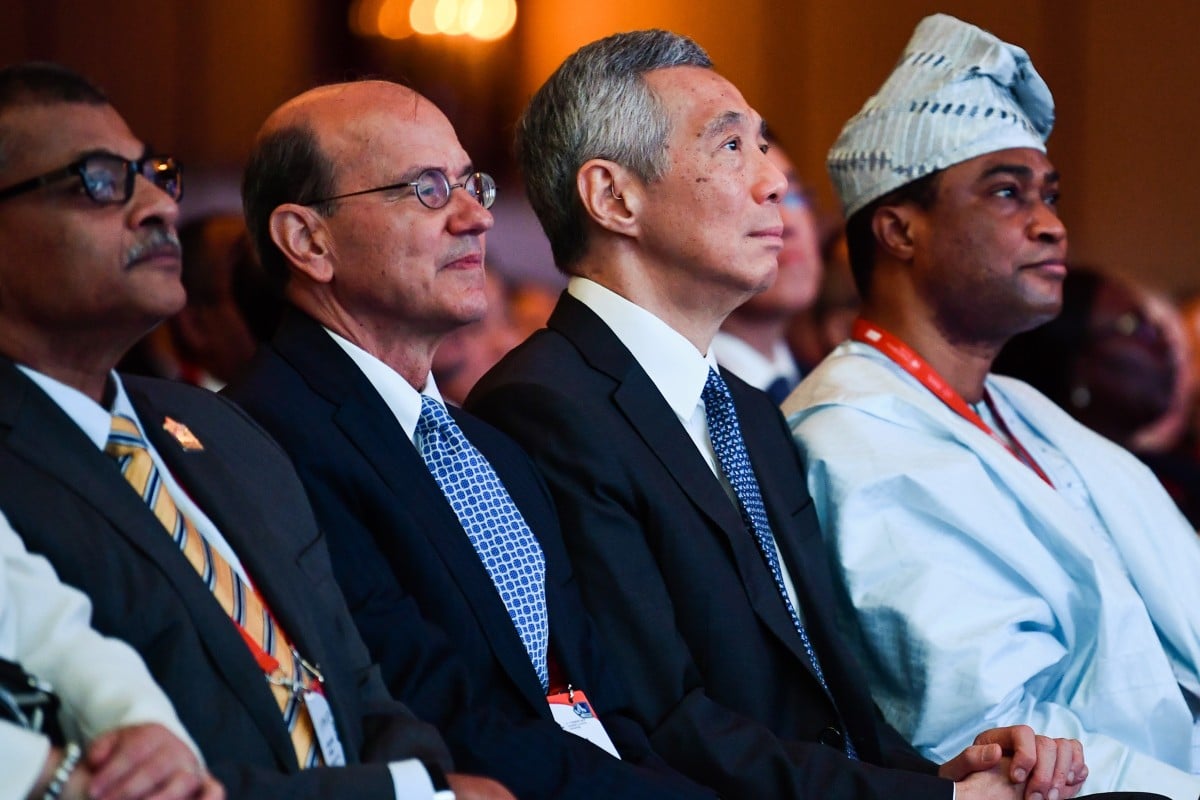
Delegates attend the signing ceremony of the Singapore Convention. Photo: Handout
The protocol contains standardised terms to apply mediation agreements across jurisdictions, and is expected to bolster the use of mediation rather than legal action to resolve trade disputes.
This rare example of international cooperation can be likened to the New York Convention on arbitration, which was adopted by the UN 60 years ago and is now applied by 160 countries.
Singapore has also capitalised on the naming of the convention, positioning itself as the legal hub in the region, in competition with Hong Kong.
The UN’s Commission on International Trade Law, for instance, has signed a memorandum to establish an academy in international dispute resolution in Singapore.
Hong Kong or Singapore: who to trust on belt and road disputes?
Mediators in Hong Kong said the convention only served to promote their rival city, as Hong Kong professionals remain competitive in the market.
“Lots of cases with a ‘Chinese element’ would pick Hong Kong,” said lawyer Christopher To Wing. “For instance, a US or British firm runs into a dispute with a Chinese firm, they will choose Hong Kong, as the city is close to China.”
But he conceded that more support and funding from the Hong Kong government is needed to catch up with similar promotion efforts by the Singapore government.
Source: SCMP
Posted in belt and road disputes, China alert, Commission on International Trade Law, Cross-border, European Union, Hong Kong, India alert, Lee Hsien Loong, mediation, sign, signing ceremony, Singapore Convention, Singapore Prime Minister, South Korea, tariffs and currency manipulation, trade and commercial disputes, trade dispute, UN protocol, UN’s assistant secretary-general for legal affairs, Uncategorized, United States, US |
Leave a Comment »




 CHINDIA ALERT: You'll be living in their world, very soon