Archive for ‘train journey’

05/07/2019

Rath Yatra: The legend behind world’s largest chariot festival

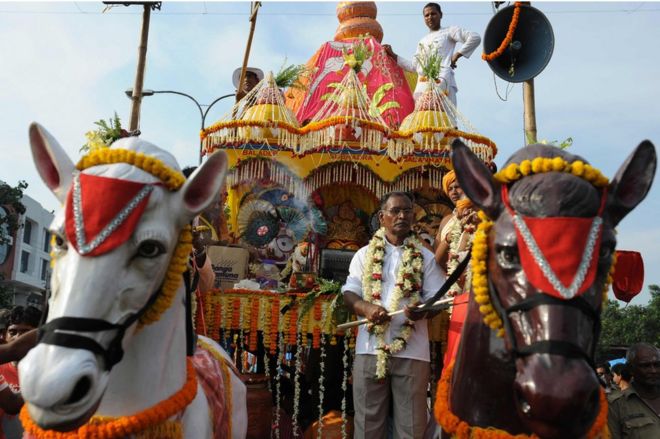
Indian devotees and members of the International Society for Krishna Consciousness (ISKCON) march alongside a chariot carrying a deity during the annual Rath Yatra Festival in Siliguri on June 24, 2009.Image copyright GETTY IMAGES
Image caption This journey is documented in undated Hindu sacred texts known as the Puranas written a few thousand years ago

One of India’s biggest religious festivals, the Jagannath Puri Rath Yatra, gets under way on Thursday. The festival is unique in that three Hindu gods are taken out of their temples in a colourful procession to meet their devotees. The BBC’s Priyanka Pathak explains the legend behind the festival and its significance.

The biggest of these processions takes place in Puri in the eastern state of Orissa, while the other takes place in the western state of Gujarat.

Believed to be the oldest Rath Yatra or chariot procession in the world, this festival marks the annual ceremonial procession of Lord Jagannath, his elder brother Balabhadra and younger sister Subhadra, from their home temple to another temple, located in what is believed to be their aunt’s home.

This journey is documented in undated Hindu sacred texts known as the Puranas which are believed to have been written a few thousand years ago.

What makes it so interesting?

This is the only festival in the world where deities are taken out of temples to travel to devotees, and it is also the largest chariot procession in the world.

Millions of people come to watch as a “king” sweeps the road with a golden mop and three massive 18-wheeled chariots bearing the sibling deities make their way through massive crowds. Their chariots, which are mini architectural marvels, are constructed over 42 days from over 4,000 pieces of wood by the only family that has the hereditary rights to make them.
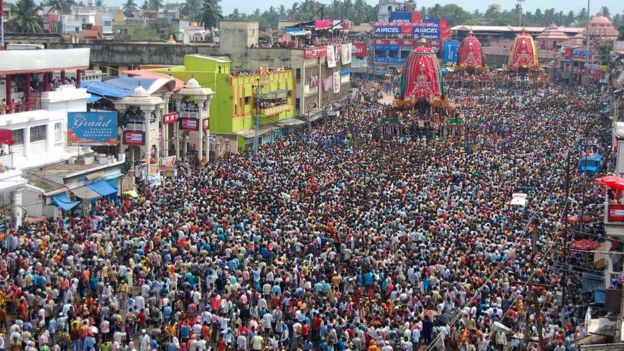
Devotees pull the chariots of Lord Jagannath, his brother Balabhadra and sister Devi Subhadra in front of the Lord Jagannath temple during the celebration of the �Rath Yatra� at Puri,Image copyright AFP

Legend says it always rains on the day of the procession. For a whole week before, the temple doors are shut and no one is allowed inside, because it is believed that the sibling deities have a fever after bathing in the sun with 108 pitchers of water. The breaking of their fever calls for a change of scene, which is why they go to their aunt’s home for a few days.

The size, pomp and splendour of this procession has even contributed a word to the English dictionary: Juggernaut.

What is the legend of the sibling deities?

Unlike the ornate, carefully crafted metal idols everywhere else, these three deities are fashioned from wood, cloth and resin. They are malformed with large heads and no arms: reminders of the legend of an impatient King.

The legend begins in different ways.

One speaks of an arrogant Indrayumna, King of Puri in the east, who tried to steal the Hindu god Krishna’s heart. It had been immersed in the legendary Dwarka sea after his cremation and had reappeared to the tribes people of the place as an idol. When Indrayumna tried to claim its possession, the idol disappeared. The repentant king sought absolution from Krishna by sanctifying him in another form.
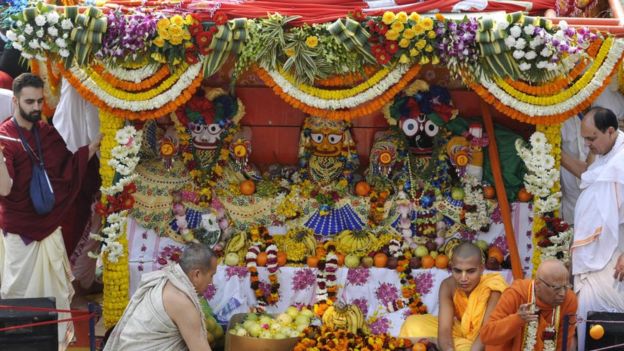
Devotees pull a chariot of Lord Jagannath, his brother Balabhadra and sister Subhadra during the Jagannath Rath Yatra, on February 17, 2019 in Noida, India.Image copyright GETTY IMAGES
Image caption Unlike the ornate, carefully crafted metal idols everywhere else, these three deities are fashioned from wood, cloth and resin

Another speaks of how Krishna’s grief-stuck siblings – his elder brother Balabhadra and younger sister Subhadra- rushed into the Dwarka sea carrying his half-cremated body. At the same moment, King Indrayumna dreamed that Krishna’s body had floated back up on his shores as a log.

The two legends merge here: Indrayumna decided to build a temple to house the log. His next task was to find someone to craft the idols from it. Legends say that Vishwakarma, God’s own architect, arrived as an old carpenter. He agreed to carve the idols, but on the condition that he was not to be disturbed. However, when he did not emerge from his workshop for weeks, going without food, water or rest, a worried and impatient King threw the door open.

At the time the images were only half-finished, but the carpenter disappeared. Still, believing the idols to be made from the very body of God, the King sanctified them and and placed them in the temple.

When the deities disintegrate, they are remade in the same half-done image with new wood every 12 years. They were last remade in 2015.

Why are there two rath yatras and how are they connected?

Dwarka in Gujarat – where Krishna’s half-cremated body is believed to have been immersed into the ocean – is located on the west coast of India and Puri in Orissa- where it is said to have re-emerged as a log – is located in the east.

About 500 hundred years ago, a travelling Hindu saint and temple priest of a Hanuman temple in Gujarat, Shree Sarangdasji, arrived in Puri to offer prayers at the historic Jagannathan temple.
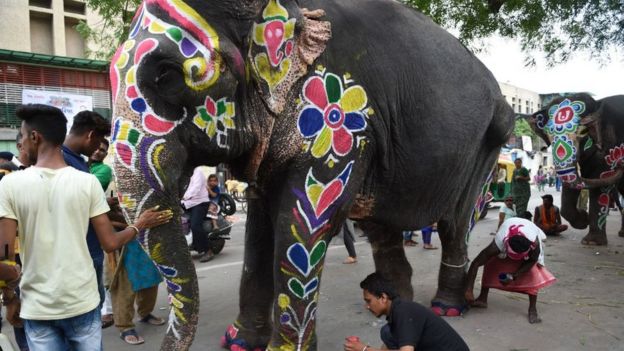
An Indian elephant is painted ahead of the annual Hindu festival Rath Yatra in Ahmedabad on July 3, 2019. - Rath Yatra, an annual Hindu festival, is scheduled to start on July 4 this year and will be led by some 15 elephantsImage copyright GETTY IMAGES

While sleeping at the temple guest house, it is believed that he received visionary instruction from Lord Jagannathan to go back to Ahmedabad in Gujarat and install three idols of Jagannathan, Balbhadra and Subhadra there. Carrying out the instructions received in his dream, he founded the Ahmedabad Jagannathan Temple.

By doing so, he sanctified the two locations – one where Krishna’s mortal remains began their journey from the west, to their transformation as Puri’s Lord Jagannathan in the east.

About 142 years ago, one of the founder’s disciples, Shree Narsinhdasji Maharaj, began the Ahmedabad Rath Yatra. The deities on chariots, pulled by elephants and humans, replicate their own journey in Puri, completing a set of rituals that sanctify the two places where Krishna’s mortal remains are believed to have come to rest.

What happens to the chariots and elephants after the journey?

At the end of the festival, the chariots are dismantled and their wood is used as fuel in the temple kitchens – believed to be the largest in the world that cook 56 things every day and feed anywhere between 2,000 to nearly 200,000 people.

The elephants are returned to the lands managed by the temple trusts to roam free – until the procession the following year.

This year’s festival was, however, marred by controversy over the elephants.

Following the death of some of the temple elephants in Gujarat, there was massive outcry over plans to replace them with elephants from the north-eastern state of Assam.

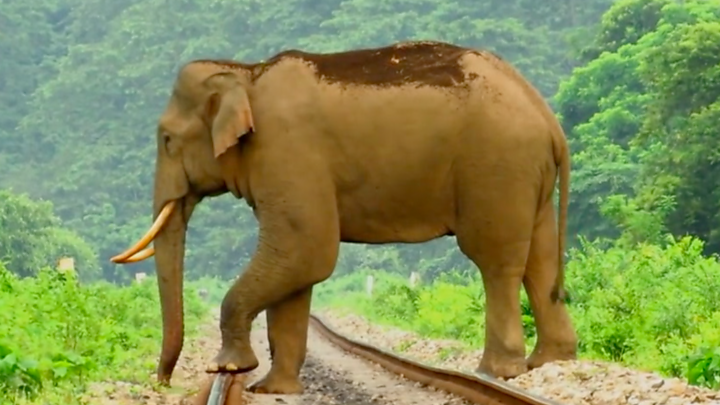
The four elephants would have had to make a perilous train journey of more than 3,100km (1,926 miles) in heatwave conditions to participate in the festival.

This decision was suspended by a wildlife official after activists went to court.


Source: The BBC
22/06/2019

Fears for elephants facing 1,900 mile train journey in India

Decorated elephants stand prior to the arrival of Gujarat state Chief Minister, Narendra Modi to offer prayers at the the Lord Jagannath Mandir in Ahmedabad on July 9, 2013Image copyright AFP
Image caption Decorated elephants lead the procession at the Jagannath temple’s annual festival in Ahmedabad

Animal rights activists in India have criticised a plan by the Assam state government to send four elephants on a perilous train journey of more than 3,100km (1,926 miles) to participate in a temple ritual. They say the long journey could be dangerous for the animals and may even kill them, writes the BBC’s Geeta Pandey in Delhi.

The elephants are to be moved from Tinsukia town in the north-eastern state of Assam to the extreme west of the country – Ahmedabad city in Gujarat state.

Reports say the railway authorities in Assam, who have been asked to make travel arrangements for the elephants, are looking for a coach to transport them.

No date is set for their departure yet, but they are expected to reach Ahmedabad before 4 July to participate in the annual Rath Yatra (chariot procession) at the Jagannath temple. The train journey is expected to take three to four days.

In previous years, Prime Minister Narendra Modi, who hails from Gujarat, has participated in the festival and the elephant procession, although temple officials say he’s not expected to attend this year.

Temple trustee Mahendra Jha told BBC Gujarati that they decided to “borrow” the animals from Assam “for two months” because three of their own elephants died from old age last year.

But activists and conservationists say the plan to move the elephants is “cruel and completely inhuman”, especially since temperatures are more than 40C (104F) in many places along the northern Indian route these elephants are expected to take.

Media caption Human-elephant conflict destroying lives in India

“Most of north-western India is reeling under a heatwave. There have been reports of people dying from heat during train journeys,” Kaushik Barua, a wildlife conservationist based in the Assam state capital, Guwahati, told the BBC.

“The wagon in which the elephants will be transported is not climate-controlled. It will be hitched to a passenger train which will be travelling at a speed of 100km/h (62mph), so can you imagine the plight of the animals?”

Mr Barua warns the journey may prove “dangerous” for the animals.

“They can suffer from heatstroke, from shock, and even die.”

Under the law, he says, there’s no problem moving these elephants since all the paperwork is in order, “but where’s the animal welfare?”

Also weighing in on the debate is the opposition Congress party MP from Assam, Gaurav Gogoi, who’s petitioned India’s Environment Minister Prakash Javadekar to intervene.

“Roughly half of the country is struggling through its worst drought in six decades…. These are extreme conditions for the elephants to travel… The elephants may suffer from acute skin infection and dehydration,” Mr Gogoi wrote in his letter on Thursday.

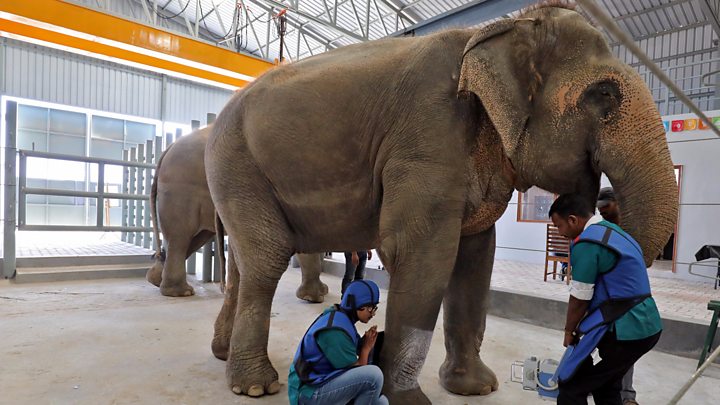
Media caption India’s first elephant hospital is run by the charity Wildlife SOS

“Therefore, I request the central government to intervene and instruct the state government to withdraw the decision as soon as possible.”

Elephants – both wild and captive – are a protected species in India and there are strict guidelines for their transportation, wildlife biologist Dr Bibhuti Prasad Lahkar told the BBC.

According to the rules, no elephant can be made to walk for more than 30km (18 miles) at a stretch or transported for more than six hours in one go.

The state’s wildlife officials, who’ve issued transit permits for the elephants, have so far refused to comment on the controversy. But after protests from activists and conservationists, “they have gone into a huddle, discussing a plan B,” according to a wildlife expert.

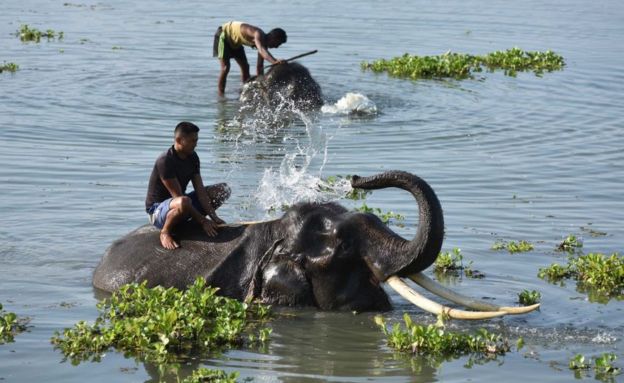
A mahout gives a bath to an elephant in a lake at Pobitora Wildlife Sanctuary on a hot summer day on June 05, 2018 in the Morigaon district, Assam, India.Image copyright GETTY IMAGES
Image caption Elephants are a protected species in India

“There’s some suggestion that the pachyderms may be moved in trucks to allow them the flexibility to stop if needed and that they could be accompanied by a forest department veterinarian to look after them,” he said.

Mr Barua, however, is blunt.

“Gujarat doesn’t need these elephants,” he says. “Wildlife laws prevent [the] display and exhibition of elephants. Laws ban performances by elephants in circuses, zoos are not allowed to exhibit them, so why should temples be allowed to use them in rituals or processions? Don’t elephants have rights?

“We worship Ganesha, the Elephant God. Why are the Gods then being put through such cruelty by a temple?”

Source: The BBC

03/02/2019

Xinhua Headlines: Moving China: The Spring Festival train journey now and then

Xinhua Headlines: Moving China: The Spring Festival train journey now and then

This combo photo shows attendants getting ready to work aboard the train K1/6 during the Spring Festival travel rush in Nanjing, east China’s Jiangsu Province in January of 1998 (top, photo taken by Gao Meiji); and bullet train stewards taking part in an etiquette training in Nanjing, east China’s Jiangsu Province, Jan. 17, 2019 (bottom, photo taken by Su Yang). (Xinhua)

BEIJING, Feb. 2 (Xinhua) — Veteran train driver Zhou Li, 54, has driven all four generations of Chinese trains — from steam locomotives to high-speed.

Having spent two-thirds of his Spring Festivals driving a train, this year is Zhou’s 31st Spring Festival travel rush.

The Spring Festival holiday is a frenetic travel period in China when hundreds of millions of Chinese return to their hometowns for family gatherings, to visit relatives and friends or just for a break from city life.

Zhou is one of many Chinese train drivers who have witnessed the fast development of the national railway network in connection with the changes of the world’s biggest travel rush.

Since the founding of the People’s Republic of China 70 years ago, the speed of trains has increased sixfold while the length of the entire railway system has expanded from only slightly more than 20,000 km in 1949 to some 131,000 km by the end of 2018.

Thanks to this enormous train network, the journey home for 413 million Chinese, the number of people who travel via train during the holiday this year, has become faster, more convenient and more high-tech.

According to calculations based on archived reports by the People’s Daily, some 31 million trips were made via train during Spring Festival 1957, which seems like nothing compared to this year’s number.

However, it still exerted a huge pressure on the country’s transport system. The People’s Daily even carried an editorial in 1959 urging short-distance travelers to walk or use bicycle wherever possible, to ease the burden on the public transport system.

Just 10 years ago, standing in carriages filled with passengers and their luggage for a 58-hour trip was ordinary for many. Today, the constantly improving and expanding railway network and the launch of bullet trains means such journeys are less crowded and more enjoyable.

Yu Maosheng, 38, said that he used to wait for several hours when queuing for train tickets, and it used to take him more than 30 hours to return home to Linyi in eastern China’s Shandong Province from Shenzhen in southern China’s Guangdong Province.

Today, the trip between Shenzhen and Linyi has been shortened to 10 hours thanks to high-speed trains.

In September 2017, Fuxing high-speed trains independently developed by China began to run between Beijing and Shanghai. With a speed of 350 kmh, it is the fastest train in commercial service in the world.

Fuxing trains will be running on the railway between Beijing and Zhangjiakou, in northern China’s Hebei Province, when the two cities host the 2022 Winter Olympic Games.

“Efforts are also being made to introduce intelligent railways, which will apply cutting-edge technologies including big data and artificial intelligence,” said Wang Junbiao with the China Academy of Railway Sciences.

Meanwhile, China has developed the world’s largest real-time ticket service website, with nearly 3.5 billion tickets sold annually. New technologies including face scan check-in have been applied in many train stations.

This year, Yu bought his tickets online and said he is looking forward to checking in with facial recognition technology.

For veteran driver Zhou, he can still remember the days he would witness travelers carrying multiple bags while rushing to get on the train and secure enough room for their belongings. With neat and more spacious carriages, that chaos is rarely seen nowadays.

“It all improved very quickly, just like the speed of the train,” he said.

Source: Xinhua

Law of Unintended Consequences

continuously updated blog about China & India

ChiaHou's Book Reviews

continuously updated blog about China & India

What's wrong with the world; and its economy

continuously updated blog about China & India