Chindia Alert: You’ll be Living in their World Very Soon
aims to alert you to the threats and opportunities that China and India present. China and India require serious attention; case of ‘hidden dragon and crouching tiger’.
Without this attention, governments, businesses and, indeed, individuals may find themselves at a great disadvantage sooner rather than later.
The POSTs (front webpages) are mainly 'cuttings' from reliable sources, updated continuously.
The PAGEs (see Tabs, above) attempt to make the information more meaningful by putting some structure to the information we have researched and assembled since 2006.
t was agreed that Saudi Arabia and India should work together for irreversible, verifiable and credible steps against all terrorists without any discrimination.
Statesman News Service | New Delhi | March 12, 2019 2:10 pm
Prime Minister Narendra Modi on Monday held discussions with leaders of three key Islamic nations ~ Saudi Arabia, the United Arab Emirates (UAE) and Turkey ~ and, without directly naming Pakistan, impressed on them the importance of immediate, demonstrable and irreversible action against terrorism by all countries.
Visiting Saudi Minister of State for Foreign AffairsAdel bin Ahmed Al Jubeir had a meeting with Modi in New Delhi on Monday evening while the Indian leader had telephonic conversations with Sheikh Mohammed bin Zayed Al-Nahyan, Crown Prince of Abu Dhabi and Deputy Supreme Commander of the UAE Armed Forces, and Turkish President Recep Tayyip Erdogan.
Saudi Arabia, UAE and Turkey are key allies of Pakistan and are said to have played a significant role in reducing tension between India and Pakistan in the wake of the Pulwama attack.
During his meeting with the Saudi minister, PM Modi thanked the leadership of Saudi Arabia for expressing full solidarity with India in the fight against terrorism in all its forms and manifestations.
It was agreed that Saudi Arabia and India should work together for irreversible, verifiable and credible steps against all terrorists without any discrimination, the External Affairs Ministry said.
During his four-hour visit to the Indian capital, the Saudi minister also met External Affairs Minister Sushma Swaraj. The Indian minister reiterated that an immediate, irreversible and verifiable action to dismantle terror infrastructure was essential to fight the menace of terror.
The Turkish President conveyed to PM Modi his condolences for the victims of the recent terror attacks in India and wished a speedy recovery to those injured in these attacks.
PM Modi told him that terrorism remained one of the gravest threats to global peace and security. He underscored the importance of demonstrable and irreversible action against all terror groups.
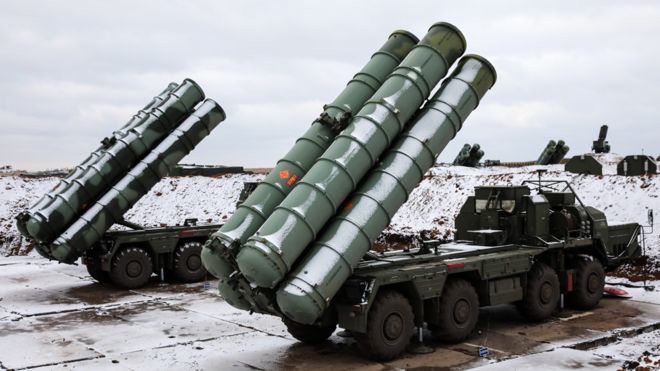
China is getting two regimental units, which amounts to at least 128 missiles.
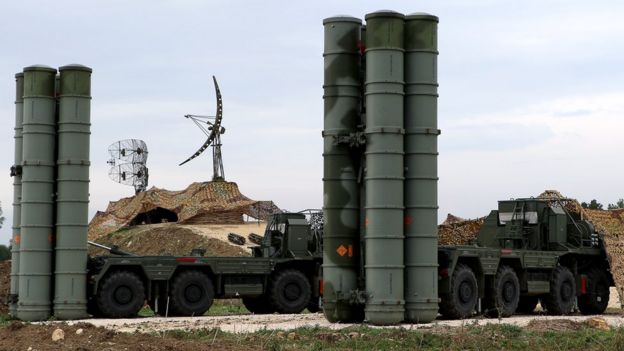
Image copyrightAFPImage captionThe S-400 missile system is deployed at Russia’s Hmeimim airbase in Syria
The S-400 “Triumf” is one of the most sophisticated surface-to-air missile systems in the world. It has a range of 400km (248 miles) and one S-400 integrated system can shoot down up to 80 targets simultaneously.
Russia says it can hit aerial targets ranging from low-flying drones to aircraft flying at various altitudes and long-range missiles.
The US sanctions are aimed at putting pressure on the Russian government over its annexation of Crimea and intervention in eastern Ukraine in 2014.
In October, India signed a $5bn (£3.9bn) deal to buy five S-400 regimental units. That amounts to at least 320 missiles. Each S-400 launch vehicle – a heavy lorry – carries four missiles.
Russia has deployed S-400s to protect its military airbase at Hmeimim in Syria.
Turkey, a Nato member, is buying S-400s despite US warnings. The US wants to sell Patriot missiles, made by Raytheon Co, to Turkey instead. The US argues that S-400s are incompatible with Nato systems.
“We made the S-400 deal with Russia, so it’s out of the question for us to turn back. That’s done,” Turkish President Recep Tayyip Erdogan said.
Neither Turkey nor India are yet under US sanctions over the purchases.
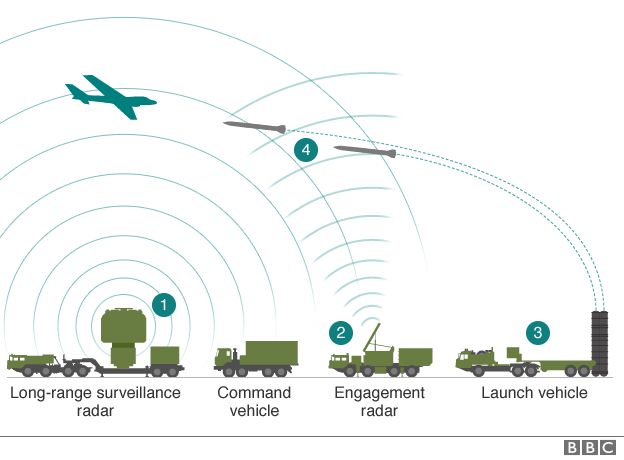
How the S-400 system works
Long-range surveillance radar tracks objects and relays information to command vehicle, which assesses potential targets
Target is identified and command vehicle orders missile launch
Launch data are sent to the best placed launch vehicle and it releases surface-to-air missiles
Engagement radar helps guide missiles towards target.