Archive for ‘‘two sessions’’

29/05/2020

Xi Focus: Xi’s “two sessions” messages reassuring at difficult times

The closing meeting of the third session of the 13th National People’s Congress (NPC) is held at the Great Hall of the People in Beijing, capital of China, May 28, 2020. Leaders of the Communist Party of China and the state Xi Jinping, Li Keqiang, Wang Yang, Wang Huning, Zhao Leji, Han Zheng and Wang Qishan attended the meeting, and Li Zhanshu presided over the closing meeting and delivered a speech. (Xinhua/Ju Peng)

BEIJING, May 28 (Xinhua) — Eradicating absolute poverty, upholding people-centered philosophy and seeking new opportunities from challenges, Chinese President Xi Jinping brought reassuring messages at times of uncertainty and difficulty.

Xi spoke on a wide range of topics at this year’s “two sessions,” which closed on Thursday.

The two sessions are the country’s annual meetings of the National People’s Congress (NPC) and the National Committee of the Chinese People’s Political Consultative Conference (CPPCC).

Xi, also general secretary of the Communist Party of China (CPC) Central Committee and chairman of the Central Military Commission, participated in deliberations with national legislators and joined in discussions with political advisors.

Chinese President Xi Jinping, also general secretary of the Communist Party of China Central Committee and chairman of the Central Military Commission, takes part in a deliberation with his fellow deputies from the delegation of Inner Mongolia Autonomous Region at the third session of the 13th National People’s Congress (NPC) in Beijing, capital of China, May 22, 2020. (Xinhua/Ju Peng)

PEOPLE FIRST

An NPC deputy himself, Xi joined deliberations with lawmakers from north China’s Inner Mongolia Autonomous Region on May 22, the first day of the annual session of the national legislature.

“People first” was the keyword in the discussions. Xi referred to the recovery of an 87-year-old COVID-19 patient after 47 days of care by a team of 10 doctors and nurses.

“Many people worked together to save a single patient. This, in essence, embodies doing whatever it takes (to save lives),” he said.

China mounted swift and sweeping actions to contain the disease. It has mobilized the best doctors, most advanced equipment and high-demand resources. The eldest patient to have been cured is 108 years old.

“President Xi emphasized people and lives are the top priorities,” said Huhbaater, a professor of Inner Mongolia Agricultural University and an NPC deputy who heard Xi speak.

NEW OPPORTUNITIES

China decided not to set a specific annual economic growth target for 2020, but set eyes on winning the battle against poverty and finishing building a moderately prosperous society in all respects.

Xi touched upon the absence of a numerical growth target. “Had we imposed a target, the focus would have been strong stimulus and a simple grasp on growth rate. That is not in line with our social and economic development purposes,” he said.

Xi urged efforts in seeking new opportunities amid challenges as he joined discussions with national political advisors from the economic sector on May 23.

“Our economy is still characterized by ample potential, strong resilience, large maneuver room and sufficient policy instruments,” Xi said.

China has the largest industrial system in the world with the most complete categories, strong production capabilities and complete supporting sectors, as well as over 100 million market entities and a talent pool of 170 million people.

The Chinese president anticipates faster growth in the digital economy, intelligent manufacturing, life and health, new materials and other strategic emerging industries, highlighting the creation of new growth areas and drivers.

Xi stressed steady progress in creating a new development pattern where domestic and foreign markets can boost each other, with the domestic market as the mainstay.

He called for unwavering efforts to make economic globalization more open, inclusive and balanced so that its benefits are shared by all, and to build an open world economy.

Chinese President Xi Jinping, also general secretary of the Communist Party of China Central Committee and chairman of the Central Military Commission, joins a deliberation with deputies from Hubei Province at the third session of the 13th National People’s Congress (NPC) in Beijing, capital of China, May 24, 2020. (Xinhua/Li Xueren)

PUBLIC HEALTH PROTECTION

On May 24, Xi joined deliberations with lawmakers from central China’s Hubei Province, which was the hardest hit by COVID-19.

“We must face the problems upfront, step up reform and waste no time in addressing the shortcomings, insufficiencies and loopholes exposed by the epidemic,” he said, stressing fortifying the public health protection network.

Xi noted several priorities: reforming the disease prevention and control system; boosting epidemic monitoring, early warning and emergency response capacity; perfecting the treatment system for major epidemics; and improving public health emergency laws and regulations.

ENHANCING NATIONAL DEFENSE

When attending a plenary meeting of the delegation of the People’s Liberation Army and People’s Armed Police Force, Xi commended their role in battling COVID-19 and stressed achieving the targets and missions of strengthening the national defense and armed forces for 2020.

The epidemic has brought a profound impact on the global landscape and on China’s security and development as well, he said.

He ordered the military to think about worst-case scenarios, scale up training and battle preparedness, promptly and effectively deal with all sorts of complex situations, and resolutely safeguard national sovereignty, security and development interests.

Noting that this year marks the end of the 13th five-year plan for military development, Xi said extraordinary measures must be taken to overcome the impact of the epidemic to ensure major tasks on the military building are achieved.

Source: Xinhua
26/05/2020

China’s Hong Kong garrison ‘ready to safeguard national security’ in the city

  • PLA commander says new law will help to crack down on separatist and foreign forces in ‘two sessions’ interview
  • Military has ‘determination, confidence and ability’ to safeguard national security interests and Hong Kong prosperity
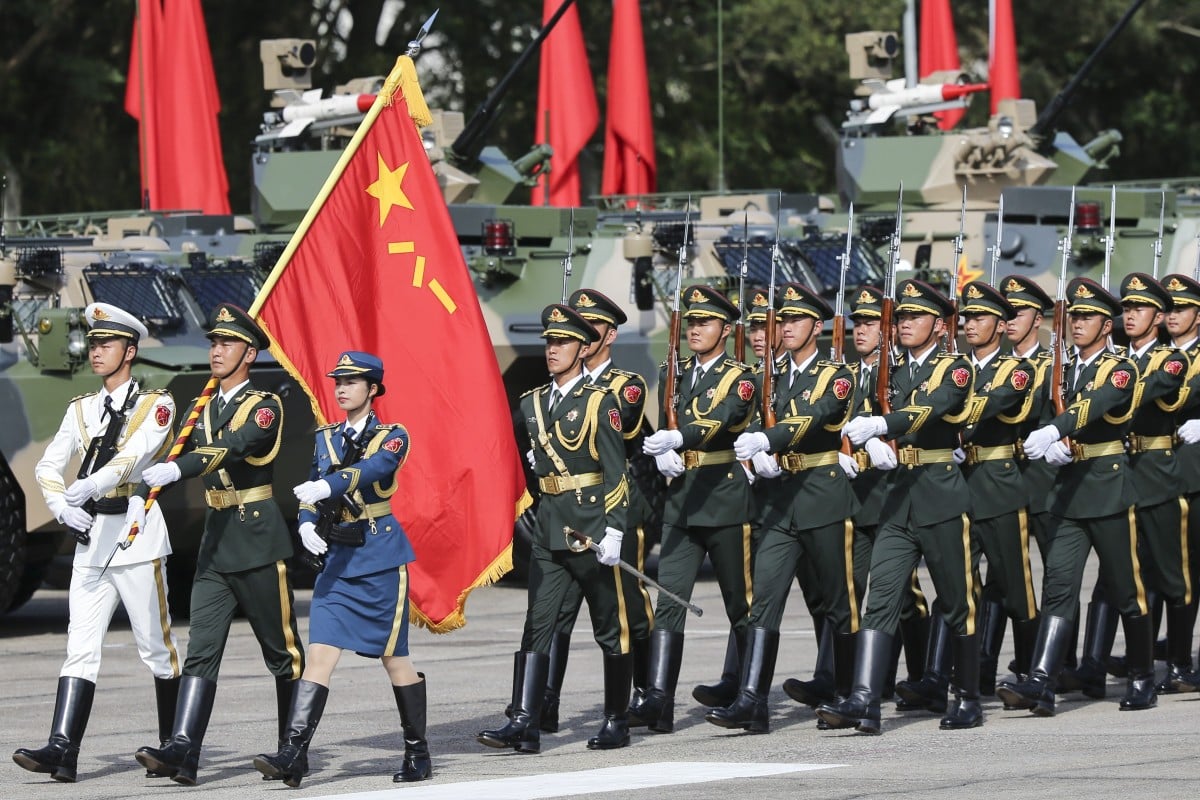
China’s People’s Liberation Army has said its Hong Kong garrison will “resolutely” safeguard national security and sovereignty. Photo: Sam Tsang
The People’s Liberation Army has said the Chinese military will “resolutely” safeguard China’s national security and sovereignty, in its first statement since Beijing announced plans to impose a sweeping national security law in Hong Kong.
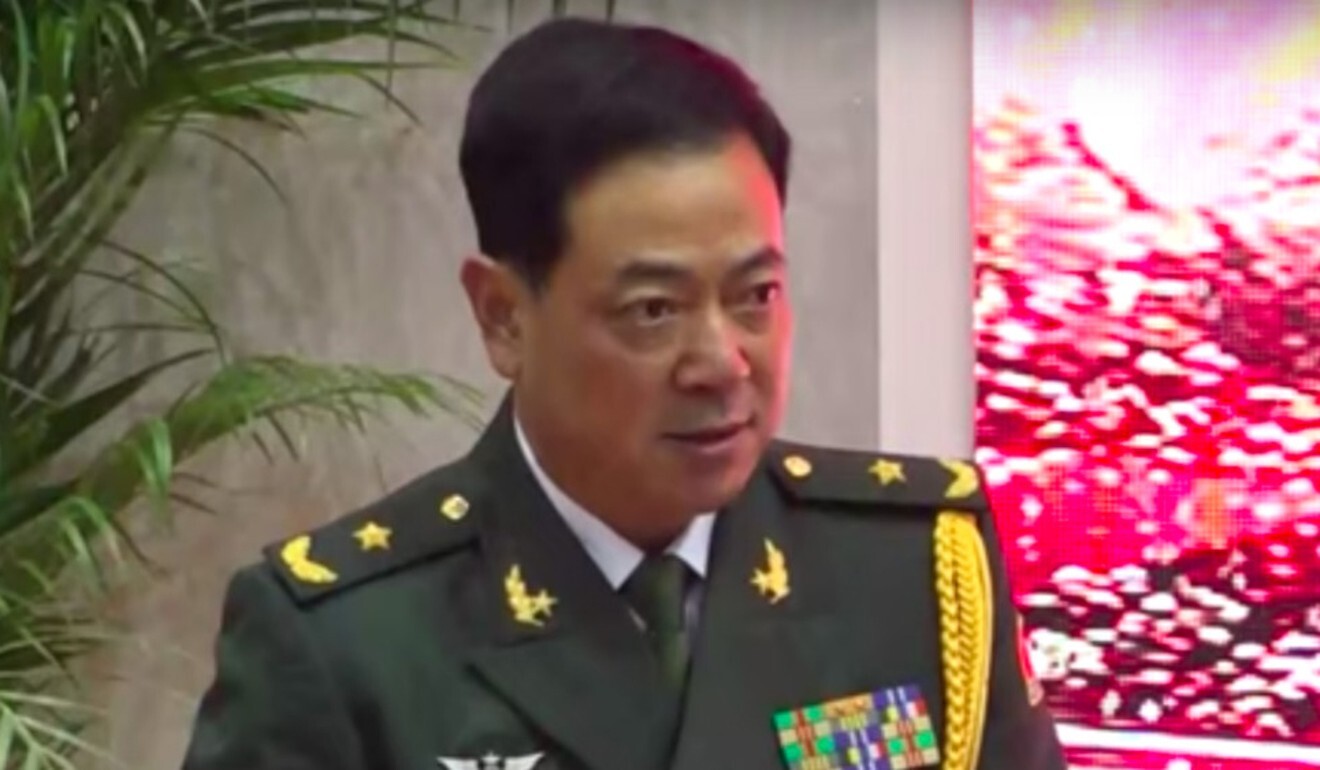
Chen Daoxiang, commander of the PLA’s Hong Kong garrison, said it would “act with firm resolve to implement the central government’s decision and plans” as well as continuing to implement the “one country, two systems” policy in the city.
How China is drafting a new Hong Kong national security law at the National People’s Congress
Speaking on the sidelines of China’s annual parliamentary meetings, also known as the

“two sessions”

, Chen told state broadcaster CCTV that the new law would help to crack down on separatist and foreign forces aiming to undermine China’s national unity.

“[The garrison] will implement, according to law, various tasks delegated by the party and the people, and has the determination, confidence and ability to safeguard national security and development interest as well as Hong Kong’s continuing prosperity,” he said.

Commander of the PLA Hong Kong garrison Chen Daoxiang. Photo: Weibo
The proposal to impose a national security law in Hong Kong – which will give Beijing more direct control over the city – was introduced by China’s legislature on Friday. Beijing has blamed foreign forces for inciting last year’s months-long protests in Hong Kong, sparked by opposition to a separate and now-withdrawn extradition bill, and described the unrest as a grave threat to national security.

Separately, CCTV reported that a group of top military officials said in a session on Tuesday that there was a “great urgency” for Beijing to impose the law in a bid to address the “new risks and challenges” in governing the city.

The officials, who included Central Military Commission vice-chairmen Xu Qiliang and Zhang Youxia, said the plan was a “very timely, necessary and important” step to prevent and punish efforts to undermine China’s national sovereignty and security.

They reiterated the PLA’s commitment to opposing intervention from foreign forces in Hong Kong as well as maintaining China’s national unity and territorial integrity.

“Hong Kong affairs are purely China’s internal affairs. We resolutely oppose efforts by any foreign country, organisation and individual in interfering with Hong Kong affairs, and will resolutely guard against and contain any attempts by external forces in … engaging any separatist, subversion and infiltration activities,” they said, according to CCTV.

The planned national security law has drawn strong condemnation from the US government, with Secretary of State Mike Pompeo calling it a “death knell” for the territory’s relative autonomy. White House national security adviser Robert O’Brien said on Sunday that the US government would likely impose sanctions on China if Beijing went ahead with the plan.

Source: SCMP

24/05/2020

China and US must find ways to get along and avoid new cold war, says Foreign Minister Wang Yi

  • Countries must respect each others’ systems and be wary of US political forces who want to ‘hijack relations’, Wang tells press conference at ‘two sessions’
  • Beijing is not looking for confrontation and wants to work with Washington to fight coronavirus, minister says
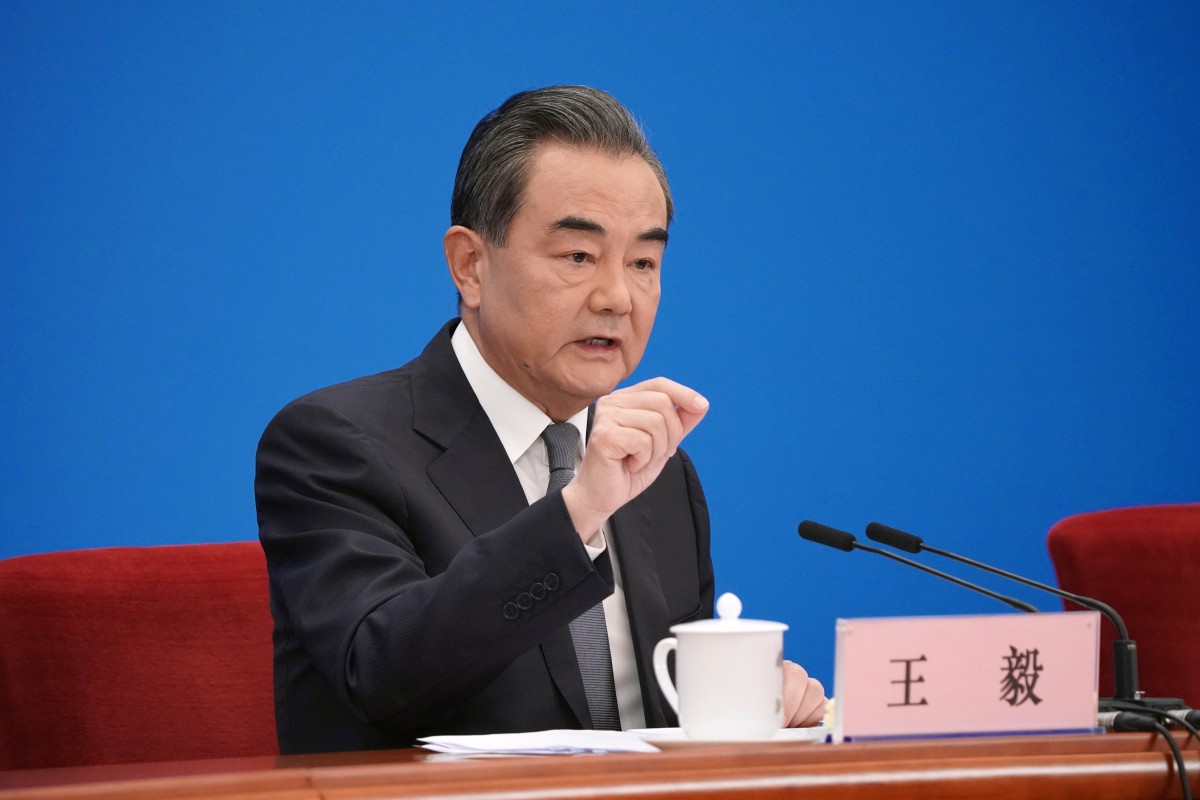
Foreign Minister Wang Yi said China did not want to replace or change the US. Photo: Xinhua

China and the US should try to avoid a new cold war and find new ways to cooperate despite their differences, China’s Foreign Minister Wang Yi said on Sunday.

“We need to be alert to efforts by some political forces in America to hijack China-US relations and who try to push the two countries towards a so-called ‘new cold war’.

“This is a dangerous attempt to turn back the course of history,” Wang told a press conference on the sidelines of the annual parliamentary meetings known as the ‘two sessions’.

Ties between the two countries have further worsened due to escalating tensions over the handling of the Covid-19 pandemic.

Voices calling for decoupling have been on the rise in the US, with some arguing that the two countries are edging towards a new cold war akin to that against the Soviet Union.

Wang called for the two countries to respect each other’s political systems and to find a way to get along despite their differences.

The two nations should step up cooperation on global pandemic control, and coordinate on macro policies to deal with the economic impact.

“China has no intention of changing the United States, much less replacing it. The US should give up the wishful thinking that it can change China.”

“For the benefit of the two peoples, as well as the future and well-being of humankind, China and the US should and must find a way to coexist peacefully despite the differences in system and cultures of the two societies.”

Wang said China will not seek confrontation with the United States, but China is determined to protect its sovereignty, territorial integrity and development.

Source: SCMP
Law of Unintended Consequences

continuously updated blog about China & India

ChiaHou's Book Reviews

continuously updated blog about China & India

What's wrong with the world; and its economy

continuously updated blog about China & India