Archive for ‘Uighur Muslims’

10/12/2019

China Uighurs: Detainees ‘free’ after ‘graduating’, official says

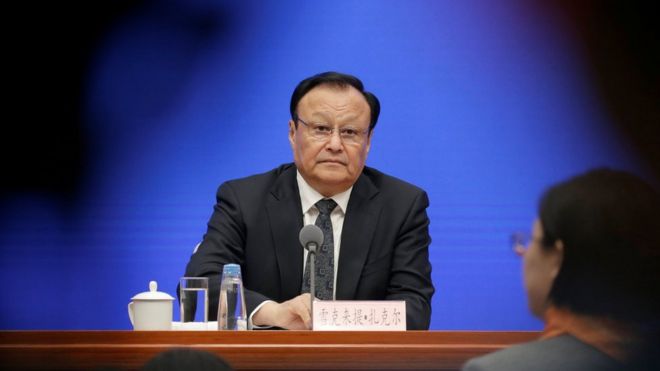
Shohrat Zakir, deputy secretary of the Communist Party committee for China's Xinjiang and chairman of the Xinjiang Uighur Autonomous Region, attends a news conference in BeijingImage copyright REUTERS
Image caption Shohrat Zakir told reporters the released detainees now had an “improved quality of life”

A senior Chinese official has said that all of the people sent to detention centres in the western region of Xinjiang have now been released.

Regional government chairman Shohrat Zakir told reporters those held in what Beijing say are “re-education camps” had now “graduated”.

It is not possible to independently verify Mr Zakir’s claims.

Rights groups say the camps are actually high-security prisons, holding hundreds of thousands of Muslims.

Beijing has always denied this, despite the prevalence of high-security features, like watchtowers and razor wire, and leaked documents detailing how inmates at the so-called centres are locked up, indoctrinated and punished.

What is Beijing saying?

Mr Zakir told reporters in the Chinese capital on Monday that everyone in the centres had completed their courses and – with the “help of the government”- had “realised stable employment [and] improved their quality of life”.

He said that, in future, training would be based on “independent will” and people would have “the freedom to come and go”.
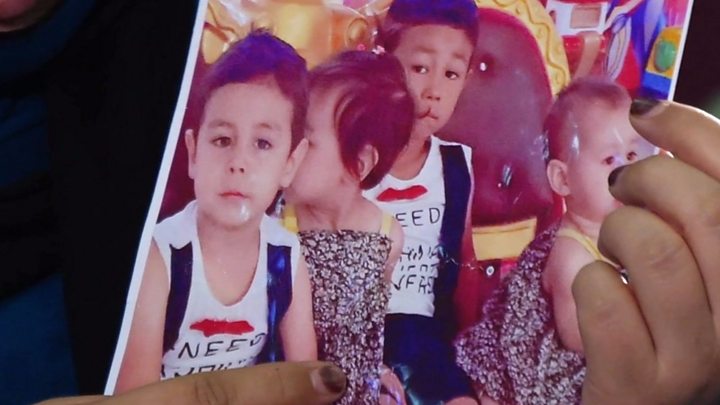
Media caption The BBC’s John Sudworth meets Uighur parents in Turkey who say their children are missing in China

BBC China correspondent John Sudworth points out it is not possible to verify the claims, as access for journalists is tightly controlled and it’s impossible to contact local residents without placing them at risk of detention.

In recent months, independent reports have suggested that some camp inmates are being released, only to face house arrest, other restrictions on their movement or forced labour in factories.

What could be behind the move?

Pressure has been increasing on Beijing in recent months.

A number of high-profile media reports based on leaks to the New York Times and the International Consortium of Investigative Journalists (ICIJ) have shone a spotlight on what is happening at the network of centres, which are believed to hold more than a million people, mainly Uighur Muslims and other minorities.

Then last week, the US House of Representatives passed a bill to counter what it calls the “arbitrary detention, torture, and harassment” of the Uighurs, calling for “targeted sanctions” on members of the Chinese government – and names the Communist Party secretary in the Xinjiang autonomous region, Chen Quanguo.

The bill still needs approval from the Senate and from President Donald Trump.

However, Mr Zakir used the press conference to dismiss the numbers detained as “pure fabrication”, reiterating Beijing’s argument that the centres were needed to combat violent religious extremism.
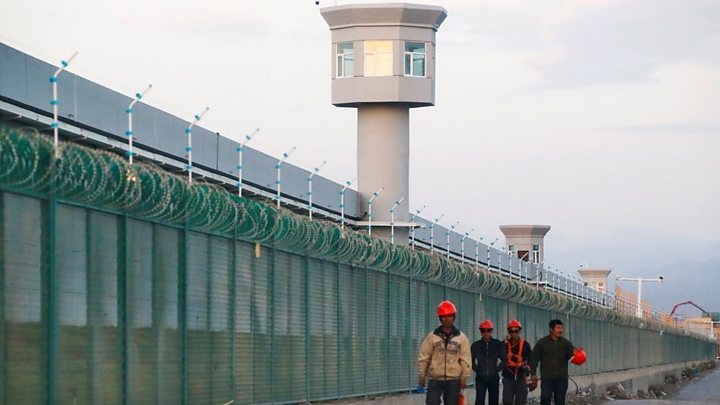
Media caption“An electric baton to the back of the head” – a former inmate described conditions at a secret camp to the BBC

“When the lives of people of all ethnic groups in Xinjiang were seriously threatened by terrorism, the US turned a deaf ear,” Mr Zakir said at a press briefing.

“Now that Xinjiang society is steadily developing and people of all ethnicities are living and working in peace, the US feels uneasy, and attacks and smears Xinjiang.”

What’s going on in Xinjiang?

Reports of widespread detentions first began to emerge in 2018, when a UN human rights committee was told there were credible allegations that China had “turned the Uighur autonomous region into something that resembles a massive internment camp”.

Rights groups also say there’s growing evidence of oppressive surveillance against people living in the region.

The Chinese authorities said the “vocational training centres” were being used to combat violent religious extremism. However, evidence showed many people were being detained for simply expressing their faith, by praying or wearing a veil, or for having overseas connections to places like Turkey.

Presentational white space

Records seen by the BBC show China has deliberately been separating Muslim children from their families.

This is an attempt to “raise a new generation cut off from original roots, religious beliefs and their own language”, Dr Adrian Zenz, a German researcher, told BBC News earlier this year.

“I believe the evidence points to what we must call cultural genocide.”

China’s ambassador to the UK said the allegations were “lies”.
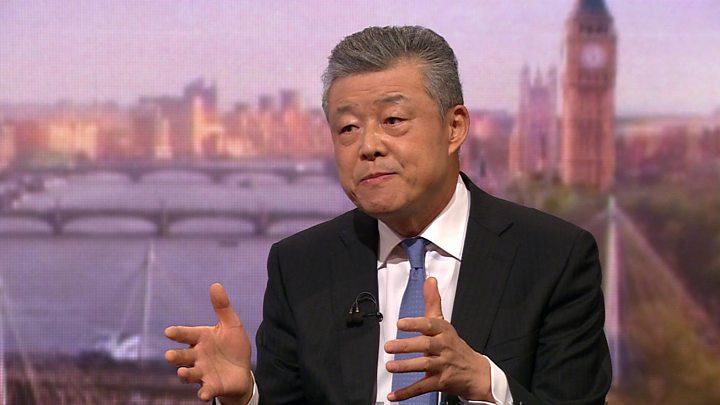
Media caption Chinese Ambassador Liu Xiaoming dismisses evidence of a separation campaign in Xinjiang

Source: The BBC

09/05/2019

China’s Xinjiang citizens monitored with police app, says rights group

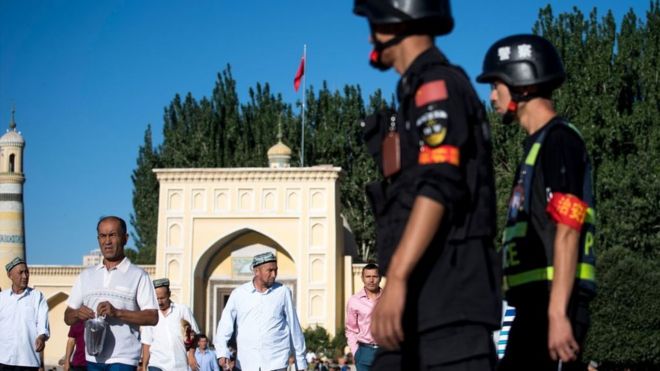
Police patrolling as Muslims leave the Id Kah Mosque in the old town of Kashgar in China's XinjiangImage copyright GETTY IMAGES
Image caption Police in Xinjiang now have one more way to record data about its citizens

Chinese police are using a mobile app to keep data on millions of ethnic Uighurs in Xinjiang province, according to Human Rights Watch (HRW).

In a report released on Thursday, HRW said it had reverse engineered the app to see how mass surveillance worked.

The app is used to closely monitor behaviours, it said, including lack of socialising, using too much electricity or having acquaintances abroad.

Rights groups say Uighur Muslims are being severely persecuted in China.

The UN has said there are credible reports up to a million Uighurs are being held in detention in Xinjiang, in what China says are “re-education centres”.

‘Most intrusive surveillance system’

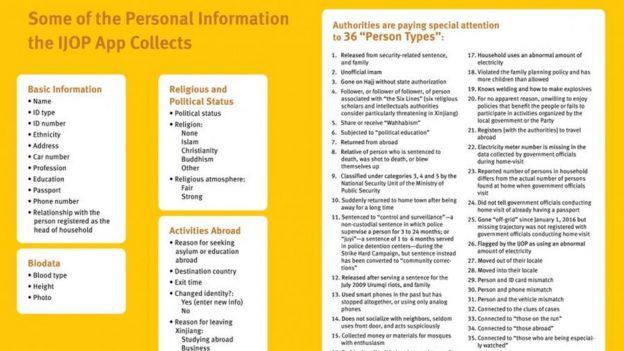
According to the rights group’s report, the app is used by officials to record and file away information about people.

In particular, it targets “36 person types” that authorities should pay attention to.

These include people who seldom use their front door, use an abnormal amount of electricity and those that have gone on Hajj – an Islamic pilgrimage – without state authorisation.

The report does not make explicit mention of any ethnic groups specifically targeted, but the “36 person types” include “unofficial” imams – Islamic leaders – and those who follow Wahhabism, an Islamic doctrine.

Graphic by HRWImage copyrightHRW
Image captionThe 36 person types listed in the HRW report

The information taken from the app will be fed into the central system of the Integrated Joint Operations Platform (IJOP) – the main system for mass surveillance in Xinjiang, says HRW.

HRW senior China researcher Maya Wang said IJOP was “one of the world’s most intrusive mass surveillance systems”.

“It gathers information from checkpoints on the street, gas stations, schools… pulls information from these facilities and monitors them for ‘unusual’ behaviour that triggers alerts [to the]authorities.”

The app was obtained and analysed by HRW in partnership with Cure53, a Berlin-based security firm.

Media caption In your face: China’s all-seeing surveillance system

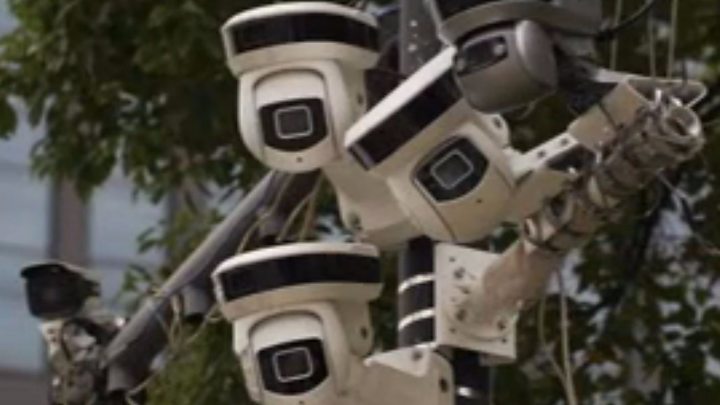
As well as its Xinjiang operations, China has 170 million CCTV cameras in place across the country and by the end of 2020, an estimated 400 million new ones will be installed.

All this is part of China’s aim to build what it calls “the world’s biggest camera surveillance network”.

China’s also setting up a “social credit” system that is meant to keep score of the conduct and public interactions of all its citizens.

The aim is that by 2020, everyone in China will be enrolled in a vast national database that compiles fiscal and government information, including minor traffic violations, and distils it into a single number – ranking each citizen.

China’s detention camps

Xinjiang is a semi-autonomous region and in theory at least, has a degree of self-governance away from Beijing.

The Uighurs, a mostly Muslim ethnic minority, make up around 45% of its population.

HRW’s report comes as China faces increasing scrutiny over its treatment of them and other minorities in Xinjiang.

Up to one million Uighurs are being held in detention camps across Xinjiang, a UN human rights committee heard last year.

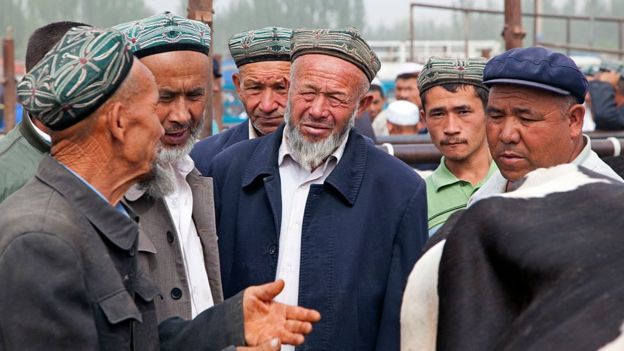
Uyghur farmers wearing doppas, trading cows at the cattle market in KashgarImage copyright GETTY IMAGES
Image caption Uighurs make up around 45% of Xinjiang’s population

One member said she was concerned by reports that Beijing had “turned the Uighur autonomous region into something that resembles a massive internment camp”.

A BBC investigation last year revealed that what appear to be “large prison-type structures” have been built across Xinjiang in the past few years.

China says these buildings are “vocational training centres” used to educate and integrate Muslim Uighurs and steer them away from separatism and extremism.

A Chinese Foreign Ministry spokeswoman, Hua Chunying, said, “everyone can see that people of all ethnicities in Xinjiang live and work in peace and contentment and enjoy peaceful and progressing lives”.

Source: The BBC

Law of Unintended Consequences

continuously updated blog about China & India

ChiaHou's Book Reviews

continuously updated blog about China & India

What's wrong with the world; and its economy

continuously updated blog about China & India