Archive for ‘UK’

22/01/2019

Peppa Pig: China falls for an unlikely UK brand ambassador

Undated handout photo supplied by Peppa Pig World of a poster for Peppa Pig celebrating Chinese New YearImage copyrightPA

She’s unlikely to feature on many lists of the all-time top British cultural icons.

But Peppa Pig – the UK-made children’s cartoon character – is right up there with the best of them, at least in China.

With the series racking up 18 billion online views since its launch here seven years ago, the story of Peppa and her unfeasibly English middle class family is, arguably, doing more for Brand Britain than the Beatles, Manchester United and any of the culinary delights – for which the UK is rightly so renowned – put together.

Pork scratching anyone?

It is then no surprise that, when a Peppa-shaped opportunity came knocking, the British powers that be seized the moment.

After watching an episode in which the precocious piglet and her friends visit the Queen in Buckingham Palace – and encourage her to join them jumping in muddy puddles – two Chinese twins posted a video message online, addressed to none other than Her Royal Majesty.

They too, like Peppa, wanted to visit her in her palace, they said.

And it worked.

Well, sort of.
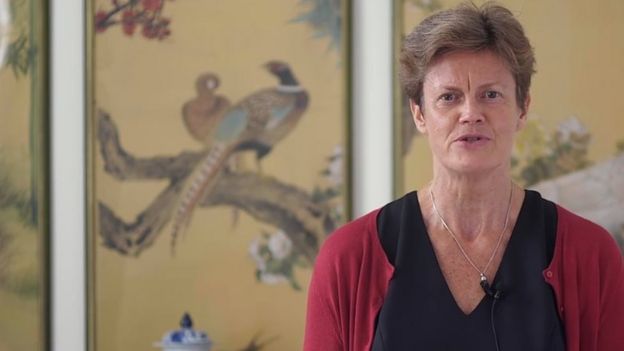
Dame Barbara Woodward, British Ambassador to ChinaImage copyrightBRITISH EMBASSY CHINA
Image captionDame Barbara Woodward, British ambassador to China, invited the twins to her Beijing residence

The British ambassador to China, Dame Barbara Woodward, posted her own video message in reply.

“Hello Mi Ni and Mi Ai,” she said. “I’m the British ambassador, so I’m the Queen’s representative in China.

“I’d like you to come and visit me in my house in Beijing,” she went on, “and we can perhaps have tea and scones in a British style.”

The post has been viewed more than nine million times in China – a multiple of 10 times more views than anything else Dame Barbara has posted in her entire four years as ambassador.
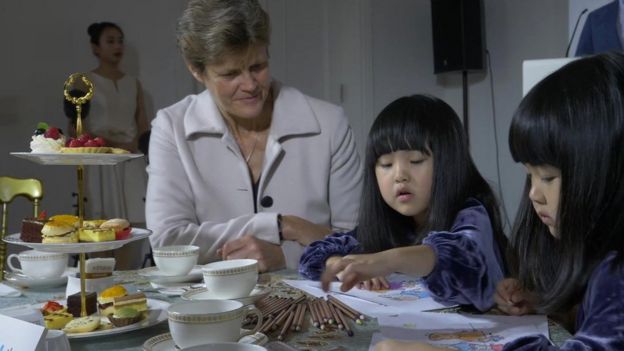
Dame Barbara Woodward, British ambassador to China, with twins Mi Ni and Mi AiImage copyrightHUW EVANS PICTURE AGENCY
Image captionThe twins might travel to the UK next

And so it was that two slightly bewildered five-year-olds found their way to her residence and munched on scones and chocolate cake, and sat colouring in pictures of Peppa Pig, in front of the assembled media.

“Do you think that the Queen really has muddy puddles in her garden?” I asked them.

They nodded. It is a big garden after all.

The whole experience may not have been quite the same as the real deal, but they have also been promised a trip to the UK where they will, at least, get to see Buckingham Palace.

And the British embassy has launched a competition along with Youku – the online channel with the Chinese rights to Peppa Pig – the young winners of which will also join the twins for the trip.
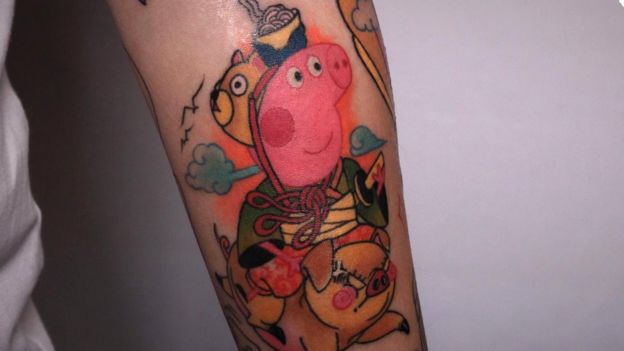
Peppa Pig tattooImage copyrightYUNTIANZHONG TATTOO
Image captionPeppa Pig tattoos have become the symbol of a certain counter-culture in China

The whole Peppa phenomenon, it must be said, has a bit of a dark side in China.

A couple of years ago, pictures began to appear online of people sporting Peppa Pig tattoos.

She appeared to have become the chosen symbol for a counter-culture known as “shehuiren” – literally “society people”.

Early last year, one popular Chinese streaming site, Douyin, began removing Peppa videos en masse.

The nationalist, Communist Party-controlled tabloid Global Times described Shehuiren as people who are “poorly educated with no stable job” and “unruly slackers roaming around and the antithesis of the young generation the party tries to cultivate”.

Soft power

But Peppa has survived this brush with subversion.

A new Peppa Pig movie – made especially for the Chinese market – is due to be launched this coming Chinese New Year.

It is a collaboration between China’s Alibaba Pictures and Canada’s Entertainment One; although still made in the UK, Peppa Pig is now owned by the Canadian company.

The viral trailer for the film – which artfully grafts the story of Peppa onto seasonal themes of Chinese family and belonging – has received more than 300 million hits to date.

With the need for stronger ties with major economies in a post-Brexit world, I asked the UK ambassador whether she thought that a certain pink pig was proving rather more adept at it than British politicians.

“I wouldn’t put it quite as zero sum as that, to be honest,” Dame Barbara laughs in reply.

There are three components to good UK-China ties, she tells me – a strong government-to-government relationship, a strong business-to-business relationship and a strong people-to-people relationship.

“Peppa Pig is as much a part of the latter as the Royal Family, Wimbledon, the Premier League and all the other things we think of when we think of soft power.”

With cute twins, a great British-made product, and massive Chinese media exposure, she must be wishing all UK-China diplomacy could end so happily.

And pigs, as they say, might fly.
20/01/2019

China’s slowdown and what it means for the UK

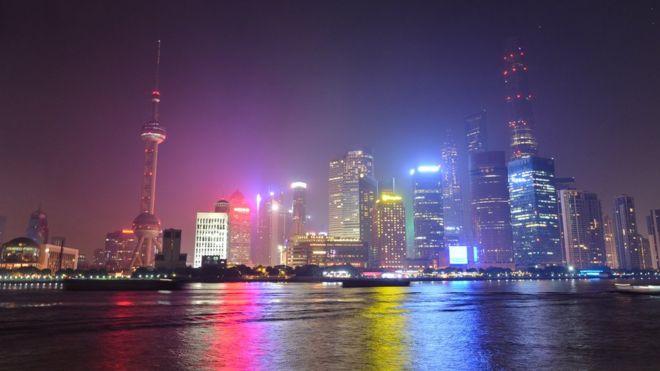
Shanghai at nightImage copyrightGETTY IMAGES
Image captionExporters and investors will be looking at China’s GDP figures closely

Monday sees the release of China’s GDP figures, and they’ll be even more closely watched than usual.

Apple’s CEO, Tim Cook, blamed cautious Chinese consumers in part for his company’s failure to sell as many iPhones as he hoped, sending share prices down around the globe.

Car sales in the country, meanwhile, have dropped for the first time in two decades.

On the back of such evidence, investors and policymakers are becoming increasingly jittery about the state of such a crucial engine of world growth.

How concerned should they be?

Measuring an economy’s output is never easy but China’s data comes with a bigger health warning than most.

Rather than 6.5%, independent economists say the GDP figure may actually be closer to 5% – or even lower.

Xiang Songzuo, a finance professor and former chief economist of China Agriculture Bank, has claimed that 2018 growth may have been as low as 1.7%.

His online video has since been censored by authorities.

The unreliability of the official figures is one reason why other indicators such as Apple’s sales have the power to send shockwaves around global stock markets.

It may be hard to confirm the scale of the slowdown in China but it’s clear that growth has shifted down a gear.

It’s recently been revealed that activity in factories and workshops stalled for the first time in two years in November.

The month after, exports dropped 4.4% compared to a year previously. Chinese households are clearly feeling the squeeze: retail sales are growing their slowest rate in 15 years.

Is the slowdown intentional?

In part, possibly. After establishing itself as the world’s workshop over the last forty years, China’s found itself losing its competitive edge to the likes of the Philippines and Vietnam, where labour is even cheaper.

The government decided to switch focus away from exports to growing domestic demand.

However, concerns then arose about the size of China’s debt pile – and the risk of bad loans.

Between them, the country’s households, government and corporations have debts totalling almost three times the size of GDP.

A tightening of credit appears to have weighed on spending and investment. And then there’s the trade war with the US.

While there was an initial flurry of orders brought forward to evade tariffs, those latest export figures suggest those measures are now hurting Chinese producers.

While the government has introduced measures to support the economy, most economists expect China’s growth to slow further.

How much does this matter to the UK?

In terms of our exports, China’s is the UK’s 6th largest trading partner. We sold them over £22bn worth of our goods in 2017 – with cars, medicines and oil-based products forming the major part.

Politicians’ have pinned their hopes on a closer trading relationship with China in the post-Brexit era.

But demand might not be quite as strong as they’re anticipating .

Then there’s the billions of pounds Chinese companies and entrepreneurs invest in the UK every year – £20bn in 2017 alone.

Thames Water, Pizza Express and West Bromwich Albion FC are among the many which enjoy Chinese backing. That kind of investment is notoriously volatile.

A West Bromwich Albion Football Club playerImage copyrightGETTY IMAGES
Image captionWest Bromwich Albion FC is one of many British organisations which has Chinese backers

And let’s not forget the concerns about bad loans. There’s a good reason why the Bank of England’s Governor Mark Carney cites China as one of the biggest risks to global financial stability.

Several large banks, not least HSBC and Standard Chartered have significant exposure to that market.

What of China’s longer-term prospects?

Since 1980, growth (if the official figures are to be believed) has averaged over 10% per year, meaning the size of the economy has surged 42-fold over that time.

China’s time in the sun, its superhuman growth spurt, may be over.

By 2030, economists say growth will have settled down to about a third of its current figure.

But even that would be enough to ensure it overtakes the US to take pole position as the world’s largest economy.

Source: The BBC

Law of Unintended Consequences

continuously updated blog about China & India

ChiaHou's Book Reviews

continuously updated blog about China & India

What's wrong with the world; and its economy

continuously updated blog about China & India