Archive for ‘Uncategorized’

28/05/2019

China gains, auto sector lift Asian shares, but sentiment fragile

SHANGHAI (Reuters) – Asian shares rose on Tuesday, lifted by gains in China and as auto firms climbed on merger news, but broad uncertainties over trade and economic growth kept investor enthusiasm in check.

European equity markets were expected to open higher. In early European trade, pan-region Euro Stoxx 50 futures were up 0.39% at 3,365, German DAX futures were up 0.39% at 12,112, FTSE futures were up 0.5% at 7,299.5, and France’s CAC 40 futures were up 0.41% at 5,319.

MSCI’s broadest index of Asia-Pacific shares outside Japan rose 0.38%, and U.S. S&P 500 e-mini futures rose 0.22% to 2,837.25, pointing to gains when U.S. markets reopen on Tuesday after a holiday.

Despite the day’s gains, Joanne Goh, Asia equity strategist at DBS in Singapore, said broad market sentiment remained uncertain ahead of a possible meeting between the Chinese and U.S. presidents at the G20 summit next month.

“There’s still a lack of direction in the markets in terms of all the different asset classes,” she said.

“You actually see Chinese bond yields are ticking up, but that shouldn’t be the case because we are expecting stimulus and bond yields should start to come off…there’s quite a lot of uncertainty in the markets right now.”

Chinese blue-chips climbed 0.61% a day after data showed Chinese industrial firms’ profits shrank in April, which could prompt more government stimulus to support the slowing economy.

A planned increase in the weighting of Chinese A-shares in MSCI indexes after the market close later on Tuesday also boosted shares.Seoul’s KOSPI added 0.37%, while Australian shares gained 0.45%. Japan’s Nikkei stock index finished 0.37% higher.

In China’s debt markets, 10-year government bond futures for September delivery, the most-traded contract, rebounded 0.34% on Tuesday having dropped as much as 0.71% the day before, after China’s takeover of a troubled bank sparked concerns of wider financial risks.

“With economic indicators mixed and trade war risks lingering, the bias is still tilted towards loose monetary policy to cushion growth. We think that the rise in longer-term (Chinese) govvie…yields is probably not warranted,” DBS analysts said in a note.

The equity market gains in Asia followed a relatively light session in Europe on Monday, with UK and U.S. financial markets closed for holidays.

European auto shares had rallied after Italian-American carmaker Fiat Chrysler confirmed it had made a “transformative merger” proposal to French peer Renault in a deal that would create the world’s third-biggest carmaker. That sector rally spilled into Asia with Mitsubishi Motors Corp in Japan adding 5.95% and Nissan Motor Co gaining 2.31%.

Shares in Hong Kong-listed Geely Automobile Holdings Ltd jumped 5.47%.​ Provisional results from EU elections also buoyed markets after pro-union parties kept a firm grip on power in elections to the European Parliament. The pan-European STOXX 600 added 0.22%.

“Although Eurosceptic and anti-establishment parties didn’t win as many seats as expected, their influence has increased significantly. This could have implications for the political colour of key EU positions,” said Rodrigo Catril, senior FX strategist at National Australia Bank.

“The Parliament composition is also likely to have implications on the priority agenda for future EU reform, particularly with respect to things like immigration, fiscal spending and fiscal union,” he added, noting a decrease in bond yields pointed to continued risk aversion.

The yield on benchmark 10-year German Bunds fell to -0.147% on Monday, its lowest since September 2016.

On Tuesday, U.S. yields were also lower. Benchmark 10-year Treasury notes yielded 2.3097%. The two-year yield touched 2.1724%.

Trade worries remain high on investors’ list of concerns. U.S. President Donald Trump said on Monday that Washington was not ready to make a deal with Beijing but he expected one in the future, while at the same time pressing Japanese Prime Minister Shinzo Abe to even out a trade imbalance with the United States.

The dollar was flat against the yen at 109.50, and fell 0.13% against the euro, with the common currency buying $1.1182.

The dollar index, which tracks the greenback against a basket of six major rivals, was 0.17% higher at 97.782.

In commodity markets, oil prices extended gains after rising more than 1% on Monday on tensions in the Middle East and OPEC-led supply cuts, as well as continuing Russian supply disruptions after a contamination problem discovered last month.

Brent crude 0.29% higher at $70.31 per barrel, having earlier dipped below the $70 mark, and U.S. West Texas Intermediate crude added 1.16% to $59.31 per barrel.

Spot gold was down 0.12% at $1,283.30 per ounce.

Bitcoin, which on Monday touched $8,939.18, its highest in more than a year, was down 0.55% at $8,722.61. The cryptocurrency topped $8,000 for the first time since July 2018 on May 13.

Source: Reuters

28/05/2019

Pakistan PM Khan speaks with India’s Modi to congratulate him on election win

ISLAMABAD (Reuters) – Pakistani Prime Minister Imran Khan on Sunday spoke to Narendra Modi and congratulated the Indian leader on the runaway election victory of his Hindu-nationalist Bharatiya Janata Party (BJP), both countries said on Sunday.

“Prime Minister Imran Khan spoke to Prime Minister Narendra Modi today and congratulated him on his party’s electoral victory in the Lok Sabha elections in India,” Pakistan’s foreign ministry said in a statement.

“The Prime Minister expressed his desire for both countries to work together for the betterment of their peoples.”

Tensions between India and Pakistan, both nuclear-armed countries, flared in February with cross-border air strikes and a brief battle between fighter jets above Kashmir.

India’s Ministry of External Affairs confirmed Khan had called Modi on Sunday, adding the two leaders had discussed fighting poverty together.

He (Modi) stressed that creating trust and an environment free of violence and terrorism were essential for fostering cooperation for peace, progress and prosperity in our region,” the ministry added in a statement.

Source: Reuters

28/05/2019

Priyanka meets Rahul Gandhi as he stays firm on quitting as Congress chief

The meeting between Priyanka and Rahul Gandhi comes in the backdrop of reports that the powerful working committee of the party may meet in the next three-four days to discuss the leadership issue.

INDIA Updated: May 28, 2019 13:42 IST

HT Correspondent
HT Correspondent
Hindustan Times, New Delhi
Priyanka Gandhi Vadra,Randeep Surjewala,Congress spokesperson
Congress president Rahul Gandhi with his sister and AICC General Secretary Priyanka Gandhi. (ANI file photo)
Congress general secretary Priyanka Gandhi Vadra met her brother, Congress president Rahul Gandhi amid reports that he wants to quit after the crushing defeat in the Lok Sabha elections.
Priyanka Gandhi, Rajasthan chief minister Ashok Gehlot, his deputy Sachin Pilot and Congress spokesperson Randeep Surjewala arrived at Rahul Gandhi’s 12, Tughlaq Lane residence on Tuesday morning. The meeting between Rahul Gandhi and senior Congress leaders comes in the backdrop of reports that the powerful working committee of the party may meet in the next three-four days to discuss the leadership issue
Rajasthan’s ruling duo Ashok Gehlot and Sachin Pilot calling on him amid rumblings of discontent in the state and his insistence on quitting.
The Congress has denied that any such meeting has been scheduled in the near future. “These reports are baseless,” KC Venugopal, general secretary in-charge of organization who is responsible for convening Congress Working Committee meetings.
On Monday, Congress treasurer Ahmed Patel and KC Venugopal met Rahul Gandhi. But Patel insisted that he had gone to meet Rahul Gandhi for routine administrative work. “I had sought time before the CWC to meet the Congress President to discuss routine administrative work. The meeting today was in that context. All other speculation is incorrect and baseless,” Patel tweeted.
Three more state Congress chiefs resigned on Monday taking ‘moral responsibility’ for party’s poor performance in Lok Sabha elections. Other than Sunil Jakhar (Punjab) and Ajoy Kumar (Jharkhand) and Ripun Bora (Assam), HK Patil, who was tasked to oversee the Karnataka Congress campaign in December, also put in his papers.
ANI

@ANI

Delhi: Priyanka Gandhi Vadra and Randeep Singh Surjewala arrive at the residence of Congress President Rahul Gandhi. pic.twitter.com/WXmvlPMJv0

View image on TwitterView image on Twitter
Source: Hindustan Times
26/05/2019

China Focus: Rare all-white panda spotted in China

CHINA-SICHUAN-ALL-WHITE PANDA (CN)

Infrared camera image taken on April 20, 2019 shows an all-white giant panda in the Wolong National Nature Reserve in southwest China’s Sichuan Province. A rare all-white panda has been captured on cameras in the Wolong National Nature Reserve in southwest China’s Sichuan Province, the reserve management authorities said on Saturday. (Xinhua)

CHENGDU, May 25 (Xinhua) — A rare all-white panda has been captured on camera in the Wolong National Nature Reserve in southwest China’s Sichuan Province, the reserve management authorities said on Saturday.

The panda was captured in mid-April by an infrared camera about 2,000 meters above sea level in the wild, the authorities said.

The panda has no spots on its body and its eyes look red. It was crossing the forest at the time.

“Judging from pictures, the panda is an albino, one to two years old,” said Li Sheng, a researcher with Peking University and a specialist in bears, who studied the pictures.

The panda is a rare all-white individual in wild pandas, which showed that the albinism genes exist in the wild population of giant pandas in Wolong, he said.

“The panda looked strong and its steps were steady, a sign that the genetic mutation may not have quite impeded its life,” Li said, adding that the gender of the panda cannot be decided based on current data.

Albinism exists in different vertebrate species. The albino mutation inhibits melanin synthesis in animal’s body. Albino usually does not affect animal’s physical makeup and functions. It could make them easier to be discovered and more sensitive to direct sunlight, Li said.

The albino mutation is a recessive gene. Only when the parent pandas both carry such gene, can the baby show the albino traits.

If this white panda would mate with a normal panda, their first generation babies will still be black and white. But their babies, carrying the albino gene, will possibly give birth to all-white pandas if their partners also carry such genes, Li said.

In order to better protect the ecosystems, the Wolong nature reserve has been using infrared cameras to monitor the distribution and activities of wild animals in its seven demonstration areas.

Previously, some rare brown giant pandas were found in China’s Qinling Mountains. The cause of the brown fur color was also considered as genetic mutation by some researchers.

Source: Xinhua

26/05/2019

China’s robot censors crank up as Tiananmen anniversary nears

BEIJING (Reuters) – It’s the most sensitive day of the year for China’s internet, the anniversary of the bloody June 4 crackdown on pro-democracy protests at Tiananmen Square, and with under two weeks to go, China’s robot censors are working overtime.

Censors at Chinese internet companies say tools to detect and block content related to the 1989 crackdown have reached unprecedented levels of accuracy, aided by machine learning and voice and image recognition.

“We sometimes say that the artificial intelligence is a scalpel, and a human is a machete,” said one content screening employee at Beijing Bytedance Co Ltd, who asked not to be identified because they are not authorised to speak to media.

Two employees at the firm said censorship of the Tiananmen crackdown, along with other highly sensitive issues including Taiwan and Tibet, is now largely automated.

Posts that allude to dates, images and names associated with the protests are automatically rejected.

“When I first began this kind of work four years ago there was opportunity to remove the images of Tiananmen, but now the artificial intelligence is very accurate,” one of the people said.

Four censors, working across Bytedance, Weibo Corp and Baidu Inc apps said they censor between 5,000-10,000 pieces of information a day, or five to seven pieces a minute, most of which they said were pornographic or violent content.

Despite advances in AI censorship, current-day tourist snaps in the square are sometimes unintentionally blocked, one of the censors said.

Bytedance declined to comment, while Weibo and Baidu did not respond to requests for comment.

SENSITIVE PERIOD

The Tiananmen crackdown is a taboo subject in China 30 years after the government sent tanks to quell student-led protests calling for democratic reforms. Beijing has never released a death toll but estimates from human rights groups and witnesses range from several hundred to several thousand.

June 4th itself is marked by a cat-and-mouse game as people use more and more obscure references on social media sites, with obvious allusions blocked immediately. In some years, even the word “today” has been scrubbed.

In 2012, China’s most-watched stock index fell 64.89 points on the anniversary day here, echoing the date of the original event in what analysts said was likely a strange coincidence rather than a deliberate reference.

Still, censors blocked access to the term “Shanghai stock market” and to the index numbers themselves on microblogs, along with other obscure references to sensitive issues.

While companies censorship tools are becoming more refined, analysts, academics and users say heavy-handed policies mean sensitive periods before anniversaries and political events have become catch-alls for a wide range of sensitive content.

In the lead-up to this year’s Tiananmen Square anniversary, censorship on social media has targeted LGBT groups, labour and environment activists and NGOs, they say.

Upgrades to censorship tech have been urged on by new policies introduced by the Cyberspace Administration of China (CAC). The group was set up – and officially led – by President Xi Jinping, whose tenure has been defined by increasingly strict ideological control of the internet.

The CAC did not respond to a request for comment.

Last November, the CAC introduced new rules aimed at quashing dissent online in China, where “falsifying the history of the Communist Party” on the internet is a punishable offence for both platforms and individuals.

The new rules require assessment reports and site visits for any internet platform that could be used to “socially mobilise” or lead to “major changes in public opinion”, including access to real names, network addresses, times of use, chat logs and call logs.

One official who works for CAC told Reuters the recent boost in online censorship is “very likely” linked to the upcoming anniversary.

“There is constant communication with the companies during this time,” said the official, who declined to directly talk about the Tiananmen, instead referring to the “the sensitive period in June”.

Companies, which are largely responsible for their own censorship, receive little in the way of directives from the CAC, but are responsible for creating guidelines in their own “internal ethical and party units”, the official said.

SECRET FACTS

With Xi’s tightening grip on the internet, the flow of information has been centralised under the Communist Party’s Propaganda Department and state media network. Censors and company staff say this reduces the pressure of censoring some events, including major political news, natural disasters and diplomatic visits.

“When it comes to news, the rule is simple… If it is not from state media first, it is not authorised, especially regarding the leaders and political items,” said one Baidu staffer.

“We have a basic list of keywords which include the 1989 details, but (AI) can more easily select those.”

Punishment for failing to properly censor content can be severe.

In the past six weeks, popular services including a Netease Inc news app, Tencent Holdings Ltd’s news app TianTian, and Sina Corp have all been hit with suspensions ranging from days to weeks, according to the CAC, meaning services are made temporarily unavailable on apps stores and online.

For internet users and activists, penalties can range from fines to jail time for spreading information about sensitive events online.

In China, social media accounts are linked to real names and national ID numbers by law, and companies are legally compelled to offer user information to authorities when requested.

“It has become normal to know things and also understand that they can’t be shared,” said one user, Andrew Hu. “They’re secret facts.”

In 2015, Hu spent three days in detention in his home region of Inner Mongolia after posting a comment about air pollution onto an unrelated image that alluded to the Tiananmen crackdown on Twitter-like social media site Weibo.

Hu, who declined to use his full Chinese name to avoid further run-ins with the law, said when police officers came to his parents house while he was on leave from his job in Beijing he was surprised, but not frightened.

“The responsible authorities and the internet users are equally confused,” said Hu. “Even if the enforcement is irregular, they know the simple option is to increase pressure.”

Source: Reuters

25/05/2019

Feature: Governors compete for investment at China-U.S. Governors Forum

LEXINGTON, the United States, May 24 (Xinhua) — Chinese and U.S. governors gathered here on Thursday, competing to promote their state or province for investment at the Fifth China-U.S. Governors Forum.

“I want to be a little bit more objective. I’ll tell you not what I think, but what U.S. News (and World Report) just said,” said Cyrus Habib, lieutenant governor of the U.S. state of Washington, grabbing the opportunity when he took the podium to present his state. “In the U.S. News ranked states in the United States, they ranked Washington state No. 1 overall.”

The national media U.S. News and World Report published its yearly Best States Rankings on May 14, putting Washington state on top based on several criteria including health care, education, economy and opportunity.

“It is not a coincidence for Washington to get ranked the No. 1 place to do business and the No. 1 place to live,” he said. “I always tell them the key is international relationships … We are the No. 1 exporter per capita of any state in the country.”

“We are the No. 1 source of U.S. imports into China and so our relationship with China is absolutely key central to the success that we have had now economically in terms of trade,” he added.

Dianne Primavera, lieutenant governor of the U.S. state of Colorado, advertised her state by saying “according to the U.S. News and World Report, Colorado is home to the No. 1 economy in the United States.”

“Our business climate is an active mix of knowledge-based industries and entrepreneurial activity that drives successful startups,” Primavera said. “Colorado welcomes the opportunity to do business with China.”

Matt Bevin, governor of Kentucky and host of the event, was also eager to grasp the opportunity to talk about the benefits of his state.

“We have rivers and roads and railways that transect through this state. You can put goods on the Ohio River and take them straight to any port in China,” he said. “We want you here, we want your investment here.”

U.S. state of Tennessee Governor Bill Lee introduced his state as a neighbor of Kentucky, saying “when Kentucky or Tennessee has investment from companies, from countries like China, then we both benefit. We are a regional economy and what is good for one state and our region is good for another state in our region.”

Local Chinese officials also presented their province or municipality.

Mayor of Chongqing Tang Liangzhi said the southwestern Chinese municipality has an important role in regional development and China’s opening-up layout, and that he hopes to cooperate with U.S. states in many fields like intelligent industry, auto manufacturing, and environmental protection.

Liu Guozhong, governor of China’s northwestern Shaanxi Province, deliberated on the long-standing history and culture, as well as the recent tax-cutting policies of his province, hoping to expand cooperation in technological innovation and environmental protection between the two countries.

Chinese and U.S. companies signed three cooperation agreements at the forum on Thursday. Meanwhile, China’s southeastern province of Jiangxi and the U.S. state of Kentucky signed a memorandum of understanding.

Initiated in 2011, the China-U.S. Governors Forum has become an important platform to promote exchanges and cooperation between the local governments of the two countries.

Source: Xinhua

25/05/2019

Uzbekistan, China agree to cooperate in preschool education

TASHKENT, May 24 (Xinhua) — Uzbek and Chinese experts discussed innovative approaches to the education of preschool children at a forum held here on Friday.

The one-day forum opens a new direction in cooperation between the two countries, said Agrippina Shin, minister of preschool education of Uzbekistan.

It has become an effective platform for comparing notes, she said in her opening speech.

The forum was held as the two sides are implementing the consensus reached by the leaders of the two countries and are advancing cooperation in people-to-people exchanges and education, said Jiang Yan, Chinese ambassador to Uzbekistan.

Source: Xinhua

25/05/2019

Service trade between China, B&R countries surpasses 120 bln dollars

BEIJING, May 25 (Xinhua) — China’s service trade with countries and regions along the Belt and Road (B&R) reached over 120 billion U.S. dollars last year, according to the Ministry of Commerce (MOC).

In 2018, the import-export volume of the service trade between China and Belt and Road countries and regions amounted to 121.7 billion U.S. dollars, accounting for 15.4 percent of China’s service trade, said Wang Bingnan, vice minister of the MOC.

China has been the world’s second-largest country in service trade for five consecutive years, with the total volume reaching 5.24 trillion yuan (759 billion U.S. dollars) in 2018, up 11.5 percent year on year, MOC data showed.

The share of service trade in China’s total foreign trade went up from 11.1 percent in 2012 to 14.7 percent in 2018, according to the MOC.

China has established bilateral cooperation mechanisms on service trade with 14 countries, endowing the country with a more diversified service trade market, said Wang.

The 2019 China International Fair for Trade in Services will open on May 28 in Beijing and last for five days, attracting 130 countries and regions and 21 international organizations.

Among the delegations, 98 come from the Belt and Road Initiative partner countries. A series of themed activities will be held during the fair, including forums on service trade cooperation.

Source: Xinhua

25/05/2019

Across China: “Sino-British Street” seeks rejuvenation

SHENZHEN, May 25 (Xinhua) — A southern Chinese trade hub boasting special links with Hong Kong is hoping the enhanced efforts to build the g will revitalize its tourism industry and local economy.

Chung Ying Street, or “Sino-British Street,” straddles the Hong Kong Special Administrative Region and the mainland city of Shenzhen and has been a special zone where local residents from both sides are allowed to cross the border freely.

It was once a boomtown popular among mainland visitors, who entered with a special permit to snatch duty-free goods from Hong Kong, but fell into decline after travel to Hong Kong was made easier for mainlanders.

The street derived from a small village, which was divided by the “Sino-British” borderline after Hong Kong became a British colony in the 19th century.

Sha Jintao, a 73-year-old resident, remembers how the street became a boomtown as China opened up and tightened links between the mainland and Hong Kong.

“When I was a child, there were only a few farmers and fishermen living on the mainland side of the street, while the Hong Kong side bustled with shops and businesses,” Sha said.

But as Shenzhen rose as a forefront of China’s reform and opening up starting in the late 1970s, the street became the center of changes. New shops and factories propped up with the inflow of Hong Kong investments, and the fancy commodities from its Hong Kong stores wooed in large numbers of mainland tourists.

Historical records show the number of tourists flocking into the 250-meter-long street peaked at 100,000 a day in the 1980s. As many as 89 jewelry stores opened in its heyday and sold 5 tonnes of gold jewelry in half a year.

SURVIVAL CRISIS

The heyday was however short-lived. After Hong Kong returned to the motherland in 1997, the street began to lose its appeal, as shopping in Hong Kong was made much easier for mainland tourists. Its daily visitors dropped below 10,000 after 2003, when mainlanders were allowed to independently travel to Hong Kong.

Many stores closed due to a loss of customers, and some survived by selling fake jewelry, winning the street much notoriety, recalled Sha, who then headed the local neighborhood committee.

Sha said the ephemeral boom was limited to the era when most Chinese had limited access to the outside world, so as the country opened its door wider, the street’s function as a “window” faced an inevitable doom.

“Now with a smartphone, a consumer could easily buy goods from across the globe,” he said, referring to China’s cross-border e-commerce boom. “So if is just for the purpose of shopping, why take the trouble of traveling to the Chung Ying Street?”

The street is now more of a cultural site, dotted with relics and museums displaying its history, but locals are hopeful that the ongoing construction of the Guangdong-Hong Kong-Macao Greater Bay Area will usher in another golden era for their neighborhood.

China has planned to turn the greater bay area, which encompasses Hong Kong, Macao and nine cities in Guangdong Province, into the world’s largest bay area in terms of GDP by 2030.

Earlier this month, the city government of Shenzhen said it will upgrade its ports with Hong Kong to boost the greater bay area development. The Shatoujiao Subdistrict, where the Chung Ying Street is located, was reserved for a new cooperation zone featuring tourism and consumption.

Optimism is running high in the community. New industries like artificial intelligence (AI), health and high-end shipping service have taken root in Yantian District, which administers Shatoujiao, and Sha is buzzing around to connect business people from Hong Kong and Shenzhen.

“Shatoujiao and its Chung Ying Street have boasted the one-of-the-kind advantage in Shenzhen-Hong Kong cooperation. We’ll work hard to turn the blueprint of the greater bay area into a reality here,” said Chen Qing, party secretary of Yantian.

Source: Xinhua

25/05/2019

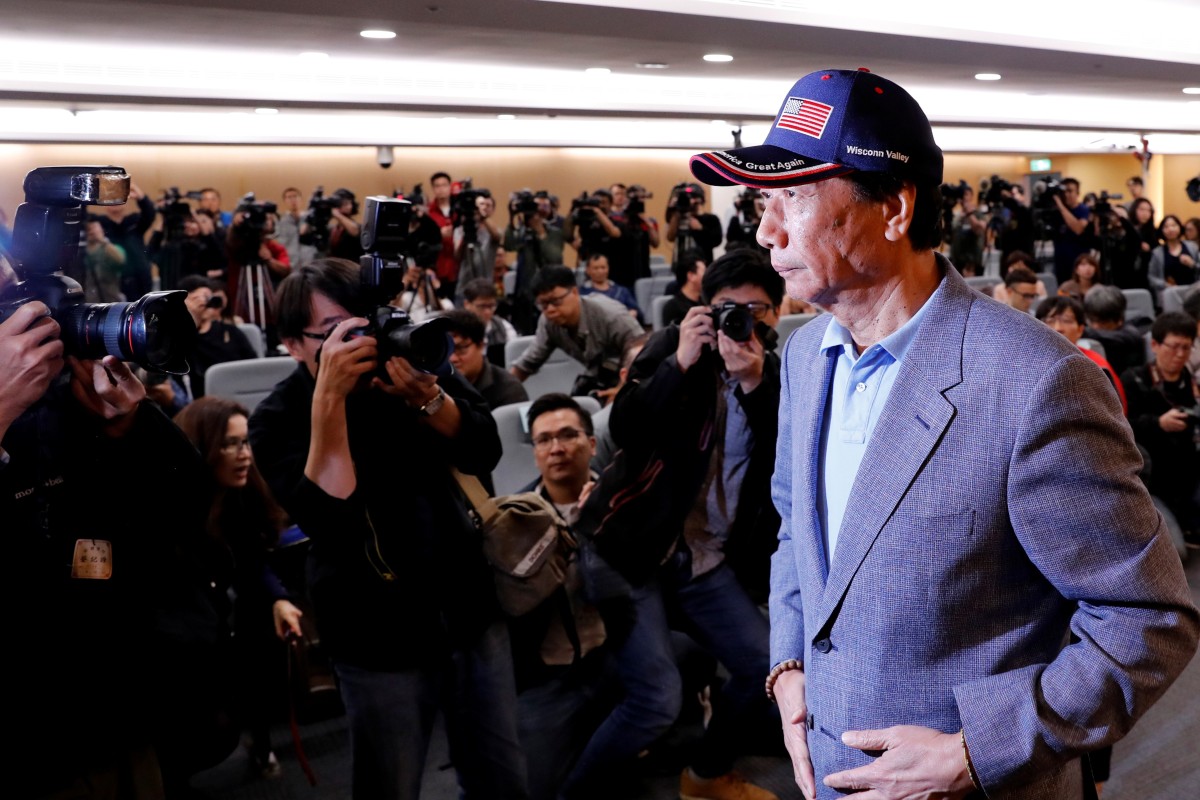
Recognise Taiwan’s title and then we’ll talk, Foxconn billionaire Terry Gou tells Beijing

  • Presidential hopeful takes a stand on ‘Republic of China’ after critics question his sovereignty credentials
  • Foxconn chief’s investments on mainland and close contact with mainland leadership have brought him under intense scrutiny
Taiwanese presidential hopeful Terry Gou. Photo: Reuters
Foxconn’s billionaire chairman and aspiring Taiwanese presidential candidate Terry Gou has called on Beijing to recognise the “Republic of China”, Taiwan’s official title.
Gou also said he had no plan to meet Chinese President Xi Jinping, countering critics who claim he would sell out the self-ruled island because of his multibillion-US dollar manufacturing empire on the mainland.
The businessman, who hopes to be the nominee for the Beijing-friendly Kuomintang (KMT) in the presidential race next year against incumbent Tsai Ing-wen, gave the assurances after the Tsai government accused him of spreading erroneous information about Taiwan’s sovereignty – a highly sensitive election issue.
In Taipei on Monday after returning from a trip to the United States,

where he met US President Donald Trump

, Gou said he would do all he could to defend the interests of the island.

“And since I have announced that I will take part in the KMT primaries to run on the party ticket for president, I will continue to do so without hesitation. As the president of the [Republic of China] of course, I must make the interests of the ROC the priority without a second thought,” he said.
He said he had long required Foxconn employees to sing the island’s anthem and hoist the island’s flag during annual parties.
Taiwan can turn a hi-tech profit from China-US rivalry: Foxconn chief

He also said he had the island’s flag displayed prominently during a ceremony marking his purchase of Japanese electronics maker Sharp in 2016 – all because he wanted the world and the mainland to note the existence of the ROC.

“If the Chinese mainland does not want to take note of the existence of the ROC, then what does it want us to be?” he said.

Gou added that he decided to run for president because he wanted to talk to Beijing about this issue “on an equal basis”.

Beijing considers Taiwan a wayward province that must returned to the mainland’s fold – by force if necessary.

It has suspended exchanges with Taiwan since Tsai became president in 2016. She refused to accept the “1992 consensus” – an understanding that allows the two sides to continue talks as long as they support the principle that there is only one China.

Since Gou launched his presidential bid last month, his huge investments on the mainland and his close contact with the mainland leadership have brought him under intense scrutiny from the pro-independence camp.

On Monday, Chen Ming-tung, head of Taiwan’s Mainland Affairs Council, which charts the island’s cross-strait policy, took aim at Gou for “incorrectly” saying that Taiwan was a part of the People’s Republic of China – mainland China’s official title.

Chen was responding to various Taiwanese media outlets that reported Gou as saying in the US that Taiwan was an inseparable part of China.

Cho Jung-tai, chairman of the ruling Democratic Progressive Party, also accused Gou of diminishing the island’s sovereignty.

In response, Gou said he was describing historical and religious links between the island and the mainland – not commenting on sovereignty.

Terry Gou: Taiwan’s wealthiest man – and future presidential candidate
“I hereby solemnly clarify that what I meant was that ‘China’ is the ROC as underlined in our constitution, and Taiwan, of course, is part of the ROC,” he said, adding “the ROC was never a part of the PRC”.
Gou said Foxconn had invested greatly in businesses not just on the mainland but also in other parts of the world, and it was unlikely for him to bow to Beijing simply because of his huge investments on the mainland.
He said he wanted to run for president because he hoped to be the peacemaker between Taiwan, the mainland and the US.
“No [Taiwanese] business can escape a conflict between the two sides of the Taiwan Strait,” he said.
During his meeting with Trump, Gou said he told the US leader of his desire to forge a mutually beneficial peace and improve commercial links between the three sides.
Observers said Gou must work out a cross-strait policy to convince voters that he would stand firm on Taiwan’s interests, and the scrutiny from the pro-independence camp would only grow if he was on the KMT’s presidential ticket.
Source: SCMP
Law of Unintended Consequences

continuously updated blog about China & India

ChiaHou's Book Reviews

continuously updated blog about China & India

What's wrong with the world; and its economy

continuously updated blog about China & India