Chindia Alert: You’ll be Living in their World Very Soon
aims to alert you to the threats and opportunities that China and India present. China and India require serious attention; case of ‘hidden dragon and crouching tiger’.
Without this attention, governments, businesses and, indeed, individuals may find themselves at a great disadvantage sooner rather than later.
The POSTs (front webpages) are mainly 'cuttings' from reliable sources, updated continuously.
The PAGEs (see Tabs, above) attempt to make the information more meaningful by putting some structure to the information we have researched and assembled since 2006.
WASHINGTON, Jan. 30 (Xinhua) — China and the United States kicked off here on Wednesday morning a new round of high-level talks to address their differences on outstanding economic and trade issues.
The talks, scheduled for two days, mark a significant step in the implementation of the important consensus reached by Chinese President Xi Jinping and U.S. President Donald Trump during a working dinner in Buenos Aires, Argentina, on Dec. 1.
The two heads of state agreed back then that the two sides should try to reach a mutually beneficial and win-win agreement within 90 days to bring an early end to their months-long trade friction featuring massive tariffs on imports from each other.
The latest talks began shortly after 9 a.m. local time (1400 GMT) at the Eisenhower Executive Office Building, part of the White House complex, following a brief session open to the media.
All the discussions and negotiations, which are expected to last until Thursday afternoon, will be held behind closed doors.
The Chinese delegation, headed by Vice Premier Liu He, includes senior officials from major economic sectors of the Chinese government, while the U.S. team is led by Trade Representative Robert Lighthizer and includes Treasury Secretary Steven Mnuchin, among others.
The White House has said that the U.S. side welcomes the Chinese delegation, which arrived in Washington on Monday, and that Trump is scheduled to meet with Liu on Thursday.
The world is watching these talks closely, with many hoping for some substantial, positive progress to be made.
Analysts have warned that the lasting trade tension between the world’s two largest economies would not only impact their own businesses, workers and consumers, but also stoke global market fears of uncertainty and disruption, and erode confidence in the long-term global economic growth.
While acknowledging that the talks will not be easy given the complexity and difficulty of certain issues in dispute, China maintains that there will be no insoluble problems between the two countries as long as they both keep the great benefits of cooperation in mind and show sincerity and mutual respect at the negotiating table.
MUMBAI (Reuters) – Doubts over how India will vote in a coming election and fears that the government will overspend persuading people to extend its mandate is keeping investors wary of buying bonds despite the lure of low inflation and possible interest rate cuts.
“There is obviously increasing uncertainty going into the general election and that is making investors generally a bit more cautious,” said Leong Lin-Jing, investment manager at Aberdeen Standard Investments in Singapore.
On Friday, the Hindu Nationalist government of Prime Minister Narendra Modi will unveil an interim budget that is expected to be full of goodies for rural and urban middle class voters.
Direct cash transfers to farmers, interest-free loans and income tax cuts might help the ruling Bharatiya Janata Party’s chances in a general election that must be held by May.
But pre-election largesse won’t reassure investors wanting more commitment to fiscal consolidation.
Investors have generally liked Modi’s pro-business stance, and his government’s earlier fiscal conservatism. And the size of the BJP’s parliamentary majority at the last election bred confidence in Modi’s ability to deliver on policies.
But the BJP’s defeat in state polls last month, and recent opinion polls that show it could be forced to form a coalition with partners who could make it harder to press forward with economic reforms and revert to fiscal prudence.
“It is really about having a stable leadership,” said Mitul Kotecha, senior emerging market strategist at TD Securities in Singapore.
“If there is no clear mandate at the elections then implementation of reforms could take a hit and prompt foreign capital outflows from India’s bond and equity markets.” And if the opposition Congress Party were to form the next coalition government it could adopt populist measures even more worrying for investors.
Earlier this week, Congress announced plans for a universal basic income scheme to support 300 million poor, which some analysts reckon would cost around 1 trillion Indian rupees ($14 billion)annually, and also potentially ignite inflation.
“The universal basic income scheme or any such fiscal largesse can lead to higher wages and therefore higher core inflation,” Maneesh Dangi, head of fixed income at Aditya Birla Sun Life, one of India’s largest mutual funds.
(Graphic: Foreign flows into Asian bonds-monthly – tmsnrt.rs/2SS8ZDO)
The fears of fiscal slippage have already pushed benchmark 10-year bond yields up about 30 basis points during the past six weeks, and some analysts expect them to rise further.
That gloominess comes despite hopes of a more dovish stance on interest rates from the Reserve Bank of India following the appointment last month of a new governor. Dangi, who manages around $22.5 billion of debt assets, believes the bond market should be even more bearish, as it is probably over-optimistic over chances for an early RBI rate cut.
“In our view the market is overextending its bullishness that there will be a rate cut in February,” he said.
Worried about underpriced risks posed by fiscal slippage and the RBI proving to be more hesitant reducing rates, Aditya Birla Sun Life has significantly cut holdings of long-tenure bonds and switched to tenures of one to two years.
Aberdeen has also cut its exposure to Indian debt paper during the past couple of weeks.
The uncertainties have prompted some investors to sharply reduce their duration of debt holdings while many are switching to Indonesia, Malaysia, Philippines and Thailand.
India saw a sustained sell-off by foreigners who have sold $736 million of Indian debt so far in January on top $5.9 billion sold in 2018. In contrast, foreigners bought 7.09 trillion rupiah ($501.95 million) of debt in Indonesia this month after having pumped in 57 trillion rupiah ($4.05 billion) in 2018.
For all the near term uncertainty, foreign investors remain bullish on India in the long term given its stable macro-economic outlook and attractive returns.
“There is a bit of hesitancy ahead of elections about raising exposure to India, but we are constructive on India in the medium to longer term,” said Kotecha.
Regarding the announcement of the back-series data, the ministry said the NSC had itself urged it to finalise and release it.
SNS Web | New Delhi | January 30, 2019 4:11 pm
A day after two independent members of the National Statistical Commission resigned over a disagreement with the Government, the Ministry of Statistics and Programme Implementation issued a clarification stating that “no concerns were expressed by the members in any of the meetings of the Commission in the last few months”.
NSC acting chairperson PC Mohanan and another member JV Meenakshi quit on Monday expressing concerns on the functioning of the panel including the release of the labour force survey results and the Back Series of GDP.
“I have resigned from NSC. We thought that the commission is not very effective nowadays and we also thought that we are not able to discharge the commission’s responsibility,” Mohanan told PTI.
“We have resigned from the NSC. Over the months, we have been feeling that we were not been taken seriously and being sidelined by the government. Recent decisions of the NSC were not being implemented,” Mohanan was quoted as saying by media reports.
HONG KONG (Reuters) – Investors are bracing for a series of “down rounds” in China’s much-hyped tech sector as weak stock markets worldwide and the country’s economic slowdown weigh on once-buoyant private markets.
Falling valuations risk denting investor enthusiasm for future funding rounds – potentially limiting the amounts startups are able to raise. One senior tech-focused dealmaker estimated that targeted valuations have fallen between 20 and 40 percent in China’s tech space over the last three months alone.
This week Maoyan Entertainment, China’s top movie ticketing app, became the latest example of the trend as the Hong Kong initial public offering of the group backed by Tencent Holdings Ltd valued the company at $2.16 billion – more than a quarter below the valuation reached in its last 2017 funding round.
Valuations of some sizeable unicorns – startups with at least a billion-dollar valuation – have also been dropping in the more opaque market of private secondary trading, where investors trade their holdings in unlisted companies.
Stakes in China’s ride-hailing champion Didi Chuxing have traded at prices implying a valuation of $40-44 billion, according to Moncef Heddad, managing partner and head of Asia at securities brokerage firm Rainmaker Asia Holdings.
Didi’s valuation exceeded $65 billion after its 2018 funding round, according to two sources familiar with the company. The privately held firm had been valued at $56 billion in a 2017 fundraising. Didi declined to comment.
“Most people pay for forward-looking valuations assuming that growth will only go in one direction, but when the economy is having a downturn, these forward-looking valuations are not going to sustain and need to adjust and correct too,” said Hong Kong-based Heddad.
Companies expected to seek funding in public or private markets this year include Beijing Bytedance Technology Co, owner of leading news aggregator Jinri Toutiao; artificial intelligence firms Megvii and SenseTime; and coffee startup Luckin, sources have told Reuters.
Bytedance, SenseTime and Luckin declined to comment. Megvii didn’t respond to a request for comment.
Other companies have had to lower their target valuations in funding rounds, including Ping An-backed financial technology company Lufax, which closed its latest funding effort in December at a valuation of $38 billion versus a target of $40 billion.
IPO MOMENT OF TRUTH
Tech investors in China have for the last few years enjoyed soaring valuations and a far-faster pace of unicorn creation compared with other markets, including the United States
But Hong Kong’s IPO markets in 2018 began to dampen the dizzying optimism as a string of hotly anticipated floats, including smartphone maker Xiaomi, priced towards the bottom end of their indicated ranges – and then fell further on trading.
Xiaomi’s July IPO valued the firm at about $54 billion, or just over half the $100 billion that industry insiders had touted early in the year. Its current market cap, at around $33 billion, is also below the $46 billion valuation it reached in its last pre-IPO fundraising in 2014.
“I think it’s healthy,” said Joe Tsai, co-founder of Alibaba Group when asked about the effect of such down rounds at a Reuters BreakingViews event in Hong Kong last week.
“The public markets have already reflected the down round… and I expect to see that happen in the next 6-9 months in the private markets.”
“I think the entrepreneurs had it too easy being able to raise gigantic billion dollar levels of capital at multi billion dollars of valuation. It’s just distorted,” he said.
Alibaba affiliate Ant Financial was one beneficiary of the funding boom. Last year it raised $14 billion in the world’s largest single fundraising by a private company – a deal that also made the payments operator the world’s largest unicorn with a valuation of $150 billion.
But even IPOs backed by Alibaba have since felt the chill: Babytree Group, a parenting website operator backed by the e-commerce giant, was valued at $1.5 billion in its $217 million November IPO in Hong Kong – down from a $2 billion valuation when Alibaba invested last May.
LESSER OF TWO EVILS
Investors concerned by the outlook have increasingly begun to demand downround protection clauses in fundraising agreements, industry sources said.
These can take different forms, but typical conditions involve a company agreeing to buy back shares, or otherwise compensate investors, if it fails to go public within a certain period or above a specified valuation.
Beijing Bytedance is one example, according to sources. The company, which also owns popular short video streaming app TikTok, raised $3 billion at a $78 billion valuation late last year.
But two sources say that at least some investment agreements for the deal included a pledge it would reach a value of at least $90 billion when it launches an IPO.
Industry participants have cautioned however that the deals may not be enforced when it comes down to it since for many late-stage investors, a down round via IPO is often a better option, despite the price, than being trapped in a still-private company.
“A down-rounded IPO isn’t good news but is more acceptable for investors because that at least offers an exit and creates market liquidity,” said a senior private equity investor who focuses on tech investments. “Of the two evils, we choose the lesser.”
Hubei province has banned female hosts from wearing revealing clothes as part of new guidelines for live-streaming broadcasts, making it the first authority in China to do so.
The provincial government in central China banned live stream broadcasters from wearing sexy costumes, lingerie, see-through dresses, skin-colour body tights or any clothes that are too revealing, state news agency Xinhua reported.
“The law may be too vague, but our standards are more detailed in terms of what to wear from bottom to top,” Xie Qiuqi, head of Gaoxin branch of the Hubei Standardisation and Quality Institution, told Hubei TV.
“Clothes showing the national flag and emblem and other unlawful content are also banned,” he said.
Under the new rules, minors are required to provide live stream platforms with an identity card, the household registration of their guardians and a signed application form before going live online by themselves.
Live-streaming platforms should install an around-the-clock system for reporting abuses and a means of shutting down accounts or online posts in 90 seconds, the latest rules said.
The new standards in Hubei followed live-streaming platform operator Wuhan Douyu Network Technology’s announcement that it had drafted broadcast rules in conjunction with research institutes and media associations including the Wuhan Software Industry Association, Wuhan University, and Wuhan New Media Industry Association.
Live streaming is hugely popular in China, helping companies to popularise their products, while individuals can earn an income with unique online offerings. These range from something as simple and innocuous as glimpses of the life of a farmer to scantily-clad women performing dance routines.
The industry has been under intense scrutiny after a string of scandals and mishaps, including minors who stripped online and the death of Wu Yongning, a “rooftopping” star who was killed in a fall from a tall building in Changsa, Hunan province, in November 2017.
In October, Yang Kaili, a 21-year-old, self-made online celebrity, was detained for five days after singing part of the national anthem in a “disrespectful” manner.
Also last year, China conducted checks on more than 5,000 live-streaming apps and shut 370 streams for illegal programming such as pornography or “content that instigates crime”, state media reported.
“Everyone had seen unhealthy, dangerous and inappropriate content in the past that may cause others to feel uneasy. We hope that through our official announcement of the policies, we can minimise or get rid of such phenomenon,” Yuan Gang, vice-president of Douyu TV, told Hubei TV.
“Where the industry is heading is what we are worried about. We want to launch these standards before 5G is rolled out,” he said.
Female live-streamers have become very high profile. By broadcasting themselves singing, dancing, applying make-up or everyday, mundane activities like eating, some hosts can make more than 100,000 yuan (US$14,300) a month from members of a mostly male Chinese audience from an estimated 456 million viewers nationwide.
With 42 million more men than women in China, according to World Bank figures from 2017, live-streaming platforms have become a major source of entertainment for single men, helping to make it a thriving business for many enterprising women who are not averse to using sex appeal to cash in on their fan following.
In November, a 19-year-old man surnamed Lee, from eastern China, was reported to have spent more than US$37,000 on a live-stream host he claimed was his girlfriend. The money included 260,000 yuan (US$3,871) drawn from his parents’ savings for a new home. Lee was diagnosed with depression.
The Hubei government’s latest policy sparked debate on Weibo, China’s microblogging service.
“This rule is controlling too much. What is considered revealing? You can set swimsuits as the standard or black robes as the standard,” one user wrote.
“All men should wear monotone Chinese tunic suits, and all women should wear qipao,” another user said.
MANILA, Jan. 29 (Xinhua) — Chinese Ambassador to the Philippines Zhao Jianhua said Tuesday that China will give its “firm support” to the Filipinos and the Philippine government in the fight against violent extremism after twin blasts hit a cathedral in the southern Philippines.
In a speech at the Chinese New Year reception, Zhao said the Chinese government expressed its deepest condolences and sympathies to the families of those who were killed and injured in Sunday’s blasts in Jolo city of Sulu province.
“Chinese government once again will give its firm support to the Philippine people and Philippine government for fighting against all barbaric violence including terrorism,” he said.
Bombings hit a cathedral in Sulu province of the southern Philippines last Sunday, killing 21 people and wounding more than 100 others.
HONG KONG, Jan. 29 (Xinhua) — With “one country, two systems” as its greatest advantage, Hong Kong will acquire more of a sense of contentment and happiness by staying committed to the basis of “one country” and well leveraging the benefits of “two systems,” an official said here Tuesday.
Wang Zhimin, director of the Liaison Office of the Central People’s Government of China in the Hong Kong Special Administrative Region (HKSAR), made the remarks while addressing more than 4,000 attendees at the liaison office’s Chinese New Year reception held at the Hong Kong Convention and Exhibition Center.
In 2018, China celebrated the 40th anniversary of its reform and opening-up, and solemnly declared a firm resolve to carry on this cause without pause in the new era, Wang said.
He added that Hong Kong has actively participated in the development of the Belt and Road Initiative and the Guangdong-Hong Kong-Macao Greater Bay Area, with a positive trend of integrating itself into the country’s overall development.
“By participating in the Greater Bay Area construction, the HKSAR, for the first time, is deeply engaged in drafting and implementing an outline of a national strategic plan,” he said.
“All of these achievements again explain that ‘one country, two systems’ is Hong Kong’s greatest advantage and the Chinese mainland with reform and opening-up is Hong Kong’s biggest stage,” he said.
This year marks the 70th anniversary of the founding of the People’s Republic of China. Pointing out that during the past 70 years, Hong Kong has always been developing and thriving together with the mainland, Wang expressed hope that all circles of Hong Kong society will contribute to the country’s comprehensive opening-up in a more proactive manner.
“Hong Kong compatriots will acquire more of a sense of contentment, security and happiness by staying committed to the basis of ‘one country’ and well leveraging the benefits of ‘two systems’,” he said.
Wang also pledged that the liaison office will open its doors wider in the new year, and will invite the HKSAR government officials and friends from various social walks, including all members of the HKSAR Legislature Council, for a gathering to further enhance mutual understanding.
HANGZHOU, Jan. 29 (Xinhua) — Alibaba’s Tuesday report shows that China’s rural areas are growing faster than some first-tier cities in digital consumption.
Statistics indicate that the growth rate of digital spending on Alibaba’s e-commerce platforms in rural areas reached 23.8 percent last year, 4.5 percent higher than that in first-tier cities of Beijing, Shanghai, Guangzhou and Shenzhen.
The huge consumption potential in rural areas would be turned into a major engine of growth as a result of the digital economy, more internet access and faster logistics, said the report.
Moreover, the internet will narrow the gap between the country’s developed eastern regions and the less-developed remote areas.
The report suggests that digital consumption further drives the sales of agricultural products in rural areas as more farmers turn to live-streaming and other popular internet marketing tools to attract customers.
In 2018, state-level impoverished counties sold goods worth over 63 billion yuan (about 9.4 billion U.S. dollars) on Alibaba’s online shopping platforms, with the most popular hits being agricultural products.
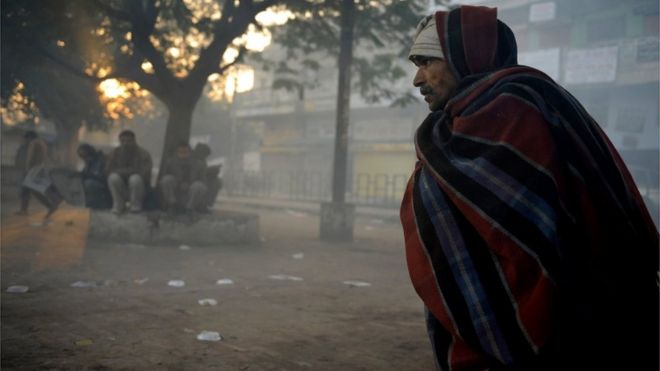
Image copyrightAFPImage captionMillions of Indians remain vulnerable to income shocks
India’s opposition Congress Party has promised to guarantee a minimum income for the country’s poor if it wins the upcoming summer elections.
So will this scheme be a game-changer and bolster the fortunes of the Congress party? (There are rumours that the BJP is primed to announce a similar scheme soon) Or does it risk becoming a handout, fuelled by populism, mired in confusion and blighted by misallocation?
The details of the minimum income plan will be only revealed in the party manifesto, which is due soon.
The Congress’s scheme essentially promises a basic income support for India’s poorest households after fixing an income eligibility threshold. It is also likely to be progressive in nature: if the household is entitled to, say 50,000 rupees ($700; £534) a year, and it already earns 30,000 rupees, it will receive 20,000 rupees as income support. So the poorer the family, the more income support it will get.
Abhijit Vinayak Banerjee, a professor of economics at MIT, told me that there is “a lot of sympathy for the minimum income guarantee in purely ethical terms”. But, he says, there will be a lot of challenges in implementing it in a vast and complex country like India.
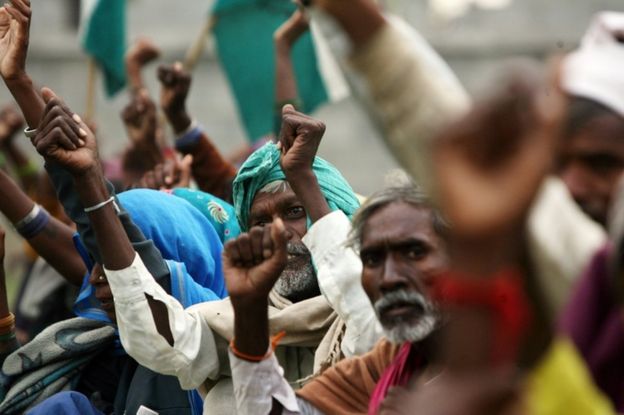
Image copyrightAFPImage captionThe gap between the rich and poor has widened in India
For one, what happens to India’s massive rural employment guarantee programme? The Mahatma Gandhi National Rural Employment Guarantee Scheme (MNREGA) also promises a minimum income to every rural household by providing at least 100 days of guaranteed wage employment in a financial year. Will the new scheme also count income from the rural programme? What happens if someone stops going for rural work?
“Our research suggests this is where the poor often lose out and the less poor make hay, partly – but probably not mostly – because of corruption, but also because the less poor are better at figuring out how to make claims,” says Prof Banerjee.
Then there’s the problem of what economists call the “moral hazard” – undue risks that people could take if they don’t have to bear the consequences of it.
‘Lack of incentive’
Welfare schemes, many economists believe, can end up trapping people in poverty. One criticism of guaranteed income support is that it reduces the incentive to work – generations of families stay on welfare in the US because there’s no incentive to come out of it.
Economist Vivek Dehejia wonders whether something similar could happen with this scheme. “If you fix a household income eligibility threshold of 10,000 rupees a month to be eligible for income support, what incentive do you have rise above it,” he says.
There are also questions about where India will find the money to support such a scheme – we are talking about hundreds of millions of eligible families who will have to be paid.
India already has more than 900 federally funded schemes – like cheap food, fertiliser subsidies, rural jobs guarantee, crop insurance, student scholarships – accounting for about 5% of the GDP by budgetary allocation. Many of these schemes are marred by leakage, wastage, exclusion of the eligible, and even fraud.
Economists wonder whether the vast amount of money required for the new income scheme will come from pruning subsidies and existing welfare schemes, which are always politically difficult.
“A lot thinking and working has gone into the income scheme,” Praveen Chakravarty, head of the data analytics department of the Congress party, told me. “It is fiscally doable without drastic reduction of existing welfare schemes”.
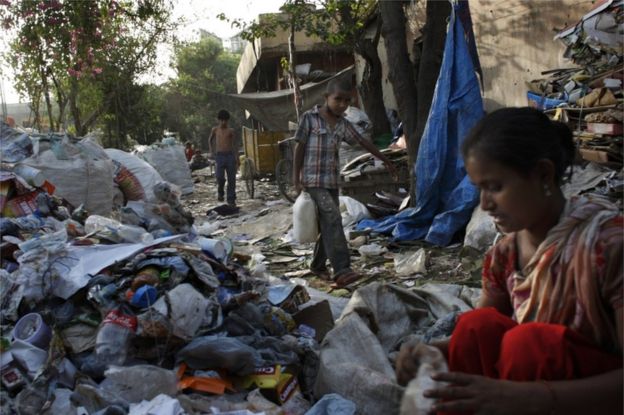
Image copyrightAFPImage captionGuaranteed basic income is intended to pull more people out of poverty
So the plan is to apparently find money for it through expenditure reduction (trimming wasteful government expenditure?) and “new revenue streams” (new taxes?). Both are going to be daunting tasks.
Vivek Dehejia says the scheme would make financial sense if it subsumes other welfare schemes and subsidies. Otherwise, he says, it will “become another handout, and will not help fix India’s poorly sorted out welfare architecture”.
Clearly, the scheme, inspired in part by the Brazil’s Bolsa Familia or Family Grant to lift people out of poverty will also reignite the debate over cash transfers to the poorest, who, some believe, often do not have enough fiscal knowledge and information to handle money. However. the Indian scheme will be unique because Bolsa Familia is a conditional transfer of money
Test for the state
Supporters of cash transfers say they reduce poverty, give the poor the choice to spend as they think best, targets better, and acts as a buffer against shocks. It also improves financial inclusion, and by helping the poor to consume more, boosts the GDP. Other economists, most notably Nobel laureate Amartya Sen, believe that people in a market driven economy will spend more on private education and healthcare if the state gives them a minimum income.
Any which way, handing out guaranteed income in a vast and complex country in India will remain a formidable challenge, irrespective of the government in the power. It will be a test for the Indian state.
NEW DELHI (Reuters) – Walmart Inc’s online retailer Flipkart has told the Indian government the company faces the risk of “significant customer disruption” if the implementation of new curbs for e-commerce is not delayed by six months, a source told Reuters.
India’s new foreign investment restrictions will, from Feb. 1, bar e-commerce companies from selling products from firms in which they have an equity interest and also ban them from reaching deals with sellers to only sell on one platform.
In a letter to India’s industries department earlier this month, Flipkart Chief Executive Kalyan Krishnamurthy said the rules required the company to assess “all elements” of its business operations, according to a person privy to the communication.
“Redesigning numerous elements of our technology systems to ensure that we can validate and evidence our compliance, in such a compressed period of time, has caused us to divert significant resources,” Krishnamurthy wrote in the letter. The new curbs were only announced on Dec. 26.
He also said the regulations could cause “significant customer disruption” if the deadline for compliance wasn’t extended. He asked for a six-month delay.
The contents of Flipkart’s letter have not been previously reported. Flipkart declined to comment.
Indian officials have said the government is unlikely to change the policy’s implementation date. The industries department declined to comment for this article.
The policy move has jolted Walmart, which last year invested $16 billion in Flipkart in its biggest ever deal, and Amazon, which has committed $5.5 billion in India investments.
Industry sources have said the new policy would raise compliance costs and force Amazon and Flipkart to review their business arrangements in the country.
Flipkart and Amazon have both started working on approaching thousands of sellers on their platforms to ensure the companies comply with the regulations, three sources aware of the matter said, even as they seek a deadline extension.
For Flipkart, the process would take five-to-six months, said one of the sources, who told Reuters: “the company is right now focusing on working with sellers (for compliance), all rest is on the back burner”.
UNFAIR MARKETPLACE?
India’s small traders had complained that large e-commerce companies used their control over inventory from their affiliates to create an unfair marketplace that allowed them to offer deep discounts on some products. Such arrangements would be barred under the new policy.
Amazon told Reuters last week it had written to the Indian government to seek an extension of four months. With more than 400,000 sellers and “hundreds of thousands of transactions” daily, Amazon said it needed the time to understand the policy.
Flipkart, in its letter, said the group has more than 80,000 employees and contractors and the number of shipments and packages which move daily were between 500,000 and 600,000.
The new policy “imposes several new conditions, which we believe could potentially have undesirable impacts on the continued growth of e-commerce in India”, Krishnamurthy wrote.
The company added that it wanted to work with the federal government to promote “pro-growth policies” which can help develop the e-commerce sector. Before the policy change, Morgan Stanley estimated India’s e-commerce market would grow 30 percent a year to $200 billion in the 10 years up to 2027.
The U.S. government has been concerned and earlier this month told Indian officials to protect Walmart and Amazon’s investments in the country, citing “good relations” between the two countries, Reuters reported on Thursday.



 CHINDIA ALERT: You'll be living in their world, very soon
COMMENTS: