Chindia Alert: You’ll be Living in their World Very Soon
aims to alert you to the threats and opportunities that China and India present. China and India require serious attention; case of ‘hidden dragon and crouching tiger’.
Without this attention, governments, businesses and, indeed, individuals may find themselves at a great disadvantage sooner rather than later.
The POSTs (front webpages) are mainly 'cuttings' from reliable sources, updated continuously.
The PAGEs (see Tabs, above) attempt to make the information more meaningful by putting some structure to the information we have researched and assembled since 2006.
BEIJING, Jan. 12 (Xinhua) — China will continue its efforts to widen market access for foreign investment and build a better business environment, Minister of Commerce Zhong Shan has said.
In an interview on Friday, Zhong said measures will be taken to shorten negative lists for foreign investors adopted in pilot free trade zones (FTZs) and nationwide, and wholly-foreign ownership will be allowed in more sectors.
China will press ahead with opening-up in the service sector, and encourage foreign investment in manufacturing and high-tech industries, and in central and western regions, Zhong said, adding that governments will help foreign companies address difficulties in investing in China.
To provide a favorable environment, the ministry will push for the foreign investment law and improve governments’ handling of complaints from foreign businesses, Zhong said.
As a major investment destination in the world, China maintained stable growth in foreign direct investment (FDI) against a gloomy global climate. Its FDI went up 3 percent year on year to 135 billion U.S. dollars last year, while that of the world’s total and developed countries slumped 41 percent and 69 percent, respectively, in the first half of 2018.
The World Bank has raised China by 32 places in terms of business environment, and 95 percent of companies surveyed by the U.S.-China Business Council said they would increase investment or maintain the existing presence in China in the coming year.
“The Chinese market has huge potential and sound prospects,” Zhong said. China’s goods consumption is expected to gain 9.1 percent from a year ago in 2018 to 38 trillion yuan (5.6 trillion U.S. dollars), serving as the biggest growth driver for five consecutive years.
“China is steadily marching toward the largest country of goods consumption,” Zhong said.
The ministry will further stimulate domestic consumption this year, with measures to promote urban consumption upgrades, tap into the potential in rural areas, foster modern supply chains, and bolster services consumption.
China’s foreign trade also remained steady, with the total imports and exports up 14.8 percent to stand at 4.2 trillion U.S. dollars in the first 11 months, hitting a new high. The services trade increased 15 percent from a year ago to 656.2 billion U.S. dollars in the first ten months, the world’s second largest.
Zhong listed three major tasks of the ministry in 2019: holding the second import expo, properly handling trade frictions with the United States, and pushing forward pilot FTZs and the Hainan free trade port.
The ministry will implement the consensus reached between Chinese and U.S. heads of states, propel economic and trade negotiations, and expand cooperation with U.S. states and cities, businesses and non-governmental institutions in a bid to promote stable China-U.S. economic ties and win-win cooperation.
Guo Shengkun (R), a member of the Political Bureau of the Communist Party of China (CPC) Central Committee and head of the Commission for Political and Legal Affairs of the CPC Central Committee, meets with Afghan president’s national security adviser Hamdullah Mohib in Beijing, capital of China, Jan. 11, 2019. (Xinhua/Shen Hong)
BEIJING, Jan. 12 (Xinhua) — Guo Shengkun, a member of the Political Bureau of the Communist Party of China (CPC) Central Committee, met with Afghan president’s national security adviser Hamdullah Mohib Friday in Beijing.
Guo, also head of the Commission for Political and Legal Affairs of the CPC Central Committee, called on China and Afghan to implement the consensus reached by the two heads of state and continue to advance the strategic cooperative partnership between the two countries.
China’s law enforcement and security departments stand ready to enhance cooperation with Afghan in counter-terrorism, border security, institution and personnel security, so as to safeguard security and development interests of the two countries, and promote regional peace and stability.
Mohib said Afghan will resolutely fight against terrorism, and stands ready to deepen law enforcement and security cooperation between the two countries.
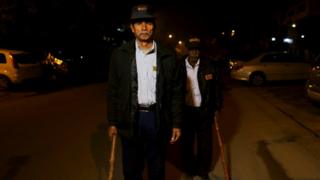
Image captionRanjit Singh goes on foot patrols every night with his torch
On a dimly-lit street, they look like lone warriors against unknown threats. From afar, their shadows loom over suburban Noida, a newly-gentrified satellite city on the outskirts of India’s capital, Delhi.
Heavy silence blankets the area, broken only by the occasional shrill blast from a whistle.
Two men, dressed in dark blue jackets and caps with the word “security” sewn in bright yellow, have just begun their nightly patrol.
“I have stopped thieves from stealing cars,” 55-year-old Khushi Ram, who goes by a first name only, says with pride. “And then I handed them over to the police.”
He and Ranjit Singh, 40, are security guards. But they are not protecting banks, brightly-lit jewellery stores or corporate offices.
They protect more than 300 posh homes every night – and they do this by going on foot patrol for hours.
“I like my job because I feel like I’m doing something for the public,” Khushi Ram says.
It is bitingly cold and as they rub their hands together to spark some warmth, they breathe out – and it blends easily with the dense smog hanging in the air.
Walk through any of the grid-like neighbourhoods that make up the bulk of Delhi’s residential housing for the middle and upper classes, and you will see many such security guards whose jobs are a halfway point between a watchman and a police officer.
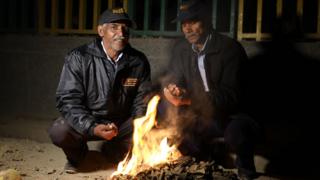
Image captionKhushi Ram (L) and Ranjit Singh say they are proud of their job
They can be seen sitting on plastic chairs at the entrance to a neighbourhood, logging details as vehicles enter and exit; or patrolling the blocks through the night while tapping their wooden sticks on the ground – a familiar sound that is both tedious and reassuring.
They are part of India’s informal and often invisible workforce, which runs into hundreds of millions by some estimates. Many informal workers end up in jobs that are crucial to city neighbourhoods, from domestic workers to security guards.
“Everybody in the neighbourhood – from small children to the elderly – depends on us for their safety,” says Ranjit. “This is always on my mind when I am patrolling and it pushes me to do my best.”
Image captionThey protect more than 300 homes every night
Ranjit’s weapon is a torch. And Khushi Ram has a whistle slung around his neck.
The two men divide the sprawling block – lined with metal and wooden gates that stand in front of two and three-storey homes – between them and set off. Often, they walk and occasionally, they cycle.
They cautiously stop in front of every house and examine it through the gates before walking past.
The two men did not think they would be checking gates and streets in a neighbourhood they could never afford to live in when they left their villages in search of greener prospects.
The invisible workforce – stories about the unorganised workers at the heart of India’s economy
Ranjit is from the eastern state of Bihar and Khushi Ram is from the northern state of Uttar Pradesh – both are largely rural and among India’s poorest states.
Many of the guards I spoke to say they moved to Delhi in search of a government job, hoping to work for the police or the railways. These jobs are coveted because they come with benefits and tenure. Some of them even harboured dreams of joining the Indian Army.
Image captionEach neighbourhood in Noida has five or six such security guards
“We work with the police to keep residents safe,” says Ranjit, who moved to Delhi two years ago. He was immediately hired by a local contractor to guard the neighbourhood in Noida.
Local police have also benefited from the work of such guards, seeing as there are about five or six of them in each residential block. “We consider them an extra force,” says Ajay Pal Sharma, a senior police officer in Noida. The crime rate in the Noida, he adds, decreased by 40% in 2018 compared with the year before.
“This is partly because of our relationship with the guards, who have a lot of manpower, so we try and work closely with them.”
Mr Sharma adds that his precinct has also trained some of the guards in recent years, as the bulk of them do not receive any formal training.
He said they have taught the guards to watch out for car thieves and suspicious activity.
The guards also keep their ears open for stray dogs – they say barks from them signal something worth investigating.
Image captionKhushi Ram says he has handed over car thieves to the police
Khushi Ram moved to Delhi more than 20 years ago and has been doing the same job ever since.
He says that most people in the neighbourhood respect him, but others tend to look down on this line of work. “Some get nasty because they see us as a lowly-paid person who doesn’t deserve respect.”
His first pay check was for 1,400 rupees (about $20; £15.50). Now, he earns 9,000 rupees a month. “The increase in pay is not much, considering how basic living costs constantly go up when you live in cities,” he says. “I can barely survive with this income, but I don’t have any other skill so I have to continue.”
“I employ 200 guards and pay them the best I can. But the problem is that people don’t want to pay a lot,” says Himanshu Kumar, who owns a small private security firm that stations guards in residential areas.
He says that many see these guards as chowkidars, a term for villagers who voluntarily patrol the streets in exchange for food and money.
“But cities are different,” Mr Kumar says. “You have to pay more because the job is tougher. Unfortunately, people’s attitudes have not changed.”
Image captionRanjit Singh and Khushi Ram work in the biting cold in winter and sweltering heat at other times of the year
It is a winter night in Delhi, and the air is leaden with pollution. As Ranjit and Khushi Ram walk, they cough frequently.
The job requires that they walk for at least five to six hours every night and sometimes, they stop to make a fire to warm themselves.
There is no relief in the summer either as sweltering temperatures persist through the night.
It can be a pretty thankless job, says Ranjit, who only gets to see his family once a year since they still live in Bihar.
“In an ideal world, I would be paid more for this job but the pay is so low that I want to quit,” he says.
“It is harder than you think – to stay awake when the rest of the city sleeps.”
NEW DELHI/MUMBAI (Reuters) – Two political rivals in the northern Indian state of Uttar Pradesh will form an alliance in a bid to defeat Prime Minister Narendra Modi’s Bharatiya Janata Party (BJP) in national election scheduled for May, leaders of the parties said.
The Samajwadi Party (SP) and the Bahujan Samaj Party (BSP), both of whom command large support bases among Uttar Pradesh state’s working class and are led by former chief ministers, will contest the election as a team, they said.
Uttar Pradesh is India’s most populous state and accounts for about a sixth of all members of the parliament, the highest by a single state. Barring a couple of exceptions in the 1990s, the party winning the most number of seats there has helped form the federal government.
Out of the 80 seats in the state, SP and BSP will nominate candidates for 38 seats each, BSP chief Mayawati Das said at a joint press conference with SP chief Akhilesh Yadav on Saturday.
They will not contest the other four seats, which include two that have historically been held by the country’s main opposition party, Congress.
Congress, which ruled India for nearly four decades since its independence from Britain in 1947, has also been working to build a “grand alliance” with other parties ahead of the polls.
Mayawati, however, said Congress would not be a part of the BSP-SP alliance in Uttar Pradesh. “We can surely stop the BJP from coming to power with this alliance with SP,” she said.
On Friday, Yadav had told news channel NDTV: “We can give Congress two seats they have always held”, referring to the constituencies from where Congress President Rahul Gandhi and his mother Sonia Gandhi have contested in the past.
Mamata Banerjee, head of Trinamool Congress party and chief minister of eastern India’s West Bengal state who has been pushing to create a mega alliance of regional parties to defeat the BJP, welcomed the announcement in a tweet.
“I welcome the alliance of the SP and the BSP for the forthcoming Lok Sabha elections,” Banerjee tweeted.
Akhilesh Yadav, Chief Minister of the northern state of Uttar Pradesh and Samajwadi Party (SP) President, addresses a news conference before resigning from his post in Lucknow, India, March 11, 2017. REUTERS/Pawan Kumar
“Let us cherish the ‘idea of India’ for which our freedom fighters laid down their lives. Our people and our great institutions must strive to remain “independent”, in the true sense of the word.”
OPPOSITION GETS A FILLIP
Opposition parties across the country received a fillip last month, when India’s ruling party lost power in three states and dealt Modi his biggest defeat since he took office in 2014.
The BJP, SP and BSP contested against each other during the state elections in March 2017, which the BJP comfortably won, but political analysts say a BSP-SP alliance could affect the ruling party’s prospects.
Congo’s opposition leader wins chaotic presidential election
The BJP had a 40 percent vote share in the state polls, the BSP and SP put together accounted for 44 percent. To be sure, voting patterns could be different when the world’s largest democracy goes to polls.
The BJP, however, is confident of winning elections in Uttar Pradesh. “We will win 74 out of the 80 seats in Uttar Pradesh,” president Amit Shah said in a televised address on Friday.
Despite the strategic significance and having been ruled by different parties since independence, Uttar Pradesh remains one of India’s most backward states.
It is notorious for its crime rate and unlicensed gun use, has below-average literacy levels, an abysmally low human development index and worrying levels of population growth.
SHANGHAI (Reuters) – China’s plans for tax cuts targeting smaller companies will help to support employment and economic stability, and will expand the country’s tax base over the long term, Premier Li Keqiang was quoted as saying on Saturday.
“Implementing tax cuts for small and micro enterprises is mainly to support employment,” Li said in comments posted on the Chinese government’s website.
Developing and strengthening small companies is linked to economic stability and stable employment, he said.
“Looking at the long term, this will continue to expand the tax base, conserve tax resources and ultimately achieve wins for mass employment, corporate profits and fiscal revenues,” he was quoted as saying, referring to the corporate tax cuts.
Li’s comments come amid growing official concern over China’s slowing economic growth and its impact on the labour market.
Chinese authorities plan to set a lower economic growth target of 6 to 6.5 percent in 2019, compared with “around” 6.5 percent in 2018, sources told Reuters, as weakening domestic demand and a damaging trade war with the United States drag on business activity and consumer confidence.
Analysts expect that China’s economy grew around 6.6 percent last year, its slowest pace since 1990, and it is expected to cool further in coming months before a slew of support measures start to kick in.
“The bottom line for the policymakers is social stability, which is crucially tied to the unemployment rate and job creation,” analysts at BoAML said in a recent note. “With U.S.-China trade risks still looming large, we believe policymakers would not hesitate to take pre-emptive measures to stabilise expectations on job stability.”
More growth boosting steps are expected this year as policymakers seek to avert the risk of a sharper slowdown.
China’s State Council, or cabinet, said on Jan. 9 that it would further reduce taxes for smaller companies. On Friday, Finance Minister Liu Kun said authorities would step up tax and fee cuts to lower corporate burdens.
Image copyrightCLEPImage captionAn image of the rover taken with the lander’s terrain camera (TCAM)
A Chinese rover and lander have taken images of each other on the Moon’s surface.
The Chinese space agency says the spacecraft are in good working order after touching down on the lunar far side on 3 January.
Also released are new panoramic images of the landing site, along with video of the vehicles touching down.
The rover and lander are carrying instruments to analyse the region’s geology.
The Chang’e-4 mission is the first to explore the Moon’s far side from the surface.
Image copyrightCLEPImage captionA picture of the lander taken by the rover’s panoramic camera (PCAM)
The rover has just awoken from a period on “standby”.
Controllers placed it in this mode shortly after the touchdown as a precaution against high temperatures, as the Sun rose to its highest point over the landing site.
Those temperatures were expected to reach around 200C. But the Chinese Lunar Exploration Program (CLEP) said that as of the morning of 11 January, the Yutu 2 rover, its lander and the relay satellite were all in a “stable condition”.
Image copyrightCLEPImage captionPart of the cylinder projection of Von Kármán crater from one of the lander’s camerasImage copyrightCLEPImage captionAzimuth projection of the landing site from one of the cameras on Chang’e-4’s lander
The panoramic images show parts of the static lander and the Yutu 2 (“jade rabbit”) rover, which is now exploring the landing site in Von Kármán crater.
CLEP, which released the images, said in a statement: “Researchers completed the preliminary analysis of the lunar surface topography around the landing site based on the image taken by the landing camera.”
In contrast with previous images from the landing site, the panoramic image has been colour-corrected by Chinese researchers to better reflect the colours we would see if we were standing there.
Online commentators had pointed out that these earlier, unprocessed images made the lunar landscape look reddish – a far cry from the gunpowder grey landscapes familiar from other missions to the surface.
Image captionRaw images made the lunar surface appear red; the new images have been calibrated
In an article for The Conversation, Prof Dave Rothery, from the Open University in Milton Keynes, observed: “In the raw version, the lunar surface looks red because the detectors used were more sensitive to red than they were to blue or green.”
Chang’e-4 was launched from Xichang Satellite Launch Centre in China on 7 December. It touched down at 10:26 Beijing time (02:26 GMT) on 3 January.
Because of a phenomenon called “tidal locking”, we see only one face of the Moon from Earth. This is because the Moon takes just as long to rotate on its own axis as it takes to complete one orbit of Earth.
The far side is more rugged, with a thicker, older crust that is pocked with more craters. There are also very few of the “maria” – dark basaltic “seas” created by lava flows – that are evident on the more familiar near side.
Because there’s no way to establish a direct radio link to Earth from the far side, the spacecraft must bounce data off a relay satellite, called Queqiao (or magpie bridge), which orbits 65,000km beyond the Moon, around a so-called Lagrange point.
CLEP said: “The ground receiving image was clear and intact, the Chinese and foreign scientific loads were working normally, and the detection data was valid.”
Space News reported that the rover would be put into a dormant state on 12 January, to coincide with the lunar night-time, when temperatures could drop to around -180C.
During this time, the rover would have limited functions.
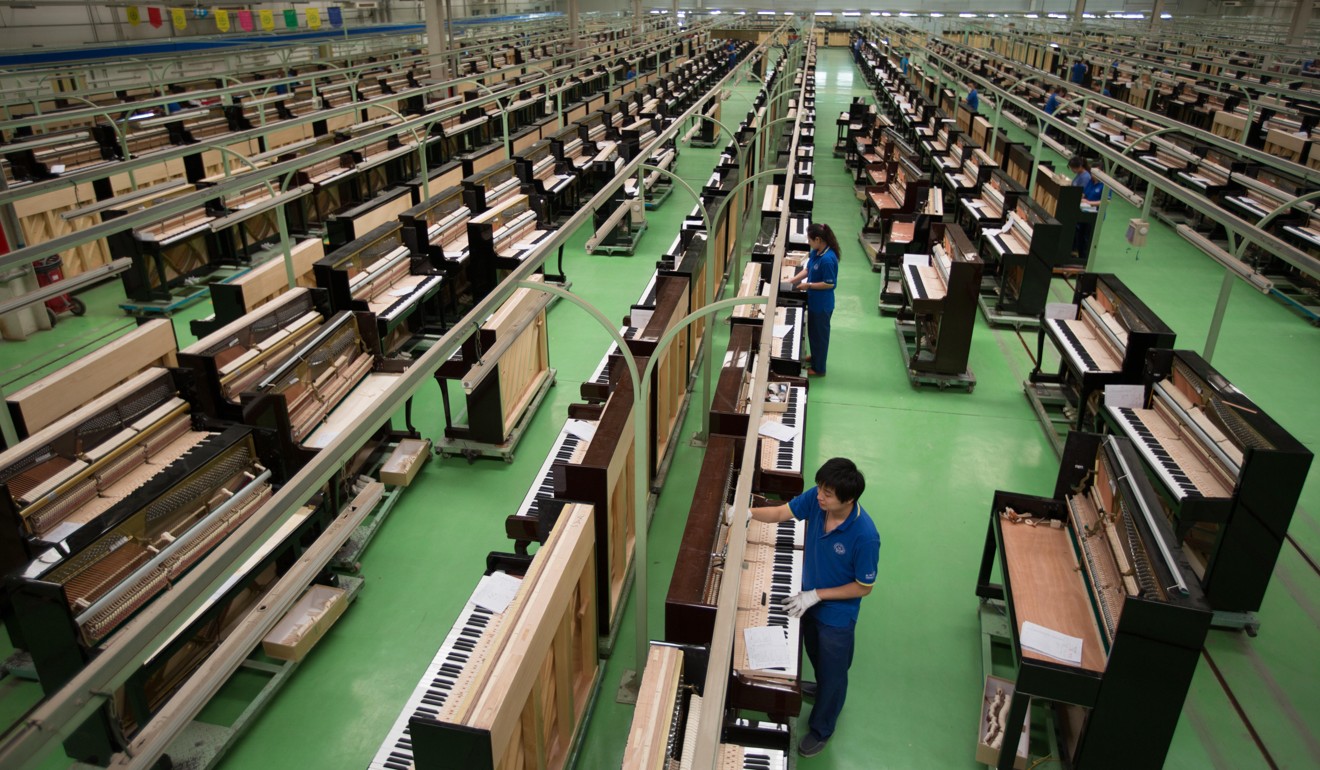
Country is the world’s biggest manufacturer and exporter of pianos, shipping about 350,000 a year, but has a reputation for producing low-quality models
As living standards have improved across the country, pianos are no longer seen as luxury items
Playing the piano is becoming an increasingly popular pastime for Chinese people young and old, but while their passion is indubitable, the same cannot be said about the local manufacturers that make more of them than anywhere else in the world.
China opened its first piano factory in 1895 but it was not until the 1950s, after the founding of the People’s Republic, that state-controlled manufacturers began to spring up in major cities. Today, the country builds and sells about 350,000 models a year.
But despite its prolific output, China is not regarded as a maker of quality pianos.
According to Hong Kong pianist Gwendoline Cho-ning Kam, the “character” of a piano is determined by the craftsmanship of the people who make it, and when it comes to quality, China still has a long way to go.
“Pianos are about personal preference, but the ones made in China can’t compete on the world stage,” she said. “We rarely see them in international concert halls.”
Kam has been playing the piano for about 30 years and has tried out all sorts of brands, from locally made models like Pearl River and Yangtze River, to the best in the world from Germany’s Steinway and Italy’s Fazioli.
A manager with a leading Chinese manufacturer, who asked not to be named, said local firms did not have the expertise to produce all of the components needed to make a piano and so had to rely on imports.
“We can’t produce strings, for example,” he said. “So we buy them from Germany or Japan.”
It was the same with the felt needed for the hammers, he said.
“The raw material for hammer felt is Australian wool, but different companies make different types to create different sounds,” he said. “We’ve made a lot of progress making hammer felt but when it comes to high-end pianos, we have to import it from Germany.”
China also had a lack of technicians who truly understood music, he said.
“This is a young industry for us and our technicians’ understanding of the piano and piano music is way below that of Westerners, and that affects a piano’s character.”
David Sun, who has been tuning and repairing pianos in Shanghai and Nanjing since graduating from Nanjing University of the Arts in 2011, said that although China was not known for the quality of its pianos, most people were unconcerned.
“Most families don’t care much about the brand and most of the pianos they buy come from small Chinese factories,” he said. “The most popular ones are priced between 20,000 and 30,000 yuan (US$3,000 to US$4,400), with some costing just a little over 10,000 yuan, which is much cheaper than comparable European or American brands.”
The industry is in a different phase of development to those in the West, he said.
“The mission for many of the factories in China is to make pianos as affordable as possible, while others, who understand nothing about pianos, are in the business only to make money,” he said.
“China also doesn’t have the tradition or cultural links with the piano,” he said. “So even if a domestic maker spent a lot of money to produce a great piano, people [who know about these things] would still choose one made in Europe.”
Xiao Wei, vice-chairman of piano manufacturer Pearl River, which bought German brand Schimmel two years ago, said the company had been trying to upgrade its products after a period of rapid growth.
“Buying Shimmel in 2016 was an important part of our strategy to shift to high-end instruments,” he said.
About 90 per cent of the company’s pianos are sold in China with the rest going to Europe and North America.
“As salaries have increased in China, so the piano is no longer regarded as a luxury item,” Xiao said. “And many families have realised that playing the piano is a good way for their children and themselves to develop.”
Sun agreed there had been a spike in the number of people taking up the piano, with the fastest growing sector being the elderly.
“I would say 20 to 25 per cent of my clients are retirees in Shanghai,” he said. “Many of them went to the local college to learn how to play.”
But everyone knows that if you really want to master an instrument you have to start young. And that is exactly what six-year-old Tingting from Shanghai is doing.
“As far as I know, at least a third of my daughter’s classmates are learning to play the piano,” said her mother, Lucy Chen.
Tingting had been taking weekly lessons for nearly two years and practised for about an hour a day at home, she said.
As well as wanting her little girl to “develop an artistic temperament”, Chen said that learning the piano might also one day provide a useful source of income.
“Even if she never becomes a master, she can at least find a job,” she said. “I know lots of college students majoring in piano that make big money by teaching in their spare time.”
BEIJING, Jan. 11 (Xinhua) — China is mulling tax reductions on a larger scale this year to bring down the burden on the real economy and improve market confidence, Minister of Finance Liu Kun has said.
Liu said in an interview on Thursday that the tax cut in the pipeline would be inclusive, simple and practical, and be implemented at an early date.
His remarks came on the heels of a new batch of tax breaks for small and micro firms, which comprised of lower tax rates, higher tax thresholds and favorable policies for investors of tech startups.
“Some 17.98 million businesses in China are covered by the inclusive tax reduction, accounting for more than 95 percent of the total corporate taxpayers and with 98 percent of them privately owned,” Liu said.
China will also step up efforts to push forward value-added tax reform for substantive tax cuts, implement special individual income tax deductions, and ease the business burden from social insurance payments, Liu said.
With intensive tax breaks, China is estimated to save a total of 1.3 trillion yuan (nearly 200 billion U.S. dollars) for market entities in 2018, outshining similar moves by any other countries in terms of scale and ratio to GDP.
While persisting in tax cuts, China will take bolder and more effective measures to implement proactive fiscal policy, Liu said.
“The fiscal expenditure will be improved moderately according to the economic situation and demand, and there will be a relatively substantial increase in the issuance of special-purpose local government bonds to support projects under construction and fix shortcomings,” Liu said.
China will make fiscal funds more effective and channel more capital into weak areas including poverty relief, agriculture, innovation and environmental protection, Liu said, adding that the general government spending would be cut by more than 5 percent.
Liu denied concerns about massive stimulus and stressed that the measures were counter-cyclical, aimed to strike a balance between stable growth and risk prevention, and would be more market-oriented and law-based.
China has assigned 1.39 trillion yuan worth of bonds to local governments, which Liu said would be used to finance the development of poor areas and major projects of railways, water conservation and rural revitalization.
UNITED NATIONS, Jan. 11 (Xinhua) — A Chinese envoy on Friday asked the international community to continue to assist the government of the Democratic Republic of Congo (DRC) in maintaining peace and stability in the country at a crucial juncture after elections.
The international community should show full respect for the national sovereignty, independence and territorial integrity of the DRC and the authority of the national electoral commission, Ma Zhaoxu, China’s permanent representative to the United Nations, told the Security Council.
“We see elections as a country’s internal affair. We believe that the people of the DRC have the ability and wisdom to resolve relevant issues in their own way. We hope that parties in the DRC can stay calm, exercise restraint and resolve differences through dialogue and negotiation so as to maintain peace and stability.”
A peaceful handover of power is in the interests of the DRC people, and is conducive to peace, stability and development of the DRC and the African continent as a whole, he said.
The Chinese envoy also asked the international community to keep up humanitarian assistance. The Ebola epidemic in the northeast of the DRC also requires continued support from the international community, he said.
China has been a staunch supporter of DRC’s peace process and will continue to provide medical, food and other assistance, remain engaged in the country’s social and economic development, he said.
Presidential, legislative and provincial elections were held in the DRC on Dec. 30 after long and repeated delays. Provisional results were released on Wednesday.
“There is nothing to worry about the Citizenship Bill or 10 per cent quota for the poor among the general category,” said Madhav.
SNS Web | New Delhi | January 9, 2019 4:01 pm
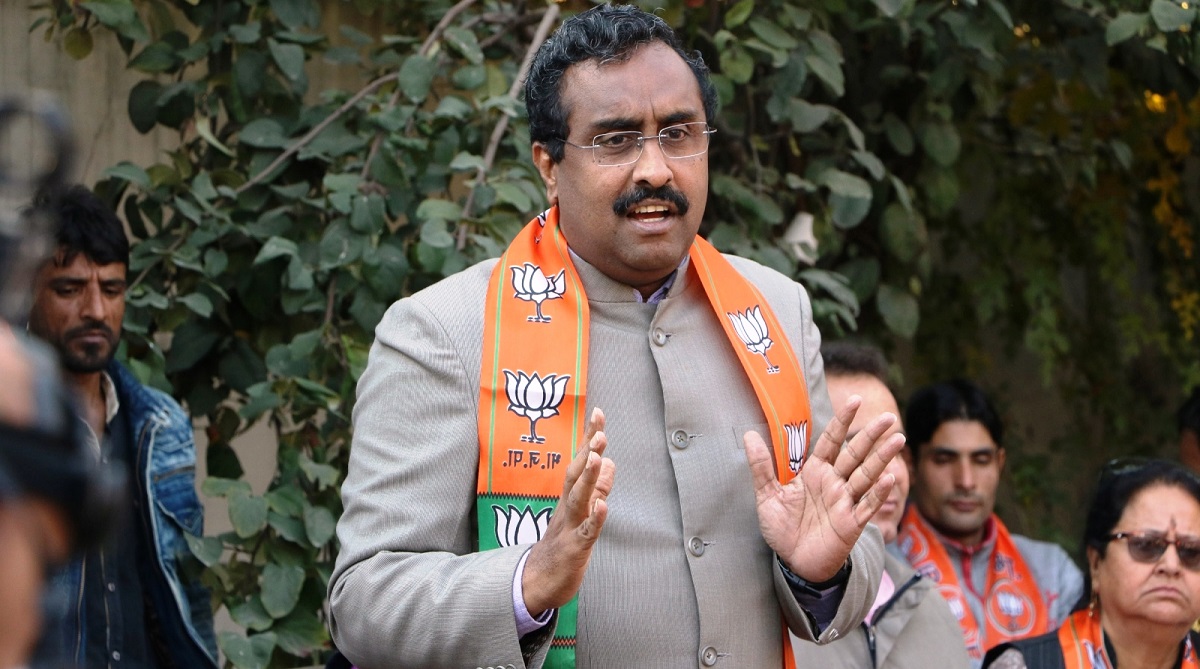
“There is nothing to worry about the Citizenship Bill or 10 per cent quota for the poor among the general category,” said Madhav. (Photo: IANS)
BJP General Secretary Ram Madhav on Wednesday defended Modi government’s stand on the Citizenship Amendment Bill and the announcement of 10 per cent quota for the poor among the general category.
“The Centre under the leadership of PM Modi is committed to the welfare of all, and there is nothing to worry about the Citizenship Bill or 10 per cent quota for the poor among the general category,” said Madhav talking to ANI.
Talking about the former NDA ally, the Asom Gana Parishad (AGP), which left the alliance in protest against the proposed Citizenship Amendment Bill, Madhav said, “Unfortunate that AGP has decided to quit NDA. Their apprehensions are just apprehensions; there is no truth in them. We are committed to protecting the identity of people of Assam. Appeal to AGP to reconsider decision.
“This has been a long-standing demand of successive Assam governments right from 1980. Our government has taken this decision of extending the ST status to six communities like Thai Ahom, tea-tribes and others. They will be categorized as a separate tribal group,” added Madhav.
The Citizenship Amendment Bill will enable granting of Indian citizenship to minorities from Bangladesh, Pakistan, and Afghanistan such as Hindus, Sikhs, Christians, Buddhists, Jains, and Parsis on grounds of religious persecution.
“The Citizenship Amendment Bill is not any state or region specific. It’s for the entire country. In last so many decades India has seen phenomena of minorities from neighbourhood, especially from Pakistan and Afghanistan coming to India as they have nowhere else to go. They seek refuge in India. It’s India’s duty to extend citizenship facility to them but it’s not for any one region. It’s coming with a number of conditions so that no single state will be unnecessarily burdened or unnecessarily subjected to demographic problem,” said Madhav.
On Wednesday, while addressing a rally in Maharashtra’s Solapur, Modi had ‘assured’ the protesting people of Assam and other states of the northeast that the Citizenship (Amendment) Bill 2016 will not infringe upon their rights.
Earlier, on Monday, the Union Cabinet had announced 10 per cent reservation in jobs and educational institutions for the economically backward upper castes.
The Lok Sabha has already passed the Constitution (124th Amendment) bill providing for 10 per cent reservation for the economically weaker sections among the general category in government service and higher educational institutions. Now it is tabled in the Rajya Sabha to be finalised.


















COMMENTS: