Chindia Alert: You’ll be Living in their World Very Soon
aims to alert you to the threats and opportunities that China and India present. China and India require serious attention; case of ‘hidden dragon and crouching tiger’.
Without this attention, governments, businesses and, indeed, individuals may find themselves at a great disadvantage sooner rather than later.
The POSTs (front webpages) are mainly 'cuttings' from reliable sources, updated continuously.
The PAGEs (see Tabs, above) attempt to make the information more meaningful by putting some structure to the information we have researched and assembled since 2006.
SHANGHAI (Reuters) – China’s population is set to reach a peak of 1.442 billion in 2029 and start a long period of “unstoppable” decline in 2030, government scholars said in a research report published on Friday.
The world’s most populous country must now draw up policies to try to cope with a declining labour force and a rapidly ageing population, according to the summary of the latest edition of the “Green Book of Population and Labor” published by the China Academy of Social Sciences (CASS).
Growth in the working population had now stagnated, the report said, and the rising number of elderly people will have a far-reaching impact on the social and economic development in the country, especially if fertility rates remain low.
“From a theoretical point of view, the long-term population decline, especially when it is accompanied by a continuously ageing population, is bound to cause very unfavourable social and economic consequences,” it said.
China’s population is expected to fall back to 1.36 billion by the middle of the century, it said, which could mean a decline in the workforce of as much as 200 million. If fertility rates remain unchanged, the population could fall to 1.17 billion by 2065, it said.
China decided in 2016 to relax a controversial “one-child policy” aimed at curbing population growth and allow all couples to have two children. However, the country’s birth rate still fell 3.5 percent in 2017 and is expected to have fallen again last year.
China’s “dependency rate” – or the proportion of non-working people, including children and the elderly, in the total population – rose for the first time in more than 30 years in 2011, and is widely predicted to increase further for at least the next few decades.
The proportion of retirees is projected to rise until 2060, the CASS report said, and while the decision to relax “one-child” rules was designed to rebalance China’s age structure, in the short term it will also lead to a greater dependency rate.
According to previous forecasts, China’s elderly population is expected to reach 400 million by the end of 2035, up from around 240 million last year.
China has dismissed the US travel warning as unjustified.
“To be frank, the issuance of such a travel advisory by the US side does not hold water,” foreign ministry spokesman Lu Kang said.
“From January to November 2018, 2.3 million visits to China were made by Americans, which means 70 per 10,000 American people made the trip, a ratio far higher than that of the Chinese visiting the US.
“So, this figure is a testament to China’s safety.”
The exit bans are also being used to try to lure other individuals back to China, it warns.
It advises citizens travelling to China to use their US passport with a valid China visa. They should ask officials to notify the US embassy immediately if they are detained or arrested.
The state department says that as dual-citizenship is not recognised under Chinese law, “US-Chinese citizens and US citizens of Chinese heritage may be subject to additional scrutiny and harassment”.
The advisory says exit bans are being used to “compel US citizens to participate in Chinese government investigations” and “to aid Chinese authorities in resolving civil disputes in favour of Chinese parties”.
Victor and Cynthia Liu, who are the children of a fugitive businessman, and their mother, Sandra Han, have reportedly been detained since June.
The businessman, Liu Changming, is wanted in a $1.4bn (£1bn) fraud case in China and the family has said their detention is an attempt to lure him back to face charges.
Beijing has defended its decision to bar the three US citizens from leaving the country.
A foreign ministry spokesman told reporters that they “all have… valid identity documents as Chinese citizens” and are “suspected of having committed economic crimes”.
On Thursday, Global Affairs Canada revealed that 13 Canadians had been detained in China since 1 December, although eight have since been released.
Image copyrightEPAImage captionMeng Wanzhou, the chief financial officer of Huawei, was arrested in Canada at the request of the US
Among the Canadians who remain detained are former diplomat Michael Kovrig and businessman Michael Spavor.
Taiwan’s President Tsai Ing-wen said on Saturday she was open to talks with the mainland if Beijing was willing to promote democracy and renounce the use of force against the self-ruled island.
Tsai’s comments came two days after she rejected Chinese President Xi Jinping’s proposal for the two sides to start talks on unification based on the “one country, two systems” model which applied in Hong Kong.
“As the democratically elected president, I have to defend our democracy, freedom, and way of life,” she told foreign journalists in Taipei to explain her rejection of Xi’s proposal, made in a speech on Wednesday to mark 40 years since the end of military confrontation across the Taiwan Strait.
Tsai said Xi’s statement highlighted two fundamental dangers posed by Beijing to freedom and democracy in Taiwan.
“First, by emphasising ‘one China’ and ‘one country, two systems,’ particularly in the context of the so-called 1992 consensus, China has made clear their political intentions towards Taiwan and their steps for unification.
“This is a major disregard for the fact that the Republic of China, Taiwan does exist, and is in full operation like all other democratic countries,” she said.
“Second, China’s plan to engage in political consultation with the political parties instead of the democratically elected government of Taiwan, is a continuation of its deliberate campaign to undermine and subvert our democratic process and create division in our society.”
The 1992 consensus refers to an understanding that there is only one China, though each side may have its own interpretation of what constitutes “China”.
In his speech, Xi rephrased the consensus as an understanding that “the two sides of the Taiwan Strait belong to one China, jointly seeking to achieve cross-strait unification”.
Beijing suspended official talks and exchanges with Taiwan when Tsai was elected president in 2016 and refused to accept the consensus.
Since then Beijing, which considers Taiwan a wayward province awaiting unification by force if necessary, has staged a series of war games to intimidate the island and poached five of Taiwan’s diplomatic allies to try to pressure Tsai into accepting the consensus.
“As a democracy, cross-strait interaction must follow the rules and oversight of the people of Taiwan, and therefore any discussions must be between governments that are representative of the people on both sides,” Tsai said on Saturday.
She identified a lack of mutual trust as the key problem keeping the two sides from consulting on a possible way of dealing with each other.
“The lack of democracy and protection of human rights, as well as the military threats from China are the major reasons [that people here do not trust Beijing],” Tsai said.
This was why majority opinion in Taiwan opposed cross-strait unification, as people there did not want to live in a system without democracy and human rights, she said.
Asked if the Tsai administration would want talks with Beijing, Tsai said her government did not oppose talks, but Beijing must “move towards democracy, protect human rights and renounce the use of force against us”.
“Only when the two sides step up efforts to accumulate adequate trust will the room for [negotiation] be widened and options [for talks] increased,” she said.
Tsai said Taiwan had long adhered to the principle of refraining from provoking Beijing and had done all it could to maintain stability in the region.
On the contrary, she said, Beijing had tried to suppress Taiwan and refused to cooperate with the island, even on health issues like the outbreak of African swine fever which threatened the well-being of the public in Taiwan.
Tsai added that she had also sought international support to defend the self-ruled island’s democracy and way of life, as well as Taiwan’s refusal to accept the one country, two systems approach offered by Xi for unification talks, given Beijing’s snubbing of democracy and human rights.
She asked Beijing to take note of the democratic mindset of Taiwanee.
BEIJING, Jan. 4 (Xinhua) — Chinese President Xi Jinping has appointed eight new ambassadors in accordance with a decision by the Standing Committee of the National People’s Congress, according to a statement by the national legislature Friday.
Zou Xiaoli has been appointed ambassador to Argentina, replacing Yang Wanming.
Yang Wanming has been appointed ambassador to Brazil, replacing Li Jinzhang.
Hou Yanqi has been appointed ambassador to Nepal, replacing Yu Hong.
Li Minggang has been appointed ambassador to Kuwait, replacing Wang Di.
Li Lingbing has been appointed ambassador to Oman, replacing Yu Fulong.
Li Lianhe has been appointed ambassador to Algeria, replacing Yang Guangyu.
Liu Bin has been appointed ambassador to Tajikistan, replacing Yue Bin.
Wang Shunqing has been appointed ambassador to Slovenia, replacing Ye Hao.
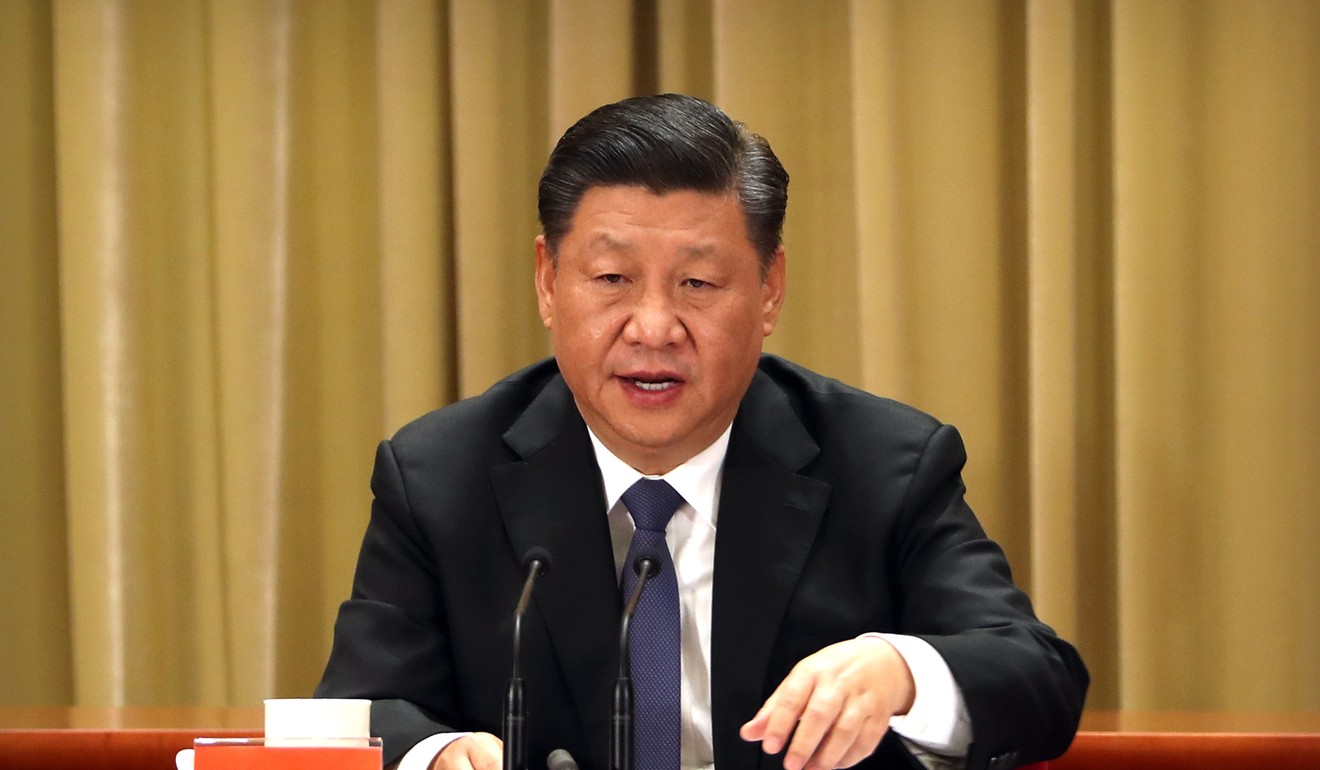
Chinese President Xi Jinping, also general secretary of the Communist Party of China (CPC) Central Committee and chairman of the Central Military Commission (CMC), delivers a speech at a CMC meeting held in Beijing, capital of China, Jan. 4, 2019. (Xinhua/Li Gang)
BEIJING, Jan. 4 (Xinhua) — President Xi Jinping Friday ordered the Chinese armed forces to enhance their combat readiness from a new starting point and open new ground for developing a strong military.
Xi, also general secretary of the Communist Party of China (CPC) Central Committee and chairman of the Central Military Commission (CMC), made the instruction at a CMC meeting held in Beijing.
Hailing the landmark, pioneering and historic military achievements since the 18th CPC National Congress, Xi said the armed forces had resolutely safeguarded national sovereignty, security and development interests and withstood complex situations and severe struggles.
“The world is facing a period of major changes never seen in a century, and China is still in an important period of strategic opportunity for development,” he said, warning that various risks and challenges were on the rise.
The entire armed forces should have a correct understanding of China’s security and development trends, enhance their awareness of danger, crisis and war, and make solid efforts on combat preparations in order to accomplish the tasks assigned by the Party and the people, Xi said.
Regarding combat capability as the only and fundamental criterion, Xi ordered all work, forces and resources to focus on military preparedness and ensure a marked progress in this regard.
Xi stressed the armed forces’ ability to respond quickly and effectively to contingencies, asking them to upgrade commanding capability of joint operations, foster new combat forces, and improve military training under combat conditions.
Party and government departments and agencies at the central and local levels are required to support the defense and military development.
Xu Qiliang, a CMC vice chairman, presided over the meeting, and Zhang Youxia, the other CMC vice chairman, announced the decision to give awards to 10 model units and 20 model individuals. They received awards from leaders, including Xi.
Xi also signed a mobilization order for the training of the armed forces, the CMC’s first order in 2019.
In the world’s largest democracy, politicians are finding that they need to listen to women if they want power.
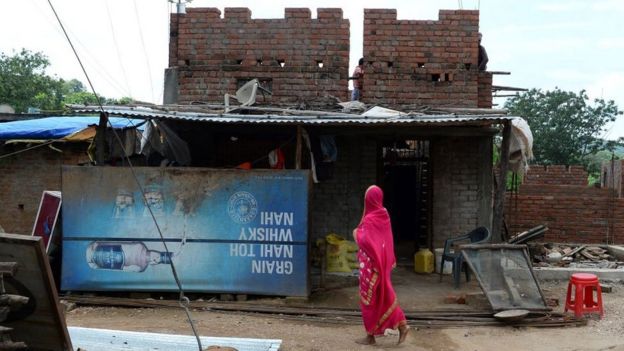
In northern India, some women had long complained that they were fed up with their husbands being drunk.
An alcohol ban brought in at their request has affected 100 million people in the state of Bihar.
The domestic violence, petty crime and wasted income that had long plagued their region fell soon afterwards, the state government claims.
Women-centric campaigns are playing an even bigger role in India’s upcoming national election, in a country of 1.3bn people.
Politicians offering free girls’ education, money to newlywed brides, and special women’s police stations scored highly in the recent regional polls.
The reason? In India’s male-dominated, conservative society, women voters are rapidly gaining ground.
Women voters
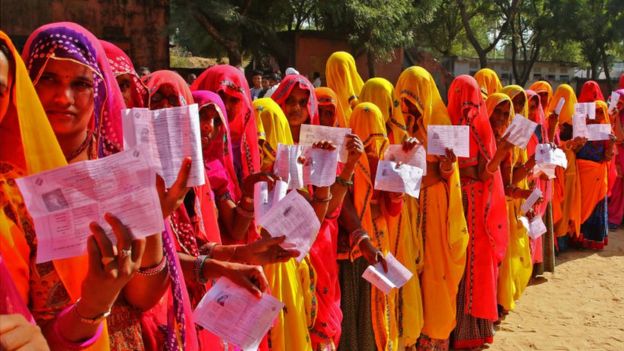
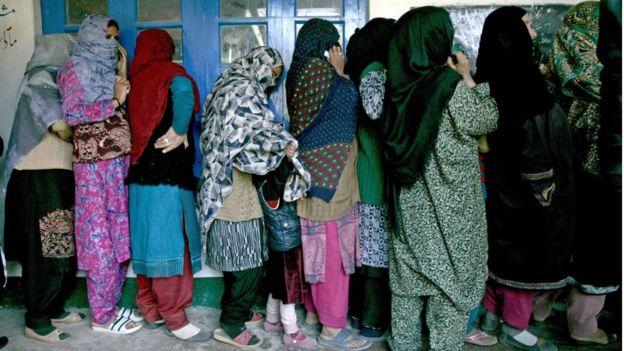
Image copyrightGETTY IMAGESImage captionWomen queue with their identity cards at the state elections in Rajasthan, December 2018
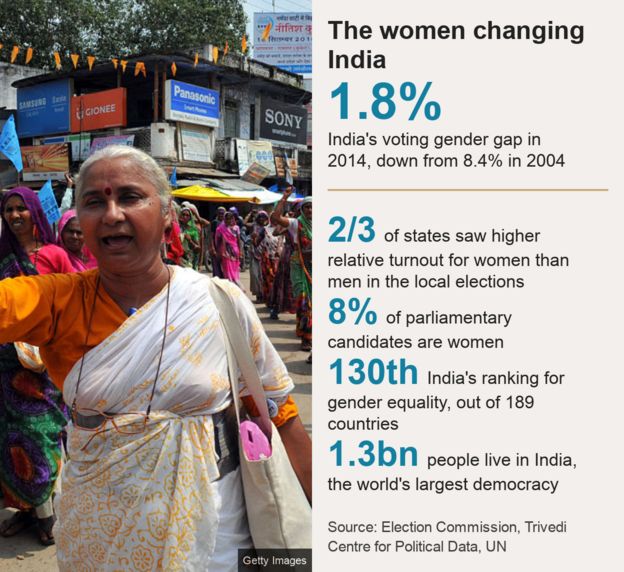
Ranked in the bottom third of countries for gender equality, India has long struggled to get women to the ballot box.
There are a number of reasons for this.
The gender gap in voting is partly because women traditionally have been less likely to register in the first place.
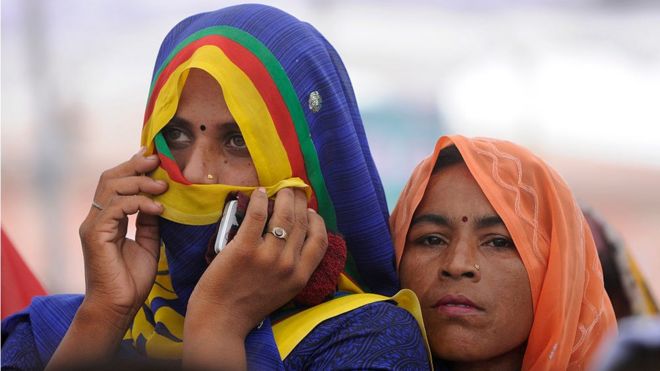
Even if they are registered, the idea of women leaving the household to vote is sometimes frowned upon, and they can face harassment and intimidation at the polls.
For decades, registered women voters’ turnout in elections lagged behind men’s by an average of 6-10%, reflecting their marginalisation in society and giving them less opportunity to shape policy.
There are also fewer women to start with. Sex-selective abortions, female infanticide and preferential treatment for boys in India, mean that there are only 943 women for every 1,000 men in the population.
However, one study found the police resources needed to enforce the alcohol ban meant there was less capacity to deal with violent crime.
Why are more women voting?
What has caused the sudden political mobilisation of women across India?
Increased female literacy and education have certainly brought more women to the polls.
But while progress on those measures has been slow, female voter turnout has shot up in just a decade.
A combination of personal factors and government intervention is likely to have contributed.
High-profile cases of violence against women have undoubtedly galvanised female voters to fight for rights and safety in their communities.
Image copyrightGETTY IMAGES
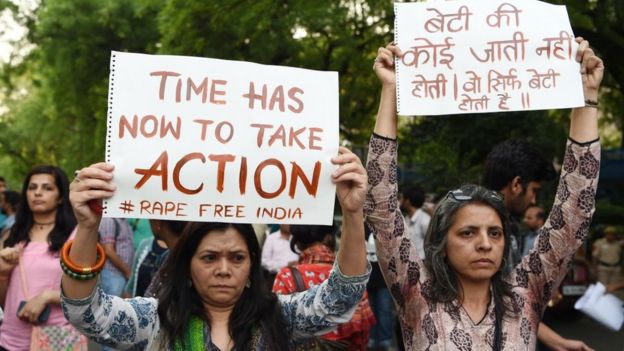
Protests erupted across the country earlier this year after rape cases in Uttar Pradesh, Jammu and Kashmir, and other states made headlines, while the #MeToo movement took hold from the autumn.
The Election Commission of India (ECI) is trying to tackle the violence and intimidation faced by women going to the polls.
It has tried to improve security at India’s more than 900,000 polling booths, meaning women can now vote in relative safety.
The ECI has also experimented with setting up separate women-only queues on election day, and establishing polling stations run entirely by women.
A groundbreaking general election
In 2019, voter turnout may be higher for women than men for the first time in an Indian national election.
This trend has many implications, not only for how politicians campaign, but also how they govern.
Since coming to power in 2014, Prime Minister Narendra Modi has made no secret of his desire to appeal to women voters.
Image copyrightGETTY IMAGES
For instance, he has introduced a scheme to provide cooking gas cylinders to millions of Indian households. His party claims this will stop women from breathing in harmful smoke or spending hours collecting fuel.
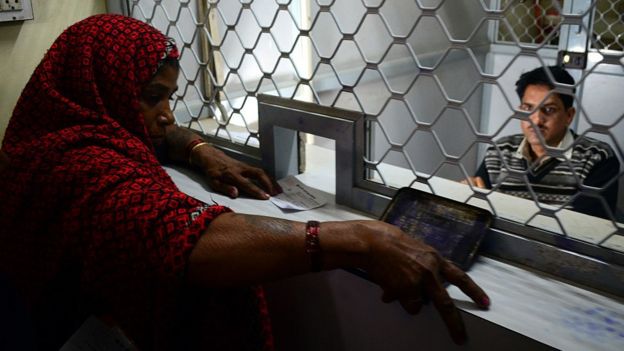
Another scheme aims to provide every household with a bank account. At least half of newly-opened accounts are registered to women, who have historically lacked access to modern banking.
Looking to the future
The path to female empowerment in India has been slow and prone to setbacks.
In politics, women make up just eight per cent of parliamentary candidates and only 11.5 per cent of eventual winners.
This may change. Women’s activism is putting pressure on political parties to pass the Women’s Reservation Bill, guaranteeing one-third of Parliamentary seats for women.
Similar quotas already exist in local-level politics, creating a “pipeline” of women running for high-level office.
Image copyrightGETTY IMAGESImage captionWomen cast their votes in the state of Jammu and Kashmir
With more women in charge, India’s political establishment would look much more like the population it represents.
Electing more women may benefit the country in unexpected ways as well: recent research links female politicians to higher growth and less corruption.
While gender equality in the world’s largest democracy is a long way off, the influence of women at the ballot box and in the corridors of power is already having a clear impact.
GUWAHATI, India (Reuters) – Indian rescuers trying to reach a group of miners trapped in a remote and illegal “rat-hole” coal mine are struggling to pump out water from the 370-foot-deep pit, further dimming their chances of survival more than three weeks into their ordeal.
The slow progress in the rescue efforts in the northeastern state of Meghalaya has been contrasted with the dramatic rescue of 12 Thai boys and their football coach from a flooded cave in July last year, which drew a massive international audience.
The mine became flooded after at least 15 miners went down the narrow pit on Dec. 13. Rat-hole mines killed thousands of workers in Meghalaya before India’s environmental court banned the practice in early 2014.
Many mines continued operation, despite the ban, requiring workers, often children, to descend hundreds of feet on bamboo ladders and dig coal out of narrow, horizontal seams.
“We are continuously engaged in our efforts but the terrain and conditions out here are extremely difficult,” Santosh Kumar Singh, an assistant commandant with the National Disaster Response Force (NDRF), told Reuters from the site.
Navy divers and NDRF personnel had not been able to reach the trapped miners, he said.
Rescuers are now placing their hopes on a huge pump from state miner Coal India Ltd that is being installed on a concrete platform near the mine.
One dead in Thailand as tropical storm uproots trees
India’s Supreme Court on Friday ordered the federal government and Meghalaya to file a report by Monday on the rescue operation. Meghalaya told the court on Thursday that nearly 86 people had been working on the rescue effort.
At its peak, the state produced coal worth $4 billion a year, or about a tenth of India’s total production.
While the Thailand drama got round-the-clock international media coverage, the trapped miners in Meghalaya are getting very little attention, even within India.
“Whole media, government and us, the common people, have completely ignored them,” one Twitter user, Rahul Sribastab, wrote. “The government, opposition and media have failed us.”
The Allahabad High Court had in 2010 trifurcated the disputed site, giving one portion each to Ram Lalla, Nirmohi Akhara and the original Muslim litigant.
SNS Web | New Delhi | January 4, 2019 12:21 pm
The Supreme Court on Friday set the date for hearing on the title suit in the Ayodhya case for 10 January.
A bench of Chief Justice Ranjan Gogoi and Justice Sanjay Krishan Kaul said that an appropriate bench will hear a batch of cross petitions challenging the 2010 Allahabad High Court judgment on the Ram Janmabhoomi-Babri Masjid land dispute title case and will decide the future course of the hearing.
The Allahabad High Court had in 2010 trifurcated the disputed site, giving one portion each to Ram Lalla, Nirmohi Akhara and the original Muslim litigant.
“Further orders will be passed by an appropriate bench on 10 January for fixing the date of hearing the matter,” the bench said on Friday.
The apex court also dismissed a PIL filed by an advocate Harinath Ram in November 2018 seeking to hear the Ayodhya matter on urgent and day to day basis.
Reacting to the development National Conference leader Farooq Abdullah said that the case should not have gone to the court and that Lord Ram belongs to the world.
“This(Ayodhya) issue should be discussed and sorted out across the table between people. Why to drag the issue to the Court? I am sure it can be resolved through dialogue. Lord Ram belongs to the whole world, not just Hindus,” he was quoted as saying by ANI.
The top court had on October 29 fixed the Ram Janmabhoomi-Babri Masjid land dispute cases for the first week of January next year before an appropriate bench.
On 12 November, the apex court had declined early hearing of petitions in the Ram Janmabhoomi-Babri Masjid title dispute case.
“We have already passed the order. The appeals are coming up in January. Permission declined,” the bench said while rejecting the request of early hearing of lawyer Barun Kumar Sinha, appearing for the Akhil Bharat Hindu Mahasabha.
The Supreme Court in a 2:1 verdict in October, declined to refer to a five-judge Constitution bench the issue of reconsideration of the observations in its 1994 judgement that a mosque was not integral to Islam that arose during the hearing of Ayodhya land dispute.
Clamour for a legislation to pave the way for the construction of the temple has since gained prominence.
But in an interview with ANI on 1 January 2019, Prime Minister Narendra Modi ruled out bringing an ordinance on the construction of Ram temple in Ayodhya before the judicial process is over.
“We have said in our party manifesto that a solution would be found to this issue under the ambit of the Constitution,” the Prime Minister said about the Ram temple issue in his interview to ANI.
He also suggested that the judicial process was being slowed down because of obstacles being created by the Congress in the Supreme Court – a charge he had levelled during one of the rallies in Rajasthan ahead of the elections in the state.
BEIJING (Reuters) – China’s central bank said on Friday it was cutting the amount of cash that banks must hold as reserves for the fifth time in the past year — freeing up $116 billion for new lending as it tries to reduce the risk of a sharper economic slowdown.
The latest support measures come amid mounting worries about the health of the world’s second-largest economy, which is facing both slowing demand at home and punishing U.S. tariffs on its exported goods.
Global stock markets sold off on Thursday after a warning from tech giant Apple Inc about slowing China sales, while data earlier this week showed the country’s manufacturing activity shrank in December for the first time in over two years.
The cut in banks’ reserve requirement ratios (RRR) is the
first in 2019 by the People’s Bank of China (PBOC) as the economy faces its weakest growth since the global financial crisis and mounting pressure from U.S. tariffs.
Reserve requirement ratios (RRRs) – currently 14.5 percent for large institutions and 12.5 percent for smaller banks – will be lowered by a total of 100 basis points (bps) in two stages, the People’s Bank of China (PBOC) said.
The cuts will be effective Jan. 15 and Jan. 25, and come ahead of the long Lunar New Year celebrations when cash conditions often get tight.
The moves will free up a net 800 billion yuan (£91.8 billion) after banks use some of the 1.5 trillion yuan in liquidity released into the financial system to pay back maturing medium-term loans.
“Policy easing will be stepped up further over coming months,” Capital Economics said in a research note.
“With credit growth still slowing and, typically, a six-month lag before any turnaround in credit affects the economy, worries about the outlook for China will persist for several months yet.”
MORE HELP COMING
Further cuts in the RRR had been widely expected this year, especially after a spate of weak data in recent months showed China’s economy was continuing to lose steam. The size of the move was on the upper end of market expectations, and the net funds released would be the largest amount in the five cuts since last January.
The announcement came just hours after Premier Li Keqiang said China would take further action to bolster the economy, including RRR cuts and more cuts in taxes and fees.
The central bank said China’s economic growth is still within a reasonable range and it will continue to implement a prudent monetary policy, without engaging in massive stimulus.
“We will maintain reasonable and sufficient liquidity, maintain reasonable growth in the scale of money and credit and social financing, stabilise macro-leverage, and seek internal and external balances,” it said.
China’s economic growth is expected to have cooled to around 6.5 percent last year, in line with Beijing’s target but down from 6.9 percent in 2017.
A further deceleration is seen this year, with some analysts forecasting growth will cool to nearly 6 percent, which would mark China’s weakest expansion since 1990.
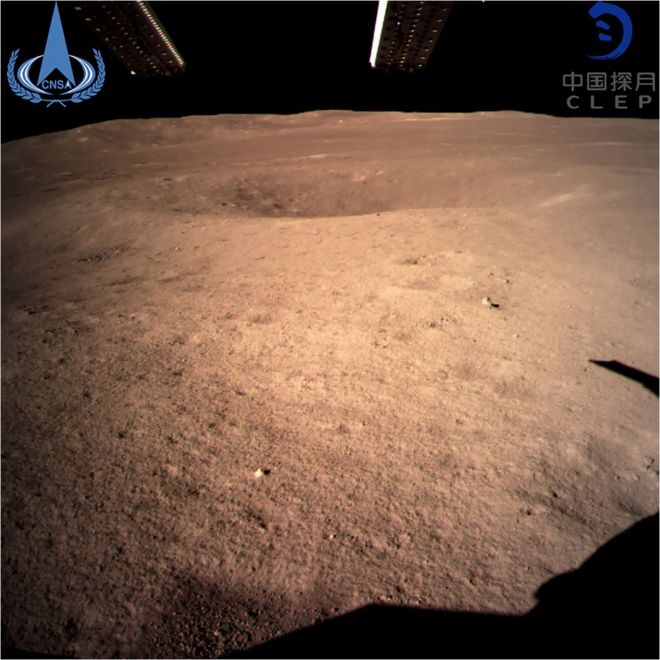
Image copyrightCNSA/AFPImage captionThe first close up pictures of the far side of the Moon
What will China’s Chang’e-4 mission learn about the far side of the Moon? Here are a few things the mission is designed to do.
Learn about the Moon’s history
No space mission has ever explored the far side from the surface. As such, it’s the first chance to explore a mysterious region of Earth’s natural satellite.
The “face” that’s never seen from Earth has some key differences to the more familiar “near side”. The far side has a thicker, older crust that is pocked with more craters. There are also very few of the “maria” (dark basaltic “seas” created by lava flows) that are evident on the near side.
Chang’e-4 has reportedly landed at a site known as Von Kármán crater, a 180km depression located in the far side’s southern hemisphere. But Von Kármán lies within a much bigger hole punched in the Moon – the South Pole-Aitken basin.
It’s the oldest, largest and deepest such basin on the Moon and formed when an asteroid – perhaps 500km across, or more – collided with it billions of years ago.
This event was so powerful that it is thought to have ploughed through the Moon’s outer crust layer and through into the zone known as the mantle.
One of the mission’s objectives is to study any exposed material from the mantle present at the landing site. This would provide insights into the internal structure and history of the Moon.
Image copyrightNASAImage captionThe South Pole-Aitken basin was formed by a giant impact billions of years ago
Indeed, data from orbiting spacecraft show that the composition of the basin is different from the surrounding lunar highlands. But exposed mantle material on the surface is just one possibility among several to explain this observation.
The rover will use its panoramic camera to identify interesting locations and its Visible and Near-Infrared Imaging Spectrometer (VNIS) to study minerals in the floor of the crater (as well as of ejecta – rocks thrown out by nearby space impacts).
Additionally, the Lunar Penetrating Radar (LPR) instrument will be able to look into the shallow subsurface of the Moon, down to a depth of about 100m. It could probe the thickness of the lunar regolith – the broken up rocks and dust that make up the surface – and shed light on the structure of the upper lunar crust.
After the huge impact that created the South Pole-Aitken basin, a large amount of melted rock would have filled the depression. The science team wants to use Chang’e-4 to identify and study variations in its composition.
Filling an astronomy gap
The far side of the Moon has long been regarded as an ideal spot for conducting a particular kind of radio astronomy – in the low-frequency band – because it’s shielded from the radio noise of Earth.
There’s a frequency band (below about 10MHz) where radio astronomy observations can’t be conducted from Earth, because of manmade radio interference and other, natural factors.
Chang’e-4’s lander is carrying an instrument called the Low Frequency Spectrometer (LFS) which can make low frequency radio observations. It will be used in concert with a similar experiment on the Queqiao orbiting satellite.
The objectives include making a map of the radio sky at low frequencies and studying the behaviour of the Sun.
Speaking in 2016, Liu Tongjie, from the Chinese space agency (CNSA), said: “Since the far side of the Moon is shielded from electromagnetic interference from the Earth, it’s an ideal place to research the space environment and solar bursts, and the probe can ‘listen’ to the deeper reaches of the cosmos.”
Thus, the mission will fill a gap in astronomical observation, allowing scientists to study cosmic phenomena in a way that has never been possible from our planet.
Radiation on the Moon
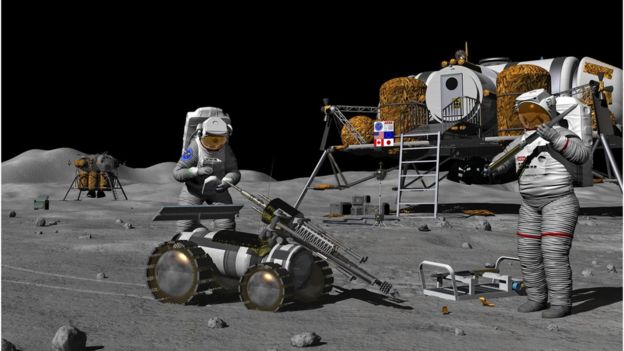
Image copyrightSCIENCE PHOTO LIBRARYImage captionUnderstanding the radiation environment will be vital for future human exploration
Several space agencies want to land humans on the Moon in the not-too-distant future, and might send astronauts there for longer than we’ve ever stayed before. So understanding the potential risks from radiation are vital.
Earth’s thick atmosphere and strong magnetic field provide adequate shielding against galactic cosmic rays and energetic charged particles travelling from the Sun.
But astronauts on the Moon will be outside this protective bubble and exposed to particles travelling through open space at near the speed of light – with potentially damaging consequences for their health.
It will provide dosimetry (measure the ionising radiation dose that could be absorbed by the human body) with a view to future exploration, and contribute to understanding of particles originating from the Sun.










 CHINDIA ALERT: You'll be living in their world, very soon

COMMENTS: 14