Chindia Alert: You’ll be Living in their World Very Soon
aims to alert you to the threats and opportunities that China and India present. China and India require serious attention; case of ‘hidden dragon and crouching tiger’.
Without this attention, governments, businesses and, indeed, individuals may find themselves at a great disadvantage sooner rather than later.
The POSTs (front webpages) are mainly 'cuttings' from reliable sources, updated continuously.
The PAGEs (see Tabs, above) attempt to make the information more meaningful by putting some structure to the information we have researched and assembled since 2006.
BEIJING, Dec. 29 (Xinhua) — The central rural work conference was held in Beijing from Dec. 28 to Dec. 29, mapping out plans for the country’s rural and agricultural work in 2019.
The meeting summarized and exchanged local experiences on the implementation of rural vitalization strategy, outlined major tasks related to agriculture, rural areas and rural people in the next two years and mapped out plans for rural and agricultural work in 2019, according to a statement released Saturday after the central rural work conference.
President Xi Jinping, also general secretary of the Communist Party of China Central Committee and chairman of the Central Military Commission, made important instructions on work related to agriculture, rural areas and rural people.
Xi stressed that new achievements were made in the rural and agricultural development in 2018, grain output reaped a good harvest and rural vitalization was off to a good start.
The year 2019 is the key year to secure a decisive victory in achieving the country’s first centenary goal of building a moderately prosperous society in all respects. Solid work related to agriculture, rural areas and rural people will play a significant role in effectively handling various risks and challenges, ensuring a steady and healthy economic development and social stability, said Xi.
BEIJING, Dec. 29 (Xinhua) — China’s meteorological authorities issued a yellow alert for a heavy snowstorm on Saturday morning.
The National Meteorological Center (NMC) said snowstorms would hit parts of Guizhou, Hunan and Jiangxi provinces, with up to 15 centimeters of new snow expected.
The observatory warned that the snow would affect transport during rush hours, and asked local authorities to be prepared for possible damage to crops, plants and livestock.
On Saturday morning, the NMC also issued a yellow alert for a cold wave as the cold front will bring down temperatures by 10 degrees Celsius in the next three days in most parts of China.
China has a four-tier color-coded weather warning system, with red representing the most severe, followed by orange, yellow and blue.
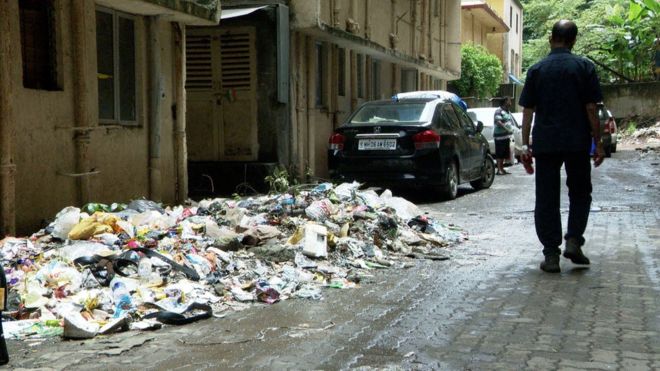
Image captionPiles of garbage are a common sight in Mahul
Tens of thousands of people are fighting to leave Mahul, a heavily industrialised neighbourhood in the western Indian city of Mumbai, saying the toxic pollution there is adversely impacting their health. BBC Marathi’s Mayuresh Konnur and Janhavee Moole report on the residents’ battle to be relocated.
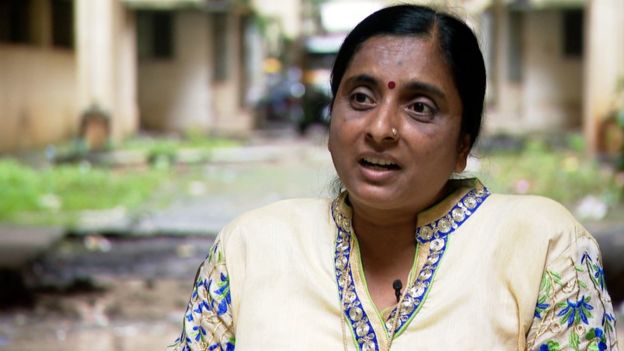
Anita Dhole, 38, was forced to move to a “transit camp” set up by the civic authorities in Mahul in May 2017 after the illegal slum she was living in was demolished. Since then, she says, she has been suffering.
“I have breathing trouble and high blood pressure, and the pollution has also affected my eyesight,” she says.
Hers was one of more than 5,000 families – estimated to be between 30,000 and 50,000 people – that lost their homes in the demolition drive and were offered temporary housing in Mahul. They were told they would be given homes in another Mumbai suburb later but, residents say, Mahul is not fit for living, even for a short time.
Image captionMs Dhole has been living here since May 2017
A former fishing village, it’s now close to oil and petroleum refineries, chemical factories and fertiliser plants.
A report in 2013 by the King Edward Memorial Hospital said that around 67% of people living in Mahul complained of breathlessness several times a month and around 84% of them complained of eye-irritation. In 2015, India’s environment court National Green Tribunal said there was “a perceptible threat to [the] health of residents” in Mahul because of the “prevailing air quality in the area”.
But local municipal authorities say three different surveys by the Maharashtra Pollution Control Board show “that the pollution levels in Mahul are not different from other areas of Mumbai”.
Yet residents blame breathing issues, asthma, skin diseases, tuberculosis and blood pressure-related problems on poor local conditions.
Ms Dhole says her parents fell so sick in Mahul that they soon left for their village.
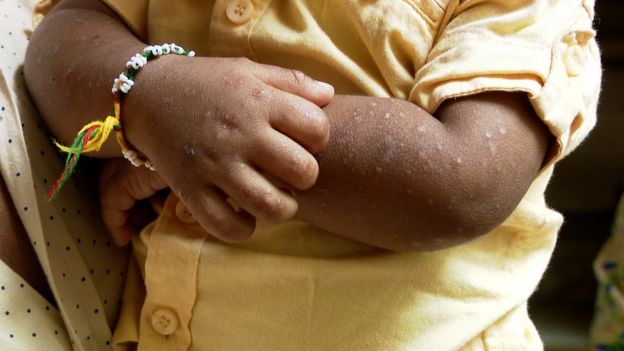
Image captionSkin infections are common among residents
Shamdas Salve, who also moved to Mahul last year, says his two-year-old son has had a persistent skin infection for the past five months.
“He doesn’t sleep the whole night and keeps scratching. I’ve consulted several skin specialists and changed his medication but he has had no relief. He cries and keeps scratching. He now has marks on his face too.”
His words are echoed by many of his neighbours – 10-year-old Sahil suffers from TB and so does 17-month-old Anshul Tusambad; Maya Goswami, 55, struggles with asthma; and 18-year-old Kavita Subramanyan has low BP and breathing problems.
Besides pollution, residents say they have no access to clean water and sewage facilities and that electricity supply is far from regular. There are also no hospitals or schools nearby. The area is poorly connected with other parts of the city and, as a result, many women have been forced to quit their jobs and stay home.
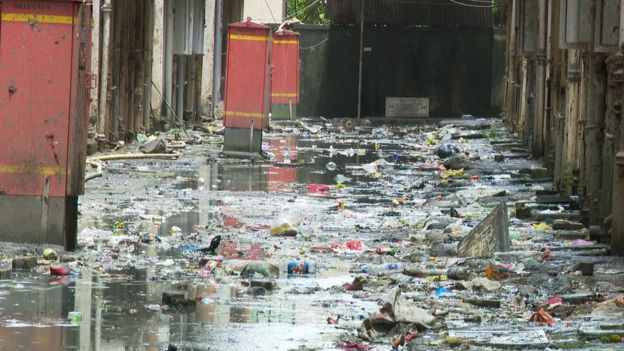
Image captionOverflowing sewage in Mahul’s transit camp
The transit camp where Ms Dhole lives is actually a block of apartments that goes by the official name of Eversmile layout.
It has dozens of buildings and each is home to 300 congested one-room apartments. The complex is filthy – sewage pipes are broken, gutters are overflowing; electric wires are dangling everywhere; the air is stuffy, mosquitoes abound and rats scurry past us as we walk around the neighbourhood.
Most of these low-cost homes are meant for families who have been relocated because of demolition of unauthorised slums.
Every year, tens of thousands migrate from rural India to Mumbai in search of livelihood and most end up living in illegal shanty towns that often encroach on roads or other city infrastructure.
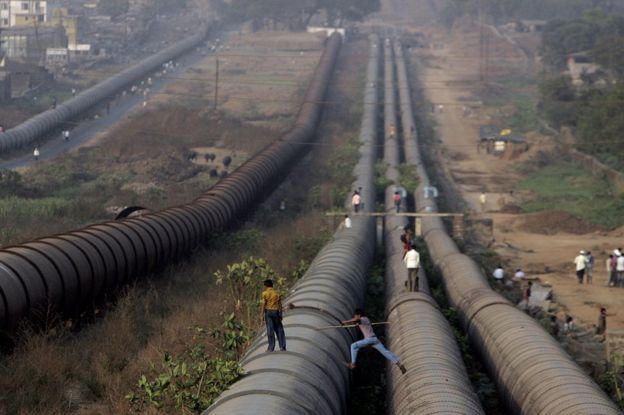
Image copyrightGETTY IMAGESImage captionThousands were relocated to build the Tansa water pipeline
Most of those who were relocated to Mahul, including Ms Dhole, used to live in a slum along the Tansa pipeline – the 160km (99 miles) long water pipeline that runs through Mumbai, carrying water from Lake Tansa. It’s a major source of water for the city.
Just over half of the pipeline is overground and, over the years, unauthorised houses came up alongside it and, in some places, on top of it.
In 2006, a petition was filed in the high court in Mumbai asking the court to order the government to relocate those living in the slums to “ensure that the water, which is used by the citizens of Mumbai, is safe, and that these pipelines do not become a target for persons to attack the citizens of Mumbai”.
Read more stories about pollution and the environment:
In 2009, the court ruled that there must be a 10-metre gap between the pipeline and the nearest home, which meant that thousands of families had to move out. Their homes were subsequently demolished and they were told to relocate to Mahul.
Many initially refused because of the pollution, but were forced to move as the demolitions continued.
In August, the court said the civic authorities could not force people to move to Mahul and that they must find alternative housing for them or pay rent for those families that did move out.
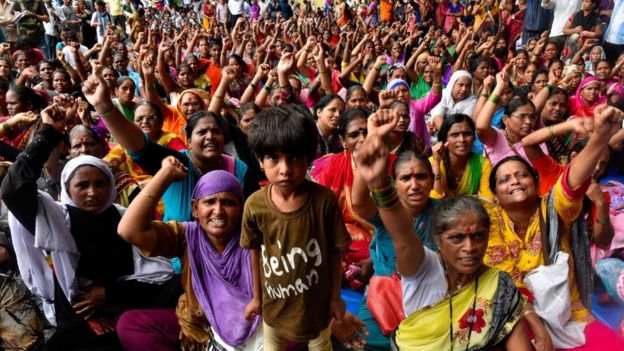
Image copyrightGETTY IMAGESImage captionResidents have been protesting for months to be moved elsewhere
The protests have intensified in the past two months with many residents of Mahul’s transit camp demonstrating at the site where their homes once stood.
They have also launched a campaign on social media with the hashtag and Twitter handle MumbaisToxicHell – demanding that they are relocated again, this time to a safer and healthier environment.
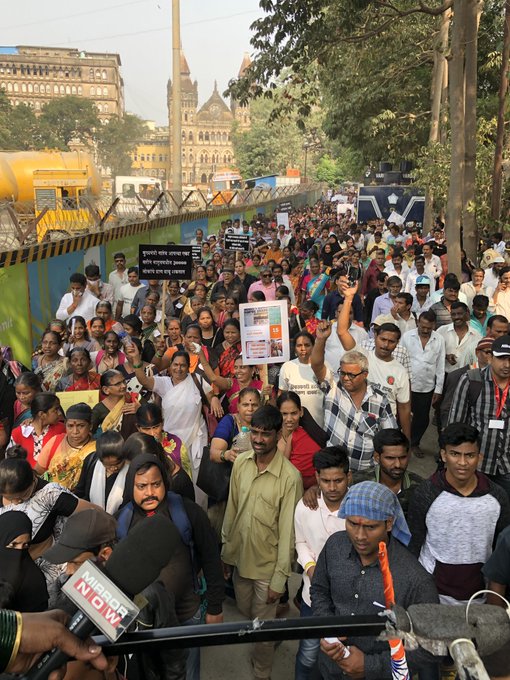
Residents of Mahul protesting on the streets yet again demanding relocation from the Maha state government. Now even IIT Bombay’s report says the area is not fit to stay. What are you now waiting for? #mumbaistoxichell#wakeupgovt#residentspleadforbetterlife#mirrornow
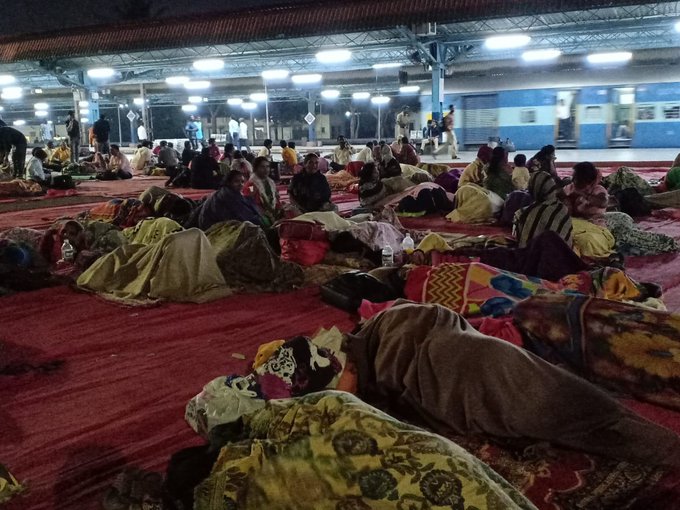
Residents of Mahul are compelled to sleep under the sky to save their lives from toxic atmosphere of Mahul. They are camping outside their homes since 50 days to save their lives.#MumbaisToxicHell
The initial rescue operation to help the miners had to be stopped as the pumps were not adequate to flush out large volumes of water. The state government then sough Centre’s help and high-powered pumps and a team was dispatched from Odisha.
An Indian Navy team has reached the mine in Meghalaya’s East Jaintia Hills where 15 people have been trapped since December 13 but will begin their operations on Sunday morning. (HT Photo)
After delays and hiccups, two teams of rescuers—one comprising divers from Indian Navy and another from the Odisha fire services—reached the flooded coal mine in Meghalaya on Saturday where 15 miners are trapped since December 13.
But except conducting recce at the site located at Khloo Ryngksan in East Jaintia Hills district and attempts to set up the high-powered pumps needed to flush out water nothing much happened during the day. Actual work on the ground will begin early on Sunday morning.
National Disaster Response Force (NDRF) Assistant Commandant Santosh Kumar Singh, who is overseeing operations at the rat hole coal mine. said a three member team of the Indian Navy visited the site.”They did a recce of the spot, spent 30 minutes inside the main pit. They also held a meeting with us and are likely to start operation tomorrow. Now that they are here we will assist them,” he said.
The water levels inside the mine remains unchanged, he said.
A team of Odisha fire and emergency services, who finally reached the spot, tried to install their high-powered pumps. “They may be operational by tomorrow,” Singh said.
“Pumps and other machinery are being installed at the site. Everyone is working overtime with extreme dedication and zeal as our mission is to save lives. That is our top priority,” East Jaiñtia Hills district police chief Silvester Nongtnger told Hindustan Times.
He aid that after all the gear has been installed and put into place on Saturday night, rescue operations will begin on Sunday morning. “We will start right from the first hour itself.”
The initial rescue operation to help the miners started on December 14 once the NDRF and SDRF teams arrived. On December 17, a team of Directorate General of Mine Safety along with Coal India officials arrived and suggested 100 HP submersible pumps be used. The district administration wrote to the state government seeking immediate help from Coal India on December 20. However, it was only on December 26 that Coal India received a request from state government for assistance.
The rescue operation launched by the state government had to be stopped as the pumps were not adequate to flush out large volumes of water. The state government then sough Centre’s help and high-powered pumps and a team was dispatched from Odisha.
The team reached Guwahati on Friday morning around 11:30 am, but due to lack of transport provided by Meghalaya they had to wait till 5:45 pm to start their 220 km journey to the mine.
“Initially we were told that we would be travelling by trucks. Then the plan was changed and it was decided that dumpers would be used to shift the equipment to the accident site,” said Sukant Sethi, Chief Fire Officer (Odisha), who is leading the team.
“By the time we reached a primary school (located 25 km from the mine) where we were supposed to spend the night it was 2 am on Saturday. There was no person from Meghalaya government’s side who helped us with basic needs,” Sethi said.
Despite the problems faced by them, the team was keen to reach the spot soon to help the trapped miners. They finally reached around 1 pm on Saturday
Another aspect of seemingly lukewarm response by the government has emerged. Tata Trusts had offered to lend two pumps which it had airlifted from London to augment rescue efforts during the Kerala floods to Meghalaya but till date, there has been no response from the government.
Efforts to reach Peter W Ingty, additional chief secretary in-charge revenue and disaster management by Hindustan Times proved futile as he did not respond to calls.
Prime Minister Narendra Modi accused the Congress governments in Madhya Pradesh, Rajasthan and Karnataka of making hollow promises to the people before elections for political gains.
SNS Web | New Delhi | December 29, 2018 4:27 pm
Prime Minister Narendra Modi addresses at the foundation stone laying ceremony of Medical College in Ghazipur, Uttar Pradesh on Dec 29, 2018. (Photo: IANS/PIB)
Prime Minister Narendra Modi accused the Congress governments in Madhya Pradesh, Rajasthan and Karnataka of making hollow promises to the people before elections for political gains.
In a public meeting in Ghazipur in eastern Uttar Pradesh, the PM said that the alliance government in Karnataka led by Congress and Janata Dal (Secular) had promised to waive off loans of lakhs of farmers but has only done so for 800.
“They gave the lollipop of a farm loan waiver, votes were stolen but so far only… the loans of 800 farmers have been waived off,” Modi said while exhorting people to understand “such games”.
“Long queues for urea, fertilizers can be seen in Madhya Pradesh and Rajasthan. Black-marketeers are now back on the field,” the PM said hitting out at the Congress governments in the two states.
He also said that the Congress, when it was in the Centre, had similarly made false promises.
“Congress had promised waiver of Rs 6 lakh crore loans of farmers. The waiver was of just Rs 60 thousand crore. And the CAG report revealed that of the persons whose ‘loans’ were waived, 35 lakh people were not farmers, they had no loans and neither were they eligible for waivers,” the PM said.
Asking the gathering to be wary of Congress’ promises, the PM said that the grand old party was trying to fool the people with such announcements.
“These people are trying to lure you by short-term benefit announcements and promises but all this will not help,” he said, adding, “Announcements made for instant benefits won’t be successful in the long run.”
Modi, who was in Ghazipur to lay the foundation stone of a medical college, said that people of the region will immensely benefit from the medical college.
“The medical college will not only provide Ghazipur with advanced medical facilities but also produce new and meritorious doctors,” he said, adding, “When this college is ready, the district hospital in Ghazipur will become a 300-bed facility.”
At the event, the PM also released a commemorative postal stamp in honour of Maharaja Suheldev in the presence of Uttar Pradesh Governor Ram Naik, Chief Minister Yogi Adityanath.
Praising the 11th century ruler semi-legendary king, the PM said that Maharaj Suheldev is among those bravehearts who struggled for the honour of India.
“Remembering Maharaja Suheldev, from whom every deprived and oppressed draws inspiration, strengthens the ‘Sabka Saath, Sabka Vikas’ mantra,” he said underlining the political significance of the king in today’s times.
The PM said that unlike the previous governments, his government is showing respect to every brave son and daughter of the country.
Ironically, the Suheldev Bharatiya Samaj Party (SBSP), an NDA ally, decided to stay away from all the events attended by the PM Saturday.
The SBSP, which has four legislators in the 403-member state assembly, announced that it will “boycott” Prime Minister’s programmes. The party claims that the name of its chief, state Minister for Backward Classes Welfare Om Prakash Rajbhar, has been “deliberately omitted from the invitation card”.
Rajbhar has been a bitter critic of the BJP government in the state and the Centre over a host of issues.
SBSP was not the only ally to boycott the PM’s events. The powerful Apna Dal, too, stayed away to protest the “arrogant attitude” of the BJP leaders in the state.
Ashish Patel, the state unit chief of Apna Dal, charged the BJP leaders of “insulting leaders and the weaker sections of the society”.
He also announced that till the matter between the two allies was not settled, Apna Dal will not attend any government programmes and demanded Modi’s intervention in sorting out the matter.
The Apna Dal has two Lok Sabha MPs, including MoS Health and Family Welfare Anupriya Patel, and 9 seats in the UP Assembly.
MONTREAL (Reuters) – A Canadian citizen who was detained in China this month has returned to Canada after being released from custody, a Canadian government spokesman said on Friday.
The spokesman did not specify when the Canadian was released or returned to Canada. Earlier in the day, broadcaster CBC identified the citizen as Canadian teacher Sarah McIver.
China’s Foreign Ministry said this month that McIver was undergoing “administrative punishment” for working illegally.
McIver was the third Canadian to be detained by China following the Dec. 1 arrest in Vancouver of Meng Wanzhou, chief financial officer of the Chinese telecommunications giant Huawei Technologies Co Ltd., but a Canadian official said there was no reason to believe that the woman’s detention was linked to the earlier arrests.
Foreign Minister Chrystia Freeland did not mention the woman in calling for the release of the other two Canadians last week.
China’s Foreign Ministry said in a statement sent to Reuters that it was aware of reports she had been released, and referred further questions to the “relevant authority”. It did not elaborate.
On Saturday, a Chinese court is hearing an appeal in the case of a Canadian citizen held on drugs charges, that could further test the tense relations between the two countries.
The high court in the city of Dalian in the northeastern province of Liaoning will hear the appeal of Robert Lloyd Schellenberg from 2 p.m. (0600 GMT), it said in a statement this week.
A Dalian government news portal said Schellenberg was a Canadian and that this was an appeal hearing after he was found by an earlier ruling to have smuggled “an enormous amount of drugs” into China.
Canada’s government said this week it had been following the case for several years and providing consular assistance, but could provide no other details, citing privacy concerns.
Drugs offences are usually punished severely in China.
China executed a Briton caught smuggling heroin in 2009, prompting a British outcry over what it said was the lack of any mental health assessment.
Image copyrightIQIYIImage captionThe Story of Yanxi Palace revolves around its female protagonist, Wei Yingluo
It has love but also hatred, intrigue, revenge, poisoning rivals and even killing babies.
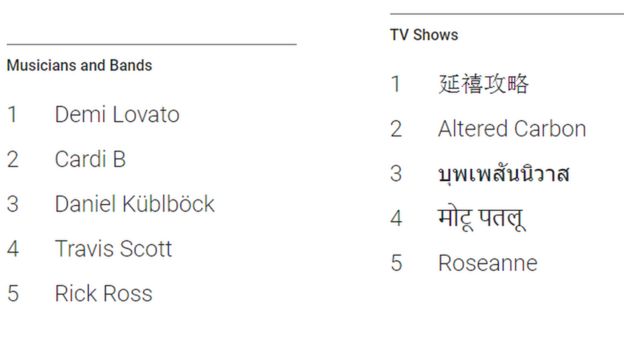
The Chinese drama Story of Yanxi Palace is the most Googled TV show of 2018 globally, despite Google being largely blocked in the country.
The search engine’s analytics suggested that the top interest in the drama has come from Asian regions like Singapore, Malaysia, Brunei and Hong Kong, but its popularity in mainland China has been overwhelming as well.
The series has been streamed more than 15 billion times on iQiyi, China’s Netflix-like site where the show premiered in July before it reached domestic TV channels and more than 70 markets abroad. It was the most watched online drama in China for 39 consecutive days over the summer.
The 70-episode Story of Yanxi Palace fictionalised the power struggles among the concubines of Emperor Qianlong in the 1700s.
The protagonist, a smart girl with a humble background, manages to rise through the ranks among the harem and wins both love and respect from the emperor.
Image copyrightGOOGLEImage captionThe Chinese title of Yanxi Palace appears as the most Googled TV show of 2018
Its theme may be likened to a Cinderella tale or Netflix’s The Crown that chronicles the reign of Queen Elizabeth II. But its own uniqueness has made it the undisputed entertainment sensation of the year.
Here’s how it took over China and its neighbouring regions.
It catches up with a trend of feminist shows
The heroine of the show, Wei Yingluo, is unlike most traditional Chinese female characters who are taught to be tolerant, submissive and fragile.
Inspired by the actual real-life consort of Emperor Qianlong, the story follows Yingluo as a woman of Chinese Han ethnicity in the Qing dynasty – the last imperial dynasty in China ruled by the Manchurian ethnicity that suppressed the Han people.
But her intelligence, determination and appropriate ferocity meant she was eventually granted her the title of imperial noble consort, the highest possible position for a Han person at that time.
Yingluo’s most famous line from the show goes like this : “I, Wei Yingluo, am naturally hot-tempered and not to be pushed around. Whoever keeps talking [nonsense], I have all kinds of methods to go against her.”
Image copyrightIQIYIImage captionWei Yingluo started off as a servant in the palace but slowly worked her way up
The woman she is based on – Xiaoyichun – was posthumously given the title of empress, making her the only Han empress during the Manchu-reigned dynasty.
The show comes as the latest example of how feminist-themed soap operas have captured Chinese audiences.
Other shows like The Legend of Zhenhuan – another imperial rising-up-the-ranks story bought by Netflix – and The Empress of China, that tells the story of the only female emperor in Chinese history, have also taken off in China.
It didn’t face much censorship
Before the show aired on TV screens, it was shown online.
The co-producer and initial distributor of the series, iQiyi, is one of China’s most popular online video platforms – helping the show gain large traffic and, more importantly, easier regulatory scrutiny for its debut.
In China, the National Radio and Television Administration oversees all content on radio and television. A TV project has to obtain the go-ahead from it even before shooting starts.
When video sites emerged a few years ago, they could publish anything as long as they thought it was within the regulator’s rules.
In 2016, an online series featuring gay love went viral but was taken off in the middle of the streaming season. A year later, a a ban on homosexual content was issued.
Online video platforms can’t broadcast shows at will but the censorship they go through is much lighter than TV channels, which are mostly owned by the government.
Low-cost cast, high-quality production
No actor in the show is very famous, except for one Hong Kong actress, Charmaine Sheh, who was willing to play a supporting role.
Gong Yu, founder and CEO of iQiyi, said the company had “deliberately cast lesser known actors… rejecting recent trends in the Chinese industry that put too much emphasis of the celebrity appeal of actors in their productions”.
It came at an essential time when Chinese celebrities’ high income and ambiguous tax practices had caught the attention of the authorities.
Total spending on the show’s cast didn’t even reach one tenth of the total production cost, according to Chinese magazine Portrait citing series producer Yu Zheng, who added that the rest of the money was mainly spent on things like costume and make-up.
Image copyrightIQIYIImage captionThe detailed costumes and intricate sets won over audiences
The well-built sets, elaborate costumes, make-up and attention to detail have won viewers’ love.
For example, concubines in the show wear three earrings on each side, as was the tradition of Manchu women at that time.
So if you’ve never heard of Yanxi Palace, you could try Googling it – you wouldn’t be the first.
US President Donald Trump’s surprise decision to withdraw US forces from Syria will leave China’s intended investment into the country’s reconstruction in uncertainty, analysts said, adding that the move might also suggest a stronger strategic focus by Washington on the Indo-Pacific region to put pressure on Beijing.
Experts said it remains unclear when the troop withdrawals will be completed but the departure is likely to prolong instability in Syria and delay its reconstruction.
“Trump is restarting the game and all parties there will make their own moves. China is watching closely how changes in the Middle East would affect its own interests there,” said Wu Xinbo, director of the Centre for American Studies at Fudan University in Shanghai.
China has kept its distance from the Syria conflict but is interested in promoting its economic presence in the war-torn country under the “Belt and Road Initiative”, according to Wang Jian, a Middle East expert at the Chinese Academy of Social Sciences in Beijing.
“Chinese companies and investment cannot hurry now,” he said, adding that security would be a major concern with the withdrawal of US troops.
“If the security situation worsens, it will affect China’s intended economic cooperation in the region. Security risks may also spill over to other countries such as Turkey, Saudi Arabia and the UAE where China has extensive economic interests.
Although China is the world’s biggest oil importing country and heavily relies on energy imports from the Middle East, it does not have a military presence in the region.
Chinese businesses used to invest in and trade with Syria before the civil war broke out in 2011. Bilateral trade between China and Syria amounted to US$2.4 billion that year. Almost all Chinese companies have since pulled out or suspended operations there.
But should the situation stabilise, Chinese companies will return and Beijing is keenly interested in reconstruction. Analysts said the belt and road plan emphasises trade and infrastructure construction, and that both will be urgently needed when reconstruction begins. According to United Nations estimates, the seven-year military conflict has wiped out nearly US$400 billion worth of assets in Syria.
Analysts said also that Chinese businesses were likely to be welcome in a post-war Syria as they have been in Iraq. In a recent interview with Xinhua, Wafiqa Hosni, Syria’s state minister for investment affairs, said the Assad government considered China, which has taken a stance similar to that of Russia at the UN Security Council concerning Syrian issues, a “friendly country”.
China, meanwhile, has already taken steps to establish an early foothold in the Syrian market. Last year, it convened its first “Syria Reconstruction Projects Fair” in Beijing, putting forward a US$2 billion plan to build an industrial estate in the country that could accommodate as many as 150 companies.
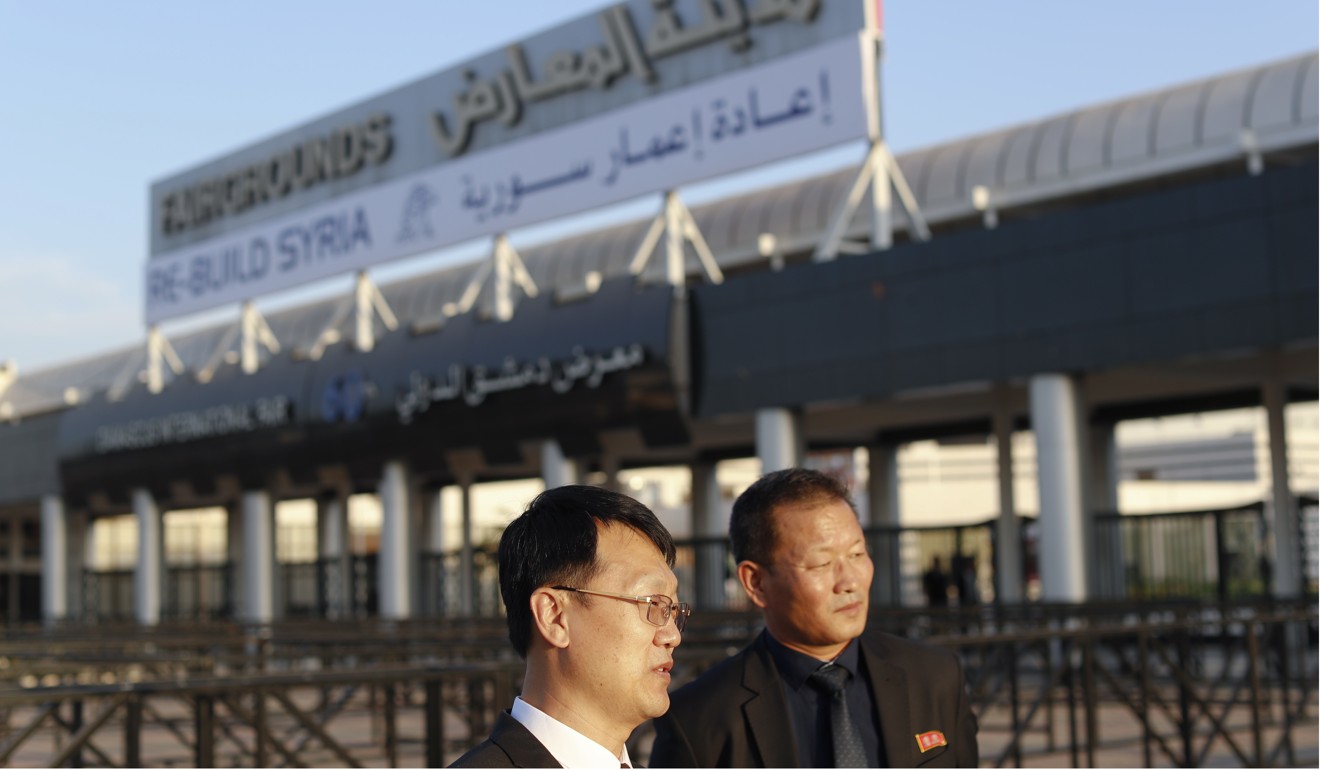
in September, China sent a delegation of 200 companies to the 60th Damascus International Fair, most of which are state-owned enterprises looking to tap in Syria and build a working relationship in its reconstruction process.
John Lee, a professor at the University of Sydney in Australia and a senior fellow at the Hudson Institute in Washington, said the troop withdrawal may also signal a rethinking of Washington’s Indo-Pacific policies.
“It represents a shift in strategic thinking [in the US] that the Middle East is becoming less important to America as more attention is being directed towards the Indo-Pacific,” he said.
“The US already views China as its primary and long-term challenge. This is brought out in the National Security Strategy, National Defence Strategy and in the speech by Vice-President Mike Pence.”
The US military’s Pacific Command has been renamed Indo-Pacific Command, and plans to upgrade equipment and weapons systems and enhance exercises with its regional allies. More specifically, it has increased patrols in the South China Sea to challenge China’s territorial claims.
In the past two years, the US navy has carried out eight freedom of navigation operations near the China’s controlled islands in the South China Sea.
However, Wu from Fudan University believes the use of US military forces in the Indo-Pacific will be limited. Their purpose, he said, was mainly to maintain a presence and profile of the US in the region for its allies and to pressure China.
“It’s unlikely that the US will take China’s South China Sea islands by force or force China to give up its ‘Maritime Silk Road’ plans,” he said, referring to Beijing’s strategy to boost infrastructure connectivity throughout Southeast Asia, Oceania and East African countries.
“I am not convinced the US will actually use military means in this region.”














COMMENTS: 6