Archive for ‘UNESCO’

10/09/2019

Sea goddess Mazu lets train take the strain on tour of eastern China

  • Deity has all the necessary travel documents for seven-day journey bringing blessings to coastal communities
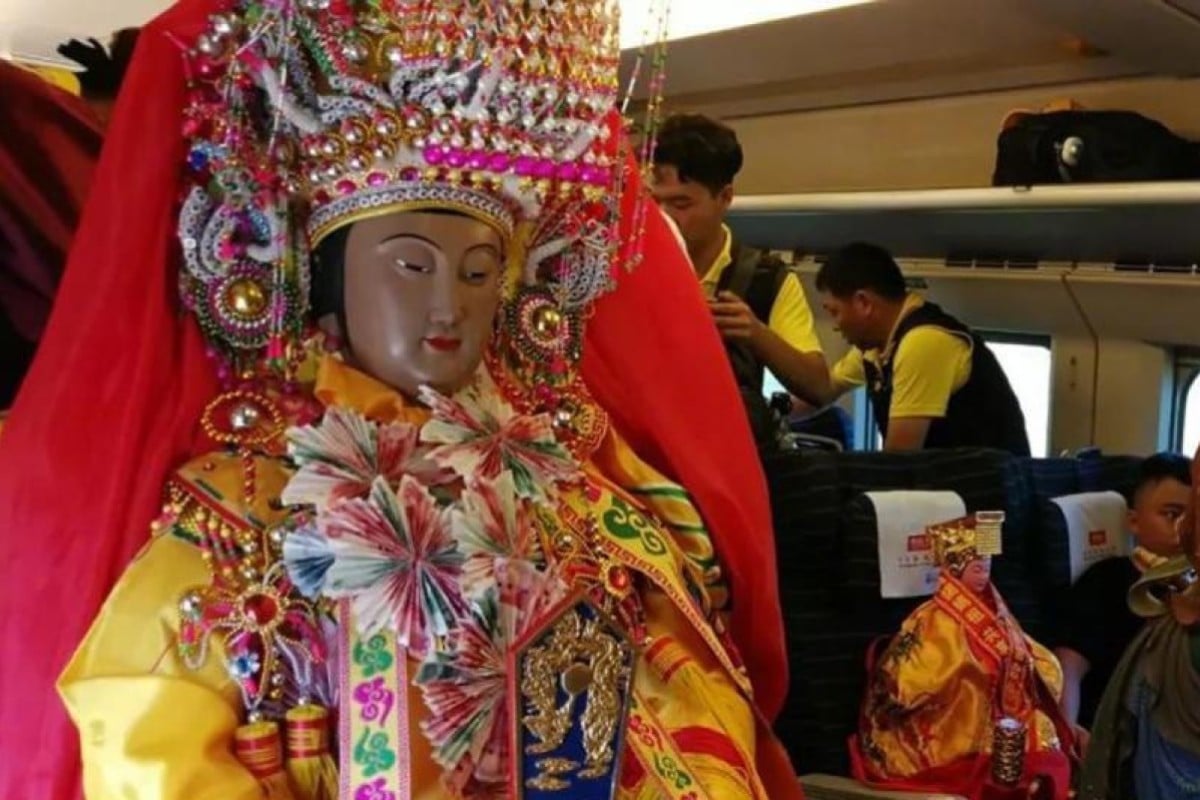
The statue of Chinese sea goddess Mazu on board the train for her seven-day tour of eastern China. Photo: Weibo

High-speed rail travellers in eastern China may find themselves in exalted company this week as one of China’s most beloved deities is on a seven-day tour.

Mazu, protector of seafarers, boarded the train at Putian in Fujian province on Friday with an entourage of 230 worshippers for one of her regular “inspection tours”. And, like any modern traveller, the sea goddess had the necessary identity card and ticket for the journey.

Mazu, known as Tin Hau in Hong Kong, began life more than 1,000 years ago as a mortal named Lin Mo, according to Chinese folk belief. As a girl she is said to have saved some of her family members when they were caught in a typhoon while out fishing. In another version of the myth, Lin Mo died while trying to rescue shipwreck victims.

She fell out of favour in mainland China during the Cultural Revolution, when her ancestral temple on Meizhou Island in the southeastern province of Fujian was destroyed to make way for a People’s Liberation Army garrison. In the late 1970s the temple was rebuilt and in 2009 the beliefs and customs surrounding Mazu were recognised as an Intangible Cultural Heritage of Humanity by Unesco.
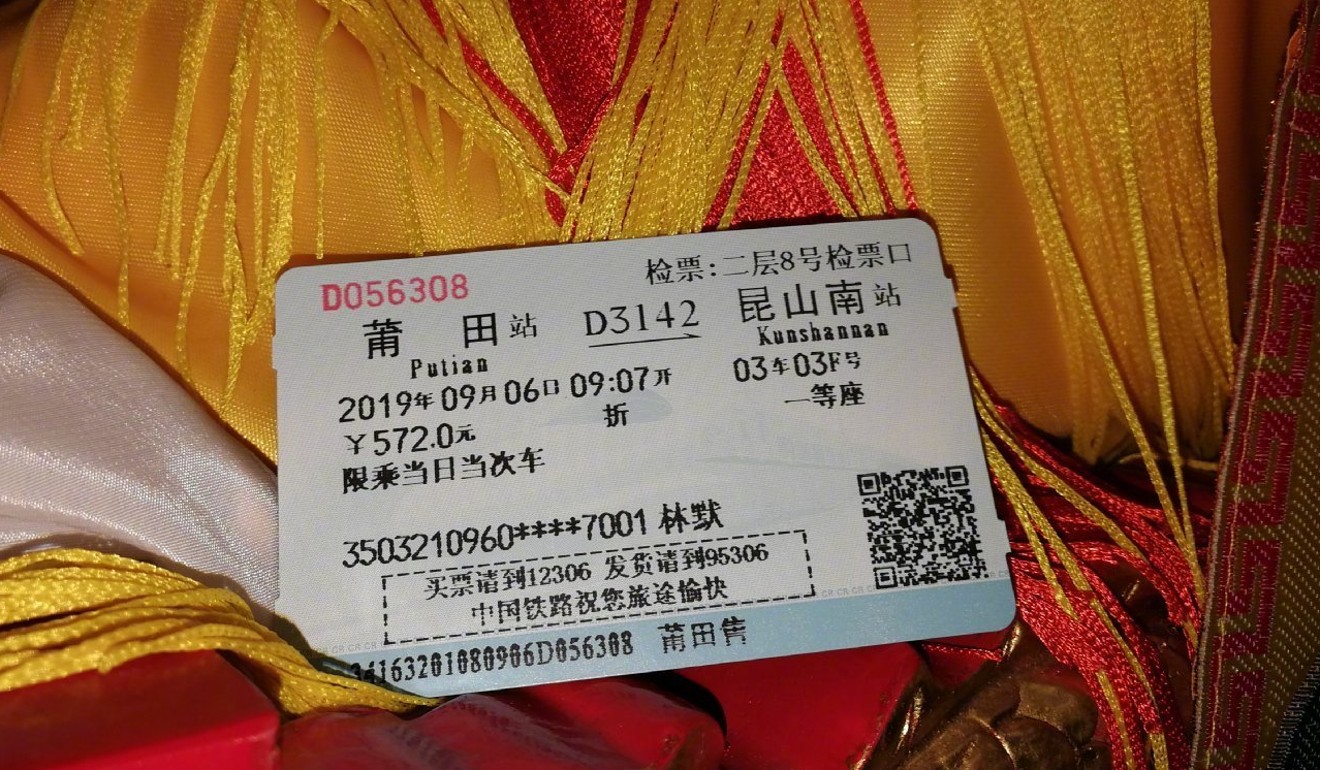
Inspectors on China’s high speed rail will find everything in order if they ask to see the goddess Mazu’s ticket during her seven-day tour. Photo: Weibo

Staff at the Meizhou Mazu Temple applied for an ID card for the goddess, in her earthly name of Lin Mo. Tickets were also organised for two other fairy figures who traditionally protect her, according to Chinese folklore.

“Not only Mazu but Thousand-Mile Eye and Wind-Accompanying Ear were all bought tickets,” a temple representative told the Southern Metropolis News.

This is not the first time the trio have been bought travel tickets. Two years ago their airfares were paid for when they visited Malaysia and Singapore and, a year later, they took a cruise ship to the Philippines.

This year’s tour includes a visit to Kunshan in Jiangsu and Shanghai, before Mazu returns to her home temple on the island of Meizhou. At each stop, devotees believe Mazu blesses the location with her presence and protects its residents from harm.

Taiwanese tycoon Gou thanks sea goddess for presidential inspiration

The tour has been organised jointly by the Meizhou Temple as well as the Huiju Mazu Temple in Kunshan and the Lugang Mazu Temple in Taiwan.

News of the celestial train journey quickly went viral on Chinese social media, with posts on Mazu receiving 460 million views on Weibo, the Twitter-like microblogging platform, since Monday. “First, respect. Second, she takes up a seat so it’s not crazy to buy her a ticket,” one comment read.

Source: SCMP

21/07/2019

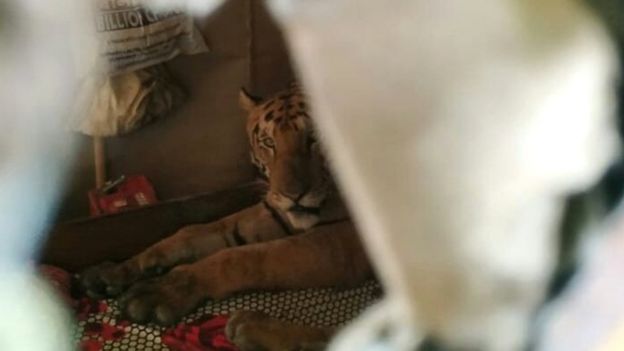
India floods: Tired tiger takes nap in resident’s bed

A tiger lying on a bed in Assam stateImage copyright WTI
Image caption The tiger was seen relaxing in a bed in Assam state

A female tiger which fled a wildlife park in India’s flood-ravaged state of Assam was found relaxing on a bed inside a local resident’s house.

She is believed to have fled the Kaziranga National Park, where 92 animals have died in recent days amid heavy flooding.

Officials from a wildlife conservation group arrived at the house and created a safe escape route for her.

She was guided in the direction of the jungle.

According to the Wildlife Trust of India (WTI), the tigress was first spotted next to a highway on Thursday morning, some 200 metres away from the national park.

She was likely to have been disturbed by the busy road and ended up seeking refuge in the house, which is located near the highway, it said.

Tiger in residence's houseImage copyright WTI
Image caption The house owner fled as soon as he saw the tiger

Rathin Barman, who led the rescue operation, said the tigress entered the house – which is next to a shop – at 07:30 local time (02:00 GMT) and slept throughout the day.

“She was very exhausted and had a nice day-long nap,” he told the BBC.

The house owner, Motilal, who also owns the adjoining shop, fled the house along with his family members as soon as they saw the tiger walking in.

“The great thing was that nobody disturbed her so she could rest. There’s a lot of respect for wildlife in this region,” Mr Barman said.

“[Motilal] says he will preserve the bed sheet and pillow on which the tiger rested.”

WTI officials were later called to the scene and began preparing a safe escape route for her.

They blocked traffic on the highway for an hour and set off firecrackers to wake the animal up. She eventually left the house at 17:30 local time, crossed the highway and went in the direction of the forest.

Media caption Floods cause death and destruction in north India

Mr Barman said it was not clear if she had actually entered the forest or if she had just “walked off into an adjoining area”.

The Unesco-recognised Kaziranga National Park is home to 110 tigers, but none of them have died in the flooding.

Animals killed in the park include 54 hog deer, seven rhinos, six wild boars and one elephant.

Monsoon floods have devastated the eastern states of Bihar and Assam, killing more than 100 people and displacing millions.

The monsoon season, which lasts from June to September, has also wreaked havoc in Nepal and Bangladesh.

Source: The BBC

Law of Unintended Consequences

continuously updated blog about China & India

ChiaHou's Book Reviews

continuously updated blog about China & India

What's wrong with the world; and its economy

continuously updated blog about China & India