Archive for ‘unique status’

31/05/2020

Hong Kong: China fury amid global pressure over security law

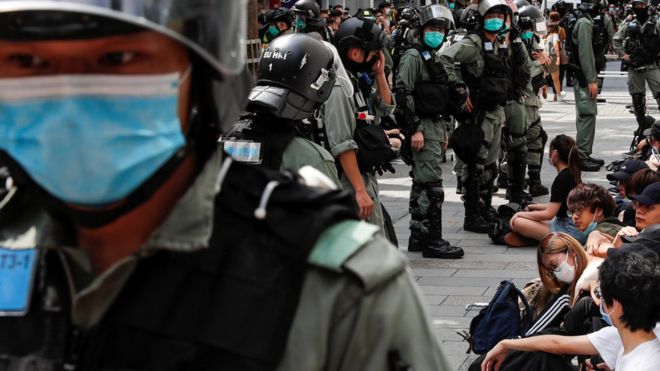
Protest on 27 MayImage copyright REUTERS

China is facing mounting criticism over a planned security law for Hong Kong which would make it a crime to undermine Beijing’s authority in the territory.

The UK and US said at a private session of the UN Security Council that the law would curtail the city’s freedoms.

China, which blocked a formal meeting, warned them to “stop interfering”.

Hong Kong’s autonomy is guaranteed by the 1997 agreement under which it was returned to China from the UK.

It enjoys some freedoms – of the press and association – unseen in mainland China.

But there are fears the proposed law – which has sparked a wave of anti-mainland protests – could end Hong Kong’s unique status.

This week, Britain said that if China went forward with the law, it could offer British National (Overseas) passport holders a path to UK citizenship.

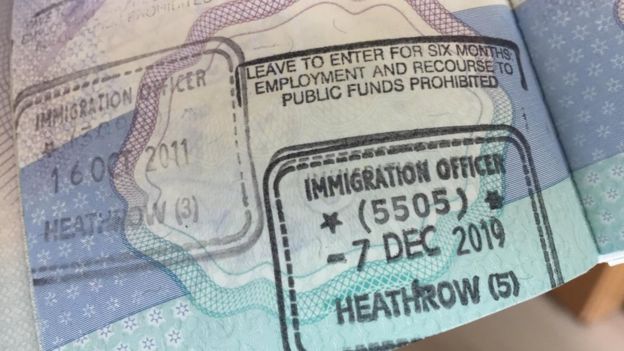
There are 350,000 BNO passport holders in Hong Kong who currently have the right to visit the UK for up to six months without a visa.

On Friday, the UK Home Office confirmed the new rights could be given to up to three million people with BNO status – as long as they applied for and were granted a passport.

China says all BNO passport holders are Chinese nationals, and if the UK changes this practice, it would violate international law.

Australia, Canada and the EU have also criticised the security law and its implications for Hong Kong.

Taiwan’s parliament has backed a plan to offer sanctuary to people who want to flee Hong Kong, but China – which considers Taiwan to be part of its own territory – has warned the island not to get involved.

On Friday, Chinese Foreign Ministry spokesperson Zhao Lijian urged other countries to stop interfering in the matter.

“We will take necessary measures to resolutely counter the wrong acts of external forces interfering in Hong Kong affairs”, he said.

What might the US do?

On Wednesday, US Secretary of State Mike Pompeo told Congress that Hong Kong no longer merited special treatment under US law, potentially paving the way for it to be stripped of trading privileges such as lower tariffs than mainland China.

US media reports that President Trump is considering a range of sanctions. These could include strong measures such as stripping Hong Kong of its trading privileges or milder options such as restricting visas and freezing the assets of Chinese officials.

He is expected to make an announcement later on Friday.

The EU has warned that imposing sanctions would not solve the crisis.

“Our relationship with China is based on mutual respect and trust… but this decision calls this into question and I think that we have to raise the issue in our continued dialogue with China”, EU High Representative for Foreign Affairs Josep Borrell said after talks with foreign ministers on Friday.
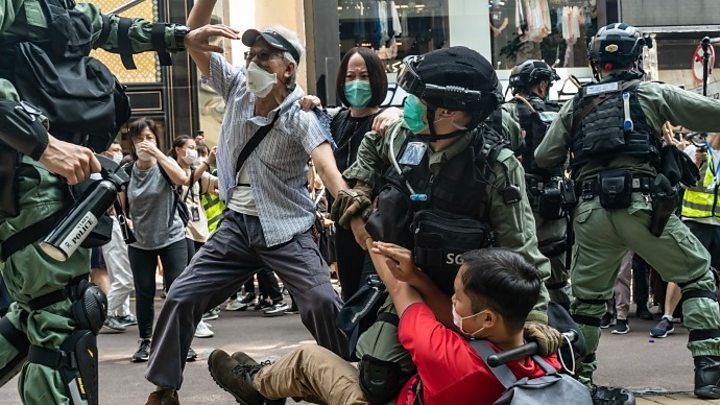
Media caption Police arrested dozens of people in Causeway Bay on Wednesday

Hong Kong’s justice secretary Teresa Cheng told the BBC’s Chinese service that any threat of sanctions was unacceptable.

“Are the sanctions being imposed with a view to coerce another state to change their policy…? Any such sanctions are not going to benefit anyone”.

What is the law about?

China’s parliament has backed the security legislation, which would make it a crime to undermine Beijing’s authority in Hong Kong.

The resolution – which now passes to China’s senior leadership – could also see China installing its own security agencies in the region for the first time.

Full details about exactly what behaviour will be outlawed under the new security law are not yet clear. It is due to be enacted before September.
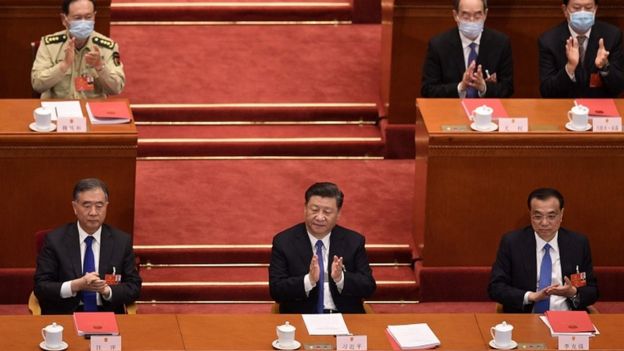
China's President Xi Jinping (c) applauds after the vote during the closing session of the National People's Congress at the Great Hall of the People in Beijing on May 28, 2020Image copyright AFP
Image caption President Xi Jinping and other senior figures applauded when the security law was passed

However, it is expected to criminalise:

  • secession – breaking away from China
  • subversion – undermining the power or authority of the central government
  • terrorism – using violence or intimidation against people
  • activities by foreign forces that interfere in Hong Kong

Experts say they fear the law could see people punished for criticising Beijing – as happens in mainland China. For example, Nobel Laureate Liu Xiaobo was jailed for 11 years for subversion after he co-authored a document calling for political reform.

China’s foreign ministry in Hong Kong described US criticism of the new draft law as “utterly imperious, unreasonable and shameless”.

Source: The BBC

29/05/2020

Hong Kong: What is the BNO and what does the UK move mean?

A Petitioner is seen holding up a BNO passport outside the British Consulate in Hong Kong on August 21, 2019Image copyright GETTY IMAGES
Image caption Around 300,000 in Hong Kong hold a British National (Overseas) passport

The UK has said it is considering more rights for holders of a special passport issued to some people in Hong Kong.

The territory, which used to be a British colony, was handed back to China in 1997. Anyone born before then is eligible to apply for a British National (Overseas) passport, known as a BNO.

If China implements a controversial proposed security law, people holding the BNO, could get a “path to citizenship”, the UK said.

What is the BNO and who has one?

The BNO passport is essentially a travel document that does not carry citizenship rights with it – although you are entitled to some consular assistance outside of Hong Kong and China with it.

It was issued to people in Hong Kong by the UK before Hong Kong was handed over to China.

Around 300,000 people currently hold a BNO passport, allowing them to visit the UK visa-free for six months. An estimated 2.9 million people are eligible for a BNO passport, said the British Consulate General in Hong Kong.

Though it gives the passport holder the right to remain in the UK for up to six months, it doesn’t automatically allow them to reside or work there. They also aren’t allowed to access public funds, including things like government benefits.

BNO holders cannot pass this status on to their children.

What is the UK proposing – and why?

China on Thursday formally approved a plan to impose controversial national security legislation in Hong Kong. It could go into effect as early as the end of June.

Hong Kong was handed back to China, on a number of conditions. These include the region’s high level of autonomy and maintaining certain rights like freedom of speech that do not exist in mainland China.

But this new plan, if put into law, would make it a crime to undermine Beijing’s authority in Hong Kong, and many are concerned it could end Hong Kong’s unique status.

The move triggered a wave of  criticism around the world, with many – including Chris Patten, the last governor of Hong Kong – urging the UK to stand up for the territory.

A BNO passport
Image caption Under current rules, BNO holders are allowed to stay for six months

Later on Thursday, UK Foreign Secretary Dominic Raab said the country would move to scrap the six-month stay limit for BNO holders if China goes on to officially implement the law.

Mr Raab said that BNO passport holders would be allowed to “apply to work and study for extendable periods of 12 months and that will itself provide a pathway to future citizenship”.

What difference could it make?

As a way to help people in Hong Kong who would rather not stay there if the new security laws are implemented, it might prove more symbolic.

For starters only a small percentage of people in Hong Kong currently have a BNO.

But also, the people who the security laws are aimed at – the young anti-mainland protesters who have been getting into violent confrontations with police for months – are not likely to be eligible for the BNO because of their age.

Additionally, though the BNO gives the passport holder the right to visit the UK for up to a year potentially, it’s not clear what other benefits the extension might bring, or if the UK would make it any easier administratively for those already in the country to apply for work or study.

On social media, some Hong Kongers dismissed it as a gesture that amounted to little more than a 12-month tourist visa.

Effectively, it means that those who come to stay in the UK for a year, and who have the funds to be able to extend this enough, could eventually be eligible to apply for citizenship.

It cuts out some of the administrative hoops BNO holders would have had to jump through before this move if they wanted this path.

How has China reacted?

China has firmly opposed the move by the UK, saying it is a violation of the handover agreement that stipulates BNO passport holders do not enjoy UK residency.

China has repeatedly warned Britain to stay out of its affairs in Hong Kong.

The Chinese ambassador to the UK Liu Xiaoming had previously accused some British politicians of viewing Hong Kong “as part of the British empire”.

Source: The BBC

Law of Unintended Consequences

continuously updated blog about China & India

ChiaHou's Book Reviews

continuously updated blog about China & India

What's wrong with the world; and its economy

continuously updated blog about China & India