23/12/2019
- Summit between Chinese, South Korean and Japanese leaders could yield results for future of Korean peninsula, analyst says
North Korea has promised an unwelcome “Christmas present” if the US does not show the “right attitude” for talks. Photo: KCNA
Chinese President Xi Jinping has again stressed the need for tensions on the Korean peninsula to be resolved through dialogue, as the deadline looms in North Korea’s threat to give the United States an
unwelcome “Christmas gift”
.
With just over a week to go until Pyongyang’s year-end deadline for Washington to change what it says a policy of hostility, Xi held separate talks with South Korean President Moon Jae-in and Japanese Prime Minister Shinzo Abe in Beijing on Monday.
Moon and Abe will also join Chinese Premier Li Keqiang for a trilateral summit in Chengdu, Sichuan province, on Tuesday.
The first trilateral leadership talks took place in 2008, but were not held in 2013 and 2014, or in 2016 and 2017.
Xi said China and South Korea “both insist on maintaining peace and stability on the peninsula, and advocate solving problems through dialogue and consultation”, state news agency Xinhua reported on Monday.
“China supports South Korea in continuing to improve its relationship with
and injecting impetus for the Korean peninsula peace talks,” the report said.
Moon said the suspension of talks between the US and North Korea and heightened tensions along the peninsula “are not beneficial to both our countries and North Korea”, according to South Korean news agency Yonhap.
Moon also said that China had played an “important role” in efforts for the denuclearise the peninsula, the report said.
North Korea has signalled impatience over the stalled talks with the US, and the fading hopes for an end to Washington’s economic sanctions.
In April, North Korean leader Kim Jong-un said that he would “wait” until the end of the year to decide whether the US had the “right attitude” to allow a resumption of negotiations, but no signs of further talks have emerged.
Then earlier this month Pyongyang warned that Washington would receive a “Christmas gift”, and US actions would determine whether the present would be good or bad.
In an apparent sign of frustration with the US, North Korean news agency KCNA reported on Sunday that Kim held a meeting of the Workers’ Party of Korea to “bolster the overall armed forces of the country” to deal with the “the fast-changing situation”.
The US imposed crippling sanctions on North Korea’s economy in 2017, though many countries, including China, South Korea and Japan, have also tightened measures against the North.
South Korea and Japan both scaled back people-to-people links in 2016, China banned coal exports to the North in 2017. Earlier this year, Trump thanked China and Russia for maintaining sanctions against Pyongyang.
As diplomats make last-ditch attempts to stop renewed confrontation, US special envoy for North Korea Stephen Biegun shuttled around the region last week, meeting senior officials in China, South Korea and Japan. Biegun urged North Korea to return to negotiations, and said the US “does not have a deadline” for talks.
China and Russia also proposed last week that the United Nations Security Council
, saying it was necessary to break the deadlock.
Xi’s meeting with Moon also comes as Beijing tries to mend ties with Seoul to prevent neighbouring nations from getting closer to Washington.
Relations between China and South Korea deteriorated in 2017 after Seoul deployed a US-led missile defence system known as THAAD, which Beijing deemed as a security threat to its own territory.
On Monday, both Xi and Moon said in their meeting that they looked forward to improving relations between their countries.
“We have been friends and partners that have continued close cooperation,” Xi said. “We have a wide range of common understandings in various fields, including on further developing bilateral relations, facilitating regional peace, stability and prosperity, and defending multilateralism and a free trade system.”
Sun Xingjie, a North Korea specialist at Jilin University, said the US signal was “very clear” in Beigun’s comments.
“They still want to continue discussions,” he said.
Sun also said the talks in Chengdu on Tuesday would likely play an important role in the future of resolving problems on the Korean peninsula.
“After returning to the platform these last couple years, I believe this will become an important, normalised place for discussions. Whatever problems they run into, the platform should continue to move forward,” Sun said.
Source: SCMP
Posted in Beijing, Chengdu, China alert, Chinese, Chinese premier Li Keqiang, Chinese President Xi Jinping, deadline, denuclearise, frustration, Japanese, Japanese Prime Minister, Japanese Prime Minister Shinzo Abe, Jilin University, Korean peninsula, leaders, North Korea, nuclear talks, President Moon Jae-in, presses, Pyongyang, Russia, sichuan province, South Korean, South Korean President, Trump, Uncategorized, United Nations Security Council, United Nations Security Council (UNSC), United States, US, Washington |
Leave a Comment »
28/10/2019
- The president is set to become the first Russian leader to make a state visit to the Philippines for more than 40 years, according to a former envoy
- Moscow is aware of China’s entry into the Philippines, and could have its eye on some projects there, while the US is also watching developments
Russian President Vladimir Putin and Philippine President Rodrigo Duterte shake hands during a 2016 meeting in Peru. Photo: EPA
The timing of Moscow’s announcement over the weekend that
President Vladimir Putin
has accepted an invitation to visit Manila has raised eyebrows, as it comes on the eve of crucial bilateral talks between
the Philippines and China on joint oil exploration in the
.
In a statement immediately welcomed by the Philippine presidential palace, Igor Khovaev, Russia’s ambassador to the Philippines, on Saturday told reporters Putin had accepted Duterte’s invitation “with gratitude”.
No date has been set for the visit, with Khovaev only saying Moscow would “do our best to arrange this meeting as soon as possible”.
A steering committee with representatives from both Manila and Beijing is set to meet this week to discuss the joint oil exploration deal. China has proposed a 60 per cent-40 per cent split in favour of the Philippines, according to Hermogenes Esperon,
Courting Russia with South China Sea oil is a ‘dangerous gamble’ for Duterte
Neither side has clarified if the split refers to ownership or revenue, and no other details were disclosed.
After an August meeting with Duterte, Chinese President Xi Jinping said the countries could take a “bigger step” in jointly developing oil and gas resources if they could properly handle their sovereignty dispute in the South China Sea.
But defence and security analysts say the Philippine president took a “dangerous gamble” on a visit to
Russia last month, when he invited the Russian state oil company Rosneft to explore for oil in Philippine waters – which include parts of the South China Sea claimed by China.
The timing of Moscow’s announcement has not gone unnoticed.
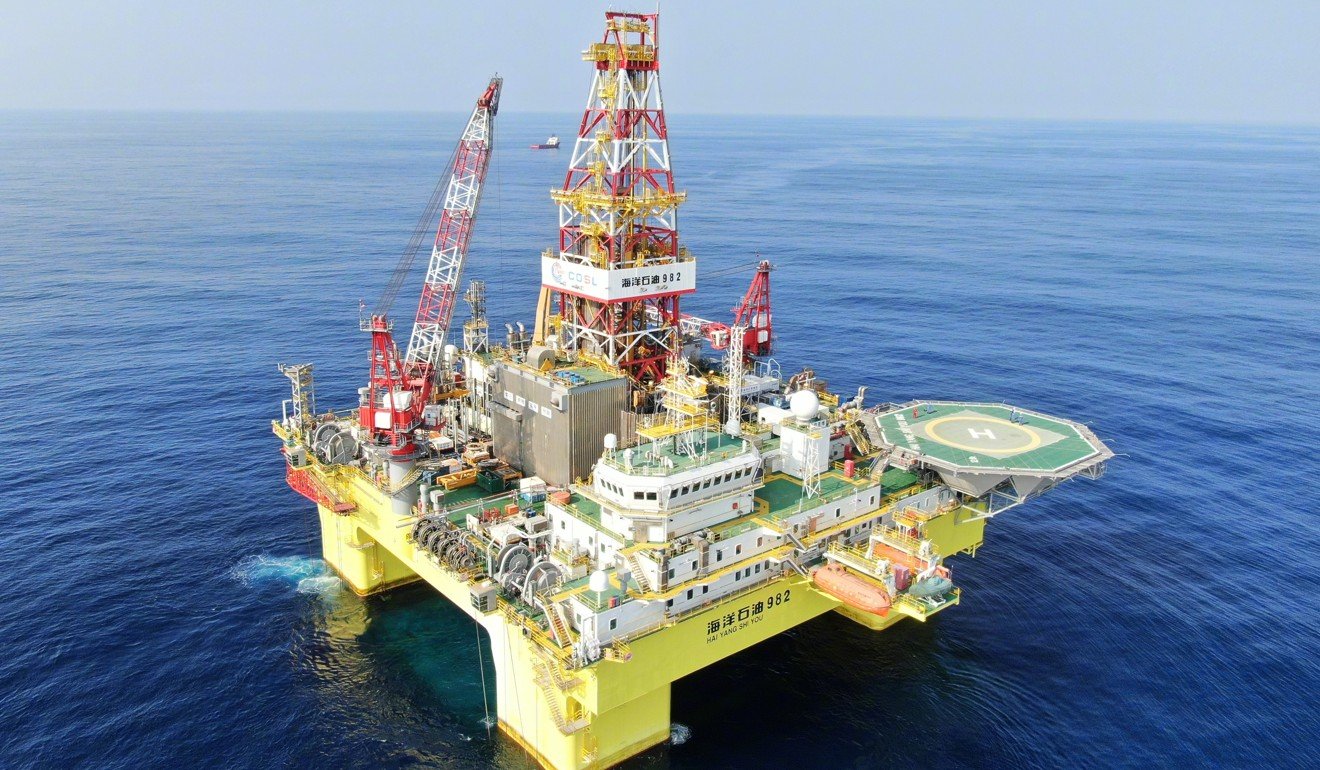
A Chinese deepwater oil rig in the South China Sea. Photo: Weibo
“It’s a welcome and historic development. Some wise guy in the Duterte government thought about timing [the invitation to Putin around the oil talks with Beijing],” said retired Philippine ambassador Lauro Baja, who once served as president of the United Nations Security Council.
Baja told the Post that no Russian president had visited the Philippines during his more than 40 years with the Department of Foreign Affairs.
“The Philippines then was almost a nonentity as far as Russia was concerned, [but] maybe now Russia recognises the strategic importance of the Philippines [in terms of] regional politics,” he said.
Baja said Moscow was aware of China’s entry into the Philippines, and could have its eye on some projects there.
“For all their so-called alliance, China and Russia are fierce competitors for influence and other benefits. And I think Russia has some objectives in mind like selling armaments and [forging] technological agreements,” he said, while cautioning that the situation remained “nebulous”.
New Philippines military chief sees no ‘shooting war’ in South China Sea despite disputes
“It’s a fascinating development but things are still early … For now, this is [just] an invitation extended by Duterte and accepted in principle by Putin.”
The United States will also be monitoring developments in the Philippines, according to Greg Poling, director of the Washington-based Centre for Strategic and International Studies’ Asia Maritime Transparency Initiative.
“Russia is eager to boost its influence in the region, and doubtless doing so with a long-standing US ally is seen as a bonus by Moscow,” he said. “There is nothing that prevents the Philippines from engaging in security cooperation with Russia, but the devil will be in the details.”
Poling added that the US would be concerned if Russia-Philippine cooperation involved acquiring military platforms that were incompatible with the shared platforms and doctrines used by Washington and Manila, as well as the latter’s other major security partners, namely Australia, Japan and South Korea.
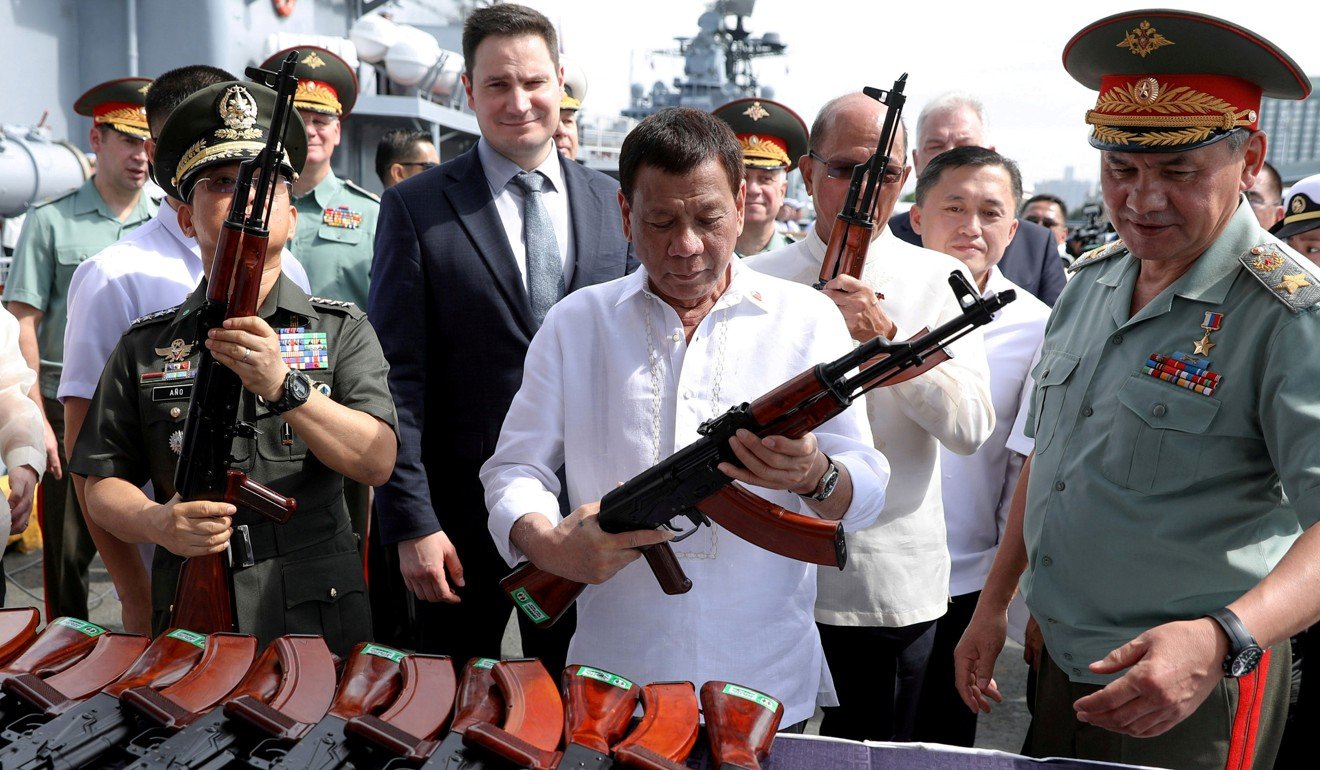
Philippine President Rodrigo Duterte inspects firearms donated by Russia in 2017. Photo: Reuters
“The US will also be concerned if any acquisitions or cooperation with Russia might threaten information security or intelligence cooperation between the US and the Philippines,” he said.
“And finally, any major platforms acquired from Russia would likely require the US to impose sanctions on the Philippines unless a waiver is granted, and the US government has been very stingy about awarding those waivers because they undermine the effectiveness of the sanctions regime.”
Moscow last week offered to help the Philippines produce its own arms for both domestic use and export with the help of Russian technology. Max Montero, an Australia-based Filipino security consultant, viewed that offer as “a swipe at the US”.
“Imagine a US stronghold and long-time ally and former colony becoming a manufacturing hub for Russian arms. And it makes it worse if [the Philippine armed forces] buys them too,” he said.
“Weakening the US alliances in Asia will benefit Russia [as it is] one of the US’ competitors in arms sales and geopolitics.”
Russia offers arms technology to the Philippines with ‘no conditions’ as US ties falter
The Philippines, Montero said, would benefit from such an arrangement since it is “a laggard in defence technology”. However, he pointed out that the country’s armed forces continue to buy weapons from the US and receive American arms as grants, potentially limiting the domestic market for Russian arms.
Navy cooperation has also been on the agenda, as Moscow and Manila discussed signing a new naval pact in March, while warships from each country have visited the other this year. Philippine naval vessels made their first-ever visit to Russia in October, while three Russian ships docked in the Philippines for a goodwill visit in January.
Russia is the top supplier of arms to Southeast Asia, and the No 2 global arms supplier, behind the US. Southeast Asia bought US$6.6 billion of Russian arms between 2010 and 2017, or more than 12 per cent of Russia’s sales, according to the Stockholm International Peace Research Institute, a Swedish think tank that publishes global arms tracking data.
Source: SCMP
Posted in acquisitions, agenda, arms sales, Australia, Beijing, Centre for Strategic and International Studies’ Asia Maritime Transparency Initiative, China’s, Chinese, Chinese President Xi Jinping, cooperation, deepwater oil rig, Department of Foreign Affairs, donated, entry, firearms, GeoPolitics, global arms supplier, global arms tracking data, inspects, invite, Japan, Manila, Manila-Beijing, Moscow, naval pact, Navy cooperation, nonentity, oil company, oil talks, Peru, Philippine President, Philippines, Putin, Rodrigo Duterte, Rosneft, Russia, Russian leader, Russian President, russian president vladimir putin, Russian state, Russian technology, South China Sea, South Korea, Southeast Asia, State visit, Stockholm International Peace Research Institute, Swedish think tank, Uncategorized, United Nations Security Council, United Nations Security Council (UNSC), United States, US, Washington |
Leave a Comment »
07/09/2019
- He is expected to join a trilateral dialogue with his counterparts from Pakistan and Afghanistan, and observers say he may try to mediate in Kashmir dispute
- Trip also includes a stop in Nepal that could pave way for a visit by Xi Jinping
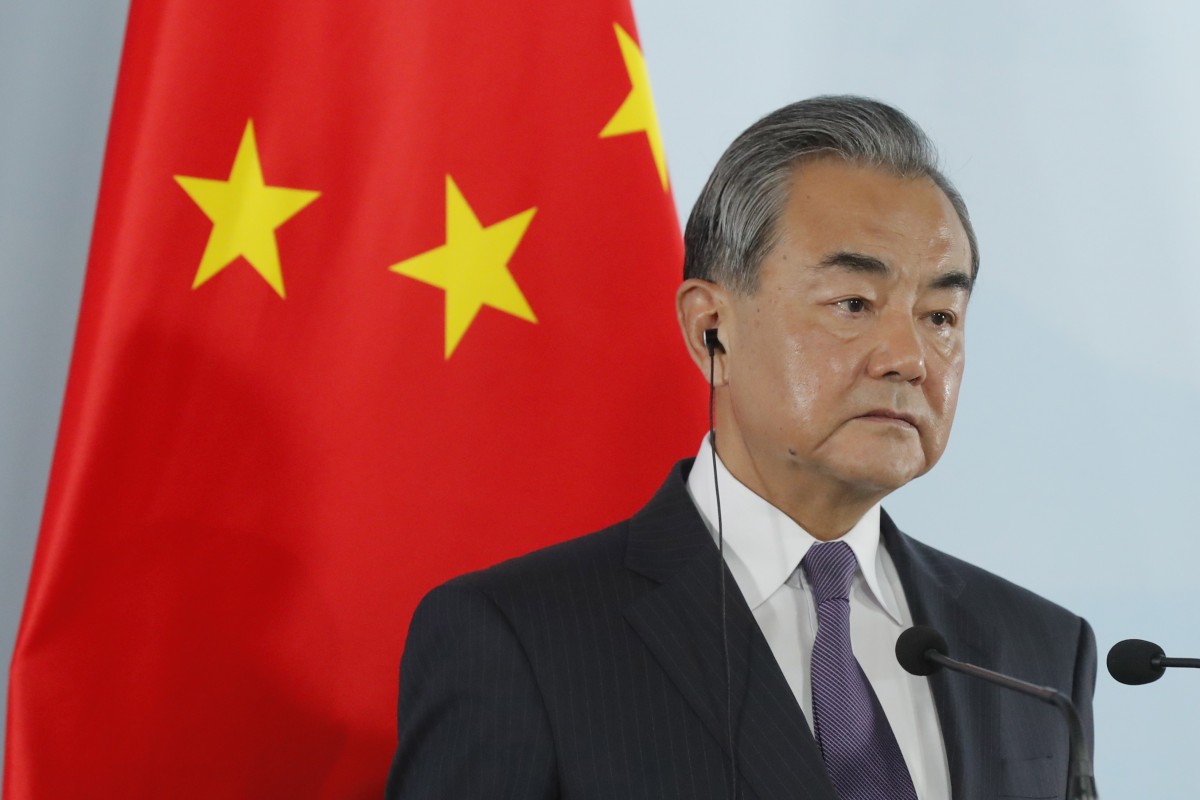
Chinese Foreign Minister Wang Yi may try to act as a negotiator in the Kashmir dispute. Photo: EPA-EFE
Chinese Foreign Minister Wang Yi began a four-day trip to Pakistan and Nepal on Saturday, amid escalating tensions between Islamabad and New Delhi over
.
Wang was expected to join a trilateral dialogue with the foreign ministers of Pakistan and Afghanistan in Islamabad, foreign ministry spokesman Geng Shuang said on Friday. He will also travel to Nepal.
Beijing has criticised India’s decision last month to strip the Jammu and Kashmir autonomous state of its special status and break it into two federally controlled territories, calling it “unacceptable”.
China also formally backed Pakistan’s request for the United Nations Security Council to hold “closed consultations” on the revocation of the state’s autonomy.
Meanwhile, observers say the Chinese foreign minister could attempt to act as a negotiator in the complex border dispute.
“Wang might try to play a role to mediate between the two sides to resolve the crisis,” said Wang Dehua, head of the Institute for South and Central Asia Studies at the Shanghai Municipal Centre for International Studies. “This has been China’s long-held position on the issue.”
Pang Zhongying, an international relations researcher at Ocean University of China in Qingdao, agreed.
“[Indian Prime Minister] Narendra Modi has visited China a couple of times and it is likely [Chinese President] Xi Jinping will visit India soon,” he said. “If Xi is to visit India later this year, China may try to contain its differing views with India on Kashmir.”
Modi has proposed an informal summit with Xi later this year that may be held in the religious hub of Varanasi, Modi’s parliamentary constituency. New Delhi said in May that Indian officials were working with the Chinese side to finalise the details, but Beijing has yet to confirm Xi’s visit.
India dismisses Beijing’s concerns over Kashmir because ‘it won’t have any impact on China’
Wang Yi was also due to visit India later this month for border talks, but the trip had to be postponed at the request of New Delhi because of scheduling problems, Hindustan Times reported, citing China’s foreign ministry.
The row over Kashmir has escalated in the past month. Pakistani Prime Minister Imran Khan said on Friday that Islamabad would make the fullest possible response to New Delhi’s actions in disputed Kashmir and that the global community would be responsible for any “catastrophic” aftermath.
Since Modi withdrew special rights for Indian-administered Kashmir on August 5, India has flooded the Kashmir valley with troops, restricted the movements of residents and cut off communication.
Both India and Pakistan claim the whole of Kashmir, which was partitioned between the two following the end of British rule in 1948, and they have subsequently fought wars over the territory.
China has its own territorial dispute with India over the part of Kashmir it controls. In early August, Chinese foreign ministry spokeswoman Hua Chunying
and said it was not binding. Beijing later appeared to soften its rhetoric, with Hua calling for a solution through dialogue and negotiation, without criticising either side.
The Chinese foreign minister will also visit Nepal, where he is expected to meet his counterpart, the president and prime minister. The trip could pave the way for an expected visit by Xi to Nepal.
Source: SCMP
Posted in 1948, Afghanistan, autonomy, British rule, China alert, Chinese foreign minister Wang Yi, complex border dispute, Hindustan Times, Imran Khan, India alert, Indian Prime Minister Narendra Modi, Institute for South and Central Asia Studies, Islamabad, Jammu and Kashmir, Kashmir, negotiator, Nepal, New Delhi, observers, Ocean University of China, Pakistan, Pakistani Prime Minister, Qingdao, Shanghai Municipal Centre for International Studies, tensions, troops, Uncategorized, United Nations Security Council, United Nations Security Council (UNSC), visits, Xi JinPing |
Leave a Comment »
15/08/2019
ISLAMABAD (Reuters) – Pakistan observed a ‘Black Day’ on Thursday to coincide with India’s Independence Day celebrations, in protest at New Delhi’s decision to revoke special status for its portion of the contested Kashmir region.
India’s decision this month, along with a communications blackout and curbs on the movement of those in Indian-administered Kashmir, caused fury in Pakistan, which cut trade and transport links and expelled India’s envoy in retaliation.
Newspapers in Pakistan printed editions with black borders on Thursday and politicians, including Prime Minister Imran Khan, replaced their social media pictures with black squares.
Protests are due to be held across the country, including Azad Kashmir, the wedge of territory in the west of the region that Pakistan controls.
The largely symbolic move comes amid growing frustration in Islamabad at the lack of international response over the Kashmir dispute.
Pakistan was isolated diplomatically and faced “a world in denial” over the situation in Kashmir, Dawn, the country’s most influential English language newspaper, said in an editorial.
The 15-member United Nations Security Council could discuss the dispute as soon as Thursday, but Pakistan says it only has guaranteed support from China, which also claims part of India’s Jammu and Kashmir state.
Permanent security council member Russia said on Wednesday it supported India’s stance that the dispute should be resolved through bilateral means, while the United States has called India’s decision an internal matter for New Delhi.
In his Independence Day speech in the Indian capital, Prime Minister Narendra Modi highlighted the decision to remove the special rights of the Muslim-majority region among the bold moves of his second term, following an election victory in May.
“Today every Indian can proudly say ‘One Nation, One Constitution’,” Modi, speaking from the ramparts of the historic Red Fort, said of the decision.
Source: Reuters
Posted in Azad Kashmir, Black Day, celebrates, China alert, English language newspaper, independence, India alert, Indian Prime Minister Narendra Modi, Islamabad, Jammu and Kashmir, Kashmir, New Delhi, observes, One Nation, One Constitution, Pakistan, Prime Minister Imran Khan, Red Fort, Uncategorized, United Nations Security Council, United Nations Security Council (UNSC) |
Leave a Comment »
09/04/2019
BEIJING, April 8 (Xinhua) — China on Monday voiced its support for multilateralism after France and Germany jointly proposed an “Alliance for Multilateralism” during a recent session at the United Nations Security Council (UNSC).
French Foreign Minister Jean-Yves Le Drian and his German counterpart Heiko Maas intended to officially launch the Alliance during the 74th session of the UN General Assembly scheduled for September.
“China has always staunchly upheld, supported and practiced multilateralism,” spokesperson Lu Kang said at a press briefing while commenting on the proposed Alliance, adding that China supports the efforts of the international community including France and Germany in maintaining multilateralism.
Lu said China stands ready to work with all parties in preserving the international order and regime with the purposes and principles of the UN Charter at its core, and the rule-based multilateral trade regime with the World Trade Organization (WTO) at its core, with a commitment to multilateralism.
Against the backdrop of a surging trend toward economic globalization and multi-polarization as well as a constant increase in global challenges, the world needs multilateralism more than ever before, the spokesperson said.
Speaking of Chinese President Xi Jinping’s remarks at a forum on global governance attended by French, German and EU leaders during Xi’s recently-concluded European visit, Lu mentioned Xi’s advocacy for safeguarding multilateralism, enhancing international dialogue and cooperation, and jointly addressing the deficits in governance, trust, peace and development, so as to improve global governance.
“China is ready to work with all parties in facilitating a new type of international relations featuring mutual respect, fairness, justice and win-win cooperation, to jointly build a community of shared future for mankind,” Lu added.
Source: Xinhua
Posted in Alliance for Multilateralism, China alert, Chinese President Xi Jinping, EU leaders, France, French Foreign Minister, Germany, Heiko Maas, Jean-Yves Le Drian, Lu Kang, multilateralism, UN Charter, UN General Assembly, Uncategorized, United Nations Security Council (UNSC) |
Leave a Comment »
26/02/2019
The IAF strike on Jaish camp in Balakot deep across LoC comes a day before the foreign ministers of Russia, India, and China (RIC) are expected to meet in the eastern China town of Wuzhen under the RIC mechanism.
INDIA Updated: Feb 26, 2019 15:56 IST
China has urged India and [pakistan to exercise restrain after the Indian Air Force hit a Jaish camp in Balakot acro(AP file photo)
China on Tuesday urged India to fight terrorism through “international cooperation” hours after the Indian air force carried out a targeted strike on a Jaish-e-Mohammed (JeM) camplocated across the Line of Control (LoC).
India should create “favourable” conditions internationally to fight terrorism, China added possibly in an oblique reference to New Delhi’s failure to convince Beijing to allow Jaish-e-Mohammed chief, Azhar Masood to be designated as a terrorist at the UN Security Council.
Follow live updates here
The strike comes a day before the foreign ministers of Russia, India, and China (RIC) are expected to meet in the eastern China town of Wuzhen under the RIC mechanism.
Responding to a question on the air strike, the foreign ministry spokesperson, Lu Kang said both India and Pakistan — one of China’s closest allies — should maintain restraint.
“We have taken note of relevant reports. I want to say that India and Pakistan are both important countries. A sound relationship and cooperation serve the interests of peace and stability in South Asia. Both parties (should) remain restrained and do more to improve bilateral relations,” Lu Kang said.
Read: Nation in safe hands, says PM Modi
“As for India’s claims on taking action against terrorism, fighting terrorism is a global practice. It needs to be dealt with international cooperation. And India needs to create a favourable condition internationally for the same,” Lu said.
The Chinese foreign ministry’s reaction came soon after foreign secretary, VK Gokhale confirmed that Indian forces carried out a strike on the biggest camp of the terror group Jaih e Mohammed in Balakot area early on Tuesday.
“Credible intelligence was received that JeM was attempting another suicide terror attack in various parts of the country, and the fidayeen jihadis were being trained for this purpose. In the face of imminent danger, a preemptive strike became absolutely necessary,” the foreign secretary said.
The Chinese foreign ministry reacted carefully, keeping in mind its close ties with Pakistan and the fact that India’s decision to carry out the strike was triggered by JeM-planned Pulwama attack that killed 40 CRPF personnel.
Read: After IAF strike on terror camp, Army tweets poem on power and peace
Interestingly, Chinese foreign minister, Wang Yi and his Pakistani counterpart, Shah Mehmood Qureshi spoke over phone about the Pulwama attack and its aftermath over the phone on Monday evening.
“Qureshi informed Wang of Pakistan’s stance on and measures to deal with the attack, reaffirming the country’s sincerity and resolution to communicate with India and find out the truth of the incident,” a report by China’s official news agency, Xinhua, said.
“Qureshi said Pakistan’s position on maintaining regional peace and fighting terrorism will remain unchanged and it is willing to join hands with other countries to cooperate in this area,” it added.
In the phone conversation, Wang said China supports Pakistan and India to resolve the issue through dialogue as soon as possible and avoid an escalation of the situation.
“He called on both sides to collaborate on fighting terrorism and jointly safeguard the security and stability of South Asia,” the report said.
Meanwhile, the Pulwama terrorist attack and the listing of Azhar as a global terrorist by the UN is expected to prominently figure at the 16th RIC foreign ministers’ meeting being held here on Wednesday.
Besides attending the annual trilateral meeting, external affairs minister Sushma Swaraj would also hold bilateral talks with Chinese FM Wang and Russian counterpart, Sergei Lavrov on the sidelines of the meeting.
Swaraj’s meeting with Wang assumes significance as it will be the first high-level interaction between the two countries after the Pulwama terror attack and Tuesday’s air strike.
China, a veto-wielding member of the UNSC, has consistently blocked India, the US, the UK and France’s efforts to list Azhar as a global terrorist since 2016 but endorsed a scathing statement issued by UN Security Council on February 21 on the Pulwama attack.
Source: Hindustan Times
Posted in Azhar Masood, Balakot, Beijing, China alert, Chinese foreign minister, CRPF, Foreign Ministry spokesperson, Foreign Secretary, India alert, Indian Air Force, Jaish-e-Mohammed, JeM, Lu Kang, New Delhi, Pakistan, Pulwama, RIC mechanism, Russia, Sergei Lavrov, Shah Mehmood Qureshi, terror camps, UN Security Council, Uncategorized, United Nations Security Council (UNSC), UNSC, VK Gokhale, Wang Yi, Wuzhen, Xinhua |
Leave a Comment »
23/02/2019
At a public rally in Rajasthan, PM Modi said attacks on Kashmiri youths after Pulwama terror attack help the enemies of the country.
INDIA Updated: Feb 23, 2019 19:11 IST
Prime Minister Narendra Modi addresses a public meeting, in Tonk in Rajasthan on Saturday. (PTI)
Prime Minister Narendra Modi on Saturday denounced reported attacks on Kashmiri youths in some parts of the country following Pulwama terror attack killing at least 40 soldiers on February 14. PM Modi said Kashmiri youths should not be targeted anywhere in the country.
Speaking at a public rally in Rajasthan’s Tonk, PM Modi said, “Our fight is against terror, the enemies of humanity… Our fight is for Kashmir not against Kashmir, not against Kashmiris.”
“What happened to Kashmiri youths in the last few days…It does not matter whether the incident was small or big, such things should not happen. Kashmiri youths are victims of terror. Every child of Kashmir is with India in our fight against terror,” said PM Modi.
Former Jammu and Kashmir Chief Minister and National Conference leader Omar Abdullah welcomed the statement of PM Modi. “Thank you @narendramodi Sahib. Aaj aap ne hamaray dil ki baat keh di (you said what I have in my heart),” wrote Abdullah on Twitter soon after the prime minister made the comment at his rally.
PM Modi referred to his congratulatory phone call to Pakistan Prime Minister Imran Khan, when he assumed office after the general elections in Pakistan last year. PM Modi said, “As per protocol, I telephoned Pakistan’s new prime minister. I told him we have fought for long. Let India and Pakistan together fight poverty and illiteracy.”
“Pakistan’s prime minister told me, ‘I am the son of a Pathan. I do what I say.’ It is time to test his words,” PM Modi said at his rally in Rajasthan.
Also read: Centre moves 100 companies of paramilitary forces to Srinagar amid massive crackdown
The prime minister said incidents like these “give power to Bharat ke tukde honge gang” and their supporters. “It is the responsibility of every Indian to protect every laal (child) of Kashmir,” he said.
The prime minister served another warning to Kashmiri separatist leaders, many of whom were stripped of their security cover early this week. The Union home ministry had ordered to review the security provided by the government to the separatist leaders in the wake of Pulwama attack.
PM Modi said, “Action has been taken against separatists and more action will be taken against such people…We can’t keep silent, we know how to crush terror.”
‘Trust Modi Sarkar’
Asserting that the government has moved swiftly to “avenge” Pulwama terror attack, PM Modi said all the major institutions of the world have condemned “the terror attack that was engineered at Pulwama”.
“I am proud that our security forces sent the perpetrators (of Pulwama attack) within 100 hours to where they belong,” he said referring to encounter in Pulwama a day after the terror attack on Jammu-Srinagar highway, where a CRPF convoy carrying more than 2,500 jawans was targeted by a suicide bomber.
Also read:In crackdown in Kashmir, JLKF chief Yasin Malik, Jamaat leaders detained
“Trust the brave soldiers of the country and trust the Modi government…This time, everyone will be taken to justice and complete justice will be served,” said PM Modi adding, “Your pradhan sevak is busy finishing terror…If I am destined to put locks to the factory of terror, so be it.”
He also talked about the steps, the government has taken to put pressure on Pakistan following Pulwama attack. He said, “Pakistan is being accounted for everything that they have done. There is anxiety in Pakistan due to the steps we have taken after the terror attack.”
A day after Pulwama terror attack, the government decided at a meeting of the Cabinet Committee on Security (CCS) to withdraw the most favoured nation (MFN) status granted to Pakistan in 1996. The government also hiked tariff on goods to be imported from Pakistan by 200 per cent.
The external affairs ministry reached out to more than a dozen countries to corner Pakistan, which denied its hand behind the terror attack in Jammu and Kashmir despite Jaish-e-Mohammed, a terror group based out of that country, claimed responsibility for the attack on CRPF jawans.
On Thursday, the United Nations Security Council (UNSC) passed a resolution condemning Pulwama terror attack. The UNSC named Jaish-e-Mohammed in its statement. The UNSC resolution was unanimously approved by all members including China, which has been shielding Jaish-e-Mohammed chief Masood Azhar from being declared as global terrorist by the top UN body.
In the latter half of his public speech, PM Modi sounded poll bugle throwing what appeared as an election slogan, “Modi hai to mumkin hai” (it is possible if Modi is there). He said, “People have faith in the current government because of the work done in last four years. Modi hai to mumkin hai.”
He listed out achievements of his government and talked about schemes such health insurance, One-Rank-One-Pension and electrification among others repeating the same slogan at the end. He also accused the Congress of misleading the people of Rajasthan in last year’s assembly election by making farm loan waiver promise.
Source: Hindustan Times
Posted in assembly election, Cabinet Committee on Security (CCS), Chief Minister and National Conference leader, Congress, electrification, External Affairs Ministry, farm loan waiver, fight poverty and illiteracy, Health insurance, Imran Khan, India alert, Jaish-e-Mohammed, Jammu and Kashmir, Jammu-Srinagar highway, Kashmiri youths, Masood Azhar, Modi hai to mumkin hai, most favoured nation (MFN), Omar Abdullah, One-Rank-One-Pension, Pakistan, paramilitary, Pathan, PM Narendra Modi, Prime minister, Pulwama, Rajasthan, Srinagar, terror attack, Tonk, Uncategorized, United Nations Security Council (UNSC) |
Leave a Comment »




 CHINDIA ALERT: You'll be living in their world, very soon