Archive for ‘USA’

21/12/2018

US charges ‘China government hackers’

  • 20 December 2018
FBI wanted posterImage copyrightFBI

The US justice department has indicted two Chinese men accused of hacking into the computer networks of companies and government agencies in Western countries.

The pair are allegedly part of a “hacking group” known as Advanced Persistent Threat 10, affiliated with China’s main intelligence service.

They have not been arrested.

The US and UK have accused China of violating an agreement relating to commercial espionage.

Zhu Hua and Zhang Shilong worked for a company called Huaying Haitai and in association with the Chinese Ministry of State Security, the US court filing says.

The Federal Bureau of Investigation (FBI) said that from at least 2006 until 2018, the two extensively hacked into computer systems with the aim of stealing intellectual property and confidential business and technological information from:

  • at least 45 commercial and defence technology companies in at least 12 US states
  • managed service providers (MSPs) and their government and commercial clients in at least 12 countries, including the UK, Brazil, Canada, Finland, France, Germany, India, Japan, Sweden, Switzerland, and the UAE, as well as the US
  • US government agencies

The FBI said they had also hacked into US Navy computer systems and stolen the personal information of more than 100,000 personnel.

FBI director Christopher Wray said the two men were at present “beyond US jurisdiction”.

‘Economic aggression’

Announcing the unsealing of the indictments, US Deputy Attorney General Rod Rosenstein said China had violated a 2015 agreement under which it had pledged to not engage in commercial cyber-spying.

Image captionUS Deputy Attorney General Rod Rosenstein: “We want China to cease its illegal cyber activities”

Mr Rosenstein said his department’s move had been co-ordinated with US allies in Europe and Asia to rebuff “China’s economic aggression”.

He added: “We want China to cease its illegal cyber activities.”

The UK government said it was joining allies in holding the Chinese government responsible for a global campaign targeting commercial secrets.

UK Foreign Secretary Jeremy Hunt said: “This campaign is one of the most significant and widespread cyber intrusions against the UK and allies uncovered to date, targeting trade secrets and economies around the world.

“These activities must stop. They go against the commitments made to the UK in 2015, and, as part of the G20, not to conduct or support cyber-enabled theft of intellectual property or trade secrets.”

Australia and New Zealand said they too held China responsible for the global hacking campaign and joined their “like-minded partners” in condemning the activity.


‘Chinese hackers return’

By Gordon Corera, security correspondent

This is the latest salvo in Washington’s attempt to pressure Beijing on a range of issues, with economic espionage one of the most high-profile.

US and UK officials are reluctant to name the companies that have been hit but they say the economic damage has been significant.

The hackers, officials say, work under the direction of China’s Ministry of State Security – one of the country’s intelligence organisations.

“It is organised more like a corporation than a gang,” one UK official says, adding that British intelligence has the highest level of confidence in their assessment of who was responsible.

The UK and US believe China is breaking a 2015 agreement not to steal commercial data to help its companies. There was a dip in activity after the deal was signed (which followed a period of pressure by Washington, including the indictment of Chinese military hackers and the threat of sanctions).

But US and UK sources both say that recently they have seen Chinese hackers return, now operating more stealthily, whereas in the past they were easier to spot.

Where the US has been vocal in recent months, this is the first time the UK has spoken out – perhaps because it has been concerned about risking trade ties and getting pulled into the Trump administration’s broader confrontation with Beijing.

UK officials say they have raised the matter privately a number of times with Beijing over the last two years, including during the prime minister’s visit earlier this year, and officials are keen to stress that they think the relationship with China is strong enough to allow them to address these issues without causing wider problems.

20/12/2018

China says ‘resolutely opposes’ new U.S. law on Tibet

BEIJING (Reuters) – China denounced the United States on Thursday for passing a new law on restive Tibet, saying it was “resolutely opposed” to the U.S. legislation on what China considers an internal affair, and it risked causing “serious harm” to their

relations.

U.S. President Donald Trump on Wednesday signed into law the Reciprocal Access to Tibet Act.

The law seeks to promote access to Tibet for U.S. diplomats and other officials, journalists and other citizens by denying U.S. entry for Chinese officials deemed responsible for restricting access to Tibet.

Beijing sent troops into remote, mountainous Tibet in 1950 in what it officially terms a peaceful liberation and has ruled there with an iron fist ever since.

Chinese foreign ministry spokeswoman Hua Chunying told a daily briefing that the law “sent seriously wrong signals to Tibetan separatist elements”, as well as threatening to worsen bilateral ties strained by trade tension and other issues.

“If the United States implements this law, it will cause serious harm to China-U.S. relations and to the cooperation in important areas between the two countries,” Hua said.

The United States should be fully aware of the high sensitivity of the Tibet issue and should stop its interference, otherwise the United States would have to accept responsibility for the consequences, she added, without elaborating.

Rights groups say the situation for ethnic Tibetans inside what China calls the Tibet Autonomous Region remains extremely difficult. The U.N. High Commissioner for Human Rights said in June conditions were “fast deteriorating” in Tibet.

All foreigners need special permission to enter Tibet, which is generally granted to tourists, who are allowed to go on often tightly monitored tours, but very infrequently to foreign diplomats and journalists.

Hua said Tibet was open to foreign visitors, as shown by the 40,000 American visitors to the region since 2015.

At the same time, she said it was “absolutely necessary and understandable” that the government administered controls on the entry of foreigners given “local geographic and climate reasons”.

Tibetan rights groups have welcomed the U.S. legislation.

The International Campaign for Tibet said the “impactful and innovative” law marked a “new era of American support” and was a challenge to China’s policies in Tibet.

“The U.S. let Beijing know that its officials will face real consequences for discriminating against Americans and Tibetans and has blazed a path for other countries to follow,” the group’s president, Matteo Mecacci, said in a statement.

Next year marks the sensitive 60th anniversary of the flight into exile in India of the Dalai Lama, the highest figure in Tibetan Buddhism, after a failed uprising against Chinese rule.

China routinely denounces him as a dangerous separatist, although the Dalai Lama says he merely wants genuine autonomy for his homeland.

20/12/2018

Looking for China’s spies

The US has launched a crackdown on Chinese attempts to steal secrets.

American officials say the Chinese state is boosting its own companies.

But in the UK there’s no equivalent crackdown.

15/12/2018

Boeing opens first 737 plant in China amid U.S.-Sino trade war

ZHOUSHAN, China (Reuters) – Boeing Co (BA.N) opened its first 737 completion plant in China on Saturday, a strategic investment aimed at building a sales lead over arch-rival Airbus (AIR.PA) in one of the world’s top travel markets that has been overshadowed by the U.S-China trade war.

The world’s largest planemaker also delivered the first of its top-selling 737s completed at the facility in Zhoushan, about 290 km (180 miles) southeast of Shanghai, to state carrier Air China (601111.SS)(0753.HK) during a ceremony on Saturday with top executives from both companies.

The executives, alongside representatives from China’s state planner and aviation regulator, unveiled the plane at an event attended by hundreds of people.

Boeing and Airbus have been expanding their footprint in China as they vie for orders in the fast-growing aviation market, which is expected to overtake the United States as the world’s largest in the next decade.

Boeing invested $33 million last year to take a majority stake in a joint venture with state-owned Commercial Aircraft Corp of China (COMAC) to build the completion center, which installs interiors and paints liveries.

Chicago-based Boeing calls itself the top U.S. exporter and delivered more than one out of every four jetliners it made last year to customers in China, where it forecasts demand for 7,700 new airplanes over the next 20 years valued at $1.2 trillion.

However, the plant’s inaugural ceremony was overshadowed by tensions between the United States and China as they engage in a bruising tit-for-tat tariff war. The world’s two largest economies are in a 90-day detente to negotiate a trade deal.

“Am I nervous about the situation? Yeah, of course. It’s a challenging environment,” John Bruns, President of Boeing China, told reporters on a conference call earlier on Saturday.

“We have to keep our eye on the long game in China. Long term, I’m optimistic we will work our way through this,” he said.

While the trade frictions have hurt businesses such as U.S. soy bean farmers and Chinese manufacturers, their impact on Boeing has been unclear. U.S.-made aircraft have so far escaped Beijing’s tariffs.

Bruns said he remained optimistic about the outcome of trade talks between the United States and China and described aviation as a “bright spot” amid tensions between the two countries.

Asked about the possibility of technology transfer agreements between Boeing and COMAC, Bruns stressed that the purpose of the plant was for installing seats, painting vehicles, and completing the planes’ final delivery.

“That’s only a part of what we do in the production of airplanes,” he said.

Officials and executives made no direct reference to the trade tensions in public remarks at the planemaker’s Zhoushan facility.

Boeing aims eventually to hit a delivery target of 100 planes a year at Zhoushan, although Bruns deflected a question on how quickly it would reach that level and said Boeing had no plans to expand work to other aircraft types.

Boeing also hopes the plant will relieve pressure at the Seattle-area facility where it plans to boost production next year of its best-selling 737 narrowbody aircraft but has struggled with production delays.

15/12/2018

After the Doolittle Raid: across the generations, second world war ties that bind China and the United State

  • As a museum to the Doolittle Raiders opens, family members visit Chinese villages that rescued the airmen after the 1942 US attack on Tokyo
PUBLISHED : Sunday, 16 December, 2018, 12:01am
UPDATED : Sunday, 16 December, 2018, 12:21am

Weeks ago, in the cool of late October, Thomas Macia finally saw the mountainous land and village homes of Gangfeng county in Jiangxi province he had heard about all his life, territory his father would describe in stories from the second world war.

It was there James Macia, a B-25 navigator, had to bail out and parachute into the rainy night of April 18, 1942 – just hours after bombing Tokyo in the Doolittle Raid, the first-ever air attack on Japan’s home islands, and a turning point in the United States war in the Pacific.

James Macia and his four fellow airmen of Crew 14, including one who was injured, were eventually rescued by local villagers amid bombing by the Japanese army and travelled west until they reached Chongqing, then the capital of Nationalist China.

Thomas Macia, 71, had always been curious about the route his father took through China. He began to identify those locations after James died in 2009, at 93. During a three-day trip in late October, Macia saw the hill where his father landed and spent the night, and spoke with people whose parents or grandparents helped move him to safety.
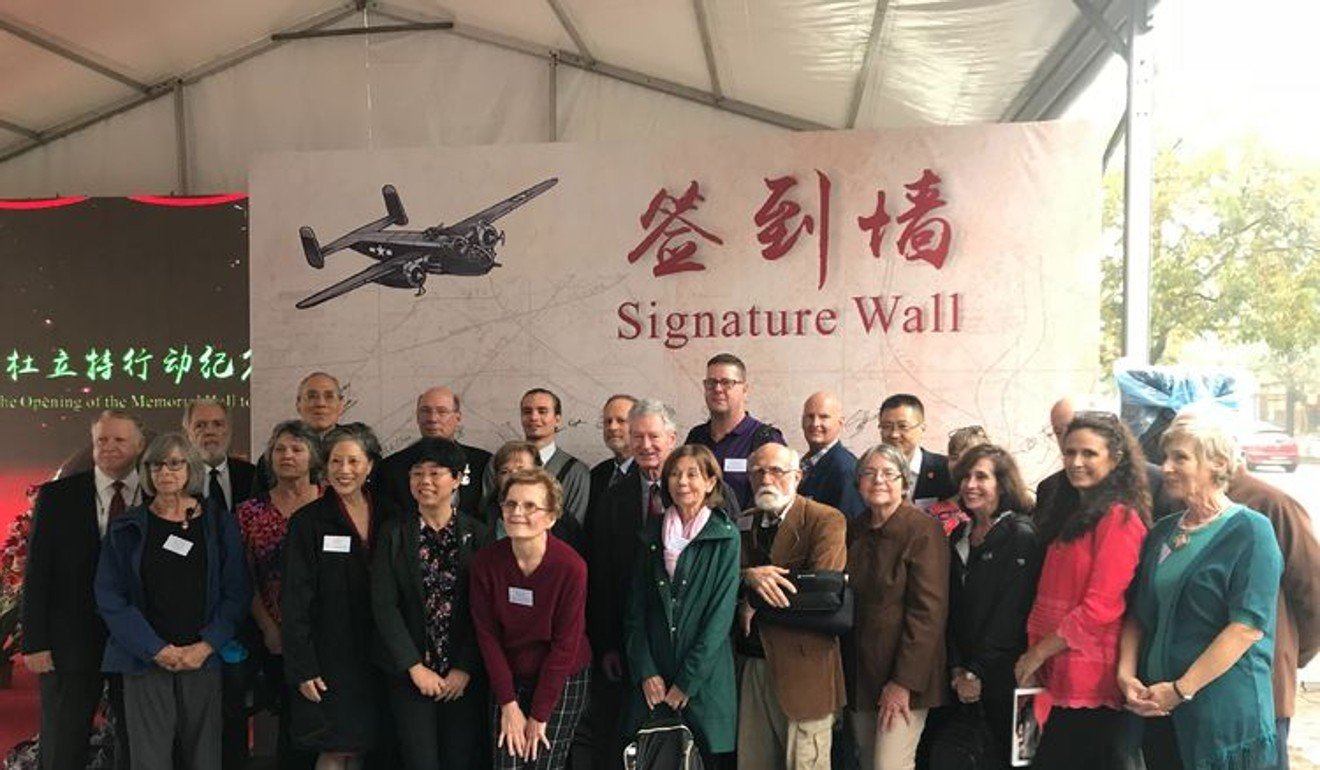
“It was very gratifying to actually see the terrain and the locations and meet people whose ancestors had protected and assisted my father. Without them, I would not be here today,” said Macia in an email interview from the United States.

Before he left Jiangxi, he wrapped some stones in part of the parachute his father used 76 years ago, and brought them back to his home in Arlington, Virginia.

“I wanted to have a piece of China that represented the area where my father was in 1942. It serves as a tangible connection with the location in China of this very historic and important event in his life, and in the memory of my family,” Macia said.
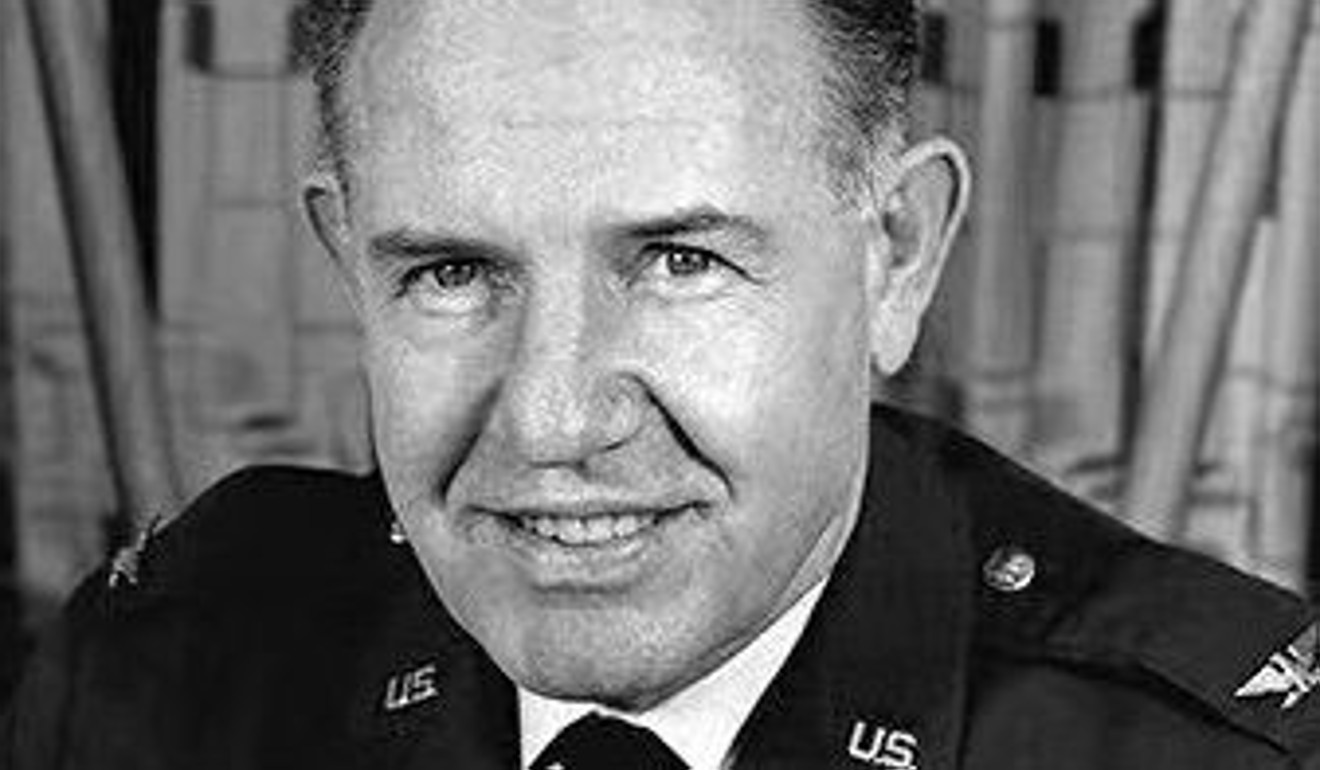
Thomas Macia is a member of Children of Doolittle Raiders, a group of families of the men who took part in the Doolittle Raid. First the men themselves, and now their families, maintained ties with China over the years, even though the Chinese and US governments had their ups and downs in official relations. For the families, the relations formed through the blood and death of their fathers should continue to be nurtured.

The Doolittle Raid involved 80 airmen aboard 16 B-25s, and 75 crash-landed or had to bail out of their planes in Jiangxi, Anhui and Zhejiang provinces, including three who were killed in action and eight captured by the Japanese troops.

Chinese civilians and soldiers helped 64 of the raiders, using stretchers, jampans, doolees, trucks and trains to move the men through war zones to safety within a month.

Over the years, some of the raiders’ children have tried to retrace their steps in China, an act that not only commemorates their fathers’ heroism, but firms their bonds into another generation. Along the way, they lighted the hearts of many Chinese who may not have known the bravery of their own fathers as unsung rescuers.

Last month a museum dedicated to the Doolittle Raid opened in a scenic spot in Quzhou, Zhejiang province. Situated in an ancient courtyard with white walls and dark cornices, the museum featured photographic introductions to each raider and exhibited 200 items from the raid, including wreckage from some of the crashed planes.

Quzhou was home to one of three airstrips the raiders planned to land on, had the operation not started hours earlier and farther from Japan than scheduled because the US Navy had been spotted by Japanese picket boats. The Chinese side was not notified of the change in plans and the airfields, where the planes were supposed to land on April 19 to refuel, were not open the night of April 18.

Short of fuel and with no response from the airfields, the raiders had to bail out or crash-land, not knowing for sure whether the area was controlled by Chinese or Japanese troops. In all, 51 raiders ended up in Quzhou before they were smuggled out to safety.

A delegation of 24 Children of Doolittle Raiders members travelled from the US to take part in the museum’s opening ceremony. Also present was a local historian from Shangrao, who later would inform Thomas Macia about the people involved in his father’s rescue.
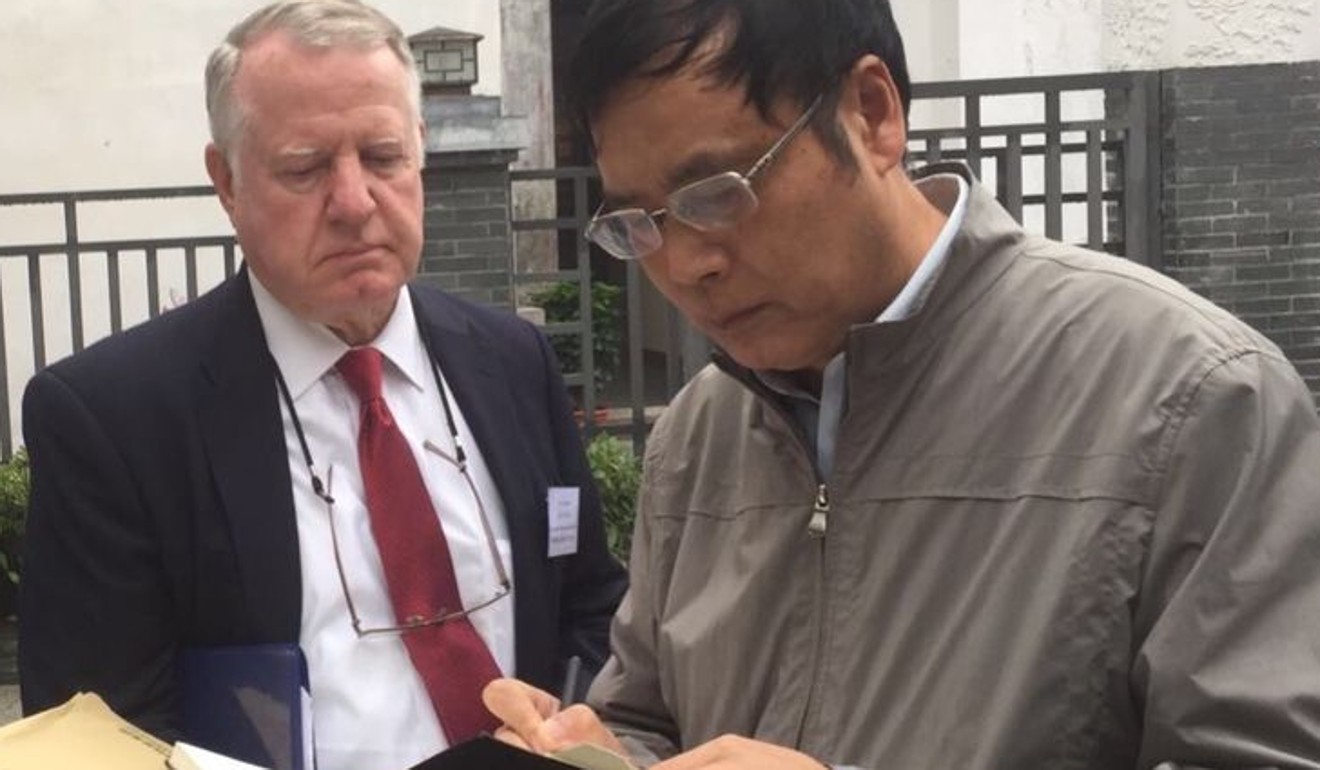
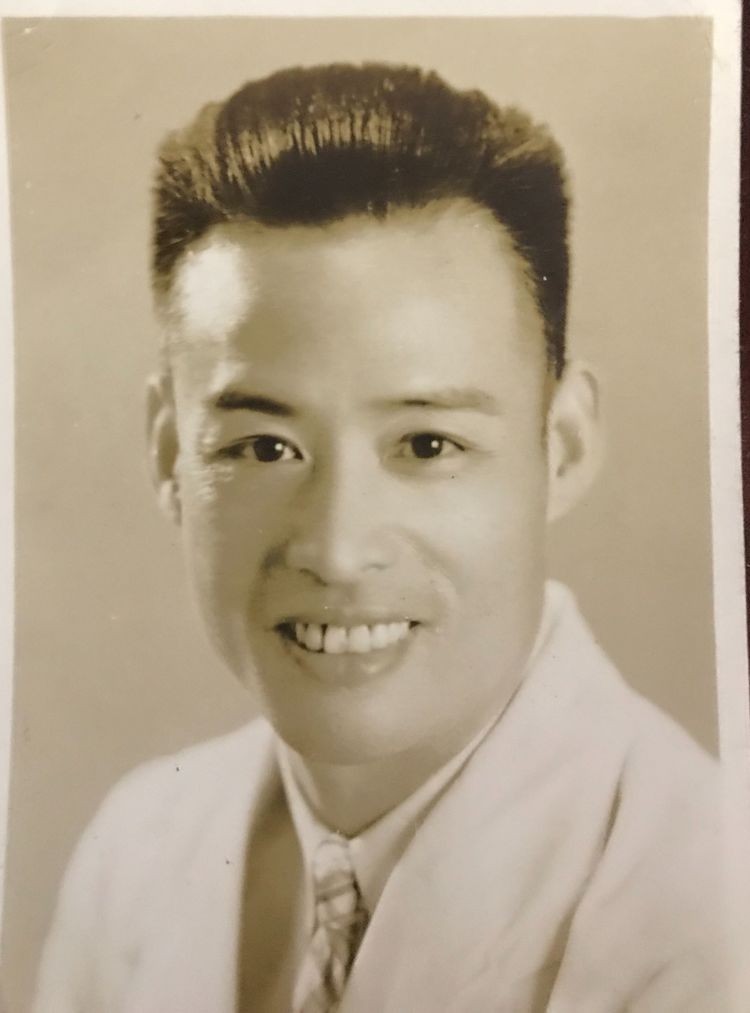
Luo Shiping, a history professor from Shangrao, Jiangxi province, saw the photo album Macia brought along and noticed a name card, which read Dr B C Chen and included an address in Shangrao.

Dr B C Chen was on the list James Macia provided to the US government of those who helped rescue him, but the identity of the man had always been unknown to the son.

With wide connections, Luo sent out a message in his circle and within hours he received word: the card belonged to Dr Chen Baocong, who had been a senior army doctor in the No 3 War Zone Hospital.

Trained in Tongji Medical School in Shanghai, Chen spoke fluent German and English. During the war, he worked as a translator in the hospital and helped treat injured pilots – four crews from Doolittle’s Raid parachuted into the Shangrao area and some had been injured, Luo said.

Chen was better known as one of the organisers of a student movement in Tianjin in 1925 and was thrown in the same prison cell with Zhou Enlai, later the first premier of the People’s Republic of China.

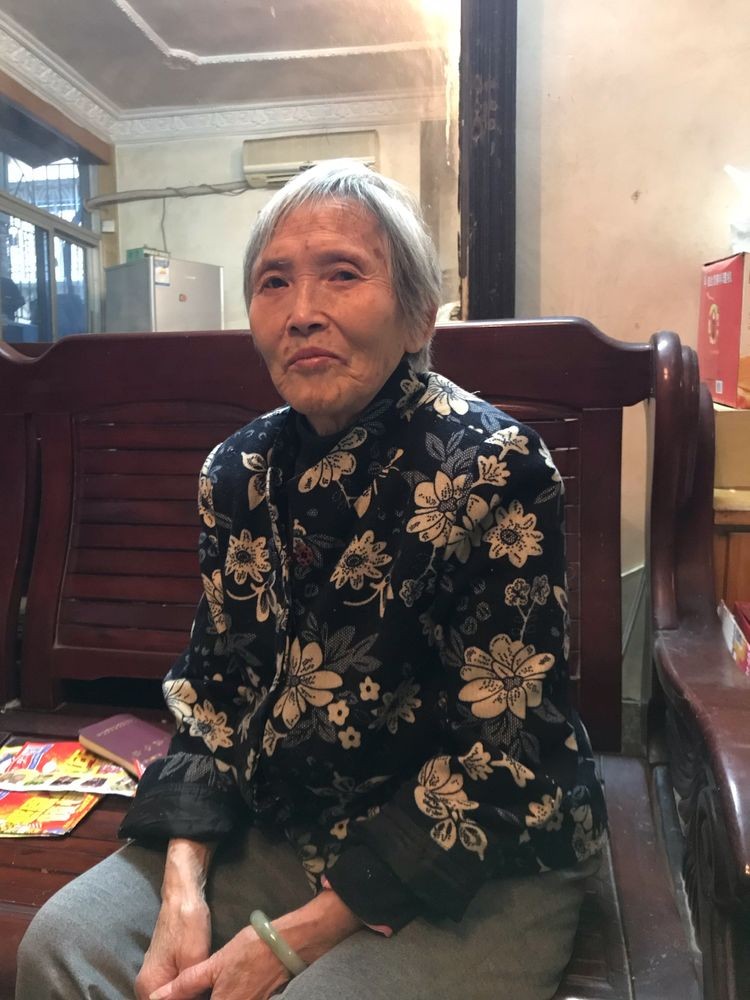
Chen Kangqian, Dr Chen’s youngest daughter, said she was only three in 1942 and had no memory of her father talking about the rescue. She remembered her father as a warm-hearted man who sometimes did not charge patients for consultation and even gave them rice instead.

“I am not surprised that he could be friends with some American airmen,” Chen, now 81, said.

Professor Luo said the tumultuous political environment surrounding the second world war, and the Chinese civil war that followed it, might have led Chen to be quiet about his experience.

Dr Chen was convicted as an anti-revolutionary and thrown into a labour camp in 1951. His wife, Kong Cangzhen, killed herself after seeing others being tortured; their eldest daughter, a first-year medical school student, killed herself a year later, in 1952.

Dr Chen had his name cleared in 1954. He continued his medical career and died in 1983, a highly esteemed doctor.
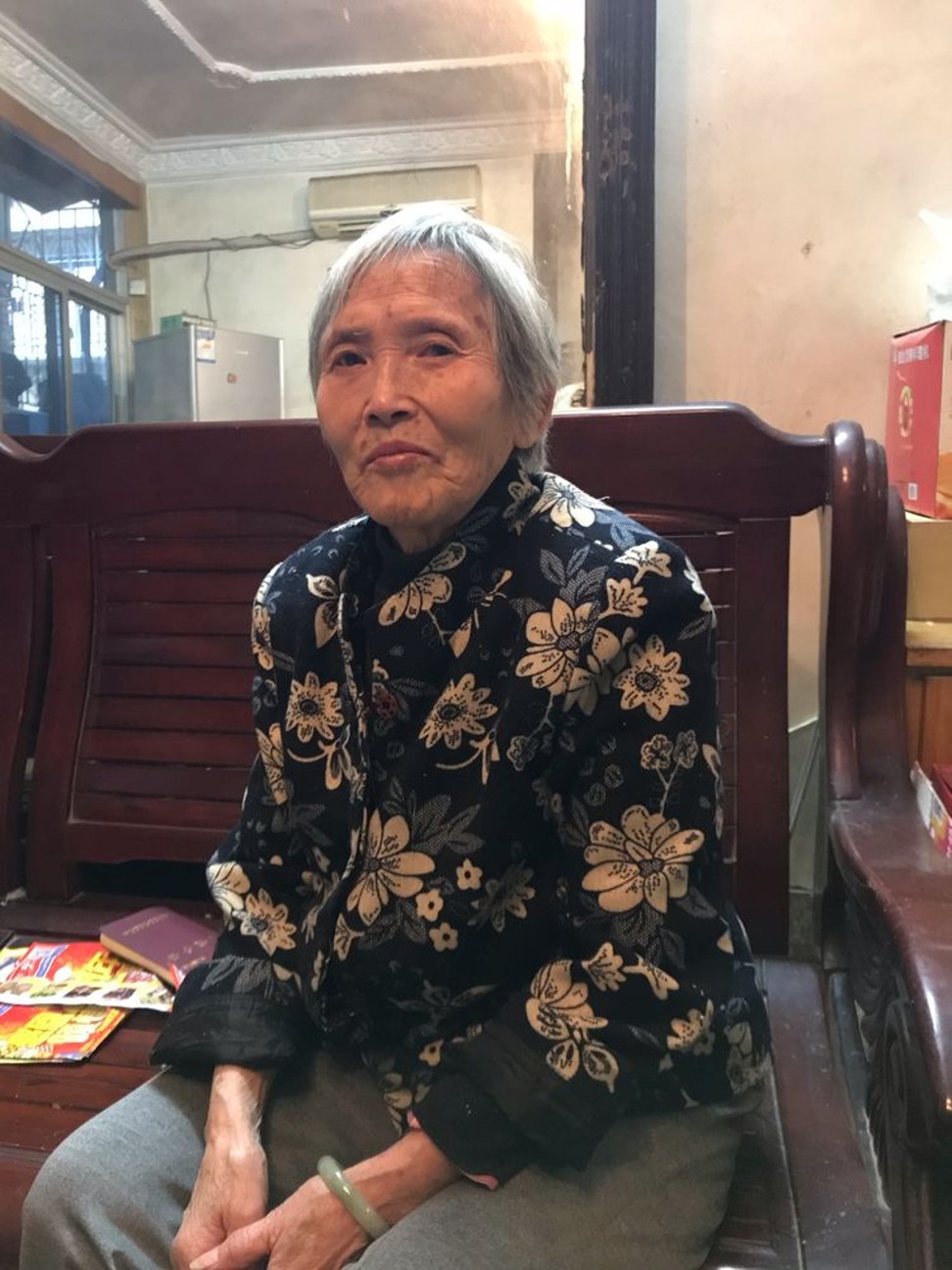
Seeing a picture of her father’s calling card, Chen Kangqian said she felt very emotional.

“If I could meet Mr Macia, I would tell him how grateful I was that the card was kept so well. I am very touched that this card has been cherished by them.”

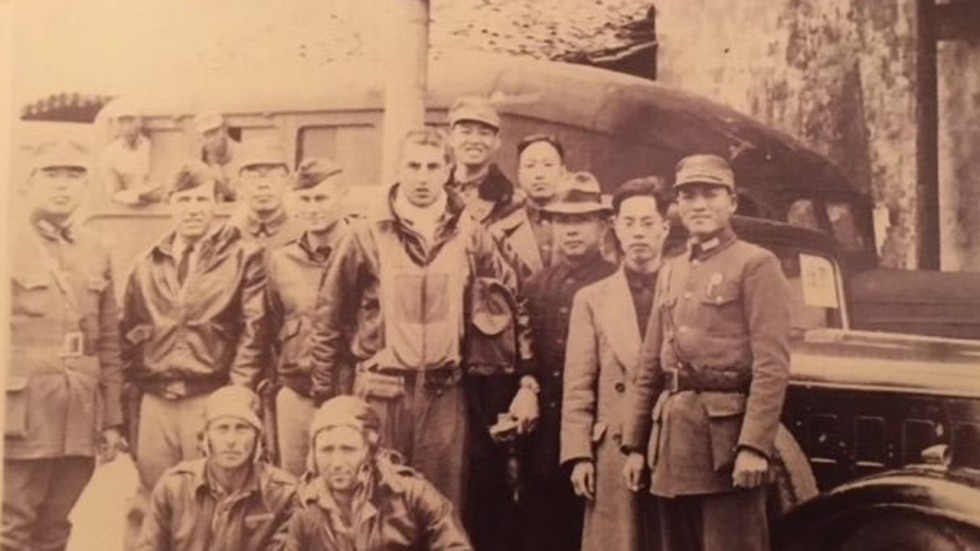
Macia, who maintained an email correspondence with Luo after returning to the United States, sent another photograph of Crew No 14 with three Chinese men before they left Guangfeng county for the No 3 War Zone Headquarters in Shangrao. He asked the professor if he could find the children of those men.

With help of local historians, Luo spent 10 days digging up local archives and was able to identify the men. Wang Fengling was an official in charge of Kuomintang (KMT) party matters; Zhang Renshi, then the Guangfeng county chief; and Zhang Mutao, then the chief of the gendarme regiment.

Wang Fengling died in 1943 and was survived by a son who is now a retired worker in Shangrao. Zhang Mutao followed the KMT to Taiwan in 1949 and died in 1985. He was survived by five children. Zhang Renshi worked in primary school education and died in 1966. Three of his four children have died; the youngest is living in the US.

“The children of the men in this photograph had little memory of their fathers – except that they recognised their father the moment they saw the picture,” Luo said. “Zhang Renshi’s daughter called me from the US and said she had never known her father was Guangfeng county chief and helped save some Americans. She felt so amazed.”

Macia, who had not expected to learn about the men in the picture his father had passed to him, said he felt very fortunate to meet Luo, and through him, the stories of these people.

“It has been very important and informative to me to understand exactly who some of those people were and their roles in saving my father,” Macia said.

China paid dearly for the rescue. Japan retaliated with massacres in at least three villages, and villagers who helped the Doolittle raiders were tortured and killed. Airfields in Zhejiang and Jiangxi endured heavy bombing and the Japanese launched a Zhejiang-Jiangxi campaign a month after the air attack, which eventually saw 250,000 people in the region killed, according to Zheng Weiyong, a historian in Quzhou and author of Fall in China – Doolittle Tokyo Raid.
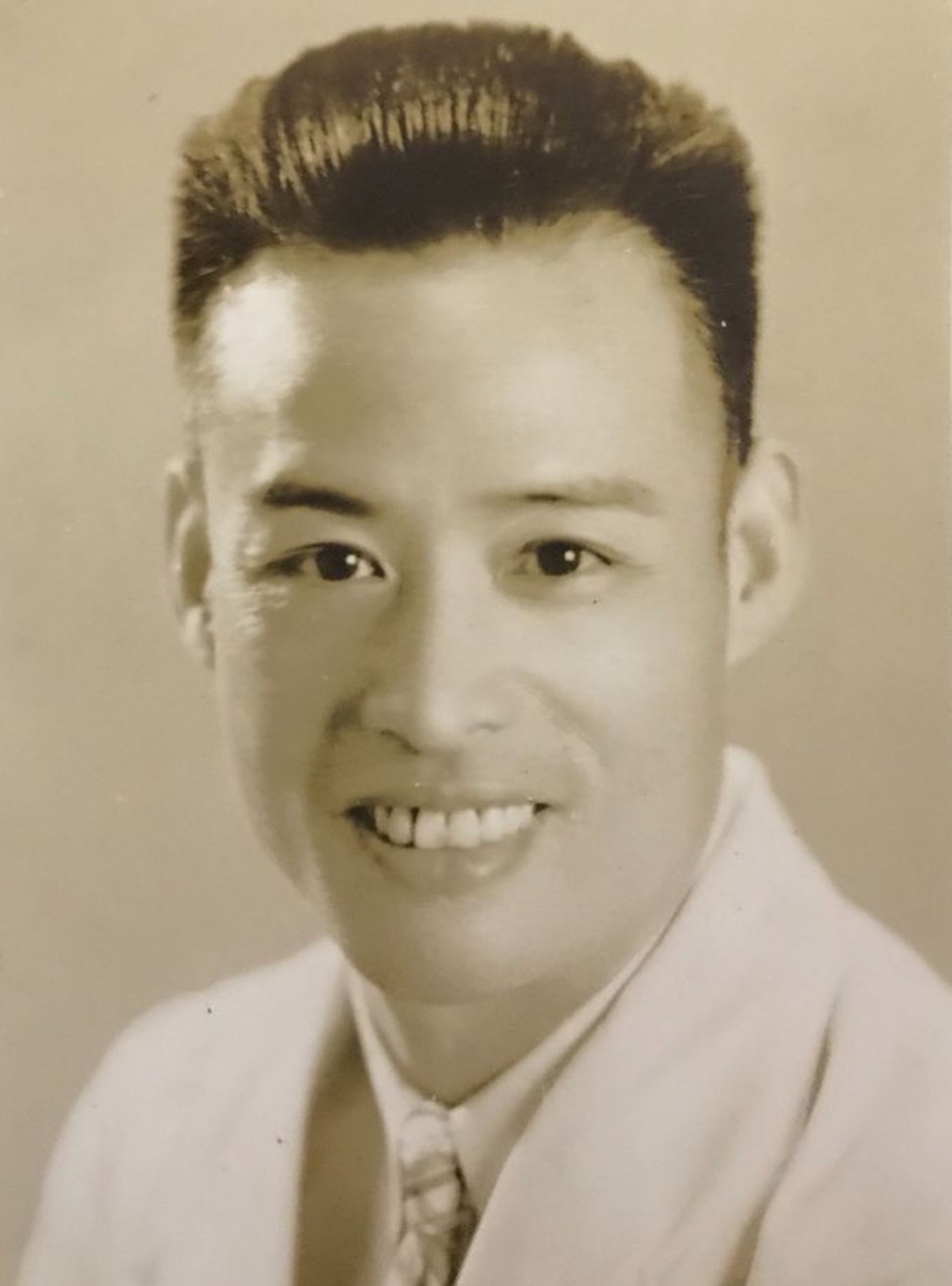
Some rescuers were officially recognised by the US government. Dr Chen Shenyan, who ran the Enze Hospital in Taizhou, Zhejiang, treated the injured airmen and escorted five of them from Taizhou all the way south to Guilin, in Guangxi, and Kunming, Yunnan province, was recommended to work as an army doctor and later invited by the US government to study medicine in the States, which he did: and Johns Hopkins and the University of Southern California.

President Harry Truman played Thirty Seconds Over Tokyo, the 1944 movie depicting the Doolittle Raid and its aftermath, for Chen; according to Zheng, his eyes brimmed with tears when he saw himself depicted in the film.

After the end of the civil war in 1949, contacts between the raiders, their families and China stopped for decades. After the US and China officially established diplomatic ties in 1979, though, contact resumed when John Hilger, the pilot of Crew 14, sent a letter in 1987 to the Shaorang government to express gratitude. Henry Potter, the navigator from crew 1, revisited crash sites in Jiangxi and Zhejiang provinces in 1990 and met Dr Chen Shenyan again.

Over the years since, several raiders and their families have come to China, and some of their rescuers have visited the US.

In 2015 Jeff Thatcher, son of David Thatcher, engineer and gunner of Crew No 7, attended the grand military parade in Beijing commemorating the 70th anniversary of victory over Japan in the second world war.
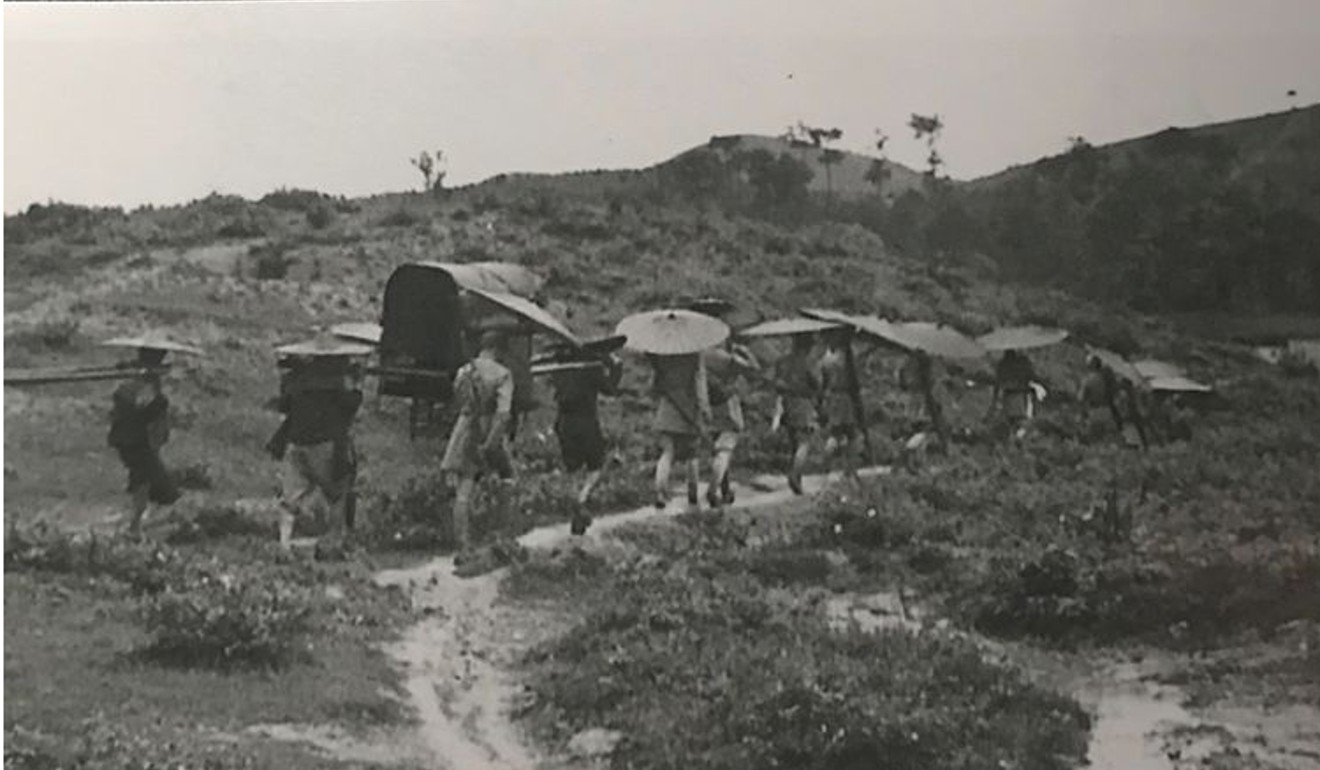
Before attending the parade, Jeff Thatcher interviewed his father about his experience in China. David Thatcher recalled that they had been “treated like royalty”.

Plane 7, nicknamed the Ruptured Duck, crash-landed off Zhejiang province’s Nantian Island and all five crew members were injured, including two seriously. They were found by fishermen who would escort them in doolees to Sanmen and, later, Enze Hospital in Taizhou. The crew eventually travelled more than a month before reaching Guilin, Guangxi.

“They did not have anything, but they gave us all they had,” Thatcher recounted his father as saying. “We played a game of basketball with the Chinese one day. They had never played basketball before.”

After the parade, Jeff Thatcher travelled to Ningbo, Zhejiang province, with two Children of Doolittle Raiders to follow the route his father trekked more than seven decades earlier, from the beach where they landed through stops in Sanmen county, Linhai city and then Quzhou. It was an emotional experience.

“My epiphany occurred the morning I was standing on the beach on Nantian Island close to where my father’s plane had crash-landed. Like the waves crashing in from the South China Sea, I was suddenly overcome by emotion and touched deeply by the scene,” Thatcher said.

“I feel a kinship and a huge debt of gratitude to the Chinese people. If they had not rescued my father and the other members of his crew, I doubt that they would have avoided capture by Japanese troops.”

Three of the airmen captured by the Japanese were executed. Five others were sentenced to life in prison, one of whom died in prison, and the remaining four eventually were rescued in 1945.

On Thatcher’s way from the beach to the village above, where his father’s crew spent the night in a hut, an elderly woman came to him and gave him a metal fire suppression rod. It was made from the engine of the Ruptured Duck that her husband found on the beach after the crash.

Thatcher called his father and told him about the visit to the beach that morning.

“Even though we were half a world apart, I could feel his emotion through the phone,” Thatcher said. David Thatcher died a year later at age 94.

That trip prompted an idea between the raiders’ children and the local historians, to build a museum and start a scholarship at a local school. Thatcher wrote to Quzhou municipal officials to consider building a Doolittle Raid Memorial Hall and the project was agreed.

For the past two years pupils of Quzhou No 2 Middle School wrote essays in English about the Doolittle Raid’s impact on China and three recipients were to receive certificate and a cash prize in US dollars. This year all 12 shortlisted received the prize because the essays were all “creative and well-written”.

Thatcher was proud of the two projects because they brought “new chapters in the history of the Doolittle Raid in China”.

“Both of these endeavours represent cooperative efforts on the parts of our two countries to engender the spirit of friendship and gratitude that began when the Doolittle Raiders bombed Japan on April 18, 1942,” he said.

The historians regarded their dives into the archives and the sharing of memories beyond a quest for the past. Their efforts serve as a lesson for the future, especially when the two countries are sliding into a trade war.

Zheng said that the Doolittle Raiders museum reminded people of both countries that the special friendship was formed during a cruel war and that friendly ties must be nurtured.

“The American friends are grateful for the Chinese who helped them and we wanted to maintain the friendship, too. We should remember the lesson of war, not to repeat it and to let future generations continue to keep the friendly relations,” he said.

14/12/2018

China buys US soybeans for first time since trade war

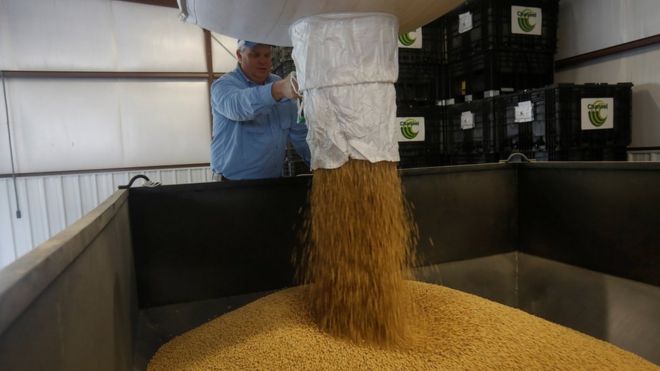
Soybeans coming thru siloImage copyrightREUTERS
Image captionChina’s purchase of 1.13 million tonnes of US soybeans has been hailed as a wonderful, great step by US officials.

China has bought US soybeans for the first time since the trade war between the two countries started in July – a move hailed as a “great step” by US officials.

One of the biggest casualties of the US-China trade war has been the US soybean sector.

China is by far the world’s biggest importer of soybeans.

And Beijing’s high tariffs placed on US soybeans this year has been severely hurting US farmers.

A trade truce between China and the US was reached earlier this month however, and there had been much anticipation that China would soon return to the US soybean market.

But while China’s purchase of 1.13 million tonnes of US soybeans on Thursday was met with much applause from some, others said the purchase was too small, and not a sign that the trade war was cooling.

“Having a million, million-and-a-half tonnes is great, it’s wonderful, it’s a great step,” said Steve Censky deputy secretary of the US Department of Agriculture.

“But there needs to be a lot more as well, especially if you consider it in a normal, typical year, we’ll be selling 30 to 35 million metric tonnes to China.”

The sale also failed to excite traders, who said the numbers fell short of estimates, which saw a sell-off in soybean futures.

“It’s a start, but it’s not nearly enough to fix our problems in regards to soybeans and a soybean oversupply in this country,” said Joe Vaclavik, president of Standard Grain, a Tennessee-based brokerage.

Why do soybeans matter?

In 2017, soybeans were the single biggest US agricultural export to China, which accounts for some 60% of the global trade in the commodity.

And soybeans are vitally important to China because they use the product to feed livestock.

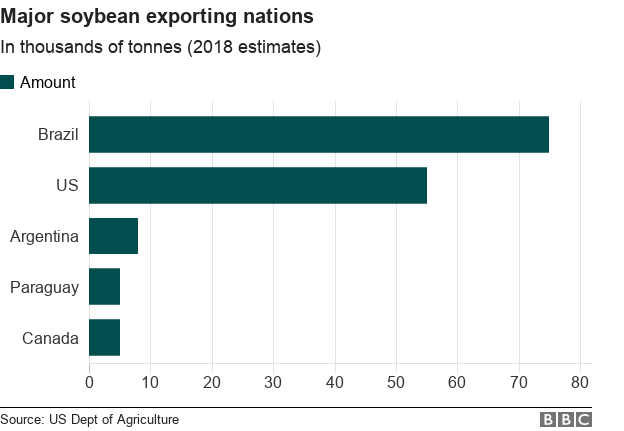
The key supplier globally is Brazil, but China has also relied heavily on the US for soybeans supplies – in part due to seasonality.

Bar chart for major soybean exporters

Chief economist Robert Carnell from ING Bank told the BBC that China’s purchase on Thursday was more about convenience than anything else.

“The simple fact is China needs a lot of soybeans and it’s been buying them from Brazil, not the US,” he said.

“But Brazil could never supply all the soybeans China needed, so ultimately [China has] been driven back to US soybeans. And I think it’s just convenient for them to do that right now.”

Mr Carnell said that the recent arrest of Meng Wanzhou, Huawei’s chief financial officer and deputy chair, was far more indicative of where the trade war between the US and China was really up to.

“[It’s] a battle for technology, a battle for 5G,” he said. “In particular, Huawei has become one of the world’s biggest suppliers of telecoms technology – and the US doesn’t really like that.

“[So that arrest] is giving you a much better, a much clearer message on where the trade war lines in the sand are really being drawn.”

14/12/2018

Lowest retail sales growth for 15 years dash China’s hopes that consumption will offset trade war

Beijing had high hopes that tax cuts for individuals would lift consumer spending and boost an economy which is showing the effects of the trade war, but overall retail sales in November proved disappointing.

Even record spend on Singles’ Day’ on November 11 could not prevent retail sales from posting their weakest growth rate in 15 years.

November’s retail sales, which covers both corporate and consumer spending, stood at 3.52 trillion yuan, down from 3.55 trillion yuan in October, according to data released by the National Bureau of Statistics on Friday.

The growth rate fell to 8.1 per cent compared to November 2017, below the 8.6 per cent rate in October. The figure was also below the 8.8 per cent growth forecast by a Bloomberg poll of economists. Adjusted for inflation, the growth was even lower, at 5.8 per cent.

As the US-China trade war continues to weigh on exports, Beijing is counting on households and companies to spend more to stabilise growth.

However, weak consumption underscores the difficulties the Chinese leadership is having in its efforts to keep the economy stable.

The government expected that its October move to raising the threshold for taxable personal income to 5,000 yuan per month would release unlock spending power equivalent to hundreds of billions of yuan.

It appears likely that some consumers saved their extra income for the November 11 shopping festival, when they can benefit from large discounts.

Shen Li, a physical therapist from Beijing, said his monthly after-tax income increased by 1,000 yuan due to the tax cut, which he used to purchase items such as household appliances on Singles’ Day.

Singles’ Day, China’s version of the US’ Black Friday, is often seen as a gauge of Chinese consumers’ spending power, but in the past it has not been able to drive up total retail sales figures.

This year’s Singles’ Day sales across Alibaba’s e-commerce platforms totalled US$30.8 billion, dwarfing the online sale numbers for Black Friday and Cyber Monday combined. But the growth rate of total transactions fell to 27 per cent, from last year’s 39 per cent.

The late October launch of Apple’s new iPhone XR, which is cheaper than the earlier iPhone XS series, did not boost telecom sales in China, which dropped 5.9 per cent in November year on year, to 48.5 billion yuan.

However, a plunge in car sales was the main culprit for weak consumption. Auto sales were down 10 per cent on a year earlier, to 345.9 billion yuan, according to the statistics bureau figures, as auto dealers struggled to clear their inventories.

This matched industry surveys from the China Passenger Car Association (CPCA), which reported this week that retail sales of sedans, multi-purpose vehicles and sport utility vehicles plunged 18 per cent to 2.05 million units last month, which makes a full-year decline very likely in the world’s largest auto markets.

Ding Shuang, chief China economist from Standard Chartered Bank, said weak auto sales were caused by the expiration of tax rebates for smaller cars, a slowdown in consumer loans partly due to the crackdown in online peer-to-peer lending platforms, and subdued property investment, since new homes are often sold together with garages.

Local commentators worried about ‘downgrading’ of consumption in 2018 as spending on premium goods slowed.

The growth of real estate investment from January to November remained stable at the 9.7 per cent rate seen in the January to October period.

“The decline of consumers’ abilities and willingness to spend is going to first cut down on big ticket items like cars,” said Jiang Chao, chief economist from Haitong Securities. “Auto accounts for two-thirds of China’s consumption of consumer durables.”

Rising household debt has given Chinese policymakers few options to boost spending other than cutting taxes. China’s household debt-to-GDP rose to 49.3 per cent in the first quarter, which was lower than in advanced economies but higher than the average 40 per cent among emerging economies, according to the Bank of International Settlements.

“Household debt will continue to rise and so debt service costs will remain a drag on consumption. But the debt service burden on households should not get much worse unless there is a big acceleration in credit growth (which we do not expect),” Ernan Cui, an analyst from research firm Gavekal Dragonomics, wrote in a report.

“Local commentators worried about ‘downgrading’ of consumption in 2018 as spending on premium goods slowed,” Cui said. “The biggest boom in products favoured by affluent households is probably over, but consumption upgrading will continue as long as income growth does.”

NBS spokesman Mao Shengyong said at a press conference on Friday that China still had the potential to maintain a stable and fast rate of consumption growth next year, given the rise in the number of middle class citizens.

Economists are eyeing new individual tax deductions that will go into effect next year and more tax relief for private companies to prevent the economy from slowing further.

A more complex tax deduction policy which takes in six types of expenses – from elderly care to medical costs- could inject an additional 80 billion yuan in consumers spend, according to Cui’s estimate.

Beijing has also indicated that it will tighten the collection of social insurance contributions that employers are required to pay, but analysts fear that this could negate the benefits of the tax deductions for employees.

14/12/2018

Sino-US trade talks advance amid close contact: Ministry of Commerce

BEIJING, Dec. 13 (Xinhua) — China and the United States are advancing their trade talks with close communication on details, the Ministry of Commerce (MOC) said Thursday.

“The Chinese side welcomes the U.S. team to visit China for consultation and is open to visiting the U.S. for communication,” MOC spokesperson Gao Feng told a news conference.

Gao said the two countries had reached consensus on specific issues including agricultural products, energy and automobiles. “Soybean has always been an important kind of agricultural import from the U.S. given the huge demand in China.”

Gao said more details of the trade talks would be released.

Chinese Vice Premier Liu He, who currently heads the China-U.S. trade talks, spoke with U.S. officials on Tuesday, and the two sides exchanged views on implementing the consensus reached by the heads of state of the two countries and on the timetable and roadmap to push forward the trade talks.

13/12/2018

China to ‘cut US car tariff to 15%’

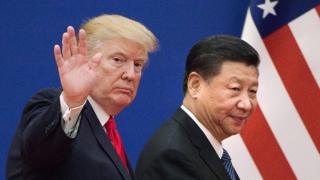
This file picture taken on November 9, 2017, shows US President Donald Trump (L) and China"s President Xi Jinping leaving a business leaders event at the Great Hall of the People in BeijingImage copyrightAFP/GETTY
Image captionUS President Donald Trump says he has a good relationship with President Xi Jinping

China has reportedly proposed cutting tariffs on US-made cars to 15%, the same tax levied on car imports from other countries.

Bloomberg reported that China’s cabinet will review the plans, which would undo the 40% import duty China imposed on US cars this summer.

The proposal, the timing of which remains uncertain, comes as the two countries restart trade talks.

President Donald Trump said earlier this month China would cut the tariffs.

However the claim has not yet been confirmed by Chinese officials, sowing confusion.

Tuesday’s reports in US media, which were based on anonymous sources including a car industry executive, said China outlined the plan on a recent telephone call between top trade negotiators from the two countries.

Bloomberg, which cited “people familiar with the matter”, said the step was not finalised and could still change.

The office of the US Trade Representative, which is leading the discussions, did not respond to a BBC request for comment.

In a tweet, Mr Trump said the two sides were having “very productive conversations”.

China’s commerce ministry confirmed that the two sides had spoken. In a statement it said the conversation concerned “pushing forward the timetable and road map for the next stage of economic and trade consultations work.”

Shares in car companies, including BMW, rose on the reports.

Image captionTesla, a US electric car-maker, has said its sales have been hurt by Chinese tariffs

Argentina meeting

The back-and-forth is the latest in a trade tow triggered by US claims that China engages in “unfair” trade practices, such as theft of intellectual property.

The dispute has prompted the US and China to impose new tariffs on billions of dollars worth of annual trade this year, measures that have contributed to economic worries in both countries.

The two sides, led by Mr Trump and President Xi Jinping, recently met in Argentina, where they agreed to a 90-day halt to any new tariffs.

Image captionMr Trump (front right) met Mr Xi (front left) after the G20 summit in Buenos Aires

US officials later said they wanted to see China move to reduce the car tariffs “immediately” as a sign that negotiations would proceed in good faith.

Analysts remain sceptical that the two sides will be able to reach a resolution of the underlying issues by 1 March.

Those doubts increased after the recent arrest of a high-ranking Huawei official in Canada at the request of the US, which worsened relations between the two countries.

Deja vu?

White House officials have maintained that the two matters are separate, but apparent agreements have faltered before.

In May, after talks in Washington, the US agreed to hold off on tariff threats, while China said it would reduce the import duty on foreign cars from 25% to 15%.

However that deal fell apart within weeks, after Mr Trump decided to move ahead with tariffs.

In retaliation, China raised the duty on US car imports to 40%, though it proceeded with the lower rate on imports from other countries.

13/12/2018

Can South China Sea conflict between Washington and Beijing be avoided?

This story is part of an ongoing series on US-China relations produced jointly by theSouth China Morning Post and POLITICO, with reporting from Asia and the United States.

Rising tensions over Beijing’s accelerating military build-up in the South China Sea are stoking fears of a major-power clash between China and the United States – fuelling urgent calls for new security talks before the two nations stumble into a shooting war.

But the worries come amid a dearth of official dialogue between two of the world’s largest militaries, and as US leaders espouse an increasingly harder line against China’s actions.

The US and its allies have stepped up naval and air patrols over the sea and cancelled joint exercises with Beijing, while China is considering requiring all aircraft flying over the area to first identify themselves – a step that many nations would consider threatening.

Military experts say the showdown could easily spin out of control.

“Chinese colleagues have said to me explicitly that if the US continues to sail through and overfly what they see as their waters, China will eventually shoot down the offending aircraft,” said Matthew Kroenig, a former CIA analyst and Pentagon strategist.

“Maybe that’s just a bluff, but if China shot down a US plane, that would be a scenario ripe for escalation. It’s hard to see President Trump or any other US leader backing down from that.”

US military leaders insist they’re determined to avoid that. Navy Admiral Phil Davidson, the US commander of the Indo-Pacific Command, told POLITICO he’s eager to open a new dialogue with his Chinese counterparts, contending that “a military-to-military relationship is quite important.”

“I have yet to meet the [chief of defence] or the minister of defence in China,” he said. “I hope to visit early next year.”

Marine General Joseph Dunford, the chairman of the US Joint Chiefs of Staff, says establishing more channels for the militaries to avoid conflict is one of his top priorities as Washington and Beijing also tussle over issues such as trade and North Korea’s nuclear program. “Competition does not necessarily lead to conflict,” he said at a recent security forum in Canada.

On the other hand, the US is trying to send Chinese leaders a pointed message by sending an increased number of military patrols through the disputed waters, Dunford said in an interview with POLITICO.

“What we are doing is preserving the principle of open access to the global commons,” Dunford said. And he said nations “violating international norms, standards and the law” should know they are “going to pay a cost that is higher than whatever they hope to gain.”

Similarly, Beijing’s leaders are not backing down from their military expansion in the vast South China Sea, which stretches more than 1.3 million square miles with trillions of dollars worth of trade transiting annually. Those waters near the Spratly Islands chain where China seized reefs and began building artificial islands during the second term of the Obama administration.

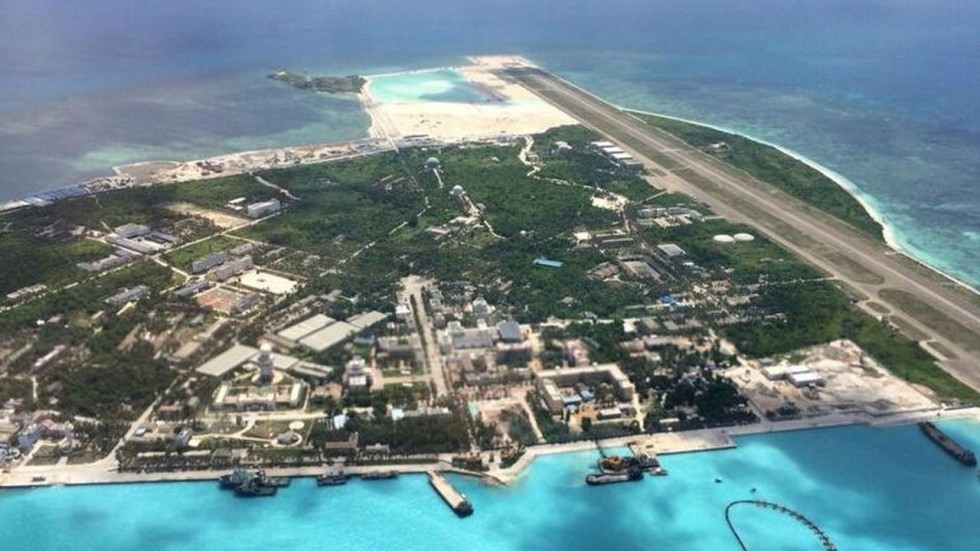
Despite public assurances from President Xi Jinping that the features would not be militarised, China recently deployed surface-to-air missiles and other weapons and equipment. Earlier this year, satellite images showed that Beijing has built at least four airstrips suitable for military aircraft on Woody Island, as well as the reefs in the archipelago known as Fiery Cross, Mischief and Subi.

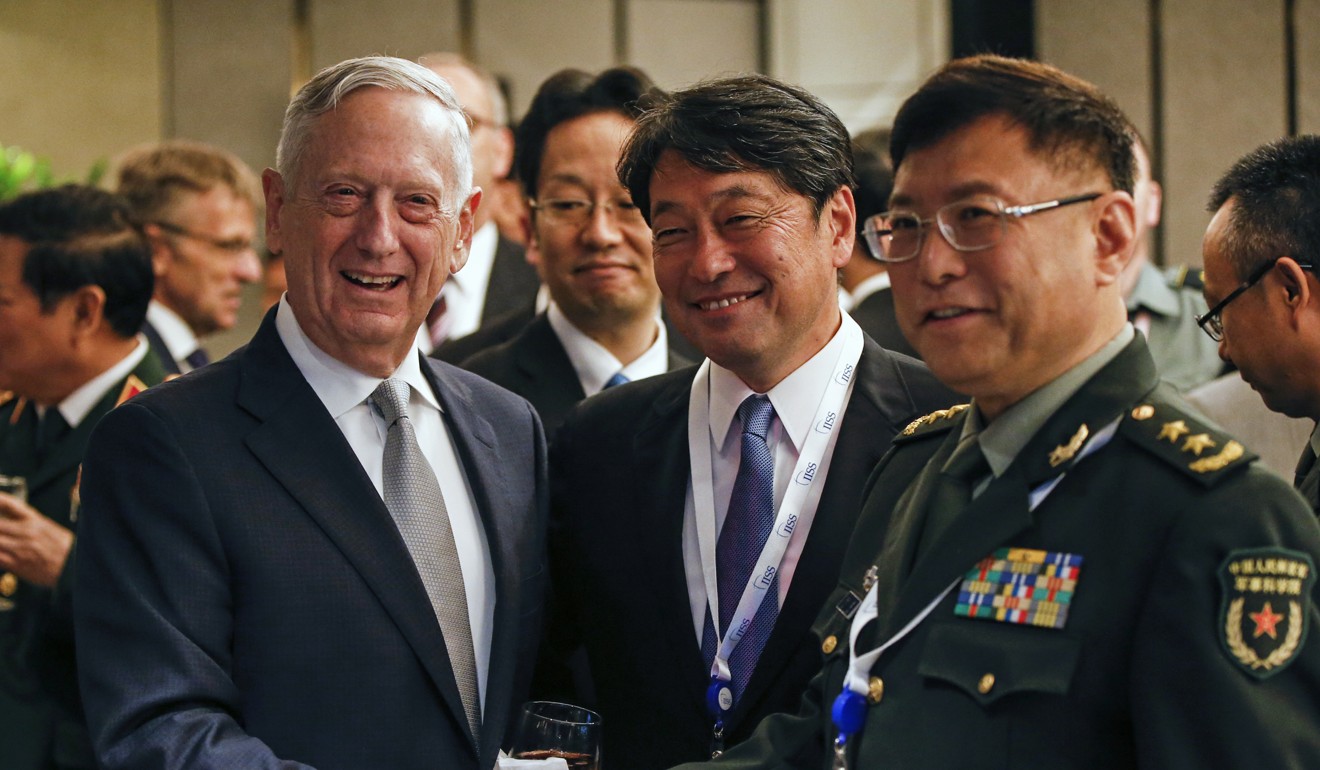
China has telegraphed steps to further solidify its claims in the waters. In June, Chinese Lieutenant General He Lei acknowledged during the Shangri-La defence summit in Singapore that China is deploying troops and weapons on both natural and man-made islands in the Paracel and Spratly archipelagos.

Chinese military sources from a state-owned firm specialising in radar systems to detect stealth aircraft for the PLA said the People’s Liberation Army’s Air Force and Strategic Support Force have also placed sophisticated radar systems in the South China Sea.

“Since the US has kept sending spy aircraft to do the close-in reconnaissance activities near China’s territory waters in the South China Sea, it’s necessary to deploy a sophisticated radar system to the artificial islands to detect the US aircraft,” one of the sources from the firm said.

Lieutenant General He Lei, who led the Chinese military delegation to the Shanghai-La Dialogue, said that “deploying troops and weapons on islands in the South China Sea is within China’s sovereign right to do and allowed by international law.”

The US and other countries have condemned the expansion as a violation of international law. And, in recent months, top American military officials have dropped some of their usual diplomatic language.

US Defence Secretary James Mattis revoked China’s invitation to participate in an annual military exercise this fall, then cancelled a trip to Beijing planned for October.

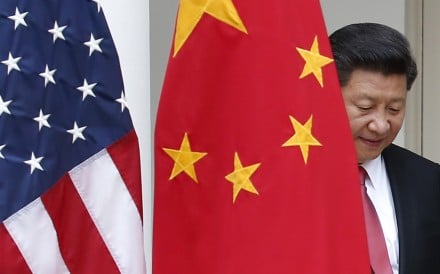
“If you’d asked me two months ago, I’d have said we are still attempting to maintain a cooperative stance,” the retired four-star general said at the Shangri-La summit. “But then you look at what President Xi said in the Rose Garden of the White House in 2015, that they would not militarise the Spratlys, and then we watched what happened four weeks ago, it was time to say there’s a consequence to this.”

During his trip to Vietnam in October, Mattis said Washington was highly concerned about China’s “predatory” behaviour and militarisation of the South China Sea.

“We remain highly concerned with the continued militarisation of features in the South China Sea,” he said, saying that this continued to happen despite a pledge by President Xi Jinping not to do so.

Davidson, the top American commander in the Asia-Pacific, expressed alarm recently at China’s “secretly deployed anti-ship missiles, electronic jammers and surface-to-air missiles.”

“So what was a great wall of sand just three years ago,” Davidson added, “is now a great wall of SAMs in the South China Sea, giving [the People’s Republic of China] the potential to exert national control over international waters in the South China Sea.”

The US and its allies have also launched “freedom of navigation” operations in the region. In September, two pairs of US Air Force B-52 bombers flew over the disputed area – one pair over the South China Sea and one over the East China Sea. A week later, the destroyer USS Decatur came within 12 nautical miles of two of the disputed reefs, prompting manoeuvres by a Chinese destroyer that the Pentagon called “unsafe” and “unprofessional.”

Australia, Japan, France, Canada and New Zealand are among the allies taking part in the patrols.

But the growing prominence of those other military forces has caused China to “push back more, and that heightens the risk that you could have an inadvertent crisis,” said Lindsey Ford of the Asia Society, who is also a former senior adviser to the US assistant secretary of Defence for Asian and Pacific security affairs.

China’s interest is not simply to exert political or economic influence in the region, said Kroenig, the former CIA analyst. Its activities are also defensive in nature, he believes.

China, like the Soviet Union during the cold war, is not confident that its nuclear ballistic missile submarines could survive in the open ocean during a conflict with the United States, he said – because waters closer to Chinese territory are too shallow. So it hopes to use the South China Sea as an operating area for its subs.

“That’s a strategic military purpose on top of the political purpose,” said Kroenig. “I’ve had a Chinese colleague say to me: ‘You guys don’t really care about these territorial claims in the South China Sea. You’re trying to deny our nuclear deterrent.’”

Now, Chinese military experts say, Beijing is considering establishing an “air defence identification zone”, which would require all aircraft over the area to declare their identity and destination.

The rationale is ostensibly peaceful in nature: Chinese officials maintain it would help prevent disasters such as the 2014 disappearance of Malaysia Airlines flight MH370.

But a zone Beijing established in the East China Sea in 2013 drew a joint rebuke from Japan and the Association of Southeast Asian Nations, which considered it threatening.

The resistance from other nations “implied that such a move constituted a security challenge”, said Collin Koh Swee Lean, an analyst at the S. Rajaratnam School of International Studies in Singapore.

Koh warned that the air traffic proposal could derail regional talks about establishing a code of conduct to avoid confrontations in the area. He also predicted that the US might feel compelled to ramp up its military presence in response – a view echoed by Zhou Chenming, a military expert based in Beijing.

Further fuelling tensions in the South China Sea is the growing role of China’s so-called Maritime Militia, a naval paramilitary force that operates disguised as fishing or other civilian vessels. Vice-President Mike Pence recently criticised the forces as extra-legal, and the rules for approaching them are ill-defined.

“Should we treat them as military vessels and expect them to behave that way?” asked the Asia Society’s Ford. “China is exploiting a loophole. Pence’s recent remarks calling out the Maritime Militia explicitly suggest the US is refining its thinking about how to approach that loophole.”

For now, senior American military leaders are expressing confidence that US forces can continue to aggressively promote their freedom of navigation mission without sparking a violent confrontation.

“I think one of the unfortunate things is the focus on two destroyers passing in the daylight,” Davidson told POLITICO. “That is not what the issue is about in the South China Sea. It is about trade, commerce, financial markets moving their information around the globe – every airline that flies over the top.”

Others worry that the longer the United States and China up the ante the more likely things could spin out of control.

Law of Unintended Consequences

continuously updated blog about China & India

ChiaHou's Book Reviews

continuously updated blog about China & India

What's wrong with the world; and its economy

continuously updated blog about China & India