Chindia Alert: You’ll be Living in their World Very Soon
aims to alert you to the threats and opportunities that China and India present. China and India require serious attention; case of ‘hidden dragon and crouching tiger’.
Without this attention, governments, businesses and, indeed, individuals may find themselves at a great disadvantage sooner rather than later.
The POSTs (front webpages) are mainly 'cuttings' from reliable sources, updated continuously.
The PAGEs (see Tabs, above) attempt to make the information more meaningful by putting some structure to the information we have researched and assembled since 2006.
NEW YORK (Reuters) – A senior U.S. intelligence official said on Tuesday that Chinese cyber activity in the United States had risen in recent months, targeting critical infrastructure in what may be attempts to lay the groundwork for future disruptive attacks.
“You worry they are prepositioning against critical infrastructure and trying to be able to do the types of disruptive operations that would be the most concern,” National Security Agency official Rob Joyce said at a Wall Street Journal cybersecurity conference.
Joyce, a former White House cyber adviser for President Donald Trump, did not elaborate. A spokeswoman for the NSA said Joyce was referring to digital attacks against the U.S. energy, financial, transportation and healthcare sectors.
The comments are notable because U.S. complaints about Chinese hacking have to date focussed on espionage and intellectual property theft, not efforts to disrupt critical infrastructure.
China has repeatedly denied U.S. allegations it conducts cyber attacks.
Joyce’s remarks coincide with U.S. prosecutors preparing to unveil as early as this week a new round of criminal hacking charges against Chinese nationals. They are expected to charge that Chinese hackers were involved in a cyber espionage operation known as “Cloudhopper” targeting technology service providers and their customers, according to people familiar with the matter.
The U.S. Congress is looking into the allegations of increased Chinese hacking activity.
Senior officials from the Department of Homeland Security and Justice Department are scheduled to testify Wednesday morning at a Senate Judiciary Committee hearing on “China’s Non-Traditional Espionage Against the United States: The Threat and Potential Policy Responses.”
NEW YORK/HONG KONG (Reuters) – China-based music streaming company Tencent Music Entertainment Group (TME.N) said it raised close to $1.1 billion in its U.S. initial public offering (IPO) after pricing its shares at the bottom of its targeted range.
The music arm of gaming and social network giant Tencent Holdings Ltd (0700.HK) priced its American Depositary Receipts (ADRs) at $13 per share, at the low end of its indicated $13 to $15 per share range, it said in a filing with the Hong Kong stock exchange.
The IPO values Tencent Music at $21.3 billion and shows how companies are defying a bout of market volatility with flotations.
Tencent Music sold 41 million ADRs, while existing shareholders sold a further 40.9 million, the filing said.
Tencent Music’s IPO tops off a bumper year for U.S. listings by Chinese companies, with $7.9 billion raised before Tencent Music’s debut, Refinitiv data showed.
That is the highest amount since 2014, the year of Alibaba Group Holding Ltd’s (BABA.N) record $25 billion IPO.
Tencent Music’s U.S. IPO is the fourth largest among Chinese firms this year by deal value. Video streaming company iQiyi Inc (IQ.O) leads with its $2.4 billion listing, followed by online group discounter Pinduoduo Inc (PDD.O) at $1.6 billion and electric vehicle maker NIO Inc (NIO.N) at $1.15 billion.
Returns for investors have been mixed, with the 31 Chinese IPOs in 2018 down an average of around 11 percent as of Dec. 10, according to data provider Dealogic.
With streaming apps QQ Music, KuGou, Kuwo as well as karaoke app We Sing, Tencent Music is China’s largest online music platform boasting more than 800 million active users monthly.The firm is often compared with Spotify Technology SA (SPOT.N) but offers more socially interactive services that make it profitable while its Swedish counterpart is not.
Tencent Music initially planned to launch the deal in October but postponed because of a sell-off in global markets roiled by a U.S.-China trade war and fears of slowing global growth.
BEIJING (Reuters) – China and the United States discussed a road map for the next stage of their trade talks on Tuesday, during a telephone call between Vice Premier Liu He and U.S. Treasury Secretary Steven Mnuchin and Trade Representative Robert Lighthizer.
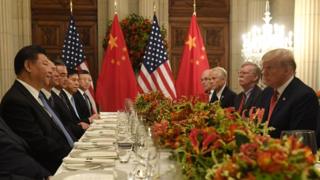
U.S. President Donald Trump and Chinese President Xi Jinping agreed at a Dec. 1 meeting in Argentina to a truce that delayed the planned Jan. 1 U.S. increase of tariffs to 25 percent from 10 percent on $200 billion (157 billion pounds) worth of Chinese goods.
Lighthizer said on Sunday that unless U.S.-China trade talks wrapped up successfully by March 1, new tariffs would be imposed, clarifying there was a “hard deadline” after a week of seeming confusion among Trump and his advisers.
China’s commerce ministry said in a statement Liu had spoken to Mnuchin and Lighthizer on Tuesday morning, Beijing time, on a pre-arranged telephone call.
“Both sides exchanged views on putting into effect the consensus reached by the two countries’ leaders at their meeting, and pushing forward the timetable and roadmap for the next stage of economic and trade consultations work,” the ministry said.
It did not elaborate.
A U.S. Treasury spokesman confirmed that the call with Liu took place, but offered no further details. The U.S. Trade Representative’s office did not immediately respond to a query about the call.
The Wall Street Journal, citing people familiar with the issue, said Liu planned to go to Washington after the new year.
The Harvard-education Liu, Xi’s top economic adviser, is leading the talks on the Chinese side.
In comments reported separately by China’s Foreign Ministry, the government’s top diplomat, State Councillor Wang Yi, said if China and the United States cooperated, it would benefit the whole world.
Stock selloff snowballs on fresh fears for world growth
“If China and the United States are antagonistic, then there are no winners, and it will hurt the whole world,” Wang told a forum.
The United States should look at China’s development in a more positive light, and constantly look to “expand the space and prospects for mutual benefit”, he said.
Global markets are jittery about a growing clash between the world’s two largest economic powers over China’s huge trade surplus with the United States and Washington’s claims that Beijing is stealing intellectual property and technology.
The arrest of a top executive at China’s Huawei Technologies Co Ltd [HWT.UL] has also roiled global markets amid fears that it could further inflame the China-U.S. trade row.
China suffered another economic blow on Sunday with the return of the deflation threat, a day after it reported slower than expected growth in exports and imports.
A fall in both consumer and producer price indexes was a result of weakness in demand from both Chinese consumers and investors and reflected their reluctance to spend as confidence in future growth is undermined by the trade war with the US.
The figures add the challenge faced by the Chinese leadership in keeping economic growth on track ahead of the annual central economic work conference, where policies for next year will be determined.
Last month the consumer price index fell 0.3 per cent from October while the producer price index dropped 0.2 per cent – the first month-on-month fall in seven months – due to the steep fall in the price of crude oil and coal, according to data released by the National Bureau of Statistics on Sunday.
On a yearly basis, China’s PPI rose only 2.7 per cent in November, the lowest reading in two years, while China’s CPI in November rose 2.2 per cent from a year earlier, the lowest in four months, the official statistics showed.
Analysts said deflationary pressure was set to continue as economic activities to weaken.
Jiang Chao, an analyst with Haitong Securities, wrote in a note before the Sunday data was released that China’s PPI would drop to zero in December and fall further into negative territory in 2019, officially putting China in a deflationary zone.
The return of deflation risks, which often associated with a contraction in economic activities, provides fresh evidence that China’s US$12 trillion economy is heading into trouble, even though China and US have agreed a 90-day truce in the trade war during which they will try to resolve their differences.
The official purchasing managers index, a leading indicator of economic growth, showed activity in China’s vast manufacturing sector stalled in November for the first time in over two years as new orders shrank.
The country’s exports decelerated rapidly last month, although China’s trade surplus with the US widened to a record level, the Chinese customs administration said on Saturday.
The Chinese government has been trying to shore up confidence in the country’s economic prospects since the summer and shifted its policy priority from cutting debt to bolstering growth.
However, signs of stress continue to mushroom in the economy.
Economic data from the first three quarters of the year has suggested that as many as 19 provinces have fallen behind their annual GDP targets and many local governments are scrambling to spur investment so that they can meet their growth targets for 2018.
The Chinese government has expressed its concerns about unemployment and promised to give cash subsidies – in the form of a partial refund of unemployment insurance payments – to employers if they do not cut their labour force.
China’s economic growth also slowed to 6.5 per cent in the third quarter of this year from 6.7 per cent in the second quarter of this year
BEIJING, Dec. 6 (Xinhua) — The eighth China-U.S. Dialogue on Rule of Law and Human Rights concluded in Beijing Wednesday.
Jiang Jianguo, deputy head of the Publicity Department of the Communist Party of China Central Committee, addressed the opening session of the three-day event.
Jiang expressed the hope that the dialogue between China and the United States in the field of human rights could comply with the trend and look at the big picture, respect differences and communicate equally, deepen cooperation and enhance mutual trust, in order to play a unique role in promoting the cause of human rights of the two countries and the healthy development of China-U.S. relations.
Huang Mengfu, chairman of China Foundation for Human Rights Development, said the dialogue, initiated in 2009, had become an important platform for non-governmental organizations of both countries to conduct exchanges on human rights, effectively enhancing mutual understanding.
“It reflects the good wishes of both sides to contribute to China-U.S. relations through people-to-people communication and exchanges,” Huang added.
Next year will mark the 40th anniversary of the establishment of diplomatic relations between the two countries, said Stephen A. Orlins, president of the National Committee on U.S.-China Relations.
Orlins said he hoped the dialogue would have a positive influence on relations between the two countries and called for confidence in the future of U.S.-China relations.
Over 50 experts and scholars from China and the United States attended the event. The American representatives visited the Supreme People’s Court and Beijing Internet Court on Wednesday.
BEIJING, Dec. 6 (Xinhua) — China has lodged solemn representations with Canada and the United States and demanded the immediate release of Meng Wanzhou, chief financial officer of Huawei Technologies Co., Ltd., a Foreign Ministry spokesperson said Thursday.
Meng was provisionally detained by the Canadian Authorities on behalf of the United States of America, when she was transferring flights in Canada, Huawei said in a statement Thursday.
Spokesperson Geng Shuang told a daily news briefing that China has lodged solemn representations with the Canadian and U.S. sides, urging the two countries to clarify the reason they detained Meng, immediately release her and effectively protect her legitimate rights and interests.
Failure to strike a deal would have seen tariffs on $200bn worth of Chinese goods rise from 10% to 25% at the start of next year, and would have opened the way for tariffs on additional Chinese goods.
On Monday, China’s foreign ministry said the presidents of China and the US had instructed their economic teams to work towards removing all tariffs following the G20 meeting,
But it didn’t say if that was a plan with specifics or something that was merely desirable.
Asian markets rallied after news of the trade war truce. In China, Hong Kong’s Hang Seng index climbed 2.5% and the Shanghai Composite index jumped 2.6%. Japan’s Nikkei 225 index rose 1%.
The gains spread to Europe, with the UK’s FTSE 100 index, the Cac 40 in France and Germany’s Dax index all up by about 2% in early trade.
The trade war has seen the US and China hit each other with escalating tariffs in an attempt to make their domestically made goods more competitive.
The US says its tariff policy is a response to China’s “unfair” trade practices and accuses it of intellectual property theft.
Since July, the US has hit China with tariffs on $250bn (£195.9bn) worth of goods. China has retaliated with duties on some $110bn of US goods over the same period.
As part of this, the US imposed a 25% tariff on Chinese cars, on top of the 2.5% already in place.
In July, China, which is the world’s largest market for cars, imposed a 40% tariff on US vehicle imports. The rate is much higher than the 15% it places on other trading partners and forced many carmakers to raise prices.
In his tweet, President Trump said Beijing had “agreed to reduce and remove tariffs on cars coming into China from the US”.
He did not provide a new level for the Chinese tariffs, and Beijing did not immediately confirm the statement.
What was agreed at the G20?
In a statement, the White House said US tariffs on Chinese goods would remain unchanged for 90 days, but added: “If at the end of this period of time, the parties are unable to reach an agreement, the 10 percent tariffs will be raised to 25 percent.”
Image captionThe US manufactures cars for export to China, the world’s largest car market
The US said China agreed to “purchase a not yet agreed upon, but very substantial, amount of agricultural, energy, industrial, and other products from the United States to reduce the trade imbalance between our two countries”.
Both sides also pledged to “immediately begin negotiations on structural changes with respect to forced technology transfer, intellectual property protection, non-tariff barriers, cyber intrusions and cyber theft”, according to the White House.
Chinese Foreign Minister Wang Yi told reporters after the talks that “the principal agreement has effectively prevented further expansion of economic friction between the two countries”.
Are tariffs still in place?
Yes. The truce prevents raising tariffs as planned on $200bn worth of Chinese goods.
But it does not remove tariffs that apply to a total of $250bn of Chinese goods targeted since July.
The truce also does not affect the existing duties China has imposed on $110bn of US goods in a tit for tat retaliation.
Will this resolve the dispute?
While the result of the G20 meeting was better than expected, it is unclear how the two countries will manage to resolve their underlying differences.
“There should be no wishful thinking that the truce would end the trade war between the world’s two largest economies,” DBS strategist Philip Wee wrote in a research note.
He said it “remains to be seen if real progress could be achieved during this narrow window to resolve the contentious issues, not just on trade, but also intellectual property”.
Louis Kuijs, head of Asia economics at Oxford Economics, said while the agreement itself was “positive” the next steps remained unclear.
“Whether we will see further de-escalation or whether it is temporary reprieve continues to be very much up to a political decision in Washington DC – that will continue to make this uncertain,” Louis Kuijs, head of Asia economics at Oxford Economics said.



 CHINDIA ALERT: You'll be living in their world, very soon
