Archive for ‘users’

22/12/2019

Economic Watch: Smart economy fledging in China as AI empowers industries, individuals

BEIJING, Dec. 21 (Xinhua) — Ask the silver-haired residents of the elderly care community Yinheyuan in central Beijing what they know about artificial intelligence (AI), and they will probably throw the question to the smart speakers within their reach.

These smart speakers, capable of interacting with users with voice-recognition technologies, are also part of the answer. Via voice command, senior residents can control lights, TVs and other home appliances, order food or ask for help.

AI is no longer a technical term used exclusively by professionals in China. Both young and old are enjoying the benefits of the growing smart economy.

After personal computers (PC), PC internet and mobile internet, the growth focus of China’s digital economy is shifting to smart technologies like AI, said Baidu Chairman and CEO Robin Li at the World Internet Conference in October.

In the smart economy era, Li predicted a declining reliance on cellphones and a rising popularity of other smart devices. AI chips, cloud computing services, among others, would become the new digital infrastructure, while innovative businesses will flourish as transport, health, education and other sectors go smart.

Wearable devices, smart home appliances, autonomous driving and smart cities are among the fastest-growing fields in the smart economy.

China is the largest smart speaker market in the world, accounting for 36 percent of global shipments in the third quarter of 2019, according to global market firm Strategy Analytics. It found in a July and August survey that 63 percent of Chinese people without a smart speaker planned to buy one within the following year. Another 22 percent planned to make a purchase later on.

Chinese firms are stepping up investment in 5G, AI and the Internet of Things to gain a foothold in the emerging field. By end-June, China had over 1,200 AI-related enterprises, according to the Ministry of Industry and Information Technology.

Baidu launched its autonomous driving open platform ApollBo in 2017 to coordinate cross-sector efforts in this field. It has launched several L4 autonomous driving vehicles in partnership with leading automobile companies, and a fleet of Apollo-powered robotaxis are now taking test runs in central China’s Changsha.

Nurturing a smart economy is also on the government agenda. China has passed a guideline to boost the integration of AI and the real economy this year, and plans to build some 20 national AI innovative development pilot zones by 2023.

The country’s AI sector is forecast to be worth more than 160 billion yuan (about 22.83 billion U.S. dollars) in 2020, spurring related sectors to exceed 1 trillion yuan, said Lin Nianxiu, deputy director with the National Development and Reform Commission, citing industrial data.

Lin said China would focus on 100 firms dedicated to AI technologies and relevant applications, improve the industrial ecosystem, facilitate the deep integration of AI and the real economy, and intensify its international collaboration on AI technology, standards, industries, laws and regulations and ethics.

Source: Xinhua

08/11/2019

Jackie Chan cancels Vietnam charity visit after South China Sea backlash

  • Chan is accused of supporting Beijing’s so-called nine-dash line, which is its historical justification for its territorial claims in the resource-rich sea
  • Vietnam, Malaysia, the Philippines, Taiwan and Brunei all have competing claims in the waterway that overlap with China’s
Film star Jackie Chan. Photo: Reuters
Martial arts film star Jackie Chan’s planned visit to Vietnam for a charity has been cancelled following an online backlash related to Beijing’s expansive claims in the disputed South China Sea.
The Hong Kong-born actor was set to visit Hanoi on November 10 to support Operation Smile, a charity that gives free surgery to children with facial disfigurements.
Jackie Chan says he wants to make films in Saudi Arabia
But the plans were scrapped after thousands of angry Facebook users flooded the charity’s official page when his visit was announced last week.
Some of their comments claimed Chan had spoken in support of China’s so-called nine-dash line – its historical justification for its territorial claims in the resource-rich sea.
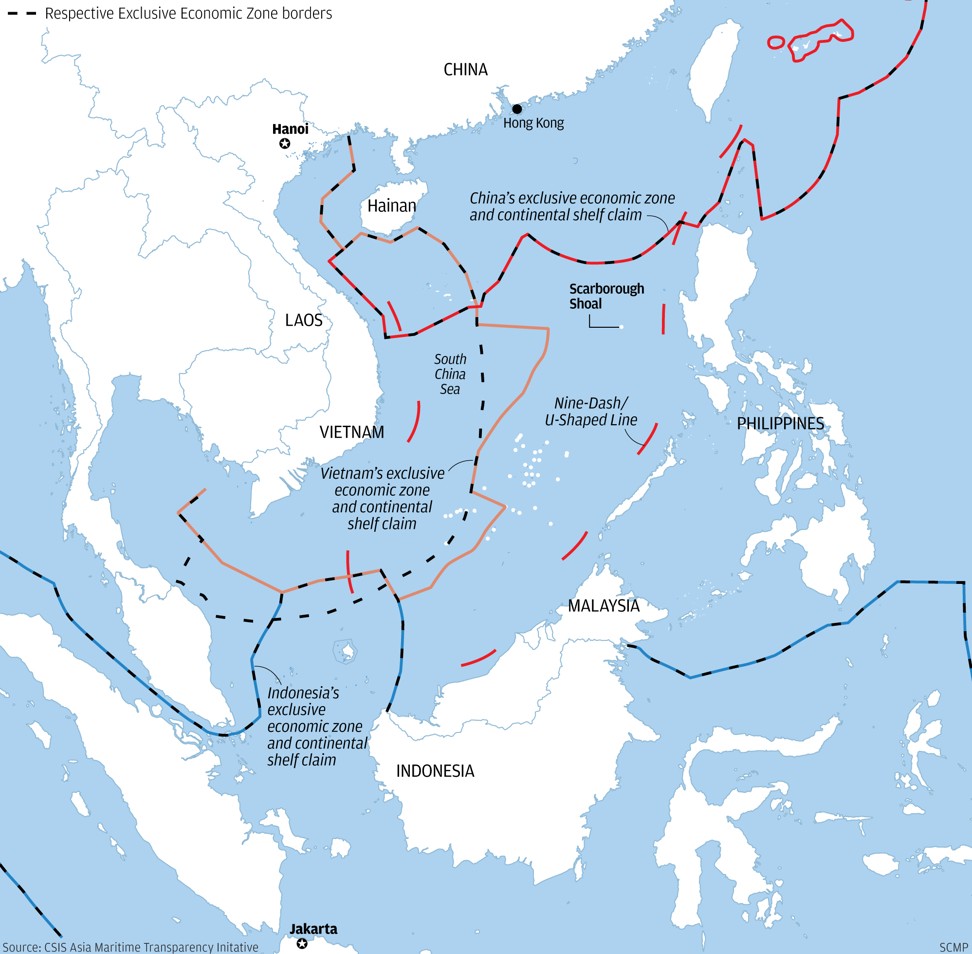
A map showing claimant countries’ exclusive economic zones in the South China Sea.

However, Chan has not explicitly expressed public support for the controversial maritime assertion.

Vietnam, Malaysia, the Philippines, Taiwan and Brunei all have competing claims in the waterway that overlap with China’s – long a source of tension in the region.

Issuing a mea culpa on Friday for failing “to predict the reaction” of the Vietnamese public, the charity asserted that their work is “non-political”.

“We are very sorry … Operation Smile will not organise any activities with [Chan’s] involvement” in Vietnam, they said.

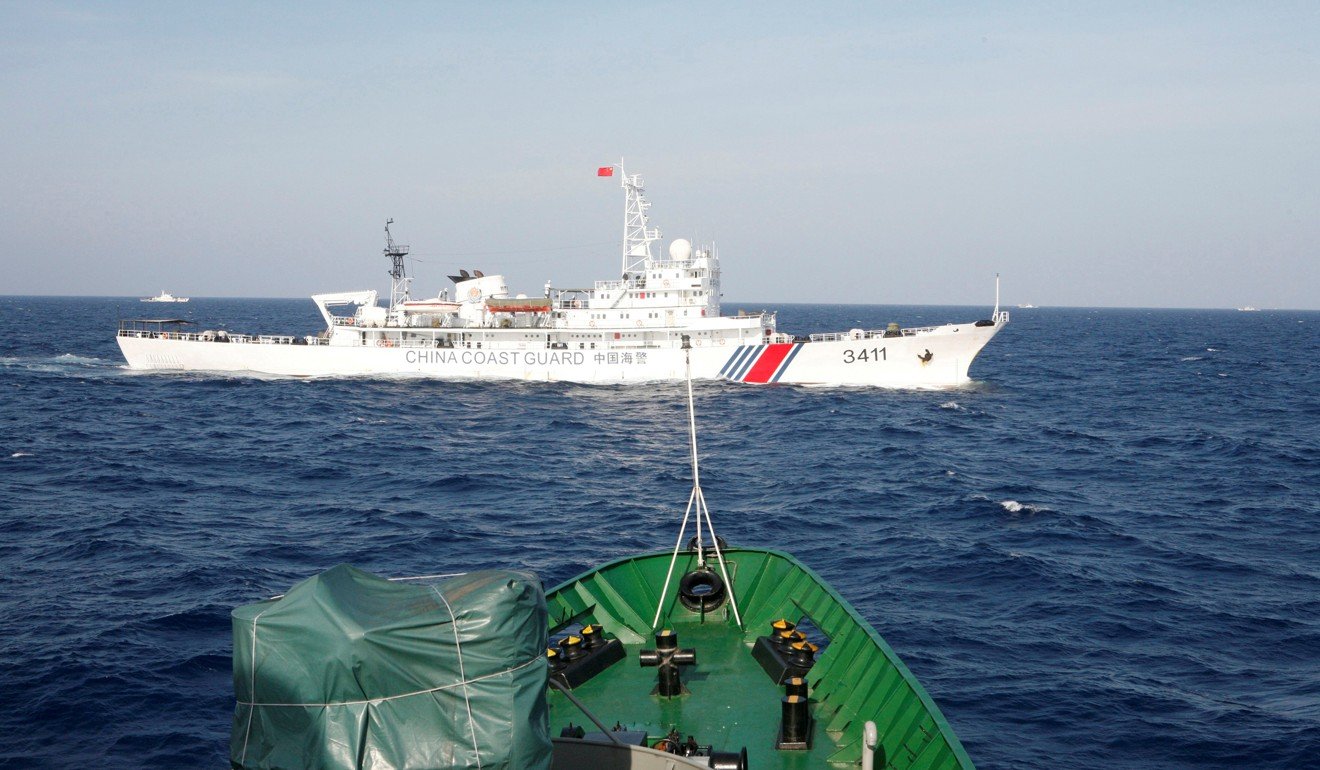
A Chinese coastguard ship sails by a Vietnamese vessel off the coast of Vietnam in 2014. Photo: Reuters

Vietnam is one of Beijing’s most vocal critics over the flashpoint South China Sea issue.

The foreign ministry on Thursday repeated its usual proclamation on the sea, citing the country’s “full legal basis and true evidence to affirm Vietnam’s sovereignty”, deputy spokesperson Ngo Toan Thang said.

Chan has in the past been accused of siding with China over Hong Kong’s democracy protests after calling the unrest in his hometown “sad and depressing”.

The comment sparked ire in Hong Kong but was warmly received by many in China where he has a massive fan base.

Abominable has been criticised for a scene showing the nine-dash line. Photo: DreamWorks
Earlier this month Hanoi pulled the DreamWorks film Abominable from theatres over a scene featuring a map showing the nine-dash line.
Beijing claims most the South China Sea through the vague delineation, which is based on maps from the 1940s as the then-Republic of China snapped up islands from Japanese control.
Abominable is not being shown in Malaysia either

after its distributor refused to cut the offending scene, while the Philippines also filed complaints.

The US this week accused Beijing of intimidating smaller countries in the South China Sea, a key global fishing route.
China has built military installations and man-made islands in the area, and for several weeks earlier this year sent a survey ship to waters claimed by Vietnam.
Source: SCMP
Law of Unintended Consequences

continuously updated blog about China & India

ChiaHou's Book Reviews

continuously updated blog about China & India

What's wrong with the world; and its economy

continuously updated blog about China & India