Archive for ‘vanity-project’

07/04/2019

Greece says EU’s China concerns must not harm its economic interests

  • Deputy prime minister Yannis Dragasakis hopes ‘logic will prevail’ ahead of EU-China summit
  • Affirms Greek support for Beijing’s belt and road plan for global trade
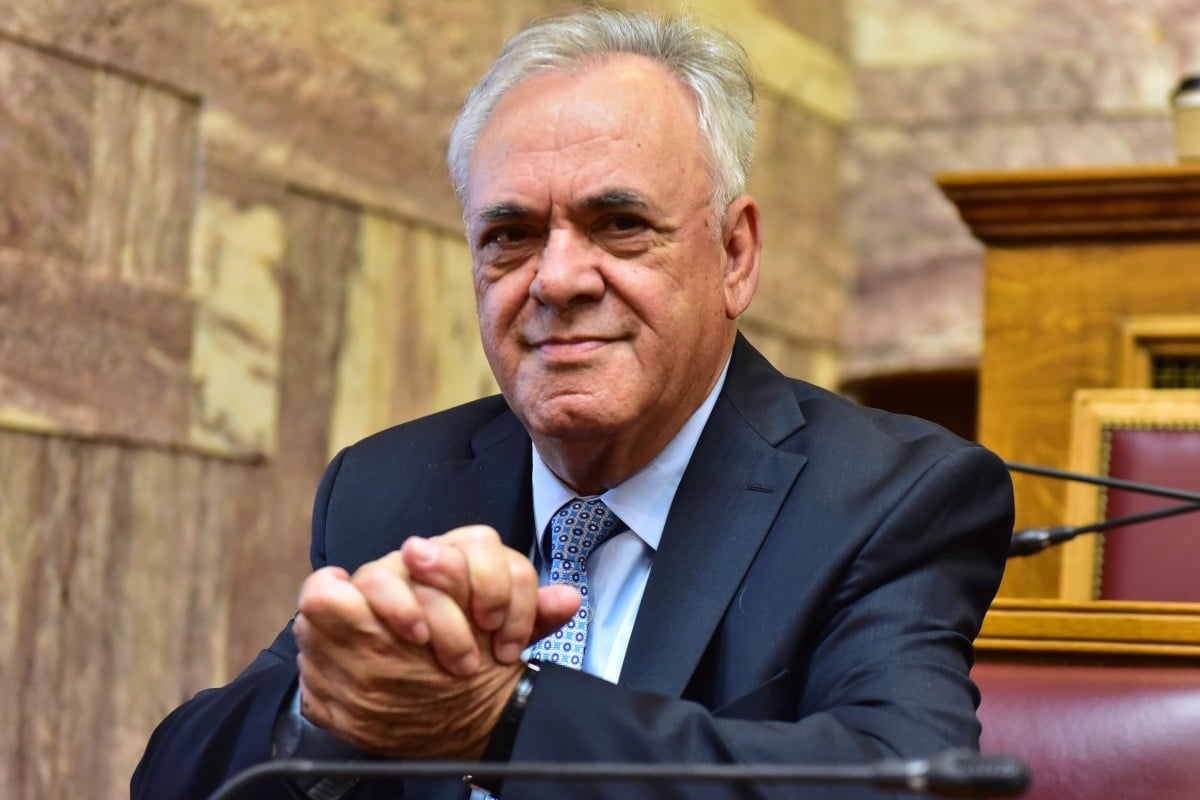
Greece’s deputy prime minister Yannis Dragasakis says the European Union’s suspicion about China is in danger of becoming a “self-fulfilling prophecy”. Photo: Alamy
The deputy prime minister of Greece has warned that European Union suspicion of China is in danger of becoming a “self-fulfilling prophecy” while reaffirming his country’s support for Beijing’s controversial “Belt and Road Initiative”.
In an exclusive interview with theSouth China Morning Post in Athens on Monday, Yannis Dragasakis said he hoped logic would prevail in the EU’s relationship with the world’s second-largest economy.
“We would like to see the EU having good relations with China,” he said.
“Seriously, we should start [the discussion about China] from the opposite end, which is, what are the needs and problems that we can work on with China?”
Dragasakis was speaking ahead of the annual summit between the EU and China in Brussels on Wednesday, which this year will take place against a backdrop of suspicion among some EU countries over Beijing’s political and commercial ambitions in the region.
Europe has been divided over whether to work with China’s enormous belt and road plan, which aims to link China by sea and land with southeast and central Asia, the Middle East, Europe and Africa, through an infrastructure network along the lines of the old Silk Road.
Italy becomes first G7 nation to sign up for China’s belt and road plan

Washington has criticised the scheme as a “vanity project”, and the EU looks set to refer to China as a “strategic rival”, with some European leaders fearing Beijing’s diplomatic manoeuvres could derail unity among member states.

Last month Italy, which is grappling with its third recession in a decade, became the first G7 nation to join the belt and road programme, in a bid to boost exports and upgrade its port facilities.

Last year Greece – ranked second lowest in economic competitiveness within the EU by the World Economic Forum in 2018 – signed up to the scheme, after years of relying on China to help it through its own financial crisis.

Chinese state-owned shipping company Cosco bought a 51 per cent stake in Pireaus Port, Greece’s most important infrastructure hub in 2016 with an option to buy another 16 per cent after five years.

China aims to make the port the “dragon head” of its belt and road programme, serving as a gateway for its cargo to Europe and North Africa.

Will Greece be China’s bridge to the rest of Europe?

With its warming relationship with Beijing, Athens has, at times, departed from EU positions on China.

In 2016, Greece helped stop the EU from issuing a unified statement against Chinese aggression in the South China Sea. The following year, Athens stopped the bloc from condemning China’s human rights record. Days later, it opposed tougher screening on China’s investments in Europe.

Dragasakis was clear that the EU should not devise any policies that may hinder Greece’s ability to revive its economy.

“Greece badly needs investment. We hope logic will prevail at the end of the day, which means we should take advantage of all opportunities and build on these prospects to further our collaboration,” he said.

“Greece will keep following a multidimensional policy, an inclusive policy, without excluding anyone.”

Dragasakis hit back at France and Germany for treating China as a geopolitical rival, while simultaneously signing up to trade agreements with Beijing.

Days before receiving Chinese President Xi Jinping in France last month, President Emmanuel Macron declared that the “time of European naivety” towards China was over – a remark the Greek deputy prime minister described as “interesting” during the interview.

“It’s so interesting, yes. Mr Macron, despite his statement, actually signed very large-scale agreements with China,” he said, adding: “Germany, the same”.
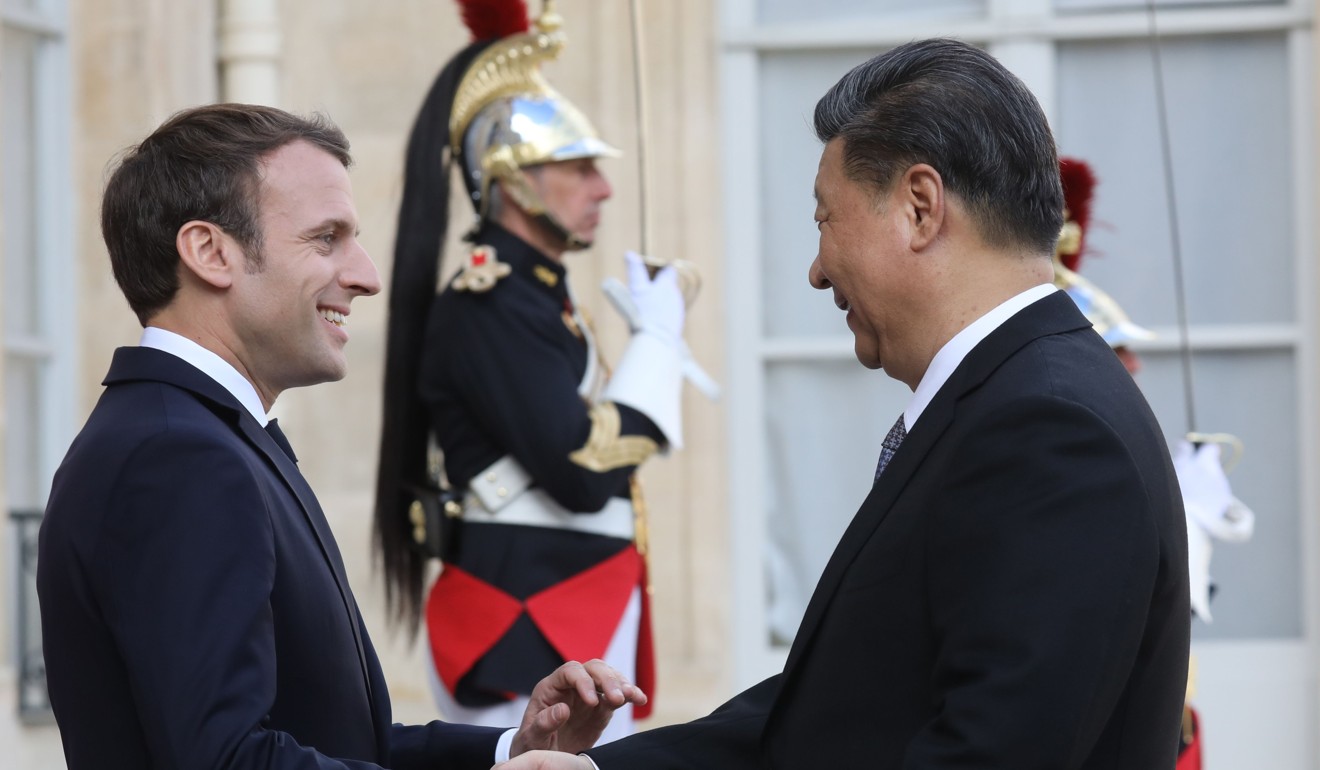
French President Emmanuel Macron welcomes Chinese President Xi Jinping to the Elysee Palace in Paris last month. Photo: AFP

Macron invited German Chancellor Angela Merkel and European Commission President Jean-Claude Juncker to his meeting in Paris with Xi, where the four sought to reassure each other over economic cooperation between the European trading bloc and China.

Dragasakis said Greece’s relations with China were based on “very solid ground” with the two countries sharing complementary interests, particularly through the belt and road plan.

Greek Prime Minister Alexis Tsipras is understood to be considering joining Foreign Minister George Katrougalos at the belt and road summit in Beijing, which will be hosted by Xi later this month.

More than 40 heads of state are expected to attend the summit, with China’s foreign ministry recently saying that Europe had started to see the value of the scheme.

If confirmed, Tsipras’ presence at the summit will be interpreted as an attempt by Greece to consolidate Chinese support in the wake of Italy’s joining of the scheme.

He will also need to mend ties with Beijing, following a recent decision by Greece’s archaeological body to block a plan by Cosco to upgrade facilities at the Piraeus port, throwing the future of the multimillion euro privatisation deal into uncertainty.

Portugal’s support for China’s belt and road plan ‘bad news’ for EU

Dragasakis said there were strong prospects for the future relationship between Greece and China because of the two countries’ reciprocal interest.

Relations with other Asian countries, while not yet as close as Greek ties with China, would continue to be developed, he said.

Dragasakis said Athens would not adopt discriminatory policies against any country as it looked to shore up foreign investments to boost its economy.

India, for instance, has set its sights on Greece as a potential business partner, with President Ram Nath Kovind becoming its first titular head of state to visit Greece last year.

“Relations with India are lagging behind – they are not at the same level as with China, but of course we are mulling further developments with India,” Dragasakis said, adding that Greece would also work more closely with Japan, South Korea and Vietnam.
EU leaders hold out olive branch to Chinese ‘rival’ by saying they want active role in Belt and Road Initiative

EU leaders hold out olive branch to China over belt and road

Read more
China will not divide Europe, senior diplomat says

China will not divide Europe, senior diplomat says

Read more

Beijing calls for ‘objective’ assessment of human rights record.


Source: SCMP

16/12/2018

Deep in the red – Chinese county pays price for vanity-project binge

RUCHENG COUNTY, China (Reuters) – In the heart of an impoverished village in southern China, a life-sized statue of Mao Zedong sits on a platform adorned with intricate stonework, flanked by a diorama of Red Army soldiers and traditional brick-and-tile homes with curved roofs.

Shu Zhang Officials have spent a small fortune on the project that has transformed the village of Shazhou, in Hunan province, into an open-air museum dedicated to the Chinese Communist Party. But few tourists have come to peer at the inscription at the foot of Mao’s statue, or take selfies in front of the heroes of the revolution.


The “red tourism” project was the brainchild of the former Communist Party chief of the local county, Rucheng, and cost 300 million yuan (). But it has yet to produce a profit, just like the string of public gardens, town squares and office buildings that the county has built in recent years.

Now the clock is ticking as Rucheng, among China’s poorest counties, and with a population of just 420,400 people, is under pressure to resolve $1 billion in debt, following a decade of credit-fuelled vanity projects, three local officials told Reuters. They requested anonymity due to the sensitivity of the matter.

To raise funds and conserve cash, Rucheng – which doesn’t have a train station or an airport – has been slashing public investment in infrastructure projects and increasing government land sales to generate revenue, the officials said.

Rucheng is not alone – hundreds of other indebted counties in China are in the same boat. In a recent financial stability report, the central bank said that much of China’s hidden debt risk is held at lower-tier levels, meaning prefectures and counties like Rucheng.

As China prepares this month to celebrate the 40th anniversary of the economic reforms that transformed it into the world’s second-largest economy, fears over local government debt are growing.

China’s local governments had 18.4 trillion yuan of outstanding debt at the end of October, and were estimated by S&P Global Ratings to have up to 40 trillion yuan in off-budget borrowing.

Of particular concern to the authorities as they tackle risks in the financial system are those governments with tiny revenue streams relative to their debt. Their over-reliance on income from land sales is also driving asset bubbles in China.

Rucheng’s free-spending ways came onto Beijing’s radar this year when visiting anti-corruption inspectors were shocked by the contrast between the county’s newly built but deserted municipal district and cramped older areas where residents drink polluted water from ageing pipes.

When the inspectors were in town, numerous anonymous complaints arrived in the mail.

Since 2008, Rucheng has spent billions on 10 office buildings, 11 public gardens and squares and 26 urban roads, the anti-corruption inspectors found. But less than 6 percent of government spending went on investing in industry.

Vanity investments helped drive Rucheng’s debt ratio – or borrowing relative to fiscal revenue – to 336 percent last year from 286 percent in 2016, and 274 percent in 2015.

“We must rectify the problem according to what is required of us, otherwise the local people will not trust our government officials anymore,” said one of the officials.

The head of Rucheng’s Communist Party was sacked for profligate spending and “ignoring the livelihood of the local people”.

Hunan province also placed Rucheng on a “top-level government debt warning list” of counties with debt ratios over 100 percent, the Rucheng officials said.

Local governments on the list face restrictions on taking on new debt, launching new projects, hiring employees and travelling overseas, they said.

RUCHENG CUTS BACK

Since the anti-corruption inspection, Rucheng has suspended, cancelled and scaled back 79 government projects, cutting investment by 2.1 billion yuan, the officials said.

All Rucheng officials have been working seven days a week and meeting regularly with local residents, the three officials said. One official died from overwork, they added.

More than 30 million yuan is also being spent on renovating old water pipes in the area.

To resolve the debt problem, Rucheng has to repay 400 million yuan a year in principle and interest to reduce its outstanding government debt, which was around 9 billion yuan at the end of 2017, an official at Rucheng’s finance and debt department told Reuters.

Slideshow (19 Images)

Rucheng’s debt ratio has since dropped to about 60.6 percent, said the official at its finance department. On Dec. 5, the provincial government lowered Rucheng’s government debt warning level from “first-level” to “second-level”, the officials said.

At the same time, Rucheng officials are under pressure to produce economic growth.

“The higher authorities require us to have zero additional debt but deliver high-quality economic growth,” said a Rucheng official in charge of the economy.

WASHING VEGETABLES, BOILING EGGS

But the legacy of the vanity spending remains.

A mineral bath tourism spot in Rucheng was deserted during a recent visit by Reuters.

Local residents washing vegetables and boiling eggs in the hot springs said the tourism spot, which had cost about 400 million yuan to build, had done little to improve livelihoods.

In nearby Shazhou, which has a population of 500, residents said they had been pressured to sell land at bargain prices to the government for the red tourism project while getting paid only 100 yuan a day as construction workers at the site.

White elephant projects built by local governments proliferated across China after the central government pumped trillions of yuan into the economy during the 2008-2009 global financial crisis.

Beijing has since tried to curtail direct borrowing by local governments for such projects, but officials have found ways around the curbs. One widespread method has been the establishment of shell companies known as local government financing vehicles to obtain funds for infrastructure and real estate projects, from which local officials often can profit.

Rucheng had nine such financing vehicles until recently, said the Rucheng finance official, adding that the number had now been cut to two. More than 1 billion yuan in debt was disposed of in that restructuring, he said.

Rucheng still has another 1.4 billion yuan of “mid- to long-term payment obligations”, which will take Rucheng 10 years to repay, the official said.

Despite Rucheng’s large debts, the officials said the county’s 5.36 billion yuan in government bonds presented “no default risk” because they would keep issuing so-called refinancing bonds to roll over the debt.

WOBBLY ECONOMY

The crackdown by Beijing in Rucheng was not only painful for local officials, but it also threatened a fragile local economy that is comprised of agriculture, green industries and eco-tourism.

Like other places in China, Rucheng needs to develop its private sector and new industries to counter a slowing regional economy at a time when government investment is severely constrained, the officials told Reuters.

There are signs that some private capital is entering Rucheng.

In September, the Dongguan Electronic Industry Association in Guangdong signed a 10 billion yuan investment plan to create an industrial park in Rucheng, attracted by cheaper land and labour costs.

That would bring in at least 20 mid-sized electronic firms and create 10,000 local jobs, Guo Peng, manager of the association, told Reuters.

But for Rucheng officials, the fear of being punished for increasing government debt risks has extinguished much of their desire to chase higher economic growth.

Rucheng indicated in August that its growth target for the region would be cut to 8 percent from 10.5 percent.

“We are not taking on any new debt illicitly for construction,” said an official at the county’s Communist Party. “If a local administration raises debt in violation of central government policy, local officials will be held responsible for their entire life.”

Law of Unintended Consequences

continuously updated blog about China & India

ChiaHou's Book Reviews

continuously updated blog about China & India

What's wrong with the world; and its economy

continuously updated blog about China & India