Archive for ‘verdict’

06/02/2019

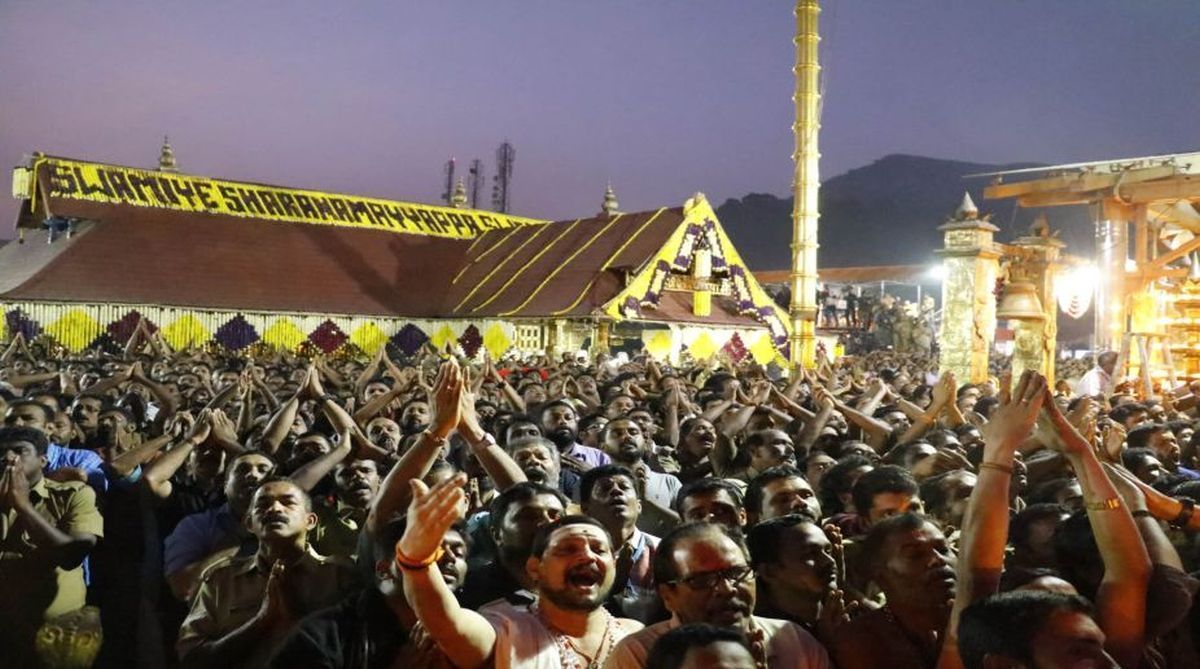
Respect Sabarimala verdict, want SC order allowing women of all ages to stay: Dewasom Board

A five-judge Constitution Bench headed by the then Chief Justice Misra had on September 28 last year junked the age-old tradition of the Lord Ayyappa temple by a majority verdict of 4:1.

SNS Web | New Delhi | 

In a complete turnaround from its earlier stand that women aged between 10 and 50 should not be allowed inside the Sabarimala temple, the Travancore Dewasom Board, on Tuesday opposed the review and told the Supreme Court that it wants the verdict allowing women of all ages to stay.

“Everyone is entitled to enter the temple. Any practice has to be dominant with the view of equality,” the board said adding “We have to move and transform the society to include women in all walks of life”.

“We have taken a decision to respect the judgement,” the board added.

It is an essential part of the Hindu religion to allow women to enter the temple, the temple board said.

Following the temple board’s U-turn in the matter, Justice Justice Indu Malhotra said, “There is a complete change of stand by the Travancore Dewasom Board”.

Justice Indu Malhotra had presented a dissenting opinion on the Supreme Court’s September verdict saying, “the court should not interfere in matters of faith”.

Advocate Indira Jaising arguing for women rights said that “purification ceremony being held affirms that menstruating women are considered polluted”.

“Social boycott going on against the women who entered the temple,” she added.

She further asserted that women should be allowed to enter the temple which is set to open on February 12.

The apex court has reserved its verdict on the matter.

Several organisations including the Nair Service Society and the Thantri of the Sabarimala temple had earlier in the day advanced arguments before the bench and sought reconsideration of the verdict.

Senior advocate K Parasaran appearing for the Nair Service Society told the court that “the exclusionary practice in Sabarimala is based on the character of the deity”.

The petitioners also argued that “Sabarimala custom cannot be equated to untouchability. It is only a religious custom”.

Abhishek Manu Singhvi appearing for ex-Chairman of the Devaswom Board argued before the court that “untouchability will not be applicable as it is not a caste or religion-based exclusion. There is no exclusion of men and women, but only exclusion for a class of women.”

The Supreme Court, in its September judgement, had said the practice is akin to untouchability.

Read | Supreme Court scraps Sabarimala temple ban on entry of women

Senior Advocate Nafade argued that “religion was a matter of faith and only community can decide the custom, not the court”.

“As long as the community decides not to change the practice, the Supreme Court cannot intervene,” he said.

The Chief Justice also allowed 90 minutes to those supporting the Supreme Court verdict.

Jaideep Gupta, arguing for the Kerala state said that there was no need to review the verdict.

Opposing the review, the government said there was also a consensus of judges on three issues – First, that Sabarimala is not a denominational temple, second, that a person’s right to worship in a temple is taken away for a major part of her life, and third, that the rule violated the act governing the temples itself.

The government further submitted that only if it is a denominational temple, the question of essential practice arises.

“Jagannath temple is unique in its practice and yet this court has held it’s not a denominational temple… similarly Kashi Vishwanath and Tirupati have been said not to be denominational,” it said.

The 65 petitions including 56 review petitions and four fresh writ petitions are being heard by a Constitution bench comprising Chief Justice Ranjan Gogoi and Justices RF Nariman, AM Khanwilkar, DY Chandrachud and Indu Malhotra.

The petitions were earlier scheduled to be heard on January 22 but were postponed since Justice Indu Malhotra went on medical leave.

On November 13, in a rare instance, the Supreme Court decided to go for open court hearing of the petitions seeking a recall of its order permitting women of all age groups to pray at the Sabarimala temple.

Read | SC agrees to reconsider Sabarimala temple verdict in open court on Jan 22

The Lord Ayyappa temple has since then witnessed massive protests by various devotee groups and Hindu outfits against the Pinarayi Vijayan government’s decision to implement the apex court order without going for any review petition.

Only two women — Bindu and Kanakadurga — managed to enter the temple in the wee hours of January 2 with tight police security.

Though many attempts were made by some young women, to enter the temple of the ‘Naishtik Brahmachari’, the eternally celibate deity, the devotees backed by priests stood their ground, saying they would not allow the tradition to be breached.

The temple remains open only for 127 days in a year.

A five-judge Constitution Bench headed by the then Chief Justice Misra had on September 28 last year junked the age-old tradition of the Lord Ayyappa temple by a majority verdict of 4:1.

“Right to worship is given to all devotees and there can be no discrimination on the basis of gender,” former chief justice Dipak Misra had observed.

Source: The Statesman
14/12/2018

‘Not for court to scrutinise’: What the Supreme Court said in Rafale deal verdict

In a big victory for the Narendra Modi led NDA government, the Supreme Court on Friday gave a clean chit to the Centre on the procurement of 36 Rafale fighter jets from France.

A three-Judge bench headed by Chief Justice Ranjan Gogoi dismissed all the petitions, and said no Rafale probe was required.

The petitions seeking probe into the deal were filed by Prashant Bhushan, Arun Shourie, former Finance Minister Yashwant Sinha, advocates M.L.Sharma and Vineet Dhanda, and AAP lawmaker in Parliament Sanjay Singh.

Read | No Rafale probe, Supreme Court dismisses petitions

Taking up the petitions on Friday, the CJI said the court studied the materials carefully and interacted with defence officials, and was “satisfied” with the NDA government’s decision making process.

Here’s what the Supreme Court said in its order:

  • “The court does not find substantial matter to interfere with issue of procurement, pricing and offset partner in Rafale jet deal.”
  • “We studied the materials carefully, interacted with defence officials and we are satisfied with decision making process.”
  • “This is not court’s job to deal with pricing details of Rafale fighter jets.”
  • “We are satisfied that there is no occasion to doubt the procurement process. A country cannot afford to be under-prepared. Not correct for the court to sit as an appellant authority and scrutinise all aspects.”
  • “There is no reason for interference in the choice of offset partner and perception of individuals can’t be the basis for roving inquiry in sensitive issue of defence procurement.”
  • “We do not find any material to show that it is commercial favouritism.”
  • “We cannot compel the government to purchase 126 aircraft.”
  • “There has been necessity of fighter aircraft and country cannot remain without fighter jets.”


The bench had on November 14 reserved its verdict on a batch of pleas seeking a Rafale probe.

Reserving its verdict, the Supreme Court had said the pricing details of Rafale jets could only be discussed once it decided on whether to make it public.

The observation by the apex court had come after the government refused to publicly divulge pricing details of the deal, saying the Rafale deal pricing details are a matter of “national security” and cannot come under judicial review.

Read | Matter of ‘national security’, not for court to review Rafale deal: Centre to SC

The verdict comes as a major boost for the Narendra Modi government that had been cornered over the Rafale deal ahead of the five-state Assembly elections.

Manufactured by aerospace company Dassault Aviation, the Rafale fighter is a twin-engine Medium Multi Role Combat Aircraft.

India has signed an agreement with France to buy 36 Rafale fighter aircraft, costing approximately Rs 58,000-crore (about USD 8 billion), in a fly-away condition for Indian Air Force equipment upgrade.

The verdict comes as a major boost for the Narendra Modi government that had been cornered over the Rafale deal ahead of the five-state Assembly elections.

SNS Web | New Delhi | 

n a big victory for the Narendra Modi led NDA government, the Supreme Court on Friday gave a clean chit to the Centre on the procurement of 36 Rafale fighter jets from France.

A three-Judge bench headed by Chief Justice Ranjan Gogoi dismissed all the petitions, and said no Rafale probe was required.

The petitions seeking probe into the deal were filed by Prashant Bhushan, Arun Shourie, former Finance Minister Yashwant Sinha, advocates M.L.Sharma and Vineet Dhanda, and AAP lawmaker in Parliament Sanjay Singh.

Taking up the petitions on Friday, the CJI said the court studied the materials carefully and interacted with defence officials, and was “satisfied” with the NDA government’s decision making process.

Here’s what the Supreme Court said in its order:

  • “The court does not find substantial matter to interfere with issue of procurement, pricing and offset partner in Rafale jet deal.”
  • “We studied the materials carefully, interacted with defence officials and we are satisfied with decision making process.”
  • “This is not court’s job to deal with pricing details of Rafale fighter jets.”
  • “We are satisfied that there is no occasion to doubt the procurement process. A country cannot afford to be under-prepared. Not correct for the court to sit as an appellant authority and scrutinise all aspects.”
  • “There is no reason for interference in the choice of offset partner and perception of individuals can’t be the basis for roving inquiry in sensitive issue of defence procurement.”
  • “We do not find any material to show that it is commercial favouritism.”
  • “We cannot compel the government to purchase 126 aircraft.”
  • “There has been necessity of fighter aircraft and country cannot remain without fighter jets.”


The bench had on November 14 reserved its verdict on a batch of pleas seeking a Rafale probe.

Reserving its verdict, the Supreme Court had said the pricing details of Rafale jets could only be discussed once it decided on whether to make it public.

The observation by the apex court had come after the government refused to publicly divulge pricing details of the deal, saying the Rafale deal pricing details are a matter of “national security” and cannot come under judicial review.

Read | Matter of ‘national security’, not for court to review Rafale deal: Centre to SC

The verdict comes as a major boost for the Narendra Modi government that had been cornered over the Rafale deal ahead of the five-state Assembly elections.

Manufactured by aerospace company Dassault Aviation, the Rafale fighter is a twin-engine Medium Multi Role Combat Aircraft.

India has signed an agreement with France to buy 36 Rafale fighter aircraft, costing approximately Rs 58,000-crore (about USD 8 billion), in a fly-away condition for Indian Air Force equipment upgrade.

Law of Unintended Consequences

continuously updated blog about China & India

ChiaHou's Book Reviews

continuously updated blog about China & India

What's wrong with the world; and its economy

continuously updated blog about China & India