Chindia Alert: You’ll be Living in their World Very Soon
aims to alert you to the threats and opportunities that China and India present. China and India require serious attention; case of ‘hidden dragon and crouching tiger’.
Without this attention, governments, businesses and, indeed, individuals may find themselves at a great disadvantage sooner rather than later.
The POSTs (front webpages) are mainly 'cuttings' from reliable sources, updated continuously.
The PAGEs (see Tabs, above) attempt to make the information more meaningful by putting some structure to the information we have researched and assembled since 2006.
China’s economy shrank for the first time in decades in the first quarter of the year, as the virus forced factories and businesses to close.
The world’s second biggest economy contracted 6.8% according to official data released on Friday.
The financial toll the coronavirus is having on the Chinese economy will be a huge concern to other countries.
China is an economic powerhouse as a major consumer and producer of goods and services.
This is the first time China has seen its economy shrink in the first three months of the year since it started recording quarterly figures in 1992.
“The GDP contraction in January-March will translate into permanent income losses, reflected in bankruptcies across small companies and job losses,” said Yue Su at the Economist Intelligence Unit.
Last year, China saw healthy economic growth of 6.4% in the first quarter, a period when it was locked in a trade war with the US.
In the last two decades, China has seen average economic growth of around 9% a year, although experts have regularly questioned the accuracy of its economic data.
Its economy had ground to a halt during the first three months of the year as it introduced large-scale shutdowns and quarantines to prevent the virus spread in late January.
As a result, economists had expected bleak figures, but the official data comes in slightly worse than expected.
Among other key figures released in Friday’s report:
Factory output was down 1.1% for March as China slowly starts manufacturing again.
Retail sales plummeted 15.8% last month as many of shoppers stayed at home.
Unemployment hit 5.9% in March, slightly better than February’s all-time high of 6.2%.
Analysis: A 6% expansion wiped out
Robin Brant, BBC News, Shanghai
The huge decline shows the profound impact that the virus outbreak, and the government’s draconian reaction to it, had on the world’s second largest economy. It wipes out the 6% expansion in China’s economy recorded in the last set of figures at the end of last year.
Beijing has signalled a significant economic stimulus is on the way as it tries to stabilise its economy and recover. Earlier this week the official mouthpiece of the ruling Communist Party, the People’s Daily, reported it would “expand domestic demand”.
But the slowdown in the rest of the global economy presents a significant problem as exports still play a major role in China’s economy. If it comes this will not be a quick recovery.
On Thursday the International Monetary Fund forecast China’s economy would avoid a recession but grow by just 1.2% this year. Job figures released recently showed the official government unemployment figure had risen sharply, with the number working in companies linked to export trade falling the most.
China has unveiled a range of financial support measures to cushion the impact of the slowdown, but not on the same scale as other major economies.
“We don’t expect large stimulus, given that that remains unpopular in Beijing. Instead, we think policymakers will accept low growth this year, given the prospects for a better 2021,” said Louis Kuijs, an analyst with Oxford Economics.
Since March, China has slowly started letting factories resume production and letting businesses reopen, but this is a gradual process to return to pre-lockdown levels.
Media caption Why does China’s economy matter to you?
China relies heavily on its factories and manufacturing plants for economic growth, and has been dubbed “the world’s factory”.
Stock markets in the region showed mixed reaction to the Chinese economic data, with China’s benchmark Shanghai Composite index up 0.9%.
LONDON (Reuters) – World shares and bond yields rode a renewed surge in risk appetite on Tuesday, as investors were optimistic about U.S.-China trade talks and cheered Washington’s deal to avoid another government shutdown.
Tokyo’s Nikkei set the tone with its best day of the year so far and Europe wasted little time in trying to lift the STOXX 600 back to the two-month high it set last week.
Germany’s DAX jumped more than 1.2 percent, after rising 1 percent on Monday, and Paris and Milan were up 0.8 percent, while London’s FTSE approached a four-month peak despite ongoing Brexit uncertainty.
The dollar hovered at a two-month high and the Australian dollar also gained. The yen and Swiss franc dipped while U.S. Treasury and German bund yields edged up as investors jettisoned safe havens.
“We have had two bits of relatively good news overnight – optimism about the U.S. shutdown not resuming and optimism about a trade deal,” said Societe Generale strategist Kit Juckes.
“Equities are higher, bond yields are a little bit higher, yen and Swiss franc weakest overnight of the major currencies so it’s sort of risk-on rules OK!”
Juckes said he reckoned there was now a 75 percent chance that a ratcheting up of U.S. tariffs on Chinese goods at the start of March will be avoided and a 95 percent chance that another U.S. government shutdown will be dodged.
Those odds got a boost on Monday after U.S. lawmakers reached a tentative deal on border security funding, though aides cautioned that it did not contain the $5.7 billion President Donald Trump wants to build a wall on the Mexican border.
S&P 500 e-mini futures were up nearly 0.5 percent, pointing to a solid start on Wall Street later after a choppy day on Monday.
U.S. and Chinese officials expressed hopes the new round of talks, which began in Beijing on Monday, would bring them closer to easing their months-long trade war.
Beijing and Washington are trying to hammer out a deal before a March 1 deadline, without which U.S. tariffs on $200 billion worth of Chinese imports are scheduled to increase to 25 percent from 10 percent.
“There will be no winner in a trade war. So at some point they will likely strike a deal,” said Mutsumi Kagawa, chief global strategist at Rakuten Securities in Tokyo.
BIG IN JAPAN
MSCI’s broadest index of Asia-Pacific shares outside Japan edged up 0.3 percent.
Shanghai rose 0.35 percent, South Korea’s KOSPI climbed 0.6 percent and Australian shares gained 0.3 percent.
The Nikkei rallied though, shooting up 2.6 percent after closing on Friday at its lowest level since early January. The Tokyo market was closed on Monday.
With the yen backtracking again, shares of exporters such as automakers and machinery makers led the charge. Separately, Deutsche Bank noted it was 20 years since Japan cut interest rates to zero, something now standard in large parts of Europe.
The dollar held firm, having gained for eight straight sessions against a basket of six major currencies until Monday, its longest rally in two years.
Although the Federal Reserve’s dovish turn dented the dollar earlier this month, some analysts noted the U.S. currency still has the highest yield among major peers and that the Fed continues to shrink its balance sheet.
Wall St wavers as investors eye trade talks, growth fears
“The dollar is the market’s pet currency at present regardless of whether concerns about the global economy are on the rise,” currency strategists at Commerzbank said in a note.
The dollar popped up to a six-week high of 110.65 yen. In contrast, the euro dropped to as low as $1.1267, its weakest in 2-1/2 months, and last traded at $1.1277.
In commodity markets, oil prices also ticked up as traders weighed support from OPEC-led supply restraint and a slowdown in the global economy.
U.S. crude futures traded at $52.68 per barrel, up 0.5 percent. Brent crude rose 0.6 percent to $61.89 per barrel. Gold was a touch stronger at $1,312 an ounce.


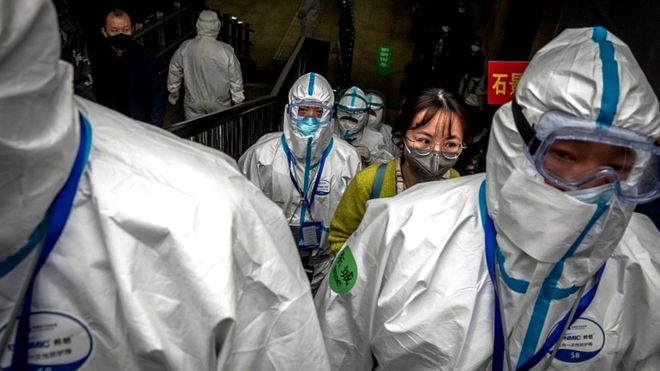 Image copyright EPA

 CHINDIA ALERT: You'll be living in their world, very soon