Archive for ‘Warren Buffett’

04/05/2020

Coronavirus: billionaire Warren Buffett’s prediction for America after Berkshire Hathaway’s US$50 billion loss

  • Buffett’s Berkshire posted a record quarterly net loss of nearly US$50 billion
  • Company sells entire stakes in US airlines, Buffett says ‘world has changed’
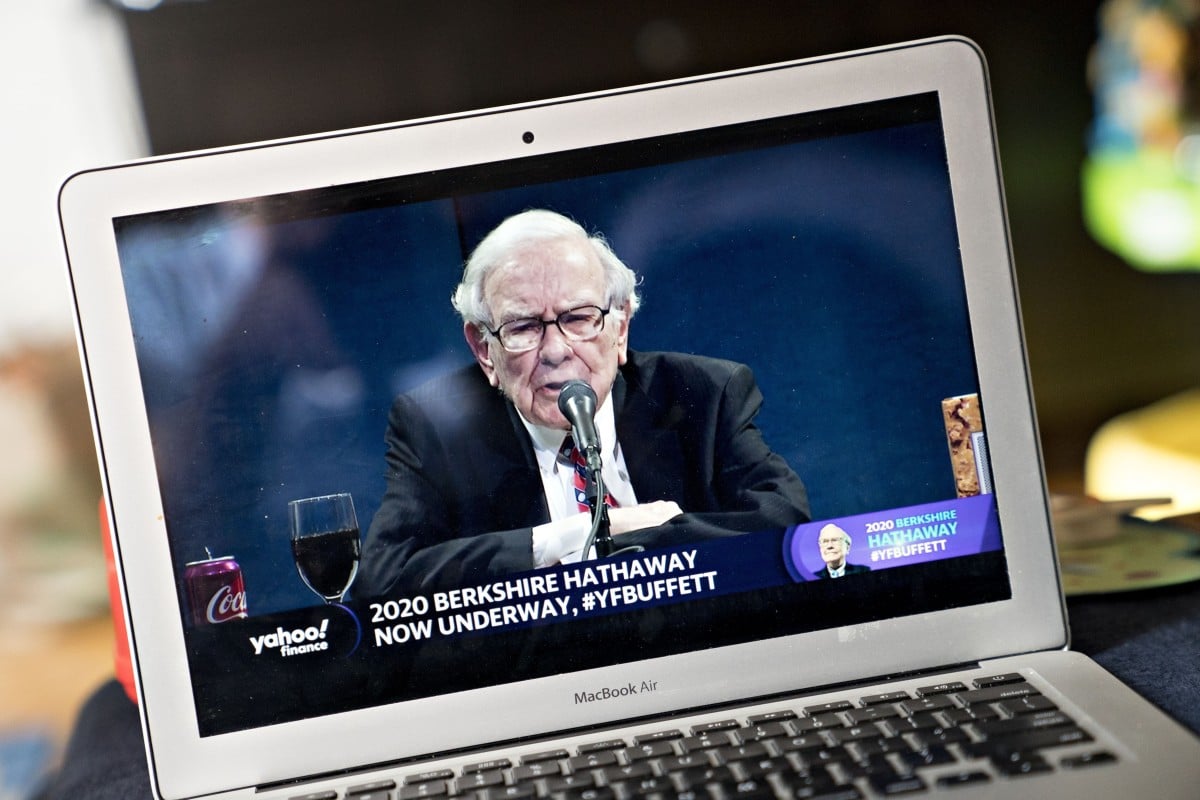
Warren Buffett speaks during the virtual Berkshire Hathaway annual shareholders meeting. Photo: Bloomberg

Billionaire investor Warren Buffett said Saturday he’s confident the US economy will bounce back from its pummelling by the coronavirus pandemic because “American magic has always prevailed”.

The 89-year-old made the sanguine prediction about the world’s largest economy as his holding company Berkshire Hathaway reported first-quarter net losses of nearly US$50 billion.

Buffett also announced Saturday that his company had sold all its stakes in four major US airlines last month, as the pandemic clobbered the travel industry.

“It turns out I was wrong,” he said of his acquisitions of 10 per cent stakes in American Airlines, Delta Air Lines, Southwest Airlines and United Airlines.

Berkshire Hathaway had paid US$7 billion to US$8 billion, and “we did not take out anything like that,” he said.

Between the purchases that took place over months, and the sale, “the airlines business I think changed in a very major way” and could no longer meet Berkshire criteria for profitability, he said.

Buffett’s announcement may further hurt airlines already pushed to the brink by coronavirus lockdown measures, now looking to the US government for US$25 billion in relief funds.

Berkshire Hathaway, based in Omaha, Nebraska, called its first-quarter setback “temporary” but said it could not reliably predict when its many businesses would return to normal or when consumers would resume their former buying habits.
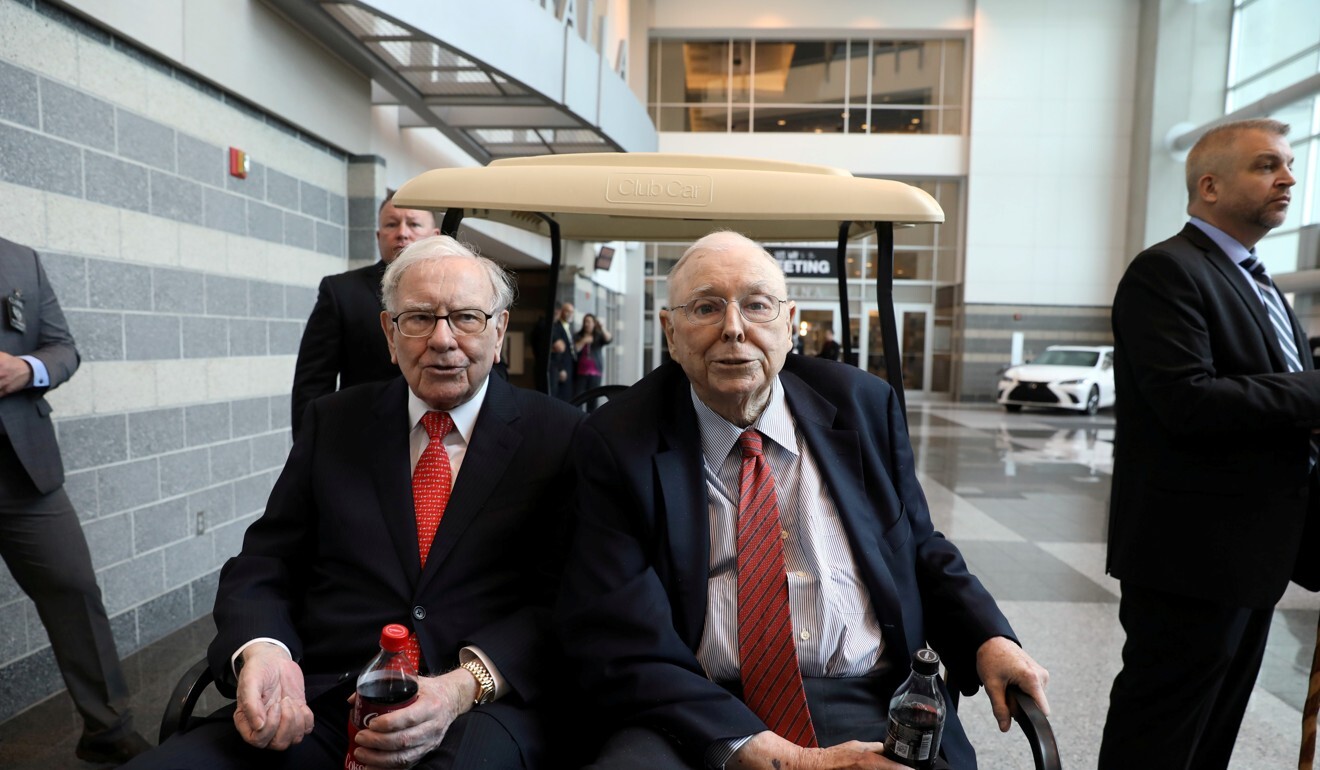
Warren Buffett (left) and vice-chairman Charlie Munger at the annual Berkshire shareholder shopping day in Omaha, Nebraska in 2019. Photo: Reuters
“We’ve faced great problems in the past, haven’t faced this exact problem – in fact we haven’t really faced anything that quite resembles this problem,” Buffett said in a lengthy speech on the country’s economic history.

“But we faced tougher problems, and the American miracles, American magic has always prevailed and it will do so again.”

“We are now a better country, as well as an incredibly more wealthy country, than we were in 1789 … We got a long ways to go but we moved in the right direction,” he said, referencing the abolition of slavery and women’s suffrage.

Warren Buffett has traded his old flip phone for Apple’s iPhone
25 Feb 2020

“Never bet against America.”

Buffett is considered one of the savviest investors anywhere. His fortune of US$72 billion is the fourth-largest in the world, according to Forbes, and in normal years, the company’s annual gathering in Omaha is a high-point of the calendar for investors, a “Woodstock for capitalists”.

But the devastating economic impact of the pandemic has hit hard at Berkshire Hathaway’s wide range of investments, and the need for social distancing forced it to hold the annual meeting online.

Buffett addressed his shareholders in a live-stream flanked only by Gregory Abel, who is in charge of Berkshire’s non-insurance operations.

His business partner for six decades, 96-year-old Charlie Munger, did not appear.
China’s first-quarter GDP shrinks for the first time since 1976 as coronavirus cripples economy
Buffett, in a statement, played down his company’s bleak-looking net figure. He said a better measure of the company’s performance was its operating earnings, which exclude investments and are less subject to sharp fluctuations.
By that measure, Berkshire Hathaway saw growth to US$5.9 billion from US$5.55 billion a year earlier.
The brutal drop in the net – to a loss of US$49.75 billion from a profit last year of US$21.7 billion – resulted primarily from the virus-related decline in value of its broad investment portfolio, which ranges from energy to transport to insurance and technology.
Chinese cryptocurrency billionaire finally sits down to eat with Warren Buffett
7 Feb 2020

The annual meeting often has an almost carnival atmosphere, as thousands of fans and investors flock to Nebraska to hear from the celebrated “Oracle of Omaha”. Buffett, famous for his relatively modest lifestyle, turns 90 on August 30.

In documents filed Saturday, Berkshire noted that until mid-March many of its companies were posting “comparative revenue and earnings increases” over the same 2019 period.

Many of its companies – including in rail transport, energy production and some manufacturing and service businesses – are deemed essential and are able to continue working amid the far-reaching confinement orders.

But their turnover slowed considerably in April, the company statement said.

Moves taken by those companies such as employee furloughs, salary cuts and reductions, and capital spending reductions are “necessary actions” and “temporary,” it said.

Source: SCMP
28/03/2020

The uncertain future for China’s electric car makers

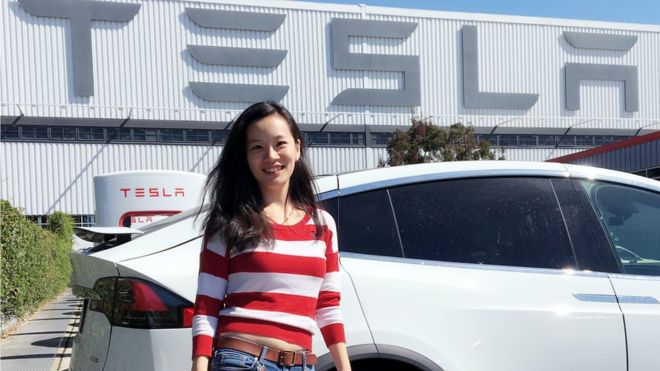
Han Zhu at the Tesla dealershipImage copyright HAN ZHU
Image caption Choosing an electric car was an easy decision for Shenzhen resident Han Zhu

Han Zhu is on a mission to go green. The 29-year-old data analyst wants her next car to be electric. But her reasons for buying an electric vehicle are in part practical.

In the southern Chinese city of Shenzhen, government restrictions on the number of petrol cars sold each year mean she would have to enter a lottery or auction to be able to buy a petrol vehicle.

“There is a possibility you may never get it. With the electric vehicle green licence, you don’t have to wait in line,” she says.

Shenzhen has become the showpiece capital for the Chinese electric dream. In 2017 it became the first city in the world to introduce a fleet of electric buses. A year later, the government rolled out a plan to replace city taxis with electric cars.

“In Shenzhen, in almost every residential building there are two charging units. One out of 10 cars on the street are Teslas,” she says. “In China if the policy leads in one direction, technology and money goes in that direction too,” she says.

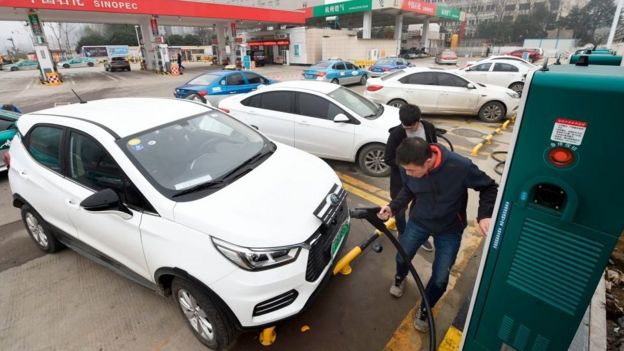
This photo taken on January 14, 2019 shows a man plugging in an electric vehicle at a Sinopec service station in Hangzhou, in China's eastern Zhejiang province.Image copyright GETTY IMAGES
Image caption China has the world’s biggest market for electric vehicles

In less than a decade China’s new electric vehicle market has become the largest in the world. In 2018 more than a million electric vehicles were sold in China, more than three times the number sold in the US.

Beijing invested an estimated $50bn (£43bn) in the industry, hoping that today’s dominance of the electric vehicle market would lead to global automobile supremacy tomorrow.

And thus far the policy has been working. Over the last three years the number of Chinese electric vehicle manufacturers has tripled, with more than 400 registered nationwide.

But that breakneck expansion alarmed the government. Last year it decided to put the brakes on by withdrawing approximately half of its financial incentives for buyers.

A slump in sales quickly followed, in the last quarter of 2019 sales for electric vehicles plummeted.

Now the coronavirus has supplied a second punch.

Manufacturers have been forced to halt production lines and close dealerships in a bid to stop the spread of virus.

Overall auto sales in plunged 79% in February compared with the same month in 2019, according to figures from the China Association of Automobile Manufacturers. Sales of new energy vehicles (NEVs) fell for the eighth month in a row.

“China’s auto market was already reeling from a large drop in demand in 2019. In 2020 no carmaker has been immune to the effects of the coronavirus. That includes everyone from the oldest joint ventures producing internal combustion engine SUVs to the most innovative upstarts making connected electric vehicles,” says Scott Kennedy from the Center for Strategic and International Studies.

“The vast majority [of electric car makers] will not survive. But how long they survive and whether industry consolidation occurs through lots of mergers or bankruptcies will depend on the willingness of the government.”

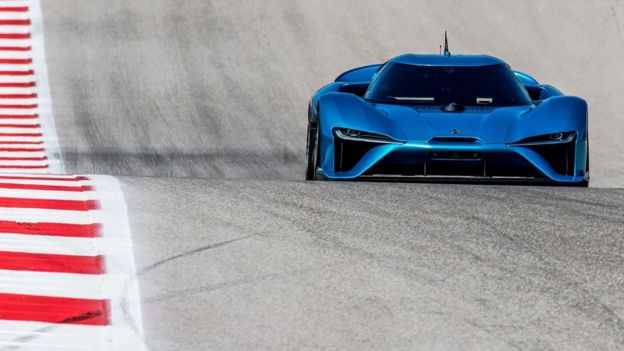
The NIO EP9Image copyright NIO
Image caption The NIO EP9 is one of the fastest electric cars in the world

After listing on the New York Stock Exchange in 2018 and raising billions of dollars, NIO is perhaps the highest-profile Chinese maker of electric cars.

But in the five years since it was founded it has been beset by problems and has burned through hundreds of millions of dollars. In 2019 the company cut 2,000 jobs on the back of falling revenues. In February it announced it had signed a tentative agreement with a local government that has pledged to fund the company.

“China is a huge market growing at an immense pace. We will adjust and adapt to the market condition,” said an NIO spokesperson.

And it’s not just the car makers. China has some giant makers of components, such as batteries.

In 2018 CATL, a Chinese electric battery maker, became the official supplier of BMW’s electric cars.

Last month Tesla announced it would enter into an agreement with the company to supply batteries for Tesla’s newly built Shanghai mega-plant, capable of producing 500,000 vehicles a year.

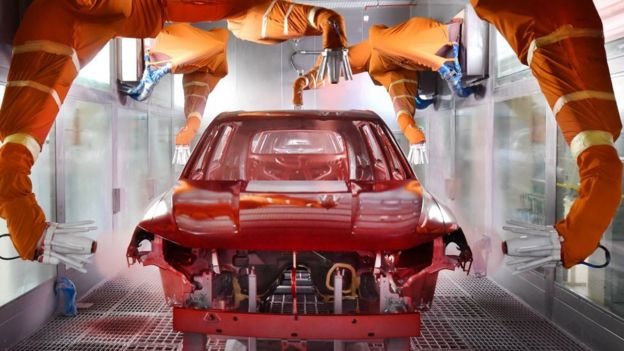
Robotic arms spray paint a car body shell at the BYD Automobile Company Limited Xi'an plant on December 25, 2019 in Xi'an, Shaanxi Province of China.Image copyright GETTY IMAGES
Image caption China’s BYD is the one of the world’s biggest makers of electric vehicles

But despite that apparent success, analysts have their doubts.

“Chinese auto and battery technology is still not world-class. CATL and BYD are strong battery makers, but they are still somewhat behind technologically from their South Korean and Japanese counterparts. And Chinese automakers are still second-class producers even in their own country and they have barely any sales outside China,” says Mr Kennedy.

For car buyers, that question of quality hangs over China’s electric car makers.

Yi Zhi Yong, a middle-aged entrepreneur, drives a hybrid car made by Chinese manufacturer BYD. Backed by US billionaire Warren Buffett, the company was the third-largest battery-only electric car producer in the world in 2019, according to research by EV-volumes.com. Tesla sold the most, followed by another Chinese firm, BAIC.

He didn’t buy a pure electric vehicle because he is not confident about the quality.

Presentational grey line

More Technology of Business

Presentational grey line

“The quality of domestic pure electric vehicles is not good at the moment,” he says. “No domestic pure electric vehicle is worth buying yet.”

But he feels the progress made by China is a source of national pride. “In the 1990s we couldn’t imagine that China could build cars that can compete with the Japanese,” he says.

Back in Shenzhen, Han Zhu says the rolling back of government subsidies won’t put her off buying an electric vehicle. But rather than buying a Chinese marque, she has her eye on a Tesla.

“I think that they are totally different. I was super excited about Tesla but not other electric cars,” she says.

Source: The BBC

02/12/2019

Factbox – The world’s biggest electric vehicle battery makers

(Reuters) – Asian companies dominate the market for electric vehicle (EV) batteries and they are expanding their production capacity in Europe, China and the United States in a fight to win lucrative contracts from global automakers.

Some carmakers worry, however, there won’t be enough batteries for all the EVs they plan to launch in the coming years and a bitter row between South Korea’s SK Innovation and LG Chem risks exacerbating the potential shortfall.

Below are details of the world’s leading EV battery makers with details of their customers and expansion plans:

CATL

China’s Contemporary Amperex Technology (CATL), the world’s biggest EV battery maker, counts BMW (BMWG.DE), Volkswagen (VOWG_p.DE), Daimler (DAIGn.DE) – which makes Mercedes cars – Volvo, Toyota Motor Corp (7203.T) and Honda Motor Co (7267.T) among its customers.

The company emerged as a major force partly thanks to Beijing’s policy of only subsidising vehicles equipped with Chinese batteries in the world’s biggest EV market. Beijing is phasing out EV subsidies next year.

CATL, which operates factories in China, is building its first overseas plant in Germany and is considering a U.S. factory.

PANASONIC CORP (6752.T)

Japan’s Panasonic, a supplier of U.S. EV pioneer Tesla (TSLA.O), said it has installed equipment to ramp up production at Tesla’s Nevada plant to 35 GWh from its current production of around 30 GWh as of late October. Panasonic has said it is investing about $1.6 billion in the factory.

Panasonic also produces EV batteries in Japan, China and plans to shift some of its plants to a new joint venture with Toyota. Panasonic’s clients also include Honda and Ford Motor Company (F.N).

For a graphic of expansion plans: tmsnrt.rs/35tFmOL

BYD CO LTD (002594.SZ)

China’s BYD, which is backed by U.S. investor Warren Buffett, is also one of the world’s biggest EV battery makers. It mainly uses them in-house for its own cars and buses. BYD said last year it is was considering cell production in Europe.

LG CHEM LTD (051910.KS)

The South Korean firm was an early industry mover, winning a contract to supply General Motor’s (GM.N) Volt in 2008. It also supplies Ford, Renault (RENA.PA), Hyundai Motor (005380.KS), Tesla, Volkswagen and Volvo.

It is investing 3.3 trillion won ($2.8 billion) to build and expand production facilities near Tesla’s plant in Shanghai. It has a joint venture (JV) in China with Geely Automobile Holdings (0175.HK), which makes Volvos, and is in talks with other carmakers about JVs in major markets.

The firm is considering building a second U.S. factory in addition to its facility in Michigan and is expanding its plant in Poland.

SAMSUNG SDI CO LTD (006400.KS) Samsung SDI an affiliate of South Korean tech giant Samsung Electronics (005930.KS), has EV battery plants in South Korea, China and Hungary, which supply customers such as BMW (BMWG.DE), Volvo and Volkswagen. Samsung SDI is investing about 1.2 billion euros ($1.3 billion) to expand its factory in Hungary though the EU is investigating whether Budapest’s financial support complies with the bloc’s state aid rules.

Samsung started production last year on the Hungary plant, which will produce batteries for 50,000 EVs a year.

SK INNOVATION CO LTD (096770.KS) LG Chem’s cross-town rival SK Innovation supplies batteries to Volkswagen, Daimler and Kia Motors (000270.KS), as well as Jaguar Land Rover [TAMOJL.UL] and Ferrari (RACE.MI).

An oil refiner that came to the battery industry late, SKI is investing about $3.9 billion to build three plants in the United States, China and Hungary, with a goal of expanding its annual production capacity to 33 GWh by 2022.

SKI currently operates one battery factory in South Korea, with a capacity of 4.7 GWh annually.

It set up a joint venture with Beijing Automotive Industry Corporation (BAIC) of China in August 2018 and another Chinese partner. It is in talks with Volkswagen about another battery JV and is building a $1.7 billion factory in the U.S. state of Georgia, not far from Volkswagen’s Chattanooga plant.

Source: Reuters

06/05/2019

Warren Buffett says U.S.-China trade war ‘bad for the whole world’

(Reuters) – Warren Buffett said on Monday that a trade war between the United States and China would be “bad for the whole world.”

Buffett spoke after U.S. President Donald Trump tweeted on Sunday that he will raise tariffs on $200 billion of Chinese imports to 25 percent from 10 percent beginning on Friday, and “shortly” slap a 25-percent tariff on $325 billion of Chinese goods that have not been taxed.

Major stock markets fell worldwide on Monday in response to the president’s tweet, which came ahead of scheduled trade talks this week, and was a “rational” response, Buffett said on CNBC television.

Buffett’s conglomerate Berkshire Hathaway Inc owns or invests in many companies that do business in China, including Apple Inc, in which it has a more than $50-billion stake.

“If we actually have a trade war it will be bad for the whole world,” Buffett said.

A full-scale trade war is unlikely but “would be bad for everything Berkshire owns,” Buffett added.

He nonetheless said it would be “nonsense” for investors to sell stocks based on headlines, and that the U.S.-China would not affect how Omaha, Nebraska-based Berkshire operates.

“We will buy the same stocks today that we were buying last week,” he said.

Trump on Monday tweeted that the United States has for many years lost $600 billion to $800 billion annually on trade, and “with China we lose 500 Billion Dollars. Sorry, we’re not going to be doing that anymore!”

Buffett said tough talk ahead of trade negotiations was understandable, saying that for some people “the best technique is to act half-crazy,” but it would be ineffective to “shake your fist first and then shake your finger later on.”

He added that Trump’s threat raises the stakes for Chinese leader Xi Jinping.

“You’re talking about two personalities who are very much used to getting their way in politics, and talking about how they will be perceived in their own country in terms of their behavior,” Buffett said. “It gets very complicated.”

Buffett said the trade dispute has already had an effect on Berkshire’s BNSF railroad.

Last week, Jim Weber, the chief executive officer of Berkshire’s Brooks Running unit, said in an interview that his company was ending most shoe production in China and moving it to Vietnam because of tariff concerns.

Buffett also said the United States should bolster its trade relations with Canada and Mexico.

“We’ve got lots and lots and lots of common interests,” he said. “Trade with Mexico and Canada is enormously important. We should treat them as neighbors, and not adversaries.”

Berkshire ended March with $191.8 billion of equity investments. It also owns more than 90 companies including energy and utility companies, Geico auto insurance and Dairy Queen ice cream.

Source: Reuters

Law of Unintended Consequences

continuously updated blog about China & India

ChiaHou's Book Reviews

continuously updated blog about China & India

What's wrong with the world; and its economy

continuously updated blog about China & India