Chindia Alert: You’ll be Living in their World Very Soon
aims to alert you to the threats and opportunities that China and India present. China and India require serious attention; case of ‘hidden dragon and crouching tiger’.
Without this attention, governments, businesses and, indeed, individuals may find themselves at a great disadvantage sooner rather than later.
The POSTs (front webpages) are mainly 'cuttings' from reliable sources, updated continuously.
The PAGEs (see Tabs, above) attempt to make the information more meaningful by putting some structure to the information we have researched and assembled since 2006.
As US financial support expires in 2023, Beijing could ‘loosen the screws’ on regional alliance with lucrative development deals
Independence vote in Micronesia’s Chuuk state in March could raise the stakes, potentially allowing China access to strategically vital waters
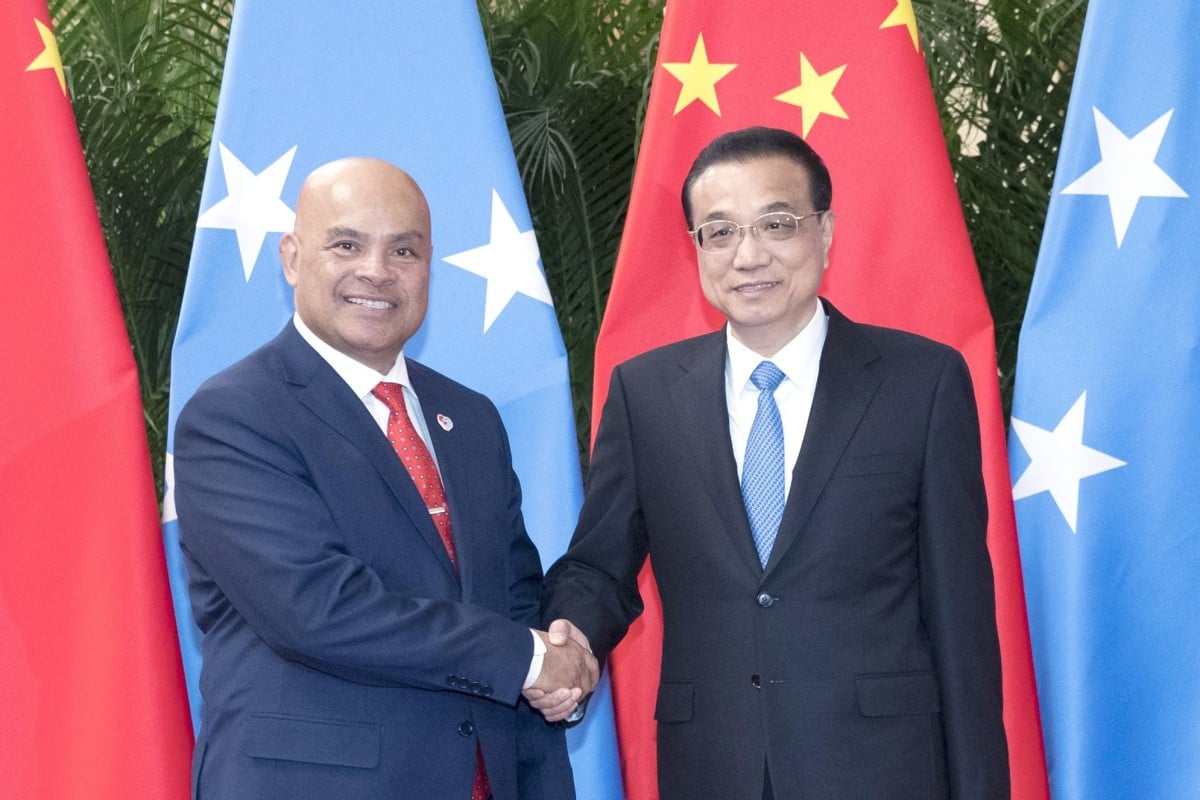
President of the Federated States of Micronesia David Panuelo shakes hands with Chinese Premier Li Keqiang at the Great Hall of the People in Beijing. Photo: Xinhua
In China earlier this month, David Panuelo, the president of the Federated States of Micronesia, climbed the Badaling section of the Great Wall. And, according to Huang Zheng, Beijing’s ambassador to the Pacific nation, the countries’ “great friendship rose to even greater heights” during Panuelo’s visit.
Chinese investment in Micronesia reached similarly lofty levels in conjunction with Panuelo’s trip, which marked three decades of diplomatic ties and included meetings with President Xi Jinping and Premier Li Keqiang. Beijing has committed US$72 million in economic development deals, almost as much as its total investment of the previous three decades.
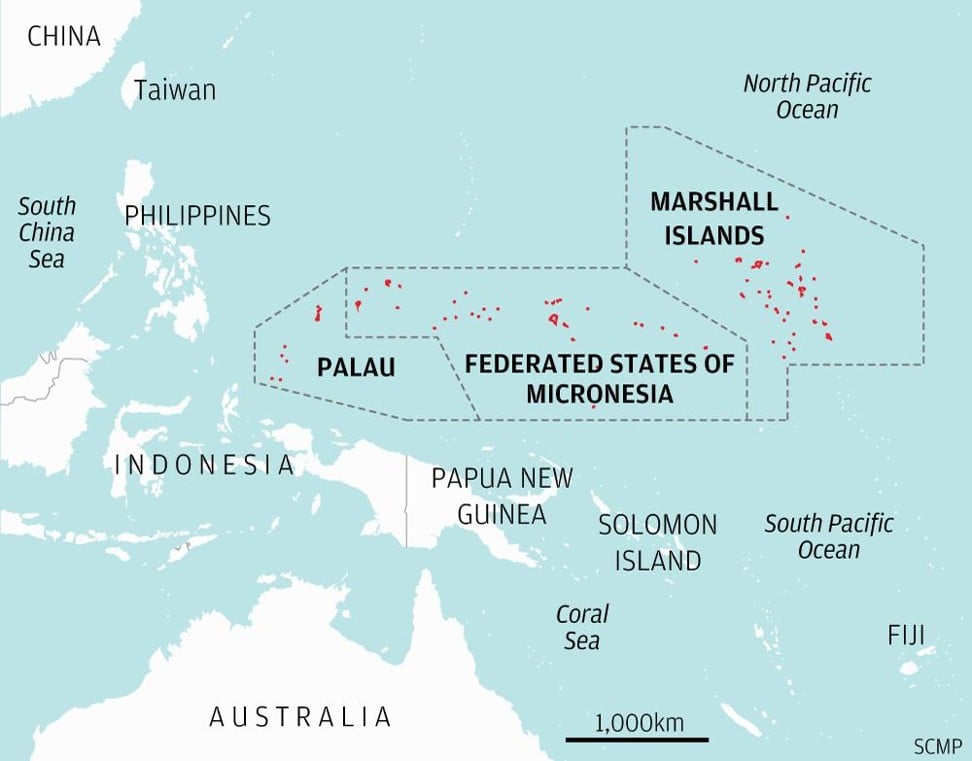
Micronesia is one of three Pacific nations with agreements with Washington, known as the Compact of Free Association (COFA), which allows their citizens to live and work in the US. In exchange, Micronesia, neighbouring Palau and the Marshall Islands grant the US exclusive military and defence access to their territorial waters – more than 2 million square miles of the Pacific that have been an essential element of Washington’s power projection in the region since World War II.
Much of China’s funding has been directed to Micronesia’s Chuuk state, which will in March vote in an independence referendum.
Although Chuuk is home to fewer than 50,000 people, its waters include one of the region’s deepest and most strategically appealing lagoons, creating extra incentive for Beijing and potential concern for Washington as the two countries
With a population of just 113,000 people, Micronesia relies on remittances sent home by citizens working in the US as well as the financial support from Washington under COFA. That assistance is scheduled to expire in 2023, creating uncertainty about the future of the relationship and making Chinese investment even more influential.
“Panuelo’s visit to China is a perfect example of how [the Chinese side] just needs to do a little to get a lot,” said Derek Grossman, senior analyst at Rand Corporation, a Washington think tank. “US$100 million is not very much for them and they can essentially loosen the screws [on COFA] with that.”
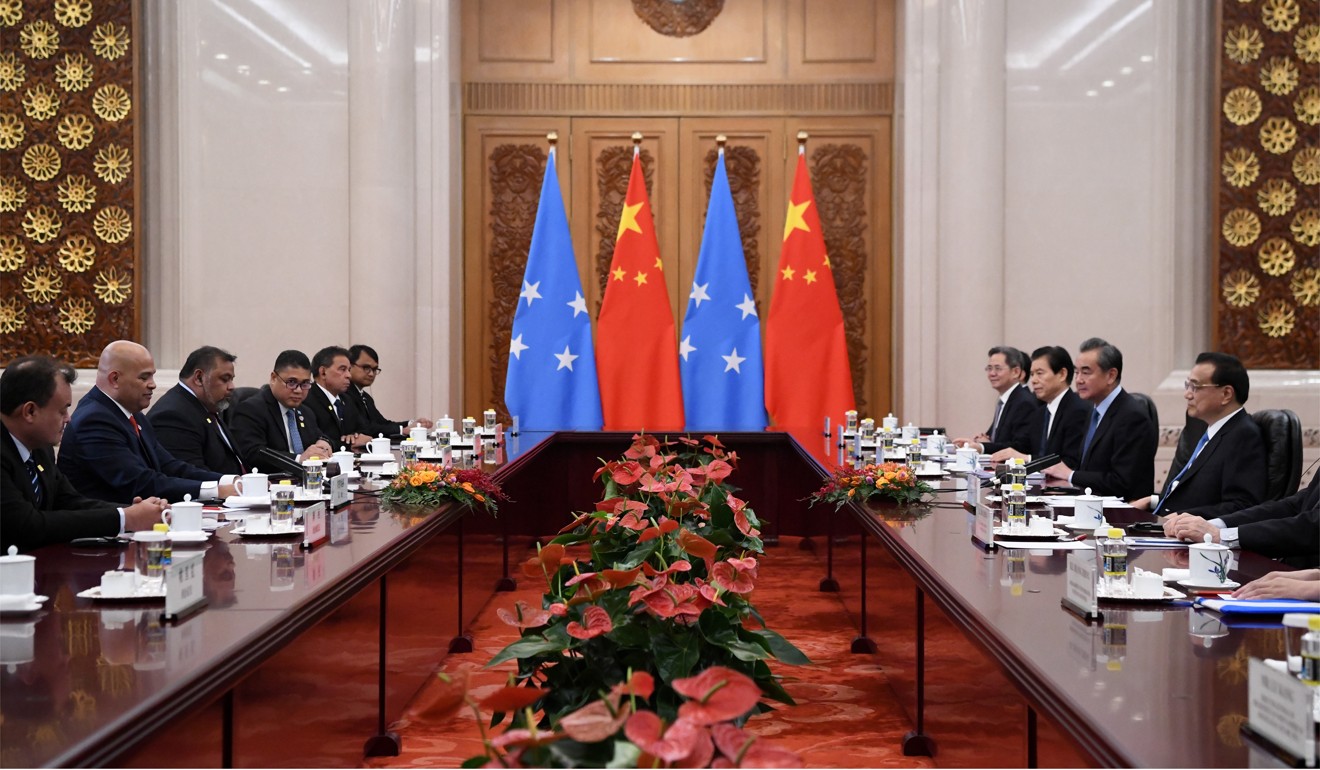
Micronesian President David Panuelo (second on left) and Chinese Premier Li Keqiang (right) during their talks in Beijing. Photo: EPA-EFE
The value of Micronesia’s bilateral trade with China has increased by nearly 30 per cent annually for the past five years, according to Micronesia’s Foreign Ministry. In 2017, the island nation signed onto President Xi’s signature Belt and Road Initiative which aims to build a vast network of strategic investment, trade routes and infrastructure projects across more than 150 countries.
US-China tech war’s new battleground: undersea internet cables14 Dec 2019
In recent years Chinese funding in Micronesia has built office and residential complexes for government officials, a showpiece new convention centre in the capital city Palikir, transport infrastructure and student exchanges, according to a recent report by Rand.
Jian Zhang, associate professor at UNSW Canberra at the Australian Defence Force Academy, said Beijing’s investment reflected a decision to cultivate broader, deeper ties.
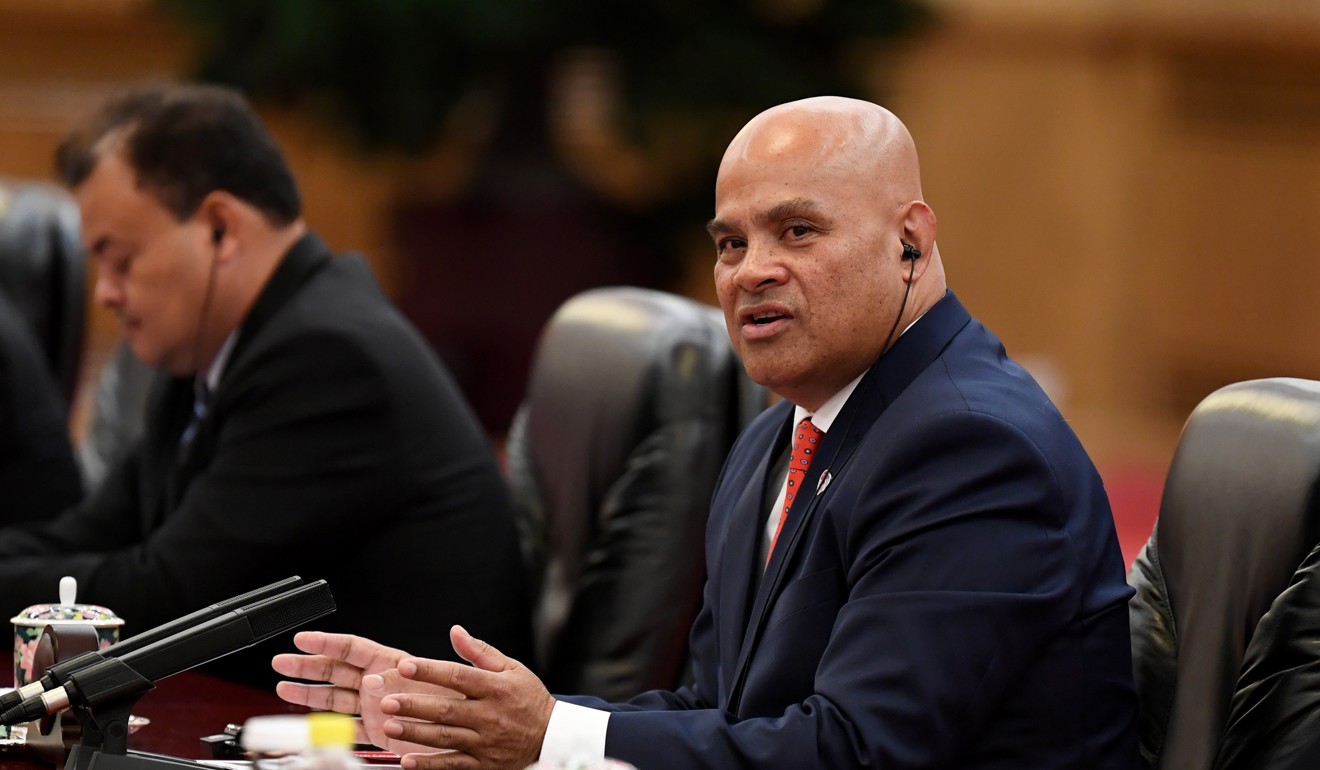
Micronesian President David Panuelo during his meeting with Chinese officials in Beijing. Photo: EPA-EFE
“China’s interest in building the relationship with Micronesia is not just about its diplomatic rivalry with Taiwan or economic interests,” he said. “It has elevated the relationship to a comprehensive strategic partnership which encompasses all areas.”
During his recent visit, Panuelo described China as Micronesia’s top economic partner and the US as its top security partner. Pompeo’s visit to Micronesia highlights US anxiety about rising Chinese influence in Pacific 5 Aug 2019
Gerard Finin, professor of regional planning at Cornell University, who previously worked with the US Department of State in the Pacific, said: “China’s leadership consistently accords large ocean states the full protocol that is expected when a head of state visits.
“In contrast, Washington has only had a limited number of meetings and never hosted an official state visit to Washington for the leader of a Pacific Island nation,” said Finin.
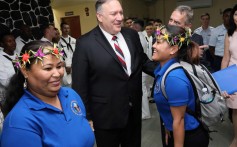
US President Donald Trump in May hosted the leaders of Micronesia, Palau and the Marshall Islands together at the White House. When Mike Pompeo visited Micronesia
in August, he became the only sitting US secretary of state to have done so.
Pompeo said negotiations to update COFA had begun but no details have been made public. Micronesia has assembled a team to conduct the negotiations but the US has not, the Honolulu Civil Beat website reported.
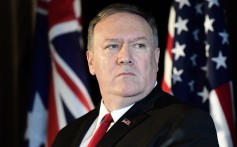
US Secretary of State Mike Pompeo visited Micronesia in August. Photo: AFP
Breakaway vote could raise the stakes
Panuelo’s team met Micronesian students studying in China and representatives of state-owned China Railway Construction Corporation, which will build the roads in Chuuk, funded in part by US$50 million from Beijing. Construction of the Chuuk government complex was also funded by Beijing and the state’s governor joined Panuelo for his visit.
Should Chuuk vote to separate from Micronesia in March, it could also mean breaking from COFA, jeopardising the US work privileges of thousands of Chuukese and opening the state’s waters to other partners, particularly China.
Chuuk is home to one of the deepest lagoons in the Pacific, a geographic rarity of particular value in strategic military operations and submarine navigation.
US Coast Guard looks to bolster Pacific allegiances as Chinese clout grows
22 Oct 2019
Zhang said Beijing would explore any opportunity to build a port with potential military capability.
“China has a long-term need to gain a strategic foothold in the region,” Zhang said. “That is a key part of the Belt and Road Initiative. At the general level it’s an economic initiative but an important aspect of the maritime Silk Road is to develop a network of strategically located port facilities.”
Sabino Asor, chair of the public education committee for the Chuuk Political Status Commission, told Civil Beat seceding from Micronesia would be the best option for Chuuk’s future.
“There is no encouraging prospect if Chuuk remains within the Federation,” he said.
However, Patrick Buchan, at Washington think tank Centre for Strategic and International Studies, said Chuuk’s dependence on remittances from the US made breaking from COFA unlikely.
China courts Pacific island states in pursuit of ‘foothold’ as US risks losing influence
8 Aug 2019
In the meantime, uncertainty over COFA negotiations persists, although there is a chance it will be renewed with few changes.
“There is circulation with people easily coming and going that provides a level of understanding and friendship that does not exist between too many other countries,” Finin said.
However, China’s most attractive feature may be its willingness to at least discuss the most pressing concern of Pacific Island nations: climate change.
“When the Trump administration talks about how it doesn’t believe in climate change, or can’t even say the words – that is really offensive for Pacific nations,” Grossman said. “China knows that, and is taking full advantage of it.”
Summit between Chinese, South Korean and Japanese leaders could yield results for future of Korean peninsula, analyst says
North Korea has promised an unwelcome “Christmas present” if the US does not show the “right attitude” for talks. Photo: KCNA
Chinese President Xi Jinping has again stressed the need for tensions on the Korean peninsula to be resolved through dialogue, as the deadline looms in North Korea’s threat to give the United States an unwelcome “Christmas gift”
.
With just over a week to go until Pyongyang’s year-end deadline for Washington to change what it says a policy of hostility, Xi held separate talks with South Korean President Moon Jae-in and Japanese Prime Minister Shinzo Abe in Beijing on Monday.
Moon and Abe will also join Chinese Premier Li Keqiang for a trilateral summit in Chengdu, Sichuan province, on Tuesday.
The first trilateral leadership talks took place in 2008, but were not held in 2013 and 2014, or in 2016 and 2017.
Xi said China and South Korea “both insist on maintaining peace and stability on the peninsula, and advocate solving problems through dialogue and consultation”, state news agency Xinhua reported on Monday.
“China supports South Korea in continuing to improve its relationship with
and injecting impetus for the Korean peninsula peace talks,” the report said.
Moon said the suspension of talks between the US and North Korea and heightened tensions along the peninsula “are not beneficial to both our countries and North Korea”, according to South Korean news agency Yonhap.
Moon also said that China had played an “important role” in efforts for the denuclearise the peninsula, the report said.
North Korea has signalled impatience over the stalled talks with the US, and the fading hopes for an end to Washington’s economic sanctions.
In April, North Korean leader Kim Jong-un said that he would “wait” until the end of the year to decide whether the US had the “right attitude” to allow a resumption of negotiations, but no signs of further talks have emerged.
Then earlier this month Pyongyang warned that Washington would receive a “Christmas gift”, and US actions would determine whether the present would be good or bad.
In an apparent sign of frustration with the US, North Korean news agency KCNA reported on Sunday that Kim held a meeting of the Workers’ Party of Korea to “bolster the overall armed forces of the country” to deal with the “the fast-changing situation”.
The US imposed crippling sanctions on North Korea’s economy in 2017, though many countries, including China, South Korea and Japan, have also tightened measures against the North.
South Korea and Japan both scaled back people-to-people links in 2016, China banned coal exports to the North in 2017. Earlier this year, Trump thanked China and Russia for maintaining sanctions against Pyongyang.
As diplomats make last-ditch attempts to stop renewed confrontation, US special envoy for North Korea Stephen Biegun shuttled around the region last week, meeting senior officials in China, South Korea and Japan. Biegun urged North Korea to return to negotiations, and said the US “does not have a deadline” for talks.
China and Russia also proposed last week that the United Nations Security Council
Xi’s meeting with Moon also comes as Beijing tries to mend ties with Seoul to prevent neighbouring nations from getting closer to Washington.
Relations between China and South Korea deteriorated in 2017 after Seoul deployed a US-led missile defence system known as THAAD, which Beijing deemed as a security threat to its own territory.
On Monday, both Xi and Moon said in their meeting that they looked forward to improving relations between their countries.
“We have been friends and partners that have continued close cooperation,” Xi said. “We have a wide range of common understandings in various fields, including on further developing bilateral relations, facilitating regional peace, stability and prosperity, and defending multilateralism and a free trade system.”
Sun Xingjie, a North Korea specialist at Jilin University, said the US signal was “very clear” in Beigun’s comments.
“They still want to continue discussions,” he said.
Sun also said the talks in Chengdu on Tuesday would likely play an important role in the future of resolving problems on the Korean peninsula.
“After returning to the platform these last couple years, I believe this will become an important, normalised place for discussions. Whatever problems they run into, the platform should continue to move forward,” Sun said.
BEIJING (Reuters) – The spectre of new confrontation between Pyongyang and Washington hangs over meetings between China, Japan and South Korea this week, with growing risks North Korean actions could end an uneasy detente and upend recent diplomatic efforts.
South Korean President Moon Jae-in and Japanese Prime Minister Shinzo Abe are expected to meet Chinese President Xi Jinping separately on Monday. They will then travel to the southwestern city of Chengdu for a trilateral meeting with Chinese Premier Li Keqiang. Though they are expected to discuss various economic matters, North Korea appears likely to dominate the agenda.
Pyongyang has grown increasingly frustrated that its halt of nuclear and long-range missile tests has not ended the crippling economic sanctions against it. It set a Dec. 31 deadline for the United States to make concessions, but Washington has been unmoved.
Some experts believe North Korea may be readying to test an intercontinental ballistic missile launch soon, which would likely end the 2018 agreement struck by its leader, Kim Jong Un, and U.S. President Donald Trump.
“Safeguarding the stability and peace of the Korean Peninsula and pushing for a political solution to the Korean Peninsula issue are in the interests of China, Japan and South Korea,” Chinese Vice Foreign Minister Luo Zhaohui told reporters on Thursday at a briefing on the trilateral meetings.
U.S. special envoy for North Korea Stephen Biegun met with two senior Chinese diplomats during his two-day visit to Beijing this week, following similar meeting in South Korea and Japan days earlier, as diplomats make last-ditch attempts to prevent new confrontation.
North Korea has not responded to his public call to resume dialogue, however.
“The silence, even after Biegun’s speech in Seoul, makes me concerned,” Jenny Town, managing editor at the North Korea monitoring website 38 North, said on Twitter.
Beijing, jointly with Russia, proposed on Monday that the United Nations Security Council lift some sanctions in what it calls an attempt to break the current deadlock and seeks to build support. But it’s unclear whether Beijing can convince Seoul and Tokyo to break ranks from Washington, which has made its opposition clear and can veto any resolution.
Though South Korea sees China as instrumental in reviving negotiations, it has so far sidestepped questions on whether it supports the new proposal by Beijing and Moscow. Japan, which has historically been a staunch supporter of sanctions against North Korea, has also refrained from commenting on the proposal.
“With the (2020 Tokyo) Olympics coming up, North Korea going wild would pose a problem for Japan,” said Narushige Michishita, professor at Japan’s National Graduate Institute for Policy Studies.
“But bilateral talks with North Korea, for example, will probably be a better approach for Japan than easing UN sanctions.”
has further bolstered its defence links with the United States with plans to build an F-16 fighter jet maintenance centre, as the Taipei government continues to resist Beijing’s objective of unification.
The self-ruled island’s Aerospace Industrial Development Corporation (AIDC) and US defence contractor Lockheed Martin signed a strategic partnership agreement on Tuesday that aimed to promote the establishment of an F-16 fighter jet maintenance centre in Taiwan, to be completed by 2023.
It is the latest of several significant agreements with the US during Donald Trump’s presidency. Trump approved a US$2.2 billion arms sale on July 8 that included 108 American-made M1A2T Abrams tanks and 250 Stinger missiles.
He was quicker to approve F-16 sales than his predecessors, agreeing in August to sell the island 66 F-16V jets, which will mean Taiwan owns the most F-16s in the Asia-Pacific region.
Trump also approved, in September last year, a US$330 million deal to provide spare parts and other logistics for several types of the island’s military aircraft – less than a year after the US agreed to sell US$1.4 billion of missiles, torpedoes and an early warning system to Taiwan.
Beijing views Taiwan as a breakaway province to be reunited with the mainland by force if necessary.
‘Fighter jets trump battle tanks’ in Taiwan’s US arms priorities
Collin Koh, a research fellow at the S. Rajaratnam School of International Studies with Nanyang Technological University in Singapore, said the planned maintenance centre underlined how Taiwan-US military ties had become stronger under the more enthusiastic US administration of Trump and the Taiwanese presidency of
“The [F-16 fighter jet maintenance] centre, by improving the availability and readiness of the F-16 fleet, allows Taiwan to sustain its combat aviation, not only for daily operation but also for training,” Koh said.
“This does represent a step up. Taiwan is no longer just an end-user operating the American hardware, but will also be empowered to service it. It is designed to help Taiwan achieve better defence self-sufficiency, one of the key pledges by the Tsai administration.”
Tang Shaocheng, a senior researcher in international relations at Taiwan’s National Cheng-chi University, said the increasingly close relations between Taipei and Washington made dealing with the island more tricky for Beijing.
Beijing ‘interferes daily’ in Taiwan’s election, says Tsai Ing-wen
“The Tsai administration cares about what the US thinks but not what Beijing thinks, paving the way for ever-closer ties,” Tang said. “That definitely leaves less room for Beijing to get Taipei into its orbit, by using various economic measures.”
Beijing has suspended exchanges with Taipei and staged a series of war games around Taiwan to intimidate the island since Tsai, of the independence-leaning Democratic Progressive Party, became president in 2016 and refused to accept its one-China policy.
Beijing has also tried to isolate Taiwan internationally by poaching its diplomatic allies
since Tsai took office, has repeatedly warned Washington against seeking closer military ties with Taipei, and has protested against every arms deal the two have made.
The US acknowledges the Chinese claim that it has sovereignty over Taiwan, which split from the mainland in 1949 and is self-governing. However, the US regards the status of Taiwan as unsettled and supports the island with arms sales and other measures, such as by sending warships through the Taiwan Strait that separates the island from China.
The Battle of Triangle Hill is known in China as a victory against foreign aggressors
Film’s timing linked to deteriorating relations between Beijing and Washington on multiple fronts
A scene from the 1956 Chinese film Shang Gan Ling, about the Korean war Battle for Triangle Hill, subject of a new film which is about to go into production in China. Photo: Handout
One of the bloodiest battles of the Korean war is the subject of a film that will soon start production in China, in a move which is being linked to surging Chinese nationalism amid poor relations between Beijing and Washington.
The film, based on the Battle of Triangle Hill – also known as the Shang Gan Ling campaign in China – was given the green light by state regulator the China Film Administration in July, but was not reported by Chinese official media until last week.
Hou Jianwei, one of China’s best known war novelists, has been signed on as screenwriter for the film, to be produced by Ao Bo Film Zhejiang which confirmed on microblogging platform Weibo that production was already in “active preparation”.
“More than 100,000 people from the People’s Voluntary Army and forces from the US and South Korea took part in the 43-day fighting, and over 2.4 million shells of ammunition were fired. The battle was unprecedentedly fierce and 40,000 lives were lost,” the film company said in its most recent Weibo post.
“With a multitude of heroes, our army built up an impenetrable barrier in the East.”
China invokes Korean war talks as reason not to bow to US in trade dispute
News of the film has coincided with mounting confrontations between Beijing and Washington on multiple fronts ranging from trade and technology, to Hong Kong and Xinjiang.
Korean war-themed productions have long been a taboo subject for China’s heavily censored film industry, partly because of Beijing’s complicated relations with the US and North Korea.
But the 1950-53 war, in which China and North Korea battled Western forces led by the US, has increasingly become a tool to rally public opinion behind Beijing’s ongoing trade war with the US. Study Times, a Central Party School publication, for example, has directly likened the trade war to the end of the Korean conflict, saying China was determined to oppose US bullying as trade negotiations entered their 17th month.
While Beijing has never given an official account of its decision to join the Korean war, it is often portrayed as a necessary intervention to shield China from US aggression.
The Battle of Triangle Hill has often been presented in China’s official media as a victory by the “volunteers” of the People’s Liberation Army over foreign aggressors.
News of the production has raised avid discussion on Chinese social media, with many seeing the new film as part of China’s efforts to reinforce surging Chinese nationalism in the face of growing pressure from the West.
“Isn’t the approval [to make the film] a strong signal to the West that we are now a strong power?” one Weibo microblogger wrote.
According to the 2019 Global Diplomacy Index, released by the Lowy Institute in Australia on Wednesday, China has 276 embassies, consulates and other missions globally, surpassing the US with 273 missions. France was third on 267.
Bonnie Bley, the index report’s lead researcher, said that while a country’s total did not equate to diplomatic influence, “diplomatic infrastructure is still important”
“China’s newly held lead serves as a telling metric of national ambition and international priorities,” Bley said.
Beijing has 169 embassies or high commissions, while Washington has 168. However, China had 96 consulates while the US had 88, suggesting that Beijing’s diplomatic expansion was closely linked to its economic interests, she said.
Beijing bulks up diplomacy budget as China extends global reach
Renmin University international relations professor Shi Yinhong said China had close and growing trade and investment ties with many developing countries, especially those taking part in the Belt and Road Initiative, increasing the need for consulates.
“One of the consulates’ main goals is to serve the citizens and businesses located in those countries,” Shi said.
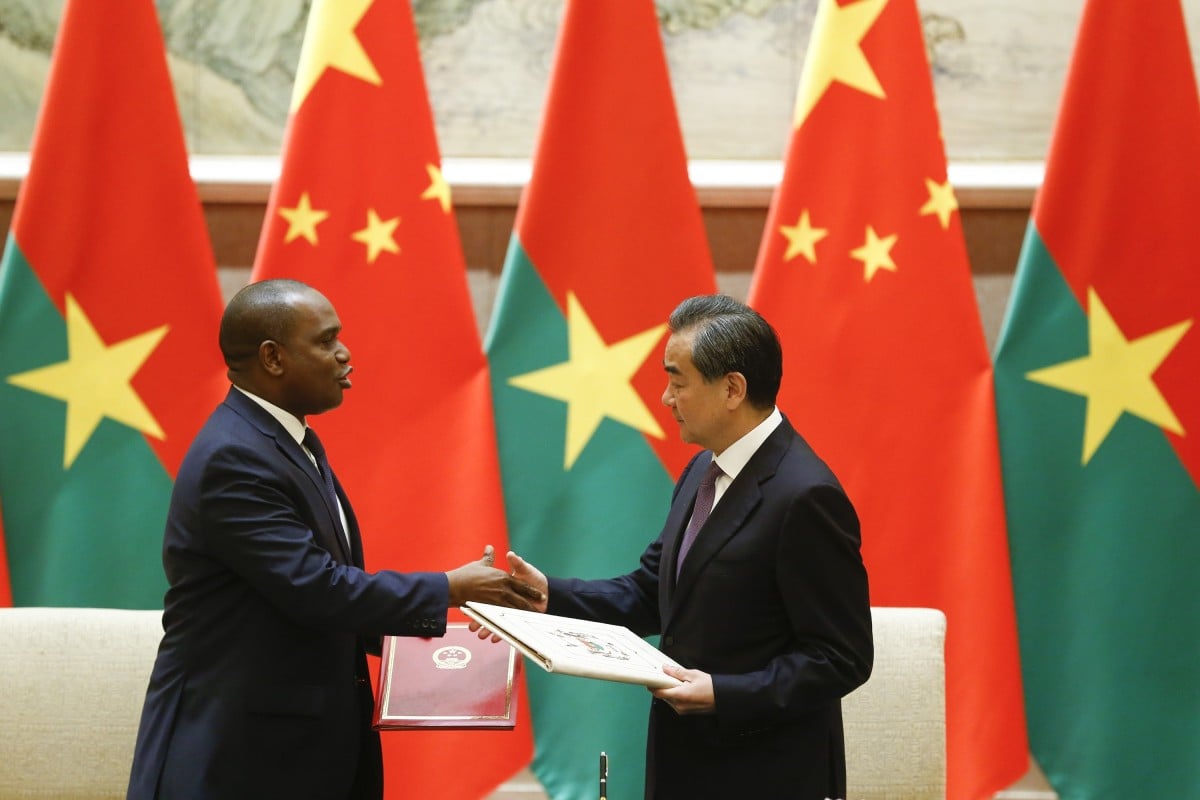
Beijing has also expanded its reach at Taipei’s expense. Since 2016, when the index was first published, Taiwan’s total number of embassies fell from 22 to 15, the biggest drop among the 61 places ranked.
China opened five new embassies – in El Salvador, Burkina Faso, Gambia, São Tomé and Príncipe and the Dominican Republic – countries that severed official diplomatic ties with Taiwan. This directly contributed to China’s lead over the US, the report said.
Beijing’s diplomatic expansion also comes as the US, under the administration of President Donald Trump, is taking an “America first” approach to foreign policy.
Sri Lanka rejects fears of China’s ‘debt-trap diplomacy’ in belt and road projects
Trump has sought to cut funding to the US State Department and the White House has not appointed US ambassadors for at least 17 countries, including Brazil and Egypt, according to the American Foreign Service Association.
“Even though the US has a strong diplomatic base but it is not so proactive any more. It has fewer consulates and fewer foreign service workers,” Shi said.
“For the long term, China is in a more advantageous position.”
But a country’s diplomatic ability and influence did not rest on the number of foreign service postings and the US still held more international diplomatic sway than China, he added.
Some of China’s biggest diplomatic missions include Islamabad in Pakistan, Washington and London.
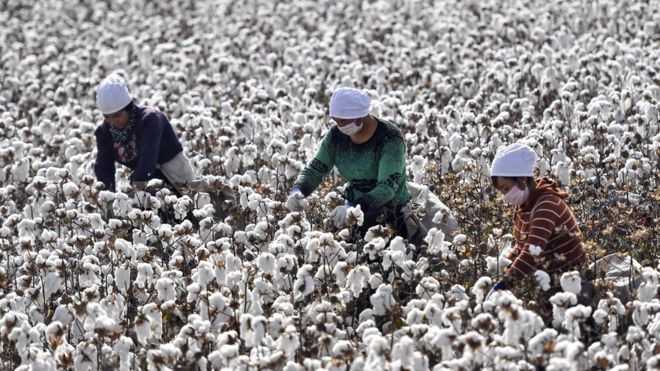
Global retailers are facing scrutiny over cotton supplies sourced from Xinjiang, a Chinese region plagued by allegations of human rights abuses.
China is one of the world’s top cotton producers and most of its crop is grown in Xinjiang.
Rights groups say Xinjiang’s Uighur minority are being persecuted and recruited for forced labour.
Many brands are thought to indirectly source cotton products from the Xinjiang region in China’s far west.
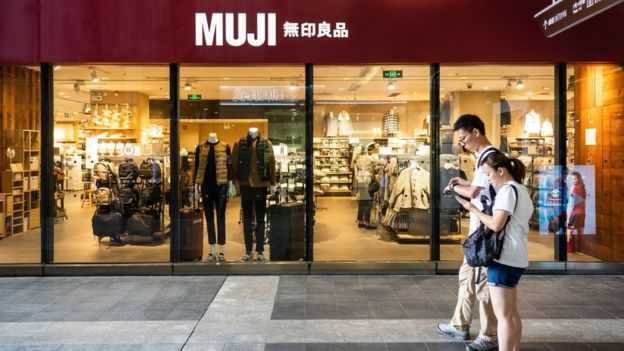
Japanese retailers Muji and Uniqlo attracted attention recently after a report highlighted the brands used the Xinjiang-origin of their cotton as a selling point in advertisements.
“You can’t be sure that you don’t have coerced labour in your supply chain if you do cotton business in China,” said Nathan Ruser, researcher at the Australian Strategic Policy Institute.
“Xinjiang labour and what is almost certainly coerced labour is very deeply entrenched into the supply chain that exists in Xinjiang.”
What is happening in Xinjiang?
UN experts and human rights groups say China is holding more than a million Uighurs and other ethnic minorities in vast detention camps.
Rights groups also say people in camps are made to learn Mandarin Chinese, swear loyalty to President Xi Jinping, and criticise or renounce their faith.
China says those people are attending “vocational training centres” which are giving them jobs and helping them integrate into Chinese society, in the name of preventing terrorism.
What is produced in Xinjiang?
The Xinjiang region is a key hub of Chinese cotton production.
Last year, 84% of Chinese cotton came from Xinjiang, the report said.
That has raised concerns over whether forced labour has been used in the production of cotton from the region.
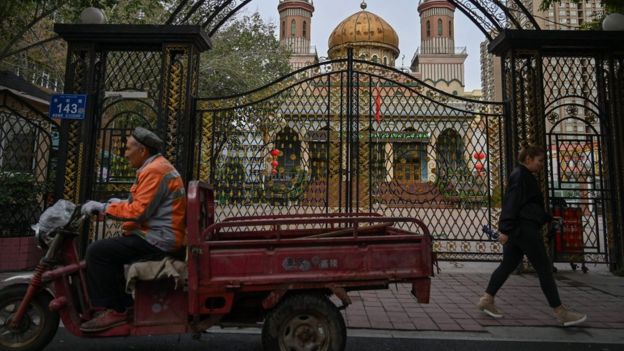
Image copyright GETTY IMAGESImage caption The Uighurs are mostly Muslims, and number about 11 million in China’s Xinjiang region
Nury Turkel, chairman of the Uighur Human Rights Project in Washington, said the Uighurs were being “detained and tormented” and “swept into a vast system of forced labor” in Xinjiang.
In testimony to US congress, he said it was becoming “increasingly hard to ignore the fact” that the goods manufactured in the region have “a high likelihood” of being produced with forced labour.
Which brands use Xinjiang cotton?
Amy Lehr, director of CSIS Human Rights Initiative, said in many cases Western companies aren’t buying directly from factories in Xinjiang.
“Rather, the products may go through several stages of transformation after leaving Xinjiang before they are sent to large Western brands,” she said.
Some, like Muji, are very open about sourcing material from Xinjiang.
“Uniqlo does not have any production partners located in the Xinjiang region. Moreover, Uniqlo production partners must commit to our strict company code of conduct.
“To the best of our knowledge, this means our cotton comes only from ethical sources,” the spokesperson told the BBC.
Many of the companies looked into the allegations, including those without clear links to the Huafu mill.
In a statement to the BBC, Adidas said: “While we do not have a contractual relationship with Huafu Fashion Co., or any direct leverage with this business entity or its subsidiary, we are currently investigating these claims.”
“We advised our material suppliers to place no orders with Huafu until we have completed those investigations,” the Adidas spokesperson said.
Esprit, which also does not source cotton directly from Xinjiang, said it had made several inquiries earlier this year.
“We concluded that a very small amount of cotton from a Huafu factory in Xinjiang was used in a limited number of Esprit garments,” the firm said in a statement.
The company has instructed all suppliers to not source Huafu yarn from Aksu, the statement said.
H&M said it does not have “a direct or indirect business relationship” with any garment manufacturer in the Xinjiang region.
“We have an indirect business relationship with Huafu’s spinning unit in Shanyu, which is not located in the Xinjiang region, and according to our data, the vast majority of the yarn used for our garment manufacturing comes from this spinning unit,” a spokesperson for H&M said.
“Since we have an indirect business relationship with the yarn supplier Huafu, we also asked for access to their spinning facilities in Aksu. Our investigations showed no evidence of forced labor.”
Negotiations going ‘as planned’, foreign ministry says after cancellation of Apec summit at which presidents were set to meet to sign ‘phase-one’ agreement
With an election looming and possible impeachment inquiry, Trump in more of a hurry to reach a deal than Xi, observers say
Talks between China and the US are going well, according to the Chinese foreign ministry. Photo: AFP
Presidents Xi Jinping and Donald Trump have “maintained contact”, China’s foreign ministry said on Thursday after authorities in Chile announced the cancellation of the upcoming Apec summit at which the US and Chinese leaders were set to meet and possibly sign a trade deal.
Talks between the two nations were going well, ministry spokesman Geng Shuang told a daily press briefing.
“The negotiations are smooth and things are working out as planned,” he said.
“Regarding the meeting between the two state leaders, they have maintained contact through various means.”
Geng’s comments came after China’s commerce ministry said that top trade negotiators from the two countries would hold a telephone conversation on Friday.
Xi and Trump were due to meet on the sidelines of the Asia-Pacific Economic Cooperation summit in Santiago on November 16-17, but the event was cancelled due to the ongoing protests in the country. The leaders were also expected to sign an interim trade deal based on the ground made at the latest negotiations in Washington on October 11.
According to diplomatic observers, while Beijing wants a truce in the trade dispute it is in less of a hurry than Trump, who is facing the threat of impeachment and trying to prepare for an election campaign.
Shen Dingli, an expert in international relations based in Shanghai, said that China faced less domestic opposition to its handling of the trade talks than Washington.
“Trump is facing a lot of problems on both the diplomatic and domestic fronts,” he said. “[But] I think both sides still need an agreement. It is always better to have an agreement than not.”
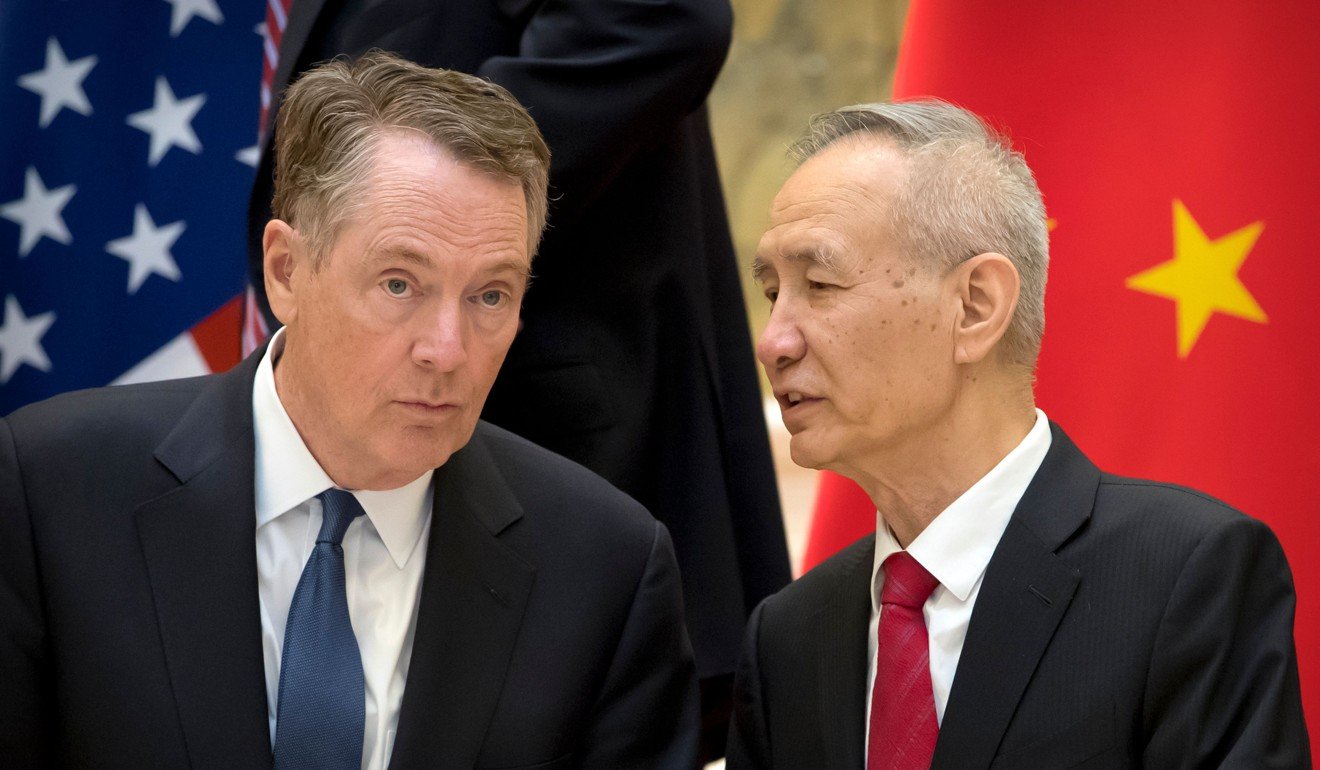
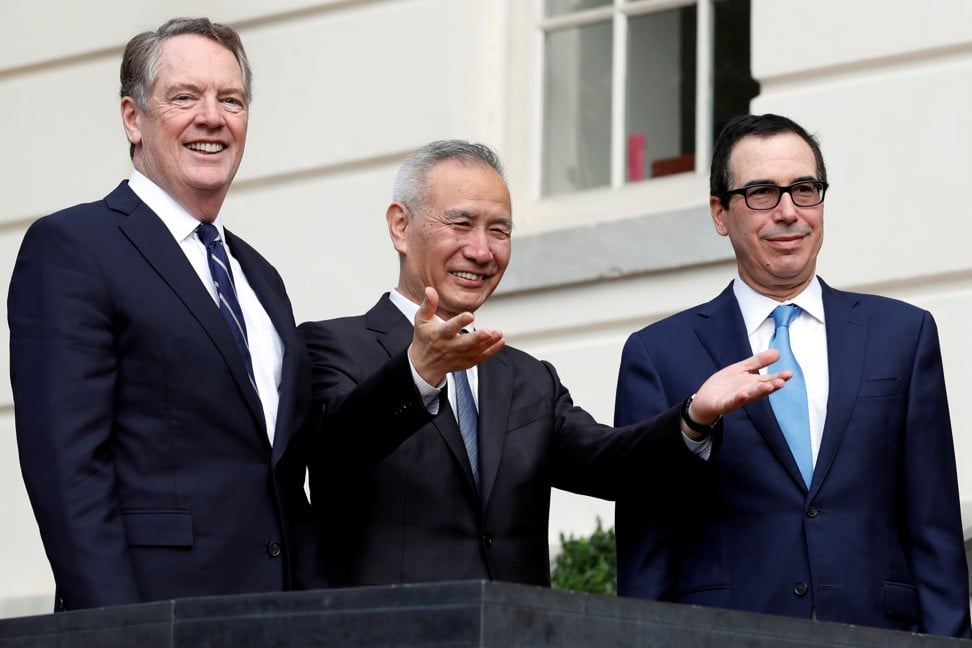
US Trade Representative Robert Lighthizer (left) and Chinese Vice-Premier Liu He met in Washington early this month. Photo: AFP
Yuan Zheng, an expert on China-US relations at the Chinese Academy of Social Sciences, said that while the Apec summit had offered a convenient way for the presidents to meet, the substance of the deal was more important than where it might be signed.
“It’s true that the deal can be signed by representatives instead of the presidents but this depends very much on how keen Trump is for the presidential meeting to happen,” he said.
“He is facing an election and huge domestic pressure, so he … needs to show his strong leadership more than Xi. But of course, if the deal is set and if the details of the meeting are practical, the Chinese side would like a presidential meeting too.”
Shen Dingli, an expert in international relations, says China faces less domestic opposition to its handling of the trade talks than Washington. Photo: AP
Speaking after the talks in Washington between Chinese Vice-Premier Liu He, US Trade Representative Robert Lighthizer and US Treasury Secretary Steven Mnuchin, Trump said the two sides had reached a “substantial phase one deal” and that after it had been put down on paper it would be signed at the Apec meeting.
Tai Hui, chief market strategist for Asia at JPMorgan Asset Management, said the cancellation of the Chile summit should not stop the US and China agreeing a truce.
“If the two sides are genuinely willing to reach an interim deal before mid-December, when the next increase in tariffs on Chinese goods is due to take place, they will find a venue to get it done,” he said.
Chinese President Xi Jinping and US President Donald Trump set to meet on the sidelines of the Apec summit in Chile next month, a source says
The two state leaders are expected to sign an interim trade deal ‘if everything goes smoothly’
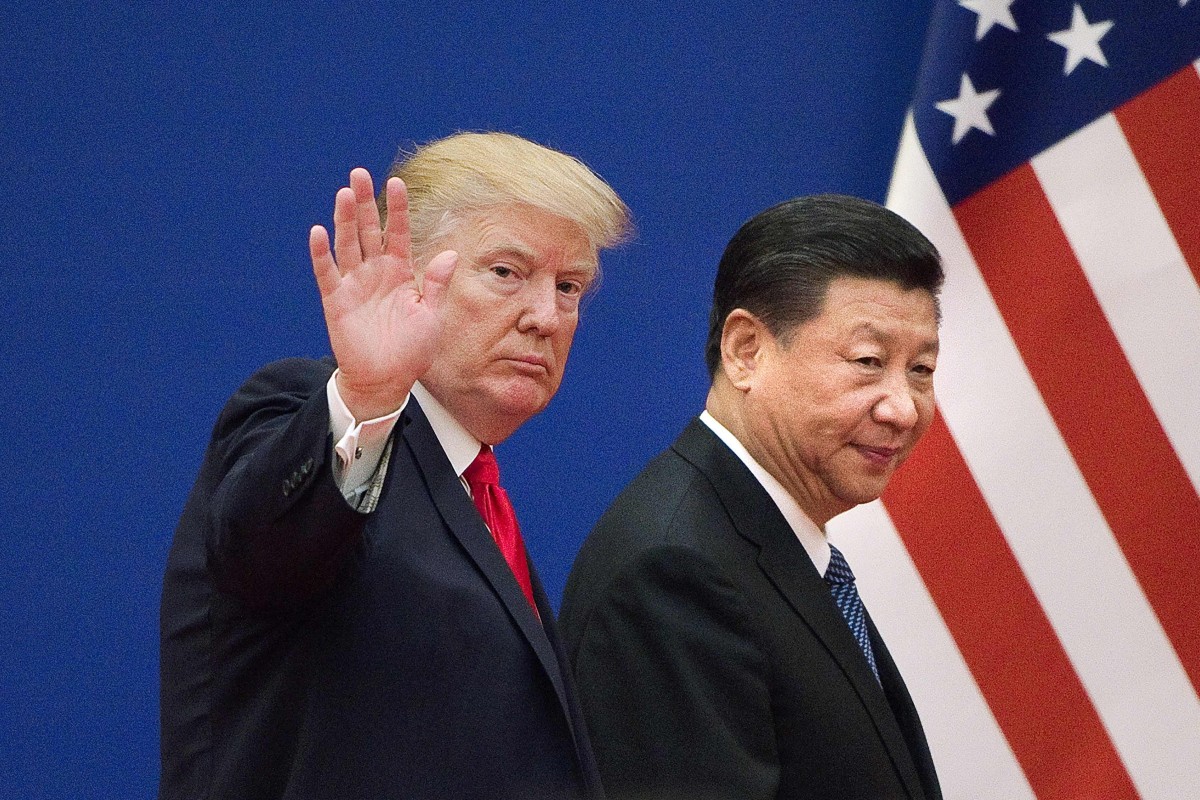
Chinese President Xi Jinping and US President Donald Trump have met twice already over the course of the 16-month trade war. Photo: AP
Chinese President Xi Jinping and US President Donald Trump are tentatively expected to meet on November 17 with the aim of signing an interim trade deal, a source briefed on the arrangements told the South China Morning Post.
The two leaders are expected to come face-to-face immediately after the Asia-Pacific Economic Cooperation (Apec) summit in Santiago, Chile, with a trade truce signed “if everything goes smoothly”, said the person, who declined to be identified.
Trade envoys from Beijing and Washington are still finalising the text for the two leaders to sign, but both sides have expressed optimism that Trump’s so-called phase one trade deal can be completed in time for the meeting.
Trump said on Monday that negotiations on the interim deal were running “ahead of schedule”.
“We are looking probably to be ahead of schedule to sign a very big portion of the China deal, and we’ll call it phase one but it’s a very big portion,” Trump said. “That would take care of the farmers. It would take care of some of the other things. It will also take care of a lot of the banking needs.
“So we’re about, I would say, a little bit ahead of schedule, maybe a lot ahead of schedule,” the president said, adding the deal would “probably” be signed.
Top trade negotiators for the two countries – US Treasury Secretary Steven Mnuchin, US trade representative Robert Lighthizer and Chinese Vice-Premier Liu He – spoke by telephone last Friday. The Office of the US Trade Representative released a statement after the call saying that the two sides “made headway on specific issues” and “are close to finalising some sections of the agreement”.
China’s official Xinhua News Agency said on Saturday negotiators have “agreed to properly resolve core concerns of each other” and had “basically completed technical discussions about parts of the text”. In particular, China would lift the current ban on US poultry imports and recognise the American public health certification system for meat product imports, Xinhua said.
The top trade envoys are expected to hold another conference call in the near future.
China’s Vice-Premier Liu He between US trade representative Robert Lighthizer (left) and US Treasury Secretary Steve Mnuchin during trade negotiations in Washington this month. Photo: Reuters
Taoran Notes, an account on Chinese social media platform WeChat run by the official Economic Daily newspaper, wrote over the weekend that Beijing and Washington had moved a step closer to agreement on a “temporary deal”.
“According to past experiences and practises, the negotiation will enter the stage of translation and legal review after the technical completion of the text,” the account said.
Geng Shuang, a Chinese foreign ministry spokesman, said that technical negotiations about part of the deal were finished but deputy-level talks were ongoing. “China hopes both sides can find a trade solution based upon mutual respect and benefits,” Geng said at a regular press conference on Tuesday.
If it goes ahead as planned, the summit between Trump and Xi in Chile next month would be the third time the two leaders have sat down to talk about ending the nearly 16-month-long trade war.
Last December, the two leaders met on the sidelines of the G20 Leaders’ Summit in the Argentinian capital Buenos Aires and agreed to a three-month tariff truce to allow time for the countries’ trade envoys to work out a comprehensive deal. But the talks collapsed in early May with the US blaming China for reneging on promises it made in negotiations, while China blamed the US for attempting to infringe on its economic sovereignty.
The pair met again in late June in the Japanese city of Osaka, where they agreed to restart trade negotiations.
A minor ceasefire was reached in October when Beijing promised to buy US$40 billion to US$50 billion worth of American agricultural products in exchange for Washington postponing indefinitely a tariff increase on US$250 billion of Chinese goods to 30 per cent from 25 per cent on October 15.
Analysts expect fresh 15 per cent duties on about US$160 billion of Chinese imports – including popular products like smartphones and consumer electronics – that are due to go into effect mid-December will also be postponed if a deal is signed, though this has not been officially confirmed.
The interim deal is also expected to contain a provision on intellectual property protection, a key US demand. China has taken steps to improve IP protection, including setting up a system to punish and compensate instances of infringement, and improve settlement disputes. But how well these measures will be implemented remains in question.
China and the US would also agree to avoid allowing currency devaluations to gain trade advantages, codifying a commitment both countries made as part of a G20 agreement several years ago. A currency agreement – similar to provisions in the yet-to-be-ratified US-Mexico-Canada Agreement – could pave the way for the US to remove its designation of China as a “currency manipulator”.
The deal may include a new dispute resolution mechanism to ensure both sides live up to commitments. The system, which will give both sides equal standing, would replace a contentious US-proposed enforcement mechanism that was a key reason for trade talks breaking down in May after China felt the demands too intrusive and one-sided. It is unclear how effective the proposal would be, but the US has insisted since talks began that a similar mechanism be implemented to ensure China did not backslide on promises as it had in the past.
In addition to large purchases of farm products, the interim agreement may contain commitments by China to buy US-built aircraft and energy products, particularly liquefied natural gas.
China will also agree to lift foreign ownership limits on Chinese financial firms under the deal, changes which are already underway.
However, the interim deal will not address broader US complaints about China’s economic model, particularly allegations that foreign firms are treated unfairly and heavy government subsidies favour some domestic industries. Nor will it contain any break for telecommunications equipment maker Huawei and other Chinese tech companies that were blacklisted by the US on national security concerns.
The president is set to become the first Russian leader to make a state visit to the Philippines for more than 40 years, according to a former envoy
Moscow is aware of China’s entry into the Philippines, and could have its eye on some projects there, while the US is also watching developments
Russian President Vladimir Putin and Philippine President Rodrigo Duterte shake hands during a 2016 meeting in Peru. Photo: EPA
The timing of Moscow’s announcement over the weekend that President Vladimir Putin
has accepted an invitation to visit Manila has raised eyebrows, as it comes on the eve of crucial bilateral talks between the Philippines and China on joint oil exploration in the
In a statement immediately welcomed by the Philippine presidential palace, Igor Khovaev, Russia’s ambassador to the Philippines, on Saturday told reporters Putin had accepted Duterte’s invitation “with gratitude”.
No date has been set for the visit, with Khovaev only saying Moscow would “do our best to arrange this meeting as soon as possible”.
A steering committee with representatives from both Manila and Beijing is set to meet this week to discuss the joint oil exploration deal. China has proposed a 60 per cent-40 per cent split in favour of the Philippines, according to Hermogenes Esperon,
Courting Russia with South China Sea oil is a ‘dangerous gamble’ for Duterte
Neither side has clarified if the split refers to ownership or revenue, and no other details were disclosed.
After an August meeting with Duterte, Chinese President Xi Jinping said the countries could take a “bigger step” in jointly developing oil and gas resources if they could properly handle their sovereignty dispute in the South China Sea.
But defence and security analysts say the Philippine president took a “dangerous gamble” on a visit to Russia last month, when he invited the Russian state oil company Rosneft to explore for oil in Philippine waters – which include parts of the South China Sea claimed by China.
The timing of Moscow’s announcement has not gone unnoticed.
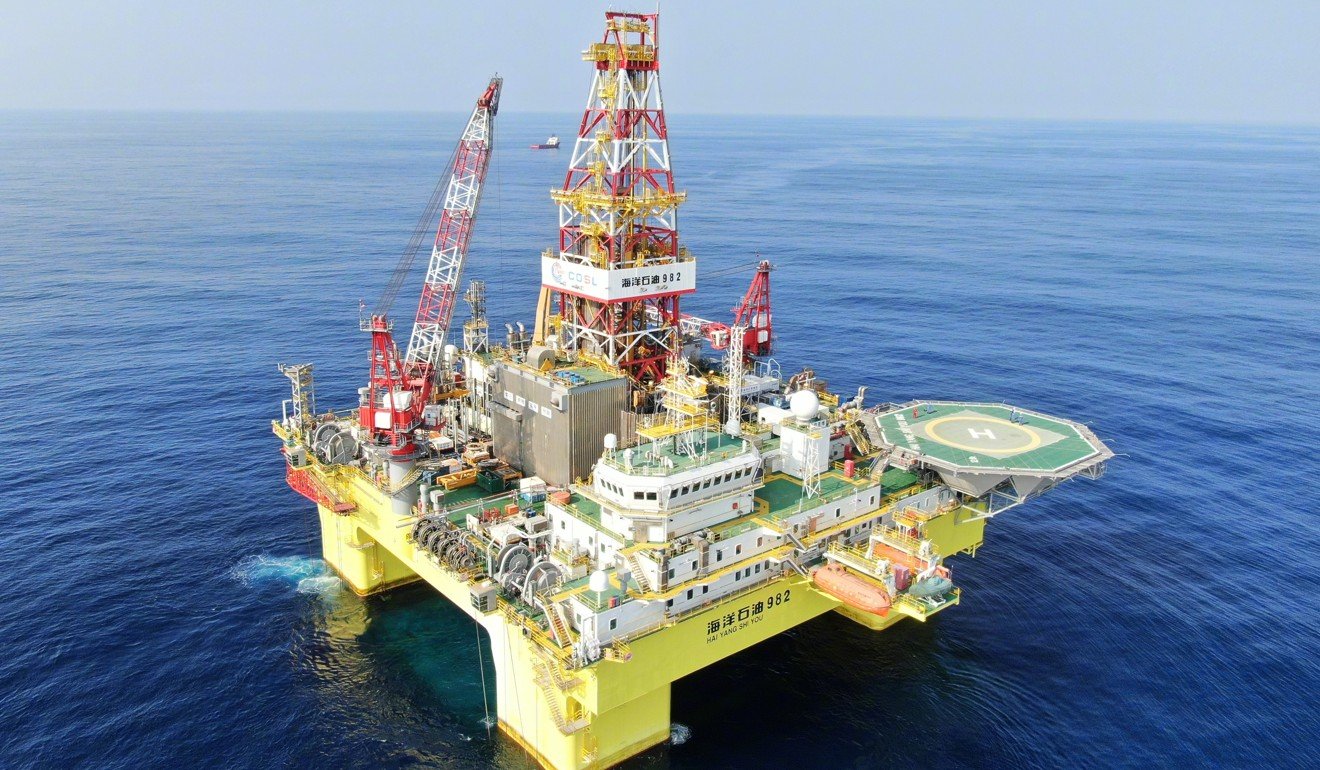
A Chinese deepwater oil rig in the South China Sea. Photo: Weibo
“It’s a welcome and historic development. Some wise guy in the Duterte government thought about timing [the invitation to Putin around the oil talks with Beijing],” said retired Philippine ambassador Lauro Baja, who once served as president of the United Nations Security Council.
Baja told the Post that no Russian president had visited the Philippines during his more than 40 years with the Department of Foreign Affairs.
“The Philippines then was almost a nonentity as far as Russia was concerned, [but] maybe now Russia recognises the strategic importance of the Philippines [in terms of] regional politics,” he said.
Baja said Moscow was aware of China’s entry into the Philippines, and could have its eye on some projects there.
“For all their so-called alliance, China and Russia are fierce competitors for influence and other benefits. And I think Russia has some objectives in mind like selling armaments and [forging] technological agreements,” he said, while cautioning that the situation remained “nebulous”.
New Philippines military chief sees no ‘shooting war’ in South China Sea despite disputes
“It’s a fascinating development but things are still early … For now, this is [just] an invitation extended by Duterte and accepted in principle by Putin.”
The United States will also be monitoring developments in the Philippines, according to Greg Poling, director of the Washington-based Centre for Strategic and International Studies’ Asia Maritime Transparency Initiative.
“Russia is eager to boost its influence in the region, and doubtless doing so with a long-standing US ally is seen as a bonus by Moscow,” he said. “There is nothing that prevents the Philippines from engaging in security cooperation with Russia, but the devil will be in the details.”
Poling added that the US would be concerned if Russia-Philippine cooperation involved acquiring military platforms that were incompatible with the shared platforms and doctrines used by Washington and Manila, as well as the latter’s other major security partners, namely Australia, Japan and South Korea.
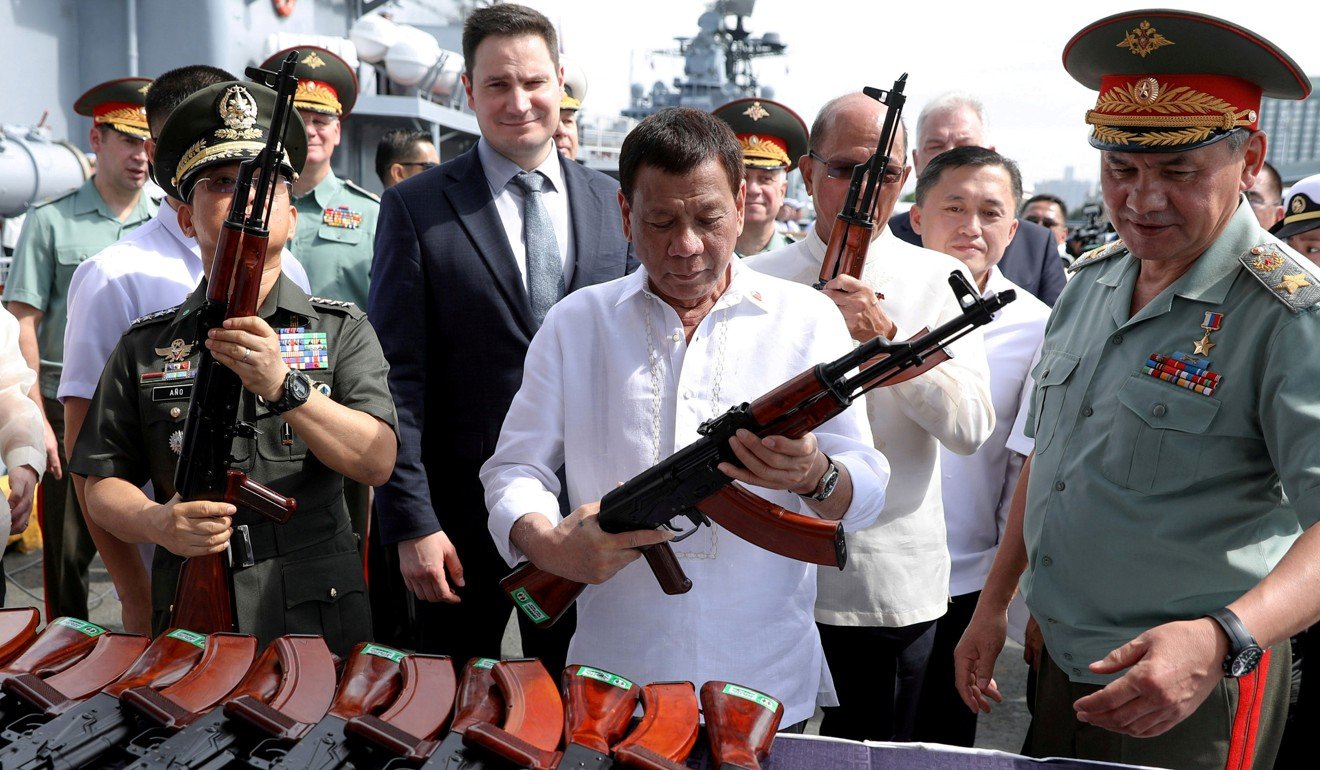
Philippine President Rodrigo Duterte inspects firearms donated by Russia in 2017. Photo: Reuters
“The US will also be concerned if any acquisitions or cooperation with Russia might threaten information security or intelligence cooperation between the US and the Philippines,” he said.
“And finally, any major platforms acquired from Russia would likely require the US to impose sanctions on the Philippines unless a waiver is granted, and the US government has been very stingy about awarding those waivers because they undermine the effectiveness of the sanctions regime.”
“Imagine a US stronghold and long-time ally and former colony becoming a manufacturing hub for Russian arms. And it makes it worse if [the Philippine armed forces] buys them too,” he said.
“Weakening the US alliances in Asia will benefit Russia [as it is] one of the US’ competitors in arms sales and geopolitics.”
Russia offers arms technology to the Philippines with ‘no conditions’ as US ties falter
The Philippines, Montero said, would benefit from such an arrangement since it is “a laggard in defence technology”. However, he pointed out that the country’s armed forces continue to buy weapons from the US and receive American arms as grants, potentially limiting the domestic market for Russian arms.
Navy cooperation has also been on the agenda, as Moscow and Manila discussed signing a new naval pact in March, while warships from each country have visited the other this year. Philippine naval vessels made their first-ever visit to Russia in October, while three Russian ships docked in the Philippines for a goodwill visit in January.
Russia is the top supplier of arms to Southeast Asia, and the No 2 global arms supplier, behind the US. Southeast Asia bought US$6.6 billion of Russian arms between 2010 and 2017, or more than 12 per cent of Russia’s sales, according to the Stockholm International Peace Research Institute, a Swedish think tank that publishes global arms tracking data.










 CHINDIA ALERT: You'll be living in their world, very soon