Chindia Alert: You’ll be Living in their World Very Soon
aims to alert you to the threats and opportunities that China and India present. China and India require serious attention; case of ‘hidden dragon and crouching tiger’.
Without this attention, governments, businesses and, indeed, individuals may find themselves at a great disadvantage sooner rather than later.
The POSTs (front webpages) are mainly 'cuttings' from reliable sources, updated continuously.
The PAGEs (see Tabs, above) attempt to make the information more meaningful by putting some structure to the information we have researched and assembled since 2006.
Military experts say PLA modernisation brought about during Xi Jinping’s presidency will be the main focus of October 1 celebration in Beijing
It’s necessary for China to ‘show some of its muscle’ amid the trade dispute with the US, observer says
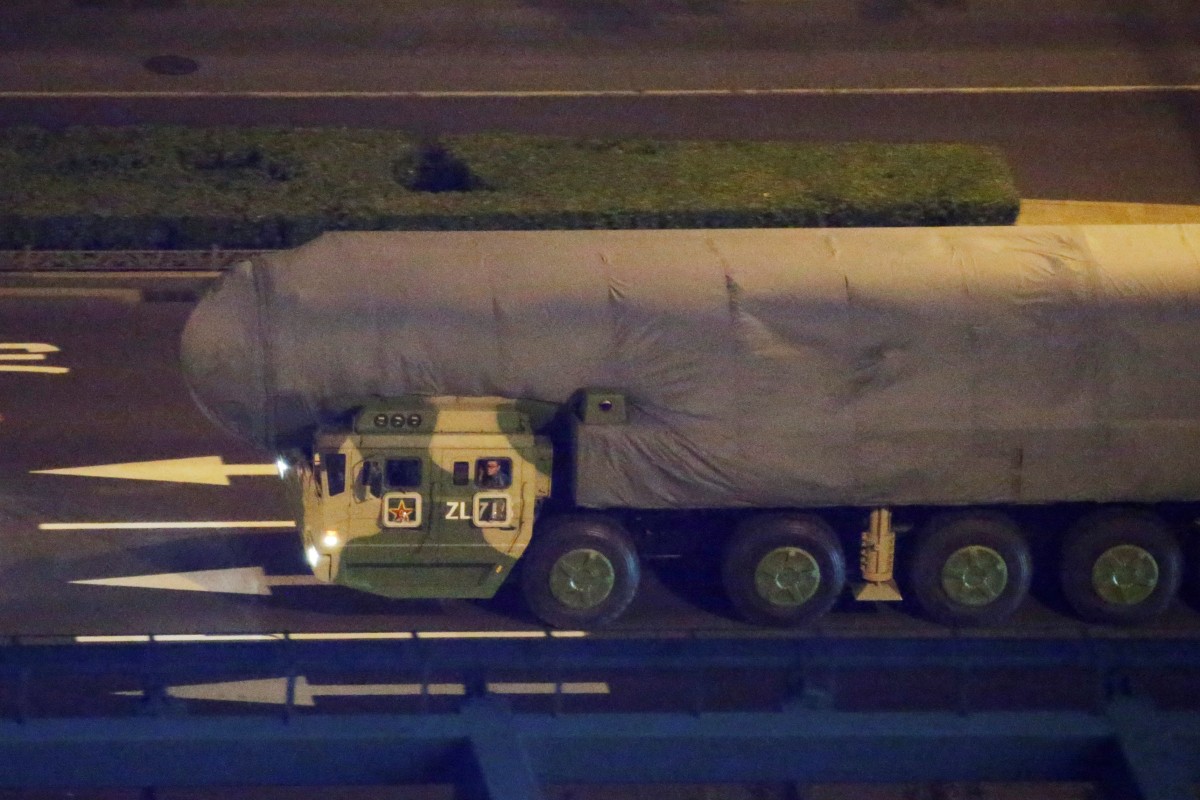
China’s land-based DF-41 intercontinental ballistic missile will be among the military hardware on show on October 1. Photo: Reuters
China plans to show off its most advanced active weapon systems at the upcoming National Day parade, which will be the biggest of the 14 such events it has held over the past seven decades.
The parade, to be held on October 1 to mark the 70th anniversary of the founding of the People’s Republic, will highlight the military modernisation – particularly in nuclear deterrence – that has taken place since President Xi Jinping came to power in late 2012, according to military experts.
The People’s Liberation Army (PLA) offered a glimpse of those weapons during rehearsals for the parade in downtown Beijing from September 14.
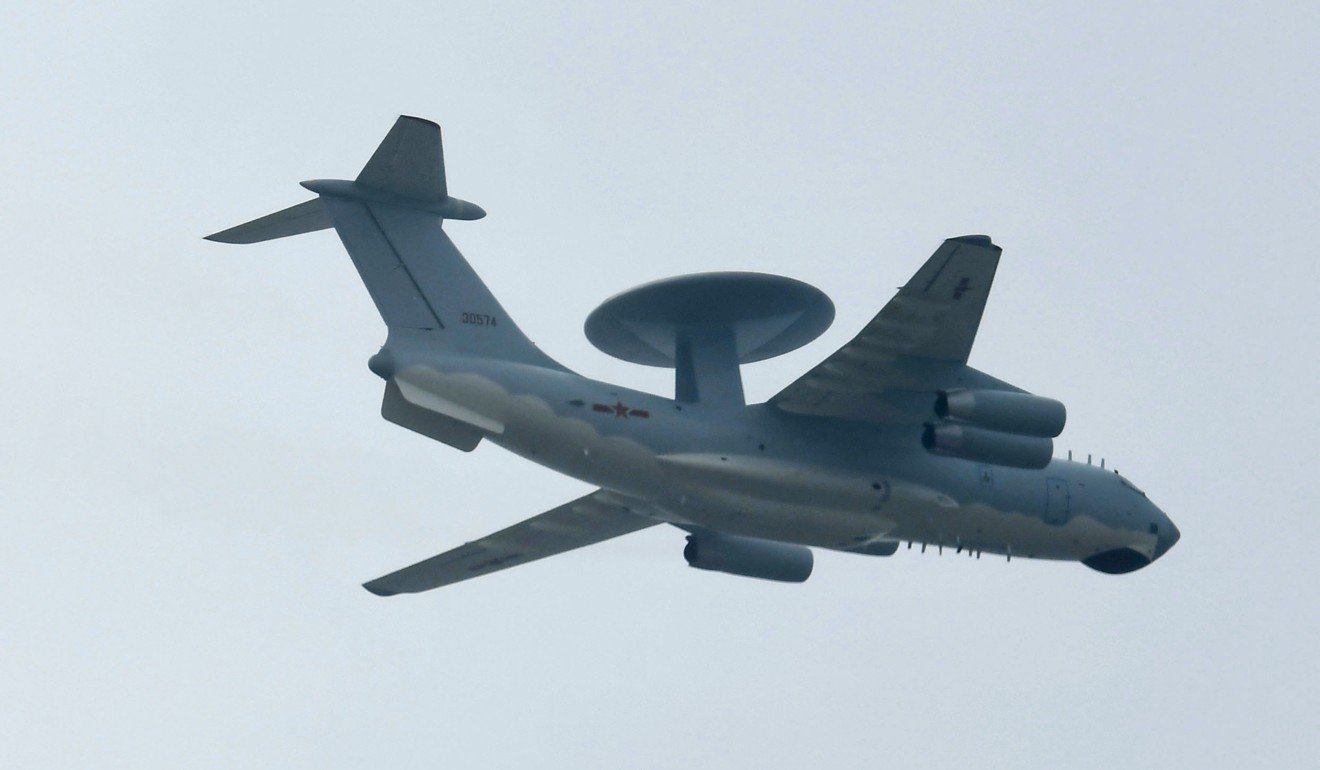
As part of the celebrations, Xi, who also chairs the Central Military Commission, will inspect 48 squads on the ground and more than a dozen airborne squadrons, according to a military insider involved in support services for the parade.
More than a dozen airborne squadrons will take part in the National Day parade. Photo: Kyodo
The squadrons will include the air force’s first stealth fighter, the J-20; the main active warplanes such as the J-10 and J-11B; and armed helicopters like the Z-20. However, the J-8 fighter jet would not appear this year, the source said, confirming that the first interceptor built in China has been formally retired.
“The ground march will be led by several hero forces from the five theatre commands, which is different from previous squads selected from the ground forces, air force and navy,” said the insider, who requested anonymity because of the sensitivity of the matter.
“The main goal of this year’s parade is to promote the military modernisation of the PLA under President Xi’s leadership over the past seven years, with the military overhaul being one of the key achievements.”
Thirty-three of the 48 squads would be “weapon squads”, while the 13 others would be made up of infantry troops from the five theatre commands, the source said.
National Day fireworks in Hong Kong cancelled over safety fears
As part of the PLA’s sweeping military reforms, the army’s previous seven military commands were reshaped into five theatre commands, while the four former general headquarters were dissolved and replaced by 15 small functional departments.
In September 2015, Xi announced the PLA would shed 300,000 troops, cutting its size to 2 million, a move aimed at turning the PLA into a more nimble and combat-ready fighting force on a par with international standards.
Xi also split the former Second Artillery Corps into the Rocket Force and the Strategic Support Force, with the latter backing up the military’s electronic warfare units in cyberspace and outer space.
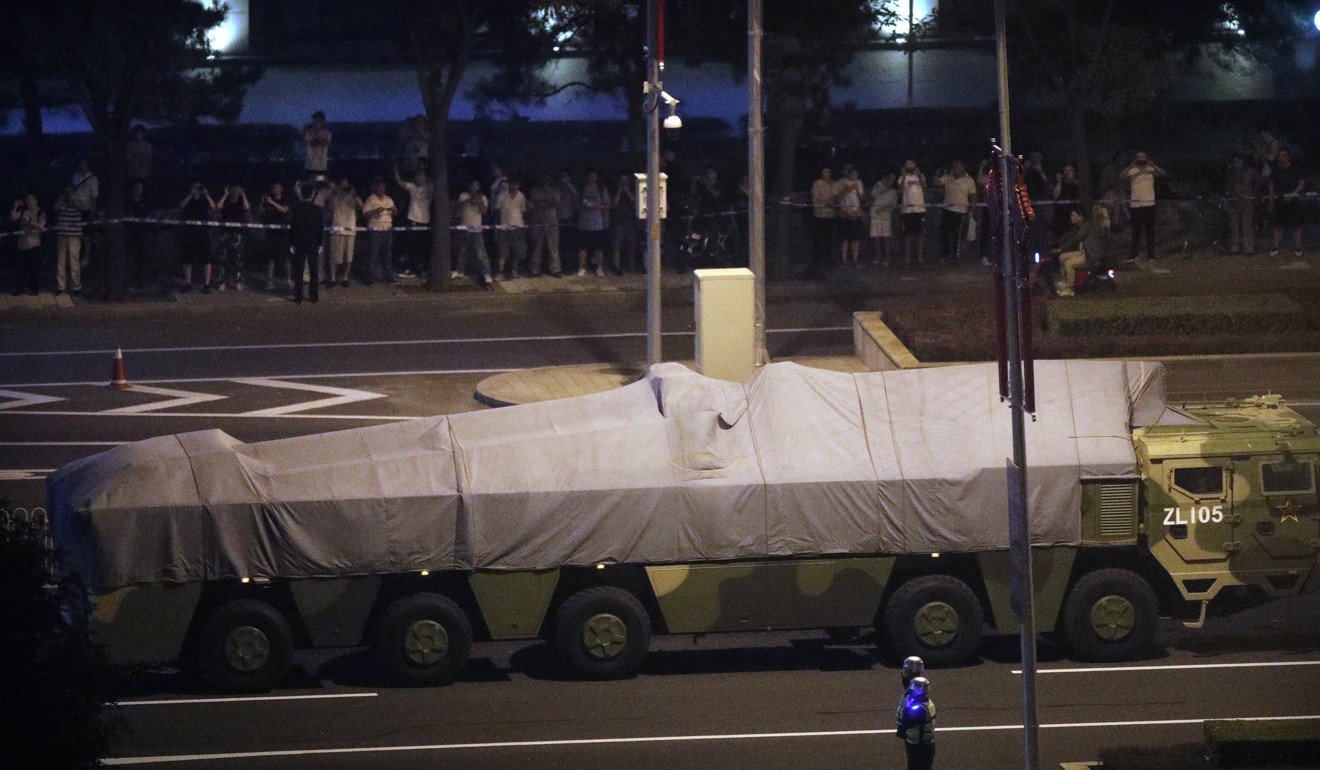
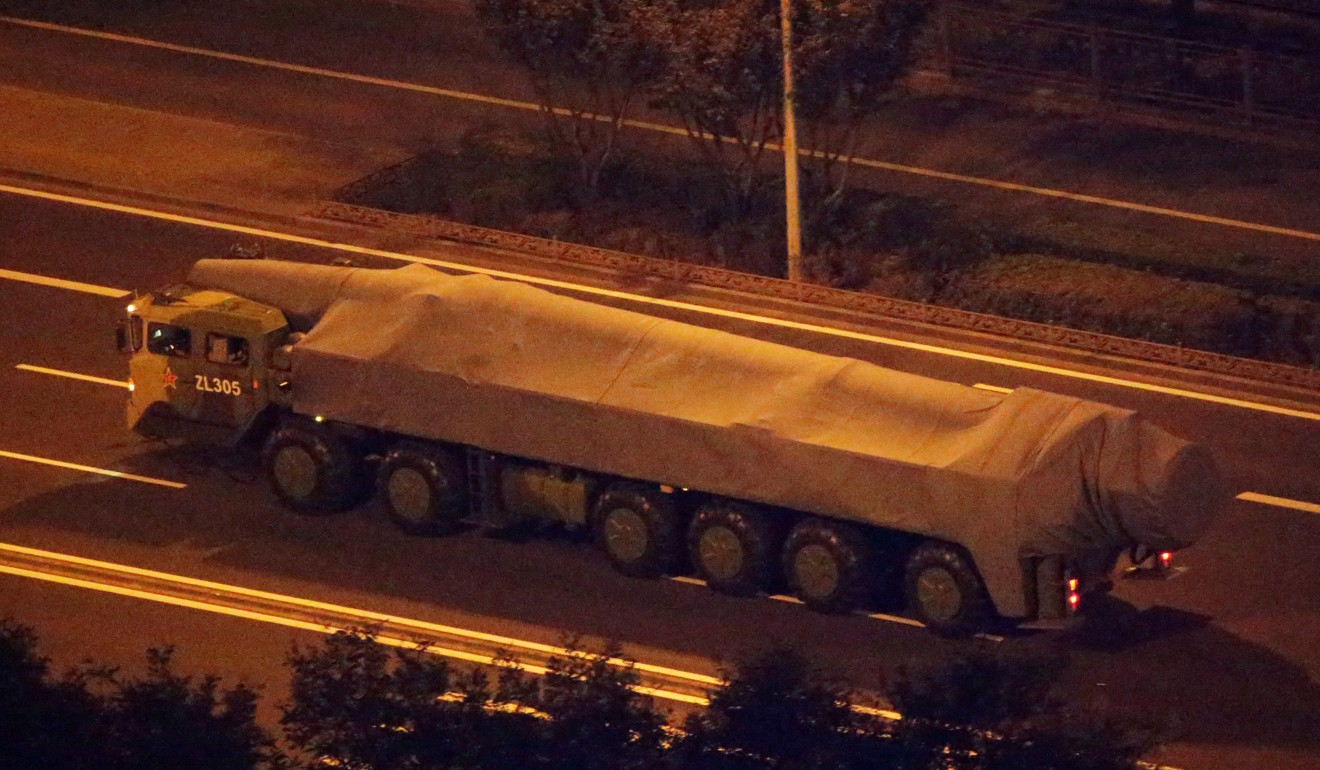
Among the 33 weapon squads, the highlights are expected to be the PLA’s strategic nuclear missiles such as the Rocket Force’s land-based DF-41 intercontinental ballistic missile (ICBM), the DF-21D anti-ship ballistic missile, the DF-17 hypersonic missile and the sea-launched JL-2, or Big Wave-2.
Adam Ni, a researcher at Macquarie University in Australia, said that showing off different types of missiles on land and sea indicated that the PLA was improving its nuclear deterrence capabilities by perfecting a three-pronged military force structure, or the so-called nuclear triad.
The DF-17 hypersonic ballistic missile will be one of the highlights of the parade. Photo: AP
The DF-41 is capable of carrying multiple warheads and many decoys, making it harder to detect than silo-based systems and better able to survive a first strike.
Ni said the DF-41 was China’s next-generation cutting-edge weapon.
“It’s actually an advanced ICBM and has a range to hit practically anywhere in the world, including the continental United States,” Ni said.
“The DF-41 is the ultimate symbol of the destructive potential of Chinese armed forces, just as nuclear weapons are similar symbols of the US and Russia.”
The JL-2 – which has a shorter range of 7,000km (4,350 miles) and can be launched by the PLA Navy’s Type 094 submarines – is unable to hit anywhere on the American continent when launched from submarines in the South China Sea and coastal areas of China.
China tests new warships in live-fire drills near Vietnam
However, China is developing the JL-3, which has a range of about 9,000km; the upgraded version of the JL-2, with a flight test conducted in June, though it is still less than the 12,000km range of the American Trident II.
“China is stepping up its military modernisation, which includes a number of aspects; the land-based aspect is introducing more mobile and survivable missile systems,” Ni said.
“The game change will happen when China is able to hit the whole US continent with its missile submarines in Chinese coastal waters.”
In military terms, survivable refers to the ability to remain mission capable after a single engagement.
The DF-17 is a land-to-land short-range strategic missile capable of delivering both nuclear and conventional payloads. The US intelligence community has estimated that it will reach initial operational capability by 2020. But if the missile is displayed in the parade, that means it is active already.
China conducted two tests of the DF-17 in November 2017, with the first launched from the Jiuquan Space Launch Centre in Inner Mongolia.
An insider said the main goal of this year’s parade is to promote the military modernisation of the PLA. Photo: Reuters
Hong Kong-based military commentator Song Zhongping said the nuclear weapons that would go on show in the parade would all be strategic missiles designed to improve China’s deterrent capabilities.
The show comes after the PLA delivered a national defence white paper in July stressing its goal to “maintain national strategic security by deterring other countries from using or threatening to use nuclear weapons against China”.
Unlike in the past, this year’s report stated that the US and China were now competing superpowers, and that the PLA’s growing forces were developing to the point that they could challenge the US.
Zhou Chenming, a Beijing-based military observer, said it was also necessary for the PLA to “show some of its muscle” amid the ongoing trade dispute between Beijing and Washington.
“To prevent misunderstanding, most of the weapons are just strategic equipment, not tactical arms, because Beijing still doesn’t want to irritate Washington,” he said.
About 280,000 people were involved in the rehearsals for the parade and related support services, according to Xinhua.
Iranian news outlet quotes military official as saying exercise will be held soon, but Chinese media silent on reported manoeuvres
An Iranian news source says China, Russia and Iran are planning a joint naval exercise soon. Photo: Xinhua
China, Russia and Iran are planning a joint naval drill in the Sea of Oman and northern Indian Ocean “soon” a semi-official Iranian news outlet reported on Saturday, just days after the United States blamed Iran for a drone attack on Saudi Arabian oil facilities.
General Ghadir Nezami Pour, head of international affairs and defence diplomacy of the Iranian Armed Forces General Staff, said the drill would take place in international waters, Iran Press news agency reported.
“The exercises have different goals including the exchange of tactical and military experiences and sometimes they seek political goals which show a kind of convergence between participants,” he was quoted as saying.
“Officials at the level of defence minister, chief of staff of the armed forces and commanders of the armed forces will come to Iran in the near future and these actions reflect Iran’s active defence diplomacy.”
The comments came in the aftermath of the September 14 missile strikes on Saudi Arabia’s Abqaiq and Khurais oil facilities.
Washington accused Tehran of masterminding the attacks, allegations that Iran denied.
Tehran warned that any military action by the United States or Saudi Arabia would result in “all-out war”.
US Secretary of State Mike Pompeo initially condemned the attacks on the oil facilities as an “act of war” but later said the US was seeking a peaceful solution to the crisis.
On Friday, Chinese President Xi Jinping condemned the attacks during a phone conversation with Saudi Arabia’s King Salman, adding that he hoped the incident would receive a full and fair investigation.
There was no report of the joint drill plan in Chinese media.
Analysts said the exercise was possible as China might want to show support for Iran.
“The timing of the joint exercise might be a bit sensitive and some might take it as a show of China’s support for Iran should there be any military conflicts between countries,” Beijing-based naval expert Li Jie said.
“But it might well be a regular military exchange between the countries if it is held in international waters and without targeting another country.”
China calls for calm in aftermath of drone strikes on Saudi oil facilities
Ni Lexiong, a military specialist and professor at Shanghai University of Political Science and Law, said the drill was to send the message that China would side with Iran “in extreme scenarios”.
“I don’t see things will go that far, but the navy drill is to send the intimidating message,” Ni said.
Two years ago China and Iran conducted a joint naval exercise near the Strait of Hormuz in the Persian Gulf after Washington accused Tehran of sending fast attack boats to harass US warships passing through the area.
Major General Mohammad Baqeri, Chief of Staff of the Iranian Armed Forces, was in Beijing for a three-day visit earlier this month and agreed that the two countries would have more visits with senior military officials and advance cooperation in training.
China still accounts for more than half of Iran’s oil exports, according to the United States, complicating Washington’s efforts to economically isolate Tehran in its “maximum pressure campaign”.
China is set to release pork supplies from its central reserves as it moves to tackle soaring prices and shortages caused by an outbreak of swine fever.
A state-backed body will auction 10,000 tonnes of frozen pork from its strategic reserves on Thursday.
China, the world’s biggest producer and consumer of pork, has struggled to control the spread of the disease.
In a bid to stabilise prices, a state-backed group that manages the pork reserves will auction imported frozen pork from countries including Denmark, France, the US and UK.
Only 300 tonnes will be sold to each bidder at the auction.
Pork is used widely in Chinese festivals, and the auction comes as the country prepares to celebrate a week-long national holiday for the 70th anniversary of the People’s Republic of China.
Julian Evans-Pritchard, senior China economist at Capital Economics, said the auction would provide slight relief to the industry but would not do much to contain prices.
“In itself, I don’t think it will be able to prevent pork prices from rising further unless they manage to get the disease under control,” he said.
Beijing created its strategic pork reserve in 2007 but the size of the stockpile is not known.
Capital Economics estimates that at most, the stockpile would hold four days’ worth of pork supplies to feed China.
About 1.2 million pigs have been culled in China in an effort to halt the spread of swine fever since August 2018, according to data from the Food and Agriculture Organization, a UN agency.
In April, Rabobank estimated Chinese pork production would fall by up to 35% this year due to swine fever.
The supply shortage has sent pork prices soaring and has eaten into household incomes.
That poses a fresh challenge for the Chinese economy, which is already facing a slowdown and a trade war between Beijing and Washington.
Operations aimed to caution Beijing that US forces can carry out amphibious campaigns far from home
Washington has power to intervene directly in territorial disputes between its allies and China
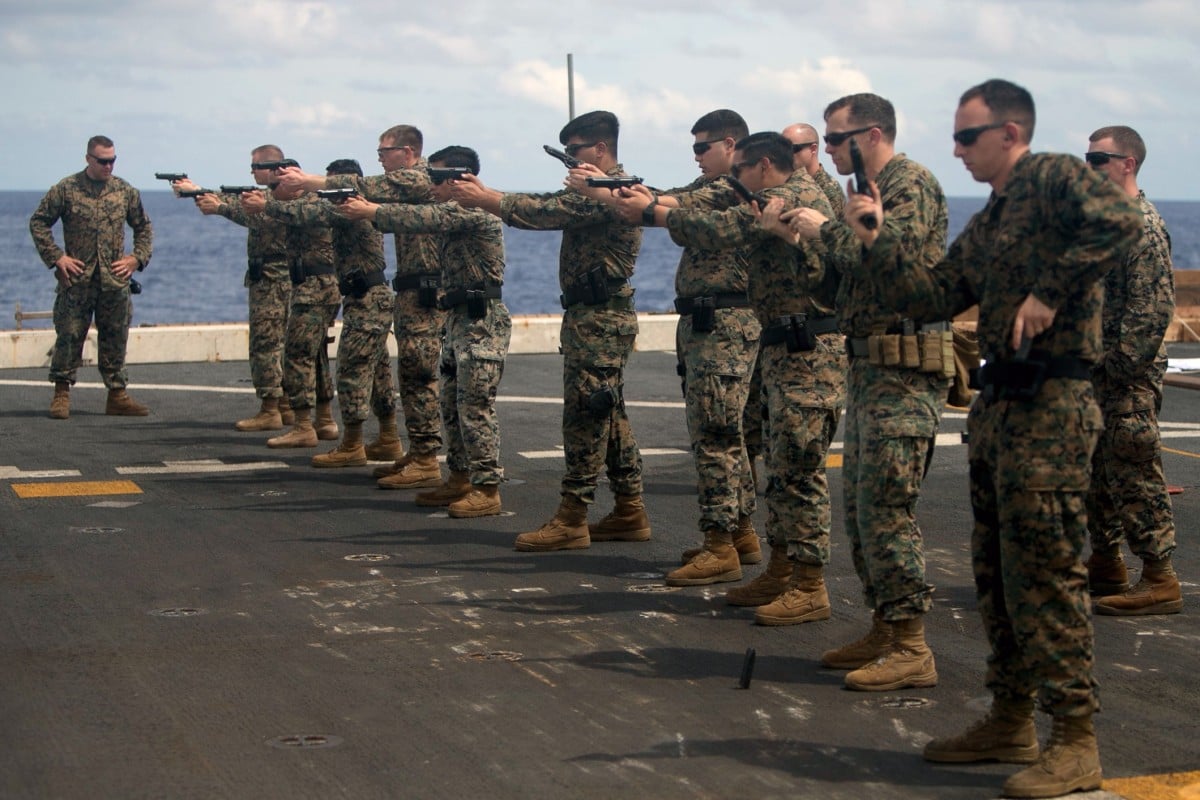
US Marines practise speed reloads on August 9 aboard the USS Green Bay, part of the Wasp Amphibious Ready Group, in the Indo-Pacific region. Photo: Handout
US Marines have conducted airfield- and island-seizure drills in the East and South China seas in what observers say is meant to remind Beijing of US military supremacy in the Asia-Pacific.
The 11-day naval drills were conducted near the Philippines and around the Japanese island of Okinawa by Okinawa-based US marine expeditionary units, the 31st Marine Expeditionary Unit said.
Observers said the operations were meant as a warning to Beijing that the US military could carry out amphibious campaigns far from home if Washington needed to intervene in territorial disputes between China and America’s allies in the region.
The 31st Marine Expeditionary Unit and Amphibious Squadron 11 conducted joint weapons drills from their Wasp Amphibious Ready Group ships from August 9-19, the Okinawa-based marine unit said in a statement.
The activity took place in the Philippine and East China seas and around an American naval base in Japan, it said.
The unit’s Amphibious Reconnaissance Platoon also performed a reconnaissance and surveillance mission through a high-altitude, low-opening parachute jump onto Okinawa.
A tilt-rotor aircraft, which hovers like a helicopter but flies like an aeroplane, afterward sent a landing team from a Wasp ship more than 400km (250 miles) away to establish the arming and refuelling point. The team achieved its objective in just over one hour, the statement said.
“The speed with which the Marines were able to establish the forward arming and refuelling point demonstrates a capability that is critical to conducting expeditionary operations in a contested environment,” the statement quoted Lieutenant Guirong Cai, a FARP officer-in-charge from the Marine Air Traffic Control Mobile Team, as saying.
“Their proficiency in swiftly setting up a refuelling point with 5,500 pounds (2.5 tonnes) of fuel demonstrates the 31st MEU’s ability to rapidly refuel and redeploy our air assets as the mission requires.”
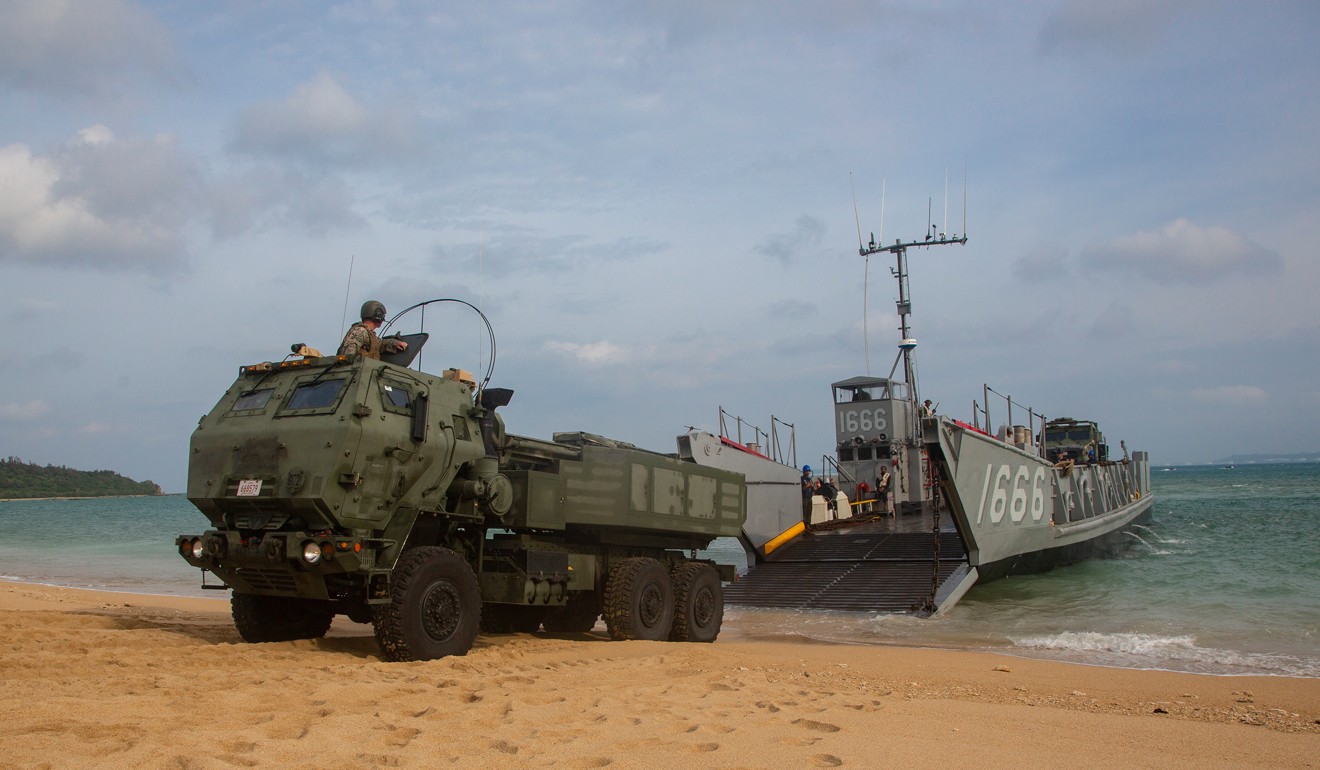
A US landing craft lowers its ramp to unload a high mobility artillery rocket system as part of a simulated amphibious raid at Kin Blue on Okinawa on August 14. Photo: Handout
China has a territory dispute with Japan over Diaoyu Islands, known as the Senkakus in Japan, in the East China Sea, while both Beijing and Manila have put in claims on the Scarborough Shoal – also known in China as Huangyan Dao – in the South China Sea.
Adam Ni, a China specialist at Sydney’s Macquarie University, said the drills near the Philippines and Okinawa showed that such a campaign would encompass a wide area, including the South and East China seas, where the US has joined other countries in the region to conduct freedom of navigation operations since 2015.
Maritime drills between US, Asean coincide with rising tensions
“It is a clear reminder to China of US military supremacy despite the narrowing of gaps in military capability in recent years,” Ni said. “The message is that the US military can still take China-controlled South China Sea features in high-intensity conflict.”
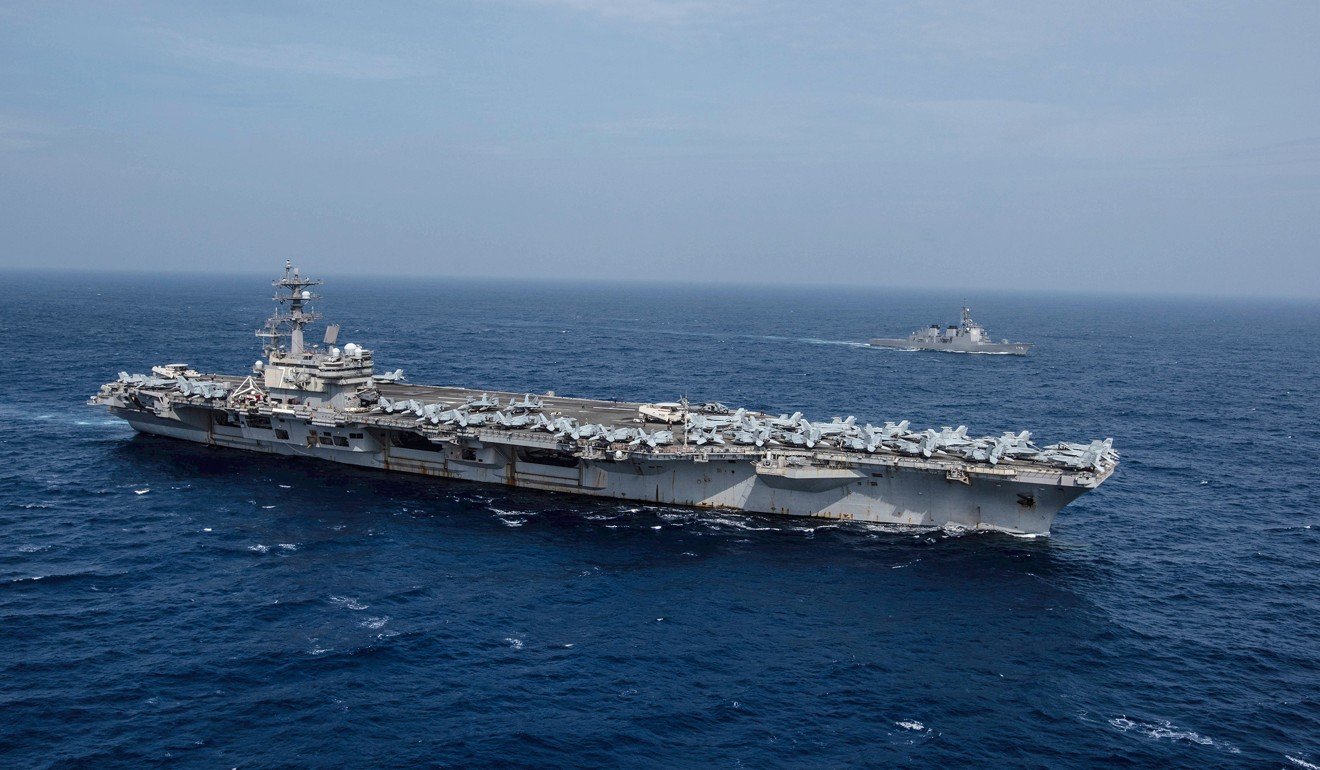
The USS Ronald Reagan aircraft carrier sails alongside a Japan Maritime Self-Defence Force guided-missile destroyer during drills. Photo: Handout
The statement did not say whether the Philippine navy and Japanese maritime self-defence force took part in the drills. But Hong Kong-based military commentator Song Zhongping said the US government would call on its two allies to observe the exercises.
“Whether Washington will intervene in territorial disputes between China and the Philippines as well as China and Japan, the American [military] has used [these drills] to strengthen its island-capture and airfield seizure capabilities in unfamiliar waters and areas,” Song said.
“To show its close relationship with and commitments to Manila and Tokyo, the Americans would invite the two allies to watch the drills. That could also be a good time to sell their amphibious warships and new model aircraft to Japan.”
During the drills, 10 simulated casualties were treated by three medical technicians from the US Air Force’s special operations group and given blood transfusions before being loaded onto a KC-130 transport aircraft for in-flight medical treatment en route to Marine Corps Air Station Futenma on Okinawa, the US Marines said.
ANKARA (Reuters) – Turkey sees opportunity to boost trade with the United States amid Washington’s trade war with Beijing, the Turkish trade minister said on Tuesday, reinforcing an ambitious goal of quadrupling the bilateral trade to $100 billion (81.1 billion pounds) a year.
“We have determined that the issues between the U.S. and China will create a significant opportunity for trade in various sectors,” Trade Minister Ruhsar Pekcan told a joint press conference with U.S. Secretary of Commerce Wilbur Ross.
“We have expressed to the U.S. side our readiness to provide goods,” she said.
Pekcan added that trade and investment would be the main topic when U.S. President Donald Trump and Turkish counterpart Tayyip Erdogan meet during the United Nations General Assembly later this month in New York.
On Saturday, Turkey asked the United States to lift trade barriers during talks aimed at sharply increasing bilateral commerce.
Washington and Ankara’s goal of $100 billion in trade a year comes despite the prospect of U.S. sanctions over Turkey’s purchase of Russian S-400 missile defence systems. The United States says trade with Turkey totalled $24 billion in 2017, with the U.S. surplus standing at $1.5 billion.
The White House said in May it was ending a preferential trade agreement with Turkey, saying Turkey’s level of economic development meant it was no longer eligible for the support.
Researchers will conduct tests at site in Gansu to see whether it will make a viable facility to store highly radioactive waste safely
Scientists say China has the chance to become a world leader in this field but has to find a way to ensure it does not leak
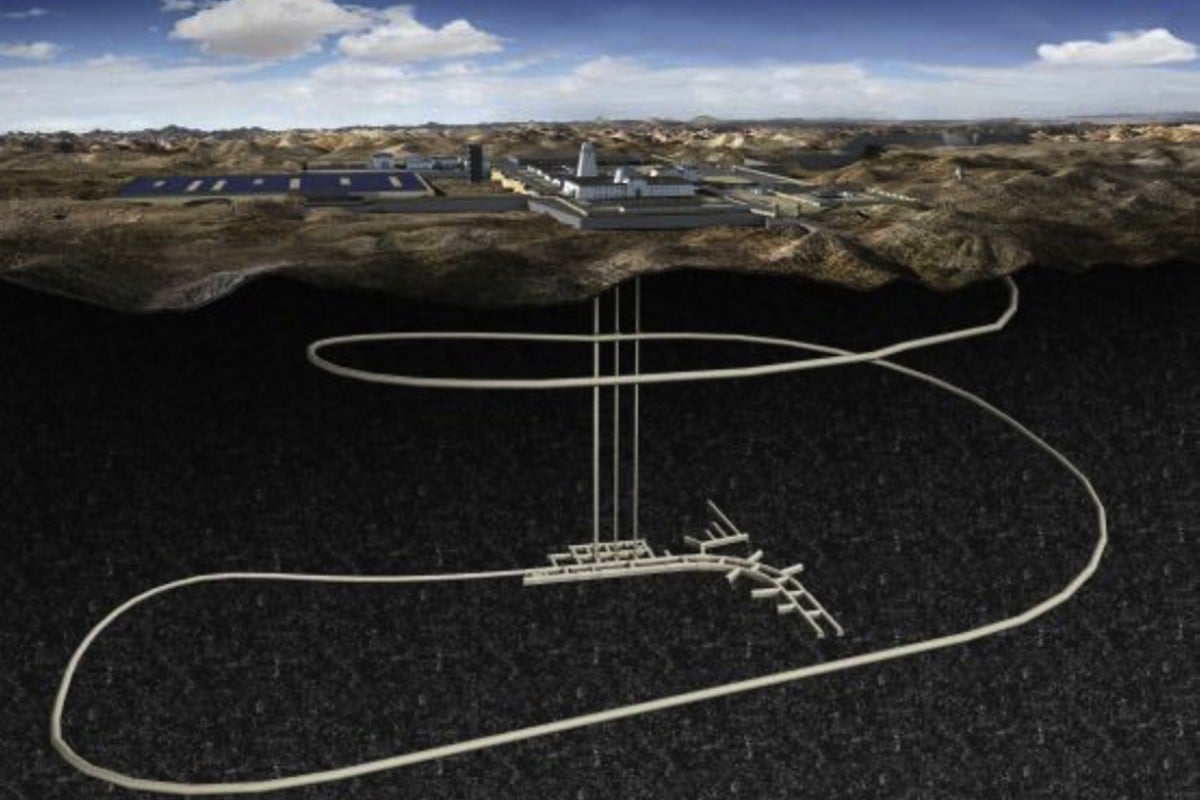
A preliminary design for the Beishan Underground Research Laboratory. Photo: Handout
China has chosen a site for an underground laboratory to research the disposal of highly radioactive waste, the country’s nuclear safety watchdog said on Wednesday.
Officials said work will soon begin on building the Beishan Underground Research Laboratory 400 metres underground in the northwestern province of Gansu.
Liu Hua, the head of the Chinese National Nuclear Safety Administration, said work would be carried out to determine whether it would be possible to build a repository for high-level nuclear waste deep underground.
“China sees radioactive waste disposal as a very important part [of the development nuclear energy],” said Liu. “To develop nuclear energy, we must have safe storage and disposal of nuclear waste.”
China condemns US blacklisting of nuclear firms and says American companies could be hurt as a result
The Chinese authorities see nuclear power an important source of energy that will help to curb carbon emissions and pollution as well as reducing its dependence on fuel imports.
But while the country has made great strides in the development of nuclear power, it needs to find a safe and reliable way of dealing with its growing stockpiles of nuclear waste.
Liu said the Gansu site had been identified as a possible location for a deep nuclear waste store after years of searching.
Once the laboratory is built, scientists and engineers will start experiments to confirm whether it will make a viable underground storage facility.
“Based on the data of the experiments, we can then decide if we are going to pick this as the final site,” he added.
China ‘actively promoting’ nuclear fuel processing plant with French Areva
Chinese officials usually stay tight-lipped about how nuclear waste is disposed of mainly because of fears that any discussion of the topic would trigger safety fears, although in recent years more efforts have been made to inform the public to win support.
Scientists say that nuclear waste can be divided into three categories depending on the level of radioactivity.
Low-level waste consists of minimally radioactive materials such as mop heads, rags, or protective clothing used in nuclear plants, while intermediate-level waste covers things such as filters and used reactor components.
High-level waste, however, is generated by the reprocessing of spent nuclear fuel and scientists generally agree that the safest way to dispose of it is to bury it deep underground in areas where the geology means it will have a minimal impact on the environment while it decays over thousands of years.
The facility will be built in a remote part of Gansu province. Photo: Handout
Some Chinese scientists said the country had the chance to lead the world in this area of research but others have expressed concerns about safety.
Jiang Kejun, a senior researcher at the Energy Research Institute of China’s National Development and Reform Commission, said that very few countries in the world are studying this form of nuclear waste disposal.
“It gives China an opportunity to be a leader in research in this area, plus China has the technology and financial means,” he said.
About a dozen countries including France, Switzerland, Japan, and the United States have carried out research in this area, but in recent years most have abandoned or scaled back their programmes.
At present there are storage sites operating in Finland and the US, but other countries such as Germany have abandoned plans to build similar facilities.
Washington blacklists Chinese nuclear firms for ‘helping military acquire US technology’
But despite broad scientific support for underground disposal, some analysts and many members of the public remain sceptical about whether it is really safe.
Lei Yian, an associate professor at the School of Physics at Peking University, said there was no absolute guarantee that the repositories would be safe when they are come into operation.
“Leakage has happened in [repositories] in the US and the former Soviet Union … it’s a difficult problem worldwide,” he said. “If China can solve it, then it will have solved a global problem.”
China is also building more facilities to dispose of low and intermediate level waste. Officials said new plants were being built in Zhenjiang, Fujian and Shandong, three coastal provinces that currently lack disposal facilities.
At present, two disposal sites for low and intermediate-level waste are in operation in Gansu and Guangdong provinces.
US president likely had Beijing ‘on his mind’ when he made his audacious offer, diplomat says
Proposal ‘could be interpreted as a very clear signal’ to China and Denmark that the US sees Greenland as part of an exclusive strategic zone, academic says
China has been building closer ties with Greenland in recent years. Photo: Reuters
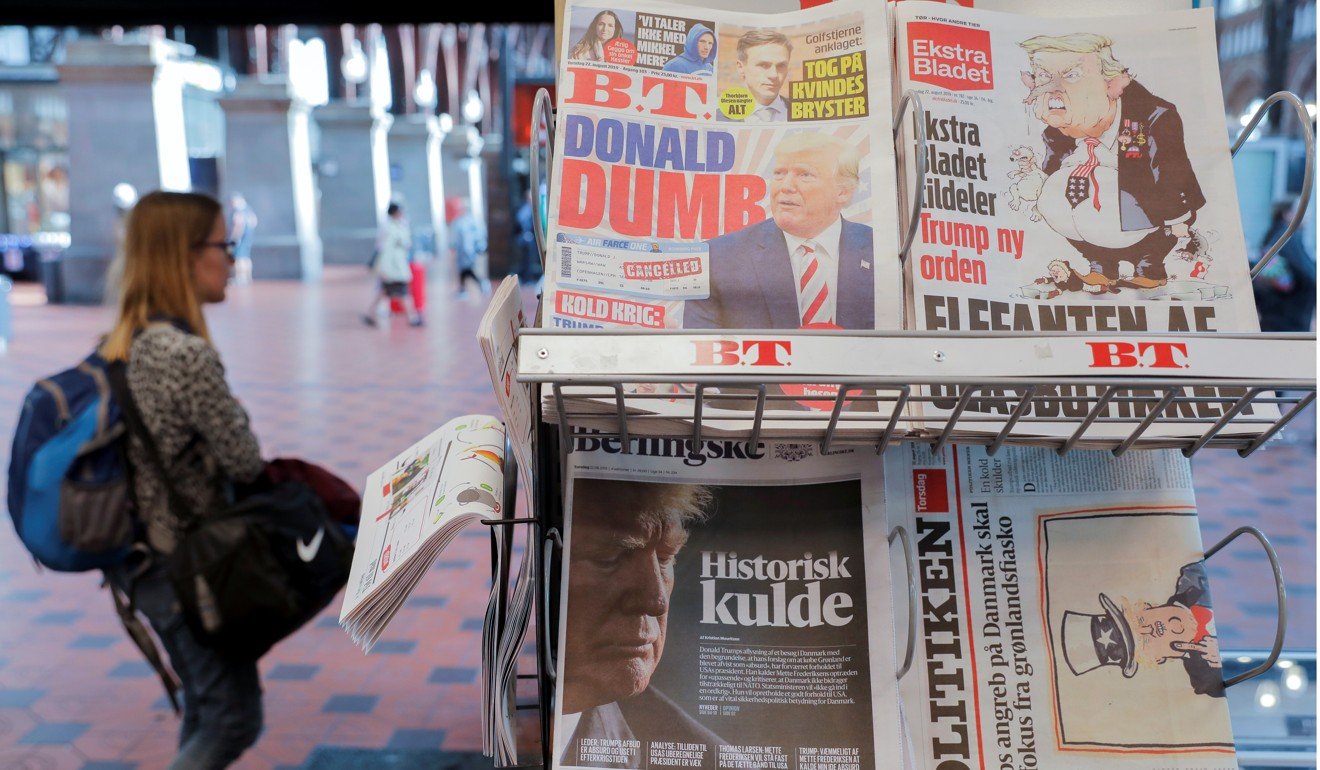
US President Donald Trump’s eyebrow-raising idea to buy Greenland from Denmark last month epitomised what analysts say is Washington’s fear of the growing interplay of Chinese money, Russian aggression and Arctic political division.
Of all the countries involved in the region, Denmark is feeling the most heat, and not just because Trump recently cancelled a trip and called its Prime Minister Mette Frederikse “nasty” for describing his plan to buy the world’s largest island “absurd”.
Over the past few years, both of Denmark’s self-ruled governments – Greenland and the Faroe Islands – have increasingly turned to China for commercial deals, adding weight to Beijing’s growing strategic influence in the vast area that forms the common backyard of Europe, North America and Russia.
Russia seeks Chinese support in developing Arctic shipping routes
Greenland is of particular concern to the White House and the Pentagon as it is home to the US Thule Air Force Base, located far above the polar circle and which served as the first line of defence during the cold war.
Nowadays, the island is also strategically important for the US ballistic missile early warning system, as the shortest route from Europe to North America goes via the ice-cloaked, resource-rich territory.
“Though it’s difficult to tell the motivations of President Trump, he likely had China on his mind with his Greenland offer,” said a Beijing-based diplomat, who asked not to be named.
The US was likely to step up its presence in Greenland in the future, the person said.
In May, US Secretary of State Mike Pompeo accused China and Russia of introducing a strategic power struggle into the Arctic region and described Beijing’s behaviour there as aggressive.
When Greenland signalled an interest in engaging a Chinese state-owned company to build two airports in 2017 – the island’s prime minister flew to Beijing to appeal for financial backing – Copenhagen stepped in amid US pressure, reluctantly agreeing to finance the projects from the public coffers.
Denmark’s reluctance stems from a long-standing mistrust between Copenhagen and Greenland, as the island’s quest for economic development is viewed by the Danes as an attempt to shore up capital to push for a future independence movement.
“There is no doubt that the US foreign and security policy community is becoming far more interested in Greenland as a strategic asset,” said Andreas Bøje Forsby, a researcher at the University of Copenhagen’s Nordic Institute of Asian Studies.
“Proposing to buy Greenland could be interpreted as a very clear signal to both China and Denmark that Greenland is part of an exclusive American strategic zone,” he said.
Danish Prime Minister Mette Frederikse described Donald Trump’s plan to buy Greenland as “absurd”. Photo: Reuters
The government of the Faroe Islands – an archipelago located between Scotland, Norway and Iceland – has a similar readiness to engage with China but for a different purpose.
Unlike Greenland, there are no immediate political movements calling for independence from Denmark, making its overall relationship with Copenhagen more amiable.
This month, the Faroese government will open a liaison office in Beijing, located within the Danish embassy.
“Our top priority is to have a free-trade agreement with China,” Sigmundur Isfeld, the first head of the Faroe Islands’ representation to Beijing, said.
US defence report flags China’s expanding military reach in the Arctic
With Norway – a key competitor of the Faroes in the fishing and export industries – eyeing a similar arrangement with China, the time was ripe to clinch a deal, he said.
“It is a challenge for us … we need to get in the game.”
Although part of Denmark, the Faroe Islands are not part of the European Union and therefore have to form separate trade agreements with other countries.
“For example, there is an EU-Japan economic partnership agreement. It covers all EU nations, but it does not cover the Faroe Islands,” Isfeld said.
Trade between Greenland and China totalled US$126 million in 2108. Photo: AFP
China, for its part, has sought to exert its economic and cultural influence on the Faroes, which has a population of about 52,000 people.
, the embattled Chinese telecoms giant, has been working with the islands’ main telecoms provider for four years and is said to be finalising a plan for 5G upgrades across the archipelago.
Beijing also helped fund a project for a Chinese-Faroese dictionary.
With a population of about 56,000 people, Greenland is one of China’s smallest trading partners. In the first seven months of 2019, trade between the two was US$126 million, with Chinese imports of fish accounting for the bulk of the total.
The Greenland government’s annual political and economic report for 2019 said that strong demand for metals from China had contributed to mineral and mining projects in the country, though China’s transition to a less mineral-intensive economy could spell trouble for the future of the sector.
The island’s gross domestic product is expected to grow by 3 per cent this year, according to the report, with seafood – principally cod, halibut and prawns – set to continue to be its chief export.
The end of the Arctic as we know it
China’s attempts in recent years to expand its involvement in Greenland have run into roadblocks.
In 2016, a Chinese mining company expressed interest in taking over an abandoned marine station in Grønnedal, an offer that the Danish government turned down the following year. A Chinese state-owned construction company had also offered to build airports in Greenland, but withdrew its offer this year.
Also this year, China expanded its involvement in exporting from Kvanefjeld, one of the world’s largest deposits of rare earths and uranium, by creating a joint venture to process and export the resources.
Beijing has made clear its strategic ambitions in the region. Early last year, it unveiled its Polar Silk Road strategy, plotting the course for its future development goals in the region – including scientific, commercial, environmental preservation and resource extraction efforts.
It also aligned its Arctic interests with its Belt and Road Initiative. Chinese companies are encouraged to invest in building infrastructure along the routes and conduct commercial trial voyages to gauge feasibility.
Putin boasts of nuclear icebreaker fleet as he outlines Arctic expansion plans
Anders Rasmussen, a former Danish prime minister and erstwhile Nato secretary general, said in an article published in Atlantic magazine last month that with melting ice caps opening the Arctic Sea to shipping, Arctic sea lanes “will likely become another flashpoint of renewed competition among the great powers as climate change alters our world”.
It was a situation he said he found “regrettable, but inevitable”.
“Both China and Russia are interested in getting a foothold in Greenland, to expand their influence in the Arctic region,” Rasmussen said. “Instead of being a source of contention,
Greenland should serve to highlight how many interests the United States and Denmark have in common.”
A recent joint exercise in Tajikistan is the latest example of Beijing’s growing security and economic interests in the former Soviet republic
Analysts say Moscow may not be happy about China’s growing reach in the lawless, mountainous area and will be keeping an eye on the situation
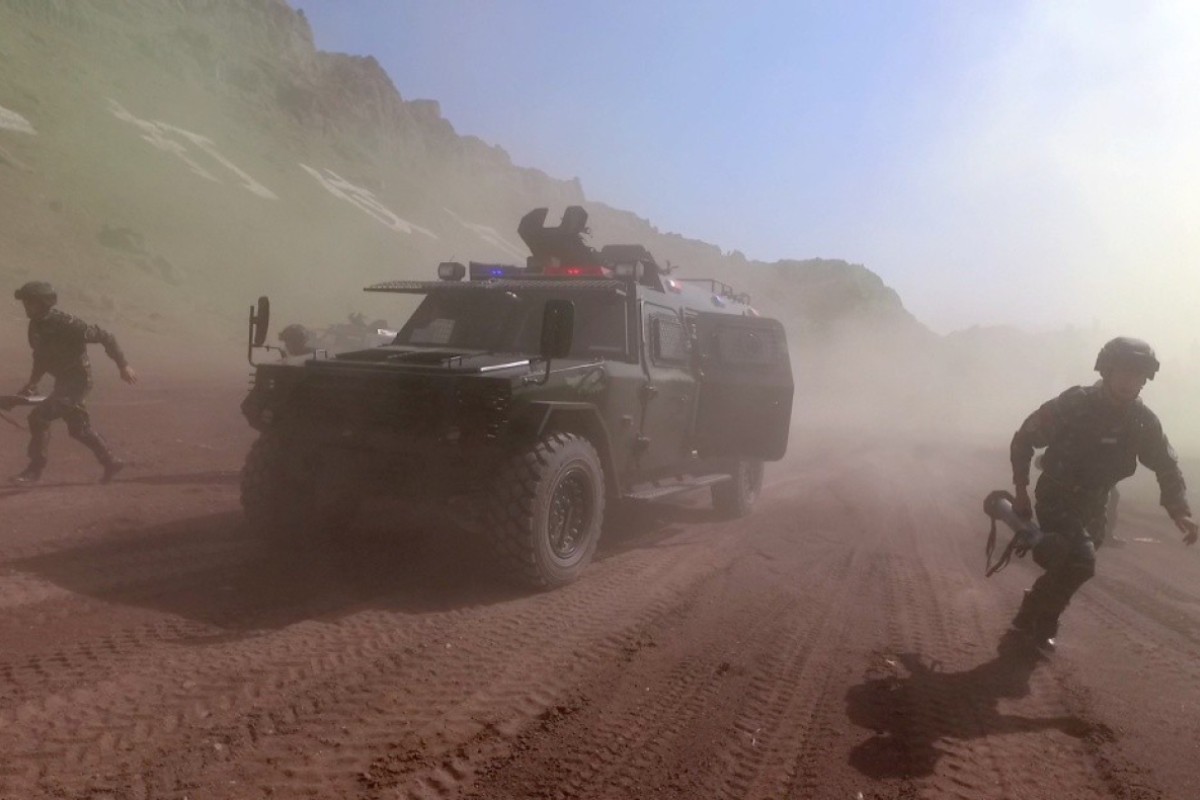
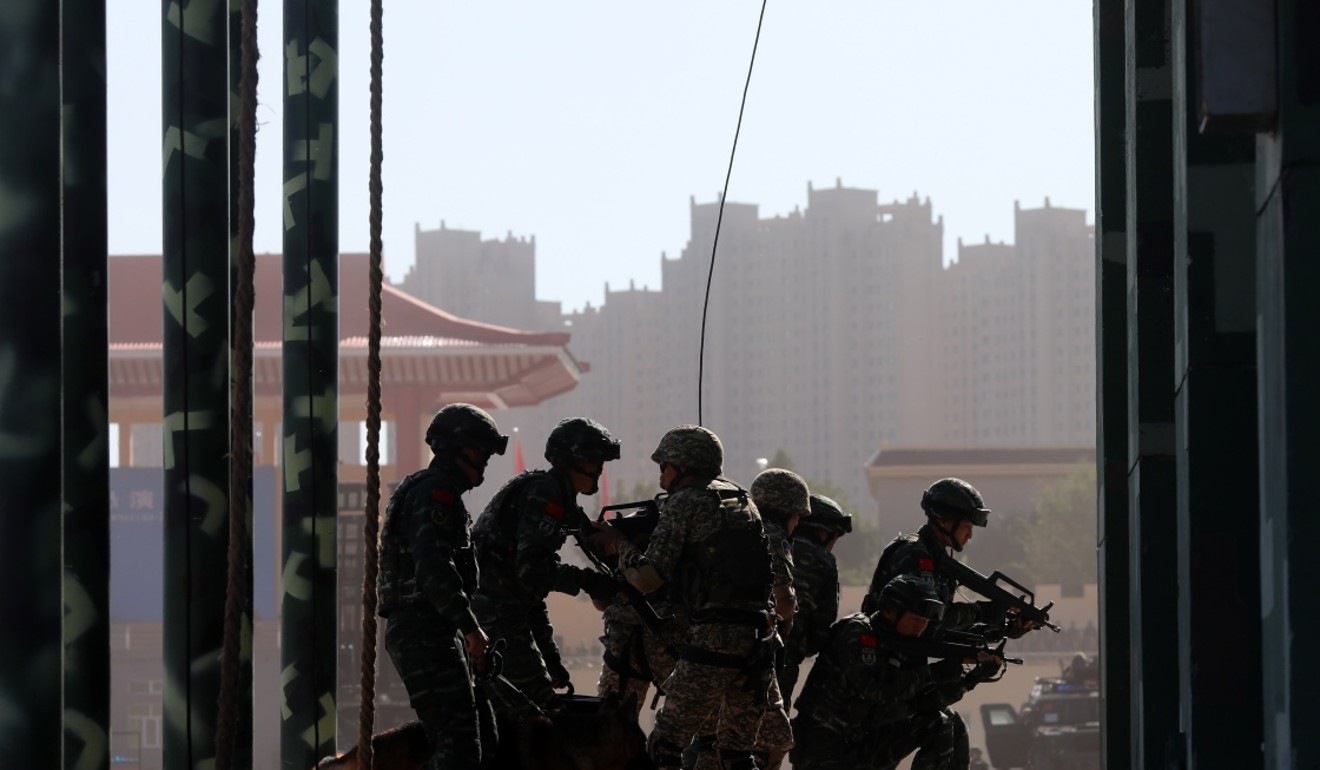
Chinese and Tajik troops completed a joint exercise earlier this month in the mountainous region of Gorno-Badakhshan. Photo: Xinhua
China is increasing its military and economic presence in parts of central Asia that Russia has traditionally considered its sphere of influence – a development some analysts believe could cause concern in Moscow.
While Russia’s influence remains strong in many former Soviet republics, China is steadily building up its military and economic influence in Tajikistan, particularly in the remote, mountainous areas on its western borders where central government authority is weak.
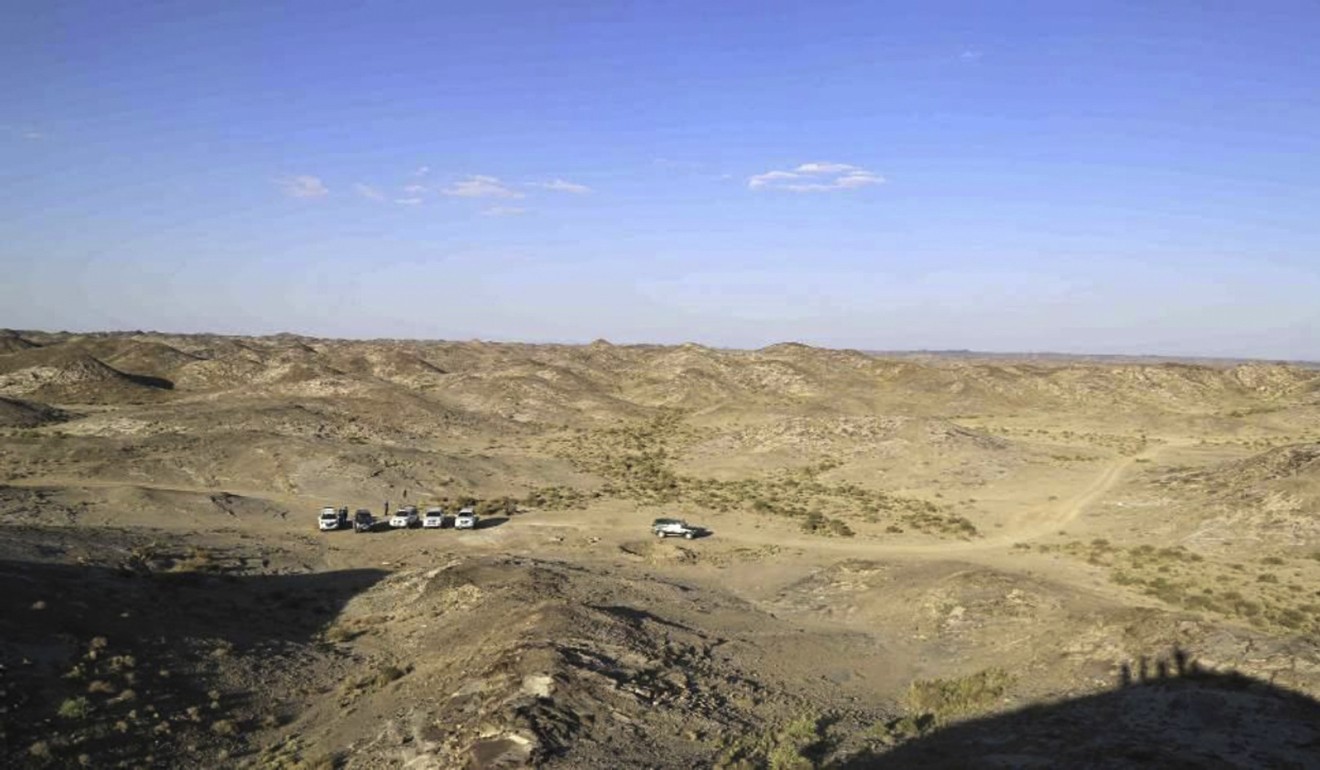
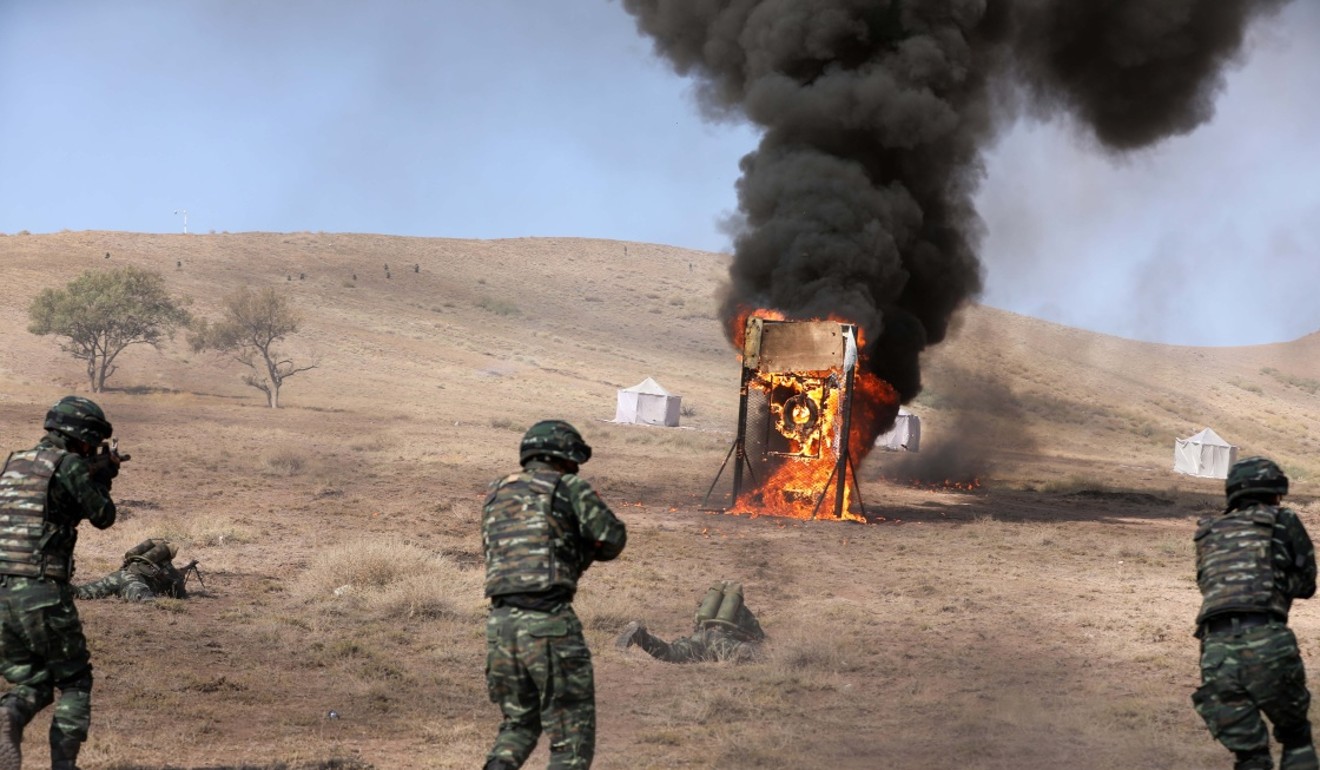
Chinese troops recently concluded a joint drill in eastern Tajikistan involving 1,200 troops from both countries.
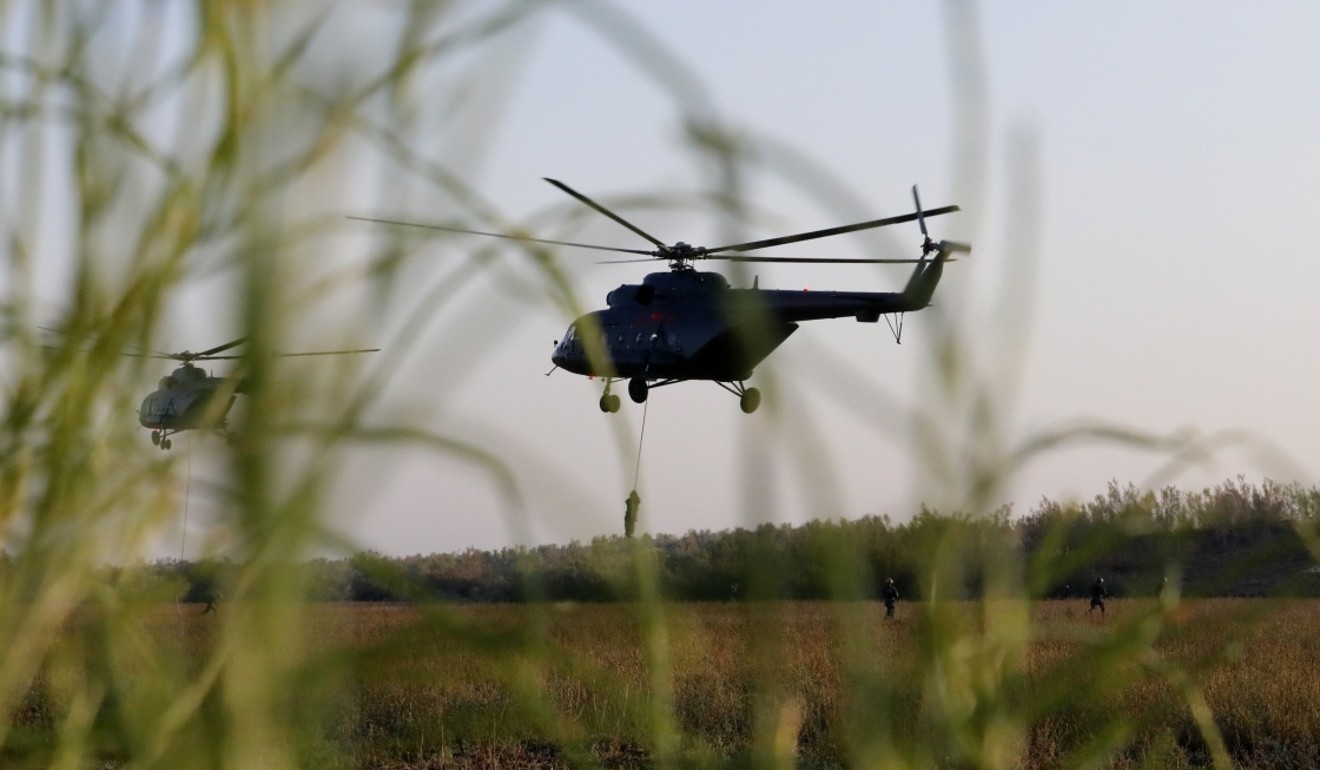
The eight-day exercise that finished on August 13 was conducted in the autonomous Gorno-Badakhshan autonomous region, a sparsely populated territory in the high Pamir mountains, which borders China’s Xinjiang region and Afghanistan.
China has been increasing its security presence in the strategically sensitive region. Photo: Xinhua
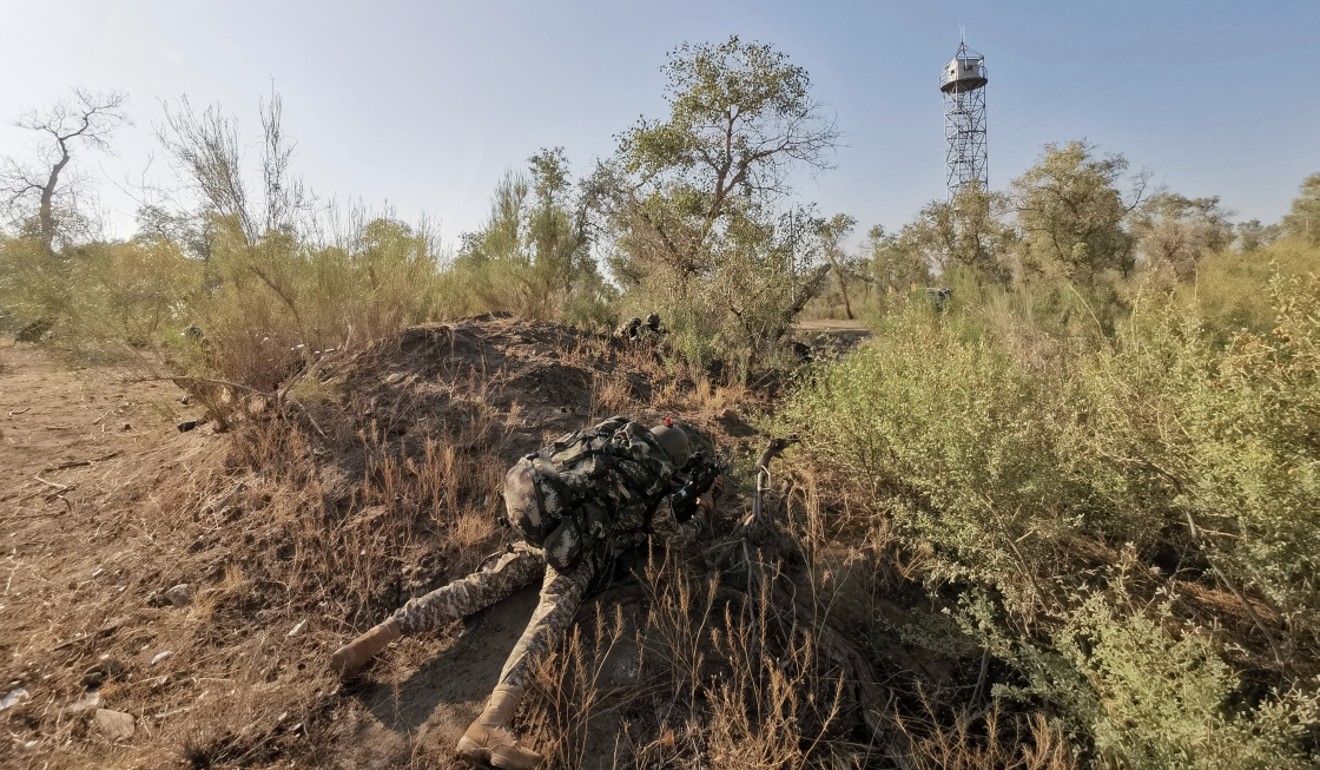
Although this year’s exercise involved fewer troops than the 10,000 involved in a previous drill three years ago, it tested the use of advanced aerial vehicles and ground reconnaissance technology to monitor the area.
The landlocked country is strategically important for China, which is worried that the porous borders will serve as an entry point for drugs and Islamic militants into Xinjiang, where its deradicalisation strategy has led to the detention of a million Muslim minorities in reeducation camps.
It also sits along the trade routes China hopes to develop under the Belt and Road Initiative – Beijing’s flagship plan to expand its global influence through infrastructure, trade and investment – but the area has long been plagued by lawlessness and outbreaks of violence.
The recent exercise tested aerial surveillance techniques. Photo: Xinhua
Artyom Lukin, a professor of international politics at Far Eastern Federal University in Vladivostok, said Russia was not happy about the deployment of Chinese forces in Tajikistan.
“Russia has traditionally considered Central Asia, including Tajikistan, as its sphere of political-military influence,” he said.
Observers said other Central Asian republics – such as Kazakhstan, Uzbekistan and Kyrgyzstan – are likely to stay within Moscow’s orbit, but China is steadily building closer security ties with Tajikistan.
In February, China’s defence ministry denied that it was building a base and stationing troops in the country, but defended its closer military cooperation with Tajikistan.
The recent training exercise was conducted in an area Russia has long seen as part of its sphere of influence. Photo: Xinhua
China has long-standing security interests in the country and in 2016 it agreed to finance 11 border outposts and a training centre for guards along the Afghan border.
This was part of a deal Beijing made through the Quadrilateral Cooperation and Coordination Mechanism – which also involves Pakistan, Afghanistan and Tajikistan – to strengthen cooperation in combating terrorism and improving security.
China has also overtaken Russia economically, becoming the largest foreign investor in Tajikistan in 2016, accounting for 30 per cent of Tajikistan’s total direct accumulated investments, state news agency Xinhua reported.
Banned Muslim political party blamed for deadly attack on tourists in Tajikistan
China’s direct investment in Tajikistan was worth US$95 million in 2017, according to the latest available figures. China has also grown to become the country’s third largest trading partner with bilateral trade reaching around US$1.5 billion in 2018.
A recent opinion piece published by the Russian state-owned news agency Sputnik suggested China may be “getting carried away” by its investments in the region.
The article suggested that China’s growing presence in the country could lead to a “partial loss” of Tajikistan’s sovereignty and argued that Beijing may want to take control of the border with Afghanistan.
China also has economic interests to protect. Photo: Xinhua
But Lukin said even though this growing involvement may be an irritant for Russia, the strategic partnership between China and Russia will remain strong.
The two countries remain the key players in the Shanghai Cooperation Organisation, an economic and security alliance that includes the Central Asian republics and India and Pakistan.
Why Chinese investors are struggling to gain a foothold in Tajikistan
Lukin said: “Moscow no doubt understands that in terms of security, Tajikistan’s border, adjacent to China’s Xinjiang and Afghanistan, is truly a vital concern for Beijing.
“The presence of Chinese troops could actually benefit Russia, because it will be China bearing the costs of policing Tajikistan’s mountainous border areas.”
Stephen Blank, a former professor at the US Army War College and a specialist in Eurasian security, said that while Russia has mostly stayed silent about China’s presence in Tajikistan, it was closely watching the situation.
“What happens in the long run depends on how far China goes to extend its military presence in Central Asia. And if it keeps extending, it may well provoke some expression of concern in Russia beyond the silence that has hitherto been the case,” Blank said.
Chinese troops could play an increasing role in policing the area in future. Photo: Xinhua
“[The recent drills] look like conventional war-fighting exercises as much as anti-terrorist operations and suggest that China may have bigger contingencies than anti-terrorism in mind.”
Mathieu Duchatel, director of the Asia programme at the Institut Montaigne, a French think tank, said both Russia and China share similar concerns about terrorism and drug trafficking in Central Asia.
He said Russia had not objected to the security pact with Pakistan, Afghanistan and Tajikistan because there are more important strategic priorities in China-Russia relations.
“Overall, Russia’s acceptance of a security role for China in Central Asia shows how Russia realistically adjusts to the changing balance of power with China, and is able to avoid a zero-sum game on issues where parallel efforts by China and Russia can serve Russian security interests,” he said.
HANOI (Reuters) – A Chinese survey vessel on Saturday extended its activities to an area closer to Vietnam’s coastline, ship tracking data showed, after the United States and Australia expressed concern about China’s actions in the disputed waterways.
The Haiyang Dizhi 8 vessel first entered Vietnam’s exclusive economic zone (EEZ) early last month where it began a weeks-long seismic survey, triggering a tense standoff between military and coastguard vessels from Vietnam and China.
The Chinese vessel continued to survey Vietnam’s EEZ on Saturday under escort from at least four ships and was around 102 kilometres (63 miles) southeast of Vietnam’s Phu Quy island and 185 kilometres (115 miles) from the beaches of the southern city of Phan Thiet, according to data from Marine Traffic, a website that tracks vessel movements.
The Chinese vessel group was followed by at least two Vietnamese naval vessels, according to the data.
Vietnam’s foreign ministry did not immediately respond to a request from Reuters for comment.
A country’s EEZ typically extends up to 200 nautical miles (370 kilometres or 230 miles) from its coastline, according to an international UN treaty. That country has sovereign rights to exploit any natural resources within that area, according to the agreement.
Vietnam and China have for years been embroiled in a dispute over the potentially energy-rich stretch of waters and a busy shipping lane in the South China Sea.
China’s unilaterally declared “nine-dash line” marks a vast, U-shaped, expanse of the South China Sea that it claims, including large swathes of Vietnam’s continental shelf where it has awarded oil concessions.
On Friday, Vietnamese Prime Minister Nguyen Xuan Phuc and his Australian counterpart expressed their concern about China’s activities in the South China Sea, known in Vietnam as the East Sea.
Earlier in the week, the United States said it was deeply concerned about China’s interference in oil and gas activities in waters claimed by Vietnam, and that the deployment of the vessels was “an escalation by Beijing in its efforts to intimidate other claimants out of developing resources in the South China Sea”
Chinese Foreign Ministry spokesman Geng Shuang, in response to the U.S. statement, said Washington was “sowing division and had ulterior motives”.
“The aim is to bring chaos to the situation in the South China Sea and damage regional peace and stability. China is resolutely opposed to this,” Geng told a daily news briefing on Friday.
President says sale of Lockheed Martin F-16Vs will go ahead if ratified by Senate
Military experts have said the jets would bolster Taiwan’s ability to counter the threat of air strikes from mainland China
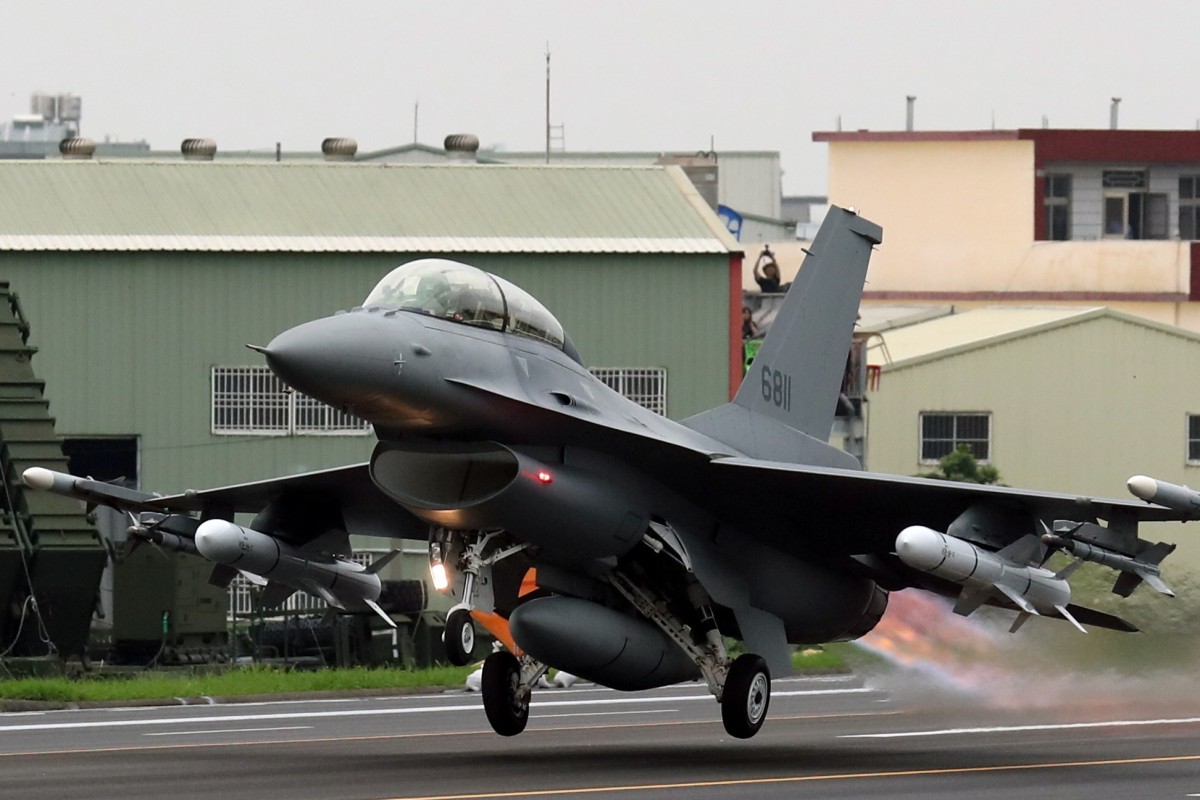
A Taiwan Air Force F-16V takes off during a drill in May. Photo: EPA-EFE
Beijing warned it would take countermeasures against Washington for selling 66 fighter jets to Taiwan after US President Donald Trump said he had approved the US$8 billion deal.
Chinese foreign ministry spokesman Geng Shuang on Monday said the sale of Lockheed Martin F-16V jets was a serious violation of the one-China principle.
“China has made numerous solemn representations to the US on the sale of F-16V jets to Taiwan,” Geng said in a press conference, adding that the United States should halt the sale.
“The US has to bear all the consequences triggered by the sale,” Geng said. “China will take necessary measures to defend its self-interest based on the development of the situation.”
Geng gave no details of the action China would take. In July, Beijing said it would impose sanctions on US firms involved in a deal to sell US$2.2 billion worth of tanks, missiles and related equipment to Taiwan, describing it as harmful to China’s sovereignty and national security.
Liang Yunxiang, an international relations expert from Peking University, said one countermeasure Beijing might use was to suspend military-to-military exchanges with the United States.
‘Fighter jets trump battle tanks’ in Taiwan’s US arms priorities
Speaking to reporters in New Jersey on Sunday, Trump said that the sale would need to be ratified by the US Senate but that he had approved it.
“It’s US$8 billion. It’s a lot of money. That’s a lot of jobs. And we know they’re going to use these F-16s responsibly,” he said.
If the deal is approved by Congress, it will be the first time since 1992 that the United States has sold F-16s to Taiwan. Previous requests were rejected by the Barack Obama administration, which instead offered to upgrade Taiwan’s existing fleet of about 140 F-16A/B Block 20 aircraft.
During months of slow progress since the sale was outlined earlier this year, some lawmakers and defence experts had suggested that Trump was using the proposed deal as leverage to secure a better agreement for the US in talks to resolve its year-long
Taiwan’s presidential office and foreign ministry lauded Trump’s announcement, calling it a strong sign of the US’ commitment to its security and saying the deal would help to maintain regional stability.
“The new warplanes will greatly strengthen our anti-air defence capability and we will continue to be devoted to safeguarding peace and stability across the Taiwan Strait and in the region, thereby maintaining freedom and democracy in Taiwan,” presidential office spokesman Alex Huang said.
‘Fighter jets trump battle tanks’ in Taiwan’s US arms priorities
In a statement, Taiwan’s foreign ministry said persistent war games by the mainland around the island and in the East and South China Sea had not only sabotaged peace and stability in the region but also triggered grave concern from China’s neighbours.
It described Trump’s approval of the deal as a “strong indicator of the close and growing security partnership between the US and Taiwan”.
Opinion: Care needed over Taiwan arms deal
Military experts have said the new variant of the F-16, the Viper – which can carry a wide range of short and medium-range air-to-air missiles – is more able to counter the threat of an air strike from mainland China’s fourth-generation aircraft, such as the Su-35 and J-10.
Last week, Republican Senator Marco Rubio said the US administration had made progress in advancing the deal, which he called “an important step in support of Taiwan’s self-defence efforts”.
In July, the US also approved arms sales to Taiwan worth US$2.2 billion, including 108 M1A2T Abrams tanks and 250 Stinger portable surface-to-air missiles.
Beijing strongly opposes arms deals with Taiwan, which it considers a renegade province, but the US is obliged to help defend the self-governing island under the terms of its Taiwan Relations Act, effective since 1979.








 CHINDIA ALERT: You'll be living in their world, very soon