25/10/2019
- Haiyang Dizhi 8 in waters close to Macau as of 4pm Friday, MarineTraffic reports
- Vessel’s work in disputed waters ‘now complete’, foreign ministry says
The Haiyang Dizhi 8 was close to Macau as of Friday afternoon, according to the MarineTraffic maritime information service. Photo: Weibo
The Chinese survey ship that has been at the centre of a stand-off with Vietnam in the
was back in waters close to home on Friday afternoon, according to an online platform that provides information about maritime activity.
As of 4pm, the Haiyang Dizhi 8 (Marine Geology 8), which had been operating close to Vanguard Bank – a disputed reef in the Spratly Island chain claimed by both Beijing and Hanoi – was located just off Macau, the MarineTraffic service said.
China’s foreign ministry said on Thursday that the vessel had finished the work it had started “in Chinese-controlled waters in early July”.
“According to our understanding the work is now complete,” spokeswoman Hua Chunying told a regular press briefing, without elaborating.
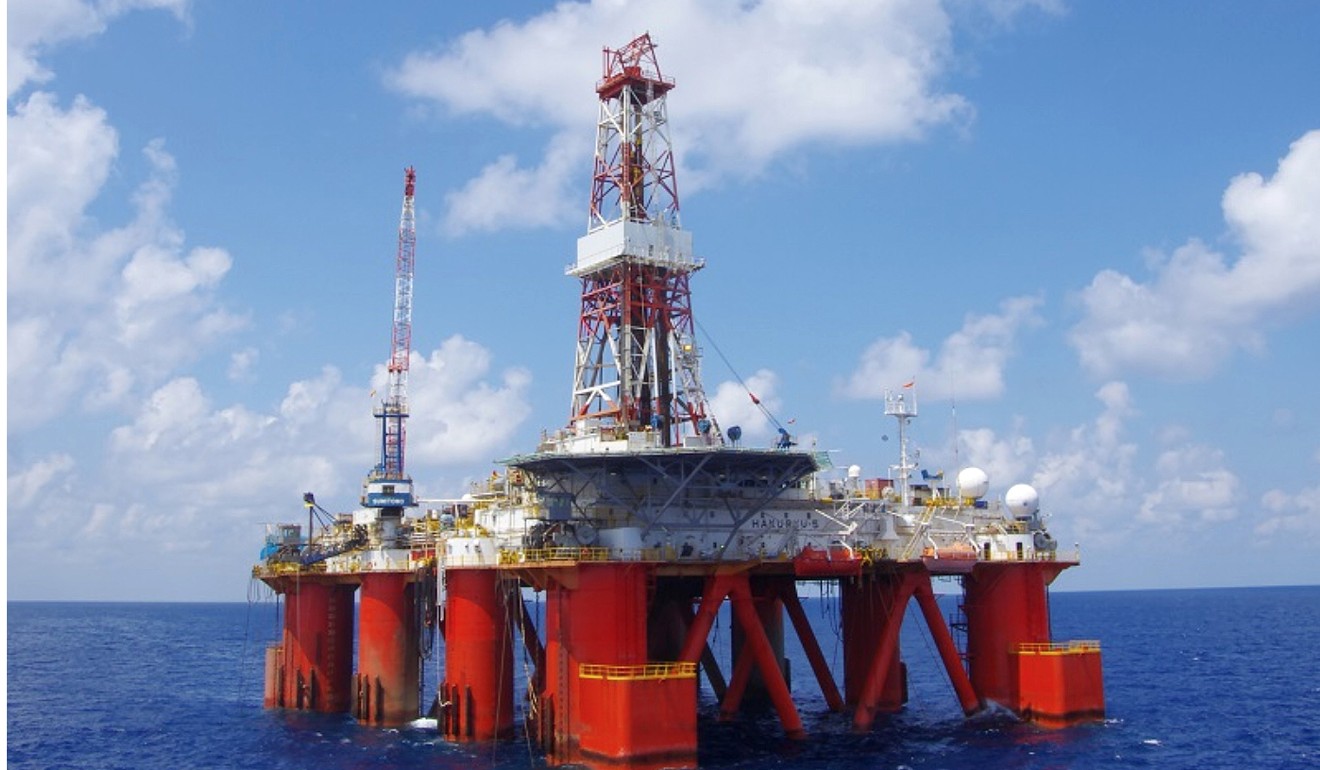
The Japanese oil rig, Hakuryu 5, is reported to have completed its drilling mission near Vanguard Bank earlier this week. Photo: Japan Drilling Co
While in the Vanguard Reef area, the
Haiyang Dizhi 8, escorted by heavily armed coastguard vessels, made multiple passes by an oil block operated by Russian energy company Rosneft.
Observers say the presence of the Chinese vessels in the region is part of Beijing’s efforts to prevent Hanoi from partnering with international energy firms to explore energy reserves in the disputed waterway. The latest activity triggered a months-long stand-off between the two countries.
The departure of the Haiyang Dizhi 8 came amid reports that the Japanese oil rig, Hakuryu 5, owned by Tokyo-based Japan Drilling Company and employed by Rosneft, had earlier this week completed a drilling mission it started in May near Vanguard Bank.
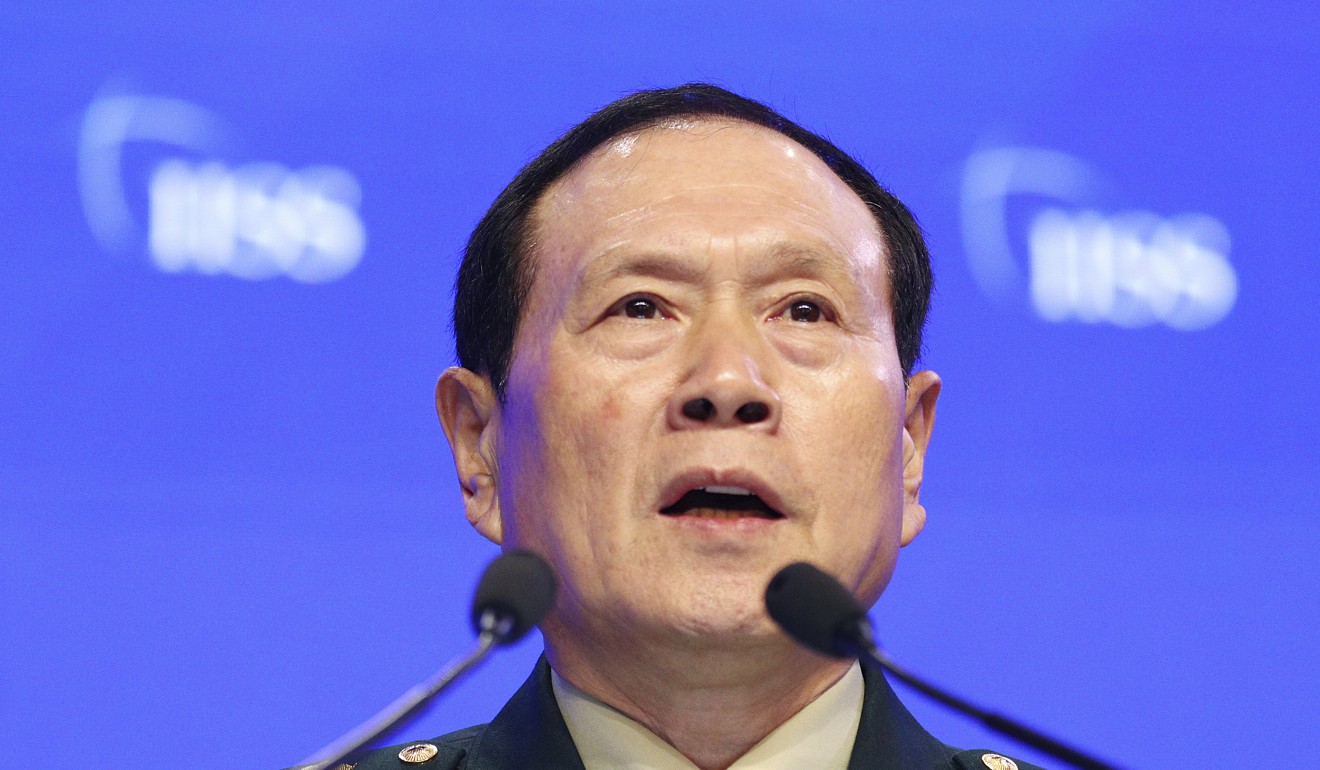
China’s Defence Minister Wei Fenghe told a regional security conference that the South China Sea was an inalienable part of China’s territory. Photo: AP
Although China and Vietnam have said they are looking for a diplomatic solution to prevent confrontations, neither has shown any signs of backing down and tensions have continued to rise.
On Monday, China’s Defence Minister Wei Fenghe told military and defence officials attending a regional security conference in Beijing that the South China Sea was an inalienable part of China’s territory.
“We will not allow even an inch of territory that our ancestors have left to us to be taken away,” he said in his opening speech at the Xiangshan Forum.
Also on Monday, Vietnamese Prime Minister Nguyen Xuan Phuc told lawmakers at the National Assembly that Hanoi would never give any territorial concessions.
“The situation in the South China Sea has become increasingly complicated,” he said. “Our party and state have consistently stated that what belongs to our independence, sovereignty and territorial integrity, we will never give up.”
Last week, Hanoi pulled DreamWorks’ animated film Abominable from theatres over a scene featuring a map that shows Beijing’s self-declared “nine-dash line” in the South China Sea. China uses the U-shaped line to claim sovereignty over more than 80 per cent of the resource-rich waterway, parts of which are also claimed by Vietnam, Malaysia, the Philippines and Brunei.
Ian Storey, a senior fellow at the ISEAS-Yusof Ishak Institute in Singapore, said that the withdrawal of the Haiyang Dizhi might only be “temporary”.
“China has made its point about drilling activities within the nine-dash line and expects Vietnam to suspend further exploration and production activities,” he said. “[But] of course Vietnam won’t.”
China, Malaysia seek to resolve South China Sea disputes with dialogue mechanism
Zhang Mingliang, a specialist in Southeast Asian affairs at Jinan University in the south China city of Guangzhou, said that the Chinese ship’s withdrawal was unlikely to have had anything to do with the comments made by Vietnam.
“I think the main reason is that it had finished its work,” he said. “But the withdrawal could also be seen as an attempt to ease the [China’s] tensions with the US.”
The significance for relations between Beijing and Hanoi was minimal, he said, as the two nations were engaged in one of the world’s most complicated territorial disputes.
“The impact on Sino-Vietnam relations will be limited because there have been too many disputes like this one,” he said.
Source: SCMP
Posted in animated film, “Abominable”, “nine-dash line”, back home, Beijing, Brunei, China's territory, Chinese, Chinese Defence Minister, confrontations, diplomatic solution, disputed waters, DreamWorks, drilling activities, drilling mission, energy company, Foreign Ministry, Guangzhou, Haiyang Dizhi 8, Hakuryu 5, Hanoi, heavily armed, inalienable part, involved, ISEAS-Yusof Ishak Institute, Japanese oil rig, Jinan University, lawmakers, Macau, Malaysia, map, Marine Geology 8, MarineTraffic, National Assembly of Vietnam, Nguyen Xuan Phuc, now complete, Philippines, regional security conference, Rosneft, Russian, Singapore, Sino-Vietnam relations, South China Sea, Southeast Asian affairs, sovereignty, Spratly Island, stand-off, survey ship, territorial concessions, theatres, U-shaped line, Uncategorized, Vanguard Bank, Vessel, Vietnam, Vietnamese Prime Minister, waters, Wei Fenghe, Xiangshan forum |
Leave a Comment »
23/06/2019
- Stalled denuclearisation talks also expected to be on the agenda when Chinese president meets Kim Jong-un this week
- Analysts say Korean peninsula has become intense diplomatic battleground between Beijing and Washington
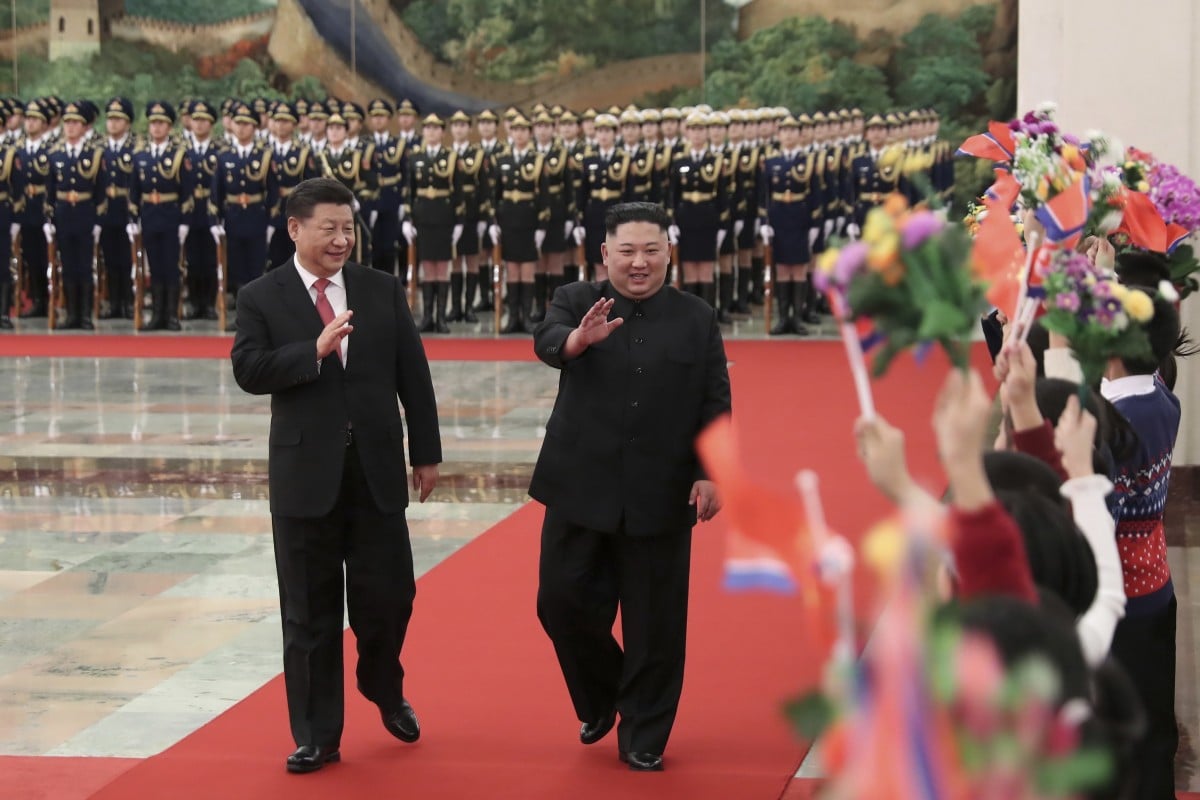
North Korean leader Kim Jong-un (right) attends a welcome ceremony in Beijing with Chinese President Xi Jinping in January. Xi will begin a visit to Pyongyang on Thursday. Photo: AP
Xi Jinping’s upcoming trip to
will be a state visit – a higher status than the last trip to the hermit kingdom by a Chinese president, highlighting the close bilateral ties between Beijing and Pyongyang.
Xi’s two-day trip, which
, is the first by a Chinese president to North Korea in 14 years and comes just a week before he is due to meet US President Donald Trump for talks on the sidelines of the Group of 20 summit in Japan.
“Leaders of the two countries will review the development of the bilateral relationship and carry out an in-depth exchange of opinions on the development of Sino-North Korean relations in the new era, and chart the future course of development,” state news agency Xinhua reported on Tuesday.
Xi’s predecessor, Hu Jintao, went to North Korea in October 2005 on a three-day trip described as an “official goodwill” visit.
Speaking at a regular press briefing in Beijing on Tuesday, foreign ministry spokesman Lu Kang said Xi’s visit aimed to “inject new impetus” into relations in the year the two countries marked the 70th anniversary of establishing diplomatic ties, and to give stalled denuclearisation talks a much needed push.
“Regarding the progress on denuclearisation, as I said, the result of the Hanoi leaders’ meeting in February was indeed a little unexpected. But after that, everyone actually looks forward to the resumption of dialogue in a good direction,” Lu said, referring to the failed talks between Trump and North Korean leader Kim Jong-un in the Vietnamese capital four months ago.
Trump hinted at the possibility of another meeting with Kim after receiving what he called “a beautiful letter” from the North Korean leader last week. On Tuesday, South Korea’s chief nuclear negotiator, Lee Do-hoon, said the US had been in contact with the North.
Life in North Korea the ‘admiration and envy’ of others, state media says
Washington will also send US Special Representative for North Korea Stephen Biegun to South Korea next week, days after Xi’s visit to Pyongyang, to fully align its position on North Korea with its ally.
Meanwhile, Trump confirmed he would meet Xi for talks in Osaka next week, saying in a tweet on Tuesday they had “a very good telephone conversation” and would hold “an extended meeting” at the G20 summit, where they are
over an almost year-long trade war.
Pyongyang has demanded the lifting of sanctions imposed on the regime following its nuclear and missile tests, while Beijing has said the livelihoods of North Koreans should not be affected. But Washington insists full sanctions should remain in place.
The US has also voiced scepticism about Chinese compliance with the sanctions. At a security summit in Singapore earlier this month, US acting Pentagon chief Patrick Shanahan – who on Wednesday stepped down from his role
– presented his Chinese counterpart Wei Fenghe with photographs and satellite images of North Korean ships transferring oil near China’s coast.
Analysts said Xi would seek to use the visit to boost China’s diplomatic leverage on the North Korean nuclear front, strengthening its hand in dealing with the US.
Exports from North Korea to China, which account for the bulk of its trade, plunged 87 per cent last year from 2017, and the country has faced other economic problems at a time when Kim has vowed to deliver on the economy.
A diplomatic source said China was expected to offer a large amount of humanitarian assistance, such as food and fertiliser, to North Korea, which could weaken the impact of sanctions.
China’s goal of denuclearisation on the Korean peninsula is unwavering and will not changeLu Chao, North Korean affairs expert at Liaoning Academy of Social Sciences
Communist Party mouthpiece People’s Daily on Tuesday said via its social media account that Xi would discuss economic and trade cooperation with Kim during the visit.
Quoting Zheng Jiyong, director of the Centre for Korean Studies at Fudan University in Shanghai, the newspaper said Pyongyang had taken steps to reform its economy and introduced China’s industrial manufacturing blueprint.
In September, Beijing proposed building a rail link from the city of Dandong, in China’s northeastern Liaoning province, to Pyongyang and then on to Seoul and Busan in the South, as well as a new road between Dandong and Pyongyang through Sinuiju.
Lu Chao, a North Korean affairs expert at the Liaoning Academy of Social Sciences, said large-scale economic cooperation between China and North Korea was unlikely because of the sanctions, but smaller moves were possible.
Chinese tourists flood North Korea as Beijing remains Pyongyang’s key ally
“For example, China may export daily necessities to North Korea. And if it’s needed, China is very likely to provide [food] assistance to North Korea,” Lu said. “I believe the UN sanctions on North Korea should change, because it has shown a more substantive approach to [achieving] denuclearisation.”
But analysts said Beijing remained firm on the need for Pyongyang to honour its pledges so that denuclearisation could be achieved.
“China’s goal of denuclearisation on the Korean peninsula is unwavering and will not change … China supports [North Korea] and the US continuing to hold talks,” Lu said.
Beijing also had an important part to play in the peace process, according to Boo Seung-chan, an adjunct professor at the Yonsei Institute for North Korean Studies in Seoul.
“China can have a positive role as a mediator to facilitate the peace process on the Korean peninsula,” Boo said.
Source: SCMP
Posted in aims, Asan Institute for Policy Studies, Beijing, Busan, Centre for Korean Studies, chinese tourists, Dandong, denuclearisation, diplomatic battleground, Fudan University, hermit kingdom, Hu Jintao, Kim Jong-un, Korean peninsula, Liaoning Academy of Social Sciences, Liaoning province, new impetus, North Korea, Patrick Shanahan, People’s Daily, President Donald Trump, President Xi Jinping, Pyongyang, Seoul, Shanghai, Singapore, Sino-North Korean relations, South Korea, State visit, ties, Uncategorized, US acting Pentagon chief, US Special Representative for North Korea, Washington, Wei Fenghe, Xinhua, Yonsei Institute for North Korean Studies |
Leave a Comment »
03/06/2019
SINGAPORE, June 2 (Xinhua) — Chinese State Councilor and Defense Minister Wei Fenghe said here on Sunday that China’s construction on its South China Sea islands and reefs is its legitimate right and is purely defensive in nature.
“The current situation in the South China Sea is improving towards greater stability. It is attributed to the common efforts of the countries in the region,” Wei said. “However, there are always people trying to rake in profits by stirring up troubles in the region.”
He said over 100,000 ships sail through the South China Sea each year, and “none has been threatened.”
However, in recent years, some countries outside the region come to the South China Sea to flex muscles, in the name of freedom of navigation. “The large-scale force projection and offensive operations in the region are the most serious destabilizing and uncertain factors in the South China Sea,” he said.
If there is chaos in the South China Sea, the regional countries are the ones who will bear the brunt, and China and the Association of Southeast Asian Nations (ASEAN) countries have made progress in negotiating the Code of Conduct in the South China Sea, he added.
Wei noted that China’s construction on its South China Sea islands and reefs is legitimate and defensive in nature. “It is the legitimate right of a sovereign state to carry out construction on its own territory. China built limited defense facilities on the islands and reefs for self-defense,” he said.
“Where there are threats, there are defenses. In the face of heavily armed warships and military aircraft, how can we stay impervious and not build some defense facilities?” he asked.
He also refuted the saying of “militarization” of China’s defensive construction on its South China Sea islands and reefs at the Q&A session. “Anyone who has some military sense would know it’s not militarization,” he said.
Wei is here to attend the 18th Shangri-La Dialogue from Friday to Sunday, and he gave a keynote speech on Sunday morning at a plenary session entitled “China and International Security Cooperation.”
Source: Xinhua
Posted in Association of Southeast Asian Nations (ASEAN), Chaos, Chinese State Councilor, Code of Conduct (COC), defense minister, freedom of navigation, International Security Cooperation, militarization, Shangri-La Dialogue, South China Sea Islands, Uncategorized, Wei Fenghe |
Leave a Comment »
26/03/2019
Egyptian President Abdel-Fattah al-Sisi (R) meets with visiting Chinese State Councilor and Minister of National Defense Wei Fenghe (L) in Cairo, Egypt, March 25, 2019. (Xinhua)
CAIRO, March 25 (Xinhua) — Egyptian President Abdel-Fattah al-Sisi pledged to further enhance defense cooperation with China during his meeting with visiting Chinese State Councilor and Minister of National Defense Wei Fenghe on Monday.
During the meeting, Sisi recalled the long-standing China-Egypt relation during which the two sides had achieved fruitful results from their cooperation in all fields and highlighted China’s contribution to world peace.
He hailed China’s great achievements in its development, saying that Egypt firmly supports the Belt and Road Initiative and expects to enhance cooperation in the field of infrastructure construction with the Chinese side.
Sisi also expressed his hope that the two sides can further enhance defense cooperation and conduct more cooperation in the fields of counter terrorism, joint military drills, armed forces buildup as well as defense industry.
Noting that the friendship between China and Egypt has a long history, Wei highlighted the comprehensive strategic partnership between the two countries, adding that it has gone deeper and achieved pragmatic results.
Wei said that China appreciates Egypt’s important role in international and regional issues, supports Egypt’s efforts to defend its independence and sovereignty, adding that China is ready to enhance cooperation and work together with Egypt to promote the Belt and Road Initiative to achieve better and faster development of bilateral relations.
Under the leadership of the two heads of state, the military cooperation between China and Egypt has achieved fruitful results. “We are willing to work together with the Egyptian armed forces to implement important consensus between the two leaders and develop a higher level of relations between the two armies,” Wei said.
Wei also met with Egyptian Defense Minister Mohamed Zaki on Sunday.
Source: Xinhua
Posted in Abdel-Fattah al-Sisi, China alert, Chinese State Councilor, defense cooperation, Egypt, Egyptian President, Minister of National Defense, Uncategorized, Wei Fenghe |
Leave a Comment »
20/02/2019
BEIJING, Feb. 19 (Xinhua) — Chinese State Councilor and Minister of National Defense Wei Fenghe on Tuesday met with Vietnam’s Deputy Minister of National Defense Nguyen Chi Vinh in Beijing.
“With shared ideals and convictions, the friendship between China and Vietnam is deeply rooted and of special importance,” Wei said. “The two countries are a community of shared future with strategic significance.”
He said the Chinese military is willing to work with the Vietnamese military to implement the important consensus reached at the high level between the two parties and the two countries, strengthen strategic communication and coordination, and deepen exchanges and cooperation in various fields.
The Chinese military also stands ready to properly handle differences, push military-to-military relations to a new level and contribute to safeguarding the fundamental interests of the two countries and regional security and stability, he said.
Vinh said that the Central Committee of the Communist Party of Vietnam and the Central Military Commission cherish the traditional friendship between the two countries and are willing and have confidence to push relations between the two countries and two militaries to a higher level and bring more benefits to the two peoples.
Source: Xinhua
Posted in Beijing, China alert, Communist Party of China Central Committee, deputy minister, Military, national defense, Nguyen Chi Vinh, State Councilor, strategic communication, Uncategorized, Vietnam, Wei Fenghe |
Leave a Comment »




 CHINDIA ALERT: You'll be living in their world, very soon