Archive for ‘WhatsApp’

27/03/2020

Coronavirus: Can one woman make kindness catch on in India?


Caremongers posterImage copyright CAREMONGERS INDIA

With India under lockdown and social distancing being advised to deal with the threat of the coronavirus, an online collective of “Caremongers” is reaching out to help the elderly and other vulnerable groups.

It started last week when Mahita Nagaraj, a digital marketing professional and single mum, received a call from a close friend in the UK requesting her to help arrange some medicines for her “very elderly parents”.

Within hours, she heard from another friend living in the US with a similar question: can you ensure that my parents have provisions for the month?

Ms Nagaraj, who lives in the southern city of Bengaluru (formerly Bangalore), says that set her thinking about other friends whose elderly parents didn’t have anyone to call upon.

So, she posted a message on Facebook asking people to get in touch if they needed help.

The response she got was “overwhelming”. People reached out to her from all over India and, surprisingly, most who got in touch said they wanted to help out too.

And thus was born Caremongers India – a Facebook group, asking people to “stop scaremongering and start caremongering” – on 17 March.

“There is so much scaremongering in the current scenario,” says Ms Nagaraj. “We are trying to address the feeling of helplessness in the people. We are telling people to stop spreading fear and panic, and instead spread love.”
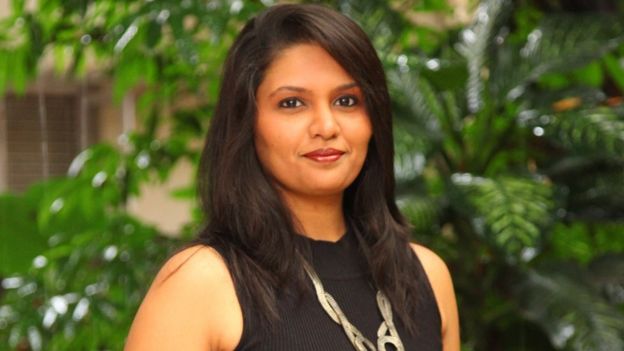
Mahita NagarajImage copyright CAREMONGERS INDIA
Image caption Mahita Nagaraj set up Caremongers India after her friends called her to seek help

Ms Nagaraj says she learnt about caremongering from a BBC article from Canada. The concept actually started in Toronto to help vulnerable people, but within days it spread to cover almost all of Canada with tens of thousands signing up.

Reports of altruism have come in from other parts of the world too. Britons are delivering soup to the elderly, in the US neighbours are helping those quarantined with buying groceries and one Long Island mother, infected with the virus, wrote about a neighbour who cooked a lasagne and left it outside her door.

Along with all the fear and panic caused by the coronavirus, the pandemic has also seen kindness go viral across the globe, with neighbours and complete strangers pitching in to help.

In India too, caremongering took off from the word go – in the first 24 hours, the Facebook group had 200 members. A week later, it has become a pan-India network with more than 6,500 volunteers.

Ms Nagaraj says she realised that on Facebook, most people were getting in touch to offer help, but only a few were asking for help. So, on Friday night, she launched a helpline number and since then, “it’s gone crazy”.

Caremongers India offers help to those who are most at risk of health complications due to the virus like the elderly, the disabled, those with pre-existing health conditions and anyone with an infant under a year.

In less than a week, Ms Nagaraj says, she has received thousands of calls and messages and although a large number of them have been to verify whether the number is genuine, she has also taken hundreds of requests for assistance.

Listed on the Caremongers India page are countless examples of assistance sought and provided; and testimonials and messages of gratitude.Transparent line (white space)

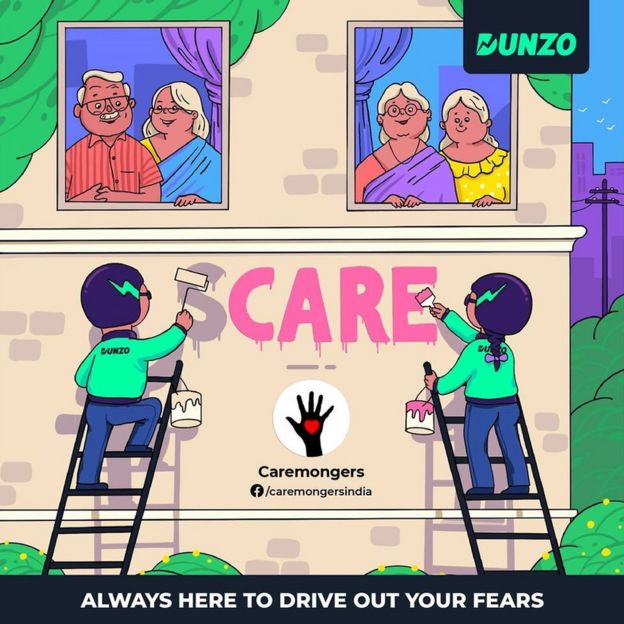
Wiping away the scareImage copyright IMAGE COURTESY: DUNZOTransparent line (white space)Besides those calling in from within India, Ms Nagaraj has been fielding dozens of calls from people across the globe seeking help for their elderly parents and grandparents.

“When people give their requirement and address, we match the requester with the closest volunteer,” she explains.

So last Saturday, when Amit Joshi, a resident of an upscale apartment block in the Delhi suburb of Noida, called the helpline, he was connected to Caremonger Madhavi Juneja, who also lives in Noida.

“We woke up to the news that our apartment complex was under lockdown,” Mr Joshi told me.

A resident had tested positive for the coronavirus and Mr Joshi was informed that they would not be allowed to leave home for a week.

“Police had put up barricades outside on the road and our complex was swamped with disaster management teams and health officials. Everything around us was shuttered. There was complete panic,” he says.

Mr Joshi, who lives with his wife and elderly parents, says his biggest worry was how to get essentials like bread and milk.

Banner image reading 'more about coronavirus'
Banner

And when he received a random WhatsApp forward from a colleague about Caremongers India, he decided to call them.

A few hours later, Ms Juneja, a psychotherapist and life coach, turned up at the gate of Mr Joshi’s housing society and handed over the supplies to him.

“I wore a mask and took my bottle of hand sanitiser and drove to his complex to carry out the delivery,” she said.

“Because the street was barricaded, I parked my car and then walked. If I had left it outside, someone else could have taken it. After I handed over the package to him, I sanitised my hands and got back into my car.”
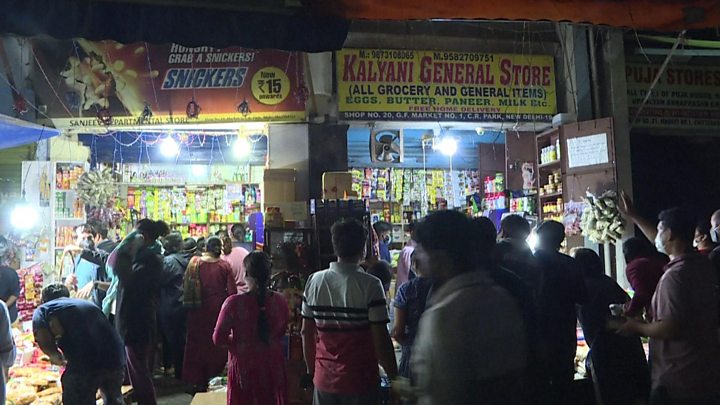
Media caption People panicked after Narendra Modi said nobody should leave their homes, and did not mention the status of essential supplies

Mr Joshi says, “In trying times like these, to have people selflessly reaching out to those in need has strengthened my belief in humanity.”

Ms Nagaraj says it’s “so heartening” to see that so many people want to help.

“Every request we receive is very special when we fulfil it. When a daughter calls to say her dad who lives alone requires provisions, we work hard to ensure he gets it.”

Ms Nagaraj says caremongering has taken over life and even her home.

“It’s not easy to answer 450 calls a day,” she says, “but when you help others, you go to bed thinking you haven’t wasted your day and that’s good enough for me.”

Source: The BBC
26/02/2020

Why Delhi violence has echoes of the Gujarat riots

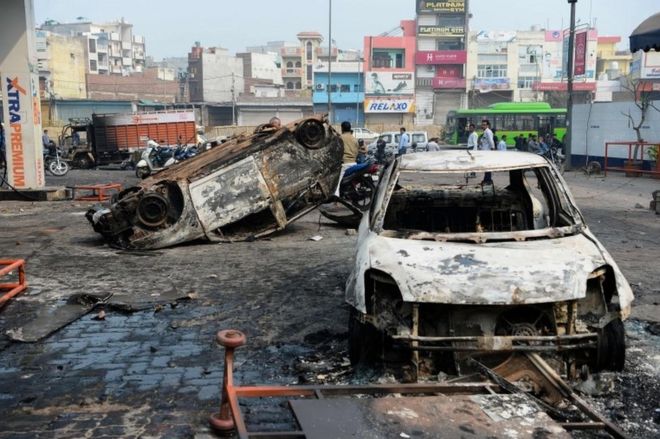
Local residents look at burnt-out vehicles following clashes between people supporting and opposing a contentious amendment to India"s citizenship law, in New Delhi on February 26, 2020Image copyright AFP
Image caption Delhi remains on edge after three days of rioting

The religious violence which has roiled Delhi since the weekend is the deadliest in decades.

What began as small clashes between supporters and opponents of a controversial citizenship law quickly escalated into full-blown religious riots between Hindus and Muslims, in congested working class neighbourhoods on the fringes of the sprawling capital.

Armed Hindu mobs rioted with impunity as the police appeared to look the other way. Mosques and homes and shops of Muslims were attacked, sometimes allegedly with the police in tow. Journalists covering the violence were stopped by the Hindu rioters and asked about their religion. Videos and pictures emerged of the mob forcing wounded Muslim men to recite the national anthem, and mercilessly beating up a young Muslim man. Panicky Muslims began leaving mixed neighbourhoods.

On the other side, Muslim rioters have also been violent – some of them also armed – and a number of Hindus, including security personnel, are among the dead and injured.

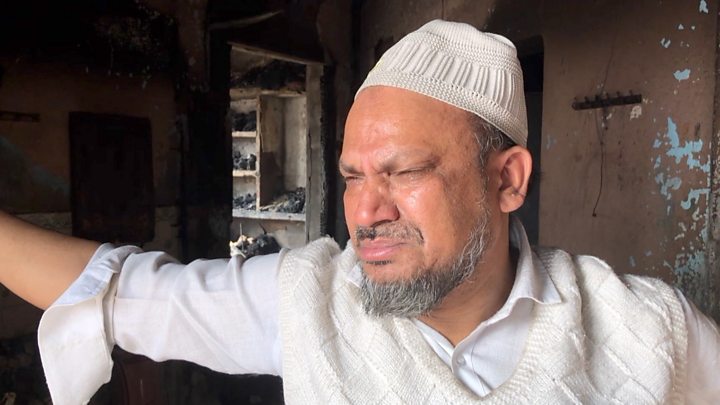
Media caption Delhi religious riots: ‘Mobs set fire to my house and shop’

Three days and 20 deaths later, Prime Minister Narendra Modi tweeted his first appeal for peace. There were no commiserations for the victims. Delhi’s governing Aam Aadmi Party was criticised for not doing much either. Many pointed to the egregious failure of Delhi’s police – the most well-resourced in India – and the inability of opposition parties to rally together, hit the streets and calm tensions. In the end, the rioters operated with impunity, and the victims were left to their fate.

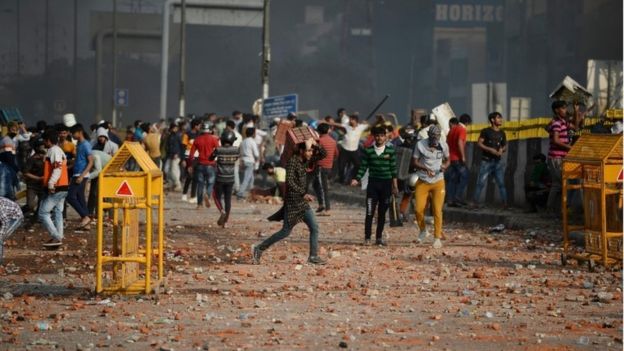
Demonstrators gather along a road scattered with stones following clashes between supporters and opponents of a new citizenship law, at Bhajanpura area of New Delhi on February 24, 2020Image copyright AFP
Image caption More than 20 people have been killed in the rioting

Not surprisingly, the ethnic violence in Delhi has drawn comparisons with two of India’s worst sectarian riots in living memory. Nearly 3,000 people were killed in anti-Sikh riots in the capital in 1984 after the then prime minister Indira Gandhi was assassinated by her Sikh bodyguards. And in 2002, more than 1,000 people, mostly Muslims, died after a train fire killed 60 Hindu pilgrims in Gujarat – Mr Modi was then the chief minister of the state. The police were accused of complicity in both riots. The Delhi High Court, which is hearing petitions about the current violence, has said it cannot let “another 1984” happen on its “watch”.

Ashutosh Varshney, a professor of political science at Brown University who has extensively researched religious violence in India, believes that the Delhi riots are beginning to “look like a pogrom” – much like the ones in 1984 and 2002.

Pogroms happen, according to Prof Varshney, when the police do not act neutrally to stop riots, look on when mobs go on the rampage and sometimes “explicitly” help the perpetrators. Evidence of police apathy in Delhi has surfaced over the past three days. “Of course, the violence thus far has not reached the scale of Gujarat or Delhi. Our energies should now focus on preventing further escalation,” he says.

Political scientist Bhanu Joshi and a team of researchers visited constituencies in Delhi ahead of February’s state elections. They found the BJP’s “perfectly oiled party machinery constantly giving out the message about suspicion, stereotypes and paranoia”. In one neighbourhood, they found a party councillor telling people: “You and your kids have stable jobs, money. So stop thinking of free, free. [She was alluding to free water and electricity being given to people by the incumbent government.] If this nation doesn’t remain, all the free will also vanish.” Such paranoia about the security of the nation at a time when India has been at its most secure has “widened” existing ethnic divisions and “made people suspicious”, Mr Joshi said.

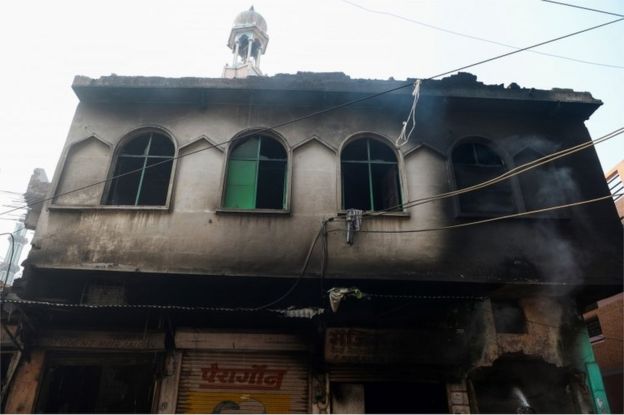
burnt-out mosque and shops are seen following clashes between people supporting and opposing a contentious amendment to India"s citizenship law, in New Delhi on February 26, 2020.Image copyright AFP
Image caption Mosques have been vandalised in the clashes

In the run-up to the Delhi elections Mr Modi’s party embarked on a polarising campaign around a controversial new citizenship law, the stripping of Kashmir’s autonomy and building a grand new Hindu temple on a disputed holy site. Party leaders freely indulged in hate speech, and were censured by poll authorities. A widely reported protest against the citizenship law by women in Shaheen Bagh, a Muslim-dominated neighbourhood in Delhi, was especially targeted by the BJP’s campaign, which sought to show the protesters as “traitors”.

“The repercussion of this campaign machine is the normalisation of suspicion and hate reflected in WhatsApp groups, Facebook pages, and conversations families have among themselves,” says Mr Joshi.

It was only a matter of time before Delhi’s fragile stability would be shaken. On Sunday a BJP leader issued a threat, telling the Delhi police they had three days to clear the sites where people had been protesting against the citizenship law and warned of consequences if they failed to do so. The first reports of clashes emerged later that day. The ethnic violence that followed was a tragedy foretold.

Source: The BBC

06/04/2019

WhatsApp: The ‘black hole’ of fake news in India’s election

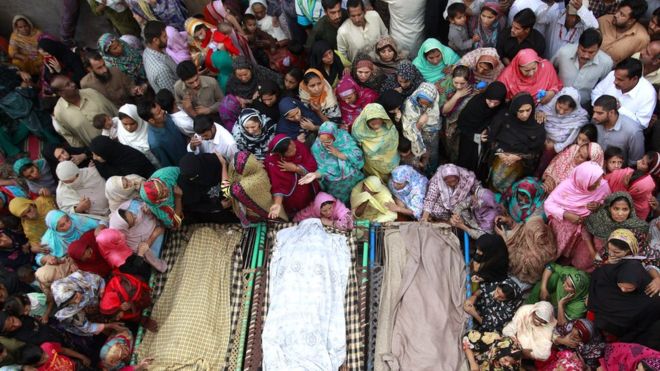
Muslim women and men gathered around three bodies in 2014Image copyrightREUTERS
Image caption The victims of a suicide attack pictured in this 2014 photo were falsely identified as Pakistani militants

WhatsApp, India’s most popular messaging platform, has become a vehicle for misinformation and propaganda ahead of the upcoming election. The Facebook-owned app has announced new measures to fight this but experts say the scale of the problem is overwhelming.

India was in the grip of patriotic fervour in early March when WhatsApp groups were flooded with photographs claiming to show proof that unprecedented Indian air strikes in Pakistani territory had been successful.

While India’s government said the 26 February strikes had killed a “large number of militants”, Islamabad insisted there had been no casualties.

But BBC fact-checkers found that the photos – purportedly of dead militants and a destroyed training camp – were old images that were being shared with false captions.

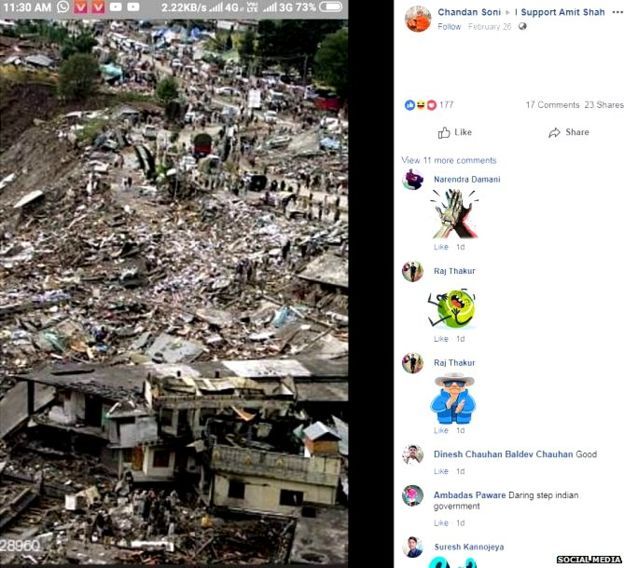
One photo showed a crowd of Muslim women and men gathered around three bodies but those pictured were actually victims of a suicide attack in Pakistan in 2014. A series of photos – of crumbling buildings, piles of debris and bodies in shrouds lying on the ground – were traced to a devastating earthquake in Pakistan-administered Kashmir in 2005.

A Facebook post misidentifying a photo from an earthquake in KashmirImage copyrightFACEBOOK
Image caption This photo of the aftermath of an earthquake in Kashmir was shared on WhatsApp and Facebook
Presentational white spaceWhatsApp and Facebook have been struggling to curb the impact of “fake news” – messages, photos and videos peddling misleading or outright false information – in elections around the world.

But India’s upcoming election – the world’s largest democratic exercise – is seen as a significant test. Internet usage in rural areas has exploded since the last election in 2014, fuelled by the world’s lowest mobile data prices.

In the lead-up to the vote, Facebook has removed hundreds of accounts and pages for misleading users. WhatsApp, meanwhile, has launched a service to verify reports sent in by users and to study the scale of misinformation on the platform.

What’s the scale of the problem?

India poses a particularly complex problem for Facebook. It is WhatsApp’s largest market – more than 200 million Indians use the app – and a place where users forward more content than anywhere else in the world.

The fact that up to 256 people can be part of a group chat makes it incredibly popular with extended families and large groups of friends. While much of these daily conversations involve people making plans, sharing jokes and catching up – political messages and videos are also shared widely.

BBC research last year found that a rising tide of nationalism was driving Indians to share fake news. Participants tended to assume that WhatsApp messages from family and friends could be trusted and sent on without any checks.

Prasanto K Roy, a tech writer, is in a group of more than 100 classmates from his old high school in Delhi. There are Christians, Hindus and Muslims in the group.

“Since 2014, we have been seeing a great deal of polarisation,” he said. “About 10 people are incessantly sending out fake stuff. Some people like me are doing fact checks and telling them but we are being ignored.”

Many Indians were first introduced to the internet through their smartphones. A recent Reuters Institute survey of English-language Indian internet users found that 52% of respondents got news via WhatsApp. The same proportion said they got their news from Facebook.

But content shared via WhatsApp has led to murder. At least 31 people were killed in 2017 and 2018 as a result of mob attacks fuelled by rumours on WhatsApp and social media, a BBC analysis found.

What’s happening before the election?

Both of the main parties – the governing Bharatiya Janata Party (BJP) of Prime Minister Narendra Modi and the opposition Congress – are exploiting the power of WhatsApp to try to influence India’s 900 million eligible voters.

Before the campaign began, the BJP had plans to assign some 900,000 people with the specific task of localised WhatsApp campaigning, the Hindustan Times newspaper reported.

Congress, the party of the Nehru-Gandhi political dynasty, is focusing on uploading campaign content on Facebook and distributing it via WhatsApp.

Both parties have been accused of spreading false or misleading information, or misrepresentation online. On 1 April, Facebook removed 687 pages or accounts that it said were linked to the Congress party for “co-ordinated inauthentic behaviour”.

Pro-BJP Facebook pages – possibly as many as 200 – were also taken down, according to reports, although Facebook did not confirm this. (The social media company did not respond to a request for an explanation).

Media caption India’s elections are the world’s biggest democratic exercise

The BJP began setting up WhatsApp groups en masse around 2016 as it saw an opportunity to reach vast numbers of people, said Shivam Shankar Singh, a former BJP data analyst who worked on regional elections in 2017 and 2018.

By mapping names on electoral rolls against purchased phone numbers and names, it was able to create groups based on certain demographics – such as caste or religion – and target messaging, he said.

Mr Singh, who now works for anti-BJP opposition parties in the state of Bihar, estimated that there were at least 20,000 pro-BJP WhatsApp groups in northern Uttar Pradesh, India’s most populous state.

National party spokesman Gopal Krishna Agarwal denied that the party had any official policy to set up WhatsApp groups – other than to facilitate communication between party workers.

He said supporters and members at a local level were allowed to set up groups, but that these had no official link to the party.

“We don’t want to control it, it’s an open social media platform,” he said.

Why does WhatsApp pose a unique problem?

Indian fact-checking websites like AltNews and Boom frequently debunk political posts shared on Facebook and Twitter – such as reports that a British analyst of Indian elections had called Congress leader Rahul Gandhi “stupid” or that an air force pilot seen as a national hero had joined Congress.

These posts, while not promoted by official party accounts, are often spread widely by unofficial groups or people supporting the parties. They are then sometimes shared by politicians.

“Facebook and Twitter are platforms that do not allow too much secrecy which allows fact-checkers like us to trace who the bad actors are in many of the cases,” said Jency Jacob, the founder of Indian fact-checking site Boom.

The difference with WhatsApp is that posts there are private and protected by encryption. Mr Roy likened it to “something of a black hole”.

“No-one, including WhatsApp itself, gets to see, read, filter or analyse text messages,” he said.

This is unlikely to change – the company said it “deeply believes in people’s ability to communicate privately online”.

Media caption The digital epidemic killing Indians

What has the company done?

Amid the furore over mob lynchings last year, WhatsApp limited the number of times a user can forward a message to five. It also now labels forwarded messages.

The company has launched a nationwide advertising campaign in 10 languages, which it says has reached hundreds of millions of Indians. It also says that it bans two million accounts globally every month that are sending automated spam messages.

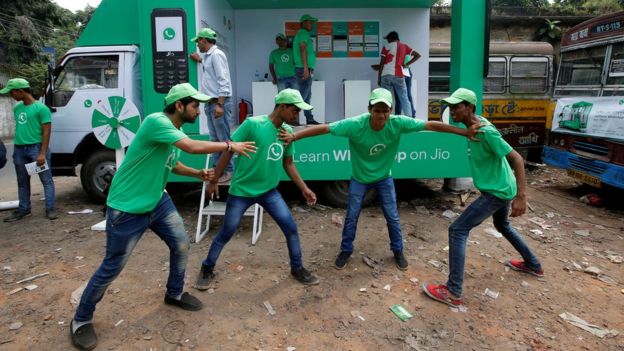
Actors in WhatsApp shirts perform a skit in Jaipur in October 2018Image copyrightREUTERS
Image captionWhatsApp has performed street plays in India to spread awareness about misinformation

New privacy settings also allow users to decide who can add them to groups. Previously any WhatsApp user could be added to a group by any other. Now you can choose to only be added automatically to groups by contacts, or by no-one at all.

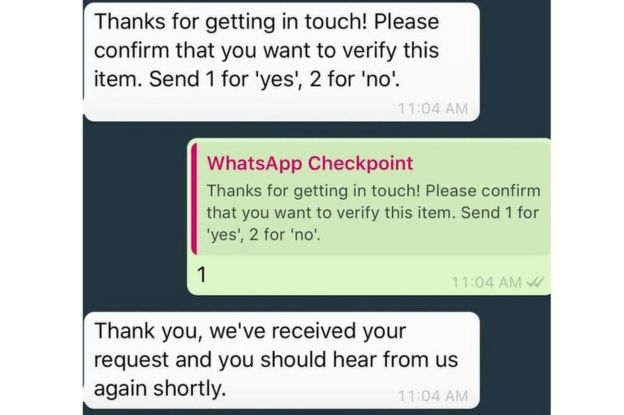
On 2 April the company announced a new project – Checkpoint – that allows users to send in suspicious messages in English and four Indian languages to WhatsApp for verification. Users are told if the message is true, false, misleading or disputed.

It was reported widely as a new fact-checking service but the company has since emphasised that it mostly aims to “study the misinformation phenomenon” and that not all users will receive a response.

Is it working?

While WhatsApp said its moves had decreased forwarded messages by 25%, fact-checkers at other organisations say fake news is still rampant. And they are frustrated that the same rumours and conspiracy theories that they have already debunked – that the Nehru-Gandhi political dynasty have Muslim roots, for example – keep resurfacing.

They say that unless WhatsApp changes its stance on encryption and privacy, the introduction of features similar to those that exist on Facebook – for example, flagging debunked content to users who try to forward it – is impossible.

Screenshots showing WhatsApp checkpoint's service responding to a BBC message asking for confirmation that we want to verify an item
Image captionThe BBC is yet to receive a response from WhatsApp’s new service

Critics also point out that new rules on the platform won’t affect the huge number of group chats that already exist – giving the party of Prime Minister Modi an advantage.

“The BJP is the only party that has WhatsApp groups at this scale,” Mr Singh said. “The other parties can’t do it now because WhatsApp has changed its policies.”

Source: The BBC

28/02/2019

Social media fake news fans tension between India and Pakistan

MUMBAI (Reuters) – With India and Pakistan standing on the brink of war this week, several false videos, pictures and messages circulated widely on social media, sparking anger and heightening tension in both countries.

The video of an injured pilot from a recent Indian air show and images from a 2005 earthquake have been taken out of context to attempt to mislead tens of millions on platforms like Twitter, Facebook and its messenger service, WhatsApp.

The spurt of fake news comes after New Delhi this week launched an air strike inside Pakistan, the first such move in over more than decades. India says the attack destroyed a militant camp run by the group that claimed responsibility for killing 40 paramilitary troops in Indian Kashmir on Feb 14. Pakistan denied there had been any casualties in the attack.
Tensions between the nuclear-armed nations peaked with both sides claiming they’d shot down each other’s fighter jets on Wednesday, and Pakistan capturing an Indian pilot.
As claims and counter claims poured in from both sides, social media became a hotbed of unverified news, pictures and video clips, according to fact checkers.
Partik Sinha, co-founder of one such fact-checking website, Alt News, said it had received requests to verify news from journalists and people on social media.
“It’s been crazy since Tuesday. There is so much out there that we know is fake, but we’re not able to fact-check all of it,” Sinha said.
A Facebook group that says it supports Amit Shah, the chief of India’s ruling Bharatiya Janata Party (BJP), posted images on Tuesday of the alleged destruction caused inside Pakistan by the Indian air strike.
Three photos posted on the group page showed debris from a destroyed building and bodies and have been shared hundreds of times.
Alt News said the pictures were from a 2005 earthquake in Kashmir.
India, where roughly 450 million people have smartphones, is already struggling with a huge fake news problem with misinformation having led to mass beatings and mob lynchings.
Facebook, WhatsApp and Twitter have begun to take steps to combat the issue, but as India heads toward general elections, due by May, fake news is getting more intensely politicized.
Another message circulated on a WhatsApp group supporting the BJP claimed the Indian jet was not shot down, but crashed due to a technical snag and blamed the opposition Congress party for failing to upgrade the jets during its tenure.
Similarly in Pakistan, a purported video of a second captured Indian pilot was being widely circulated. Fact-checking website Boom noted the clip was from an air show in the southern Indian city of Bengaluru, where two planes crashed on Feb. 19.
“Everyone has a role to play in ensuring misinformation doesn’t spread on the internet and we encourage people who use Twitter not to share information unless they can verify that it’s true,” a spokeswoman for Twitter said.
Source: Reuters
Law of Unintended Consequences

continuously updated blog about China & India

ChiaHou's Book Reviews

continuously updated blog about China & India

What's wrong with the world; and its economy

continuously updated blog about China & India