Archive for ‘women’

02/02/2019

Three women who could be Modi’s biggest nightmare in India’s election

NEW DELHI (Reuters) – Three powerful women politicians, each from a very different section of Indian society, may pose a big threat to the chances of Prime Minister Narendra Modi winning a second term in a general election due by May.

Priyanka Gandhi Vadra, part of the Nehru-Gandhi dynasty that has ruled India for much of the time since its independence from the British in 1947, joined the struggle in January, when the opposition Congress party made her its face in the nation’s most populous state, Uttar Pradesh.

Two other senior female politicians – the firebrand chief minister of West Bengal state, Mamata Banerjee, and Mayawati, a former Uttar Pradesh chief minister – are also plotting to unseat Modi’s ruling National Democratic Alliance (NDA) coalition by forming big opposition groupings, though there is no firm agreement between them as yet.

“The opposition has more powerful women leaders than the NDA, and therefore they will be able to carry conviction with voters generally, and with women voters, in particular,” said Yashwant Sinha, 81, a former finance minister who quit Modi’s Hindu nationalist Bharatiya Janata Party (BJP), which dominates the NDA, last year.

“They should be very worried, especially after the defeat in the three major Hindi heartland states,” he said, referring to BJP’s losses in recent state elections.

The entry of Priyanka – she is usually referred to by just her first name – into the political fray drew a gushing reaction from much of the Indian media.

SPONSORED

There were pictures of elated supporters dancing, a lot of talk of the 47-year-old’s resemblance to her grandmother, former Prime Minister Indira Gandhi, and comments about her gifts as a speaker able to connect with voters. That contrasts with her brother, Congress leader Rahul Gandhi, who in the past has been criticized for lacking the common touch.

TRIPLE CHALLENGE

The other two women seen threatening Modi’s grip on power have a lot more experience than Priyanka, and both could be seen as potential prime ministerial candidates in a coalition government.

Mayawati, a 63-year-old former teacher who goes by just the one name, last month formed an alliance between her Bahujan Samaj Party (BSP) – which mainly represents Hinduism’s lowest caste, the Dalits – and its once bitter foes, the Samajwadi Party that tends to draw support from other lower castes and Muslims.

Then there is 64-year-old Banerjee, who has twice been railways minister in federal governments. Last month, Banerjee – who built her All India Trinamool Congress (AITC) party after leaving Congress in 1997 – organised an anti-BJP rally in Kolkata that attracted hundreds of thousands.

Party colleagues of the three women leaders said they were not available for comment.

To be sure, Modi remains, for now, the most popular leader in the country, opinion polls show.

Modi also cannot be accused of ignoring women’s issues during his first term. He has launched a government campaign – Beti Bachao, Beti Padhao, or “Save the Daughter, Educate the Daughter” – and called for the eradication of female foeticide. His campaigns to provide toilets and subsidised gas cylinders for poorer Indians are often promoted as ways to empower women.

He has six women in his 26-strong cabinet, though a lot of power is centralised with Modi and a couple of senior male lieutenants.

The BJP said it would seek votes on the basis of achievements under Modi and the opposition did not have a “positive alternative to the government, and its activities”.

PERSONAL TIES

Congress has said it wants to form a post-poll partnership with Mayawati’s BSP and SP alliance, though it will be fighting against it in 78 seats. The alliance will not contest two Gandhi strongholds won multiple times by Rahul and his mother Sonia.

Mayawati told a press conference announcing the alliance with the SP that Congress was not part of it because they did not think “there would be much benefit in having them with us before the election”.

The BSP, however, backs Congress-led governments in the northern states of Madhya Pradesh and Rajasthan.

There is no formal alliance between Banerjee and Congress, though she does know Rahul and Priyanka.

Dinesh Trivedi, a former federal minister and a close aide to Banerjee, said she enjoys a good personal relationship with Sonia Gandhi, the matriarch of the dynasty and a former Congress president, and so working with her two children would not be a problem.

“In terms of experience, Mamata Banerjee is far ahead,” Trivedi said. “I wouldn’t be surprised if Rahul Gandhi or Priyanka Gandhi would look at Mamata Banerjee as somebody who could really inspire them.”

The strength of Priyanka, Mayawati and Banerjee as a potential opposition alliance is that they can appeal to different parts of the electorate.

Two Congress sources said the formal entry into politics of Priyanka could help rejuvenate the party in Uttar Pradesh, where it is a marginal player. Coming from what is India’s first family, they said she could appeal to upper caste voters in the state who typically vote for the pro-business BJP.

A Congress leader close to the Gandhis said she would attract women, young people, and floating voters.

Priyanka is far from a political neophyte, having supported her brother and mother during previous election campaigns. She has also experienced political and personal tragedy, as Rahul Gandhi stressed in a speech last week.

“You have to understand my relationship with my sister – we have been through a hell of a lot together,” he said.

“Everybody is like ‘look, you come from this illustrious family, and everything is easy’. Actually it’s not so easy. My father was assassinated, my grandmother was assassinated, huge political battles, wins in political battles, losses in political battles.”

“NATIONAL LEADER”

BSP spokesman Sudhindra Bhadoria said Mayawati’s gender did not matter.

“She has managed a party from scratch to this level. The important fact is that she has organised large numbers, both men and women, Dalits, other backward castes, the poor, minorities,” Bhadoria said. “I don’t fit them in the straightjacket of male-female. I think she’s a national leader.”

She is regarded as ambitious. A U.S. diplomatic cable in 2008, among many thousands leaked by Wikileaks two years later, described her as “first-rate egomaniac” who “is obsessed with becoming prime minister”.

But Mayawati has also been credited with empowering oppressed lower caste Hindus.

Banerjee, who defeated a 34-year-old communist government in West Bengal in an election in 2011, is known for her streetwise political skills and portrays herself as a secular leader in a country polarised under the BJP.

Source: Reuters
04/01/2019

The women who banned alcohol

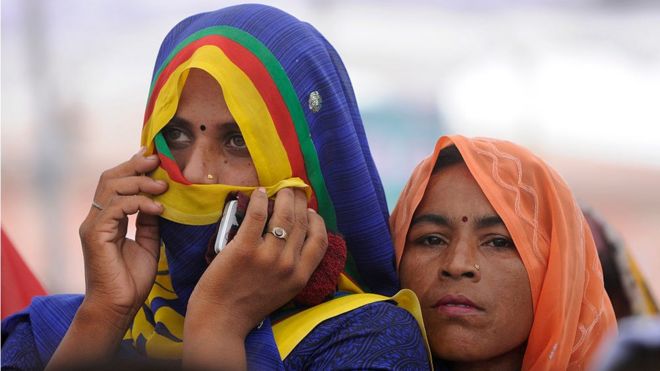
Women at an anti-alcohol rally in northern IndiaImage copyrightGETTY IMAGES

In the world’s largest democracy, politicians are finding that they need to listen to women if they want power.

In northern India, some women had long complained that they were fed up with their husbands being drunk.

An alcohol ban brought in at their request has affected 100 million people in the state of Bihar.

The domestic violence, petty crime and wasted income that had long plagued their region fell soon afterwards, the state government claims.

Women-centric campaigns are playing an even bigger role in India’s upcoming national election, in a country of 1.3bn people.

Politicians offering free girls’ education, money to newlywed brides, and special women’s police stations scored highly in the recent regional polls.

The reason? In India’s male-dominated, conservative society, women voters are rapidly gaining ground.

Women voters

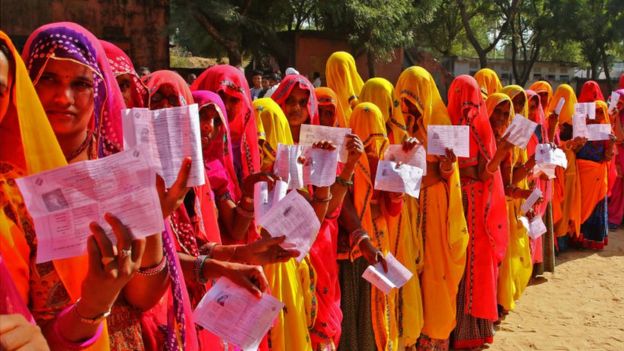
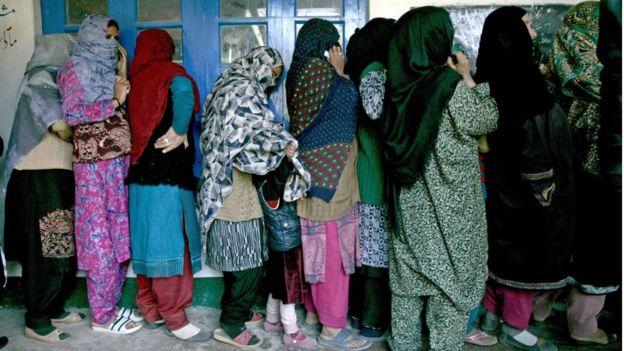
Women queue with their identity cards at the state elections in Rajasthan, December 2018Image copyrightGETTY IMAGES
Image captionWomen queue with their identity cards at the state elections in Rajasthan, December 2018

Ranked in the bottom third of countries for gender equality, India has long struggled to get women to the ballot box.

There are a number of reasons for this.

The gender gap in voting is partly because women traditionally have been less likely to register in the first place.

Even if they are registered, the idea of women leaving the household to vote is sometimes frowned upon, and they can face harassment and intimidation at the polls.

For decades, registered women voters’ turnout in elections lagged behind men’s by an average of 6-10%, reflecting their marginalisation in society and giving them less opportunity to shape policy.

There are also fewer women to start with. Sex-selective abortions, female infanticide and preferential treatment for boys in India, mean that there are only 943 women for every 1,000 men in the population.

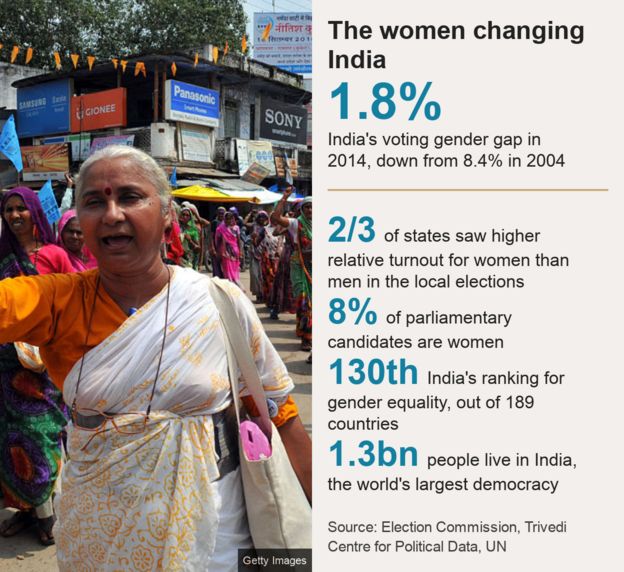
Key facts about women voters in India

Despite these issues, the voting gender gap has recently shrunk to its smallest level on record.

In India’s 2014 general election it was 1.8%, down from 8.4% in 2004.

In the 30 regional elections held from 2012 until mid-2018, female turnout was higher than men in two-thirds of states.

Banning alcohol

Bihar in northern India is one of the states with a higher proportion of women voters.

It has long suffered from problems of anti-social behaviour and crime, with alcoholism draining income away from some households.

In the 2015 state elections, women’s turnout exceeded men’s by 7% – and they had a clear message: get rid of alcohol.

Concerned about re-election, Bihar’s chief minister Nitish Kumar pledged to do just that when he won local re-election.

He introduced a ban on drinking and selling alcohol in the state.

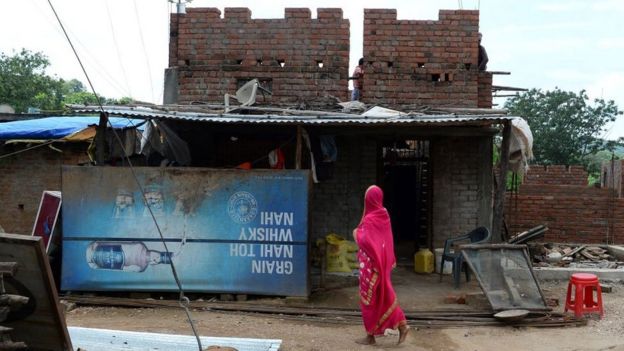
A woman walks past a closed down alcohol shop close to the Bihar borderImage copyrightGETTY IMAGES
Image captionA woman walks past a shut alcohol shop close to the Bihar border

Within a year or two, the government reported that violent crime had fallen drastically, while money available for cars and tractors increased.

Social activists such as Medha Patkar have clong called on other states to ban alcohol too, arguing that “liquor is the biggest reason for violence against women”.

However, one study found the police resources needed to enforce the alcohol ban meant there was less capacity to deal with violent crime.

Why are more women voting?

What has caused the sudden political mobilisation of women across India?

Increased female literacy and education have certainly brought more women to the polls.

But while progress on those measures has been slow, female voter turnout has shot up in just a decade.

A combination of personal factors and government intervention is likely to have contributed.

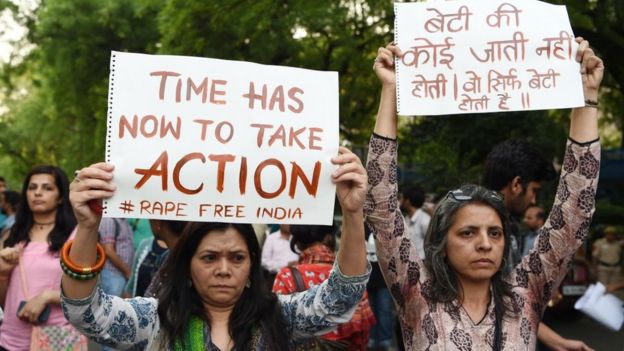
High-profile cases of violence against women have undoubtedly galvanised female voters to fight for rights and safety in their communities.

Protest march in support of rape victims in IndiaImage copyrightGETTY IMAGES

Protests erupted across the country earlier this year after rape cases in Uttar Pradesh, Jammu and Kashmir, and other states made headlines, while the #MeToo movement took hold from the autumn.

The Election Commission of India (ECI) is trying to tackle the violence and intimidation faced by women going to the polls.

It has tried to improve security at India’s more than 900,000 polling booths, meaning women can now vote in relative safety.

The ECI has also experimented with setting up separate women-only queues on election day, and establishing polling stations run entirely by women.

A groundbreaking general election

In 2019, voter turnout may be higher for women than men for the first time in an Indian national election.

This trend has many implications, not only for how politicians campaign, but also how they govern.

Since coming to power in 2014, Prime Minister Narendra Modi has made no secret of his desire to appeal to women voters.

A woman withdraws money at her bankImage copyrightGETTY IMAGES

For instance, he has introduced a scheme to provide cooking gas cylinders to millions of Indian households. His party claims this will stop women from breathing in harmful smoke or spending hours collecting fuel.

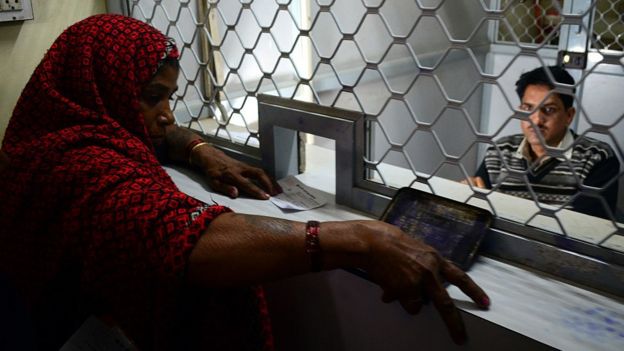
Another scheme aims to provide every household with a bank account. At least half of newly-opened accounts are registered to women, who have historically lacked access to modern banking.

Looking to the future

The path to female empowerment in India has been slow and prone to setbacks.

India ranks 121st out of 131 countries when it comes to women being represented in the workplace.

In politics, women make up just eight per cent of parliamentary candidates and only 11.5 per cent of eventual winners.

This may change. Women’s activism is putting pressure on political parties to pass the Women’s Reservation Bill, guaranteeing one-third of Parliamentary seats for women.

Similar quotas already exist in local-level politics, creating a “pipeline” of women running for high-level office.

Women cast their votes in the state of Jammu and KashmirImage copyrightGETTY IMAGES
Image captionWomen cast their votes in the state of Jammu and Kashmir

With more women in charge, India’s political establishment would look much more like the population it represents.

Electing more women may benefit the country in unexpected ways as well: recent research links female politicians to higher growth and less corruption.

While gender equality in the world’s largest democracy is a long way off, the influence of women at the ballot box and in the corridors of power is already having a clear impact.

19/12/2018

Transgender women pray at India’s Sabarimala temple

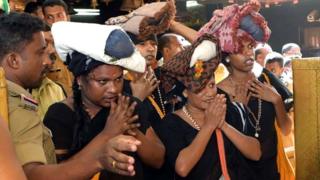
The transgender women pray at the Sabarimala shrine in Kerala stateImage copyrightA S SATHEESH
Image captionThe transwomen were accompanied by some 20 police officers

Four transgender women have been allowed to pray at an Indian temple at the centre of a bitter row over whether women should be permitted to enter.

Despite a Supreme Court ruling allowing women devotees into the Sabarimala shrine in Kerala state, they have been blocked repeatedly by mobs.

The transgender women, all wearing black sarees, were allowed to enter on Tuesday under police protection.

The temple has historically been closed to women of “menstruating age”.

The group of transgender women had been blocked from accessing the temple on Sunday by police, citing security concerns.

Image captionThe four joined prayers at the temple on Tuesday

Before September’s Supreme Court ruling, transgender women were allowed to enter the shrine, but since the decision – which sparked violent protests – some police officials had suggested that transgender women should dress as men in order to gain access.

They refused and took their case to a committee set up by the Kerala High Court.

The panel agreed that they could pray at the shrine, and temple officials also said they did not object to the transgender women because they do not menstruate.

‘We followed the rituals’

The earlier ban on women between the ages of 10 to 50 entering the Sabarimala shrine was in place partly because the temple deity, Lord Ayyappa, was a bachelor, the shrine’s management had said.

The court ruling ending the ban led to security concerns as women, including activists, were met with protests from members of the Hindu nationalist Bharatiya Janata Party (BJP) and other allied organisations.

These organisations wanted tradition to be followed, despite the ruling of the court on 28 September based on the fundamental rights of women.

Image captionTheir presence was not met with protests or resistance, police said

One of the transgender women, 33-year-old Trupthi, told BBC Hindi on Tuesday that women like her were “very much part of Hinduism” and were respected as such.

“I am very happy that we were able to pray [to Ayyappa]. We are devotees… we had followed all the rituals that a pilgrim should follow to visit the shrine,” Trupthi said.

She added that the other transgender women to pray at the shrine were Ananya, 26, Renjimol, 30, and Avantika, 24.

They were accompanied by some 20 police officers, but their presence at the temple was not met with protests or resistance, police said.

15/12/2018

The women in India building a road to a new life

Three years ago, many journeys through villages in India’s Sundarbans Delta were treacherous. Women suffered miscarriages and children’s education was suffering because it was hard for them to get to hospitals and schools.

But then, a group of women decided to take matters into their own hands, by building their own road.

Law of Unintended Consequences

continuously updated blog about China & India

ChiaHou's Book Reviews

continuously updated blog about China & India

What's wrong with the world; and its economy

continuously updated blog about China & India