08/03/2020
- Japan risks massive financial losses and a political blow for Shinzo Abe’s government if the Tokyo Olympics are cancelled or postponed
- The Olympics were last cancelled in 1940 after Japan invaded China and the outbreak of World War II, but the Zika virus did not stop the 2016 Rio Games
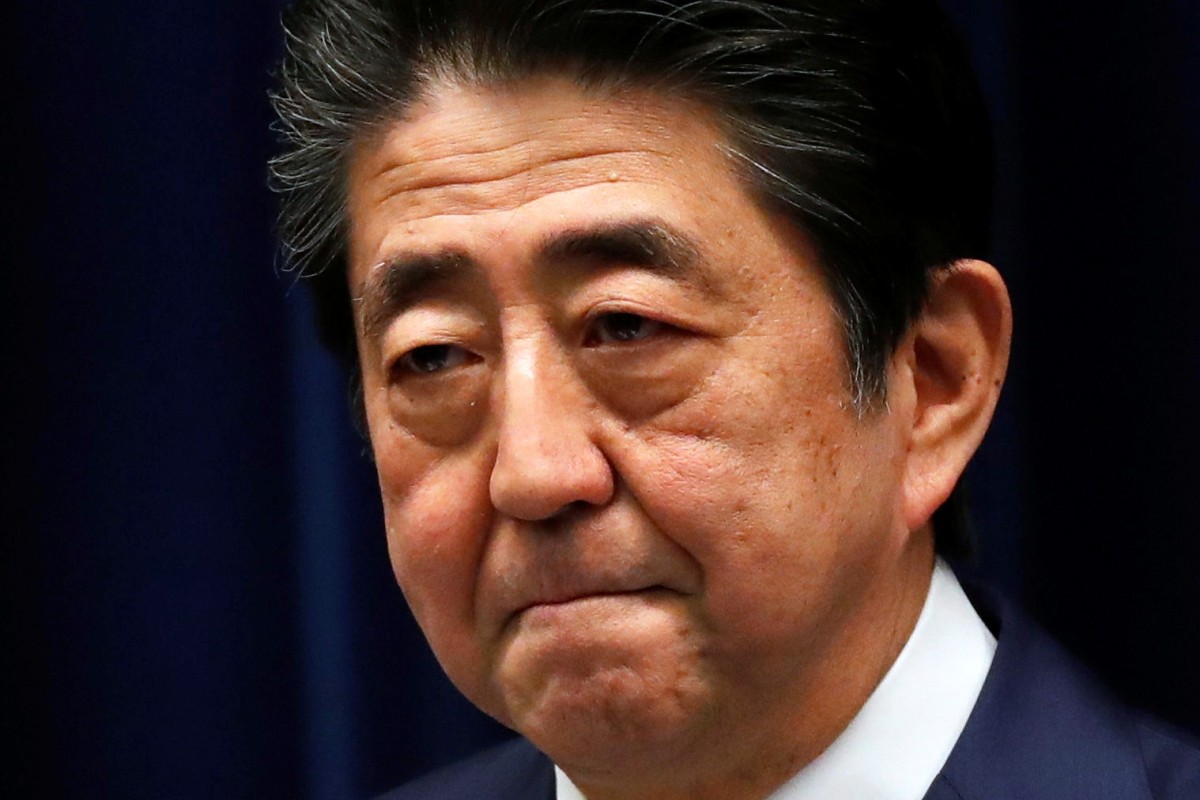
Japan’s Prime Minister Shinzo Abe attends a news conference on the coronavirus. An analyst said the cancellation of the Olympic Games would not only be a financial blow, but would also dent the political pride of his government, which wanted to show the world that Japan could host a successful Olympics. Photo: Reuters
has far more at stake than its athletes picking up medals in the upcoming
, which explains the government’s single-minded commitment to going ahead with the event in the face of the threat posed by the novel coronavirus.
The Japanese government on Wednesday morning reiterated that the Games would go ahead in July as scheduled, with chief cabinet secretary Yoshihide Suga declaring that preparations were continuing despite the spread of the virus worldwide.
The previous day, the International Olympic Committee (IOC) threw its weight behind Tokyo’s position. “We are preparing for a successful Olympic Games, Tokyo 2020,” said IOC head Thomas Bach.
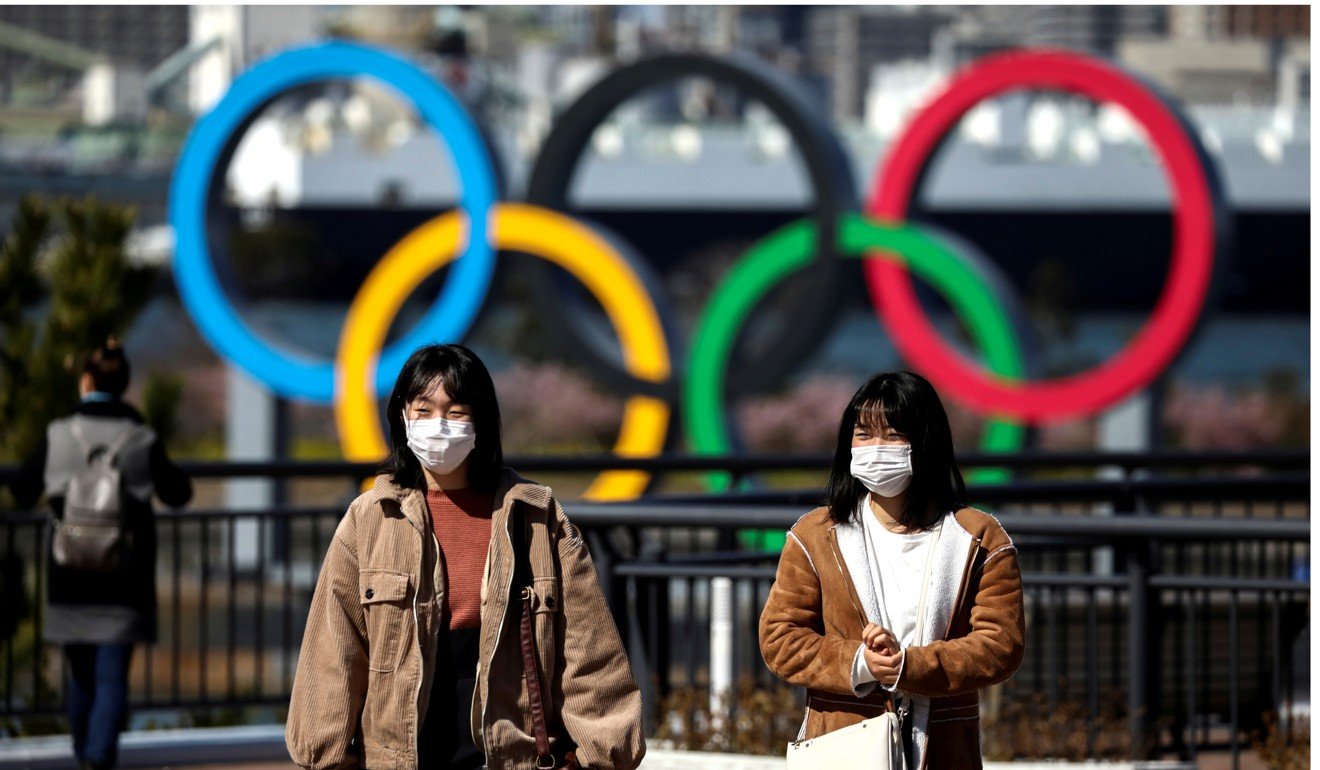
People wearing protective face masks are seen in front of the Olympic rings at the waterfront area at Odaiba Marine Park in Tokyo, Japan. Photo: Reuters
“I would like to encourage all the athletes to continue their preparations … with great confidence and full steam,” he said. “From our side, we will continue to support the athletes and the national Olympic committees.”
Both statements came on the heels of a comment by Seiko Hashimoto, Japan’s minister with responsibility for the Games, who suggested that the contract with the IOC “could be
interpreted as allowing for a postponement” until later in the year. On Thursday, Hashimoto acknowledged to the Upper House budget committee that a cancellation or delay of the games would be “unacceptable for the athletes”.
Stephen Nagy, an associate professor of international relations at Tokyo’s International Christian University, said a great deal is at stake for Japan as the last time a modern Olympic Games was cancelled was in 1940 – ironically as a result of Japan’s invasion of China in July 1937, and the outbreak of World War II. Meanwhile, the Rio Games in Brazil went on as planned in 2016 despite the outbreak of the Zika virus.
While the 1940 cancellation has largely been forgotten, it would unquestionably cause serious loss of face to the Abe administration if events did conspire to halt Tokyo 2020, he said.
I think it’s much more about the national political pride of ‘Team Abe’Economist Noriko Hama
Noriko Hama, an economist at Doshisha University in Kyoto believes a number of issues are behind the government’s refusal to contemplate the Games being postponed or cancelled, but one is dominant.
“Yes, it’s about the money that has already been spent on facilities and new infrastructure and the windfall from tens of thousands of foreign tourists, but I think it’s much more about the national political pride of ‘Team Abe’,” she said.
“They wanted to show the world that they could do this, that they would be one of the very few cities to host an Olympics for a second time and that it would be a massive success,” she said. “It’s about chest-thumping.”
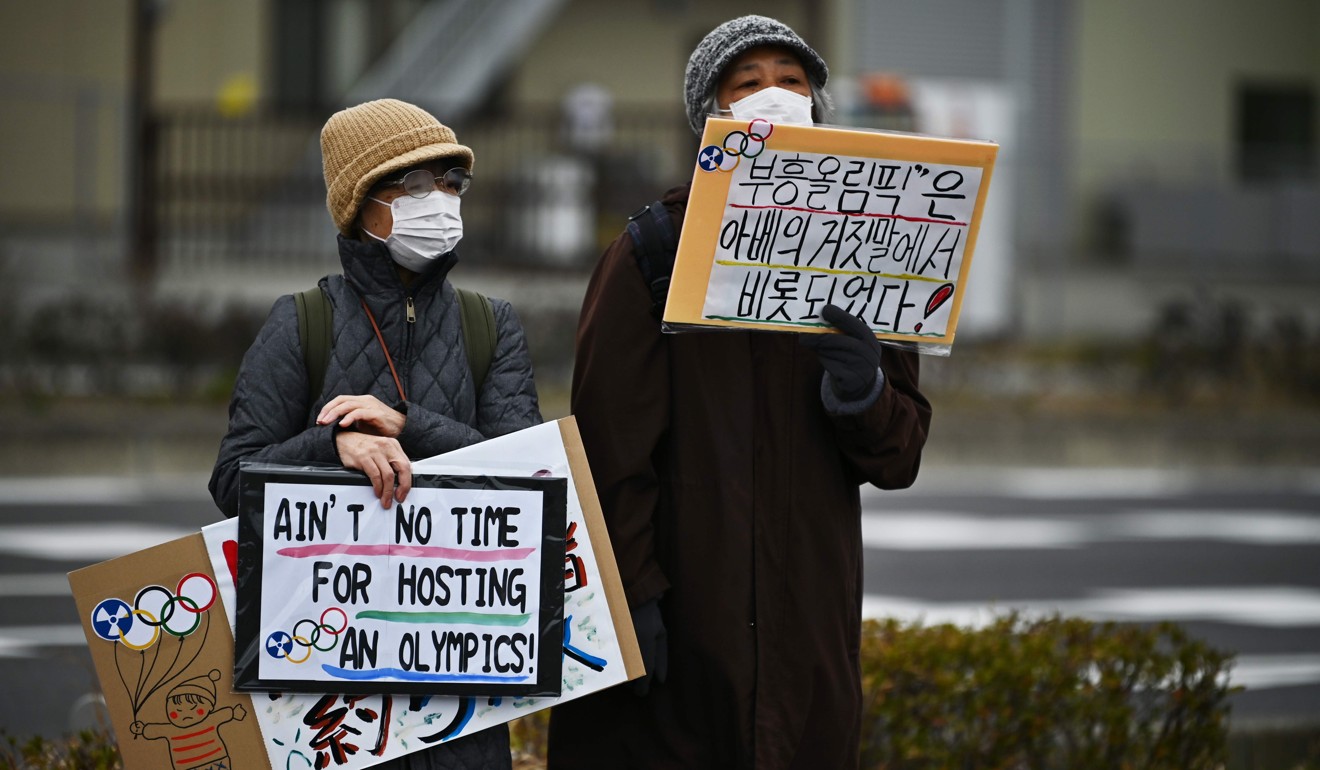
Protesters hold placards during a demonstration against the Olympics, Prime Minister Shinzo Abe and nuclear energy. Photo: AFP
Hama pointed out that many Japanese people had been sceptical about the Games, and for a variety of reasons.
Many are unhappy at the cost, which was previously estimated at 1.06 trillion yen (US$9.81 billion) but organisers confirmed in December had risen to 1.35 trillion yen (US$12.35 billion), plus another 3 billion yen required to move the marathon and walking events from Tokyo to Sapporo, in Hokkaido, to avoid the heat and humidity of the capital.
Others said the Games will cause widespread disruption to the lives of ordinary people and that Tokyo was still not fully prepared for the huge numbers of people that will inevitably flood the city. Some voiced concerns that holding the Games at the peak of a Japanese summer would cause problems for athletes, officials and spectators alike. There have been predictions that the heat is going to cause loss of life.
Only an apocalypse – or government ineptitude – can stop the Olympics
“But there is this strange sort of blind obstinacy that is driving the whole thing forward regardless,” said Hama. “And now the coronavirus has added another layer of very serious concern and I believe the government need to think very carefully what they are going to do.”
Nagy said the Japanese government would be reluctant to postpone the Games as that would “once again tarnish the brand”.
“Seven or eight years ago, Japan was largely seen as a stagnant country that was struggling to shake off the legacy of two decades of economic underperformance, but that changed quite suddenly,” he said.
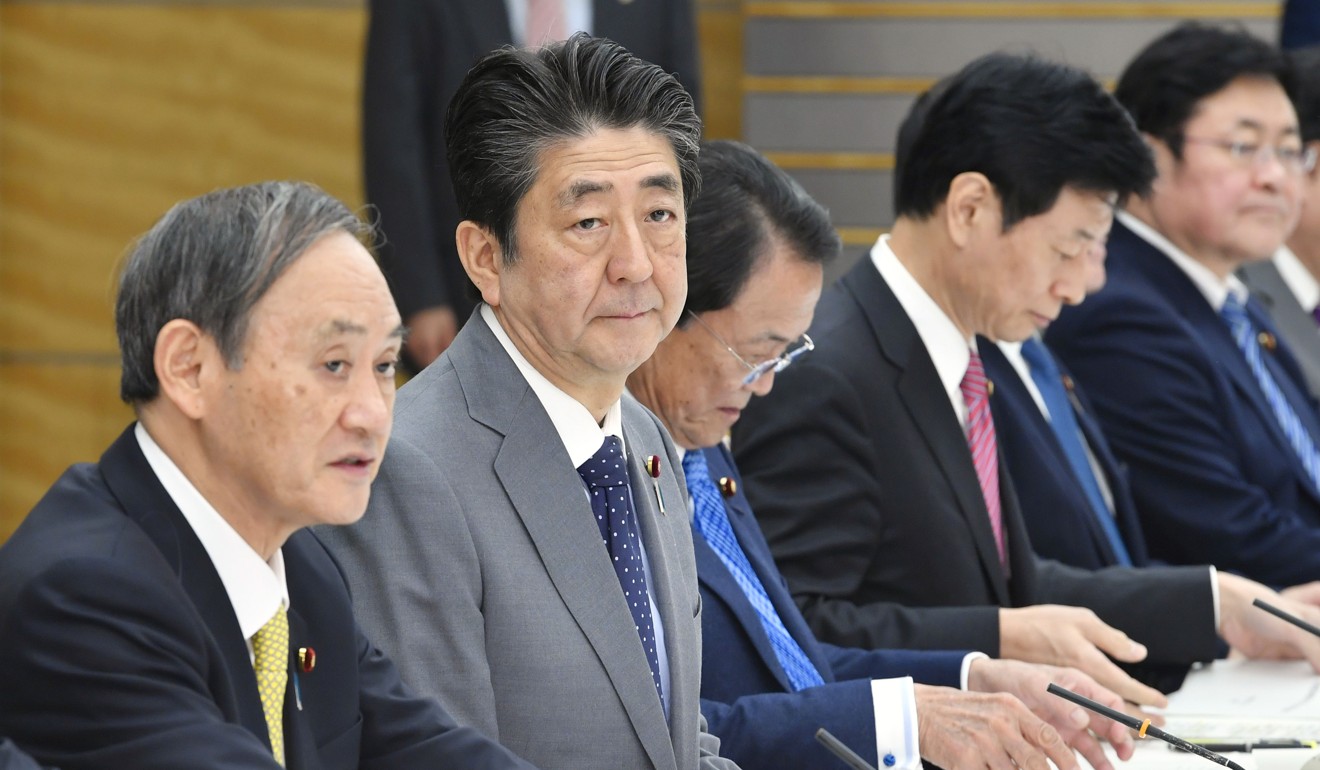
Japan’s chief cabinet secretary Yoshihide Suga and Prime Minister Shinzo Abe attend a meeting with other ministers in Tokyo. Photo: Kyodo
“Now the ‘Japan brand’ is strong and vibrant as they have successfully hosted G-7 conferences and, more importantly, last year’s Rugby World Cup.”
The rugby served to put Japan on the world stage, said Nagy, and everyone went away feeling very positive and it worked exceptionally well as a “dry run” for the Olympics.
Other considerations are the massive amount of money that was spent on preparing for the Games, as well as the political capital that Abe was obliged to use up to win the right to be the host city and then smooth the way in the run-up to the event.
Hong Kong backs IOC’s Olympic pledge despite coronavirus threat
Dick Pound, a senior member of the IOC, said there is a window of two to three months in which organisers must make a decision, meaning there could only be clarity by the end of May. He told Associated Press that if the coronavirus situation worsens, it would probably mean a cancellation.
“You just don’t postpone something on the size and scale of the Olympics. There’s so many moving parts, so many countries and different seasons, and competitive seasons, and television seasons. You can’t just say, ‘We’ll do it in October’,” he said. It was also unlikely that the IOC would move the Games to another city at such short notice.
In the meantime, the local organising committee said it had stepped up its measures to protect runners and spectators for the torch relay, including limiting the number of visitors at venues and monitoring the health of runners.
While the Japanese government remains defiant that the Olympics will go ahead as scheduled, Nagy said both Abe and the IOC were walking a “fine line” on making a final decision.
“There are simply no good choices at this point,” he said. “Policymakers just do not know how long this virus is going to stick around, whether it is going to mutate or anything else. But there will come a point when they absolutely have to make a decision.
Coronavirus fear, paranoia reveal cracks in Japan’s polite facade
“If they wait too long and the outbreak goes on longer than anticipated, then they risk the possibility of a poor public turnout and people getting ill,” he said. “But if they cancel too early and the virus disappears, then they will be accused of being alarmist and of wasting all the effort and money that has already gone into the Games.
“The best they can do, in the circumstances, is to use science and facts and compare this outbreak to previous cycles – and then hope the decision that they do make is the right one.”
Source:SCMP
Posted in 1940, 2016 Rio Games, apocalypse, Associated Press, ‘Japan brand’, cancelled, China, coronavirus, despite, Doshisha University, go ahead, Government, Hokkaido, Hong Kong, hosting, International Christian University, International Olympic Committee (IOC), Japan, Japanese summer, keen, Kyoto, marathons, novel coronavirus, Odaiba Marine Park, Olympic Games, Olympics, outbreak, Paralympics, Rugby World Cup, Sapporo, Seiko Hashimoto, Shinzo Abe’s, threat, Tokyo Olympics, Uncategorized, walking events, World War II, Zika virus |
Leave a Comment »
31/10/2019
- The deaths of three airmen in a helicopter crash and a second accident days later point to problems with training and equipment
- The crashes happened within a span of 10 days, amid an increased number of intensive drills
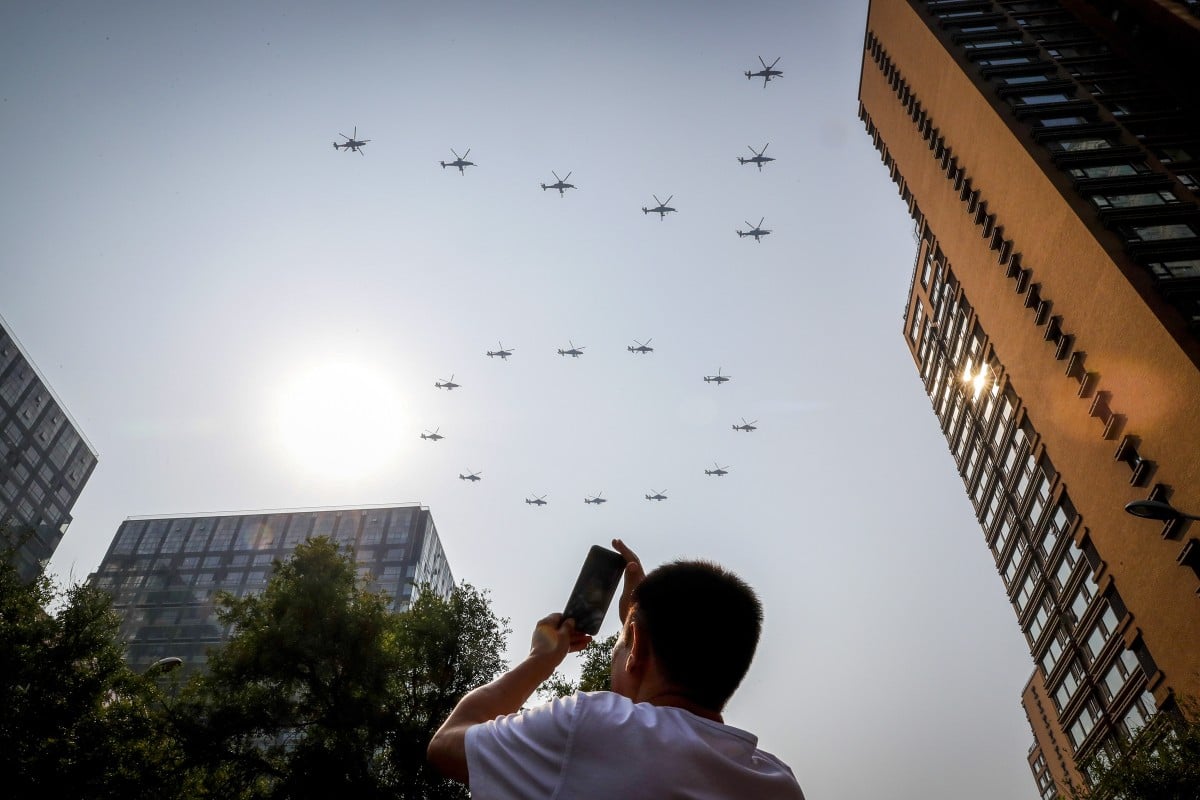
Chinese military helicopters form the number 70 as part of the National Day parade in Beijing. Photo: AP
Engine flaws and a lack of training have been identified as the likely causes of two accidents that hit the Chinese air force in the space of little over a week – one of which claimed the lives of three airmen.
Deaths from the crashes, which happened within a span of 10 days, included a helicopter pilot who took part in the National Day grand parade at the start of the month.
A number of military sources said that as the air force stepped up its exercises – part of President Xi Jinping’s call to strengthen the “combat readiness” of the military – more accidents would happen as increased drills exposed technical problems and inadequate training.
“[If these problems are not resolved], it is foreseeable that more accidents will happen because the top brass is pushing for more drills and exercises across the military,” said one source close to the air force.
The fatal accident happened about three weeks ago in central Henan province, when a transport helicopter crashed, killing all three people on board.
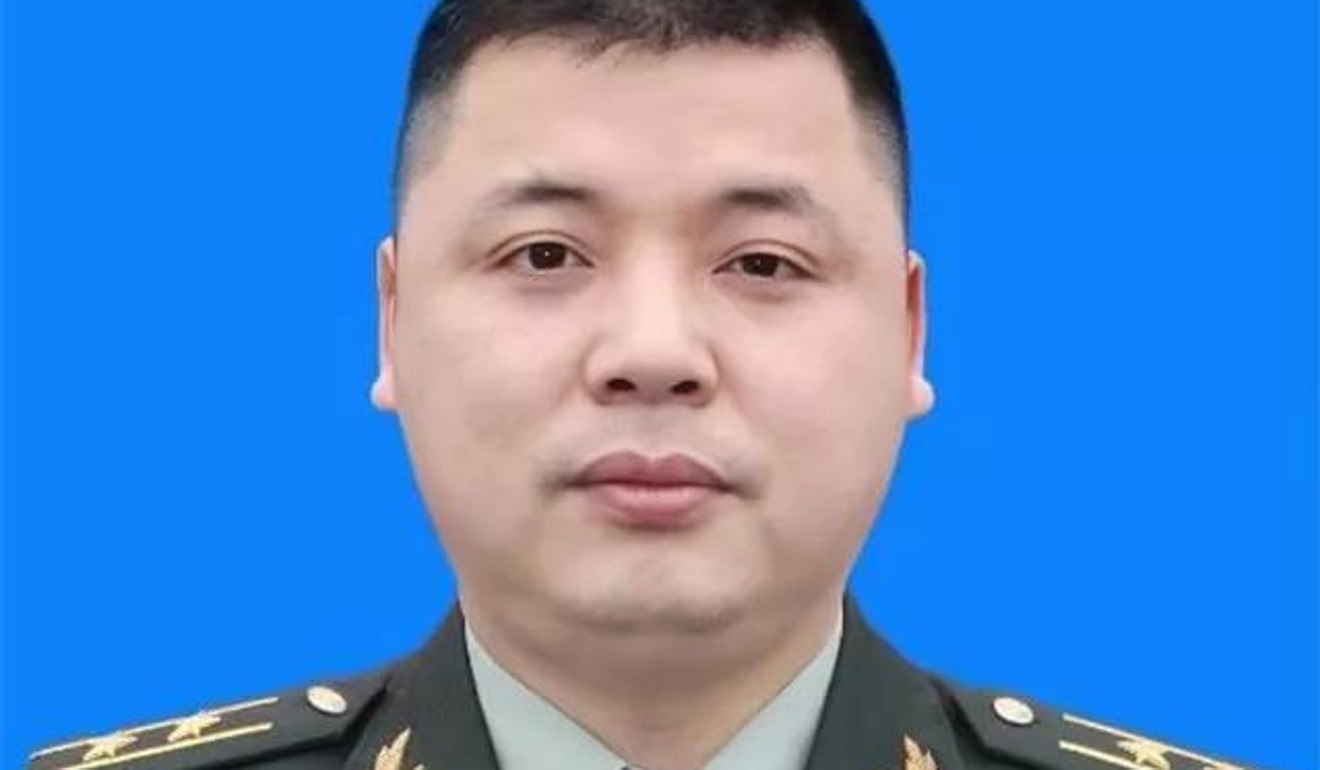
Gong Dachuan, 33, was one of the airmen killed in the crash. Photo: Handout
Local television reports named pilot Gong Dachuan, 33, and 37-year-old engineer Wen Weibin, as two of this killed in the crash. The third victim was later named as Luo Wei, from Luzhou in Sichuan, by an online mourning website.
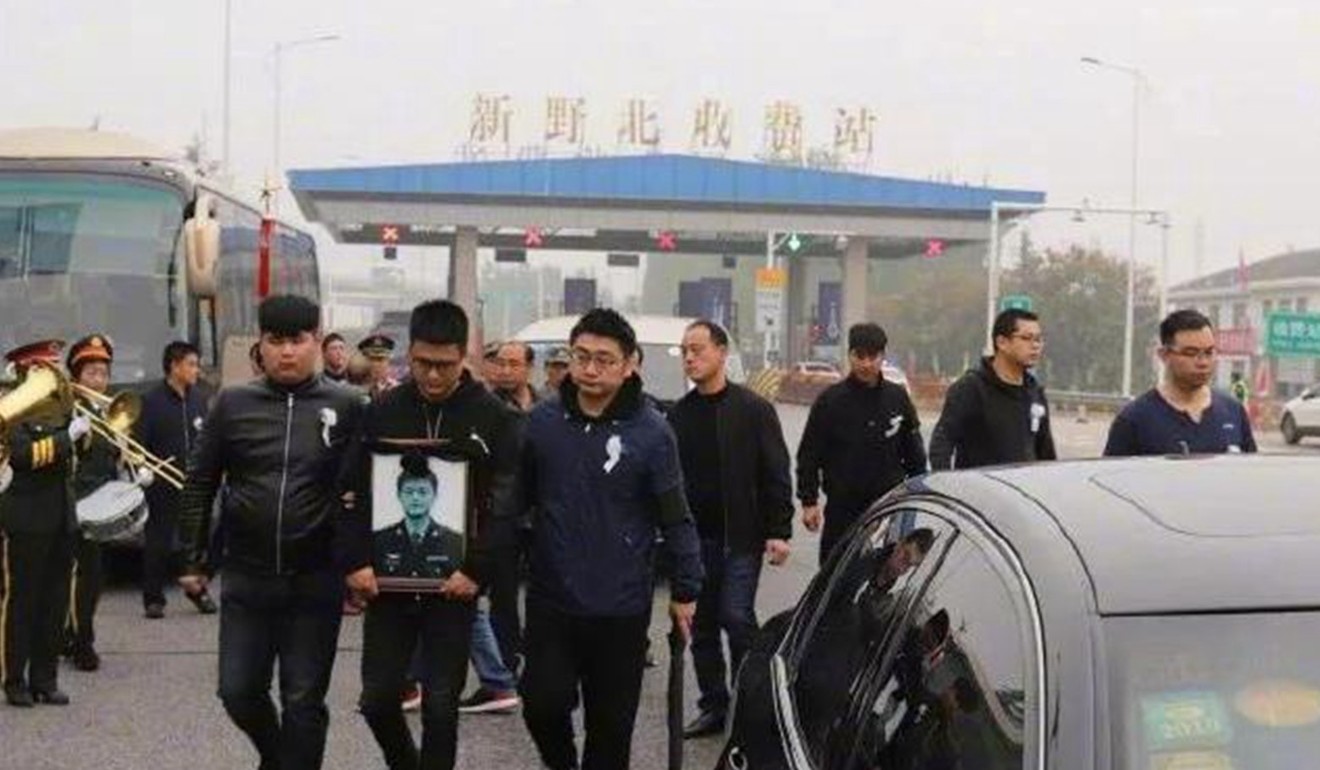
A memorial for Gong was held by the local government in Xinye County last Tuesday.
“The three people were conducting some tests on the helicopter,” said a local source who declined to disclose where the crash happened and the nature of the test.
Xinye county government in Henan province held a memorial to honour the dead pilot. Photo: Handout
Media reports said that Gong had flown in this year’s National Day parade in Beijing, while Wen had been decorated for his participation in the 2015 parade in Beijing to mark the 70th anniversary of victory over Japan in World War II.
The three dead airmen have been designated as martyrs, the reports added.
The second accident happened eight days later on the Tibetan Plateau where a J-10 fighter jet on a low-altitude flying drill crashed into the mountain.
“Fortunately, the pilot ejected safely in time, but the J-10 crashed into the mountain,” said an informed source, who requested anonymity since no official announcement about the accident has been made.
“Preliminary investigations indicated that the accident had something to with the Russian-made AL-31 engine on board the J-10,” the source said.
Military analysts said the air force needs to improve the durability of its aircraft and training for pilots.
Hong Kong-based military expert Song Zhongping suggested that problems with engines and flight control systems were also key reasons behind some of the fatal crashes.
Wen Weibin, 37, also died in the crash. Photo: Handout
Two J-15 fighter jets crashed in April 2016, resulting in one death and one serious injury. Investigations into the two crashes pointed to problems with the flight control system.
A source from the Chinese air force said that, unlike their American counterparts, PLA pilots generally lack training in avionics engineering and had little flying experience before enlistment.
“PLA pilots may be strong and courageous, and they are motivated to make sacrifices,” the air force source said. “But they don’t have as much experience as American pilots – many of [whom] have a lot of experience in flying civilian aircraft before they join the air force.”
Posted in 70th anniversary, accident, air force, AL-31 engine, avionics engineering, Chinese air force, civilian aircraft, deaths, drill and equipment problems, enlistment, equipment, flaws, flew, flight control system, helicopter crash, Henan province, highlights, implicated, J-10 fighter jet, J-15 fighter jets, Luzhou, military parade, National Day, pilot, PLA pilots, point, President Xi Jinping, problems, sichuan province, Tibetan Plateau, training, Uncategorized, victory over Japan, World War II, Xinye County |
Leave a Comment »
30/06/2019
- Veterans of Sino-Japanese war – which ended 74 years ago – among those likely to be set free, state media says
- Nine categories of convicts will be pardoned, but actual numbers will not be disclosed until cases have been reviewed by the courts
China’s amnesty will be no benefit to people like Bo Xilai, the former Chongqing party boss who was sentenced to life imprisonment for corruption in 2013. Photo: AFP
There will be no pardons for people jailed under President Xi Jinping’s sweeping anti-corruption campaign, Chinese state media said late Saturday after Beijing announced a prisoner amnesty as part of its celebrations for the 70th anniversary of the founding of the People’s Republic of China, which falls on October 1.
While the report did not give any indication of how many people would be set free – the cases must first be reviewed by the courts – it said the amnesties would be granted to those who fell into one of nine categories.
These include convicts aged 75 and above who are suffering from a physical disability, people who fought in the Sino-Japanese war – which ended in 1945 – or in the Chinese civil war, which ended in 1949 and led to the creation of modern-day China.
Other categories include prisoners sentenced as minors to terms of not more than three years, and those who were convicted of a crime while acting in self-defence and, again, sentenced to a maximum of three years.
The Communist Party declared a “crushing victory” in Xi’s war on corruption. Photo: EPA-EFE
Anyone convicted of a serious or violent crime, including murder, rape, kidnapping, corruption, arson and drug trafficking is ineligible for the amnesty, the report said. This group also encompasses those who refused to confess to their crimes or show remorse, and anyone deemed still a threat to society.
The amnesty is the second of Xi’s presidency and ninth in the country’s history. The previous seven were all during Mao Zedong’s leadership.
China considers prisoner amnesty for 70th anniversary
In 2015, about
to commemorate the 70th anniversary of the end of the Sino-Japanese war, which also marked the end of World War II. Though, as will be the case this time around, none of them were serving prison terms for corruption.
A spokesperson for the National People’s Congress, which approved the amnesty, was quoted by Xinhua as saying that Beijing hoped the pardons would have a positive political, legal and social impact.
“Considering the fight against corruption remains a challenge, and in order to maintain the pressure of the crackdown, it would be inappropriate to grant amnesties to corruption convicts,” the spokesperson said.
In December, the Communist Party declared a “crushing victory” in Xi’s war on corruption, which since 2012 has seen more than 1.3 million party officials – from powerful “tigers” to low-ranking “flies” – rounded up and convicted.
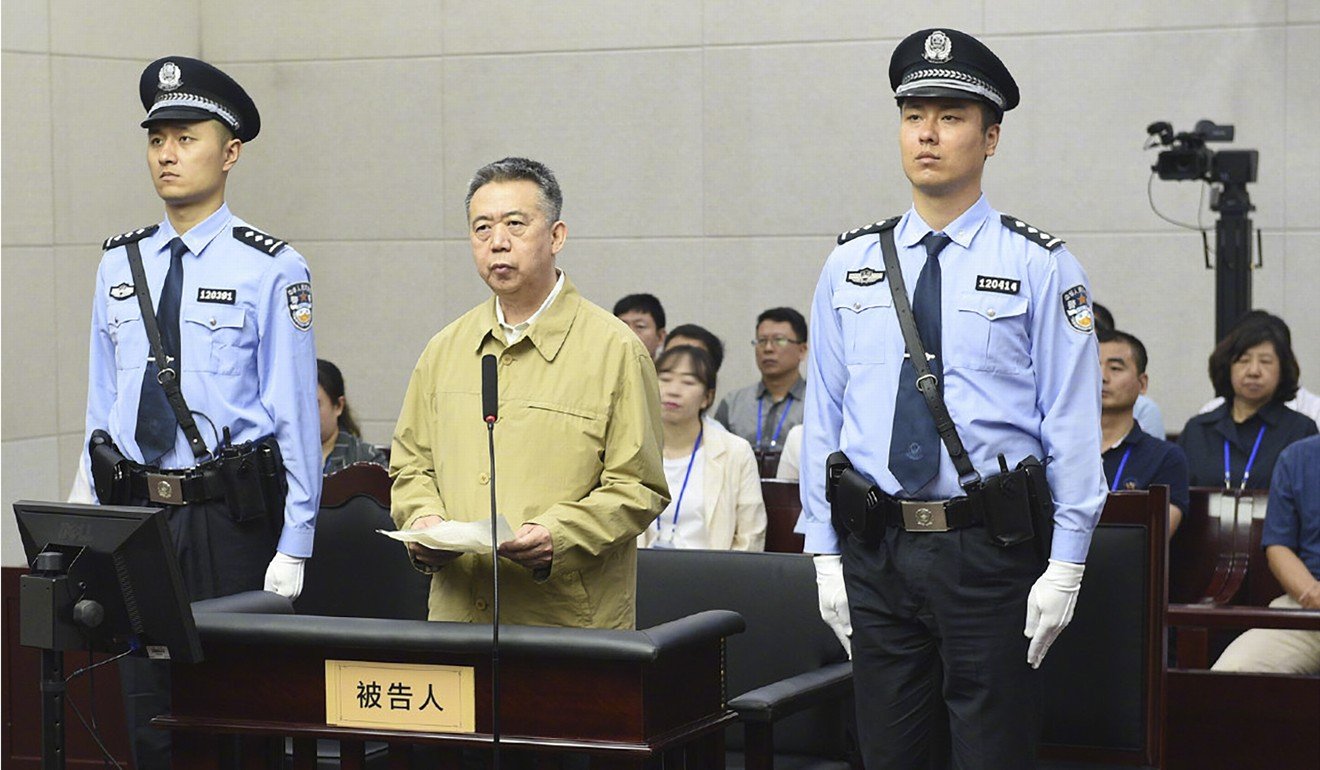
Meng Hongwei, the former president of Interpol, pleaded guilty earlier this month to taking bribes totalling more than US$2 million.
Among the most high profile officials to have been snared are former Politburo Standing Committee member and domestic security tsar
, former Politburo member
, and former vice-chairman of the Central Military Commission
.
Former Politburo member and Chongqing party boss
, who was detained just months before Xi rose to power in 2012, is also serving a life sentence for taking millions of US dollars in bribes.
, the former president of Interpol, looks set to become the latest senior official to join the convicts’ club after pleading guilty in court earlier this month to taking bribes totalling more than 14 million yuan (US$2 million).
Source: SCMP
Posted in amnesty, Bo Xilai, Central Military Commission (CMC), China announces, Chongqing party boss, Communist Party, corrupt officials, Interpol, Mao Zedong’s leadership, nation’s 70th anniversary, No joy, Politburo Standing Committee member, President Xi Jinping, to mark, Uncategorized, Veterans of Sino-Japanese war, World War II |
Leave a Comment »
11/05/2019
SARAJEVO, May 10 (Xinhua) — An agreement has been signed in Beijing on recording a remake of the 1969 movie “The Bridge” by the Sarajevo Film Center (SFC), Shanghai Huahua Culture Media Co. Ltd and Dandelion Productions Inc. of Serbia, SFC Director Jasmin Durakovic told Xinhua on Friday.
Directed by Hajrudin “Siba” Krvavac, “The Bridge” tells the story of partisans during World War II who send an elite team of explosive experts to blow up a strategically important bridge.
Durakovic emphasized that all movies directed by Krvavac are precious cultural assets in the Bosnia and Herzegovina’s (BiH) film archives.
He hopes that the remake of “The Bridge” — and possibly also of “Walter Defends Sarajevo” — will present the culture of BiH and the region through the global language of the film to today’s audiences.
Durakovic said he was highly confident that the remake will attract audiences in the countries of the former Yugoslavia, in other European countries and even in the United States.
In a telephone interview with Xinhua, Huahua Chief Executive Officer Kefei Wang, said his company will use cutting-edge film technology to present this period of history and its heroes “so as to revitalize the classics and live up to the profound expectations of the people of China, Serbia, and Bosnia and Herzegovina for movies.”
Production on the remake will begin in early 2020.
Source: Xinhua
Posted in Beijing, blow up, Bosnia, Bosnia and Herzegovina's (BiH) film archives, Bridge, Dandelion Productions Inc. of Serbia, elite team, European countries, explosive experts, Hajrudin "Siba" Krvavac, Herzegovina, Huahua, Huahua Chief Executive Officer, Jasmin Durakovic, Kefei Wang, partisans, Sarajevo Film Center (SFC), Serbia, SFC Director, Shanghai Huahua Culture Media Co. Ltd, strategically important, The Bridge, Uncategorized, United States, Walter Defends Sarajevo, World War II, Xinhua, Yugoslavia |
Leave a Comment »







 CHINDIA ALERT: You'll be living in their world, very soon