Archive for ‘world’s’

26/04/2020

China’s rolling stock manufacturer donates medical equipment to Germany

GERMANY-BERLIN-CRRC-MEDICAL EQUIPMENT-DONATION

Photo taken with a mobile phone on April 24, 2020 shows a handover ceremony of medical equipment donated by China Railway Rolling Stock Corporation (CRRC) Zhuzhou Locomotive Co. Ltd. in Berlin, Germany. China Railway Rolling Stock Corporation (CRRC), the world’s largest rolling stock manufacturer by production volume, donated a shipment of medical equipment to Germany via the German Red Cross on Friday to help the country fight the coronavirus. Responding to the call from the German government and the Chinese Embassy in Germany, and in accordance with an arrangement between CRRC and CRRC Zhuzhou Locomotive Co. Ltd. (CRRC ZELC), the company donated 1,000 protective suits, 20,000 FFP2 masks and 80,000 surgical masks. (CRRC ZELC/Handout via Xinhua)

BERLIN, April 24 (Xinhua) — China Railway Rolling Stock Corporation (CRRC), the world’s largest rolling stock manufacturer by production volume, donated a shipment of medical equipment to Germany via the German Red Cross on Friday to help the country fight the coronavirus.

Responding to the call from the German government and the Chinese Embassy in Germany, and in accordance with an arrangement between CRRC and CRRC Zhuzhou Locomotive Co. Ltd. (CRRC ZELC), the company donated 1,000 protective suits, 20,000 FFP2 masks and 80,000 surgical masks.

CRRC ZELC said that the donated materials will be distributed to medical staff and volunteers who are fighting the pandemic on the frontlines.

Cheng Jian, general manager of CRRC ZELC Verkehrstechnik GmbH, said that the only way to overcome the crisis is to unite strengths and meet the challenges together.

“We wish to undertake our social responsibility as part of the community. We firmly believe that with joint efforts of the international community, Germany will quickly overcome the crisis, and production and life will return to normal soon,” Cheng said.

According to Jens Quade, president of the Mueggelspree regional branch of the German Red Cross, the risk of new coronavirus infections could be reduced through the generous donation from CRRC ZELC.

“The donated material will be distributed to the Berlin Red Cross, Berlin hospitals and/or medical institutions. We will do our best to provide the necessary assistance to the people who are most in need,” Quade said.

Source: Xinhua
18/04/2020

China supports G20 action plan to help poorest countries: MOF

BEIJING, April 17 (Xinhua) — China supports the action plan issued by the Group of 20 (G20) to deal with the impact of COVID-19 and will contribute to the G20 efforts to fight the pandemic through its own policy actions, the Ministry of Finance (MOF) said Friday.

G20 finance ministers and central bank governors agreed Wednesday to suspend debt service payments for the world’s poorest countries from May 1 until the end of the year.

China will implement more proactive fiscal policies with higher quality and efficiency, appropriately increase the fiscal deficit ratio, issue special government bonds, increase the scale of special bonds for local governments, and further cut taxes and fees, the MOF said.

In the process, China will strengthen macroeconomic policy coordination with G20 members and jointly support the implementation of the G20 action plan, the MOF said.

China will carry out specific work through bilateral consultations at the request of relevant poor borrowers in accordance with the G20 consensus, the MOF said.

To achieve better results of the action plan, China calls on multilateral creditors and commercial creditors to take appropriate actions as soon as possible to jointly help the poorest countries tide over their difficulties, the MOF said.

China has been providing support to the international community through other bilateral and multilateral channels, including donating 20 million U.S. dollars to the World Health Organization and earmarking 10 million U.S. dollars in its Poverty Reduction and Regional Cooperation Fund under the Asian Development Bank to support outbreak control programs in the region.

Source: Xinhua

17/03/2020

Taj Mahal: ‘Monument of love’ shuts down amid coronavirus fears

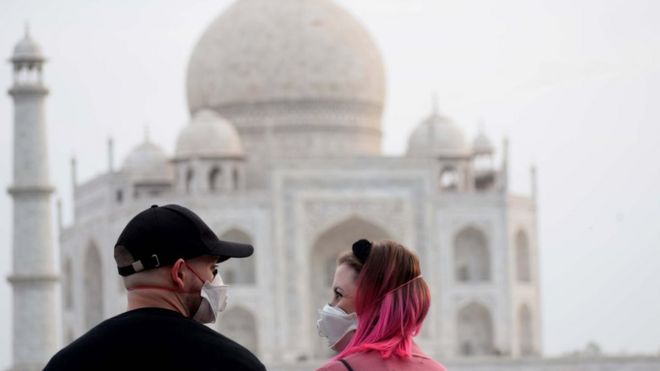
Tourists wear face masks as a preventive measure against the spread of the COVID-19 coronavirus outbreak, near Taj Mahal in Agra on March 5, 2020Image copyright GETTY IMAGES
Image caption The Taj Mahal is one of the world’s leading tourist attractions.

India’s iconic monument Taj Mahal has shut down to halt the spread of the coronavirus, officials say.

The culture ministry said tens of thousands visit the “monument of love” every day and it was “imperative to shut it down”.

The Taj Mahal is one of the world’s leading tourist attractions, and draws as many as 70,000 people every day.

India has 137 reported cases of Covid-19 and three related deaths. It has tested 6,000 people so far.

On Tuesday, the Indian government announced that all monuments and museums run by the Archaeological Survey of India across the country have also been shut to keep people safe.

Culture Minister Prahlad Patel said all the 143 monuments and museums would remain shut until 31 March and the decision would be reviewed after the shutdown period.

On Tuesday, a 60-year-old doctor in the southern state of Karnataka tested positive after treating a man who died from the coronavirus last week.

Media caption Everything you need to know about the coronavirus explained in one minute

India has taken a number of steps to halt the spread of Covid-19:

  • All visas, barring a select few categories, have been suspended for a month
  • Visa-free travel afforded to overseas citizens of the country has been suspended until 15 April and even those allowed in could be subject to 14 days of quarantine
  • Schools, colleges and movie theatres in most states have been shut until 31 March
  • The Indian Premier League (IPL), featuring nearly 60 foreign players and scheduled to begin on 29 March, has been postponed to 15 April

India’s health ministry says it was among the first countries in the world to prepare for an outbreak of the respiratory illness, and denied allegations that it was slow in testing suspected cases.

Experts say that India is in a critical phase where it needs to halt community transmissions. The country has only tested 6,000 people so far and many believe that it’s not enough to halt the spread. Experts say that India needs to start testing thousands daily to effectively stop community transmissions.

The government says it’s prepared and has now allowed even private labs to test, apart from government-run labs.

Source: The BBC

02/12/2019

Factbox – The world’s biggest electric vehicle battery makers

(Reuters) – Asian companies dominate the market for electric vehicle (EV) batteries and they are expanding their production capacity in Europe, China and the United States in a fight to win lucrative contracts from global automakers.

Some carmakers worry, however, there won’t be enough batteries for all the EVs they plan to launch in the coming years and a bitter row between South Korea’s SK Innovation and LG Chem risks exacerbating the potential shortfall.

Below are details of the world’s leading EV battery makers with details of their customers and expansion plans:

CATL

China’s Contemporary Amperex Technology (CATL), the world’s biggest EV battery maker, counts BMW (BMWG.DE), Volkswagen (VOWG_p.DE), Daimler (DAIGn.DE) – which makes Mercedes cars – Volvo, Toyota Motor Corp (7203.T) and Honda Motor Co (7267.T) among its customers.

The company emerged as a major force partly thanks to Beijing’s policy of only subsidising vehicles equipped with Chinese batteries in the world’s biggest EV market. Beijing is phasing out EV subsidies next year.

CATL, which operates factories in China, is building its first overseas plant in Germany and is considering a U.S. factory.

PANASONIC CORP (6752.T)

Japan’s Panasonic, a supplier of U.S. EV pioneer Tesla (TSLA.O), said it has installed equipment to ramp up production at Tesla’s Nevada plant to 35 GWh from its current production of around 30 GWh as of late October. Panasonic has said it is investing about $1.6 billion in the factory.

Panasonic also produces EV batteries in Japan, China and plans to shift some of its plants to a new joint venture with Toyota. Panasonic’s clients also include Honda and Ford Motor Company (F.N).

For a graphic of expansion plans: tmsnrt.rs/35tFmOL

BYD CO LTD (002594.SZ)

China’s BYD, which is backed by U.S. investor Warren Buffett, is also one of the world’s biggest EV battery makers. It mainly uses them in-house for its own cars and buses. BYD said last year it is was considering cell production in Europe.

LG CHEM LTD (051910.KS)

The South Korean firm was an early industry mover, winning a contract to supply General Motor’s (GM.N) Volt in 2008. It also supplies Ford, Renault (RENA.PA), Hyundai Motor (005380.KS), Tesla, Volkswagen and Volvo.

It is investing 3.3 trillion won ($2.8 billion) to build and expand production facilities near Tesla’s plant in Shanghai. It has a joint venture (JV) in China with Geely Automobile Holdings (0175.HK), which makes Volvos, and is in talks with other carmakers about JVs in major markets.

The firm is considering building a second U.S. factory in addition to its facility in Michigan and is expanding its plant in Poland.

SAMSUNG SDI CO LTD (006400.KS) Samsung SDI an affiliate of South Korean tech giant Samsung Electronics (005930.KS), has EV battery plants in South Korea, China and Hungary, which supply customers such as BMW (BMWG.DE), Volvo and Volkswagen. Samsung SDI is investing about 1.2 billion euros ($1.3 billion) to expand its factory in Hungary though the EU is investigating whether Budapest’s financial support complies with the bloc’s state aid rules.

Samsung started production last year on the Hungary plant, which will produce batteries for 50,000 EVs a year.

SK INNOVATION CO LTD (096770.KS) LG Chem’s cross-town rival SK Innovation supplies batteries to Volkswagen, Daimler and Kia Motors (000270.KS), as well as Jaguar Land Rover [TAMOJL.UL] and Ferrari (RACE.MI).

An oil refiner that came to the battery industry late, SKI is investing about $3.9 billion to build three plants in the United States, China and Hungary, with a goal of expanding its annual production capacity to 33 GWh by 2022.

SKI currently operates one battery factory in South Korea, with a capacity of 4.7 GWh annually.

It set up a joint venture with Beijing Automotive Industry Corporation (BAIC) of China in August 2018 and another Chinese partner. It is in talks with Volkswagen about another battery JV and is building a $1.7 billion factory in the U.S. state of Georgia, not far from Volkswagen’s Chattanooga plant.

Source: Reuters

Law of Unintended Consequences

continuously updated blog about China & India

ChiaHou's Book Reviews

continuously updated blog about China & India

What's wrong with the world; and its economy

continuously updated blog about China & India