Archive for ‘writer’

22/04/2020

How Gandalf and ancient poetry can show the world a different side to China amid coronavirus unease

  • Documentary puts China’s literary hero into context: there is Dante, there’s Shakespeare, and there’s Du Fu
  • Theatrical legend Sir Ian McKellen brings glamour to beloved verses in British documentary
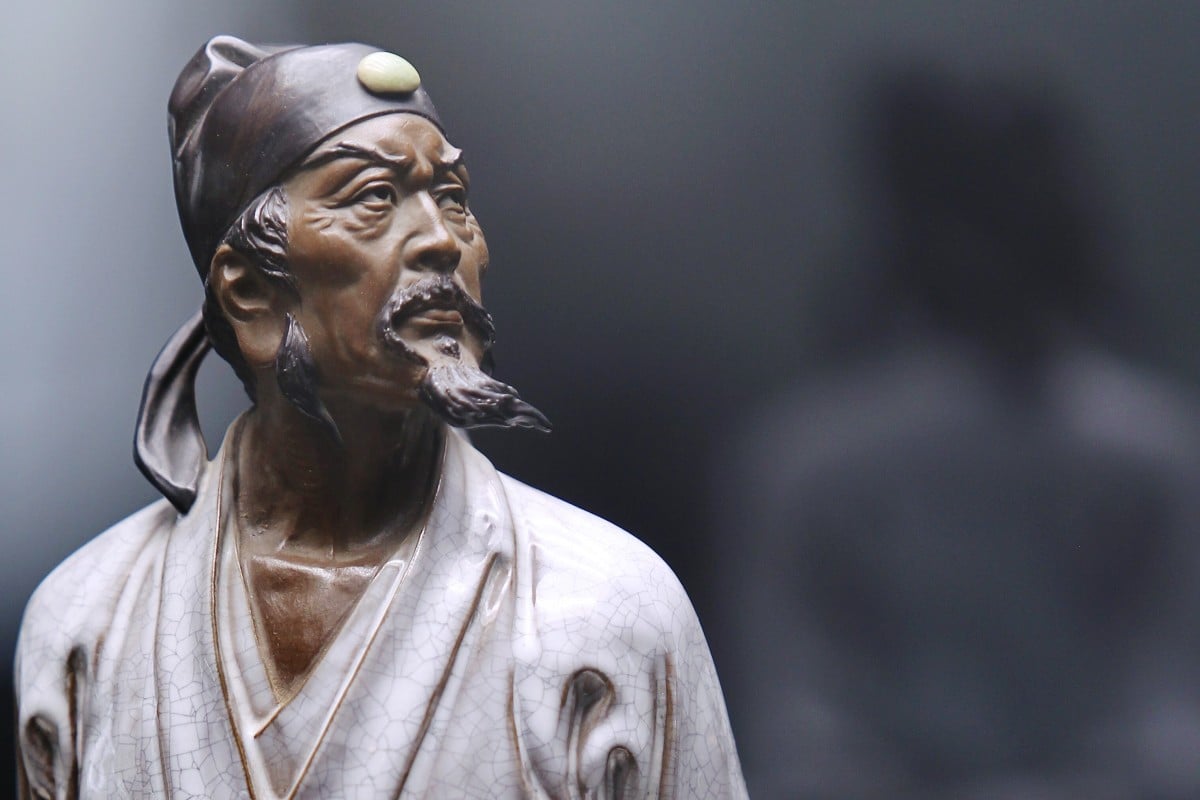
A ceramic figurine of Du Fu, a prominent Chinese poet of the Tang dynasty. Du is the subject of a new BBC documentary, thrilling devotees of his poetry. Photo: Simon Song
The resonant words of an ancient Chinese poet spoken by esteemed British actor Sir Ian McKellen have reignited in China discussion about its literary history and inspired hope that Beijing can tap into cultural riches to help mend its image in the wake of the coronavirus pandemic.
The BBC documentary Du Fu: China’s Greatest Poet has provoked passion among Chinese literature lovers about the poetic master who lived 1,300 years ago.
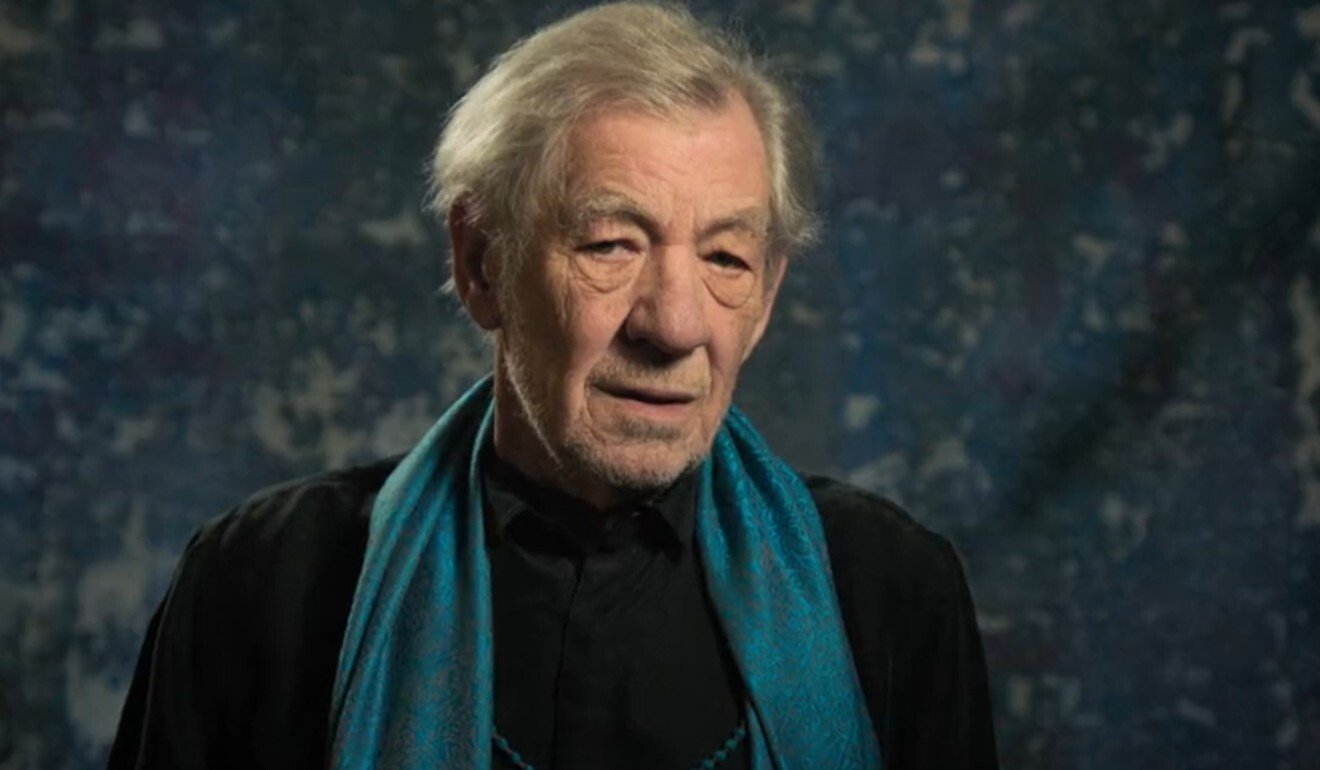
Sir Ian Mckellen read works of ancient Chinese poet Du Fu in Du Fu: China’s Greatest Poet. Photo: BBC Four / MayaVision International
The one-hour documentary by television historian Michael Wood was broadcast on television and aired online for British viewers this month but enthusiasm among Chinese audiences mean the trailer and programme have been widely circulated on video sharing websites inside mainland China, with some enthusiasts dubbing Chinese subtitles.
The documentary has drawn such attention in Du’s homeland that even the Communist Party’s top anti-graft agency has discussed it in its current affairs commentary column. Notably, Wood’s depiction of Du’s life from AD712 to 770 barely mentioned corruption in the Tang dynasty (618-907) government.

“I couldn’t believe it!!” Wood said in an email. “I’m very pleased of course … most of all as a foreigner making a film about such a loved figure in another culture, you hope that the Chinese viewers will think it was worth doing.”

Often referred to as ancient China’s “Sage of Poetry” and the “Poet Historian”, Du Fu witnessed the Tang dynasty’s unparalleled height of prosperity and its fall into rebellion, famine and poverty.
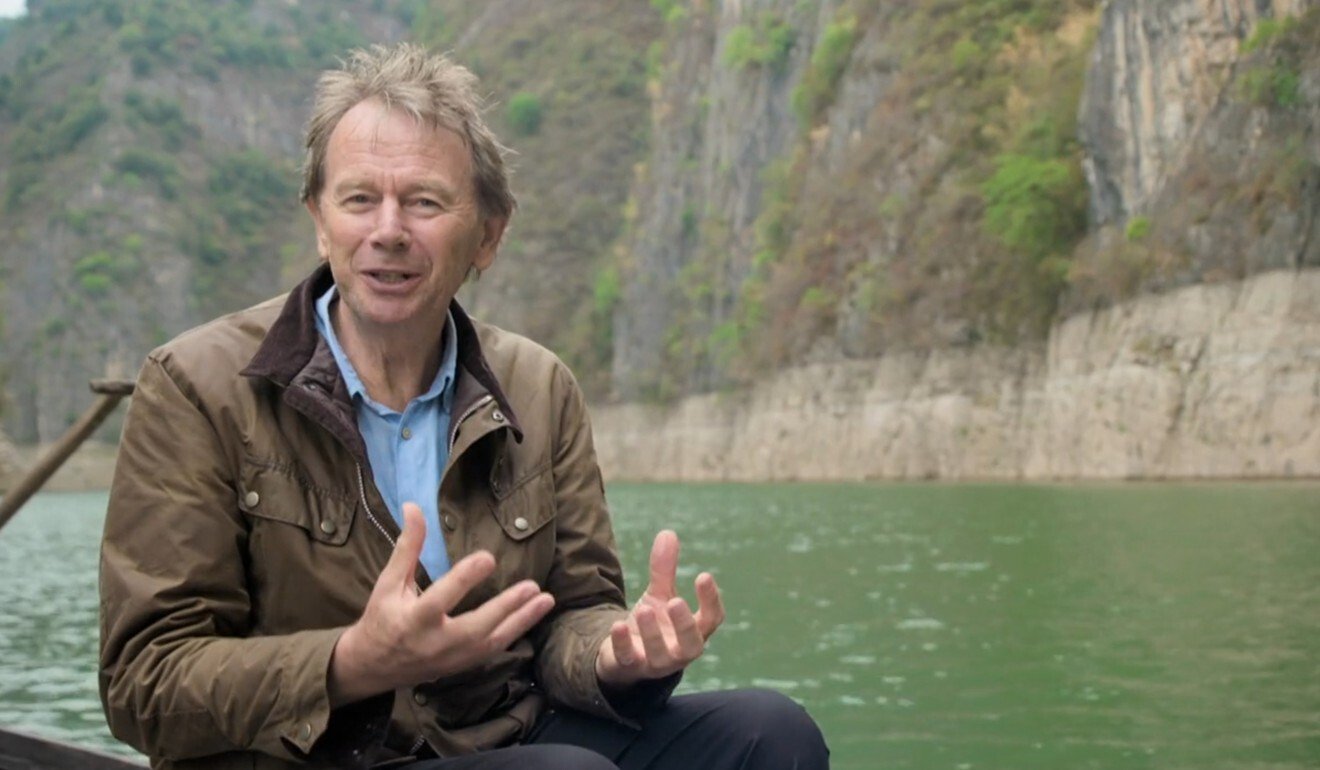
Writer, historian and presenter Michael Wood followed the footsteps of the ancient Chinese poet Du Fu in Yangtze River gorges. Photo: BBC Four / MayaVision International
Wood traced Du’s footsteps to various parts of the country. He interviewed Chinese experts and Western sinologists, offering historical and personal contexts to introduce some of Du’s more than 1,400 poems and verses chronicling the ups and downs of his life and China.
The programme used many Western reference points to put Du and his works into context. The time Du lived in was described as around the as the Old English poem Beowulf was composed and the former Chinese capital, Changan, where Xian is now, was described as being in the league of world cities of the time, along with Constantinople and Baghdad.

Harvard University sinologist Stephen Owen described the poet’s standing as such: “There is Dante, there’s Shakespeare, and there’s Du Fu.”

The performance of Du’s works by Sir Ian, who enjoyed prominence in China with his role as Gandalf in the Lord of the Rings movie series, attracted popular discussion from both media critics and general audiences in China, and sparked fresh discussion about the poet.

“To a Chinese audience, the biggest surprise could be ‘Gandalf’ reading out the poems! … He recited [Du’s poems] with his deep, stage performance tones in a British accent. No wonder internet users praised it as ‘reciting Du Fu in the form of performing a Shakespeare play,” wrote Su Zhicheng, an editor with National Business Daily.

A stone sculpture at Du Fu Thatched Cottage in Chengdu city, China. Photo: Handout
On China’s popular Weibo microblog, a viewer called Indifferent Onlooker commented on Sir Ian’s recital of Du’s poem My Brave Adventures: “Despite the language barrier, he conveyed the feeling [of the poet]. It’s charming.”
Some viewers, however, disagreed. At popular video-sharing website Bilibili.com, where uploads of the documentary could be found, a viewer commented: “I could not appreciate the English translation, just as I could not grasp Shakespeare through his Chinese translated works in school textbooks.”
Watching the documentary amid the coronavirus pandemic, some internet users drew comparisons of Du to Fang Fang, a modern-day award-winning poet and novelist who chronicled her life in Wuhan during the Covid-19 lockdown.
News of the forthcoming publication of English and German translations of Fang’s Wuhan Diary has attracted heated accusations that it would empower Western critics of Beijing’s handling of the outbreak.
Shanghai pictured in April. Devastation wrought by the coronavirus pandemic has brought about a new suspicion of China. Photo: Bloomberg
The pandemic has infected more than 2.5 million people and killed more than 170,000. It has put the global economy in jeopardy, fuelling calls for accountability. British Foreign Secretary Dominic Raab last week called for a “deep dive” review and the asking of “hard questions” about how the coronavirus emerged and how it was not stopped earlier.
Steve Tsang, director of the SOAS China Institute at University of London, said the British establishment and wider public had changed its perception of Beijing as questions arose about outbreak misinformation and the political leverage of personal protective gear supply.
“The aggressive propaganda of the Chinese government is getting people in the UK to look more closely at China and see that it is a Leninist party-state, rather than the modernising and rapidly changing society that they want to see in China,” Tsang said.

On Sunday, a writer on the website of the National Supervisory Commission, China’s top anti-corruption agency, claimed – without citing sources – that the Du Fu documentary had moved “anxious” British audience who were still staying home under social distancing measures.

“If anyone wants to put the fear of the coronavirus behind them by understanding the rich Chinese civilisation, please watch this documentary on Du Fu,” it wrote, adding that promoting Du’s poems overseas could help “healing and uniting our shattered world”.

English-language state media such as CGTN and the Global Times reported on the documentary last week and some Beijing-based foreign relations publications have posted comments about the film on Twitter.

Wood said he had received feedback from both Chinese and British viewers that talked about “the need, especially now, of mutual understanding between cultures”.

“It is a global pandemic … we need to understand each other better, to talk to each other, show empathy: and that will help foster cooperation. So even in a small way, any effort to explain ourselves to each other must be a help,” Wood said.

He said the idea for producing a documentary about Du Fu started in 2017, after his team had finished the Story of China series for BBC and PBS.

Du Fu: China’s Greatest Poet first aired in Britain on April 7 on BBC Four, the cultural and documentary channel of the public broadcaster. It is a co-production between the BBC and China Central Television.

Wood said a slightly shorter 50-minute version would be aired later this month on CCTV9, Chinese state television’s documentary channel.

The film was shot in China in September, he said.

“I came back from China [at the] end of September, so we weren’t affected by the Covid-19 outbreak, though of course it has affected us in the editing period. We have had to recut the CCTV version in lockdown here in London and recorded two small word changes on my iPhone!” Wood said.

Source: SCMP
30/11/2019

Rediscovering the forgotten Indian artists of British India

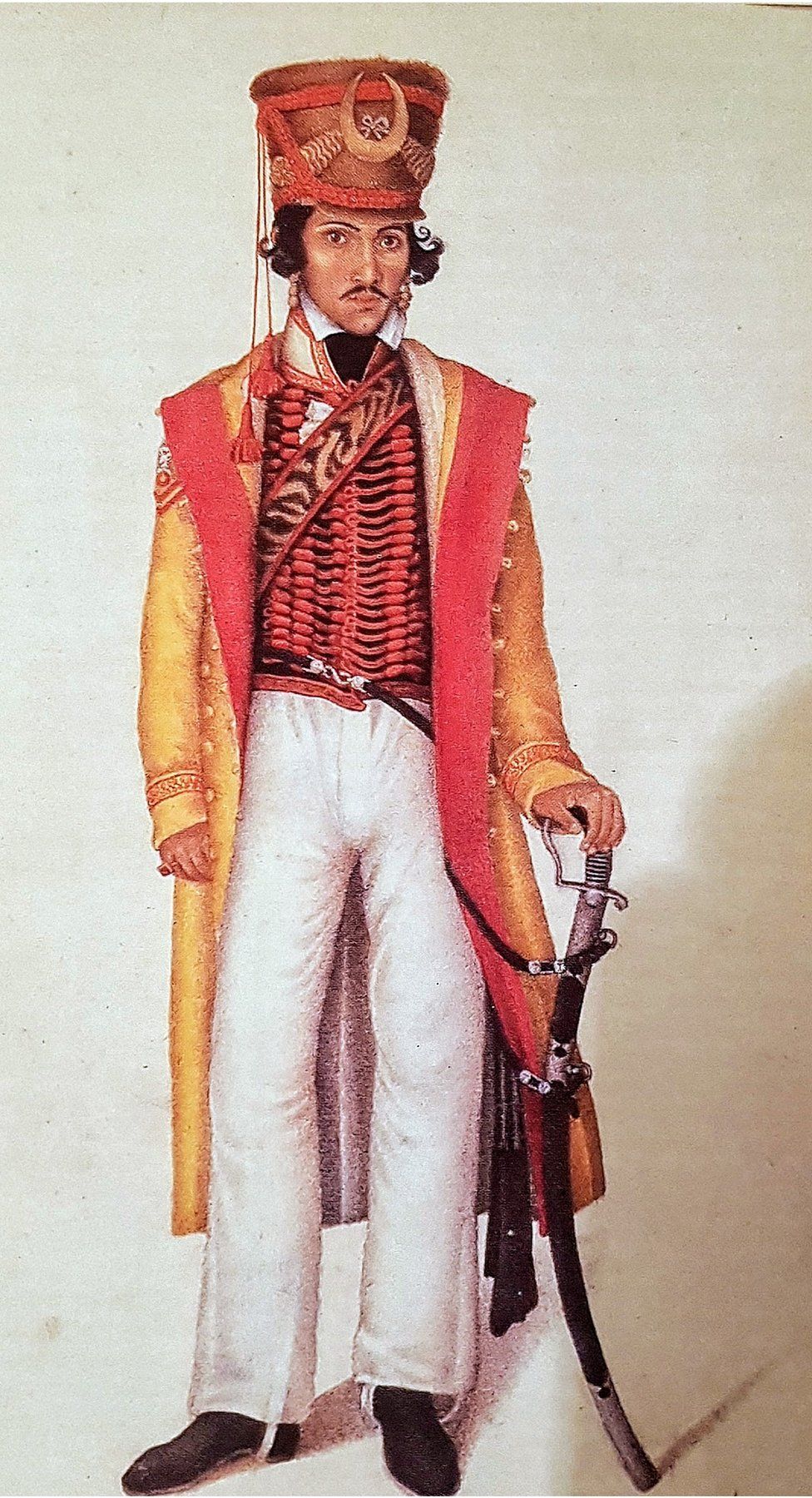
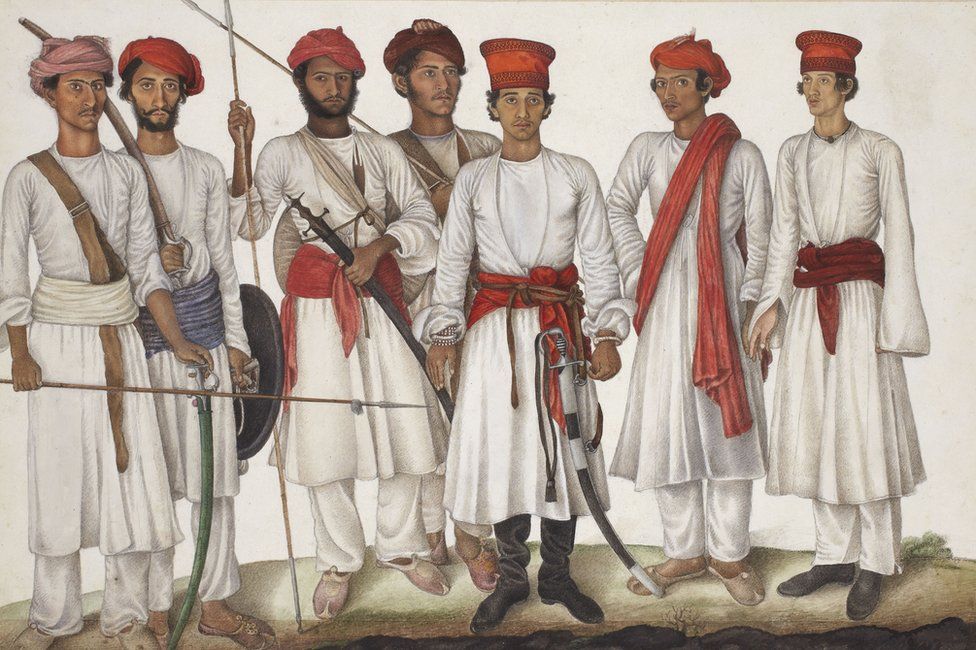
A group of Indian troopers who fought for the English by Ghulam Ali Khan, 1815-16Image copyright PEMILLE KLEMP
Image caption A group of Indian troopers who fought for the English, Ghulam Ali Khan, 1815-16

The English East India Company, founded in 1600, was established for trading. But as the powerful multinational corporation expanded its control over India in the late 18th Century, it commissioned many remarkable artworks from Indian painters who had previously worked for the Mughals. Writer and historian William Dalrymple writes about these hybrid paintings which explore life and nature.

Calcutta in the late 1770s was Asia’s biggest boom town: known as the City of Palaces, the East India Company’s bridgehead in Bengal had doubled in size to 400,000 inhabitants in a decade.

It was now unquestionably the richest and largest colonial city in the East – though certainly not the most orderly.

“It would have been so easy to turn it into one of the most beautiful cities in the world,” wrote the Count de Modave, a friend of Voltaire who passed through at this time. “One cannot fathom why the English allowed everyone the freedom to build in the most bizarre taste, with the most outlandish planning.”

Nor were visitors much taken by its English inhabitants. Most had come East with just one idea: to amass a fortune in the quickest possible time.

Impey
Image caption An Indian trooper who fought for the English, Ghulam Ali Khan, 1819
Calcutta (now Kolkata) was a city where great wealth could be accumulated in a matter of months, then lost in minutes in a wager or at the whist table. Death, from disease or excess, was a commonplace, and the constant presence of mortality made men hard and callous.

Rising with Olympian detachment above the mercantile bawdiness of his contemporaries was the rotund figure of the chief justice of the new Supreme Court, Sir Elijah Impey.

A portrait of him by Johan Zoffany still hangs, a little lopsidedly, in the Kolkata High Court. It shows him pale and plump, ermine gowned and dustily bewigged.

Impey was, however, a serious scholar and unusual in taking a serious interest in the land to which he had been posted.

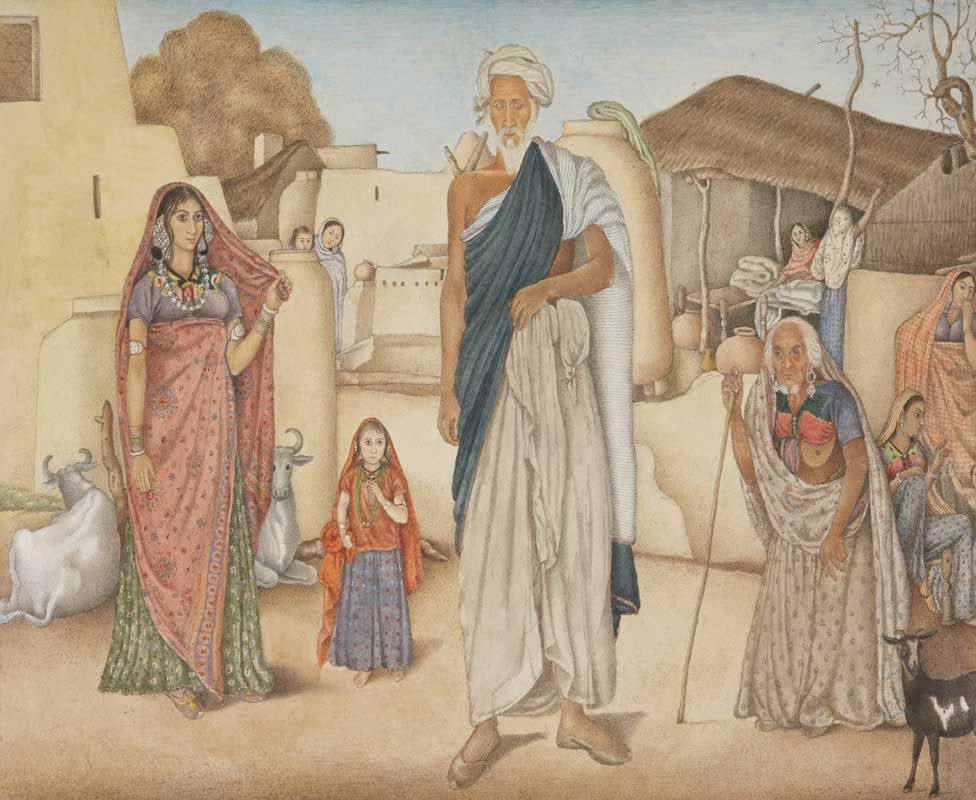
Indian villagers by Ghulam Ali Khan, 1815-16Image copyright PEMILLE KLEMP
Image caption Indian villagers by Ghulam Ali Khan, 1815-16Presentational white space

On the journey out to India, a munshi (administrator) had accompanied him to teach him Bengali and Urdu, and on arrival the new chief justice began to learn Persian and collect Indian paintings. His house became a meeting place where the more cultured elements of Calcutta society could discuss history and literature.

Impey and his wife Mary were also greatly interested in natural history and began to collect a menagerie of rare Indian animals.

At some stage in the mid-1770s, the Impeys decided to bring a group of leading Mughal artists – Sheikh Zain ud-Din, Bhawani Das and Ram Das – to paint their private zoo.

It was probably not the first commission of Indian artists by British patrons. “The Study of Botany is of late Years become a very general Amusement,” noted one enthusiast, and we know that the Scottish nurseryman James Kerr was sending Indian-painted botanical drawings back to Edinburgh as early as 1773.

But the Impeys’ albums of natural history painting remain among the most dazzlingly successful of all such commissions: today, a single page usually reaches prices of more than £330,000 ($387,000) at auctions, and the 197 images from the Impey Album are now widely recognised as among the very greatest glories of Indian painting.

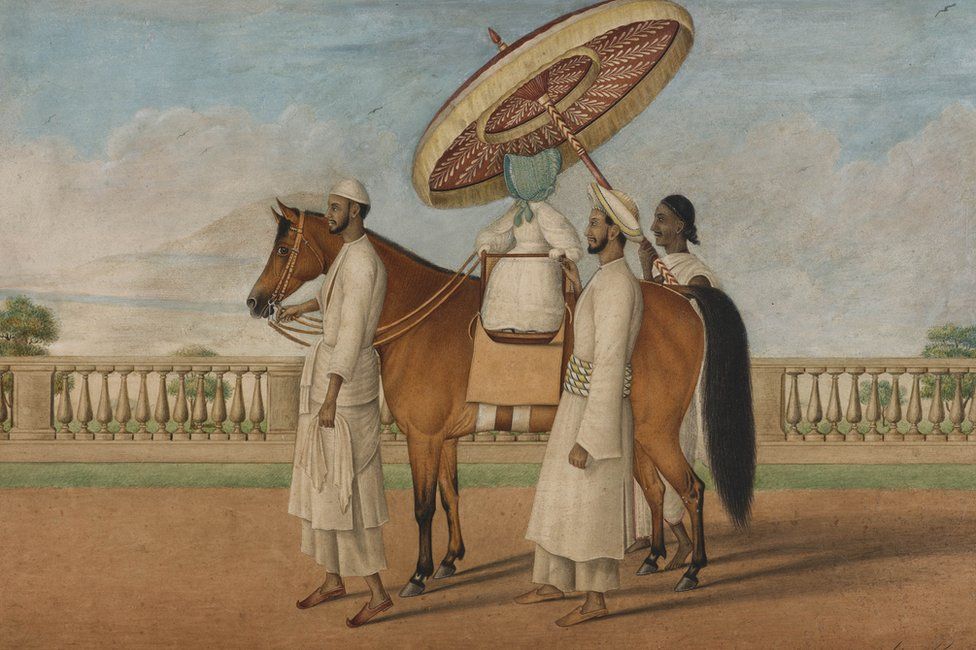
English child seated on a pony and surrounded by three Indian servants, 1830-1850Image copyright FRANCIS WARE
Image caption English child seated on a pony and surrounded by three Indian servants by Shaikh Muhammad Amir

This month, for the first time since the Impey Album was split up in the 18th Century, around 30 of its pages will be reassembled for a major exhibition in the Wallace Collection in London.

Forgotten Masters: Indian Painting for the East India Company celebrates some of the extraordinary work which resulted from commissions made by East India Company patrons from master Indian artists between the 1770s and 1840s.

It will be a unique chance to see some of the finest Indian paintings which are now scattered in private collections around the world.

The three artists who Impey summoned to his fine classical house in Middleton Street were all from Patna, 200 miles (320km) up the Ganges.

The most prolific was a Muslim, Shaikh Zain-al-Din, while his two colleagues, Bhawani Das and Ram Das, were both Hindus.

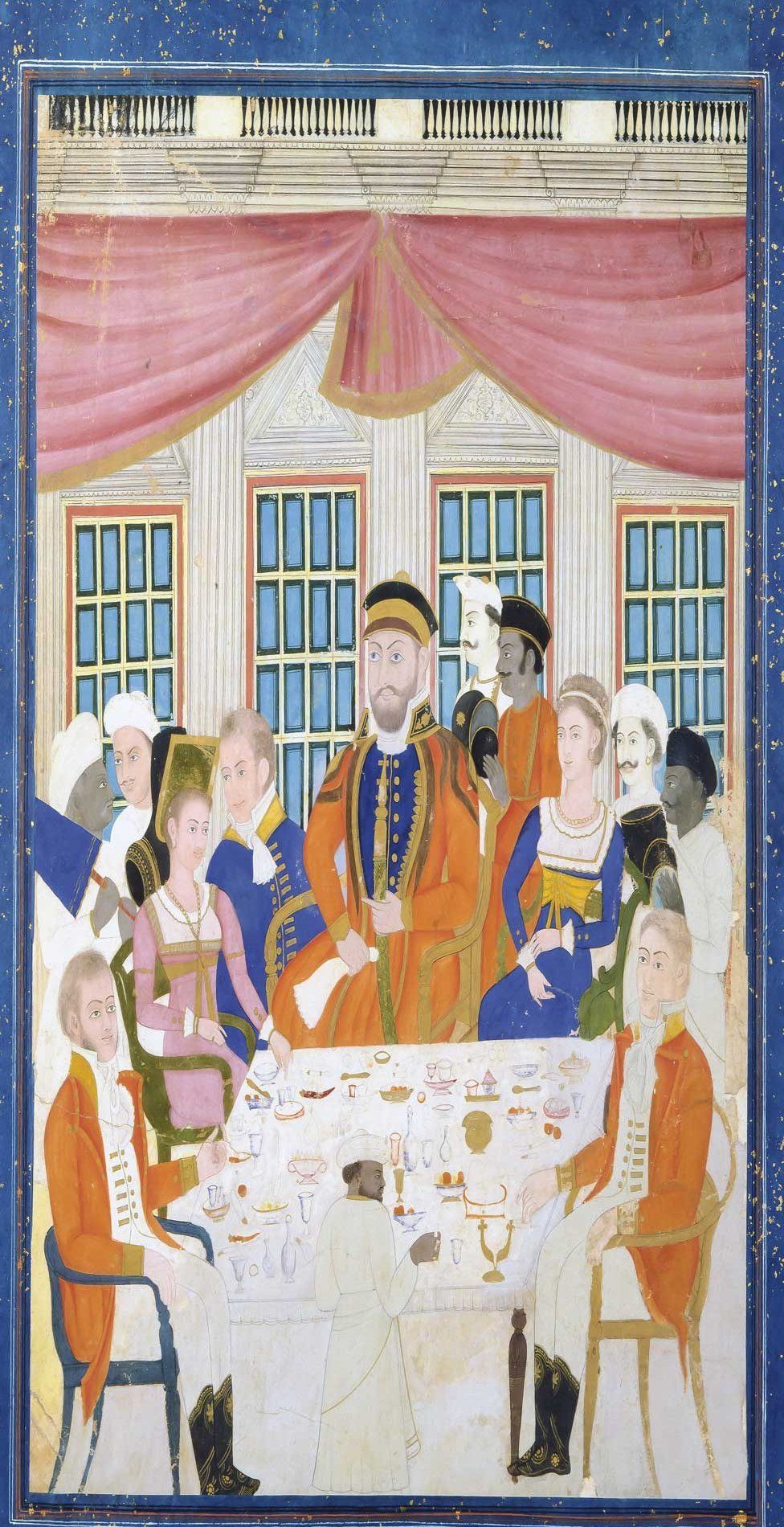
A finely painted miniature depicting four British officers with their wives taking refreshments at a table
Image caption A finely painted miniature depicting four British officers with their wives taking refreshments at a table, artist unknown

Trained in the late Mughal style and patronised by the Nawabs of Murshidabad and Patna, they quickly learned to use English watercolours on English Watman watercolour paper, and take English botanical still lives as their models. In this way an extraordinary fusion of English and Mughal artistic impulses took place.

Zain ud-Din’s best works reveal a superb synthesis between a coldly scientific European natural history specimen illustration, warmed with a profoundly Indian sensibility and vital feeling for nature.

At his best – whether by instinct or inherited knowledge and training – he channels the outstanding Mughal achievement in natural history painting of 150 years earlier, when the great Mughal artist Mansur painted animals and birds for the Emperor Jahangir.

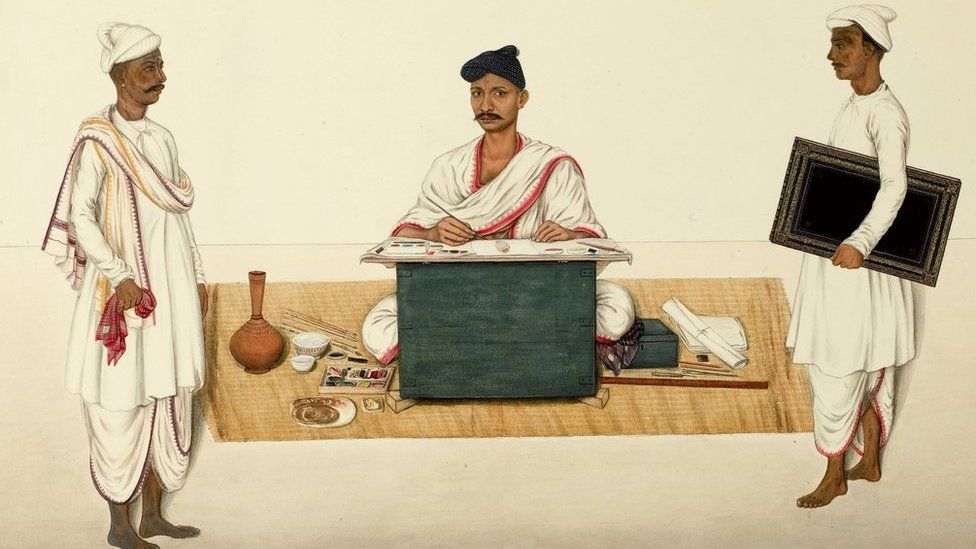
A man sits and draws while attended by two other men
Image caption Portrait of a Mughal artist, by Yellapah Of Vellore, 1832-1835

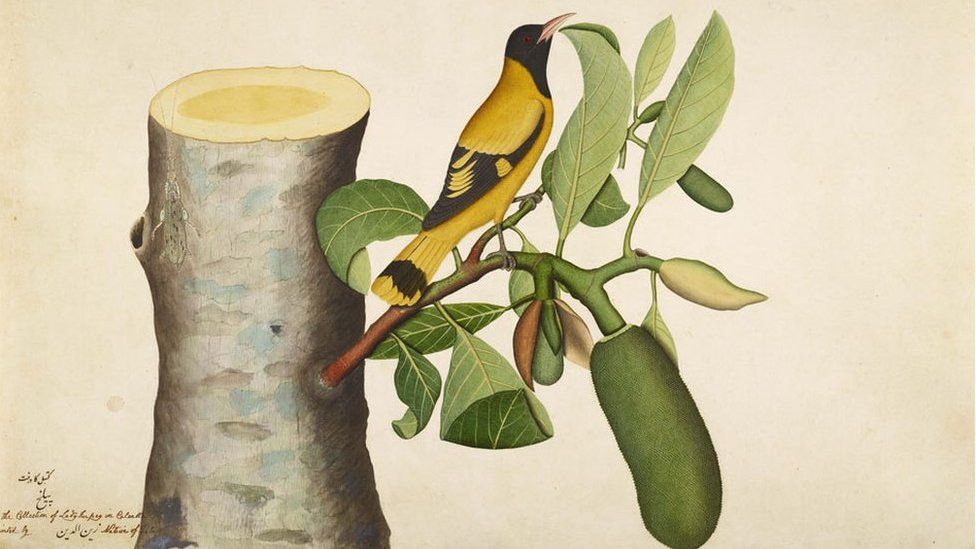
Nowhere are the merits of Company Painting better illustrated than in Zain ud-Din’s astonishing portrait of a Black Headed Oriole (No. 27).

At first glance, it could pass for a remarkably skilful English natural history painting. Only gradually does its hybrid origins become manifest.

The brilliance and simplicity of the colours, the meticulous attention to detail, the gem-like highlights, the way the picture seems to glow, all these point unmistakably towards Zain ud-Din’s Mughal training.

Zain Ud din’s portrait of black headed oriole
Image caption Portrait of a black headed oriole by Zain ud-Din

An idiosyncratic approach to perspective also hints at this background: the tree trunk is rounded, yet the grasshopper which sits on it is as flat as a pressed flower, with only a hint of outline shading to give it depth – the same technique used by Mansur.

Yet no artist working in a normal Mughal atelier would have placed his bird detached from a landscape against a white background, with the jackfruit tree on which its sits cut into a perfect, scientific cross-section.

Equally no English artist would have thought of painting the bark of that cross section the same brilliant yellow as the oriole; the tentative washes of a memsahib’s watercolour are a world away.

The two traditions have met head on, and from that blinding impact an inspirational new fusion has taken place.

Bhawani Das, who seems to have started off as an assistant to Zain ud-Din, is almost as fine an artist as Zain ud-Din.

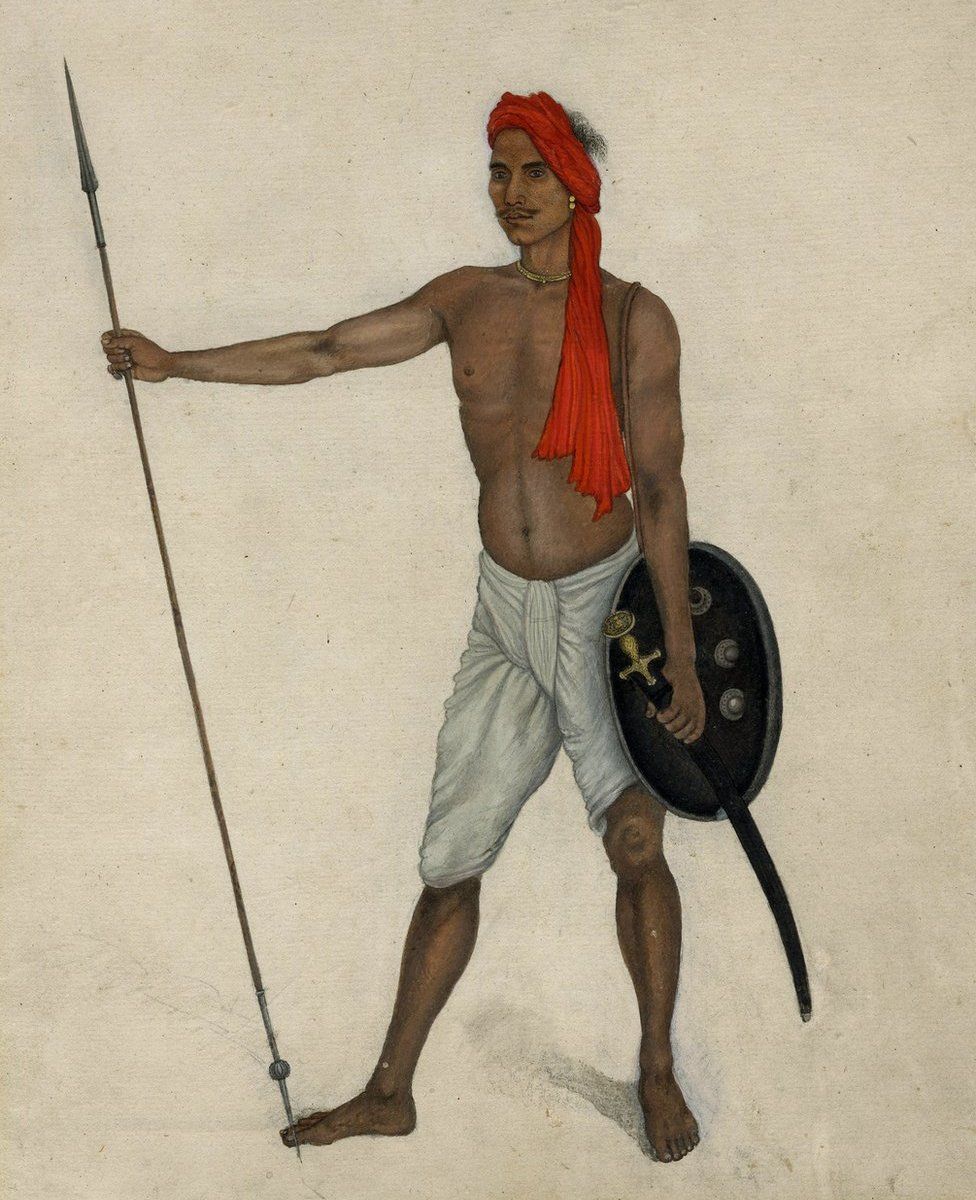
Indian trooper holding a spear by Ghulam Ali Khan, 1815-186
Image caption Indian trooper holding a spear by Ghulam Ali Khan, 1815-186

He is acutely sensitive to shape, texture and expression, as for example in his celebrated study of a great fruit bat with the contrast between its soft, furry body with the angular precision of its blackly outstretched wings, as if it were some caped Commendatore ushering a woman into a Venetian opera rather than a creature in a colonial menagerie.

Now, for the first time, the work of these great Indian artists painting in this brilliantly hybrid Anglo-Indian style are beginning to get the attention they deserve.

The first-ever museum show of this work in the UK aims to highlight and showcase the work of a series of extraordinary Indian artists, each with their own style and tastes and agency. Indeed the greatest among them – such as Zain ud-Din- deserve to be remembered as among the most remarkable Indian artists of all time.

William Dalrymple is the author, most recently, of The Anarchy: The Relentless Rise of the East India Company and Forgotten Masters: Indian Painting for the East India Company (Bloomsbury)

Source: The BBC

27/01/2019

Spy novels, ‘daigou’ and democracy: the many lives of Australian writer held in China

EIJING/SYDNEY (Reuters) – A Chinese-born Australian writer detained by authorities in Beijing for suspected espionage has long been a divisive figure among overseas Chinese dissidents and activists.

To his supporters, Yang Hengjun is a dedicated democracy activist who believed that China’s autocratic system would, with time, necessarily liberalize. His detractors say he had long since abandoned criticising the ruling Chinese Communist Party in favour of protecting his personal and business interests.

Yang, 53, whose legal name is Yang Jun, was detained in southern China’s Guangzhou while waiting for a transfer to Shanghai earlier this month, after flying in from New York.

He was taken to Beijing, where China has said the city’s State Security Bureau is holding him under “coercive measures”, a euphemism for detention, as he is investigated on suspicion of “endangering state security”.

Yang’s lawyer, Mo Shaoping, told Reuters his client was suspected of “espionage”, and was being held under “residential surveillance at a designated location”, a special detention measure that allows authorities to interrogate suspects without necessarily granting access to legal representation.

Although his recent writing has mostly avoid Chinese politics, Yang first became prominent in the early 2000s when he earned the nickname of “democracy peddler”.

Before censorship of China’s microblogs intensified, Yang’s essays on topics ranging from Chinese nationalism to the fate of ethnic minorities in Tibet, made him a popular commentator. He also wrote a trilogy of spy novels set in China.

More recently, Yang had largely steered clear of issues deemed sensitive by the Communist Party, only occasionally writing about U.S. politics, and instead had thrown his energy into a “daigou” business, procuring overseas products for Chinese buyers.

His store on China’s popular mobile platform WeChat sold U.S.-made luxury bags, vitamins, baby formula and watches.

An employee of the store, who declined to be named, said that Yang started the store at the request of his readers, who wanted to buy real and fairly priced goods. Asked what would happen to the store now, he said he was waiting for instructions.

“KEEPS TO HIMSELF”

For the last two years, Yang, who friends describe as an affable, jocular but academic figure, had been living in New York as a visiting scholar at Columbia University.

“He was quite aloof from politics and tended to keep his personal news to himself,” Yang’s former landlord, New York-based businessman Yi Gai, told Reuters.

“About 75 percent of his energy and time was spent on his daigou work,” added Yi, who is also a friend of Yang’s.

Another friend, who hadn’t spoken to Yang in several months, said the Australian writer believed his views were not a challenge to China’s rulers.

“He played within the system. He had never called for the bottom to rise up. He wants reform only,” said the friend, who declined to be named for fear for his safety.

Feng Chongyi, an academic at the University of Technology in Sydney, who was himself detained during a 2017 visit to China, said he believed Yang’s detention was related to his international connections.

Tensions have risen in recent weeks between China and some Western countries after two Canadians, a diplomat on unpaid leave and a consultant, were arrested in China on suspicion of endangering state security.

Those arrests were widely seen in the West as retaliation by China for Canada’s arrest of Meng Wanzhou, a senior Huawei Technologies executive, on Dec. 1 at the request of the United States for allegedly violating U.S. sanctions on Iran.

Australian officials have called on China to handle the matter “transparently and fairly”, but have downplayed the connection between Yang’s case and those of the Canadians.

“He is well-connected in China and internationally. He knows high-profile people in the Communist Party and he believed that meant he could travel to China with relative impunity,” Feng said.

POOR BACKGROUND

Yang came from a poor background in China, but studied political economy at Shanghai’s prestigious Fudan University, according to his own accounts of his time there.

Yang had often told friends that, before his writing career, he worked for China’s Foreign Ministry. But ministry spokeswoman Hua Chunying told Reuters that Yang had never been employed there.

He would also tell friends that he knew Wang Huning, the Chinese Communist Party’s chief of ideology, while at Fudan, according to two sources.

Friends say he became an Australian citizen in the early 2000s.

Xia Yeliang, a former professor at Peking University who now lives in Virginia, said Yang was a controversial figure among China’s overseas dissident community.

Yang was believed in recent years to have married a well-known nationalist blogger, Yuan Ruijuan, souring his reputation among overseas democracy activists, Xia told Reuters by phone.

At times Yang had said his spy novels, which were serialised on his website, were based on his abundant personal experience within the Chinese system, Xia added.

The novels pit China’s spy agency against the CIA and FBI and include double-agents, clones, and a main character who, like Yang, wrote fictional spy novels and attended Fudan University.

Yi, the landlord and friend, said Yang “was not willing to keep in close contact with radical dissidents, and definitely wouldn’t cooperate with them, so it’s natural that radical dissidents would be suspicious and speculate about him”.

Before Yang left for China this month, Yi and some friends met him and the topic of his security came up, but everyone thought he would be fine.

“It looks like we misjudged,” he said.

Source: Reuters
23/01/2019

Australia probes reports Chinese-Australian writer is missing in China

SYDNEY (Reuters) – Australia is investigating the whereabouts of a Chinese-Australian man, the Department of Foreign Affairs and Trade (DFAT) said on Wednesday, after a newspaper report raised fears that the dissident former diplomat has been detained in China.

The Sydney Morning Herald newspaper reported on Wednesday that friends feared Yang Hengjun, an author and former Chinese diplomat who is now an Australian citizen, had been detained because he had not been reachable for several days.

His disappearance comes at a time of high tension between China and some parts of the West after two Canadians, a diplomat on unpaid leave and a consultant, were arrested in China on suspicion of endangering state security.

Those arrests were widely seen in the West as retaliation by Beijing for the arrest of Meng Wanzhou, a senior Huawei Technologies [HWT.UL] executive, in Canada on Dec. 1. She is accused of violating U.S. sanctions on Iran.

Two friends contacted by Reuters said they had reported Yang as missing to DFAT. They said he had been missing since he flew from New York to Guangzhou in southern China on Friday.

One of those friends, Feng Chongyi, an academic at the University of Technology in Sydney, said Yang had been scheduled to fly on to Shanghai but never arrived.

“I believe he is in custody of the Ministry of State Security in Beijing,” Feng said.

China’s Foreign Ministry spokeswoman Hua Chunying, asked about Yang’s disappearance, told a regular briefing that she had “no understanding” of the situation.

China’s Ministry of Public Security did not respond immediately to requests for comment.

A DFAT spokeswoman confirmed the department was investigating but did not identify Yang by name.

“The Department of Foreign Affairs and Trade is seeking information about an Australian citizen who has been reported missing in China,” the spokeswoman said.

A source familiar with the investigation said Australia made contact with Chinese officials overnight to ask about Yang’s whereabouts.

Australia joined international condemnation of the arrest of the two Canadians but Yang has long been in the sights of Chinese authorities. He has criticised what he described as Chinese interference in Australia.

Chinese President Xi Jinping has presided over a sweeping crackdown on dissent since coming to power in 2012, with hundreds of rights lawyers and activists detained. Dozens have been jailed.

Source: Reuters

Law of Unintended Consequences

continuously updated blog about China & India

ChiaHou's Book Reviews

continuously updated blog about China & India

What's wrong with the world; and its economy

continuously updated blog about China & India