10/04/2020
- Malfunction happened during third stage of launch after earlier stages were completed successfully, state media says
- Failed mission is second in less than a month after Long March-7A encountered problems after lift-off on March 16
A Long March-3B carrier rocket blasts off from the Xichang Satellite Launch Centre in Sichuan province in November. A similar launch on Thursday ended in failure. Photo: Xinhua
China’s space programme suffered another setback on Thursday night with its second rocket launch failure in less than a month.
Officials are investigating what caused a malfunction during the third stage of the Long March-3B launch after lift-off from the Xichang Satellite Launch Centre in southwest Sichuan province at 7.46pm with an Indonesian Palapa-N1 satellite, Xinhua reported.
“The first and second stages of the rocket performed well, but the third stage malfunctioned,” the report said.
“Debris from the third stage of the rocket and the satellite fell [to the ground]. The launch mission failed.”
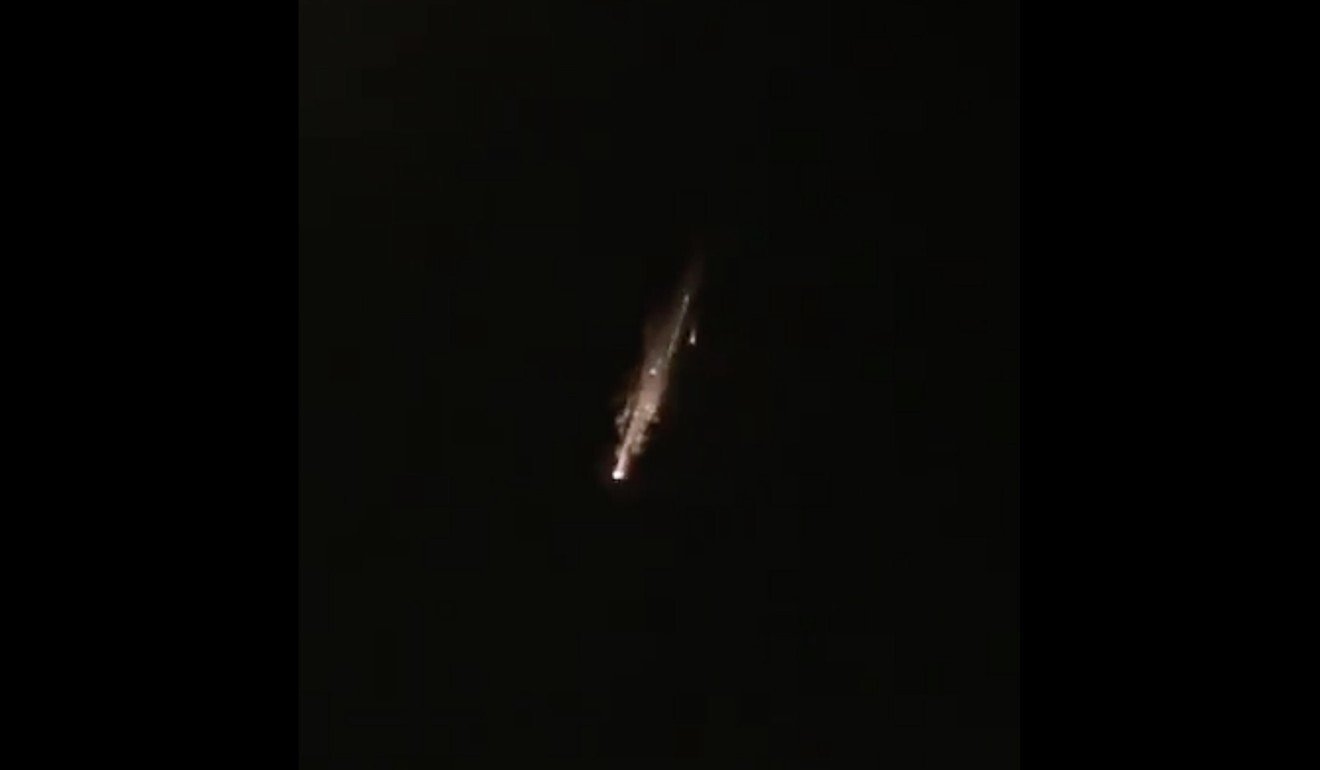
Debris from the failed mission rained down over Guam on Thursday night. Photo: Twitter
China’s state media did not say where the rocket landed, but the office of Guam Homeland Security and Civil Defence said “a fiery object over the Marianas sky” observed on Thursday evening was likely connected to the failed launch.
Video footage of the burning debris falling from the sky was widely circulated on social media.
The setback follows another failed launch on March 16, when China’s new
Long March-7A, a three-stage, medium-lift, liquid-fuel rocket, encountered an “abnormality” minutes after lifting off from its launch site in the southern island province of Hainan.
China’s BeiDou system one satellite closer to full operation
The satellite lost on Thursday – the Nusantara 2 – was built in China for Indonesian telecommunication companies Pasifik Satelit Nusantara and Indosat Ooredoo. It was intended to replace an older satellite to provide internet and broadcasting services in Indonesia and across the Asia-Pacific region to Australia, The Jakarta Post reported earlier this month.
It is not known if the failed launch will have an impact on other Long March-3B satellite launches planned for later in the year.
Introduced in 1996, the Long March-3B – also known as the CZ-3B or LM-3B – has been the main orbital carrier rocket of China’s space programme. It was used to carry many of the satellites that make up China’s BeiDou navigation system, with the latest addition being in March.
For that launch, engineers used parachutes to control where the rocket’s boosters would land after being discarded after lift-off so as to minimise the impact on people living below, state media reported.
The latest version of the Long March-3B entered service in 2007 and is dedicated to launching heavy communications satellites of up to 5.5 tonnes into geostationary transfer orbits.
Source: SCMP
Posted in 16, Australia, “abnormality”, Beidou navigation system, BeiDou system one, broadcasting services, China’s space programme, Chinese, completed successfully, debris, during, earlier stages, eight, eighth, eleven, encountered, eons, Failed mission, fails, fiery object, fifth, fifty, five, four, fourth, geostationary transfer orbits, Guam, Guam Homeland Security and Civil Defence, happened, hundred, hundredth, Indonesia, Indonesian, Indonesian Palapa-N1, Indosat Ooredoo, Internet, investigating, launch, Lift-off, liquid-fuel, Long March 3B, Long March-7A, Malfunction, March, Marianas sky, medium-lift, minutes, month, nine, ninth, November, Nusantara 2, officials, one, Pasifik Satelit Nusantara, problems, Rocket, Satellite, second, seconds, setback, seven, seventh, sichuan province, six, sixth, telecommunication companies, ten, tenth, third stage, thousand, three-stage, Thursday, twelve, twenty, two, Uncategorized, weeks, Xichang Satellite Launch Centre, Xinhua |
Leave a Comment »
29/07/2019
- Chinese scientists say they have developed controls to help steer spent boosters crashing back to Earth
Lattice-like grid fins are used to guide spent boosters as they fall to Earth. Photo: Science and Technology Daily
China says it has successfully tested new fins on its Long March rockets to help guide spent boosters away from populated areas, possibly paving the way for development of reusable technology like SpaceX’s Falcon 9.
China successfully launched a Long March 2C rocket on Friday using grid-fin technology to guide its spent booster to a landing spot in Guizhou province in the country’s southwest, state-run Science and Technology Daily reported on Sunday, citing China Aerospace Science and Technology Corporation (CASC), a key contractor for the Chinese space programme.
The report said China was the second country to master the technology, after the United States.
Grid fins are aerodynamic control surfaces that are folded during the launch but deployed in flight. In the more sophisticated applications such as the Falcon 9, the fins manipulate the direction of the rocket during re-entry.
A Long March-2C carrier rocket carrying remote sensing satellites blasts off from the Xichang Satellite Launch Centre in Xichang, Sichuan province, on Friday. Photo: Xinhua
Shanghai-based online news outlet The Paper reported that the 2C’s grid fins were developed by a team of about a dozen engineers, all under the age of 35.
The team also designed a new companion electrical control system to control the fins, taking about six months to complete the task.
China has conducted frequent satellite launches in recent years, including 38 last year, the highest total for any country in 2018. But landing safety has become an issue as traditional zones grow more populated.
Chinese start-up rocket maker counts down to launching “shoebox” satellites
Chinese media reported in January 2018 that a booster from a Long March 3B rocket created a massive fireball after it fell from the sky and exploded in a residential area, though no casualties were reported.
And Shaanxi Television reported in May this year that debris was found on a motorway in northwestern China’s Shaanxi province, with residents saying they heard a loud noise and saw an object fall to the ground.
Under existing arrangements, authorities in projected landing zones have to evacuate the areas each time, not only inconveniencing residents but adding to the economic cost and difficulty of the work, according to the The Paper. The grid fins are expected to help ease some of those problems.
“The successful test of the [grid-fin] technology is of great significance to solving the landing issue,” the report quoted CASC assistant director He Wei as saying.
“It also lays a solid foundation for recoverable and reusable technologies.”
China plans more satellites to build up navigation system to rival GPS
Long Lehao, chief commander and designer of Long March 3A rocket series, said the development of reusable technologies could support large-scale development and use of space in the future, as well as make the space programmes more commercially competitive, The Beijing News reported.
Beijing sees space as an important driver for growth and an opportunity to promote hi-tech industries.
On Thursday,
became the first private firm in China to successfully launch a rocket into space.
Source: SCMP
Posted in China Aerospace Science and Technology Corporation (CASC), China’s Long March, global space race, grid-fin tech, Guizhou Province, Lift-off, reusable rockets, Science and Technology Dail, shaanxi province, sichuan province, SpaceX’s Falcon 9, The Beijing News, Uncategorized, Xichang Satellite Launch Centre |
Leave a Comment »




 CHINDIA ALERT: You'll be living in their world, very soon