Archive for ‘xinjiang region’

19/02/2020

Coronavirus: China expels Wall Street Journal journalists for article it deemed racist

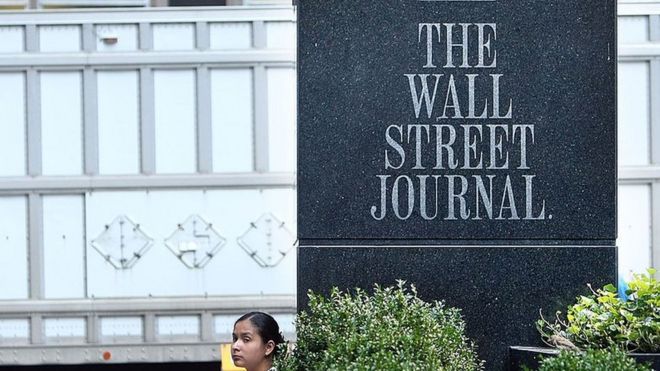
Three journalists with the Wall Street Journal have been told to leave China in five daysImage copyright GETTY IMAGES
Image caption The Wall Street Journal said the journalists were ordered to leave China in five days

China has ordered three foreign journalists of the Wall Street Journal to leave the country over an opinion piece it said was “racist”.

The article published on 3 February criticised the country’s response to the deadly coronavirus outbreak.

The Chinese foreign ministry said it had asked the newspaper to apologise several times but it had declined.

The newspaper said the journalists – who had not written the opinion piece – were given five days to leave China.

The article called the authorities’ initial response “secretive and self-serving” and said global confidence in China had been “shaken”.

China’s Foreign Ministry spokesman Geng Shuang said the article was “racist” and “denigrated” China’s efforts to combat the outbreak that has killed more than 2,000 people in the country.

“The Chinese people do not welcome media that publish racist statements and maliciously attacks China,” Mr Geng said, without naming the journalists being expelled.

The Wall Street Journal identified the reporters as two US citizens – Josh Chin, who is the deputy bureau chief, and Chao Deng – as well as Australian citizen Philip Wen. The newspaper has not yet commented.

It is the first time in more than two decades that journalists holding valid credentials have been ordered to leave China, the BBC’s John Sudworth in Beijing reports.

The Foreign Correspondents Club of China called the decision “an extreme and obvious attempt by the Chinese authorities to intimidate foreign news organizations”.

The measure comes a day after the US said it would begin treating five Chinese state-run media outlets that operate in the country in the same way as foreign embassies, requiring them to register their employees and properties with the US government.

The decision affects the Xinhua News Agency, China Global Television Network and China Daily Distribution Corp.

Presentational grey line

Press freedom in China

Presentational grey line

Last year, the government declined to renew the credentials – necessary for the work of foreign journalists in the country – of another Wall Street Journal reporter.

The journalist, a Singaporean national, had co-written a story that authorities in Australia were looking into activities of one of China’s President Xi Jinping’s cousins suspected of involvement in organised crime and money laundering.

And in 2018, the Beijing bureau chief for BuzzFeed News Megha Rajagopalan was unable to renew her visa after reporting on the detention of Muslim minority Uighurs and others in China’s Xinjiang region.

Meanwhile, two Chinese citizen journalists who disappeared last week after covering the coronavirus in Wuhan, the epicentre of the outbreak in Hubei province, remain missing.

Fang Bin and Chen Qiushi had been sharing videos and pictures online from inside the quarantined city.
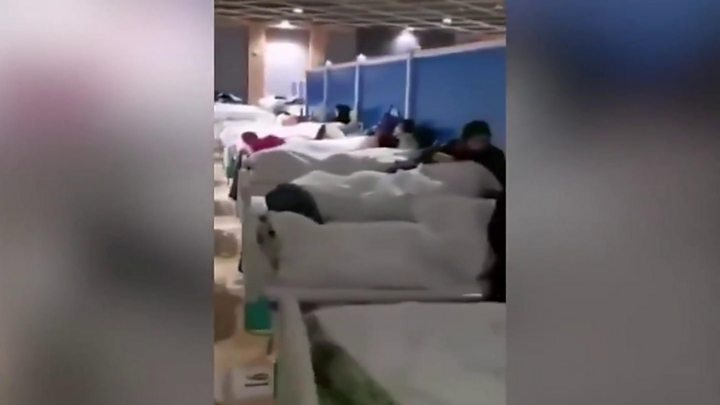
Media caption Footage appearing to show people held in quarantine in a makeshift facility in Wuhan, has been shared across social media

Source: The BBC

09/10/2019

US imposes China visa restrictions over Uighur issue

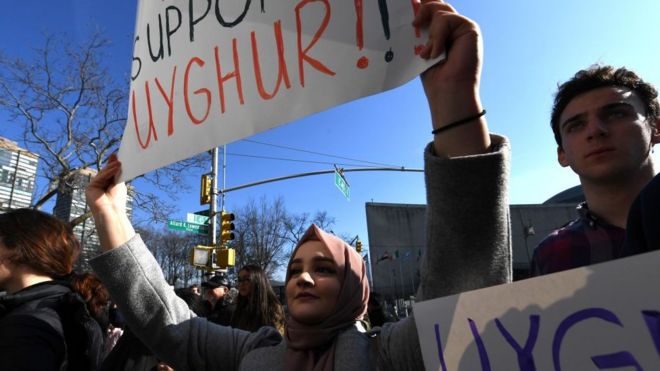
Uighur protesters demonstrating in the US in FebruaryImage copyright GETTY IMAGES
Image caption Protests calling for Uighur freedom have been happening all year

The US has said it will impose visa restrictions on Chinese officials accused of involvement in repression of Muslim populations.

It follows the decision on Monday to blacklist 28 Chinese organisations linked by the US to allegations of abuse in the Xinjiang region.

US Secretary of State Mike Pompeo said the Chinese government had instituted “a highly repressive campaign”.

China has dismissed the allegations as groundless.

In a statement, Mr Pompeo accused the Chinese government of a string of abuses against Uighurs, ethnic Kazakhs, Kyrgyz Muslims and other minority Muslim groups.

These included “mass detentions in internment camps; pervasive, high-tech surveillance; draconian controls on expressions of cultural and religious identities; and coercion of individuals to return from abroad to an often perilous fate in China”.

China has rebuffed the US moves.

“There is no such thing as these so-called ‘human rights issues’ as claimed by the United States,” foreign ministry spokesman Geng Shuang said on Monday.

“These accusations are nothing more than an excuse for the United States to deliberately interfere in China’s internal affairs.”

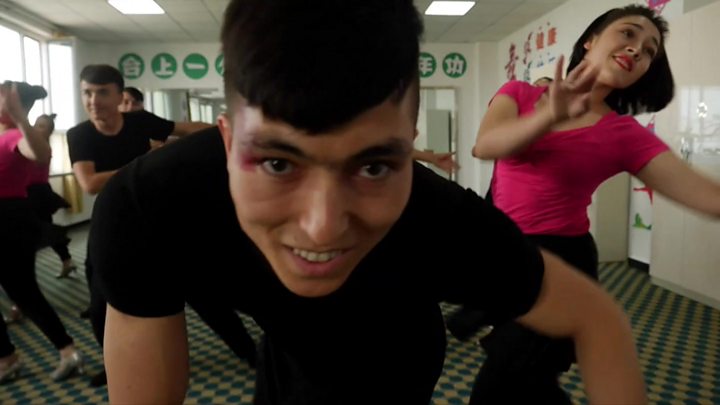
Media caption The BBC visits the camps where China’s Muslims have their “thoughts transformed”

Visa restrictions are to be imposed on Chinese government and Communist Party officials, as well as their family members.

“The United States calls on the People’s Republic of China to immediately end its campaign of repression in Xinjiang, release all those arbitrarily detained, and cease efforts to coerce members of Chinese Muslim minority groups residing abroad to return to China to face an uncertain fate,” the US statement said.

The US and China are currently embroiled in a trade war, and have sent delegations to Washington for a meeting about the tensions later this week.

What is the situation in Xinjiang?

China has been carrying out a massive security operation in Xinjiang, in its far west, in recent years.

Human rights groups and the UN say China has rounded up and detained more than a million Uighurs and other ethnic minorities in vast detention camps, where they are forced to renounce Islam, speak only in Mandarin Chinese and learn obedience to the communist government.

But China says they are attending “vocational training centres” which are giving them jobs and helping them integrate into Chinese society, in the name of preventing terrorism.

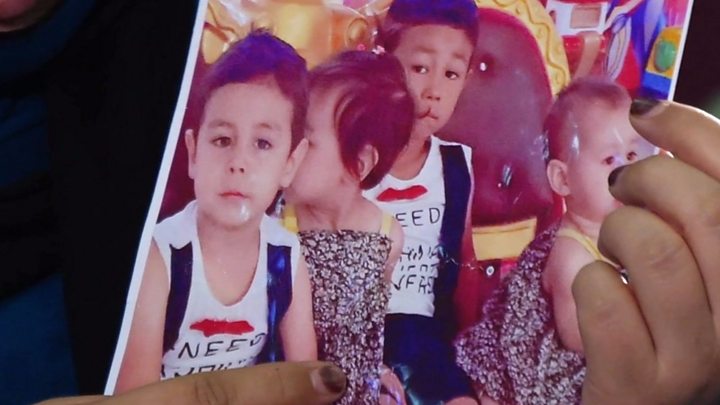
Media caption The BBC’s John Sudworth meets Uighur parents in Turkey who say their children are missing in China

There have been increasingly vocal denunciations from the US and other countries about China’s actions in Xinjiang.

Last week, Mr Pompeo alleged that China “demands its citizens worship government, not God” in a press conference in the Vatican.

And in July more than 20 countries at the UN Human Rights Council signed a joint letter criticising China’s treatment of the Uighurs and other Muslims.

Who are the Uighurs?

Uighurs are ethnically Turkic Muslims. They make up about 45% of the Xinjiang region’s population; 40% are Han Chinese.

China re-established control in 1949 after crushing short-lived state of East Turkestan.

Since then, there has been large-scale immigration of Han Chinese and Uighurs fear erosion of their culture.

Xinjiang is officially designated an autonomous region within China, like Tibet to its south.

Source: The BBC

06/09/2019

Chinese medicine herbs could defeat devastating cotton virus, study suggests

  • Scientists find some chemicals can kill the cotton leaf curl Multan virus and others can boost cotton plants’ immunity to it
  • It is feared the virus could wreak havoc in China’s Xinjiang region, which produces most of the country’s cotton
A cotton picker in Xinjiang, where cases of the virus have been reported. Photo: Xinhua

Chinese scientists have found chemicals in medicinal herbs that could tame a destructive plant virus threatening the cotton industry in its western Xinjiang region.

Some small-molecule chemicals in herbs commonly used in Chinese medicine can effectively suppress cotton leaf curl Multan virus, according to ongoing research led by Professor Ye Jian at the Institute of Microbiology in Beijing.

By targeting WRKY20, a gene in the virus’ DNA, the chemicals could disrupt the viral infection and transmission, Ye’s team found.

Some early findings from their research were published last month in the journal Science Advances.

The leaf curl virus – a species of Begomovirus, the largest genus of plant viruses – poses a significant threat to the world’s cotton plantations, causing leaf curling, stunted growth and lower yields of cotton fibre. It costs the cotton industry in the Indian subcontinent about US$1 billion a year, according to a press release about the study from the Chinese Academy of Sciences.

Were there to be a pandemic in China, the drop in output and measures to contain it could cost the cotton farming industry 50 billion yuan (US$7 billion), according to some researchers’ estimates, the academy added.

The first known cases of the virus in China over the past decade were limited to coastal areas in the country’s east, but several cases have now been reported in Xinjiang Uygur autonomous region.

“We are running out of time,” Ye told the South China Morning Post.

Cotton is a pillar industry in Xinjiang, which provides more than 80 per cent of China’s total cotton production. The industry also contributes up to 50 per cent of the income of farmers involved in it, according to government statistics.

Exact figures for infections in the region are not available, but outbreaks so far remain isolated, according to Ye and other researchers with knowledge of the situation.

Double threat to China’s cotton industry: warmer weather and mirid bug

However, Professor Gao Feng, cotton researcher at the Agricultural College of Shihezi University in Xinjiang, warned that leaf curl virus could reduce cotton production in an infected field to almost zero.

“A large-scale outbreak has not occurred yet, but the threat is very serious and people are very nervous,” Gao told the Post. “We are in desperate need of a solution.”

The challenges facing China’s pork industry highlight the danger viruses can pose to the domestic market. A swine fever outbreak that has wiped out 100 million pigs caused pork prices to rise, forcing China to look to new countries to import from, such as Portugal and Argentina.

Its biggest overseas supplier of cotton is the United States, with which it is locked in a protracted trade war. In July, the government allowed some Chinese companies to buy a total of 50,000 tonnes of cotton from the US without tariffs being charged.

The central and regional governments fear that falling incomes caused by the impact of an outbreak on the cotton industry would increase the risk of ethnic conflict, social instability and anti-government thoughts.

Ye’s team adopted two approaches to fighting the virus.

How trade war with the US is changing China’s cotton industry

Some chemicals they discovered could improve cotton plants’ immunity against the infection by stimulating them to generate an antibody that killed the virus. The other chemicals they found could target the virus, directly reducing its intensity.

“They can be used as sprays,” Ye said, adding that he planned to reveal the chemical composites and related herbs in a paper to be published in a peer-reviewed journal in the coming months.

The discovery could offer an environmental benefit, too. Cotton farmers in Xinjiang use pesticides to deter the whiteflies that transmit the virus, but their overuse has affected Xinjiang’s delicate ecology, which in its desert areas is particularly vulnerable to disturbance.

In the agricultural research community, there is growing concern that some whitefly species will become resistant to pesticides. “If that happens, we will have a major problem,” Ye said.

He said the chemicals identified in the ongoing study would not harm the environment.

“These chemicals come from plants, so the negative impact to the environment would be minimal,” he said.

The study also found that it may be possible to use the cotton leaf curl Multan virus to benefit farmers. It stimulates cotton plants to generate a chemical that is harmful to other insects, such as the bollworm, that compete with whiteflies for food, meaning that it could be genetically modified into a pest control agent.

Most cotton species in commercial plantations are genetically modified to produce an insecticide to kill bollworm. Ye said a man-made virus could reduce the dependence on genetically modified plants.

Source: SCMP

Law of Unintended Consequences

continuously updated blog about China & India

ChiaHou's Book Reviews

continuously updated blog about China & India

What's wrong with the world; and its economy

continuously updated blog about China & India