Archive for ‘Yangtze River’

20/02/2019

China to deepen reforms of agriculture sector to boost rural areas

  • Policy statement outlines broad goals including plan to revive domestic soybean production
A farmer picks tea leaves in Mianxian county, Shaanxi province. Beijing’s policy document reiterated a strategy to improve income levels and living standards in China’s countryside. Photo: Xinhua
China will deepen reforms of its agriculture sector to promote its rural economy, the government said in its first policy statement of 2019, as it seeks to bolster growth and offset trade challenges.

Beijing’s statement, released late on Tuesday, comes after the world’s second-largest economy saw its weakest growth in 28 years in 2018 and remains entangled in a trade war with Washington.

“Under the complicated situation of increasing downward pressure on the economy and profound changes in the external environment, it is of special importance to do a good job in agriculture and rural areas,” the government said in the document issued by the State Council and published by official news agency Xinhua.

The biggest winners in Shenzhen, ‘China’s Silicon Valley’? Pig and chicken farmers

Known as the “No 1 document”, this year’s policy reiterated a rural rejuvenation strategy first laid out in 2017 to improve income levels and living standards in China’s countryside.

It also highlighted a plan to boost domestic soybean production but did not offer further details.

Chinese President Xi Jinping visits a farm in northeastern Heilongjiang province during an inspection tour in September. Photo: Xinhua via AP

Industry analysts said on Wednesday they were eagerly awaiting further details to assess the impact of the plan, which had already been flagged by Agriculture Minister Han Changfu earlier this month.

China has been overhauling its crop structure in recent years, reducing support for corn after stocks ballooned, and seeking to promote more planting of oilseeds that it mostly imports.

That goal has become increasingly important since a trade war with the United States, which led China to slap tariffs on soybean imports, tightening domestic supplies.

Han has previously urged authorities in China’s northeast to support soybean production through subsidies and called for rotating of soybeans with other crops including corn and wheat.

Beijing also aims to support the production of rapeseed in the Yangtze River Basin, according to the document.

The garlic case that foreshadowed the US-China trade war

As in previous years, it also called for stable grain production, but also an increase in imports of agriculture products where there are shortages in the domestic market.

“The focus now is on retaining production capacity, in the form of high quality farmland, and using the international market to make up production shortfalls,” said Even Rogers Pay, an agriculture analyst at China Policy, a Beijing-based consultancy.

The reference to imports is positive for trade partners like the United States, said Cherry Zhang, analyst with Shanghai JC Intelligence, who said it raised the likelihood that China will buy more US agriculture products.

China’s DJI turns its eye to enterprise uses like agriculture after conquering global commercial drone market

Shares of Chinese livestock companies, along with pig and poultry breeders, rose on Wednesday following the release of the policy paper.

The document also outlines plans to accelerate development of a new farm subsidy policy system and further crack down on the smuggling of agriculture products.

Additionally, the government said it plans to strengthen the monitoring and control of African swine fever outbreaks, after more than 100 cases were reported in China since August.

Other plans include continuing to tackle rural pollution and promoting recycling of agricultural waste such as manure and agricultural film.

Source: SCMP
17/02/2019

Li Rui: The old guard Communist who was able to criticise Xi Jinping

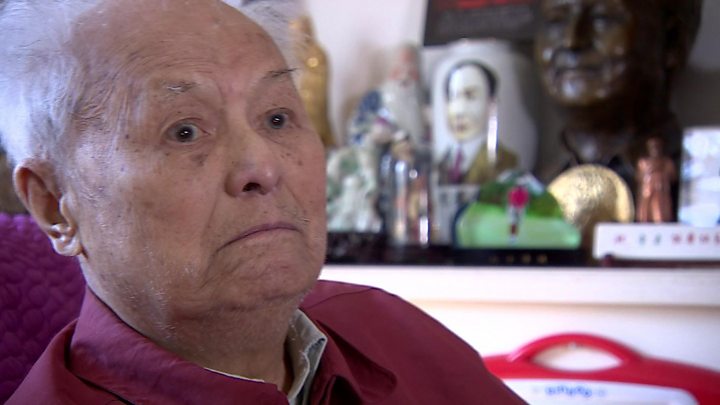
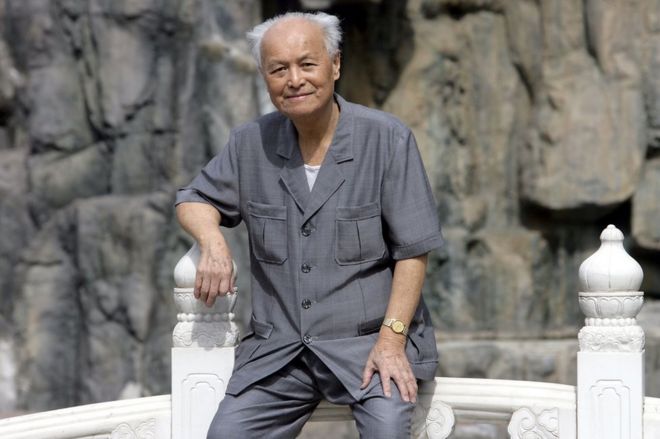
Li RuiImage copyrightAFP
Image captionLi Rui remained an activist and idealist until his death

“We are not allowed to talk about past mistakes.”

Li Rui said this in 2013, while reflecting on the similarities between China’s then-new leader Xi Jinping and the founding father of Communist China, Mao Zedong.

Mr Xi, he warned, was echoing Mao’s suppression of individual thought, and was trying to build a similar cult of personality – both things he had experienced at first hand.

Li Rui joined the Communist Party in 1937, at the start of the brutal Sino-Japanese war, and 12 years before the party won the civil war that established the People’s Republic. He was hand-picked by Mao to become his personal secretary in 1958.

But he was also imprisoned soon afterwards for criticising Mao’s Great Leap Forward, the failed modernisation programme now thought to have killed between 30 and 60 million people through torture and starvation.

Despite this turbulent history with the party, the fact that Mr Li was one of the original revolutionaries meant that he occupied a special place in contemporary China – one that allowed him a degree of freedom to talk about the ruling party’s many issues, and how he felt things should be done differently.

People may not be allowed to talk about past mistakes, but Mr Li did it anyway – and his work has helped historians understand the truth and scale of Mao’s atrocities.

Li Rui died in Beiijng on Saturday, aged 101.

An underground revolutionary

As a university student, Mr Li joined a group of idealistic Communist activists protesting against Japanese occupation. Shortly afterwards, at the age of 20, he officially joined the party. He was tortured for his communist activism.

But things changed when the party came into power in 1949, and by 1958 Mr Li had become the youngest vice minister in China.

It was also that year that he had a meeting with Mao that would change the course of his life. Mao, having seen Mr Li argue passionately against building the Three Gorges Dam on the Yangtze River, chose him to be his personal secretary.

Their relationship didn’t last long.

‘Mao put no value on human life’

In 1959, Mr Li openly criticised Mao’s Great Leap Forward – a policy that was supposed to boost China’s economic output, but instead unleashed widespread famine across the country.

For this transgression Mr Li was expelled from the Communist Party, and he was imprisoned for eight years in Qincheng, maximum security prison built for the detention of disgraced senior party officials.

“Mao’s way of thinking and governing was terrifying,” he would tell the Guardian newspaper many years later. “He put no value on human life. The deaths of others meant nothing to him.”

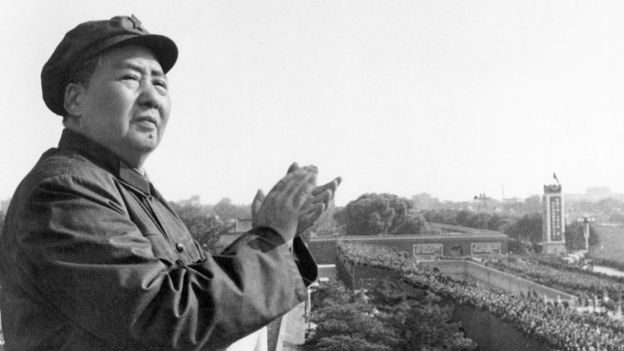
Mao ZedongImage copyrightGETTY IMAGES
Image captionLi Rui said Mao Zedong, pictured, “put no value on human life”

Following Mao’s death, the more pragmatic Deng Xiaoping came to power in 1978 and Mr Li was rehabilitated and allowed back into the party. He then became a strong advocate for political reform, and in his later years, threw himself into calling for China to move further towards a European socialist-style system.

He wrote five books on Mao, all of which were published overseas and banned in mainland China. His last book, published in 2013, called for the current “one-party, one-leader and one-ideology regime” to be overhauled. His daughter, Li Nanyang, has spoken of having her copies of his memoir confiscated at Beijing’s airport.

Aside from writing books, he worked right into his 90s as a patron of the reformist magazine Yanhuang Chunqiu – roughly translated as “China through the ages”.

Presentational grey line

Read more on other notable lives

Presentational grey line

The magazine was taken over in 2016. Its editor Wu Si was forced out, and its former staff released a statement warning that “anybody who publishes any periodicals with the title of Yanhuang Chunqiu will be nothing to do with [them]”.

Professor Steve Tsang, director of SOAS’s China Institute, tells BBC News that this affected Li Rui deeply.

“The single most important thing that Li Rui had, was the patronage that he gave to the magazine Yanhuang Chunqiu,” Professor Tsang says. “It does still exist, but it’s been completely changed it terms of management and focus. It’s practically a different magazine.”

The last idealist

But even though his writing was censored, Mr Li was not a dissident – he remained a party member until his death. And the fact that he was left to compose his memoirs from a prestigious apartment block in Beijing shows how, despite his outspoken criticism of the current leadership, he continued to be revered for his role as one of the country’s original revolutionaries.

But with Mr Li dies the idealism of the activist who joined his party eight decades ago, and spent the years since vigorously rebelling against leaders who abused their power.

“He was among the last of that generation of idealists who joined the Communist Party at the beginning, and who tried to hold the Communist Party to the rhetoric [they heard] when they were being recruited,” Prof Tsang says.

“There is probably nobody else who will hold the party now to what the party had originally said it was meant to do.”

Source: The BBC

Law of Unintended Consequences

continuously updated blog about China & India

ChiaHou's Book Reviews

continuously updated blog about China & India

What's wrong with the world; and its economy

continuously updated blog about China & India